

Clinical Trial Registry
and
Nepal Clinical Trial Registry (NPCTR)
Presenter
Ashok Pandey
Nepal Health Research Council
Contents
1. Trial registration
2. WHO- international clinical trials registry platform (ICTRP)
3. General purposes of registries
4. The Trial Registration Data Set (TRDS)
5. Specific criteria
6. Audit
7. Advisory Group
8. Why NPCTR at NHRC
Trial registration
The World Medical Association (WMA)
Declaration of Helsinki states that “Every research study involving
human subjects must be registered in a publicly accessible database
before recruitment of the first subject.”;
The International Committee of Medical Journal Editors (ICMJE)
considers clinical trials for publication only if registered in an
appropriate registry . (Either WHO International Clinical Trials Registry
Platform (ICTRP) or www.ClinicalTrials.gov)
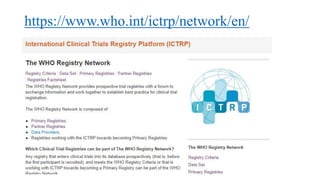
WHO-international clinical trials registry platform
(ICTRP)
1. The ICTRP is a global initiative.
2. It aims to make information about all clinical trials in humans available to all.
3. ICTRP-not a registry itself, but to provide standards to existing registries
4. Trial Registration Data Set-24 key details
5. Deduping-goal –avoid duplicative registrations (and conflicting information)
6. Results-strongly encouraged to be reported -although first goal of WHO is
registration
https://www.who.int/ictrp/network/en/
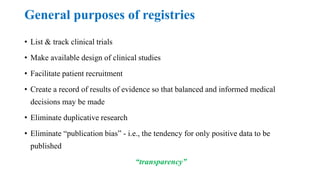
General purposes of registries
• List & track clinical trials
• Make available design of clinical studies
• Facilitate patient recruitment
• Create a record of results of evidence so that balanced and informed medical
decisions may be made
• Eliminate duplicative research
• Eliminate “publication bias” - i.e., the tendency for only positive data to be
published
“transparency”
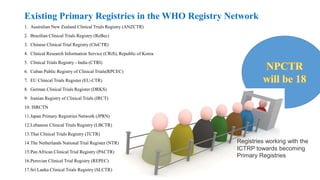
Existing Primary Registries in the WHO Registry Network
1. Australian New Zealand Clinical Trials Registry (ANZCTR)
2. Brazilian Clinical Trials Registry (ReBec)
3. Chinese Clinical Trial Registry (ChiCTR)
4. Clinical Research Information Service (CRiS), Republic of Korea
5. Clinical Trials Registry - India (CTRI)
6. Cuban Public Registry of Clinical Trials(RPCEC)
7. EU Clinical Trials Register (EU-CTR)
8. German Clinical Trials Register (DRKS)
9. Iranian Registry of Clinical Trials (IRCT)
10. ISRCTN
11.Japan Primary Registries Network (JPRN)
12.Lebanese Clinical Trials Registry (LBCTR)
13.Thai Clinical Trials Registry (TCTR)
14.The Netherlands National Trial Register (NTR)
15.Pan African Clinical Trial Registry (PACTR)
16.Peruvian Clinical Trial Registry (REPEC)
17.Sri Lanka Clinical Trials Registry (SLCTR)
Registries working with the
ICTRP towards becoming
Primary Registries
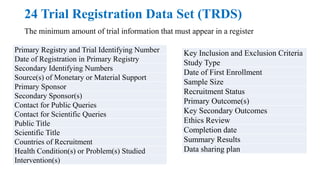
24 Trial Registration Data Set (TRDS)
Primary Registry and Trial Identifying Number
Date of Registration in Primary Registry
Secondary Identifying Numbers
Source(s) of Monetary or Material Support
Primary Sponsor
Secondary Sponsor(s)
Contact for Public Queries
Contact for Scientific Queries
Public Title
Scientific Title
Countries of Recruitment
Health Condition(s) or Problem(s) Studied
Intervention(s)
Key Inclusion and Exclusion Criteria
Study Type
Date of First Enrollment
Sample Size
Recruitment Status
Primary Outcome(s)
Key Secondary Outcomes
Ethics Review
Completion date
Summary Results
Data sharing plan
The minimum amount of trial information that must appear in a register
1. Content
1.1. The registry will accept prospective registration of interventional
clinical trials submitted by Responsible Registrants
1.2. The registry will be open to all prospective registrants (either
internationally or within one or more specific countries)
1.3. The registry will be able to collect and publicly display the WHO Trial
Registration Data Set (TRDS)
1.4. The registry will make an effort to keep registered information up to
date
1.5. The registry will never remove a trial once it has been registered
Primary Registries in the WHO Registry
Network should meet specific criteria for content,
quality and validity, accessibility, unique
identification, technical capacity and
administration
2. Quality and validity
2.1. The registry will have processes in place to make sure that
registered data is complete and accurate
2.2. The registry will have documented SOPs aligned with the
International Standards for Clinical Trial Registries
2.3. The registry will have processes in place to make sure that people
and trials exist
2.4. The registry will have a publicly accessible audit trail so that
changes made to the TRDS for an individual trial can be tracked
2.5. The registry agrees to comply with the Standards
3. Accessibility
3.1. The registry will make the TRDS for all registered trials accessible
to the public at no charge
3.2. The registry will make it possible for the TRDS for all registered
trials to be searched electronically
3.3. The registry will allow Responsible Registrants to submit a trial
for registration at any time of day on any day of the week (24 hours a
day, seven days a week)
3.4. The registry will allow their register database to be searched at any
time of day on any day of the week (24 hours a day, seven days a week)
4. Unambiguous identification
4.1. The registry will have in place processes to prevent the registration of a single
trial more than once on their database.
4.2. The registry will facilitate the retrospective linking (or bridging) on the ICTRP
Search Portal of a single trial registered with more than one registry by entering
secondary identifiers; this includes the Universal Trial Number (UTN), and the
unique identifiers allocated by other registries in the WHO Registry Network
4.3. It is desirable that Primary Registries search the ICTRP Search Portal and
attempt to determine if the trial has already been registered by another Primary
Registry in the WHO Registry Network or an ICMJE approved registry
5. Technical capacity
5.1. The registry will submit the TRDS for all records on their register,
in English, to the ICTRP Central Repository
5.2. The registry will have access to a database that is used to store and
manage the submitted data
5.3. The registry will have access to adequate information technology
support
5.4. The registry will have adequate data security and other provisions
against data corruption and loss
6. Administration and governance
6.1. The registry will have at least a national remit, and the support of
government within the country
6.2. The registry will publicly disclose ownership, governance structure and
not-for-profit status
6.3. The registry agrees that, at least the trial records will be transferred to a
Primary Registry in the WHO Registry Network
6.4. The registry will have a strategy in place ensure the medium- to long-
term sustainability of the registry
6.5. It is strongly recommended to have only one Primary Registry per
country
Audit
1. Self-audit: registries conduct their own, internal audits
2. Self-report: registries will be asked to update their Registry Profile
on an annual basis and return it to the ICTRP Secretariat.
3. Site visit: a small audit team will visit a registry and examine all
processes and procedures.
The audit will be on average for one full working day for each registry
divided equally between the administrative and the information
technology (IT) functions.
An audit is typically valid for a period of five years.
Advisory Group
Its role includes :
1. Developing a set of principles and guidelines for
clinical trial registration through NPCTR
2. Providing advice and support in establishing and
improving NPCTR
3. Monitoring the registration status of NPCTR
4. Providing consultation on planning strategy for
collaboration with domestic and international
organizations
Why NPCTR at NHRC
• Drug Act 2035 mentioned any person who intends to carry out a clinical trial of any
new drug shall obtain a license from the department, as prescribed, for such trial.
• Drugs Act, 2035, (1978)
• For conducting the clinical trial in Nepal, medicine registration guidance (Issued
under Drug Registration Regulation 2038) section 2.18 mention an approval with
government-approved agencies are required.
• Drugs Registration Rules, 2038 (1981)
• Regulation of the health research
NHRC
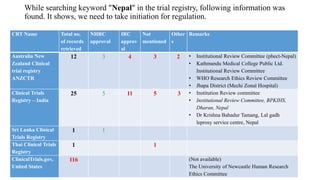
While searching keyword "Nepal" in the trial registry, following information was
found. It shows, we need to take initiation for regulation.
CRT Name Total no.
of records
retrieved
NHRC
approval
IRC
approv
al
Not
mentioned
Other
s
Remarks
Australia New
Zealand Clinical
trial registry
ANZCTR
12 3 4 3 2 • Institutional Review Committee (phect-Nepal)
• Kathmandu Medical College Public Ltd.
Institutional Review Committee
• WHO Research Ethics Review Committee
• Jhapa District (Mechi Zonal Hospital)
Clinical Trials
Registry – India
25 5 11 5 3 • Institution Review committee
• Institutional Review Committee, BPKIHS,
Dharan, Nepal
• Dr Krishna Bahadur Tamang, Lal gadh
leprosy service centre, Nepal
Sri Lanka Clinical
Trials Registry
1 1
Thai Clinical Trials
Registry
1 1
ClinicalTrials.gov,
United States
116 (Not available)
The University of Newcastle Human Research
Ethics Committee
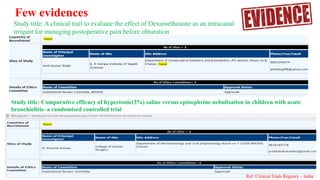
Few evidences
Study title: Comparative efficacy of hypertonic(3%) saline versus epinephrine nebulisation in children with acute
bronchiolitis- a randomised controlled trial
Study title: A clinical trail to evaluate the effect of Dexamethasone as an intracanal
irrigant for managing postoperative pain before obturation
Ref: Clinical Trials Registry – India
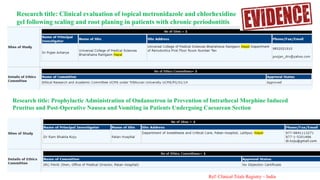
Research title: Clinical evaluation of topical metronidazole and chlorhexidine
gel following scaling and root planing in patients with chronic periodontitis
Research title: Prophylactic Administration of Ondansetron in Prevention of Intrathecal Morphine Induced
Pruritus and Post-Operative Nausea and Vomiting in Patients Undergoing Caesarean Section
Ref: Clinical Trials Registry – India
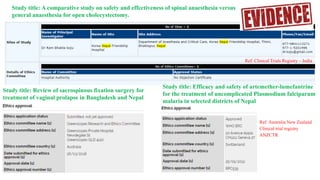
Study title: Review of sacrospinous fixation surgery for
treatment of vaginal prolapse in Bangladesh and Nepal
Study title: Efficacy and safety of artemether-lumefantrine
for the treatment of uncomplicated Plasmodium falciparum
malaria in selected districts of Nepal
Study title: A comparative study on safety and effectiveness of spinal anaesthesia versus
general anaesthesia for open cholecystectomy.
Ref: Australia New Zealand
Clinical trial registry
ANZCTR
Ref: Clinical Trials Registry – India
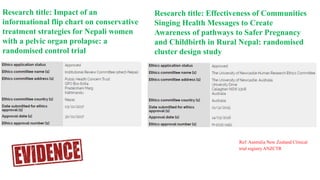
Research title: Impact of an
informational flip chart on conservative
treatment strategies for Nepali women
with a pelvic organ prolapse: a
randomised control trial
Research title: Effectiveness of Communities
Singing Health Messages to Create
Awareness of pathways to Safer Pregnancy
and Childbirth in Rural Nepal: randomised
cluster design study
Ref: Australia New Zealand Clinical
trial registry ANZCTR
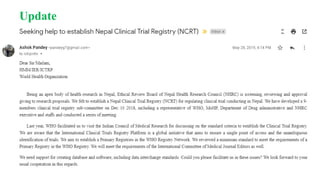
Update
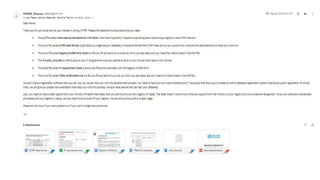
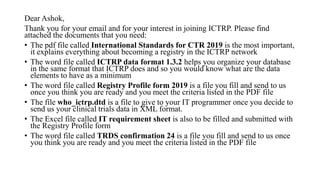
Dear Ashok,
Thank you for your email and for your interest in joining ICTRP. Please find
attached the documents that you need:
• The pdf file called International Standards for CTR 2019 is the most important,
it explains everything about becoming a registry in the ICTRP network
• The word file called ICTRP data format 1.3.2 helps you organize your database
in the same format that ICTRP does and so you would know what are the data
elements to have as a minimum
• The word file called Registry Profile form 2019 is a file you fill and send to us
once you think you are ready and you meet the criteria listed in the PDF file
• The file who_ictrp.dtd is a file to give to your IT programmer once you decide to
send us your clinical trials data in XML format.
• The Excel file called IT requirement sheet is also to be filled and submitted with
the Registry Profile form
• The word file called TRDS confirmation 24 is a file you fill and send to us once
you think you are ready and you meet the criteria listed in the PDF file
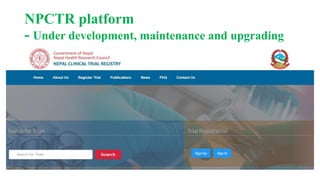
NPCTR platform
- Under development, maintenance and upgrading
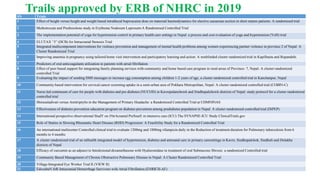
Trails approved by ERB of NHRC in 2019SN Trials
1 Effect of height versus height and weight based intrathecal bupivacaine dose on maternal haemodynamics for elective caesarean section in short stature patients: A randomized trial
2 Methotrexate and Prednisolone study in Erythema Nodosum Leprosum-A Randomised Controlled Trial
3 The implementation potential of yoga for hypertension control in primary health care settings in Nepal: a process and cost evaluation of yoga and hypertension (YoH) trial
4 ELUTAX “3” (DCB) for Intracranial Stenosis Trial
5 Integrated multicomponent interventions for violence prevention and management of mental health problems among women experiencing partner violence in province 2 of Nepal: A
Cluster Randomized Trial
6 Improving anaemia in pregnancy using tailored home visit intervention and participatory learning and action: A nonblinded cluster randomized trial in Kapilbastu and Rupandehi.
7 Predictors of oral anticoagulants utilization in patients with atrial fibrillation
8 Effect of peer based support for integrating family planning services with community and home based care program in rural areas of Province- 7, Nepal- A cluster randomized
controlled Trial
9 Evaluating the impact of sending SMS messages to increase egg consumption among children 1-2 years of age, a cluster randomized controlled trial in Kanchanpur, Nepal
10 Community-based intervention for cervical cancer screening uptake in a semi-urban area of Pokhara Metropolitan, Nepal: A cluster randomized controlled trial (COBIN-C)
11 Nurse-led continuum of care for people with diabetes and pre-diabetes (NUCOD) in Kavrepalanchowk and Sindhupalchowk districts of Nepal: study protocol for a cluster randomized
controlled trial
12 Shirasuladivati versus Amitriptylin in the Management of Primary Headache: a Randomized Controlled Trial at UDMNINAS
13 Effectiveness of diabetes prevention education program on diabetes prevention among prediabetes population in Nepal: A cluster randomized controlled trial (DiPEP)
14 International prospective observational StudY on iNtrAcranial PreSsurE in intensive care (ICU) The SYNAPSE-ICU Study ClinicalTrials.gov
15 Role of Statins in Slowing Rheumatic Heart Disease (RHD) Progression: A Feasibility Study for a Randomized Controlled Trial
16 An international multicenter Controlled clinical trial to evaluate 1200mg and 1800mg rifampicin daily in the Reduction of treatment duration for Pulmonary tuberculosis from 6
months to 4 months
17 A cluster randomized trial of an mHealth integrated model of hypertension, diabetes and antenatal care in primary caresettings in Kavre, Sindhupalchok, Sindhuli and Dolakha
districts of Nepal
18 Efficacy of curcumin as an adjunct to Intralesional dexamethasone with Hyaluronidase in treatment of oral Submucous fibrosis: a randomized Controlled trial
19 Community Based Management of Chronic Obstructive Pulmonary Disease in Nepal: A Cluster Randomized Controlled Trial
20 Village-Integrated Eye Worker Trial II (VIEW II)
21 EdoxabaN foR Intracranial Hemorrhage Survivors with Atrial Fibrillation (ENRICH-AF)
What next?
• Set up, upgrade and maintain NPCTR platform at the NHRC
• Free and online system for registration all clinical trials being
conducted in Nepal
• WHO review and regular audit
• Make it functional and sustainable
“The only way to do great work is to love what you do.
If you haven’t found it yet, keep looking. Don’t settle.”
- Steve Jobs
Thank you

Clinical Trial Registry

  • 1.
    Clinical Trial Registry and NepalClinical Trial Registry (NPCTR) Presenter Ashok Pandey Nepal Health Research Council
  • 2.
    Contents 1. Trial registration 2.WHO- international clinical trials registry platform (ICTRP) 3. General purposes of registries 4. The Trial Registration Data Set (TRDS) 5. Specific criteria 6. Audit 7. Advisory Group 8. Why NPCTR at NHRC
  • 3.
    Trial registration The WorldMedical Association (WMA) Declaration of Helsinki states that “Every research study involving human subjects must be registered in a publicly accessible database before recruitment of the first subject.”; The International Committee of Medical Journal Editors (ICMJE) considers clinical trials for publication only if registered in an appropriate registry . (Either WHO International Clinical Trials Registry Platform (ICTRP) or www.ClinicalTrials.gov)
  • 4.
    WHO-international clinical trialsregistry platform (ICTRP) 1. The ICTRP is a global initiative. 2. It aims to make information about all clinical trials in humans available to all. 3. ICTRP-not a registry itself, but to provide standards to existing registries 4. Trial Registration Data Set-24 key details 5. Deduping-goal –avoid duplicative registrations (and conflicting information) 6. Results-strongly encouraged to be reported -although first goal of WHO is registration
  • 5.
  • 6.
    General purposes ofregistries • List & track clinical trials • Make available design of clinical studies • Facilitate patient recruitment • Create a record of results of evidence so that balanced and informed medical decisions may be made • Eliminate duplicative research • Eliminate “publication bias” - i.e., the tendency for only positive data to be published “transparency”
  • 7.
    Existing Primary Registriesin the WHO Registry Network 1. Australian New Zealand Clinical Trials Registry (ANZCTR) 2. Brazilian Clinical Trials Registry (ReBec) 3. Chinese Clinical Trial Registry (ChiCTR) 4. Clinical Research Information Service (CRiS), Republic of Korea 5. Clinical Trials Registry - India (CTRI) 6. Cuban Public Registry of Clinical Trials(RPCEC) 7. EU Clinical Trials Register (EU-CTR) 8. German Clinical Trials Register (DRKS) 9. Iranian Registry of Clinical Trials (IRCT) 10. ISRCTN 11.Japan Primary Registries Network (JPRN) 12.Lebanese Clinical Trials Registry (LBCTR) 13.Thai Clinical Trials Registry (TCTR) 14.The Netherlands National Trial Register (NTR) 15.Pan African Clinical Trial Registry (PACTR) 16.Peruvian Clinical Trial Registry (REPEC) 17.Sri Lanka Clinical Trials Registry (SLCTR) Registries working with the ICTRP towards becoming Primary Registries
  • 8.
    24 Trial RegistrationData Set (TRDS) Primary Registry and Trial Identifying Number Date of Registration in Primary Registry Secondary Identifying Numbers Source(s) of Monetary or Material Support Primary Sponsor Secondary Sponsor(s) Contact for Public Queries Contact for Scientific Queries Public Title Scientific Title Countries of Recruitment Health Condition(s) or Problem(s) Studied Intervention(s) Key Inclusion and Exclusion Criteria Study Type Date of First Enrollment Sample Size Recruitment Status Primary Outcome(s) Key Secondary Outcomes Ethics Review Completion date Summary Results Data sharing plan The minimum amount of trial information that must appear in a register
  • 9.
    1. Content 1.1. Theregistry will accept prospective registration of interventional clinical trials submitted by Responsible Registrants 1.2. The registry will be open to all prospective registrants (either internationally or within one or more specific countries) 1.3. The registry will be able to collect and publicly display the WHO Trial Registration Data Set (TRDS) 1.4. The registry will make an effort to keep registered information up to date 1.5. The registry will never remove a trial once it has been registered Primary Registries in the WHO Registry Network should meet specific criteria for content, quality and validity, accessibility, unique identification, technical capacity and administration
  • 10.
    2. Quality andvalidity 2.1. The registry will have processes in place to make sure that registered data is complete and accurate 2.2. The registry will have documented SOPs aligned with the International Standards for Clinical Trial Registries 2.3. The registry will have processes in place to make sure that people and trials exist 2.4. The registry will have a publicly accessible audit trail so that changes made to the TRDS for an individual trial can be tracked 2.5. The registry agrees to comply with the Standards
  • 11.
    3. Accessibility 3.1. Theregistry will make the TRDS for all registered trials accessible to the public at no charge 3.2. The registry will make it possible for the TRDS for all registered trials to be searched electronically 3.3. The registry will allow Responsible Registrants to submit a trial for registration at any time of day on any day of the week (24 hours a day, seven days a week) 3.4. The registry will allow their register database to be searched at any time of day on any day of the week (24 hours a day, seven days a week)
  • 12.
    4. Unambiguous identification 4.1.The registry will have in place processes to prevent the registration of a single trial more than once on their database. 4.2. The registry will facilitate the retrospective linking (or bridging) on the ICTRP Search Portal of a single trial registered with more than one registry by entering secondary identifiers; this includes the Universal Trial Number (UTN), and the unique identifiers allocated by other registries in the WHO Registry Network 4.3. It is desirable that Primary Registries search the ICTRP Search Portal and attempt to determine if the trial has already been registered by another Primary Registry in the WHO Registry Network or an ICMJE approved registry
  • 13.
    5. Technical capacity 5.1.The registry will submit the TRDS for all records on their register, in English, to the ICTRP Central Repository 5.2. The registry will have access to a database that is used to store and manage the submitted data 5.3. The registry will have access to adequate information technology support 5.4. The registry will have adequate data security and other provisions against data corruption and loss
  • 14.
    6. Administration andgovernance 6.1. The registry will have at least a national remit, and the support of government within the country 6.2. The registry will publicly disclose ownership, governance structure and not-for-profit status 6.3. The registry agrees that, at least the trial records will be transferred to a Primary Registry in the WHO Registry Network 6.4. The registry will have a strategy in place ensure the medium- to long- term sustainability of the registry 6.5. It is strongly recommended to have only one Primary Registry per country
  • 15.
    Audit 1. Self-audit: registriesconduct their own, internal audits 2. Self-report: registries will be asked to update their Registry Profile on an annual basis and return it to the ICTRP Secretariat. 3. Site visit: a small audit team will visit a registry and examine all processes and procedures. The audit will be on average for one full working day for each registry divided equally between the administrative and the information technology (IT) functions. An audit is typically valid for a period of five years.
  • 16.
    Advisory Group Its roleincludes : 1. Developing a set of principles and guidelines for clinical trial registration through NPCTR 2. Providing advice and support in establishing and improving NPCTR 3. Monitoring the registration status of NPCTR 4. Providing consultation on planning strategy for collaboration with domestic and international organizations
  • 17.
    Why NPCTR atNHRC • Drug Act 2035 mentioned any person who intends to carry out a clinical trial of any new drug shall obtain a license from the department, as prescribed, for such trial. • Drugs Act, 2035, (1978) • For conducting the clinical trial in Nepal, medicine registration guidance (Issued under Drug Registration Regulation 2038) section 2.18 mention an approval with government-approved agencies are required. • Drugs Registration Rules, 2038 (1981) • Regulation of the health research NHRC
  • 18.
    While searching keyword"Nepal" in the trial registry, following information was found. It shows, we need to take initiation for regulation. CRT Name Total no. of records retrieved NHRC approval IRC approv al Not mentioned Other s Remarks Australia New Zealand Clinical trial registry ANZCTR 12 3 4 3 2 • Institutional Review Committee (phect-Nepal) • Kathmandu Medical College Public Ltd. Institutional Review Committee • WHO Research Ethics Review Committee • Jhapa District (Mechi Zonal Hospital) Clinical Trials Registry – India 25 5 11 5 3 • Institution Review committee • Institutional Review Committee, BPKIHS, Dharan, Nepal • Dr Krishna Bahadur Tamang, Lal gadh leprosy service centre, Nepal Sri Lanka Clinical Trials Registry 1 1 Thai Clinical Trials Registry 1 1 ClinicalTrials.gov, United States 116 (Not available) The University of Newcastle Human Research Ethics Committee
  • 19.
    Few evidences Study title:Comparative efficacy of hypertonic(3%) saline versus epinephrine nebulisation in children with acute bronchiolitis- a randomised controlled trial Study title: A clinical trail to evaluate the effect of Dexamethasone as an intracanal irrigant for managing postoperative pain before obturation Ref: Clinical Trials Registry – India
  • 20.
    Research title: Clinicalevaluation of topical metronidazole and chlorhexidine gel following scaling and root planing in patients with chronic periodontitis Research title: Prophylactic Administration of Ondansetron in Prevention of Intrathecal Morphine Induced Pruritus and Post-Operative Nausea and Vomiting in Patients Undergoing Caesarean Section Ref: Clinical Trials Registry – India
  • 21.
    Study title: Reviewof sacrospinous fixation surgery for treatment of vaginal prolapse in Bangladesh and Nepal Study title: Efficacy and safety of artemether-lumefantrine for the treatment of uncomplicated Plasmodium falciparum malaria in selected districts of Nepal Study title: A comparative study on safety and effectiveness of spinal anaesthesia versus general anaesthesia for open cholecystectomy. Ref: Australia New Zealand Clinical trial registry ANZCTR Ref: Clinical Trials Registry – India
  • 22.
    Research title: Impactof an informational flip chart on conservative treatment strategies for Nepali women with a pelvic organ prolapse: a randomised control trial Research title: Effectiveness of Communities Singing Health Messages to Create Awareness of pathways to Safer Pregnancy and Childbirth in Rural Nepal: randomised cluster design study Ref: Australia New Zealand Clinical trial registry ANZCTR
  • 23.
  • 25.
    Dear Ashok, Thank youfor your email and for your interest in joining ICTRP. Please find attached the documents that you need: • The pdf file called International Standards for CTR 2019 is the most important, it explains everything about becoming a registry in the ICTRP network • The word file called ICTRP data format 1.3.2 helps you organize your database in the same format that ICTRP does and so you would know what are the data elements to have as a minimum • The word file called Registry Profile form 2019 is a file you fill and send to us once you think you are ready and you meet the criteria listed in the PDF file • The file who_ictrp.dtd is a file to give to your IT programmer once you decide to send us your clinical trials data in XML format. • The Excel file called IT requirement sheet is also to be filled and submitted with the Registry Profile form • The word file called TRDS confirmation 24 is a file you fill and send to us once you think you are ready and you meet the criteria listed in the PDF file
  • 26.
    NPCTR platform - Underdevelopment, maintenance and upgrading
  • 27.
    Trails approved byERB of NHRC in 2019SN Trials 1 Effect of height versus height and weight based intrathecal bupivacaine dose on maternal haemodynamics for elective caesarean section in short stature patients: A randomized trial 2 Methotrexate and Prednisolone study in Erythema Nodosum Leprosum-A Randomised Controlled Trial 3 The implementation potential of yoga for hypertension control in primary health care settings in Nepal: a process and cost evaluation of yoga and hypertension (YoH) trial 4 ELUTAX “3” (DCB) for Intracranial Stenosis Trial 5 Integrated multicomponent interventions for violence prevention and management of mental health problems among women experiencing partner violence in province 2 of Nepal: A Cluster Randomized Trial 6 Improving anaemia in pregnancy using tailored home visit intervention and participatory learning and action: A nonblinded cluster randomized trial in Kapilbastu and Rupandehi. 7 Predictors of oral anticoagulants utilization in patients with atrial fibrillation 8 Effect of peer based support for integrating family planning services with community and home based care program in rural areas of Province- 7, Nepal- A cluster randomized controlled Trial 9 Evaluating the impact of sending SMS messages to increase egg consumption among children 1-2 years of age, a cluster randomized controlled trial in Kanchanpur, Nepal 10 Community-based intervention for cervical cancer screening uptake in a semi-urban area of Pokhara Metropolitan, Nepal: A cluster randomized controlled trial (COBIN-C) 11 Nurse-led continuum of care for people with diabetes and pre-diabetes (NUCOD) in Kavrepalanchowk and Sindhupalchowk districts of Nepal: study protocol for a cluster randomized controlled trial 12 Shirasuladivati versus Amitriptylin in the Management of Primary Headache: a Randomized Controlled Trial at UDMNINAS 13 Effectiveness of diabetes prevention education program on diabetes prevention among prediabetes population in Nepal: A cluster randomized controlled trial (DiPEP) 14 International prospective observational StudY on iNtrAcranial PreSsurE in intensive care (ICU) The SYNAPSE-ICU Study ClinicalTrials.gov 15 Role of Statins in Slowing Rheumatic Heart Disease (RHD) Progression: A Feasibility Study for a Randomized Controlled Trial 16 An international multicenter Controlled clinical trial to evaluate 1200mg and 1800mg rifampicin daily in the Reduction of treatment duration for Pulmonary tuberculosis from 6 months to 4 months 17 A cluster randomized trial of an mHealth integrated model of hypertension, diabetes and antenatal care in primary caresettings in Kavre, Sindhupalchok, Sindhuli and Dolakha districts of Nepal 18 Efficacy of curcumin as an adjunct to Intralesional dexamethasone with Hyaluronidase in treatment of oral Submucous fibrosis: a randomized Controlled trial 19 Community Based Management of Chronic Obstructive Pulmonary Disease in Nepal: A Cluster Randomized Controlled Trial 20 Village-Integrated Eye Worker Trial II (VIEW II) 21 EdoxabaN foR Intracranial Hemorrhage Survivors with Atrial Fibrillation (ENRICH-AF)
  • 28.
    What next? • Setup, upgrade and maintain NPCTR platform at the NHRC • Free and online system for registration all clinical trials being conducted in Nepal • WHO review and regular audit • Make it functional and sustainable
  • 29.
    “The only wayto do great work is to love what you do. If you haven’t found it yet, keep looking. Don’t settle.” - Steve Jobs
  • 30.