Using The Internet to create
Informed Patients
Nrip Nihalani
Plus91 Technologies Pvt. Ltd.
WHY TALK ABOUT THE INTERNET
• Marshall McLuhan predicted in 1964 that our
current and future electronic technologies would
create a Global Village  World Wide Web
• The pervasiveness of the WWW enables its users
have “Access to Information 24 hours a day, 7
days a week”. Consumer  Patient
• By providing Patients with access to information,
which can be used to influence how they make
decisions regarding their health care, the Internet
provides the ability to break down traditional
barriers of power
WHAT CANT THE INTERNET DO
• It cannot cure you
• It cannot force you to take your pills
• It wont prevent you from taking the wrong
medication
• It wont prevent a surgeon from mistakenly
operating on the wrong knee
• It wont prevent a mishap in a surgery
THEN WHY USE IT
• Fast Efficient Tool for Information
– Risks
– Options
• Pervasive Medium
• In Expensive
• Collaborative
• Self Adjusting
• Inherent Quality Check
WHAT INFORMATION CAN THE
INTERNET PROVIDE
• General Medical References  neurocysticercosis
• Side Effect Information
– Surgical  E.g. SIDE EFFECTS OF A LASIK SURGERY
– Drugs E.g. If it is not used at the correct dosage and
frequency, Crocin may cause liver damage leading to
liver failure
• Emergency and First Aid Information
• Recommendations for Medical Care
– Evaluations of hospitals, clinics and physicians
– Health Insurance Options
– Healthcare Plans from Labs and Centers
HOW TO USE THIS INFORMATION
• This health Information can be used for:
– Evaluating Risks
– Decision making
– Disease Management
– Emotional support
– Health Promotion
WHERE IS THIS ON THE INTERNET
• Medical Websites
– Hospitals and Clinics
– Physicians and Surgeons
• Informative and Interactive Portals
• Digital Medical Libraries
• Medical Newsletters
• Push Channels
– Twitter – docFeedOnTweet
– IRC –> For the advanced Internet User
EXAMPLES
• MedicineNet  www.medicinenet.com
• MedlinePlus  www.nlm.nih.gov/medlineplus/
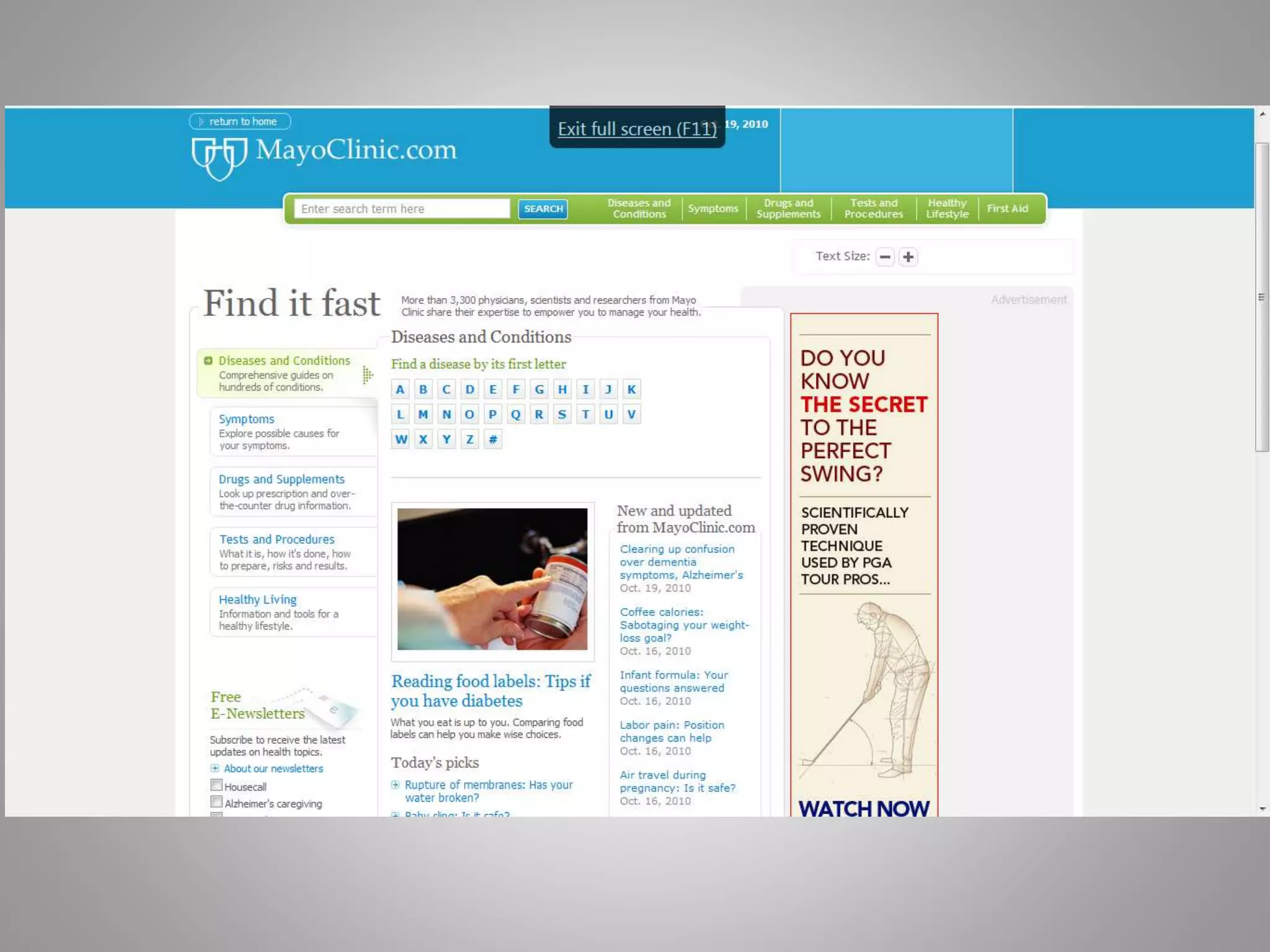
• Mayo Clinic  www.mayoclinic.com
• NoBabyNow  www.nobabynow.com
• DocFeedOnTweet on Twitter
• Wikipedia  The Ultimate Fallback Option
PAIN POINTS TODAY
• There is still a lot of collaboration required
which is missing
– Within Patient Communities
– Within the Medical Ecosystem
• Healthcare Professionals are yet to use this
medium effectively 
• Localized Sites with an Indian Context are few
and still poor in Quality
HOW TO SOLVE THEM
• Step1
– Patients force doctors to provide information
– Physicians, Clinics and Hospitals must get
Websites
– Doctors must improve their Computer skills
– Doctors must start blogging, tweeting, becoming
Social on the Web
– Doctors should encourage Patients to build online
community forums where they can frankly discuss
treatments --- INVOLVE THEM
STILL SOLVING
• Step 2
– Online Electronic Medical Record Solutions
– Provide Patients with Personalized Health Records
– Patients: Use Emails with your doctors  Save his
Time
– Doctors : Use SMS’s to provide Alerts  PUSH Info
to the Patient
• Step 3
– Lets do this first, else we will just keep talking 
SUMMARY
• The Internet is a Fantastic Medium for sharing
Healthcare Information and creating Informed
Patients
• The Informed Patient can use the Internet to
make sure the care they receive is safe,
effective, patient-centered, timely, efficient,
and equitable.
QUESTIONS

Using the internet to create informed patients

  • 1.
    Using The Internetto create Informed Patients Nrip Nihalani Plus91 Technologies Pvt. Ltd.
  • 2.
    WHY TALK ABOUTTHE INTERNET • Marshall McLuhan predicted in 1964 that our current and future electronic technologies would create a Global Village  World Wide Web • The pervasiveness of the WWW enables its users have “Access to Information 24 hours a day, 7 days a week”. Consumer  Patient • By providing Patients with access to information, which can be used to influence how they make decisions regarding their health care, the Internet provides the ability to break down traditional barriers of power
  • 3.
    WHAT CANT THEINTERNET DO • It cannot cure you • It cannot force you to take your pills • It wont prevent you from taking the wrong medication • It wont prevent a surgeon from mistakenly operating on the wrong knee • It wont prevent a mishap in a surgery
  • 4.
    THEN WHY USEIT • Fast Efficient Tool for Information – Risks – Options • Pervasive Medium • In Expensive • Collaborative • Self Adjusting • Inherent Quality Check
  • 5.
    WHAT INFORMATION CANTHE INTERNET PROVIDE • General Medical References  neurocysticercosis • Side Effect Information – Surgical  E.g. SIDE EFFECTS OF A LASIK SURGERY – Drugs E.g. If it is not used at the correct dosage and frequency, Crocin may cause liver damage leading to liver failure • Emergency and First Aid Information • Recommendations for Medical Care – Evaluations of hospitals, clinics and physicians – Health Insurance Options – Healthcare Plans from Labs and Centers
  • 6.
    HOW TO USETHIS INFORMATION • This health Information can be used for: – Evaluating Risks – Decision making – Disease Management – Emotional support – Health Promotion
  • 7.
    WHERE IS THISON THE INTERNET • Medical Websites – Hospitals and Clinics – Physicians and Surgeons • Informative and Interactive Portals • Digital Medical Libraries • Medical Newsletters • Push Channels – Twitter – docFeedOnTweet – IRC –> For the advanced Internet User
  • 8.
    EXAMPLES • MedicineNet www.medicinenet.com • MedlinePlus  www.nlm.nih.gov/medlineplus/ • Mayo Clinic  www.mayoclinic.com • NoBabyNow  www.nobabynow.com • DocFeedOnTweet on Twitter • Wikipedia  The Ultimate Fallback Option
  • 10.
    PAIN POINTS TODAY •There is still a lot of collaboration required which is missing – Within Patient Communities – Within the Medical Ecosystem • Healthcare Professionals are yet to use this medium effectively  • Localized Sites with an Indian Context are few and still poor in Quality
  • 11.
    HOW TO SOLVETHEM • Step1 – Patients force doctors to provide information – Physicians, Clinics and Hospitals must get Websites – Doctors must improve their Computer skills – Doctors must start blogging, tweeting, becoming Social on the Web – Doctors should encourage Patients to build online community forums where they can frankly discuss treatments --- INVOLVE THEM
  • 12.
    STILL SOLVING • Step2 – Online Electronic Medical Record Solutions – Provide Patients with Personalized Health Records – Patients: Use Emails with your doctors  Save his Time – Doctors : Use SMS’s to provide Alerts  PUSH Info to the Patient • Step 3 – Lets do this first, else we will just keep talking 
  • 13.
    SUMMARY • The Internetis a Fantastic Medium for sharing Healthcare Information and creating Informed Patients • The Informed Patient can use the Internet to make sure the care they receive is safe, effective, patient-centered, timely, efficient, and equitable.
  • 14.