CLINICAL RESEARCH INFORMATICS
Clinical Research Informatics involves
the use of informatics in the discovery and
management of
new knowledge relating to health and
disease.
CLINICAL RESEARCH INFORMATICS
It includes management of information related to clinical trials and
also involves informatics related to secondary research use of
clinical data. Clinical research informatics and translational
bioinformatics are the primary domains related to informatics
activities to support translational research.
Profession community – America Medical Informatics Association,
http://www.amia.org/applications-informatics/clinical-research-
informatics
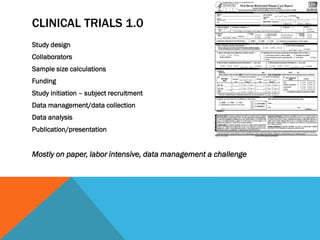
CLINICAL TRIALS 1.0
Study design
Collaborators
Sample size calculations
Funding
Study initiation – subject recruitment
Data management/data collection
Data analysis
Publication/presentation
Mostly on paper, labor intensive, data management a challenge
CLINICAL TRIALS 2.0
Exploit full use of informatics tools to:
 Create efficiency in study design and execution
 Promote full study recruitment
 Accelerate the research process
 Utilize the electronic medical record to recruit, manage data, bill
appropriately and communicate
STUDY DESIGN
Study feasibility
Power calculations – how many patients do I need to recruit to have
enough data to get significant results
In the past – guesswork
Study could proceed for 2-4 years before the investigator would
find out that there were not enough patients to recruit
Present and Future
Compare the study inclusion/exclusion criteria with active
patients in the EMR to see if the study will be successful
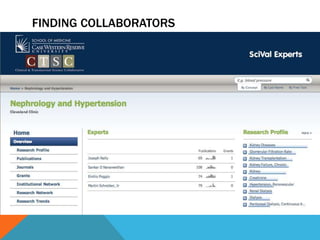
FINDING COLLABORATORS
RESEARCH SUBJECT RECRUITMENT
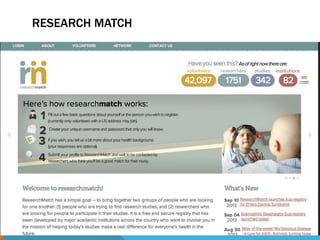
Research Match
EMR
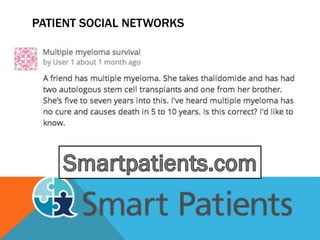
Social Media
RESEARCH MATCH
RECRUITMENT FROM THE EMR
Applying inclusion/exclusion criteria to EMR
Include only active patients
When and where is their next appointment
Make research nurse more efficient – go to site where several patients might be
recruited in one day
Essential for anesthesia/surgery research since patients must give consent prior to
the day of surgery
RECRUITMENT VIA SOCIAL MEDIA
For some studies, newspaper advertising was standard practice
Many patients now online in social media, using apps, in social network communities
of patients with similar diagnoses
Social media still considered a form of advertising – needs to be approved by the IRB
provide a link to more detailed information and who to contact
Social networks of patients – must ask permission to post a trial
Some patient advocates (e-Patients) may promote research
PATIENT SOCIAL NETWORKS
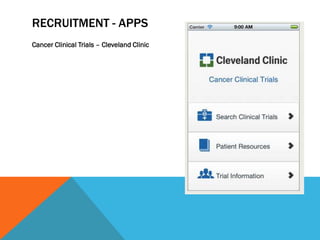
RECRUITMENT - APPS
Cancer Clinical Trials – Cleveland Clinic
DATA MANAGEMENT
REDCap
EMR – Get Data
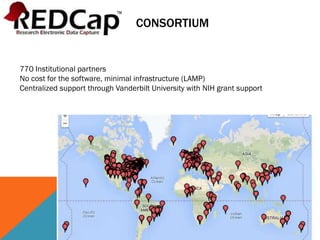
CONSORTIUM
770 Institutional partners
No cost for the software, minimal infrastructure (LAMP)
Centralized support through Vanderbilt University with NIH grant support
RESEARCH ELECTRONIC
DATA CAPTURE
Features include:
Building data collection instruments
Importing data collection instruments from a library
Creating surveys for research
Creating longitudinal studies
Controlling user access
Quality checks
Exporting data for analysis
Simple reports and data analysis tools
DATA FROM THE EMR FOR RESEARCH
Extract clinical data
Map to standard ontologies
Cohort identification tool
Select data elements of interest
Export data set or create a registry
Update on a periodic basis
DATA MAPPING
Unified Medical Language System (UMLS metathesarus)
From the National Library of Medicine
http://www.nlm.nih.gov/research/umls/
SNOMED-CT
LOINC
RxNorm
Mapped data easier for searching, data mining
Converts raw clinical data into meaningful terms
CHRONIC KIDNEY DISEASE REGISTRY
60,000 patients in the EMR
Multiple abstracts and papers from mining the data
about symptoms, lab values, comorbidities, survival
Successful grant funded by the National Institute of
Health
Includes demographics, lab results, procedures,
encounters, vital signs, etc.
Able to study disease longitudinally – data from 2005 -
2013
From the National Institutes of Health
http://bd2k.nih.gov/
Enable biomedical scientists to capitalize more fully on the Big Data being generated
by those research
Grants to enable collaborative development of tools and sharing data securely for
research
Biomedical research enterprise is increasingly becoming data-intensive and data-
driven
Appropriate access to shareable biomedical data through technologies, approaches,
and policies that enable and facilitate widespread data sharing, discoverability,
management, curation, and meaningful re-use;
Development of and access to appropriate algorithms, methods, software, and tools
for all aspects of the use of Big Data, including data processing, storage, analysis,
integration, and visualization;
Appropriate protections for privacy and intellectual property;
Development of a sufficient cadre of researchers skilled in the science of Big Data, in
addition to elevating general competencies in data usage and analysis across the
behavioral research workforce
CONCLUSIONS
Informatics can contribute
tools to every phase of
clinical research
Goal – to help accelerate
clinical research
National network –
Clinical and Translational
Science Awards
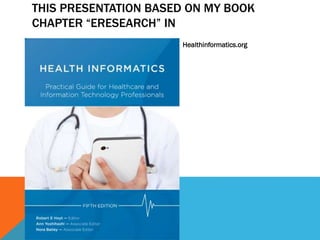
THIS PRESENTATION BASED ON MY BOOK
CHAPTER “ERESEARCH” IN
Healthinformatics.org

Clinical analytics–innovating to support clinical research

  • 2.
    CLINICAL RESEARCH INFORMATICS ClinicalResearch Informatics involves the use of informatics in the discovery and management of new knowledge relating to health and disease.
  • 3.
    CLINICAL RESEARCH INFORMATICS Itincludes management of information related to clinical trials and also involves informatics related to secondary research use of clinical data. Clinical research informatics and translational bioinformatics are the primary domains related to informatics activities to support translational research. Profession community – America Medical Informatics Association, http://www.amia.org/applications-informatics/clinical-research- informatics
  • 4.
    CLINICAL TRIALS 1.0 Studydesign Collaborators Sample size calculations Funding Study initiation – subject recruitment Data management/data collection Data analysis Publication/presentation Mostly on paper, labor intensive, data management a challenge
  • 5.
    CLINICAL TRIALS 2.0 Exploitfull use of informatics tools to:  Create efficiency in study design and execution  Promote full study recruitment  Accelerate the research process  Utilize the electronic medical record to recruit, manage data, bill appropriately and communicate
  • 6.
    STUDY DESIGN Study feasibility Powercalculations – how many patients do I need to recruit to have enough data to get significant results In the past – guesswork Study could proceed for 2-4 years before the investigator would find out that there were not enough patients to recruit Present and Future Compare the study inclusion/exclusion criteria with active patients in the EMR to see if the study will be successful
  • 7.
  • 8.
  • 9.
  • 10.
    RECRUITMENT FROM THEEMR Applying inclusion/exclusion criteria to EMR Include only active patients When and where is their next appointment Make research nurse more efficient – go to site where several patients might be recruited in one day Essential for anesthesia/surgery research since patients must give consent prior to the day of surgery
  • 11.
    RECRUITMENT VIA SOCIALMEDIA For some studies, newspaper advertising was standard practice Many patients now online in social media, using apps, in social network communities of patients with similar diagnoses Social media still considered a form of advertising – needs to be approved by the IRB provide a link to more detailed information and who to contact Social networks of patients – must ask permission to post a trial Some patient advocates (e-Patients) may promote research
  • 12.
  • 13.
    RECRUITMENT - APPS CancerClinical Trials – Cleveland Clinic
  • 14.
  • 15.
    CONSORTIUM 770 Institutional partners Nocost for the software, minimal infrastructure (LAMP) Centralized support through Vanderbilt University with NIH grant support
  • 16.
    RESEARCH ELECTRONIC DATA CAPTURE Featuresinclude: Building data collection instruments Importing data collection instruments from a library Creating surveys for research Creating longitudinal studies Controlling user access Quality checks Exporting data for analysis Simple reports and data analysis tools
  • 17.
    DATA FROM THEEMR FOR RESEARCH Extract clinical data Map to standard ontologies Cohort identification tool Select data elements of interest Export data set or create a registry Update on a periodic basis
  • 18.
    DATA MAPPING Unified MedicalLanguage System (UMLS metathesarus) From the National Library of Medicine http://www.nlm.nih.gov/research/umls/ SNOMED-CT LOINC RxNorm Mapped data easier for searching, data mining Converts raw clinical data into meaningful terms
  • 19.
    CHRONIC KIDNEY DISEASEREGISTRY 60,000 patients in the EMR Multiple abstracts and papers from mining the data about symptoms, lab values, comorbidities, survival Successful grant funded by the National Institute of Health Includes demographics, lab results, procedures, encounters, vital signs, etc. Able to study disease longitudinally – data from 2005 - 2013
  • 20.
    From the NationalInstitutes of Health http://bd2k.nih.gov/ Enable biomedical scientists to capitalize more fully on the Big Data being generated by those research Grants to enable collaborative development of tools and sharing data securely for research Biomedical research enterprise is increasingly becoming data-intensive and data- driven Appropriate access to shareable biomedical data through technologies, approaches, and policies that enable and facilitate widespread data sharing, discoverability, management, curation, and meaningful re-use; Development of and access to appropriate algorithms, methods, software, and tools for all aspects of the use of Big Data, including data processing, storage, analysis, integration, and visualization; Appropriate protections for privacy and intellectual property; Development of a sufficient cadre of researchers skilled in the science of Big Data, in addition to elevating general competencies in data usage and analysis across the behavioral research workforce
  • 21.
    CONCLUSIONS Informatics can contribute toolsto every phase of clinical research Goal – to help accelerate clinical research National network – Clinical and Translational Science Awards
  • 22.
    THIS PRESENTATION BASEDON MY BOOK CHAPTER “ERESEARCH” IN Healthinformatics.org