Nidhi Gulati
UNC Carolina Health Informatics Program Practicum
May 24, 2013
Current Data Problems
ď‚—Current data standards are inadequate to support exchange and re-use
of data collected and used in clinical domains
ď‚—Data may be exchanged between providers, but variations in meaning,
measurement, and coding systems, etc. result in data that cannot be
easily used for patient care or support secondary uses such as quality
improvement and research
ď‚—Terminologies (ICD and SNOMED) alone are insufficient to cope up with
these challenges
ď‚—This lack of semantic interoperability results in poor information
quality in health care and in secondary data uses
'Standardizing clinical data elements' paper by Meredith Nahm, et al.
'Knowledge Aquisition from and Semantic Variability in Schizophrenia Clinial Trial Data' paper by Meredith Nahm
Solution
ď‚—Standardization of data elements to support patient care
and secondary uses is strongly considered part of the
solution to the problems of lack of semantic
interoperability and poor information quality in
healthcare
ď‚—Standardization will facilitate meaningful quality
exchange of health information and re-use of data
'Standardizing clinical data elements' paper by Meredith Nahm, et al.
'Knowledge Aquisition from and Semantic Variability in Schizophrenia Clinial Trial Data' paper by Meredith Nahm
Why the same Standards?
ď‚—Standards enable interoperability
ď‚—Three aspects of interoperability:
ď‚—Technical: Moving data from system A to system B
ď‚—Semantic: Ensuring that systems A and B understand
the data in the same way
ď‚—Process: Enabling business processes at organizations
housing systems A and B to work together
http://www.hl7.org/documentcenter/public_temp_973A0F7F-
1C23-BA17-0C22BE995BB25E98/training/IntroToHL7/player.html
CDISC and HL7
There are two standards development organizations
relevant for this work:
ď‚—Clinical Data Standards Interchange Consortium
(CDISC) – the data standards organization for FDA
regulated research
Health Level Seven (HL7) – the data standards
development organization for Healthcare
2012
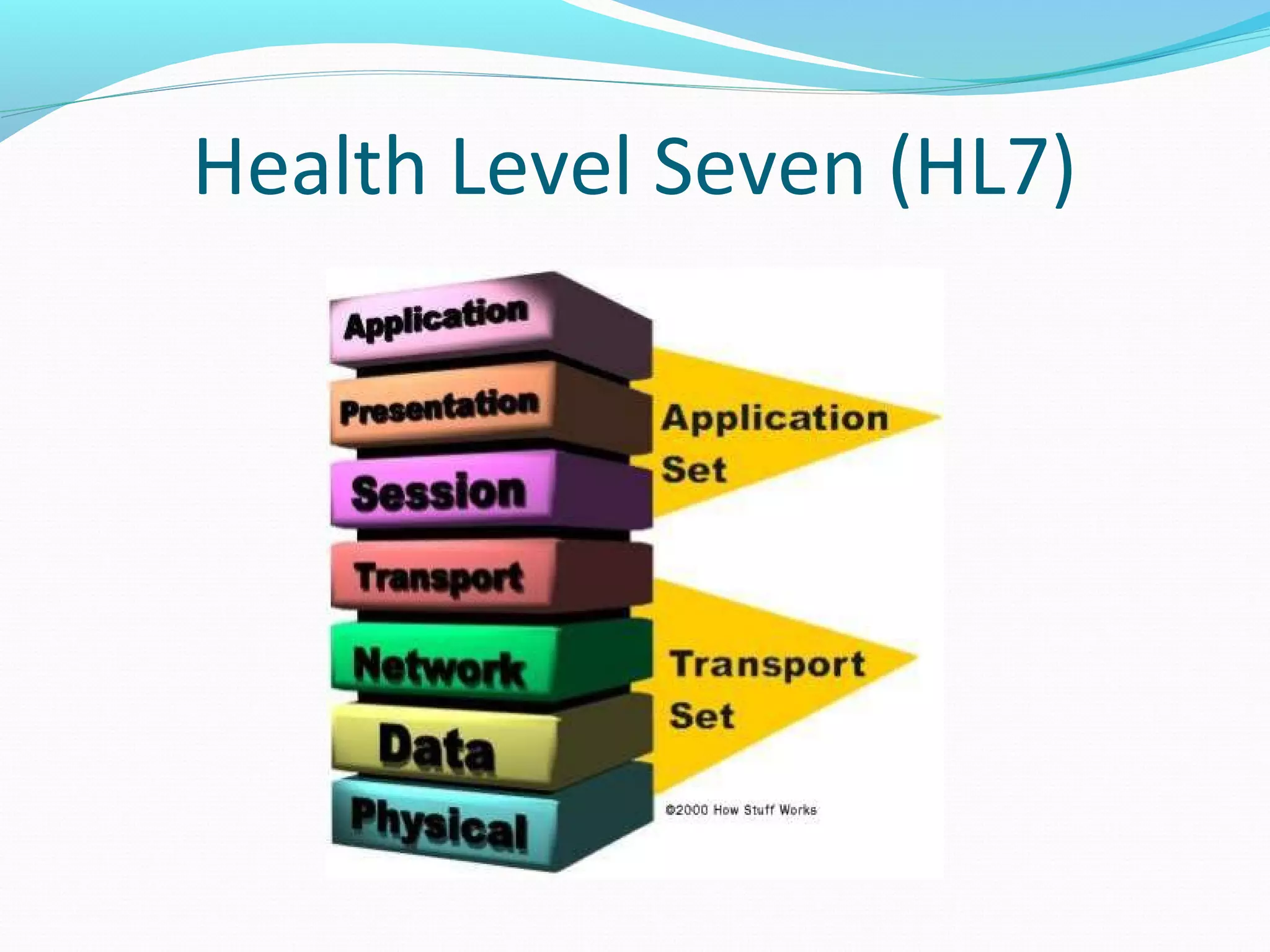
Health Level Seven (HL7)
The Philosophy
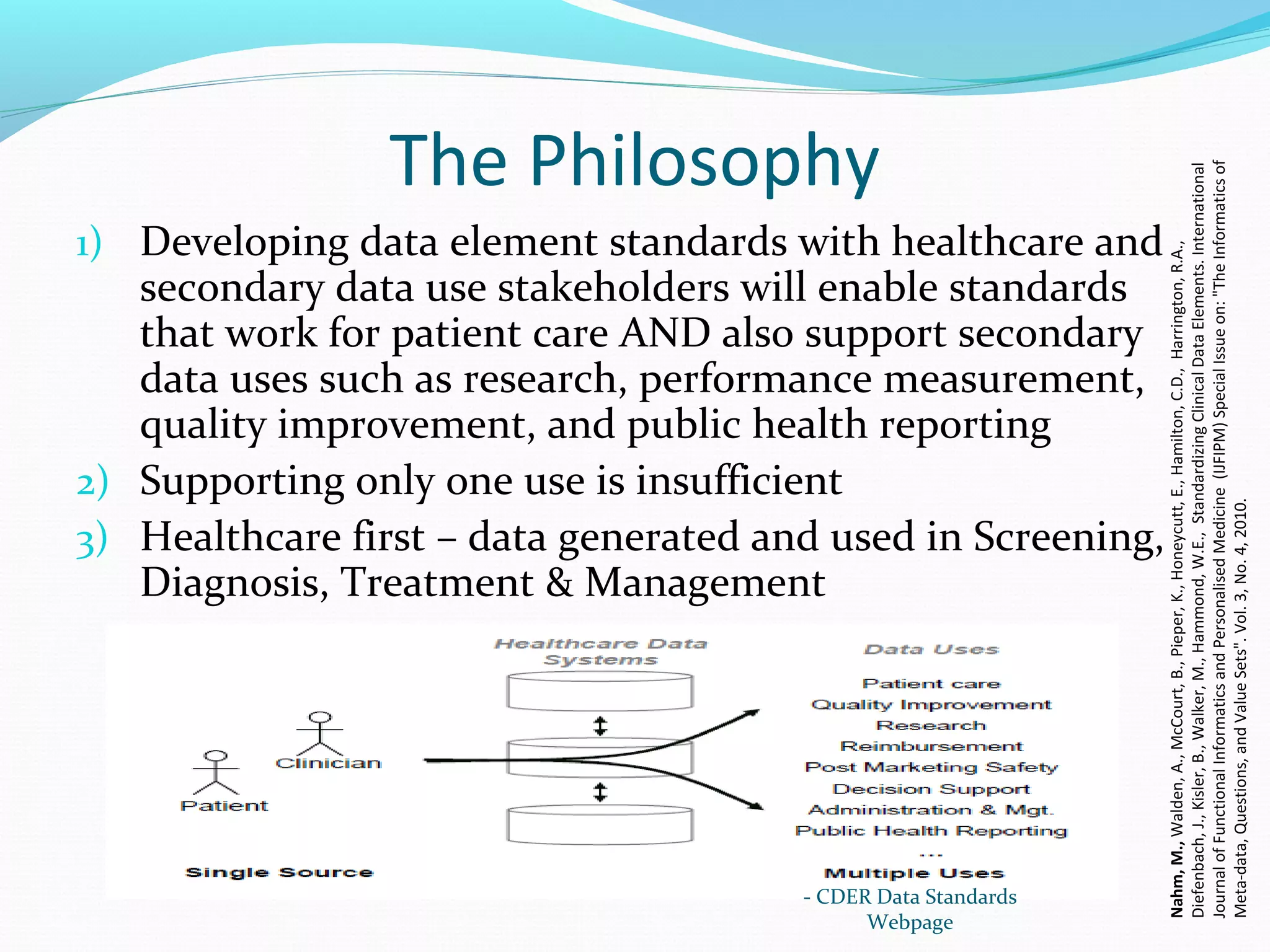
1) Developing data element standards with healthcare and
secondary data use stakeholders will enable standards
that work for patient care AND also support secondary
data uses such as research, performance measurement,
quality improvement, and public health reporting
2) Supporting only one use is insufficient
3) Healthcare first – data generated and used in Screening,
Diagnosis, Treatment & Management
- CDER Data Standards
Webpage
Nahm,M.,Walden,A.,McCourt,B.,Pieper,K.,Honeycutt,E.,Hamilton,C.D.,Harrington,R.A.,
Diefenbach,J.,Kisler,B.,Walker,M.,Hammond,W.E.,StandardizingClinicalDataElements.International
JournalofFunctionalInformaticsandPersonalisedMedicine(IJFIPM)SpecialIssueon:"TheInformaticsof
Meta-data,Questions,andValueSets".Vol.3,No.4,2010.
More Philosophy
4. Clinical professional societies are the only
authoritative source of clinical definitions
5. Data element is the fundamental unit of
information exchange and use
6. Data elements should be standardized (i.e., ANSI
accredited SDO)
7. Standard data elements should be freely
available in searchable metadata registries
Nahm,M.,Walden,A.,McCourt,B.,Pieper,K.,Honeycutt,E.,Hamilton,C.D.,Harrington,R.A.,
Diefenbach,J.,Kisler,B.,Walker,M.,Hammond,W.E.,StandardizingClinicalDataElements.
InternationalJournalofFunctionalInformaticsandPersonalisedMedicine(IJFIPM)SpecialIssueon:
"TheInformaticsofMeta-data,Questions,andValueSets".Vol.3,No.4,2010.
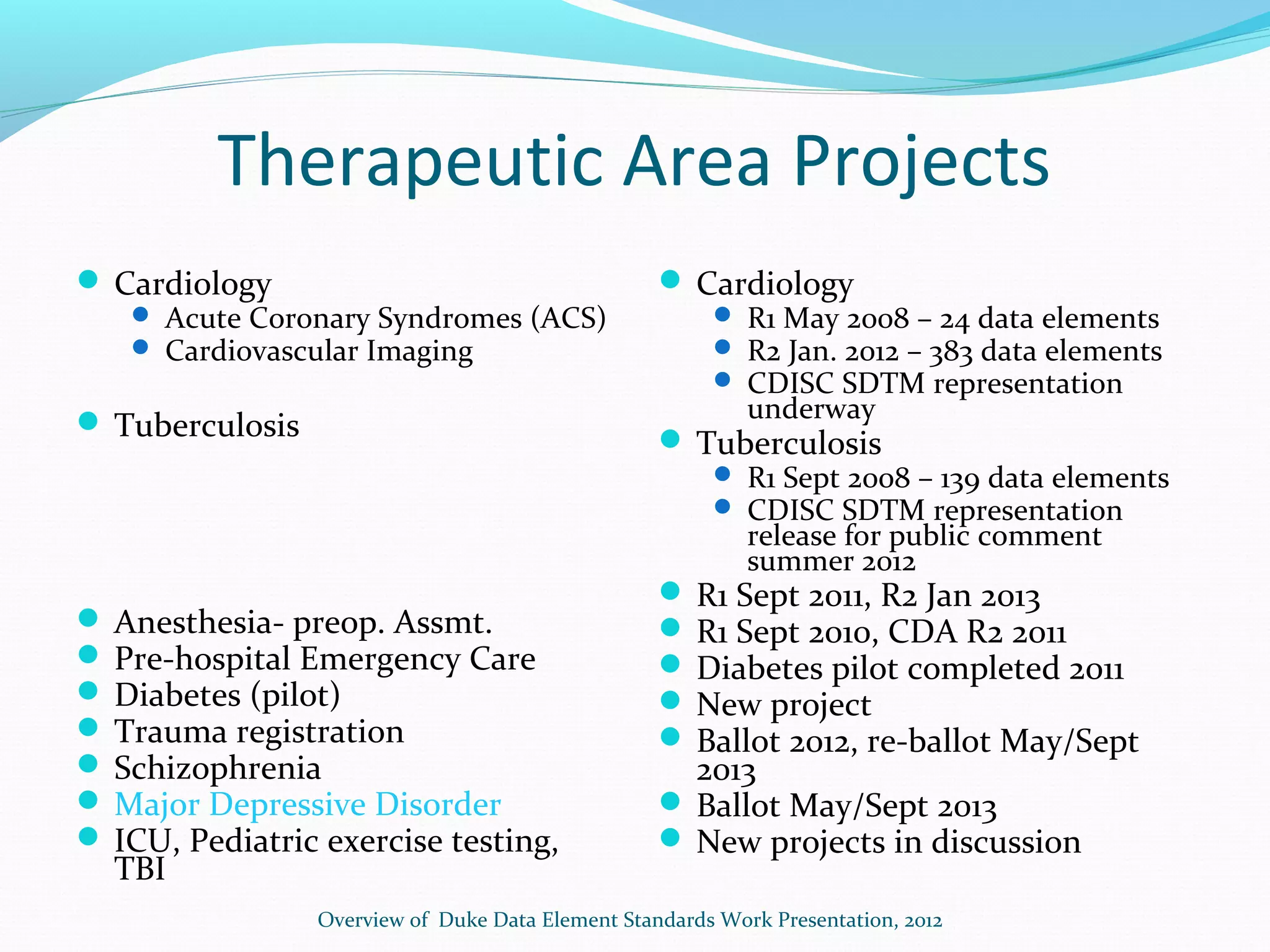
Therapeutic Area Projects
ď‚— Cardiology
ď‚— Acute Coronary Syndromes (ACS)
ď‚— Cardiovascular Imaging
ď‚— Tuberculosis
ď‚— Anesthesia- preop. Assmt.
ď‚— Pre-hospital Emergency Care
ď‚— Diabetes (pilot)
ď‚— Trauma registration
ď‚— Schizophrenia
ď‚— Major Depressive Disorder
ď‚— ICU, Pediatric exercise testing,
TBI
ď‚— Cardiology
 R1 May 2008 – 24 data elements
 R2 Jan. 2012 – 383 data elements
ď‚— CDISC SDTM representation
underway
ď‚— Tuberculosis
 R1 Sept 2008 – 139 data elements
ď‚— CDISC SDTM representation
release for public comment
summer 2012
ď‚— R1 Sept 2011, R2 Jan 2013
ď‚— R1 Sept 2010, CDA R2 2011
ď‚— Diabetes pilot completed 2011
ď‚— New project
ď‚— Ballot 2012, re-ballot May/Sept
2013
ď‚— Ballot May/Sept 2013
ď‚— New projects in discussion
Overview of Duke Data Element Standards Work Presentation, 2012
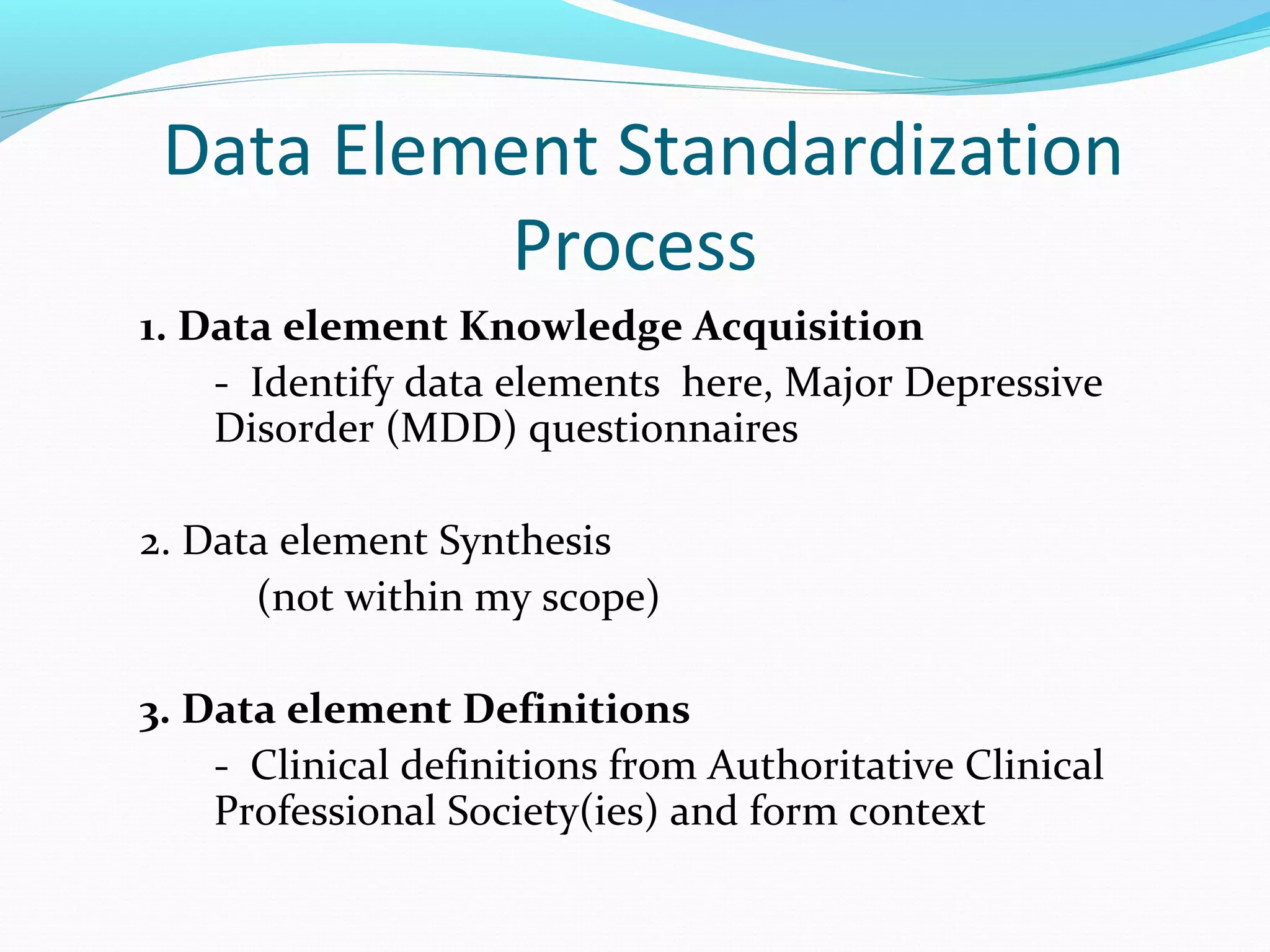
Data Element Standardization
Process
1. Data element Knowledge Acquisition
- Identify data elements here, Major Depressive
Disorder (MDD) questionnaires
2. Data element Synthesis
(not within my scope)
3. Data element Definitions
- Clinical definitions from Authoritative Clinical
Professional Society(ies) and form context
Knowledge Acquisition
Elements
1. Experts
2. Documented knowledge of
experts
ď‚—Data collection forms
ď‚—Clinical guidelines
ď‚—Clinical documentation
ď‚—Data dictionaries, e.g.,
ď‚—Registries
ď‚—EHR screens /
systems
ď‚—Protocols
Overview of Duke Data Element Standards Work Presentation, 2012
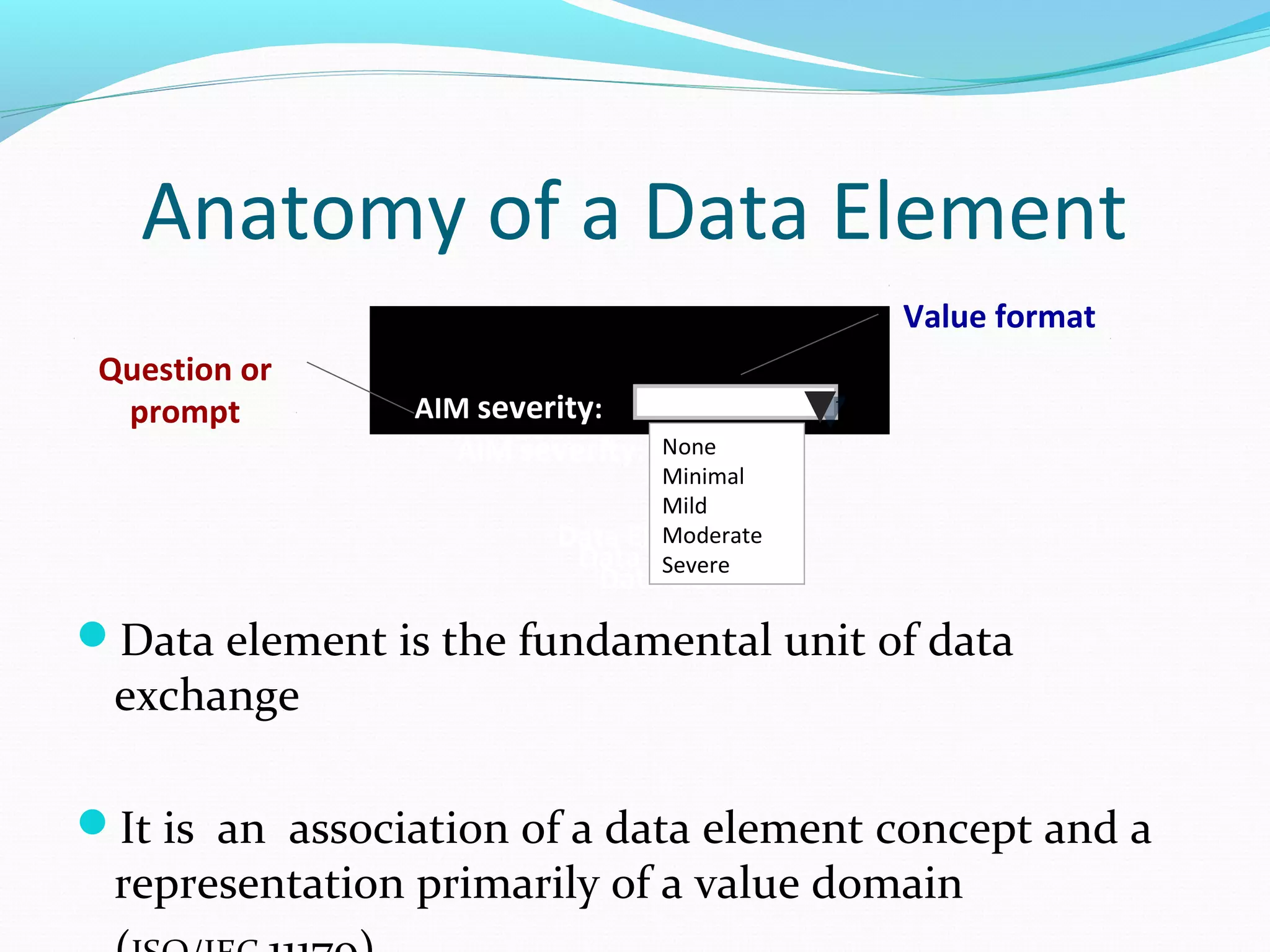
Anatomy of a Data Element
ď‚—Data element is the fundamental unit of data
exchange
ď‚—It is an association of a data element concept and a
representation primarily of a value domain
AIM severity:
Data Element
AIM severity:
Data Element
AIM severity:
Data Element
AIM severity:
Question or
prompt
Value format
Data Element
None
Minimal
Mild
Moderate
Severe
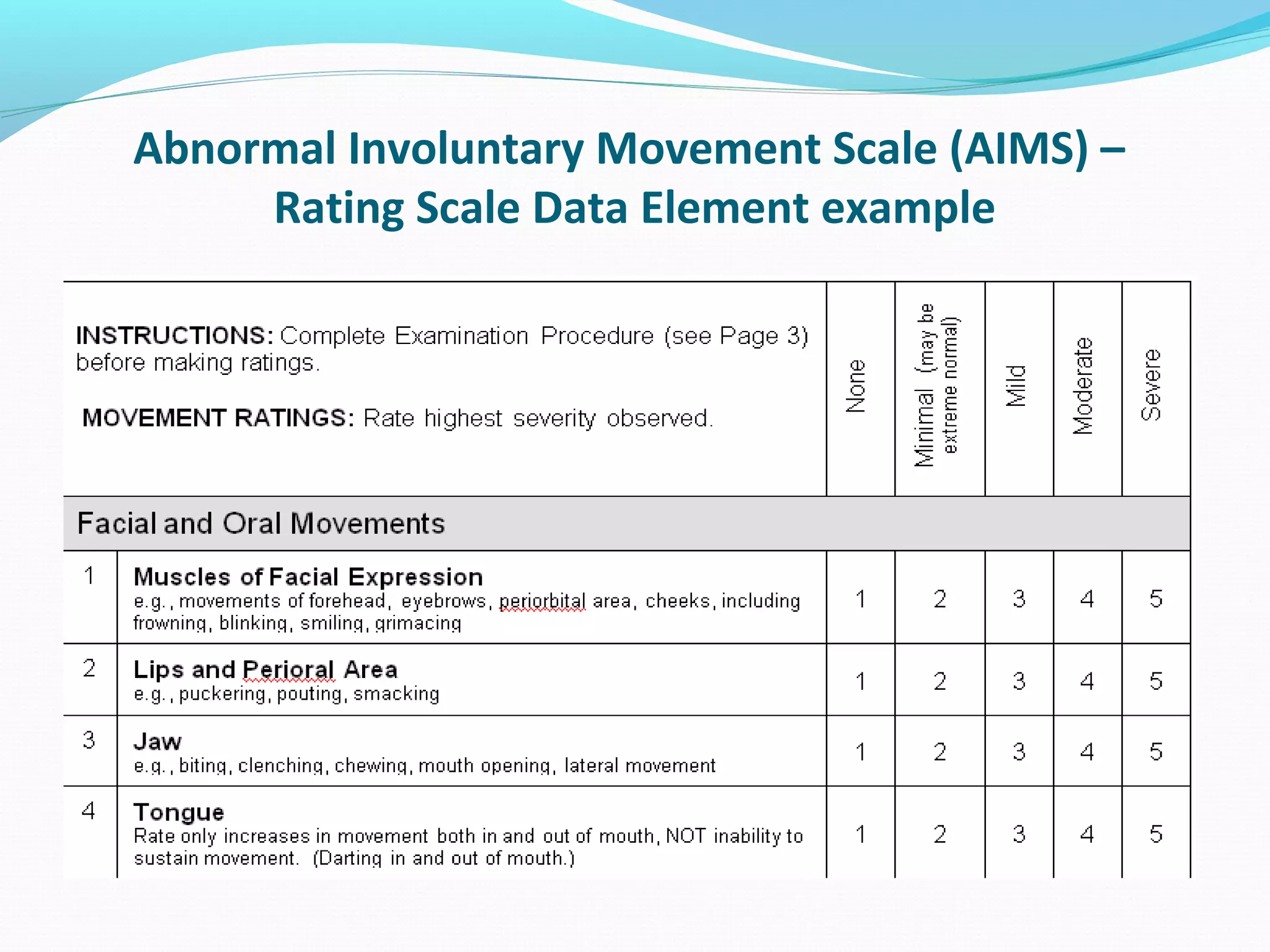
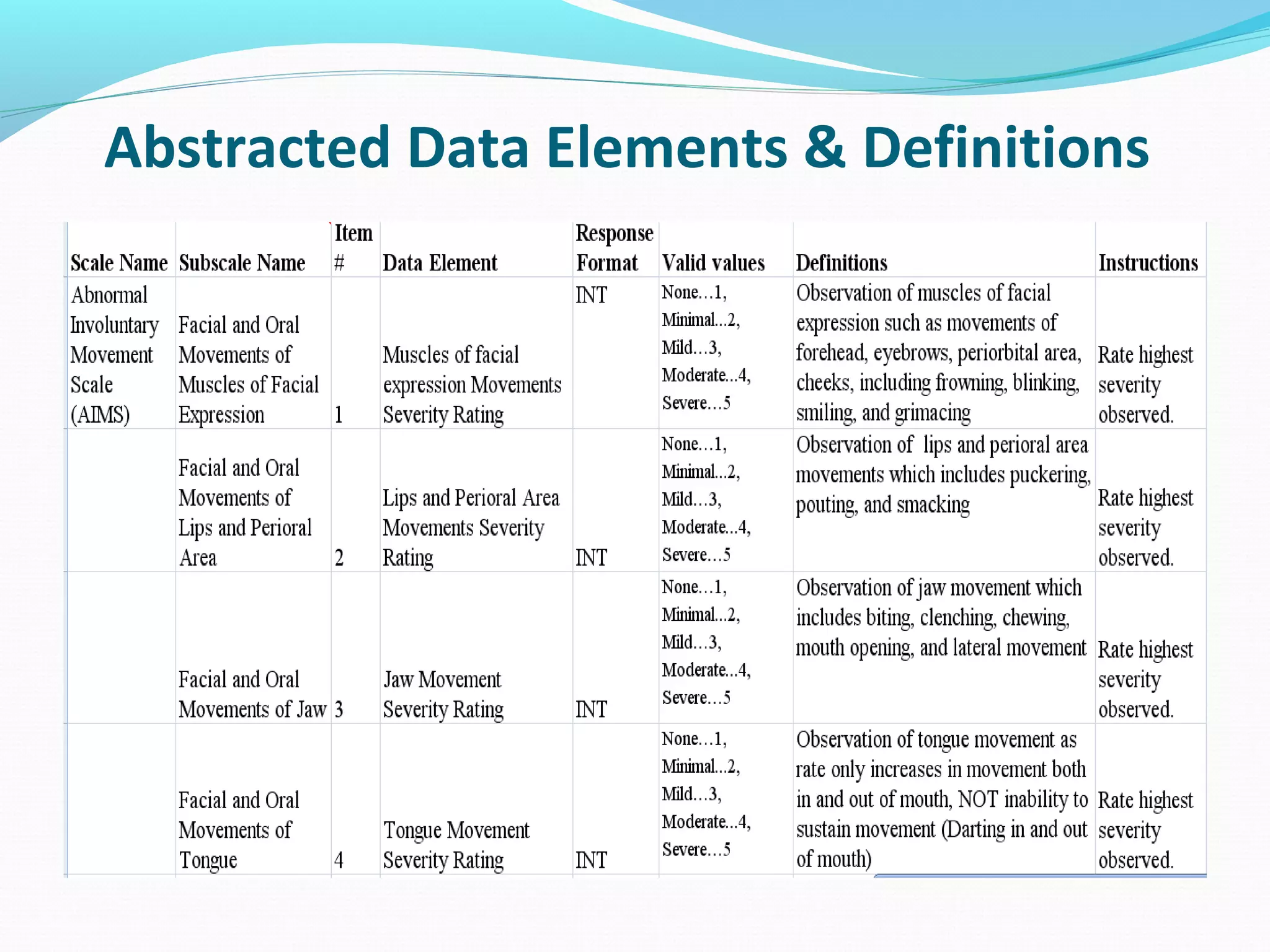
Abnormal Involuntary Movement Scale (AIMS) –
Rating Scale Data Element example
Abstracted Data Elements & Definitions
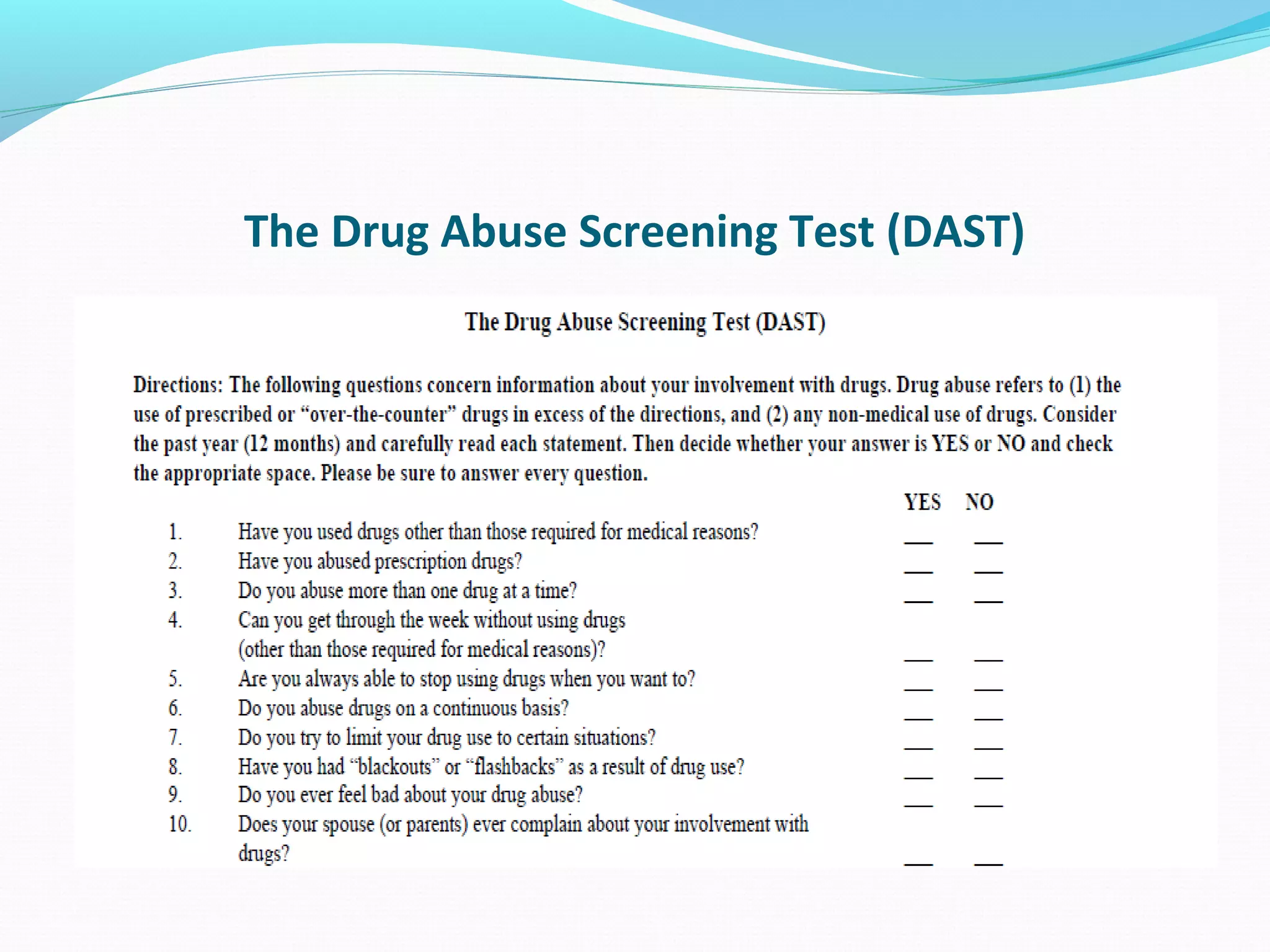
The Drug Abuse Screening Test (DAST)
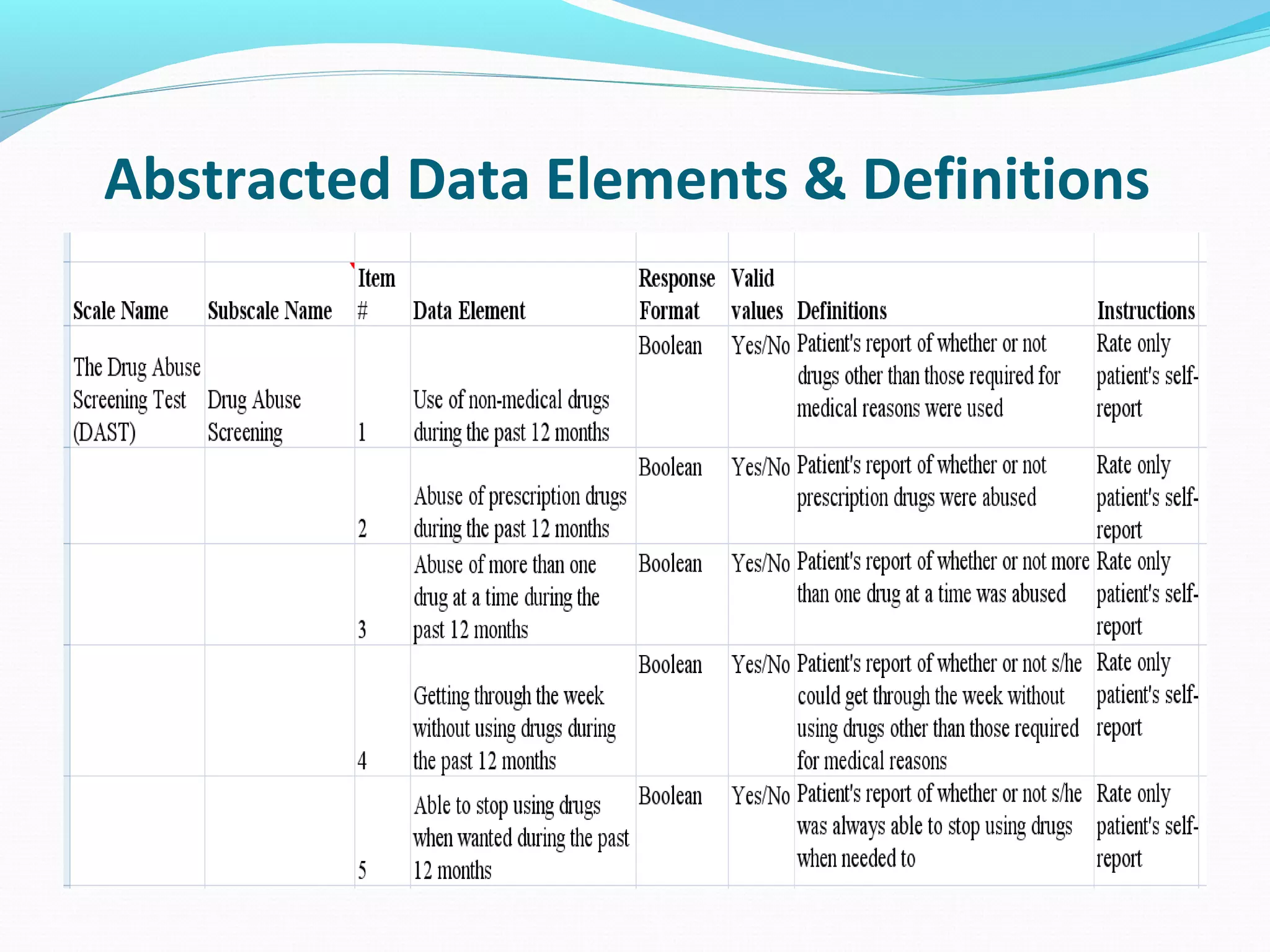
Abstracted Data Elements & Definitions
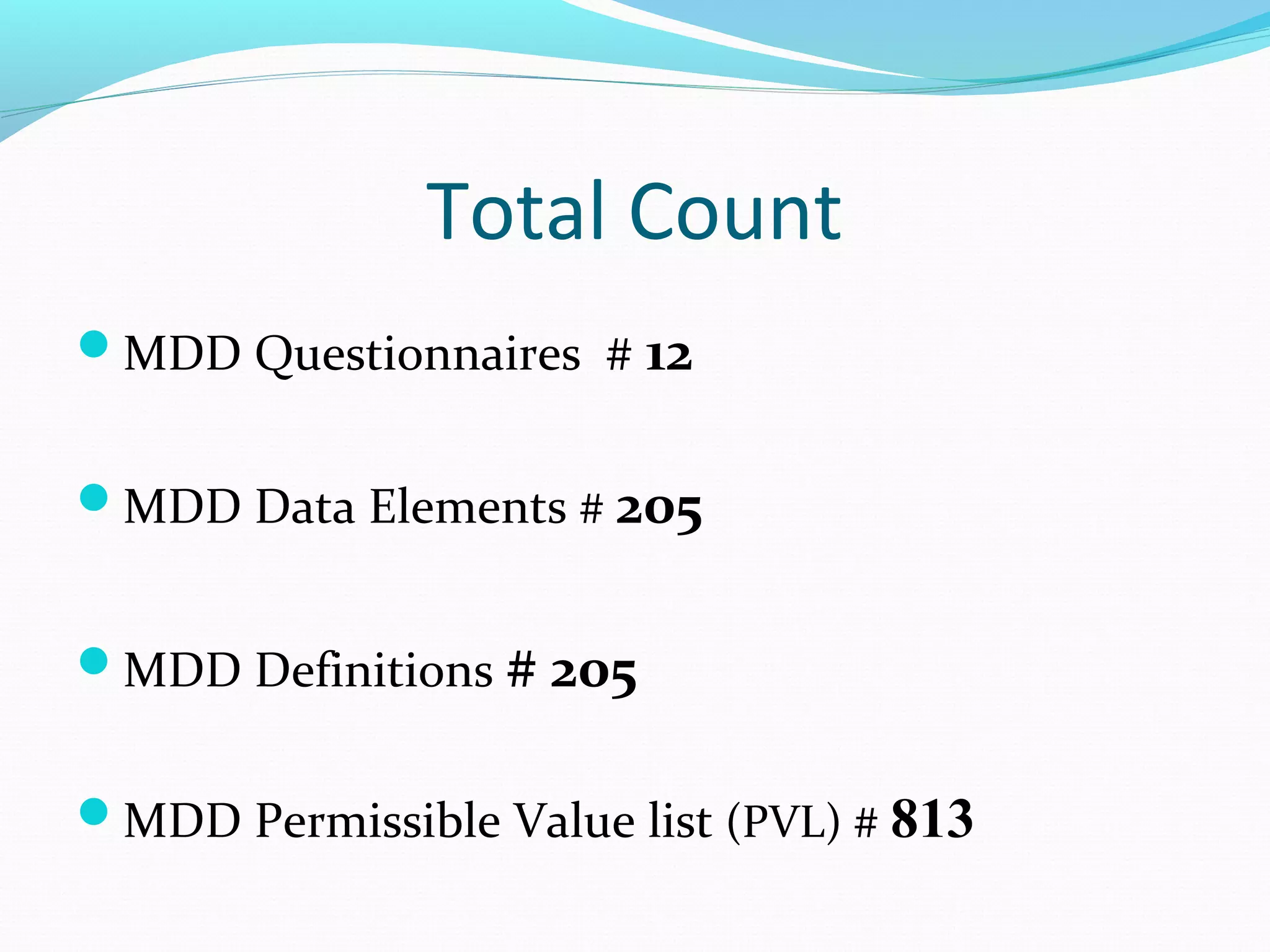
Total Count
ď‚—MDD Questionnaires # 12
ď‚—MDD Data Elements # 205
ď‚—MDD Definitions # 205
ď‚—MDD Permissible Value list (PVL) # 813
Funding
The work presented here in:
Major Depressive Disorder (R24FD004656-01)
was made possible by funding from the Food and
Drug Administration (FDA), a component of the
Department of Health and Human Services (HHS).

Practicum presentation nidhi 2013

  • 1.
    Nidhi Gulati UNC CarolinaHealth Informatics Program Practicum May 24, 2013
  • 2.
    Current Data Problems ď‚—Currentdata standards are inadequate to support exchange and re-use of data collected and used in clinical domains ď‚—Data may be exchanged between providers, but variations in meaning, measurement, and coding systems, etc. result in data that cannot be easily used for patient care or support secondary uses such as quality improvement and research ď‚—Terminologies (ICD and SNOMED) alone are insufficient to cope up with these challenges ď‚—This lack of semantic interoperability results in poor information quality in health care and in secondary data uses 'Standardizing clinical data elements' paper by Meredith Nahm, et al. 'Knowledge Aquisition from and Semantic Variability in Schizophrenia Clinial Trial Data' paper by Meredith Nahm
  • 3.
    Solution ď‚—Standardization of dataelements to support patient care and secondary uses is strongly considered part of the solution to the problems of lack of semantic interoperability and poor information quality in healthcare ď‚—Standardization will facilitate meaningful quality exchange of health information and re-use of data 'Standardizing clinical data elements' paper by Meredith Nahm, et al. 'Knowledge Aquisition from and Semantic Variability in Schizophrenia Clinial Trial Data' paper by Meredith Nahm
  • 4.
    Why the sameStandards? ď‚—Standards enable interoperability ď‚—Three aspects of interoperability: ď‚—Technical: Moving data from system A to system B ď‚—Semantic: Ensuring that systems A and B understand the data in the same way ď‚—Process: Enabling business processes at organizations housing systems A and B to work together http://www.hl7.org/documentcenter/public_temp_973A0F7F- 1C23-BA17-0C22BE995BB25E98/training/IntroToHL7/player.html
  • 5.
    CDISC and HL7 Thereare two standards development organizations relevant for this work: Clinical Data Standards Interchange Consortium (CDISC) – the data standards organization for FDA regulated research Health Level Seven (HL7) – the data standards development organization for Healthcare 2012
  • 6.
  • 7.
    The Philosophy 1) Developingdata element standards with healthcare and secondary data use stakeholders will enable standards that work for patient care AND also support secondary data uses such as research, performance measurement, quality improvement, and public health reporting 2) Supporting only one use is insufficient 3) Healthcare first – data generated and used in Screening, Diagnosis, Treatment & Management - CDER Data Standards Webpage Nahm,M.,Walden,A.,McCourt,B.,Pieper,K.,Honeycutt,E.,Hamilton,C.D.,Harrington,R.A., Diefenbach,J.,Kisler,B.,Walker,M.,Hammond,W.E.,StandardizingClinicalDataElements.International JournalofFunctionalInformaticsandPersonalisedMedicine(IJFIPM)SpecialIssueon:"TheInformaticsof Meta-data,Questions,andValueSets".Vol.3,No.4,2010.
  • 8.
    More Philosophy 4. Clinicalprofessional societies are the only authoritative source of clinical definitions 5. Data element is the fundamental unit of information exchange and use 6. Data elements should be standardized (i.e., ANSI accredited SDO) 7. Standard data elements should be freely available in searchable metadata registries Nahm,M.,Walden,A.,McCourt,B.,Pieper,K.,Honeycutt,E.,Hamilton,C.D.,Harrington,R.A., Diefenbach,J.,Kisler,B.,Walker,M.,Hammond,W.E.,StandardizingClinicalDataElements. InternationalJournalofFunctionalInformaticsandPersonalisedMedicine(IJFIPM)SpecialIssueon: "TheInformaticsofMeta-data,Questions,andValueSets".Vol.3,No.4,2010.
  • 9.
    Therapeutic Area Projects Cardiology  Acute Coronary Syndromes (ACS)  Cardiovascular Imaging  Tuberculosis  Anesthesia- preop. Assmt.  Pre-hospital Emergency Care  Diabetes (pilot)  Trauma registration  Schizophrenia  Major Depressive Disorder  ICU, Pediatric exercise testing, TBI  Cardiology  R1 May 2008 – 24 data elements  R2 Jan. 2012 – 383 data elements  CDISC SDTM representation underway  Tuberculosis  R1 Sept 2008 – 139 data elements  CDISC SDTM representation release for public comment summer 2012  R1 Sept 2011, R2 Jan 2013  R1 Sept 2010, CDA R2 2011  Diabetes pilot completed 2011  New project  Ballot 2012, re-ballot May/Sept 2013  Ballot May/Sept 2013  New projects in discussion Overview of Duke Data Element Standards Work Presentation, 2012
  • 10.
    Data Element Standardization Process 1.Data element Knowledge Acquisition - Identify data elements here, Major Depressive Disorder (MDD) questionnaires 2. Data element Synthesis (not within my scope) 3. Data element Definitions - Clinical definitions from Authoritative Clinical Professional Society(ies) and form context
  • 11.
    Knowledge Acquisition Elements 1. Experts 2.Documented knowledge of experts ď‚—Data collection forms ď‚—Clinical guidelines ď‚—Clinical documentation ď‚—Data dictionaries, e.g., ď‚—Registries ď‚—EHR screens / systems ď‚—Protocols Overview of Duke Data Element Standards Work Presentation, 2012
  • 12.
    Anatomy of aData Element ď‚—Data element is the fundamental unit of data exchange ď‚—It is an association of a data element concept and a representation primarily of a value domain AIM severity: Data Element AIM severity: Data Element AIM severity: Data Element AIM severity: Question or prompt Value format Data Element None Minimal Mild Moderate Severe
  • 13.
    Abnormal Involuntary MovementScale (AIMS) – Rating Scale Data Element example
  • 14.
  • 15.
    The Drug AbuseScreening Test (DAST)
  • 16.
  • 17.
    Total Count ď‚—MDD Questionnaires# 12 ď‚—MDD Data Elements # 205 ď‚—MDD Definitions # 205 ď‚—MDD Permissible Value list (PVL) # 813
  • 18.
    Funding The work presentedhere in: Major Depressive Disorder (R24FD004656-01) was made possible by funding from the Food and Drug Administration (FDA), a component of the Department of Health and Human Services (HHS).