MEDICAL RESEARCH AND
STUDY DESIGNS
DR B. BORTHAKUR (PROFESSOR)
DEPT OF ORTHOPAEDICS, SMCH
Introduction
THE WORD ‘STATISTICS’ IS DERIVED FROM THE LATIN FOR “STATE” INDICATING
HISTORICAL IMPORTANCE OF GOVERNMENTAL DATA GATHERING, WHICH PRINCIPALLY IS
DEMOGRAPHIC INFORMATION.
• “STATISTICS IS THE SCIENCE , WHICH DEALS WITH
• COLLECTION
• ORGANISATION
• PRESENTATION
• ANALYSIS&
• INTERPRETATION OF NUMERICAL DATA’’( ACC TO CROXTON AND COWDEN).
BIOSTATISTICS
• Biostatistics is the application of statistics to the biologic sciences, medicine and
public health.
• Biostatitical analysis key to conduct new clinical trials.
• One of the foundations of evidence based medicine.
• The need for advanced biostatistics is increasing every day.
• It enables the collection, analyzing , presenting and interpreting data to find
application in various field like-
• Epidemiology
• Clinical trials
• Population genetics
• Systems biology.
• Biostats help in clinical researches for-
• Designing
• Conducting
• Analyzing
• Reporting
• Minimizing biases
• Confounding factor
• Measuring random errors
• Understanding the research
• Make suggestions on hypothesis testing and analysis.
• Sample size.
• Power of study.
BIOSTATS IN CLINICAL TRIALS
• Biostats helps in clinical trials-
1. protocol development.
2.data management
3. study implementation
4. data analysis.
5. reports
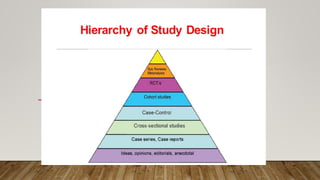
TYPES OF STUDIES
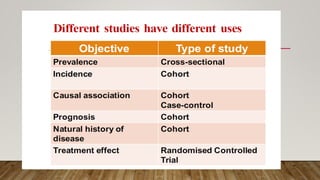
• 1. Observational study
• 2. Experimental study
OBSERVATIONAL STUDY
• Descriptive studies
• Analytical studies- further devided into
1. ecological
2. cross sectional
3.case control
4. cohort
EXPERIMENTAL STUDY
• Randomised control trial or clinical trial
• Field trial
• Community trials.
DESCRIPTIVE STUDY
• First phase of epidemiological study.
• Unit of study is population.
• Basically this is case report
• Observing distribution and characteristics of diseases in population
• Help in formulate a hypothesis and suggesting associations.
ECOLOGICAL STUDY
• Ecological study look for associations between the occurrence of disease and
exposure to known and suspected causes.
• Unit of study is population.
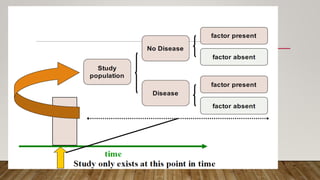
CROSS SECTIONAL STUDY
• Data collected at a single point of time.
• Like a snapshot
• Give prevalence.
• Less time consuming.
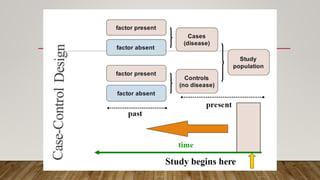
CASE CONTROL STUDY
• It is retrospective study.
• Start with people who have disease.
• Match them with people who do not have disease.
• Look back and assess the exposures.
• Quick and inexpensive.
• Multiple factors can be examined for a single disease.
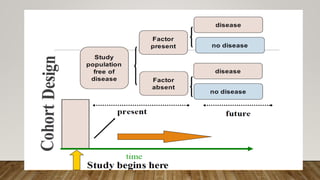
COHORT STUDY
• Begin with disease free individuals
• Patient is devided into exposed and unexposed.
• Study them for a duration.
• Outcome is recorded in both group.
• Give strongest evidence between causal association of a risk factor and a
outcome.
• Can be prospective and retrospective.
• Valuable when exposure is rare.
• Expensive
• Time consumimg.
• Loss to follow up creates a problem.
EXPERIMENTAL STUDY
• Similar to cohort.
• There is some action, intervention or manipulation.
• Provide effectiveness and efficiency of a drug, a manoeuvres or health services .
• Types-
• 1. randomised control trials 2. Non randomised trials
• Comprises of human and animal study.
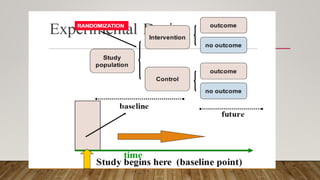
RANDOMISED CONTROL TRIAL
• One of the simplest but most powerful tools of research.
• People are allocated randomly in two group.
• Types of study-
1. parallel group
2. cross over- over time , each participant an intervention in a random sequence.
• Randomization- random allocation of study subjects in to treatment
control groups.
Advantages- avoid bias and confounding
increase in confidance on result.
THANK YOU
“karmaṇyevādhikāraste mā phaleṣu kadācana
mā karmaphalaheturbhūrmā te saṅgo’stvakarmaṇi”
“to work alone you have the right, and not to the fruits. do not be impelled by
the fruits of work.
nor have attachment to inaction.”

Medical research

  • 1.
    MEDICAL RESEARCH AND STUDYDESIGNS DR B. BORTHAKUR (PROFESSOR) DEPT OF ORTHOPAEDICS, SMCH
  • 2.
    Introduction THE WORD ‘STATISTICS’IS DERIVED FROM THE LATIN FOR “STATE” INDICATING HISTORICAL IMPORTANCE OF GOVERNMENTAL DATA GATHERING, WHICH PRINCIPALLY IS DEMOGRAPHIC INFORMATION. • “STATISTICS IS THE SCIENCE , WHICH DEALS WITH • COLLECTION • ORGANISATION • PRESENTATION • ANALYSIS& • INTERPRETATION OF NUMERICAL DATA’’( ACC TO CROXTON AND COWDEN).
  • 3.
    BIOSTATISTICS • Biostatistics isthe application of statistics to the biologic sciences, medicine and public health. • Biostatitical analysis key to conduct new clinical trials. • One of the foundations of evidence based medicine. • The need for advanced biostatistics is increasing every day.
  • 4.
    • It enablesthe collection, analyzing , presenting and interpreting data to find application in various field like- • Epidemiology • Clinical trials • Population genetics • Systems biology.
  • 5.
    • Biostats helpin clinical researches for- • Designing • Conducting • Analyzing • Reporting • Minimizing biases • Confounding factor
  • 6.
    • Measuring randomerrors • Understanding the research • Make suggestions on hypothesis testing and analysis. • Sample size. • Power of study.
  • 7.
    BIOSTATS IN CLINICALTRIALS • Biostats helps in clinical trials- 1. protocol development. 2.data management 3. study implementation 4. data analysis. 5. reports
  • 8.
    TYPES OF STUDIES •1. Observational study • 2. Experimental study
  • 9.
    OBSERVATIONAL STUDY • Descriptivestudies • Analytical studies- further devided into 1. ecological 2. cross sectional 3.case control 4. cohort
  • 10.
    EXPERIMENTAL STUDY • Randomisedcontrol trial or clinical trial • Field trial • Community trials.
  • 11.
    DESCRIPTIVE STUDY • Firstphase of epidemiological study. • Unit of study is population. • Basically this is case report • Observing distribution and characteristics of diseases in population • Help in formulate a hypothesis and suggesting associations.
  • 12.
    ECOLOGICAL STUDY • Ecologicalstudy look for associations between the occurrence of disease and exposure to known and suspected causes. • Unit of study is population.
  • 13.
    CROSS SECTIONAL STUDY •Data collected at a single point of time. • Like a snapshot • Give prevalence. • Less time consuming.
  • 15.
    CASE CONTROL STUDY •It is retrospective study. • Start with people who have disease. • Match them with people who do not have disease. • Look back and assess the exposures. • Quick and inexpensive. • Multiple factors can be examined for a single disease.
  • 17.
    COHORT STUDY • Beginwith disease free individuals • Patient is devided into exposed and unexposed. • Study them for a duration. • Outcome is recorded in both group. • Give strongest evidence between causal association of a risk factor and a outcome. • Can be prospective and retrospective.
  • 18.
    • Valuable whenexposure is rare. • Expensive • Time consumimg. • Loss to follow up creates a problem.
  • 20.
    EXPERIMENTAL STUDY • Similarto cohort. • There is some action, intervention or manipulation. • Provide effectiveness and efficiency of a drug, a manoeuvres or health services . • Types- • 1. randomised control trials 2. Non randomised trials • Comprises of human and animal study.
  • 21.
    RANDOMISED CONTROL TRIAL •One of the simplest but most powerful tools of research. • People are allocated randomly in two group. • Types of study- 1. parallel group 2. cross over- over time , each participant an intervention in a random sequence.
  • 22.
    • Randomization- randomallocation of study subjects in to treatment control groups. Advantages- avoid bias and confounding increase in confidance on result.
  • 27.
    THANK YOU “karmaṇyevādhikāraste māphaleṣu kadācana mā karmaphalaheturbhūrmā te saṅgo’stvakarmaṇi” “to work alone you have the right, and not to the fruits. do not be impelled by the fruits of work. nor have attachment to inaction.”