Climate studies
Local factors that affect climate
Altitude
The higher up you live, the colder it will be. For every 150metres the temperature
drops by 1 C. This explains why mountains are snow capped.
Relief (The shape of the land)
In the northern hemisphere South facing land is warmer than North facing land. This
is because the sun rises in the East and sets in the West. South facing slopes are also
sheltered from cold North winds.
Rain will fall mostly on windward sides of high ground and very little on the Leeward
sides. (e.g. West coast of Ireland)
http://www.youtube.com/watch?v=95TtXYjOEv4&feature=share&list=PLtbmXVrJt
odmP3K1_54OAldyvONQfYT75
Different climate types
Hot Desert Climate
These are found between 15 and 30 degrees either side of the equator. They are
generally found on the western side of continents. They are in the path of dry TRADE
WINDS. There is always a cold ocean current off the coast.
 This type of climate is very hot, over 30 degrees all summer. (because the sun is
always directly overhead)
 There is a huge RANGE of temperature. It gets very cold at night as there are no
clouds to keep the heat in.
(Click to enlarge)
How plants and animals adapt to this environment
Cactus
 Has very long roots to reach down for water
 Has needles to protect it from birds/animals
 Waxy skin to prevent water loss
 Grooves in its skin to help it collect more water
 Foamy interior to store water
The Saguaro cactus
Camels
 Humps on their back to store water. (Long time between rainy seasons)
 Large padded feet to help walk in sand and protected from very hot sand
 Long eyelashes to protect eyes during sandstorms
A one-humped camel
Boreal Climate
Boreal lands lie between 50 and 90 degrees north. This is a cold climate. Countries in
this climate include Norway, Sweden and Finland. North Russia (Siberia) and
Canada.
Boreal lands
Main Features of Boreal climates
 Very Cold winters (As low as –30 C)
 Warm (But short) Summers (16-18 C)
 Light Precipitation (Due to cold, dry winds)
Typical Vegetation
Evergreen trees.
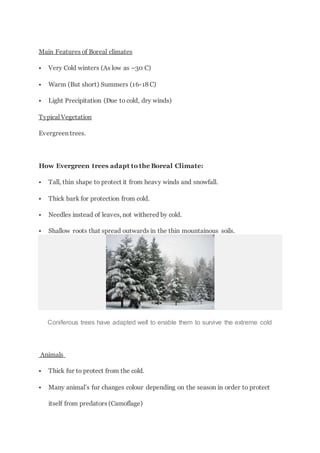
How Evergreen trees adapt to the Boreal Climate:
 Tall, thin shape to protect it from heavy winds and snowfall.
 Thick bark for protection from cold.
 Needles instead of leaves, not withered by cold.
 Shallow roots that spread outwards in the thin mountainous soils.
Coniferous trees have adapted well to enable them to survive the extreme cold
Animals
 Thick fur to protect from the cold.
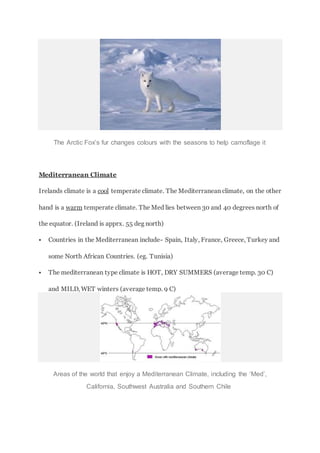
 Many animal’s fur changes colour depending on the season in order to protect
itself from predators (Camoflage)
The Arctic Fox’s fur changes colours with the seasons to help camoflage it
Mediterranean Climate
Irelands climate is a cool temperate climate. The Mediterranean climate, on the other
hand is a warm temperate climate. The Med lies between 30 and 40 degrees north of
the equator. (Ireland is apprx. 55 deg north)
 Countries in the Mediterranean include- Spain, Italy, France, Greece, Turkey and
some North African Countries. (eg. Tunisia)
 The mediterranean type climate is HOT, DRY SUMMERS (average temp. 30 C)
and MILD, WET winters (average temp. 9 C)
Areas of the world that enjoy a Mediterranean Climate, including the ‘Med’,
California, Southwest Australia and Southern Chile

Climate studies

  • 1.
    Climate studies Local factorsthat affect climate Altitude The higher up you live, the colder it will be. For every 150metres the temperature drops by 1 C. This explains why mountains are snow capped. Relief (The shape of the land) In the northern hemisphere South facing land is warmer than North facing land. This is because the sun rises in the East and sets in the West. South facing slopes are also sheltered from cold North winds. Rain will fall mostly on windward sides of high ground and very little on the Leeward sides. (e.g. West coast of Ireland) http://www.youtube.com/watch?v=95TtXYjOEv4&feature=share&list=PLtbmXVrJt odmP3K1_54OAldyvONQfYT75 Different climate types Hot Desert Climate These are found between 15 and 30 degrees either side of the equator. They are generally found on the western side of continents. They are in the path of dry TRADE WINDS. There is always a cold ocean current off the coast.  This type of climate is very hot, over 30 degrees all summer. (because the sun is always directly overhead)
  • 2.
     There isa huge RANGE of temperature. It gets very cold at night as there are no clouds to keep the heat in. (Click to enlarge) How plants and animals adapt to this environment Cactus  Has very long roots to reach down for water  Has needles to protect it from birds/animals  Waxy skin to prevent water loss  Grooves in its skin to help it collect more water  Foamy interior to store water The Saguaro cactus
  • 3.
    Camels  Humps ontheir back to store water. (Long time between rainy seasons)  Large padded feet to help walk in sand and protected from very hot sand  Long eyelashes to protect eyes during sandstorms A one-humped camel Boreal Climate Boreal lands lie between 50 and 90 degrees north. This is a cold climate. Countries in this climate include Norway, Sweden and Finland. North Russia (Siberia) and Canada. Boreal lands
  • 4.
    Main Features ofBoreal climates  Very Cold winters (As low as –30 C)  Warm (But short) Summers (16-18 C)  Light Precipitation (Due to cold, dry winds) Typical Vegetation Evergreen trees. How Evergreen trees adapt to the Boreal Climate:  Tall, thin shape to protect it from heavy winds and snowfall.  Thick bark for protection from cold.  Needles instead of leaves, not withered by cold.  Shallow roots that spread outwards in the thin mountainous soils. Coniferous trees have adapted well to enable them to survive the extreme cold Animals  Thick fur to protect from the cold.  Many animal’s fur changes colour depending on the season in order to protect itself from predators (Camoflage)
  • 5.
    The Arctic Fox’sfur changes colours with the seasons to help camoflage it Mediterranean Climate Irelands climate is a cool temperate climate. The Mediterranean climate, on the other hand is a warm temperate climate. The Med lies between 30 and 40 degrees north of the equator. (Ireland is apprx. 55 deg north)  Countries in the Mediterranean include- Spain, Italy, France, Greece, Turkey and some North African Countries. (eg. Tunisia)  The mediterranean type climate is HOT, DRY SUMMERS (average temp. 30 C) and MILD, WET winters (average temp. 9 C) Areas of the world that enjoy a Mediterranean Climate, including the ‘Med’, California, Southwest Australia and Southern Chile