Support Transition Towards Climate-
Smart Agriculture Food Systems:
GCP/RAF/496/NOR
An Overview
25th August 2015
Brahene Sebastian (Sebastian.Brahene@fao.org)
Outline
• Overview of CSA
 Introduction
 Definition of Concept
• Project GCP/RAF/496/NOR
 Background
• Conclusion
CSA Overview
Introduction
• Between now and 2050, the world’s population
will increase by one-third.
• More people will be living in cities with higher
incomes especially in developing countries.
• FAO estimates that agricultural production will
have to increase by 60 percent by 2050 to satisfy
the expected demands for food and feed.
CSA Overview
Intro Cont’d
• Agricultural transformation needed to feed a
growing global population and provide the basis
for economic growth and poverty reduction.
• Developing countries and smallholder farmers to
be more affected.
• Climate change will make this task more difficult
CSA Overview
Intro Cont’d
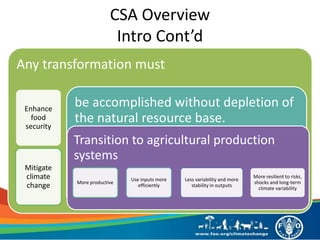
Any transformation must
Enhance
food
security
Mitigate
climate
change
be accomplished without depletion of
the natural resource base.
Transition to agricultural production
systems
More productive
Use inputs more
efficiently
Less variability and more
stability in outputs
More resilient to risks,
shocks and long-term
climate variability
CSA Overview
Defining the Concept
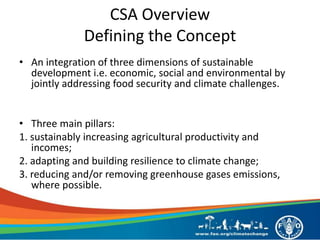
• An integration of three dimensions of sustainable
development i.e. economic, social and environmental by
jointly addressing food security and climate challenges.
• Three main pillars:
1. sustainably increasing agricultural productivity and
incomes;
2. adapting and building resilience to climate change;
3. reducing and/or removing greenhouse gases emissions,
where possible.
CSA Overview
Defining the Concept Cont’d
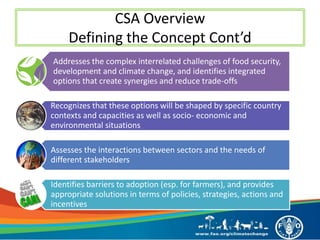
Addresses the complex interrelated challenges of food security,
development and climate change, and identifies integrated
options that create synergies and reduce trade-offs
Recognizes that these options will be shaped by specific country
contexts and capacities as well as socio- economic and
environmental situations
Assesses the interactions between sectors and the needs of
different stakeholders
Identifies barriers to adoption (esp. for farmers), and provides
appropriate solutions in terms of policies, strategies, actions and
incentives
CSA Overview
Defining the Concept Cont’d
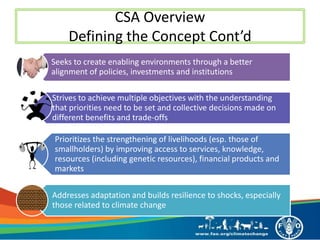
Seeks to create enabling environments through a better
alignment of policies, investments and institutions
Strives to achieve multiple objectives with the understanding
that priorities need to be set and collective decisions made on
different benefits and trade-offs
Prioritizes the strengthening of livelihoods (esp. those of
smallholders) by improving access to services, knowledge,
resources (including genetic resources), financial products and
markets
Addresses adaptation and builds resilience to shocks, especially
those related to climate change
CSA Overview
Defining the Concept Cont’d
Considers climate change mitigation as a potential
secondary co-benefit, especially in low-income,
agricultural-based populations
Seeks to identify opportunities to access climate-related
financing and integrate it with traditional sources of
agricultural investment finance
CSA Overview
Defining the Concept Cont’d
• Achieving all the CSA objectives at once not possible.
• Context-specific priorities need to be determined, and
benefits and tradeoffs evaluated.
• CSA is NOT a single specific agricultural technology or
practice that can be universally applied.
• It is AN APPROACH that requires site-specific
assessments to identify suitable agricultural production
technologies and practices.
Project GCP/RAF/496/NOR
Background
• The Fifth Assessment Report (AR5) of the
Intergovernmental Panel on Climate Change
(IPCC, 2013)
• Climate change threatens to undermine the
progress African countries have made in tackling
malnutrition, diseases, and gains in agricultural
productivity.
• Africa’s economic transformation is highly
vulnerable
• The African Union (AU) has identified environmental
and ecosystems resilience, and enhanced sustainable
agriculture productivity as key impact areas in driving
implementation of the Comprehensive Africa
Agriculture Development Programme (CAADP) over the
next decade and beyond.
• AU-NEPAD Agriculture Climate Change Programme is
being elaborated to guide identification of priority
programme issues determining and designing
programme interventions.
Background Cont’d
Background Cont’d
• The implementation of ECOWAS/CAADP is based
on the implementation of national agriculture
investment programmes (NAIPs) as well as at the
regional level.
• Within the whole CAADP and NAIP/RAIP process,
the climate change dimension has been very little
considered as it gained international momentum
through the UNFCCC process from 2009 onwards.
Problem statement
• West African agriculture depends heavily on rain-
fed crops
– provides 29% of region’s GDP
– employs 66% active population (IUCN, 2004)
• With climate change in West Africa, the area
suitable for agriculture, the length of the
growing season and potential yield, particularly
along the margins of semi-arid and arid areas,
are expected to decrease.
Justification
There is the need to intervene with appropriate
strategies that ensure continuous food
production and at the same time build the
resilience of smallholder farmers against internal
and external shocks.
Project Rationale
Key Objectives
1
• The proposed project is to support the facilitation
of the enabling environment for the scaling-up of
CSA
How?
• Capacity building needed across the different
institutions across all levels.
Why?
• Overall coherence and unified understanding of
CSA is lacking
Project Rationale Cont’d
2
• Assist the emergence of agricultural food systems
that are more climate-smart
How?
• Through improved coordination and alignment of
policies, strategies and investment frameworks.
• The capitalization and dissemination of success
stories and best approaches, as well as failures
from the COMESA-EAC-SADC region
FAO’s Comparative Advantage
• FAO main international organization with
expertise in all aspects related to the
agricultural sectors; including production
systems, management of natural resources
and policy environment.
• FAO developed CSA Approach, therefore has
extensive knowledge and experience in many
of the concepts.
Linkages
• CSA identified as a major area of work (MAW)
under FAO’s new Strategic Objectives (SOs)
• Project falls under Strategic Objective 2,
“Increase and improve provision of goods and
services from agriculture, forestry and
fisheries in a sustainable manner”.
Linkages
• Organizational Outcome 1 “Producers and natural
resource managers adopt practices that increase and
improve agricultural sector production in a sustainable
manner”
• Organizational Outcome 2 “Stakeholders in member
countries strengthen governance – the policies, laws,
management frameworks and institutions that are
needed to support producers and resource managers –
in the transition to sustainable agricultural sector
production systems”
Linkages
Project closely linked to
 SO1 (policy and investment outputs)
 SO3 (enabling environment and extension)
 SO4 (food value chains)
 SO5 (climate change resilience)
Directly linked to Regional Initiative I
“Integrated Management of Agricultural Landscapes
- Sustainable production intensification and value addition”
Falls under Priority 2 of Country Programming Frameworks
(CPF) for Ghana - “Environment and sustainable Natural
Resource Management”
Linkages
• Two areas of intervention identified for Ghana
 Ensure that the agricultural sector and the CSA approach are
included in the mid- to long-term development planning
process, including National Adaptation Plans (NAPs) and
National Agriculture Investment Plans (NAIP).
 Support Ghana in creating the required policy, financial and
enabling environment (including the National Climate Change
policies) which provides farmers, foresters and fisher folk
(especially women) the knowledge and access to resources and
services to transition to sustainable, productive, resilient and
economically viable production systems.
Stakeholders and Beneficiaries
• Ultimate beneficiaries
 smallholder male and female farmers, who will be
supported in their use of various CSA technologies.
How?
 Ability of farmers to increase productivity, profitability,
sustainability and resilience of their farming systems
through the adoption of appropriate CSA practices that
include crop, agroforestry and livestock based
production systems.
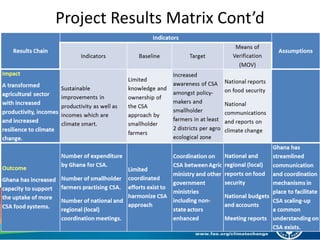
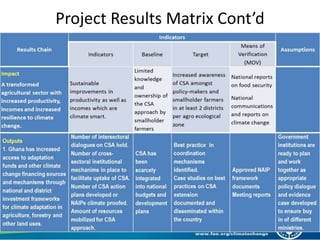
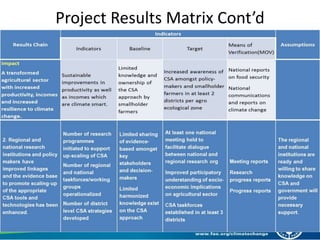
Project Results Matrix Cont’d
Efforts
• Work plan
Developed in line with the two outputs showing
various activities. (yet to adopted)
• Concept note
Prepared and accepted for inception workshop
• Implementation and management arrangement
Drafted (to be finalised and sent to LTU and LTO)
Management
• Project duration
 2 years
• Budget and inputs of partners
 $ 150 000 provided by Norway Government
• Procurement
 No large-scale procurement is planned.
 LoAs may be used if this is considered more cost effective
and beneficial for knowledge exchange and capacity
building, as compared to national consultancies.
Conclusion
CSA Sourcebook
• Book is available to further elaborate the concept of CSA and demonstrate
its potential, as well as limitations.
• Designed to help decision makers at a number of levels to understand the
different options that are available for planning, policies and investments
and the practices that are suitable for making different agricultural
sectors, landscapes and food systems more climate-smart.
• Indicates some of the necessary ingredients required to achieve a climate-
smart approach to the agricultural sectors, including existing options and
barriers.
• Available at: http://www.fao.org/3/a-i3325e.pdf
Conclusions
• Climate-smart agriculture is not a new agricultural system,
nor a set of practices.
• It is a new approach, a way to guide the needed changes of
agricultural systems, given the necessity to jointly address
food security and climate change.
• CSA brings together practices, policies and institutions that
are not necessarily new but are used in the context of climatic
changes.
• Addresses multiple challenges faced by agriculture and food
systems simultaneously and holistically, which helps avoid
counterproductive policies, legislation or financing.
Conclusion
Project GCP/RAF/496/NOR
• Creating an enabling environment
• Enhancing climate-smart food
systems
• Developing an investment
framework
• Promoting green climate activities
Thank you!

Project Transition 1

  • 1.
    Support Transition TowardsClimate- Smart Agriculture Food Systems: GCP/RAF/496/NOR An Overview 25th August 2015 Brahene Sebastian (Sebastian.Brahene@fao.org)
  • 2.
    Outline • Overview ofCSA  Introduction  Definition of Concept • Project GCP/RAF/496/NOR  Background • Conclusion
  • 3.
    CSA Overview Introduction • Betweennow and 2050, the world’s population will increase by one-third. • More people will be living in cities with higher incomes especially in developing countries. • FAO estimates that agricultural production will have to increase by 60 percent by 2050 to satisfy the expected demands for food and feed.
  • 4.
    CSA Overview Intro Cont’d •Agricultural transformation needed to feed a growing global population and provide the basis for economic growth and poverty reduction. • Developing countries and smallholder farmers to be more affected. • Climate change will make this task more difficult
  • 5.
    CSA Overview Intro Cont’d Anytransformation must Enhance food security Mitigate climate change be accomplished without depletion of the natural resource base. Transition to agricultural production systems More productive Use inputs more efficiently Less variability and more stability in outputs More resilient to risks, shocks and long-term climate variability
  • 6.
    CSA Overview Defining theConcept • An integration of three dimensions of sustainable development i.e. economic, social and environmental by jointly addressing food security and climate challenges. • Three main pillars: 1. sustainably increasing agricultural productivity and incomes; 2. adapting and building resilience to climate change; 3. reducing and/or removing greenhouse gases emissions, where possible.
  • 7.
    CSA Overview Defining theConcept Cont’d Addresses the complex interrelated challenges of food security, development and climate change, and identifies integrated options that create synergies and reduce trade-offs Recognizes that these options will be shaped by specific country contexts and capacities as well as socio- economic and environmental situations Assesses the interactions between sectors and the needs of different stakeholders Identifies barriers to adoption (esp. for farmers), and provides appropriate solutions in terms of policies, strategies, actions and incentives
  • 8.
    CSA Overview Defining theConcept Cont’d Seeks to create enabling environments through a better alignment of policies, investments and institutions Strives to achieve multiple objectives with the understanding that priorities need to be set and collective decisions made on different benefits and trade-offs Prioritizes the strengthening of livelihoods (esp. those of smallholders) by improving access to services, knowledge, resources (including genetic resources), financial products and markets Addresses adaptation and builds resilience to shocks, especially those related to climate change
  • 9.
    CSA Overview Defining theConcept Cont’d Considers climate change mitigation as a potential secondary co-benefit, especially in low-income, agricultural-based populations Seeks to identify opportunities to access climate-related financing and integrate it with traditional sources of agricultural investment finance
  • 10.
    CSA Overview Defining theConcept Cont’d • Achieving all the CSA objectives at once not possible. • Context-specific priorities need to be determined, and benefits and tradeoffs evaluated. • CSA is NOT a single specific agricultural technology or practice that can be universally applied. • It is AN APPROACH that requires site-specific assessments to identify suitable agricultural production technologies and practices.
  • 11.
    Project GCP/RAF/496/NOR Background • TheFifth Assessment Report (AR5) of the Intergovernmental Panel on Climate Change (IPCC, 2013) • Climate change threatens to undermine the progress African countries have made in tackling malnutrition, diseases, and gains in agricultural productivity. • Africa’s economic transformation is highly vulnerable
  • 12.
    • The AfricanUnion (AU) has identified environmental and ecosystems resilience, and enhanced sustainable agriculture productivity as key impact areas in driving implementation of the Comprehensive Africa Agriculture Development Programme (CAADP) over the next decade and beyond. • AU-NEPAD Agriculture Climate Change Programme is being elaborated to guide identification of priority programme issues determining and designing programme interventions. Background Cont’d
  • 13.
    Background Cont’d • Theimplementation of ECOWAS/CAADP is based on the implementation of national agriculture investment programmes (NAIPs) as well as at the regional level. • Within the whole CAADP and NAIP/RAIP process, the climate change dimension has been very little considered as it gained international momentum through the UNFCCC process from 2009 onwards.
  • 14.
    Problem statement • WestAfrican agriculture depends heavily on rain- fed crops – provides 29% of region’s GDP – employs 66% active population (IUCN, 2004) • With climate change in West Africa, the area suitable for agriculture, the length of the growing season and potential yield, particularly along the margins of semi-arid and arid areas, are expected to decrease.
  • 15.
    Justification There is theneed to intervene with appropriate strategies that ensure continuous food production and at the same time build the resilience of smallholder farmers against internal and external shocks.
  • 16.
    Project Rationale Key Objectives 1 •The proposed project is to support the facilitation of the enabling environment for the scaling-up of CSA How? • Capacity building needed across the different institutions across all levels. Why? • Overall coherence and unified understanding of CSA is lacking
  • 17.
    Project Rationale Cont’d 2 •Assist the emergence of agricultural food systems that are more climate-smart How? • Through improved coordination and alignment of policies, strategies and investment frameworks. • The capitalization and dissemination of success stories and best approaches, as well as failures from the COMESA-EAC-SADC region
  • 18.
    FAO’s Comparative Advantage •FAO main international organization with expertise in all aspects related to the agricultural sectors; including production systems, management of natural resources and policy environment. • FAO developed CSA Approach, therefore has extensive knowledge and experience in many of the concepts.
  • 19.
    Linkages • CSA identifiedas a major area of work (MAW) under FAO’s new Strategic Objectives (SOs) • Project falls under Strategic Objective 2, “Increase and improve provision of goods and services from agriculture, forestry and fisheries in a sustainable manner”.
  • 20.
    Linkages • Organizational Outcome1 “Producers and natural resource managers adopt practices that increase and improve agricultural sector production in a sustainable manner” • Organizational Outcome 2 “Stakeholders in member countries strengthen governance – the policies, laws, management frameworks and institutions that are needed to support producers and resource managers – in the transition to sustainable agricultural sector production systems”
  • 21.
    Linkages Project closely linkedto  SO1 (policy and investment outputs)  SO3 (enabling environment and extension)  SO4 (food value chains)  SO5 (climate change resilience) Directly linked to Regional Initiative I “Integrated Management of Agricultural Landscapes - Sustainable production intensification and value addition” Falls under Priority 2 of Country Programming Frameworks (CPF) for Ghana - “Environment and sustainable Natural Resource Management”
  • 22.
    Linkages • Two areasof intervention identified for Ghana  Ensure that the agricultural sector and the CSA approach are included in the mid- to long-term development planning process, including National Adaptation Plans (NAPs) and National Agriculture Investment Plans (NAIP).  Support Ghana in creating the required policy, financial and enabling environment (including the National Climate Change policies) which provides farmers, foresters and fisher folk (especially women) the knowledge and access to resources and services to transition to sustainable, productive, resilient and economically viable production systems.
  • 23.
    Stakeholders and Beneficiaries •Ultimate beneficiaries  smallholder male and female farmers, who will be supported in their use of various CSA technologies. How?  Ability of farmers to increase productivity, profitability, sustainability and resilience of their farming systems through the adoption of appropriate CSA practices that include crop, agroforestry and livestock based production systems.
  • 24.
  • 25.
  • 26.
  • 27.
    Efforts • Work plan Developedin line with the two outputs showing various activities. (yet to adopted) • Concept note Prepared and accepted for inception workshop • Implementation and management arrangement Drafted (to be finalised and sent to LTU and LTO)
  • 28.
    Management • Project duration 2 years • Budget and inputs of partners  $ 150 000 provided by Norway Government • Procurement  No large-scale procurement is planned.  LoAs may be used if this is considered more cost effective and beneficial for knowledge exchange and capacity building, as compared to national consultancies.
  • 29.
    Conclusion CSA Sourcebook • Bookis available to further elaborate the concept of CSA and demonstrate its potential, as well as limitations. • Designed to help decision makers at a number of levels to understand the different options that are available for planning, policies and investments and the practices that are suitable for making different agricultural sectors, landscapes and food systems more climate-smart. • Indicates some of the necessary ingredients required to achieve a climate- smart approach to the agricultural sectors, including existing options and barriers. • Available at: http://www.fao.org/3/a-i3325e.pdf
  • 30.
    Conclusions • Climate-smart agricultureis not a new agricultural system, nor a set of practices. • It is a new approach, a way to guide the needed changes of agricultural systems, given the necessity to jointly address food security and climate change. • CSA brings together practices, policies and institutions that are not necessarily new but are used in the context of climatic changes. • Addresses multiple challenges faced by agriculture and food systems simultaneously and holistically, which helps avoid counterproductive policies, legislation or financing.
  • 31.
    Conclusion Project GCP/RAF/496/NOR • Creatingan enabling environment • Enhancing climate-smart food systems • Developing an investment framework • Promoting green climate activities
  • 32.

Editor's Notes

  • #7 CSA, which seeks to enhance food security while contributing to mitigate climate change and preserving the natural resource base and vital ecosystem services requires the transition to agricultural production systems that are more productive, use inputs more efficiently, have less variability and greater stability in their outputs, and are more resilient to risks, shocks and long-term climate variability. More productive and more resilient agriculture requires a major shift in the way land, water, soil nutrients and genetic resources are managed to ensure that these resources are used more efficiently. Making this shift requires considerable changes in national and local governance, legislation, policies and financial mechanisms. This transformation will also involve improving producers’ access to markets. By reducing greenhouse gas emissions per unit of land and/or agricultural product and increasing carbon sinks, these changes will contribute significantly to the mitigation of climate change.
  • #8 CSA, which seeks to enhance food security while contributing to mitigate climate change and preserving the natural resource base and vital ecosystem services requires the transition to agricultural production systems that are more productive, use inputs more efficiently, have less variability and greater stability in their outputs, and are more resilient to risks, shocks and long-term climate variability. More productive and more resilient agriculture requires a major shift in the way land, water, soil nutrients and genetic resources are managed to ensure that these resources are used more efficiently. Making this shift requires considerable changes in national and local governance, legislation, policies and financial mechanisms. This transformation will also involve improving producers’ access to markets. By reducing greenhouse gas emissions per unit of land and/or agricultural product and increasing carbon sinks, these changes will contribute significantly to the mitigation of climate change.
  • #9 CSA, which seeks to enhance food security while contributing to mitigate climate change and preserving the natural resource base and vital ecosystem services requires the transition to agricultural production systems that are more productive, use inputs more efficiently, have less variability and greater stability in their outputs, and are more resilient to risks, shocks and long-term climate variability. More productive and more resilient agriculture requires a major shift in the way land, water, soil nutrients and genetic resources are managed to ensure that these resources are used more efficiently. Making this shift requires considerable changes in national and local governance, legislation, policies and financial mechanisms. This transformation will also involve improving producers’ access to markets. By reducing greenhouse gas emissions per unit of land and/or agricultural product and increasing carbon sinks, these changes will contribute significantly to the mitigation of climate change.
  • #10 CSA, which seeks to enhance food security while contributing to mitigate climate change and preserving the natural resource base and vital ecosystem services requires the transition to agricultural production systems that are more productive, use inputs more efficiently, have less variability and greater stability in their outputs, and are more resilient to risks, shocks and long-term climate variability. More productive and more resilient agriculture requires a major shift in the way land, water, soil nutrients and genetic resources are managed to ensure that these resources are used more efficiently. Making this shift requires considerable changes in national and local governance, legislation, policies and financial mechanisms. This transformation will also involve improving producers’ access to markets. By reducing greenhouse gas emissions per unit of land and/or agricultural product and increasing carbon sinks, these changes will contribute significantly to the mitigation of climate change.
  • #11 CSA, which seeks to enhance food security while contributing to mitigate climate change and preserving the natural resource base and vital ecosystem services requires the transition to agricultural production systems that are more productive, use inputs more efficiently, have less variability and greater stability in their outputs, and are more resilient to risks, shocks and long-term climate variability. More productive and more resilient agriculture requires a major shift in the way land, water, soil nutrients and genetic resources are managed to ensure that these resources are used more efficiently. Making this shift requires considerable changes in national and local governance, legislation, policies and financial mechanisms. This transformation will also involve improving producers’ access to markets. By reducing greenhouse gas emissions per unit of land and/or agricultural product and increasing carbon sinks, these changes will contribute significantly to the mitigation of climate change.
  • #12 As seen in the previous slides, CSA has many components. It is not a single specific agricultural technology or practice that can be universally applied. It is an approach that requires site-specific assessments to identify suitable agricultural production technologies and practices. This approach does the following main 10 tasks listed here. In essence, CSA brings together practices, policies and institutions that are not necessarily new but are used in the context of climatic changes, which are unfamiliar to farmers, herders and fishers.
  • #13 As seen in the previous slides, CSA has many components. It is not a single specific agricultural technology or practice that can be universally applied. It is an approach that requires site-specific assessments to identify suitable agricultural production technologies and practices. This approach does the following main 10 tasks listed here. In essence, CSA brings together practices, policies and institutions that are not necessarily new but are used in the context of climatic changes, which are unfamiliar to farmers, herders and fishers.
  • #14 As seen in the previous slides, CSA has many components. It is not a single specific agricultural technology or practice that can be universally applied. It is an approach that requires site-specific assessments to identify suitable agricultural production technologies and practices. This approach does the following main 10 tasks listed here. In essence, CSA brings together practices, policies and institutions that are not necessarily new but are used in the context of climatic changes, which are unfamiliar to farmers, herders and fishers.
  • #31 Often based on proven low-cost practices  Achievable at large scale  Best if integrated, not applied one by one  Vital for future food supplies  Already in the hands of farmers, businesses and governments