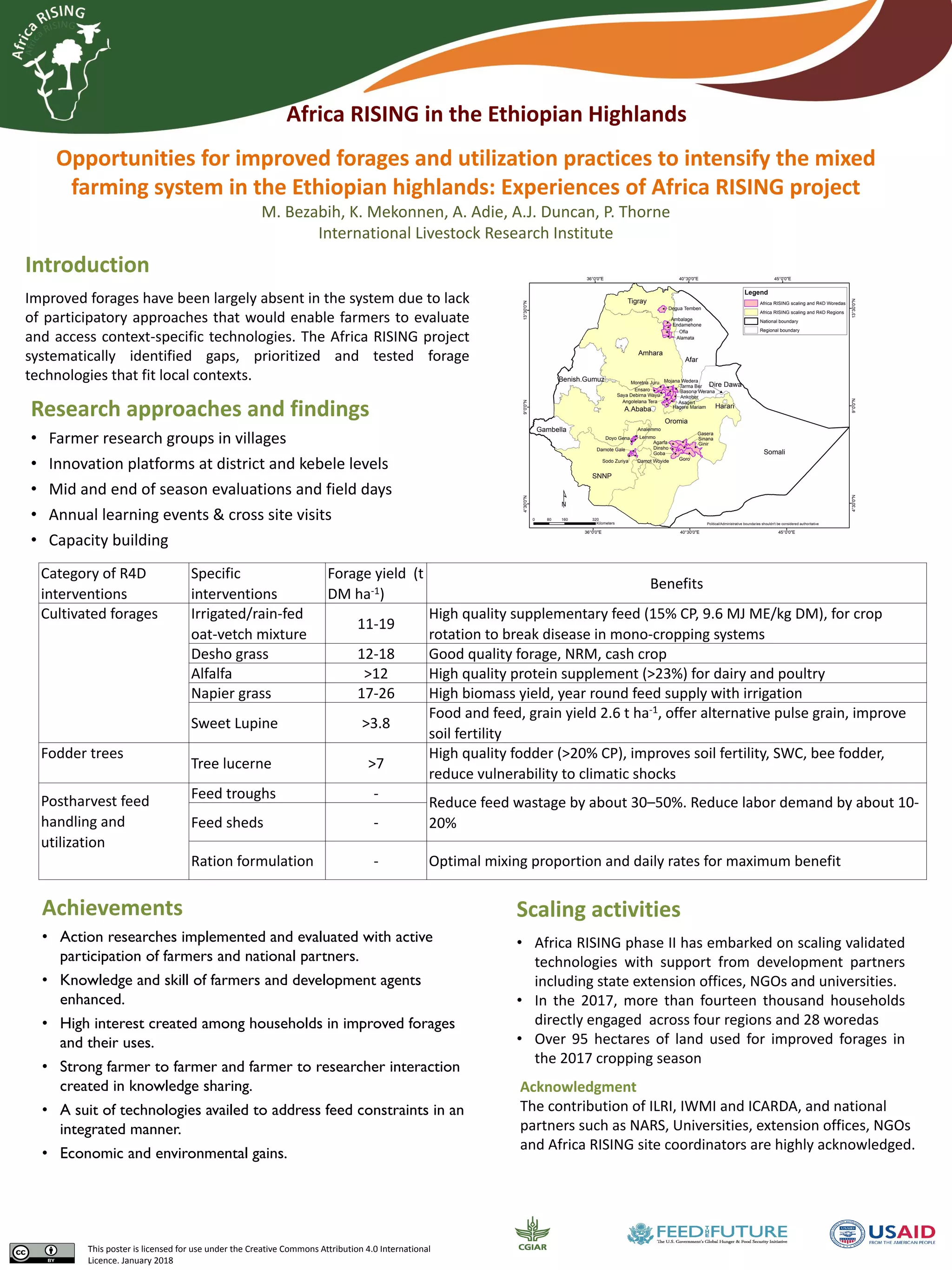
Africa RISING in the Ethiopian Highlands
Research approaches and findings
• Farmer research groups in villages
• Innovation platforms at district and kebele levels
• Mid and end of season evaluations and field days
• Annual learning events & cross site visits
• Capacity building
Achievements
• Action researches implemented and evaluated with active
participation of farmers and national partners.
• Knowledge and skill of farmers and development agents
enhanced.
• High interest created among households in improved forages
and their uses.
• Strong farmer to farmer and farmer to researcher interaction
created in knowledge sharing.
• A suit of technologies availed to address feed constraints in an
integrated manner.
• Economic and environmental gains.
Opportunities for improved forages and utilization practices to intensify the mixed
farming system in the Ethiopian highlands: Experiences of Africa RISING project
M. Bezabih, K. Mekonnen, A. Adie, A.J. Duncan, P. Thorne
International Livestock Research Institute
Introduction
Improved forages have been largely absent in the system due to lack
of participatory approaches that would enable farmers to evaluate
and access context-specific technologies. The Africa RISING project
systematically identified gaps, prioritized and tested forage
technologies that fit local contexts.
Improved feeding troughsweet lupine forage
Scaling activities
• Africa RISING phase II has embarked on scaling validated
technologies with support from development partners
including state extension offices, NGOs and universities.
• In the 2017, more than fourteen thousand households
directly engaged across four regions and 28 woredas
• Over 95 hectares of land used for improved forages in
the 2017 cropping season
Category of R4D
interventions
Specific
interventions
Forage yield (t
DM ha-1)
Benefits
Cultivated forages Irrigated/rain-fed
oat-vetch mixture
11-19
High quality supplementary feed (15% CP, 9.6 MJ ME/kg DM), for crop
rotation to break disease in mono-cropping systems
Desho grass 12-18 Good quality forage, NRM, cash crop
Alfalfa >12 High quality protein supplement (>23%) for dairy and poultry
Napier grass 17-26 High biomass yield, year round feed supply with irrigation
Sweet Lupine >3.8
Food and feed, grain yield 2.6 t ha-1, offer alternative pulse grain, improve
soil fertility
Fodder trees
Tree lucerne >7
High quality fodder (>20% CP), improves soil fertility, SWC, bee fodder,
reduce vulnerability to climatic shocks
Postharvest feed
handling and
utilization
Feed troughs -
Reduce feed wastage by about 30–50%. Reduce labor demand by about 10-
20%Feed sheds -
Ration formulation - Optimal mixing proportion and daily rates for maximum benefit
Acknowledgment
The contribution of ILRI, IWMI and ICARDA, and national
partners such as NARS, Universities, extension offices, NGOs
and Africa RISING site coordinators are highly acknowledged.
This poster is licensed for use under the Creative Commons Attribution 4.0 International
Licence. January 2018

Opportunities for improved forages and utilization practices to intensify the mixed farming system in the Ethiopian highlands: Experiences of Africa RISING project

  • 1.
    Africa RISING inthe Ethiopian Highlands Research approaches and findings • Farmer research groups in villages • Innovation platforms at district and kebele levels • Mid and end of season evaluations and field days • Annual learning events & cross site visits • Capacity building Achievements • Action researches implemented and evaluated with active participation of farmers and national partners. • Knowledge and skill of farmers and development agents enhanced. • High interest created among households in improved forages and their uses. • Strong farmer to farmer and farmer to researcher interaction created in knowledge sharing. • A suit of technologies availed to address feed constraints in an integrated manner. • Economic and environmental gains. Opportunities for improved forages and utilization practices to intensify the mixed farming system in the Ethiopian highlands: Experiences of Africa RISING project M. Bezabih, K. Mekonnen, A. Adie, A.J. Duncan, P. Thorne International Livestock Research Institute Introduction Improved forages have been largely absent in the system due to lack of participatory approaches that would enable farmers to evaluate and access context-specific technologies. The Africa RISING project systematically identified gaps, prioritized and tested forage technologies that fit local contexts. Improved feeding troughsweet lupine forage Scaling activities • Africa RISING phase II has embarked on scaling validated technologies with support from development partners including state extension offices, NGOs and universities. • In the 2017, more than fourteen thousand households directly engaged across four regions and 28 woredas • Over 95 hectares of land used for improved forages in the 2017 cropping season Category of R4D interventions Specific interventions Forage yield (t DM ha-1) Benefits Cultivated forages Irrigated/rain-fed oat-vetch mixture 11-19 High quality supplementary feed (15% CP, 9.6 MJ ME/kg DM), for crop rotation to break disease in mono-cropping systems Desho grass 12-18 Good quality forage, NRM, cash crop Alfalfa >12 High quality protein supplement (>23%) for dairy and poultry Napier grass 17-26 High biomass yield, year round feed supply with irrigation Sweet Lupine >3.8 Food and feed, grain yield 2.6 t ha-1, offer alternative pulse grain, improve soil fertility Fodder trees Tree lucerne >7 High quality fodder (>20% CP), improves soil fertility, SWC, bee fodder, reduce vulnerability to climatic shocks Postharvest feed handling and utilization Feed troughs - Reduce feed wastage by about 30–50%. Reduce labor demand by about 10- 20%Feed sheds - Ration formulation - Optimal mixing proportion and daily rates for maximum benefit Acknowledgment The contribution of ILRI, IWMI and ICARDA, and national partners such as NARS, Universities, extension offices, NGOs and Africa RISING site coordinators are highly acknowledged. This poster is licensed for use under the Creative Commons Attribution 4.0 International Licence. January 2018