Improving and Scaling
Up SRI in West Africa
Erika Styger and Devon Jenkins
SRI-Rice, Cornell University
Regional Review and Planning Workshop,
SRI Lower Mekong River Basin project
Siem Reap, Cambodia, 2-3 June, 2015
Insights from a regional,
13-country project
Extension and Adoption of SRI in 2015
55 countries in 2015, 8-10 million farmers on 3.5 million hectares in 2013 or
2% of global rice area
SRI-WAAPP SRI-LMB
Improving and Scaling Up SRI in West Africa
• 1st Phase of a 3 year project;
• January 2014 – December 2016
Climate
• Tropical
• Highly variable rainfall = < 200mm in north to > 4,500 mm in SE / SW
Rice production systems
• Predominantly rainfed upland (yields 1-1.5 t/ha) and rainfed lowland (yields 2-
4 t/ha)
• Irrigated rice predominant in the northern zones (yields 4-12 t/ha)
• Mangrove and swamp systems in more humid zones
• O. glaberrima domesticated in Mali ≈ 3,500 years ago
Cultural
• Heterogeneous
• 340 million people
• 500+ local languages
• Largely Muslim in the north, Christian in the south
West Africa Overview
Rice production in Africa
(South of Sahara)
64%
32%
3%
1%
West Africa
Eastern Africa
Central Africa
Southern Africa
Each dot represents 20,000 tons Data: FAO
Rice production 2006
64% of rice is produced
in West Africa
Nigeria, Guinea, Ivory
Coast, Mali
Ref: Warda (2008) Africa rice trends 2007
1961 1966 1971 1976 1981 1986 1991 1996 2001 2006
Rice production and consumption
in SSA from 1961-2006
Production
Consumption 40%
importedConsumption rate increase
yearly 6.3% (2000-2007)
Production rate increase
yearly 3.7% (1996-2006)
Production
increase through cropping area extension, as yields stagnate
SRI In West Africa since 2001
• Benin 2001: 1 farmer, Echo intern: SRI 7.5t/ha
• The Gambia 2002-2005: Research with farmers: SRI
5.4-8.3 t/ha
• Guinea 2003: Chinese research with hybrids: 9 t/ha
• Senegal 2003-2009: Rodale Institute; Dissertation
with WARDA
• Sierra Leone 2004: World vision, USAID, CRS:: SRI
5.3t/ha vs 2.5t/ha
• Burkina 2006: 6 farmers: SRI 7t/ha vs 3.5t/ha
• Mali: 2007-2012 : 3 projects, 6 regions, > 1000
farmers
• Since 2010: regional trainings by Mali projects in
Nigeria, Senegal, Ghana, Benin, Togo
http://sri.ciifad.cornell.edu
Improving and Scaling Up SRI in
West Africa
• Regional commissioned project to increase rice
productivity in 13 ECOWAS countries
• Project developed through participatory process over
1.5 years with representatives from research, extension,
farmers from 13 countries
– First workshop in Ouagadougou, July 2012
– Second workshop in Saly, Senegal, July 2013
– Launching of project Porto Novo, Benin, February 2014
Improving and Scaling Up SRI
in West Africa
• Part of the West Africa Agriculture Productivity Program
(WAAPP)
• Funded by the World Bank
• Steered by Central and West African Council for Agricultural
Research and Development (CORAF/WECARD)
• Regional coordination for implementation:
– Institute Economie Rural (IER) National Center for
Specialization on Rice (CNS-Rice), Mali;
– SRI-Rice Center from Cornell University is principal technical
partner
• Each country has its own implementation plan and
funding for implementation
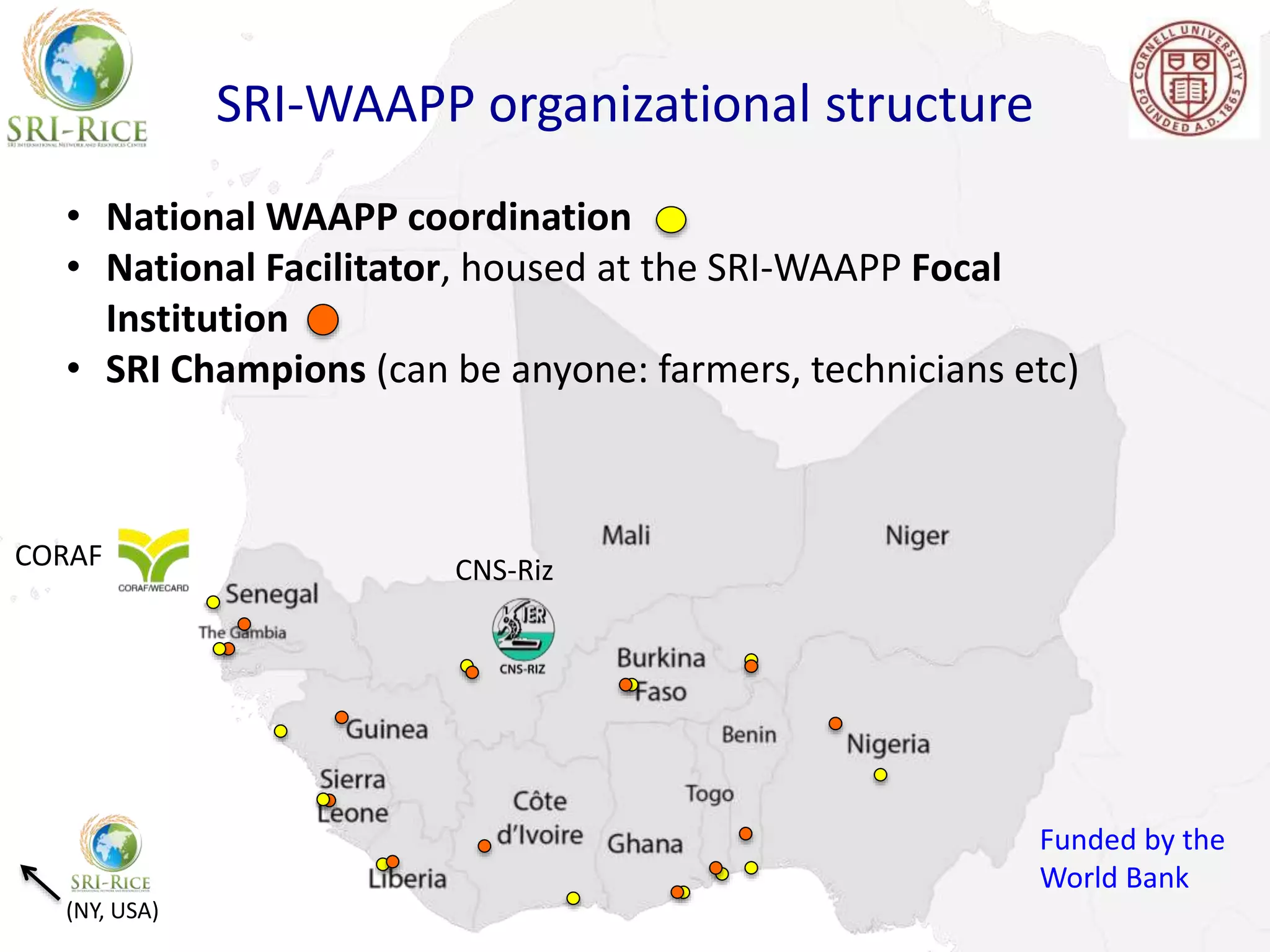
• National WAAPP coordination
• National Facilitator, housed at the SRI-WAAPP Focal
Institution
• SRI Champions (can be anyone: farmers, technicians etc)
SRI-WAAPP organizational structure
(NY, USA)
CORAF CNS-Riz
Funded by the
World Bank
French speaking
English speaking
Countries involved in SRI-WAAPP
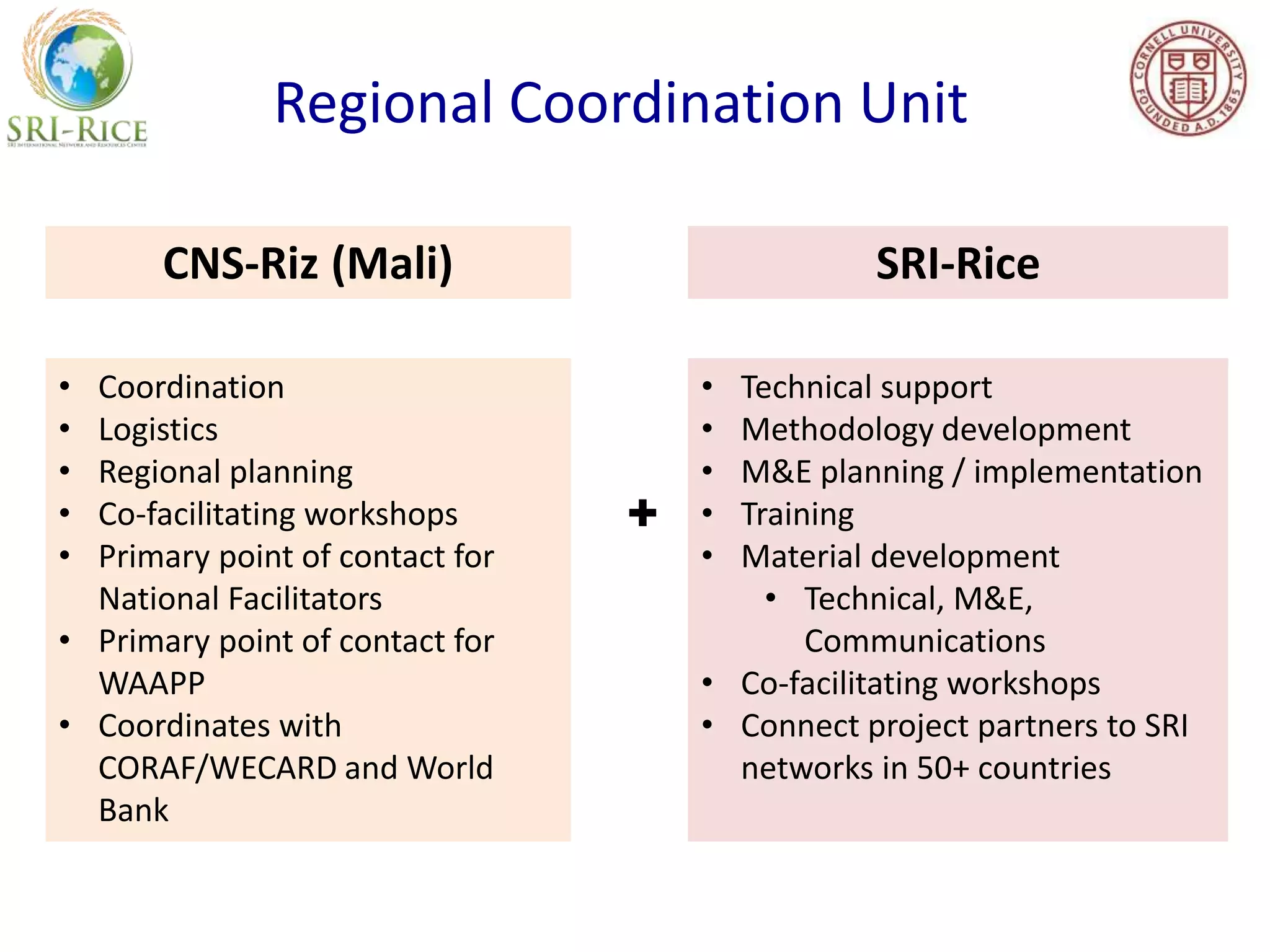
CNS-Riz (Mali) SRI-Rice
• Technical support
• Methodology development
• M&E planning / implementation
• Training
• Material development
• Technical, M&E,
Communications
• Co-facilitating workshops
• Connect project partners to SRI
networks in 50+ countries
• Coordination
• Logistics
• Regional planning
• Co-facilitating workshops
• Primary point of contact for
National Facilitators
• Primary point of contact for
WAAPP
• Coordinates with
CORAF/WECARD and World
Bank
Regional Coordination Unit
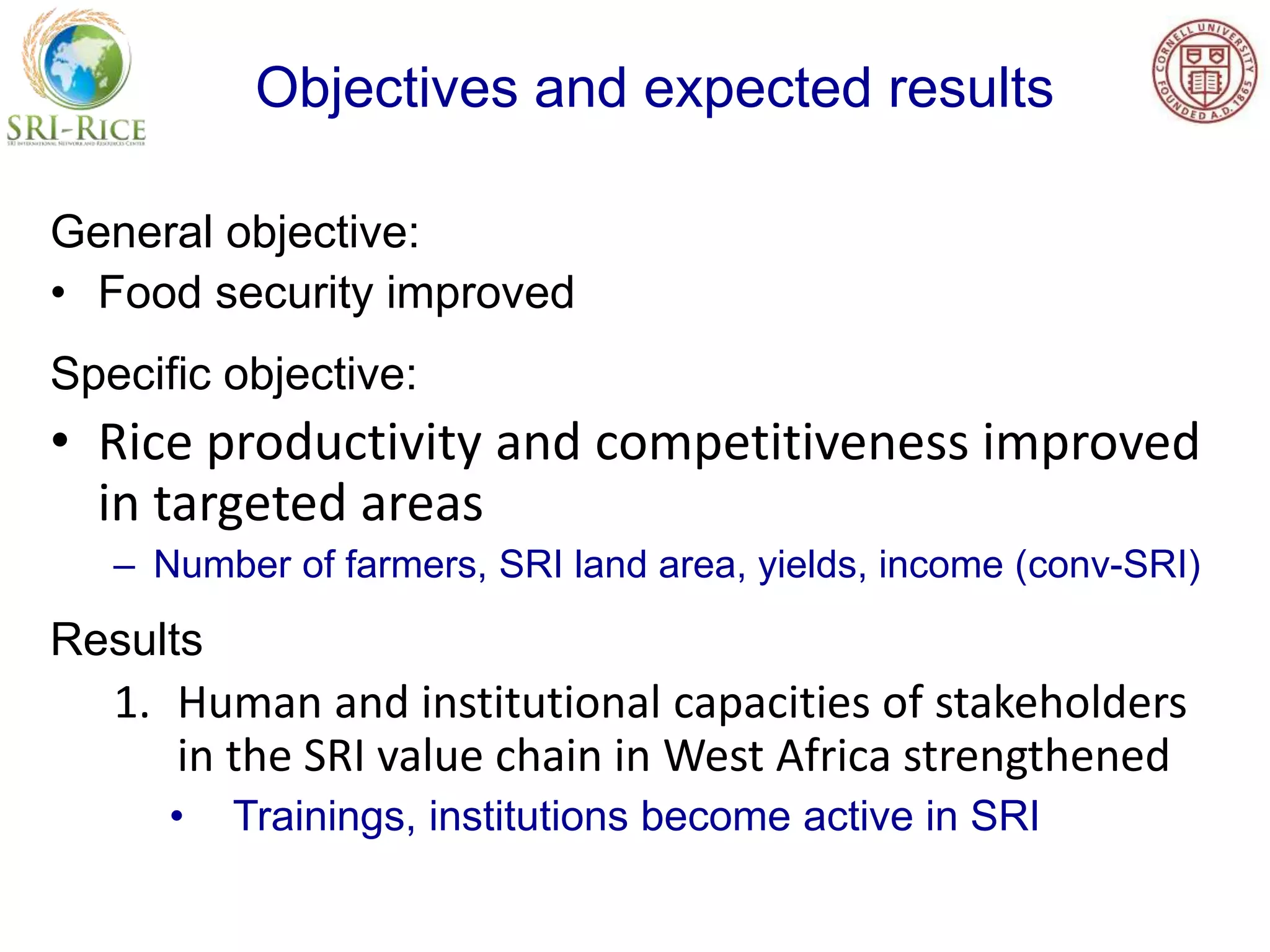
Objectives and expected results
General objective:
• Food security improved
Specific objective:
• Rice productivity and competitiveness improved
in targeted areas
– Number of farmers, SRI land area, yields, income (conv-SRI)
Results
1. Human and institutional capacities of stakeholders
in the SRI value chain in West Africa strengthened
• Trainings, institutions become active in SRI
Objectives and expected results
• Results
2. Appropriate innovations (equipment and/or best
practices) for SRI developed, scaled up, and
adopted in West Africa
• Innovations developed, disseminated and adopted
3. SRI stakeholders’ demand for knowledge and
decision-making options facilitated and met
• Knowledge products produced and disseminated
• SRI integration in rice innovation platforms
4. Efficient mechanisms and tools of coordination,
management and M&E of the project established
http://sri.ciifad.cornell.edu
Technical approach
Samuel Bimba, with his SRI field in Liberia, 2014
Climatic and agro-ecological zones
of the project
Arid < 75 d
Semi-arid 75-180 d
Semi-humid 180-270 d
Humid > 270 d
Growing period
Climate
Major rice cropping systems
Source AfricaRice, 2010
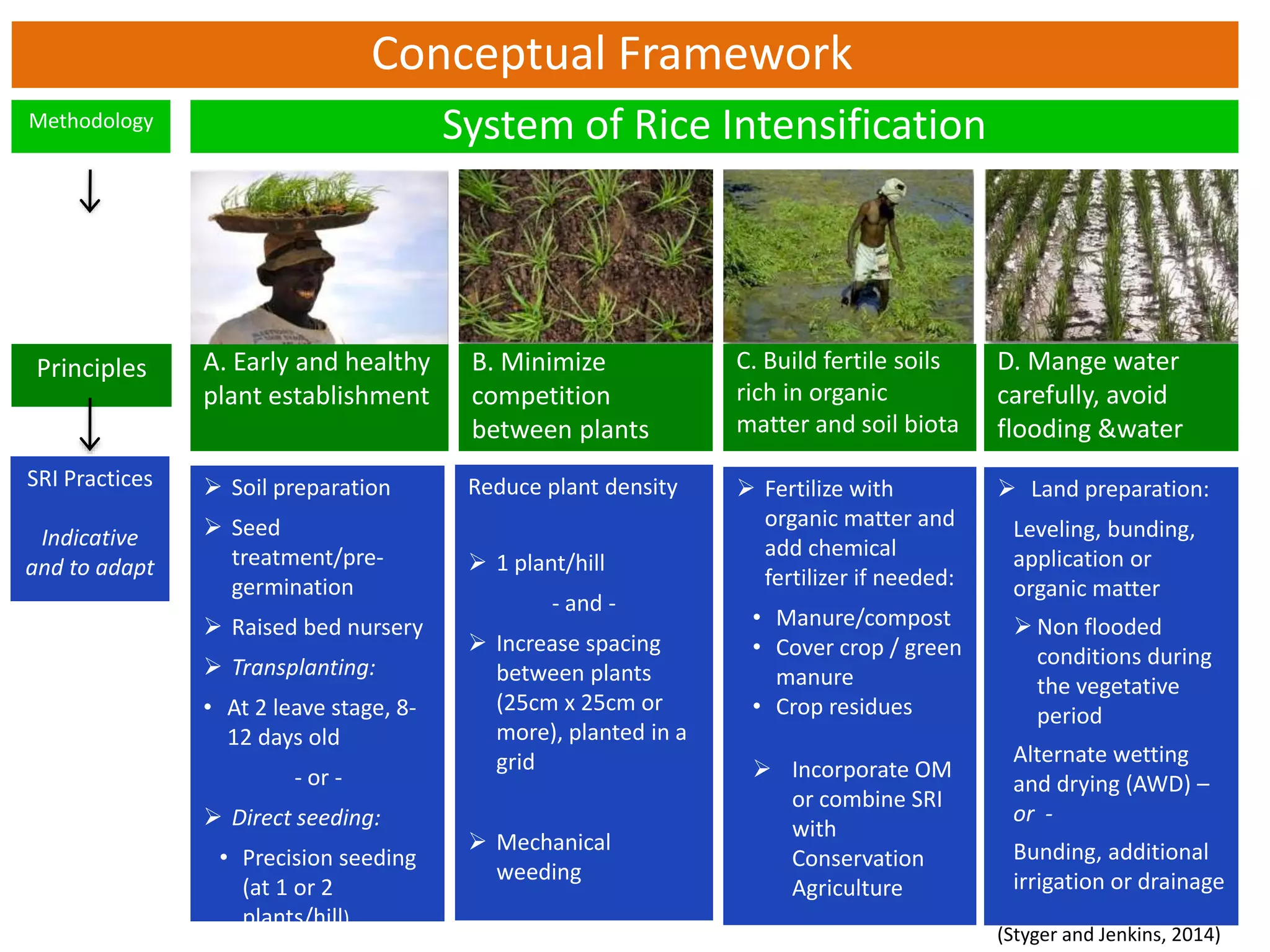
System of Rice Intensification
A. Early and healthy
plant establishment
C. Build fertile soils
rich in organic
matter and soil biota
D. Mange water
carefully, avoid
flooding &water
stress
 Soil preparation
 Seed
treatment/pre-
germination
 Raised bed nursery
 Transplanting:
• At 2 leave stage, 8-
12 days old
- or -
 Direct seeding:
• Precision seeding
(at 1 or 2
plants/hill)
Reduce plant density
 1 plant/hill
- and -
 Increase spacing
between plants
(25cm x 25cm or
more), planted in a
grid
 Mechanical
weeding
 Fertilize with
organic matter and
add chemical
fertilizer if needed:
• Manure/compost
• Cover crop / green
manure
• Crop residues
 Incorporate OM
or combine SRI
with
Conservation
Agriculture
 Land preparation:
Leveling, bunding,
application or
organic matter
 Non flooded
conditions during
the vegetative
period
Alternate wetting
and drying (AWD) –
or -
Bunding, additional
irrigation or drainage
Principles
SRI Practices
Indicative
and to adapt
Methodology
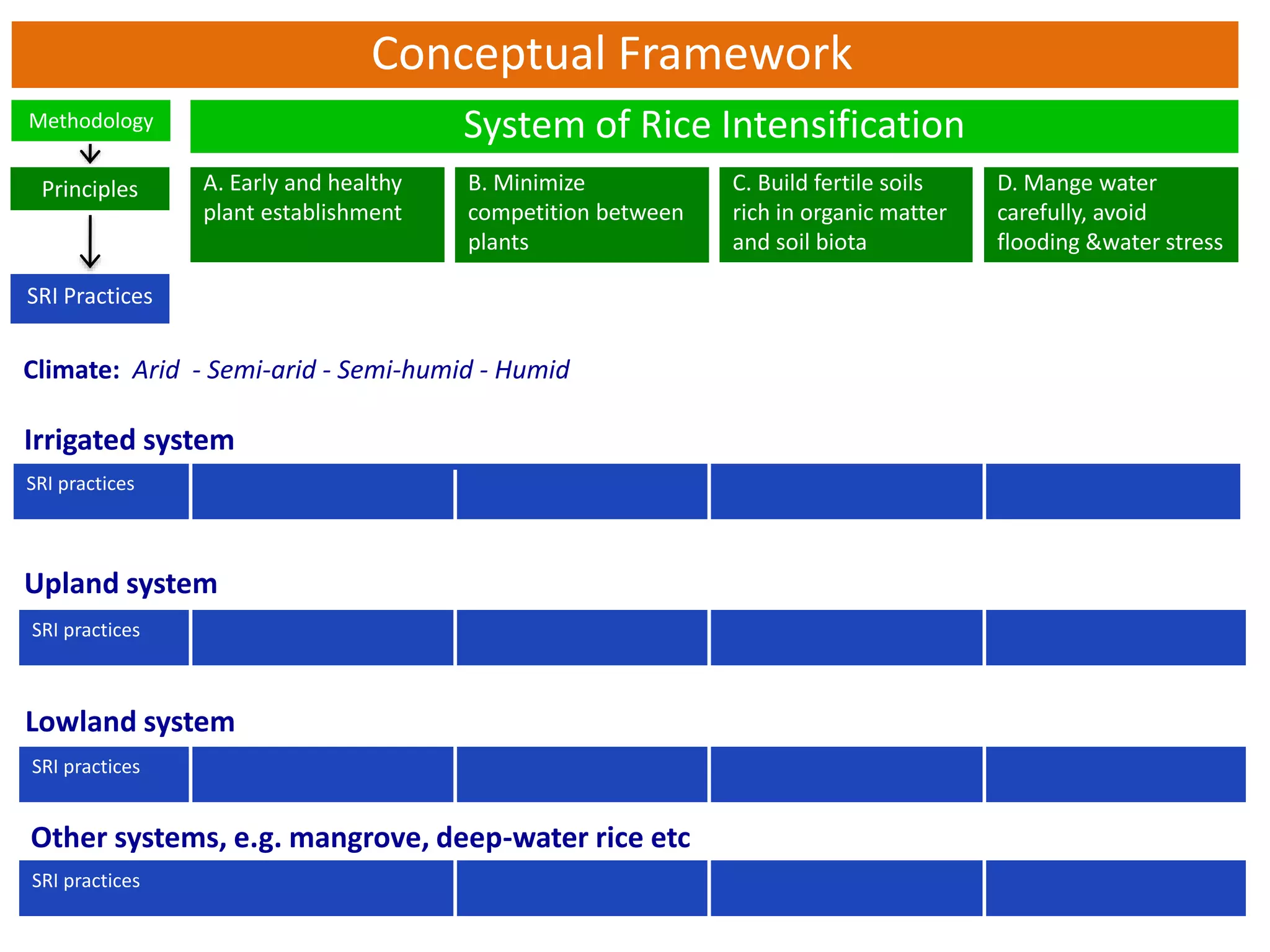
Conceptual Framework
B. Minimize
competition
between plants
(Styger and Jenkins, 2014)
System of Rice Intensification
A. Early and healthy
plant establishment
C. Build fertile soils
rich in organic matter
and soil biota
D. Mange water
carefully, avoid
flooding &water stress
Principles
SRI Practices
Methodology
Conceptual Framework
B. Minimize
competition between
plants
SRI practices
Climate: Arid - Semi-arid - Semi-humid - Humid
Irrigated system
SRI practices
SRI practices
SRI practices
Upland system
Lowland system
Other systems, e.g. mangrove, deep-water rice etc
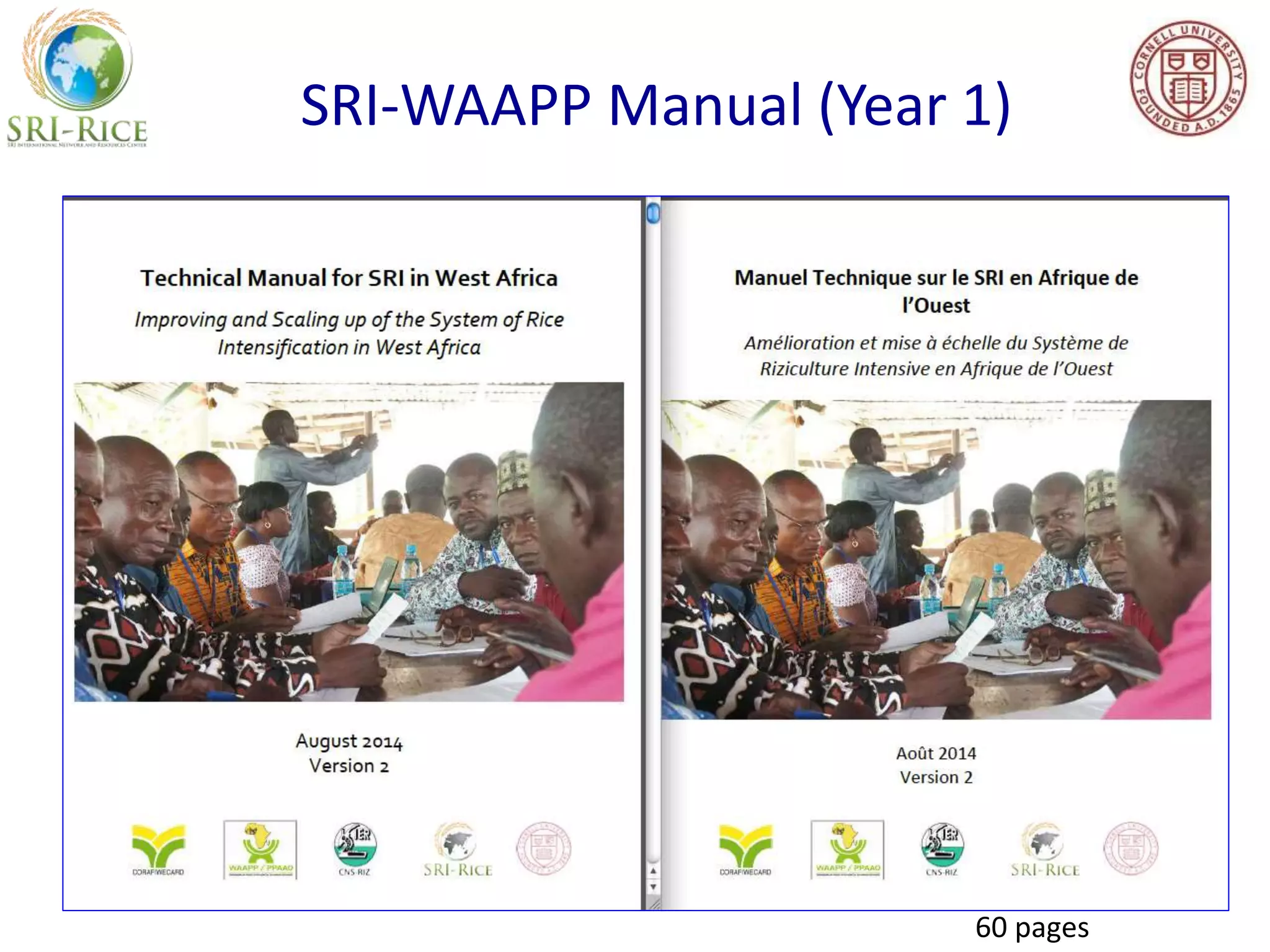
SRI-WAAPP Manual (Year 1)
60 pages
Adapted manuals by climate zone
and rice cropping system
• Templates developed by
SRI-Rice
• System’s Characterization:
– Rice system
– Crop Growing Periods
– Water availability for rice
production
– Others
• Developed by Countries in
Year 2
Adapted manuals for technicians
1-2 pages for each technical step
Adapted manuals for farmers
Shorter sections, picture based, local languages
- M&E system tracking
- Field technicians and
farmers contribute to data collection
- Information instantly and publicly available
- Android Survey App – Available offline, for tablets,
smartphones and laptop / desktop computers
Launch of pilot in
West Africa June
2015
Data collection
Online data collection and mapping platform
www.sriwestafrica.org
www.sriafriqueouest.org
SRI Activities 2014 :Training and field sites
Improving and Scaling up SRI in West Africa
‘Story Maps’ with
ESRI (makers of
ArcGIS) –
publicly accessible,
narrative websites
that explain and
illustrate the project
with interactive
multimedia
components
New tools in development
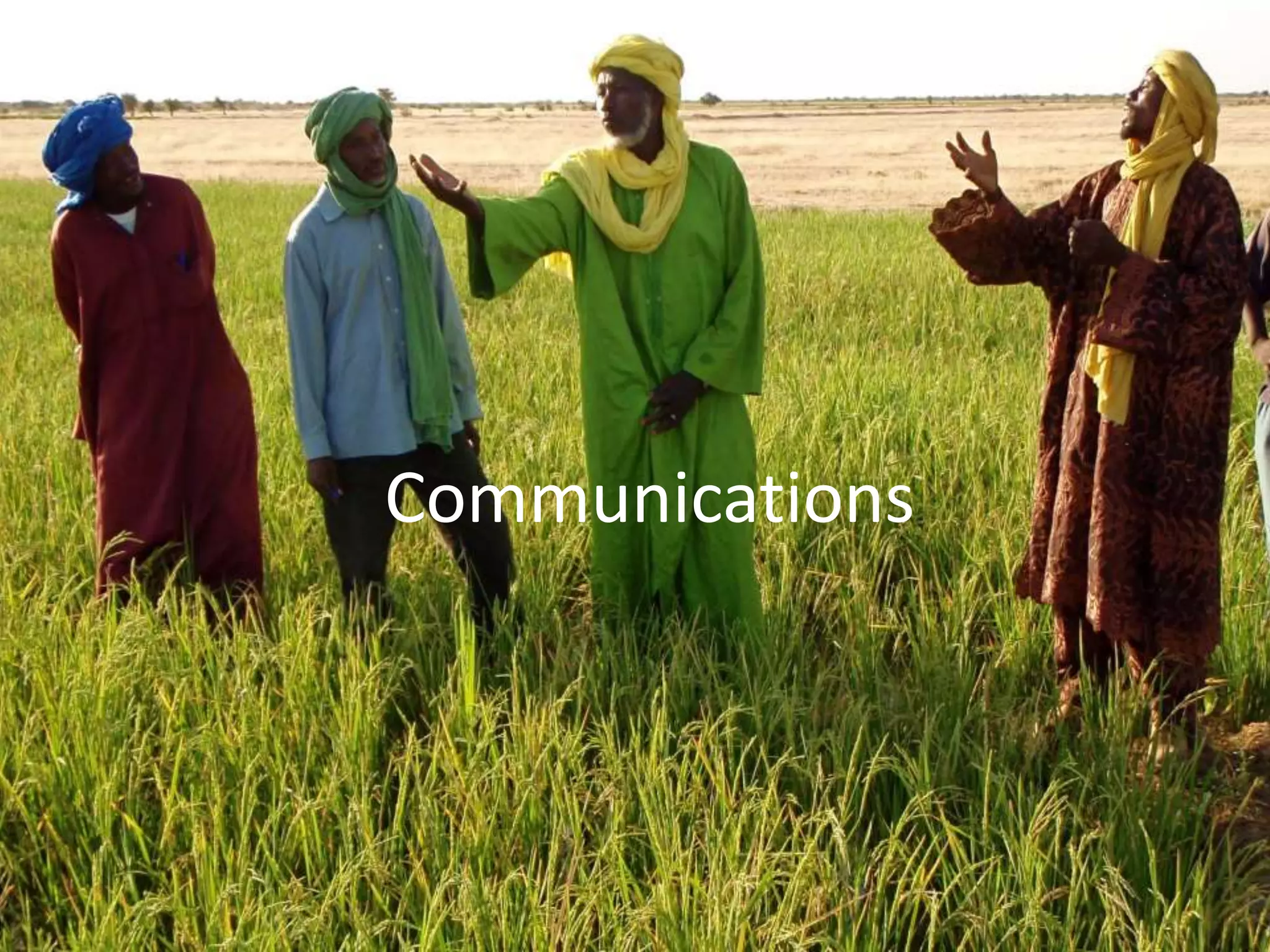
Communications
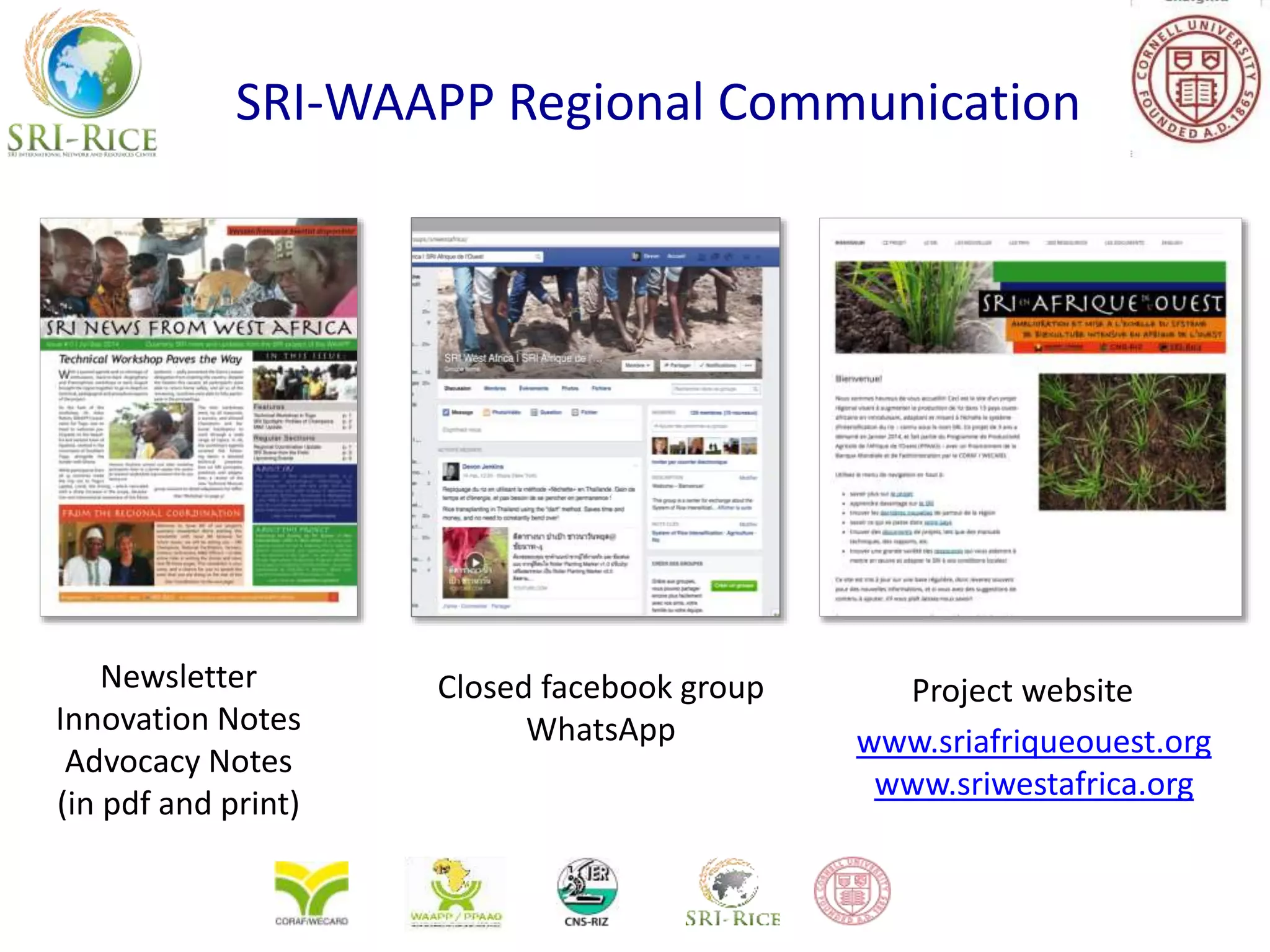
www.sriafriqueouest.org
www.sriwestafrica.org
Project websiteNewsletter
Innovation Notes
Advocacy Notes
(in pdf and print)
Closed facebook group
WhatsApp
SRI-WAAPP Regional Communication
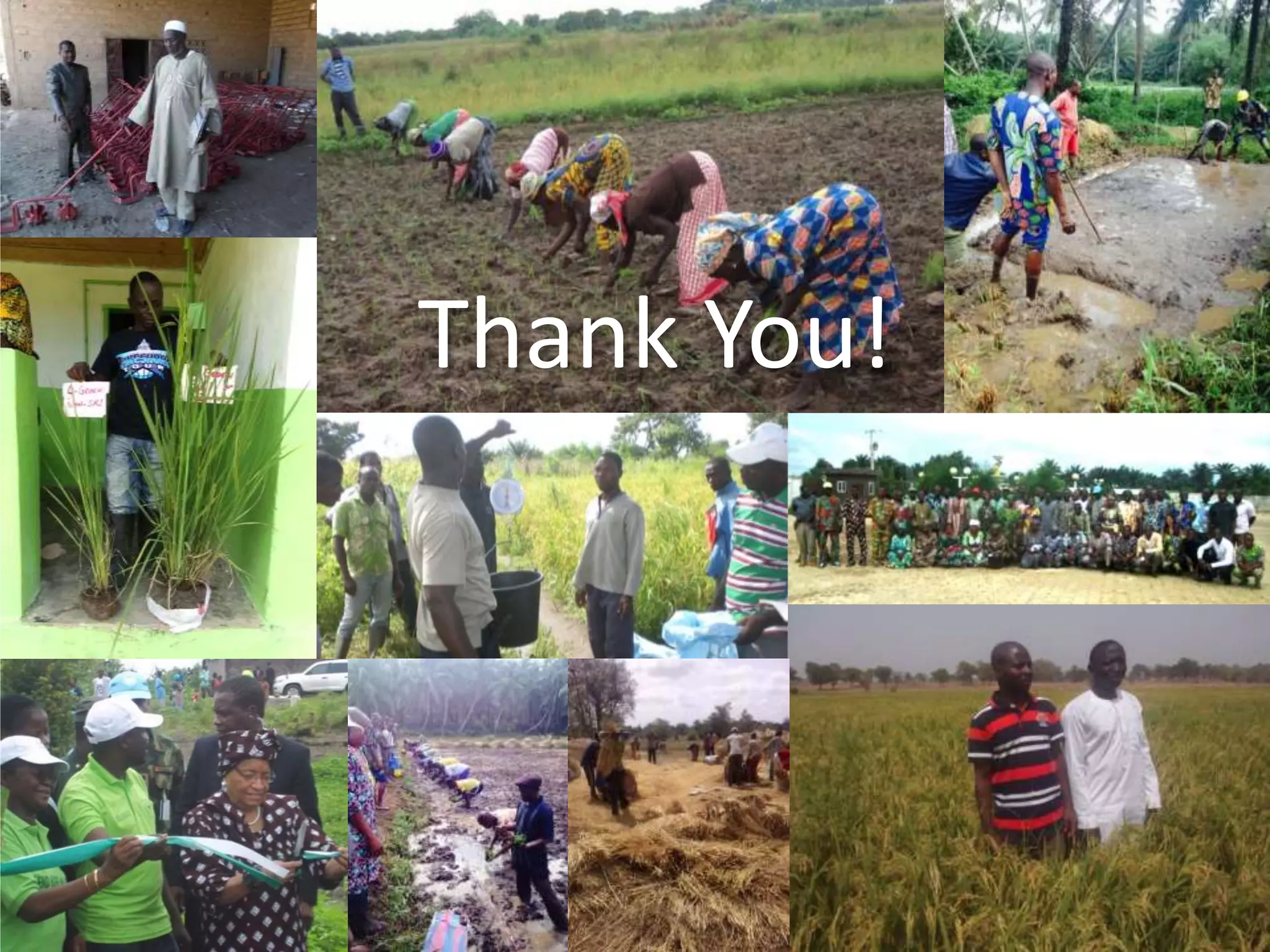
Thank You!

Improving and Scaling Up SRI in West Africa: Insights from a regional, 13-country project - Dr. Erika Styger

  • 1.
    Improving and Scaling UpSRI in West Africa Erika Styger and Devon Jenkins SRI-Rice, Cornell University Regional Review and Planning Workshop, SRI Lower Mekong River Basin project Siem Reap, Cambodia, 2-3 June, 2015 Insights from a regional, 13-country project
  • 2.
    Extension and Adoptionof SRI in 2015 55 countries in 2015, 8-10 million farmers on 3.5 million hectares in 2013 or 2% of global rice area
  • 3.
    SRI-WAAPP SRI-LMB Improving andScaling Up SRI in West Africa • 1st Phase of a 3 year project; • January 2014 – December 2016
  • 4.
    Climate • Tropical • Highlyvariable rainfall = < 200mm in north to > 4,500 mm in SE / SW Rice production systems • Predominantly rainfed upland (yields 1-1.5 t/ha) and rainfed lowland (yields 2- 4 t/ha) • Irrigated rice predominant in the northern zones (yields 4-12 t/ha) • Mangrove and swamp systems in more humid zones • O. glaberrima domesticated in Mali ≈ 3,500 years ago Cultural • Heterogeneous • 340 million people • 500+ local languages • Largely Muslim in the north, Christian in the south West Africa Overview
  • 5.
    Rice production inAfrica (South of Sahara) 64% 32% 3% 1% West Africa Eastern Africa Central Africa Southern Africa Each dot represents 20,000 tons Data: FAO Rice production 2006 64% of rice is produced in West Africa Nigeria, Guinea, Ivory Coast, Mali Ref: Warda (2008) Africa rice trends 2007
  • 6.
    1961 1966 19711976 1981 1986 1991 1996 2001 2006 Rice production and consumption in SSA from 1961-2006 Production Consumption 40% importedConsumption rate increase yearly 6.3% (2000-2007) Production rate increase yearly 3.7% (1996-2006) Production increase through cropping area extension, as yields stagnate
  • 7.
    SRI In WestAfrica since 2001 • Benin 2001: 1 farmer, Echo intern: SRI 7.5t/ha • The Gambia 2002-2005: Research with farmers: SRI 5.4-8.3 t/ha • Guinea 2003: Chinese research with hybrids: 9 t/ha • Senegal 2003-2009: Rodale Institute; Dissertation with WARDA • Sierra Leone 2004: World vision, USAID, CRS:: SRI 5.3t/ha vs 2.5t/ha • Burkina 2006: 6 farmers: SRI 7t/ha vs 3.5t/ha • Mali: 2007-2012 : 3 projects, 6 regions, > 1000 farmers • Since 2010: regional trainings by Mali projects in Nigeria, Senegal, Ghana, Benin, Togo http://sri.ciifad.cornell.edu
  • 8.
    Improving and ScalingUp SRI in West Africa • Regional commissioned project to increase rice productivity in 13 ECOWAS countries • Project developed through participatory process over 1.5 years with representatives from research, extension, farmers from 13 countries – First workshop in Ouagadougou, July 2012 – Second workshop in Saly, Senegal, July 2013 – Launching of project Porto Novo, Benin, February 2014
  • 9.
    Improving and ScalingUp SRI in West Africa • Part of the West Africa Agriculture Productivity Program (WAAPP) • Funded by the World Bank • Steered by Central and West African Council for Agricultural Research and Development (CORAF/WECARD) • Regional coordination for implementation: – Institute Economie Rural (IER) National Center for Specialization on Rice (CNS-Rice), Mali; – SRI-Rice Center from Cornell University is principal technical partner • Each country has its own implementation plan and funding for implementation
  • 10.
    • National WAAPPcoordination • National Facilitator, housed at the SRI-WAAPP Focal Institution • SRI Champions (can be anyone: farmers, technicians etc) SRI-WAAPP organizational structure (NY, USA) CORAF CNS-Riz Funded by the World Bank
  • 11.
  • 12.
    CNS-Riz (Mali) SRI-Rice •Technical support • Methodology development • M&E planning / implementation • Training • Material development • Technical, M&E, Communications • Co-facilitating workshops • Connect project partners to SRI networks in 50+ countries • Coordination • Logistics • Regional planning • Co-facilitating workshops • Primary point of contact for National Facilitators • Primary point of contact for WAAPP • Coordinates with CORAF/WECARD and World Bank Regional Coordination Unit
  • 13.
    Objectives and expectedresults General objective: • Food security improved Specific objective: • Rice productivity and competitiveness improved in targeted areas – Number of farmers, SRI land area, yields, income (conv-SRI) Results 1. Human and institutional capacities of stakeholders in the SRI value chain in West Africa strengthened • Trainings, institutions become active in SRI
  • 14.
    Objectives and expectedresults • Results 2. Appropriate innovations (equipment and/or best practices) for SRI developed, scaled up, and adopted in West Africa • Innovations developed, disseminated and adopted 3. SRI stakeholders’ demand for knowledge and decision-making options facilitated and met • Knowledge products produced and disseminated • SRI integration in rice innovation platforms 4. Efficient mechanisms and tools of coordination, management and M&E of the project established http://sri.ciifad.cornell.edu
  • 15.
    Technical approach Samuel Bimba,with his SRI field in Liberia, 2014
  • 16.
    Climatic and agro-ecologicalzones of the project Arid < 75 d Semi-arid 75-180 d Semi-humid 180-270 d Humid > 270 d Growing period Climate
  • 17.
    Major rice croppingsystems Source AfricaRice, 2010
  • 18.
    System of RiceIntensification A. Early and healthy plant establishment C. Build fertile soils rich in organic matter and soil biota D. Mange water carefully, avoid flooding &water stress  Soil preparation  Seed treatment/pre- germination  Raised bed nursery  Transplanting: • At 2 leave stage, 8- 12 days old - or -  Direct seeding: • Precision seeding (at 1 or 2 plants/hill) Reduce plant density  1 plant/hill - and -  Increase spacing between plants (25cm x 25cm or more), planted in a grid  Mechanical weeding  Fertilize with organic matter and add chemical fertilizer if needed: • Manure/compost • Cover crop / green manure • Crop residues  Incorporate OM or combine SRI with Conservation Agriculture  Land preparation: Leveling, bunding, application or organic matter  Non flooded conditions during the vegetative period Alternate wetting and drying (AWD) – or - Bunding, additional irrigation or drainage Principles SRI Practices Indicative and to adapt Methodology Conceptual Framework B. Minimize competition between plants (Styger and Jenkins, 2014)
  • 19.
    System of RiceIntensification A. Early and healthy plant establishment C. Build fertile soils rich in organic matter and soil biota D. Mange water carefully, avoid flooding &water stress Principles SRI Practices Methodology Conceptual Framework B. Minimize competition between plants SRI practices Climate: Arid - Semi-arid - Semi-humid - Humid Irrigated system SRI practices SRI practices SRI practices Upland system Lowland system Other systems, e.g. mangrove, deep-water rice etc
  • 20.
  • 21.
    Adapted manuals byclimate zone and rice cropping system • Templates developed by SRI-Rice • System’s Characterization: – Rice system – Crop Growing Periods – Water availability for rice production – Others • Developed by Countries in Year 2
  • 22.
    Adapted manuals fortechnicians 1-2 pages for each technical step
  • 23.
    Adapted manuals forfarmers Shorter sections, picture based, local languages
  • 24.
    - M&E systemtracking - Field technicians and farmers contribute to data collection - Information instantly and publicly available - Android Survey App – Available offline, for tablets, smartphones and laptop / desktop computers Launch of pilot in West Africa June 2015 Data collection Online data collection and mapping platform
  • 25.
    www.sriwestafrica.org www.sriafriqueouest.org SRI Activities 2014:Training and field sites Improving and Scaling up SRI in West Africa
  • 26.
    ‘Story Maps’ with ESRI(makers of ArcGIS) – publicly accessible, narrative websites that explain and illustrate the project with interactive multimedia components New tools in development
  • 27.
  • 28.
    www.sriafriqueouest.org www.sriwestafrica.org Project websiteNewsletter Innovation Notes AdvocacyNotes (in pdf and print) Closed facebook group WhatsApp SRI-WAAPP Regional Communication
  • 29.