Scaling-Up Climate Smart
Agriculture in Nepal
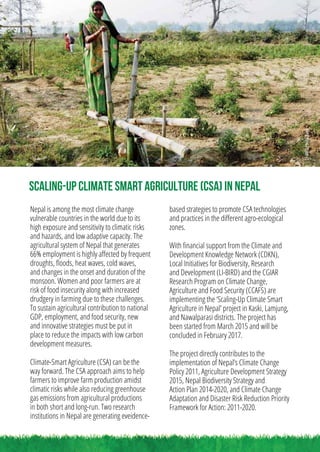
Nepal is among the most climate change
vulnerable countries in the world due to its
high exposure and sensitivity to climatic risks
and hazards, and low adaptive capacity. The
agricultural system of Nepal that generates
66% employment is highly affected by frequent
droughts, floods, heat waves, cold waves,
and changes in the onset and duration of the
monsoon. Women and poor farmers are at
risk of food insecurity along with increased
drudgery in farming due to these challenges.
To sustain agricultural contribution to national
GDP, employment, and food security, new
and innovative strategies must be put in
place to reduce the impacts with low carbon
development measures.
Climate-Smart Agriculture (CSA) can be the
way forward. The CSA approach aims to help
farmers to improve farm production amidst
climatic risks while also reducing greenhouse
gas emissions from agricultural productions
in both short and long-run. Two research
institutions in Nepal are generating eveidence-
based strategies to promote CSA technologies
and practices in the different agro-ecological
zones.
With financial support from the Climate and
Development Knowledge Network (CDKN),
Local Initiatives for Biodiversity, Research
and Development (LI-BIRD) and the CGIAR
Research Program on Climate Change,
Agriculture and Food Security (CCAFS) are
implementing the ‘Scaling-Up Climate Smart
Agriculture in Nepal’ project in Kaski, Lamjung,
and Nawalparasi districts. The project has
been started from March 2015 and will be
concluded in February 2017.
The project directly contributes to the
implementation of Nepal’s Climate Change
Policy 2011, Agriculture Development Strategy
2015, Nepal Biodiversity Strategy and
Action Plan 2014-2020, and Climate Change
Adaptation and Disaster Risk Reduction Priority
Framework for Action: 2011-2020.
Scaling-Up Climate Smart Agriculture (CSA) in Nepal
LI-BIRDPhotoBank
Mustang
Kaski
Manang
Palpa
Gorkha
Myagdi
Chitwan
Dhading
Lamjung
Tanahun
Nawalparasi
Syangja
Parbat
Legend
Project Area
Gandaki River Basin
Mountain
Hill
Terai
Ü
The project aims to
•	 Identify, test and screen suitable CSA
technologies and practices for the different
geographic, agro-ecological and socio-
economic contexts of Nepal by involving
women and poor farmers, researchers and
extension agencies;
•	 Develop scaling up pathways and
implementation plan of champion CSA
practices with active participation of local
communities and government stakeholders;
and
•	 Enhance the capacity of government
stakeholders, and public awareness to
effectively implement CSA practices in the
country.
While designing the CSA interventions, the
project has considered an inter-connectivity of
agricultural system with different ecosystems
and their services, local development
initiatives, and local knowledge, skills &
resources. In order to sustain the results, the
project has been engaged with sub-national
governments through Climate Smart Village
approach and use of multi-criteria analysis
of potential CSA technologies and practices.
The project will apply the Climate Analogue
Tool for extrapolating CSA technologies as
a decision support tool for government to
promote CSA. The project will develop the
CSA scaling up pathways and implementation
plan for Nepal based on the assessment
of Nepalese policies and institutions for
scaling-up of CSA. In the process, the project
will identify the key benefits and barriers of
the particular technology for its wide-scale
adoption. Drawing on the expertise of national
and international researchers, national
and local organizations, farmers’ groups
and policy makers, the project is meshing
global knowledge with local context to select
appropriate technological and institutional
interventions.
Map: Pilot sites of CSA project
The key project interventions are
1.	 Identify potential CSA technologies for
agroecosystem resilience at local and
national level.
2.	 Screen potential CSA technologies from the
CSA pool for field piloting/verification.
3.	 Verify promising CSA technologies that
can be scaled-up for greater stakeholder
outreach.
4.	 Extrapolate CSA technologies using a
climate analogue approach.
5.	 Review government policies and
institutional mechanisms to identify barriers
and opportunities for scaling-up CSA in
Nepal.
6.	 Develop CSA scaling-up pathways and
implementation plan for Nepal
7.	 Capacity building of government
stakeholders on the political and
socioeconomic dimensions of CSA and
enhancing outreach through engagements
at different steps of the project
implementation.
8. 	Enhance public awareness on CSA
approach, technologies and practices in
Nepal.
9.	 Joint monitoring/field monitoring by project
advisory committee and key stakeholders.
10. Document, publish, and disseminate CSA 		
knowledge products.
Project Partnership
Core partnership
LI-BIRD and CCAFS are the core partners of the
project. LI-BIRD is leading field implementation
of the project along with national level political
engagement. CCAFS is providing technical
expertise in identification and screening
champion CSA, building capacity of national
stakeholders, and disseminating knowledge
products amongst the international community.
MaheshShrestha/LI-BIRD
Associated partnership
The core partners has been collaborating with
National
Level
Ministry of Agricultural
Development (MoAD)
Department of Agriculture (DoA)
Nepal Agricultural Research Council
(NARC)
District
Level
District Development Committee
(DDC)
District Agriculture Development
Office (DADO)
Local
Level
Village Development Committee
(VDC) and Village Council
Ward Citizen Forum
Local institutions such as
Conservation Area Management
Committee (CAMC), Biodiversity
Conservation and Development
Committee (BCDC), and
Farmers’ Cooperatives
The associate partners have been consulted
in project planning and implementation. They
will also participate in the project monitoring
and evaluation for integrating the project
learnings into their regular programs.
About Climate Smart Agriculture
CSA is an agricultural system that
simultaneously improves farm production
leading to food security, adaptation to climate
change, and climate change mitigation.
It combines policies on climate change
adaptation, mitigation and food security
to help increase crop production, returns,
resource use efficiency and reduction in
emissions wherever possible (Figure 1).
CSA builds community resilience by bringing
local stakeholders together for integrated
development of local resources ensuring
improved governance, community awareness,
improved management of local resources and
infrastructure with use of local knowledge and
practices. It contributes to the food secure
society with an improved material condition
and position of women and disadvantaged
groups.
The CSA portfolio of interventions include
a range of practices and technologies
suitable for local agricultural system and
community’s need, such as changes in
agronomic practices (e.g. crop rotation,
ADAPTATION
MITIGATION
FOOD
SECURITY
C
S
A
PRODUCTIVITY
RETURNS
EFFICIENCY
EMISSIONS
RESILIENCE
GENDER AND
SOCIAL EQUITY
OUTPUTS
Figure 1: Conceptual framework of climate smart agriculture
This publication is an output from a project commissioned through the Climate and Development Knowledge Network
(CDKN). CDKN is a programme funded by the UK Department for International Development (DFID) and the Netherlands
Directorate-General for International Cooperation (DGIS) for the benefit of developing countries. The views expressed and
information contained in it are not necessarily those of or endorsed by DFID, DGIS or the entities managing the delivery of
the CDKN, which can accept no responsibility or liability for such views, completeness or accuracy of the information or for
any reliance placed on them.
diversification, improved varieties and
integration of legumes), integrated nutrient
management (e.g. green manure, compost
and site specific nutrient management), tillage
and residue management (e.g. minimum/
zero tillage, incorporation of crop residues),
water management (rainwater harvesting,
laser land levelling, micro-irrigation, raised
bed planting, crop diversification, change in
crop establishment methods) and integrated
watershed/landscape management
(agroforestry, protection of water sources,
rehabilitation of degraded landscape,
environment friendly road construction).
Although CSA research and development is
incipient in Nepal, the government policy
is enabling for research and promotion of
CSA. Nepal’s Climate Change Policy 2011
provides enabling environment for research
and development of CSA with focus on
adaptation and mitigation. Other national
policy documents such as the Agriculture
Development Strategy 2015, Low Carbon and
Economic Development Strategy (under draft),
and Nepal Biodiversity Strategy and Action
Plan 2014-2020 have focused on identifying,
validating, and promoting a range of CSA
P.O. Box 324, Pokhara, Kaski, Nepal
Tel (977-61) 535357 Ÿ Fax (977-61) 539956
Email info@libird.org Ÿ Web www.libird.org
Local Initiatives for Biodiversity,
Research and Development
This publication was prepared by Surendra Gautam1
,
Keshab Thapa1
, and Arun Khattri-Chhetri2
.
1=LI-BIRD, 2= CCAFS
Design/Layout Mahesh Shrestha/LI-BIRD
practices and technologies across the agro-
ecological regions, and capacity strengthening
of government extension agencies.
About LI-BIRD
LI-BIRD is a non-profit, non-governmental
organization established in 1995 in Pokhara,
Nepal. LI-BIRD is committed to capitalizing on
local initiatives for sustainable management
of renewable natural resources in order
to reduce poverty in Nepal and improve
livelihoods of rural poor and marginalized
farmers, especially women.
About CCAFS
CCAFS is a research initiative seeking to
overcome the threats to agriculture and food
security in a changing climate scenario. CCAFS
invests in research to address the crucial trade-
offs between Climate Change, agriculture,
and food security and works to promote more
adaptable and resilient agriculture and food
systems in five focus regions, South Asia,
Southeast Asia, West Africa, East Africa, and
Latin America.

Climate Smart Agriculture-Brochure

  • 1.
  • 2.
    Nepal is amongthe most climate change vulnerable countries in the world due to its high exposure and sensitivity to climatic risks and hazards, and low adaptive capacity. The agricultural system of Nepal that generates 66% employment is highly affected by frequent droughts, floods, heat waves, cold waves, and changes in the onset and duration of the monsoon. Women and poor farmers are at risk of food insecurity along with increased drudgery in farming due to these challenges. To sustain agricultural contribution to national GDP, employment, and food security, new and innovative strategies must be put in place to reduce the impacts with low carbon development measures. Climate-Smart Agriculture (CSA) can be the way forward. The CSA approach aims to help farmers to improve farm production amidst climatic risks while also reducing greenhouse gas emissions from agricultural productions in both short and long-run. Two research institutions in Nepal are generating eveidence- based strategies to promote CSA technologies and practices in the different agro-ecological zones. With financial support from the Climate and Development Knowledge Network (CDKN), Local Initiatives for Biodiversity, Research and Development (LI-BIRD) and the CGIAR Research Program on Climate Change, Agriculture and Food Security (CCAFS) are implementing the ‘Scaling-Up Climate Smart Agriculture in Nepal’ project in Kaski, Lamjung, and Nawalparasi districts. The project has been started from March 2015 and will be concluded in February 2017. The project directly contributes to the implementation of Nepal’s Climate Change Policy 2011, Agriculture Development Strategy 2015, Nepal Biodiversity Strategy and Action Plan 2014-2020, and Climate Change Adaptation and Disaster Risk Reduction Priority Framework for Action: 2011-2020. Scaling-Up Climate Smart Agriculture (CSA) in Nepal LI-BIRDPhotoBank
  • 3.
    Mustang Kaski Manang Palpa Gorkha Myagdi Chitwan Dhading Lamjung Tanahun Nawalparasi Syangja Parbat Legend Project Area Gandaki RiverBasin Mountain Hill Terai Ü The project aims to • Identify, test and screen suitable CSA technologies and practices for the different geographic, agro-ecological and socio- economic contexts of Nepal by involving women and poor farmers, researchers and extension agencies; • Develop scaling up pathways and implementation plan of champion CSA practices with active participation of local communities and government stakeholders; and • Enhance the capacity of government stakeholders, and public awareness to effectively implement CSA practices in the country. While designing the CSA interventions, the project has considered an inter-connectivity of agricultural system with different ecosystems and their services, local development initiatives, and local knowledge, skills & resources. In order to sustain the results, the project has been engaged with sub-national governments through Climate Smart Village approach and use of multi-criteria analysis of potential CSA technologies and practices. The project will apply the Climate Analogue Tool for extrapolating CSA technologies as a decision support tool for government to promote CSA. The project will develop the CSA scaling up pathways and implementation plan for Nepal based on the assessment of Nepalese policies and institutions for scaling-up of CSA. In the process, the project will identify the key benefits and barriers of the particular technology for its wide-scale adoption. Drawing on the expertise of national and international researchers, national and local organizations, farmers’ groups and policy makers, the project is meshing global knowledge with local context to select appropriate technological and institutional interventions. Map: Pilot sites of CSA project
  • 4.
    The key projectinterventions are 1. Identify potential CSA technologies for agroecosystem resilience at local and national level. 2. Screen potential CSA technologies from the CSA pool for field piloting/verification. 3. Verify promising CSA technologies that can be scaled-up for greater stakeholder outreach. 4. Extrapolate CSA technologies using a climate analogue approach. 5. Review government policies and institutional mechanisms to identify barriers and opportunities for scaling-up CSA in Nepal. 6. Develop CSA scaling-up pathways and implementation plan for Nepal 7. Capacity building of government stakeholders on the political and socioeconomic dimensions of CSA and enhancing outreach through engagements at different steps of the project implementation. 8. Enhance public awareness on CSA approach, technologies and practices in Nepal. 9. Joint monitoring/field monitoring by project advisory committee and key stakeholders. 10. Document, publish, and disseminate CSA knowledge products. Project Partnership Core partnership LI-BIRD and CCAFS are the core partners of the project. LI-BIRD is leading field implementation of the project along with national level political engagement. CCAFS is providing technical expertise in identification and screening champion CSA, building capacity of national stakeholders, and disseminating knowledge products amongst the international community. MaheshShrestha/LI-BIRD
  • 5.
    Associated partnership The corepartners has been collaborating with National Level Ministry of Agricultural Development (MoAD) Department of Agriculture (DoA) Nepal Agricultural Research Council (NARC) District Level District Development Committee (DDC) District Agriculture Development Office (DADO) Local Level Village Development Committee (VDC) and Village Council Ward Citizen Forum Local institutions such as Conservation Area Management Committee (CAMC), Biodiversity Conservation and Development Committee (BCDC), and Farmers’ Cooperatives The associate partners have been consulted in project planning and implementation. They will also participate in the project monitoring and evaluation for integrating the project learnings into their regular programs. About Climate Smart Agriculture CSA is an agricultural system that simultaneously improves farm production leading to food security, adaptation to climate change, and climate change mitigation. It combines policies on climate change adaptation, mitigation and food security to help increase crop production, returns, resource use efficiency and reduction in emissions wherever possible (Figure 1). CSA builds community resilience by bringing local stakeholders together for integrated development of local resources ensuring improved governance, community awareness, improved management of local resources and infrastructure with use of local knowledge and practices. It contributes to the food secure society with an improved material condition and position of women and disadvantaged groups. The CSA portfolio of interventions include a range of practices and technologies suitable for local agricultural system and community’s need, such as changes in agronomic practices (e.g. crop rotation, ADAPTATION MITIGATION FOOD SECURITY C S A PRODUCTIVITY RETURNS EFFICIENCY EMISSIONS RESILIENCE GENDER AND SOCIAL EQUITY OUTPUTS Figure 1: Conceptual framework of climate smart agriculture
  • 6.
    This publication isan output from a project commissioned through the Climate and Development Knowledge Network (CDKN). CDKN is a programme funded by the UK Department for International Development (DFID) and the Netherlands Directorate-General for International Cooperation (DGIS) for the benefit of developing countries. The views expressed and information contained in it are not necessarily those of or endorsed by DFID, DGIS or the entities managing the delivery of the CDKN, which can accept no responsibility or liability for such views, completeness or accuracy of the information or for any reliance placed on them. diversification, improved varieties and integration of legumes), integrated nutrient management (e.g. green manure, compost and site specific nutrient management), tillage and residue management (e.g. minimum/ zero tillage, incorporation of crop residues), water management (rainwater harvesting, laser land levelling, micro-irrigation, raised bed planting, crop diversification, change in crop establishment methods) and integrated watershed/landscape management (agroforestry, protection of water sources, rehabilitation of degraded landscape, environment friendly road construction). Although CSA research and development is incipient in Nepal, the government policy is enabling for research and promotion of CSA. Nepal’s Climate Change Policy 2011 provides enabling environment for research and development of CSA with focus on adaptation and mitigation. Other national policy documents such as the Agriculture Development Strategy 2015, Low Carbon and Economic Development Strategy (under draft), and Nepal Biodiversity Strategy and Action Plan 2014-2020 have focused on identifying, validating, and promoting a range of CSA P.O. Box 324, Pokhara, Kaski, Nepal Tel (977-61) 535357 Ÿ Fax (977-61) 539956 Email info@libird.org Ÿ Web www.libird.org Local Initiatives for Biodiversity, Research and Development This publication was prepared by Surendra Gautam1 , Keshab Thapa1 , and Arun Khattri-Chhetri2 . 1=LI-BIRD, 2= CCAFS Design/Layout Mahesh Shrestha/LI-BIRD practices and technologies across the agro- ecological regions, and capacity strengthening of government extension agencies. About LI-BIRD LI-BIRD is a non-profit, non-governmental organization established in 1995 in Pokhara, Nepal. LI-BIRD is committed to capitalizing on local initiatives for sustainable management of renewable natural resources in order to reduce poverty in Nepal and improve livelihoods of rural poor and marginalized farmers, especially women. About CCAFS CCAFS is a research initiative seeking to overcome the threats to agriculture and food security in a changing climate scenario. CCAFS invests in research to address the crucial trade- offs between Climate Change, agriculture, and food security and works to promote more adaptable and resilient agriculture and food systems in five focus regions, South Asia, Southeast Asia, West Africa, East Africa, and Latin America.