



WEATHER
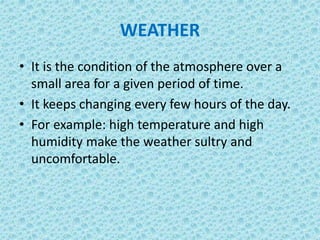
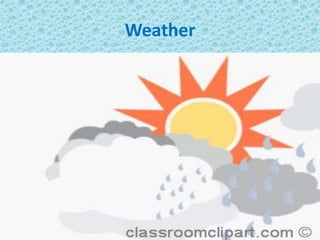
• It is the condition of the atmosphere over a
small area for a given period of time.
• It keeps changing every few hours of the day.
• For example: high temperature and high
humidity make the weather sultry and
uncomfortable.
Weather
CLIMATE
• It refers to the average weather conditions
over a large area and for a longer period of
time.
• It remains constant for a longer duration, may
be 3 months or 6 months or a year.
Four Seasons
MONSOON
• derived from the Arabic word ‘mausim’ means
season.
• It refers to the seasonal reversal in the wind
direction during a year.
• India climate called the monsoon climate.
• Two important elements of Indian climate are:
Temperature and precipitation
1.Temperature:- The degree of hotness or coldness of the
air is called as temperature.
2. Precipitation:- Air has weight and it exerts weight as
pressure on the surface of the Earth.
This weight of the air is called atmospheric pressure.
• Precipitation is in the form of
snowfall in Himalaya
rain over the rest of the country
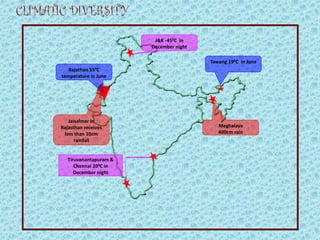
Rajathan 550C
temperature in June
Tawang 190C in June
J&K -450C in
December night
Tiruvanantapuram &
Chennai 200C in
December night
Meghalaya
400cm rain
Jaisalmer in
Rajasthan receives
less than 10cm
rainfall
Six major controls of the climate
1. Latitude
2. Altitude
3. Pressure and wind system
4. Distance from the sea
5. Ocean currents
6. Relief features
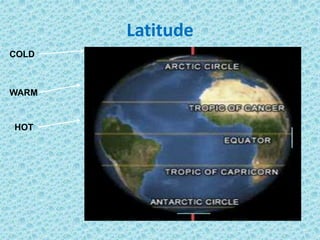
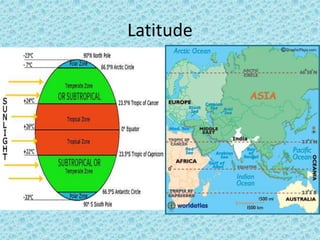
Latitude
WARM
COLD
HOT
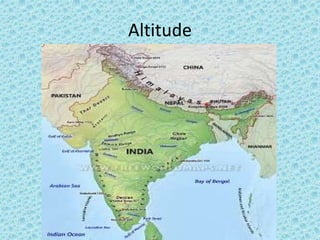
Altitude
• Higher the altitude, the lower is the
temperature.
• As one goes up, the density of the air
becomes less and less.
• Higher elevation- thinner air, therefore less air
to hold heat makes it colder.
• Lower pressure at higher altitudes causes the
temperature to be colder on the top of the
mountain.eg: Shimla is cooler than chandigarh
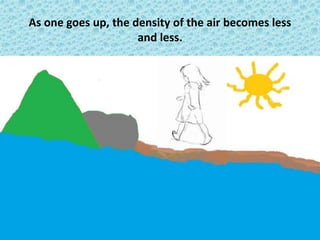
As one goes up, the density of the air becomes less
and less.
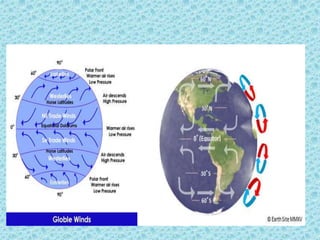
Pressure and wind system
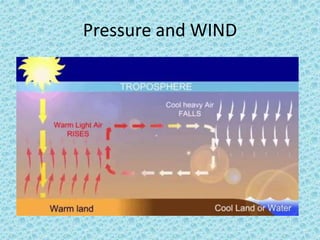
• The variations in air temperature control the
pressure and wind system of a place.
• Warm air rises, creating low pressure areas,
while cold air sinks, creating high pressure
areas.
• As a result, winds blow outward from a high
pressure location towards lower pressures.
Pressure and WIND
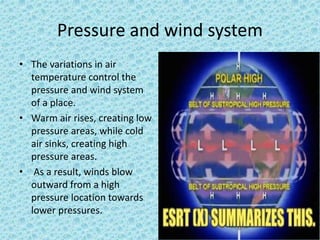
Pressure and wind system
• The variations in air
temperature control the
pressure and wind system
of a place.
• Warm air rises, creating low
pressure areas, while cold
air sinks, creating high
pressure areas.
• As a result, winds blow
outward from a high
pressure location towards
lower pressures.
Distance from the sea
• The sea temperature changes slower than
land temperature.
• The sea keeps the coastal area warmer in
winter and cooler in summer.
• As the distance from the sea increases the
weather conditions become extreme.
• Places away from the sea have very hot
summers and very cold winters.
• This condition is known as continentality.
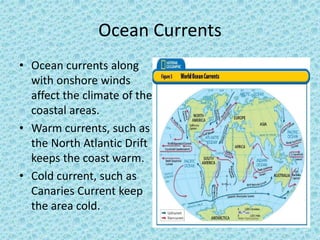
Ocean Currents
• Ocean currents along
with onshore winds
affect the climate of the
coastal areas.
• Warm currents, such as
the North Atlantic Drift
keeps the coast warm.
• Cold current, such as
Canaries Current keep
the area cold.
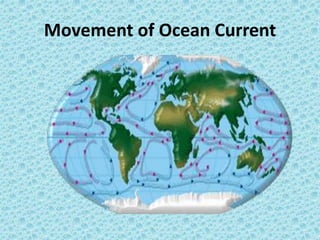
Movement of Ocean Current
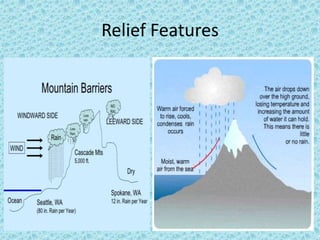
Relief Features
Factor Affecting India’s Climate
• Latitude
• Altitude
• Pressure and wind
Latitude
Altitude
Pressure and Winds
• Pressure and surface winds
• Upper air circulation
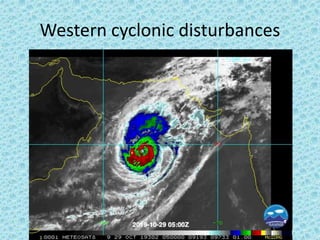
• Western cyclonic disturbances and tropical
cyclones
Coriolis force
India –lies in the region of
north easterly wind
originated from the
subtropical high
pressure belt of NH.
Due to Coriolis force-
high pressure moves
towards equatorial low
pressure area.
• As these winds
originate and blow over
land bring little or no
rain.
• Due to this reason India
should have been arid
land but not so…..
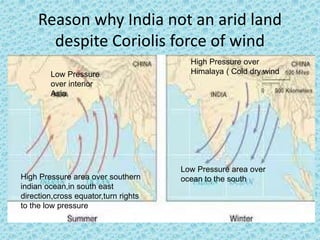
Reason why India not an arid land
despite Coriolis force of wind
High Pressure area over southern
indian ocean,in south east
direction,cross equator,turn rights
to the low pressure
Low Pressure
over interior
Asia
High Pressure over
Himalaya ( Cold dry wind
Low Pressure area over
ocean to the south
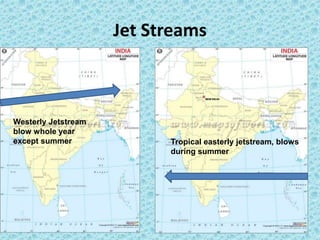
Jet Streams
Westerly Jetstream
blow whole year
except summer Tropical easterly jetstream, blows
during summer
Western cyclonic disturbances
The Indian Monsoon
• The Monsoon – seasonal reversal of wind
• Sailors:-
first notice the phenomenon
Benefited from the reversal of the wind
• Word monsoon derived from Arabic word
mausim.
• Experience in the tropical area roughly
between 20*N and 20*S
Mechanism of Indian Monsoon
• The differential heating and cooling of land
and water
• The shift of the position of Inter Tropical
Convergence Zone (ITCZ)
• The presence of the high –pressure area,east
of Madagascar
• The Tibetan plateau gets intensely heated
• Westerly Jet stream and Easterly Jet stream
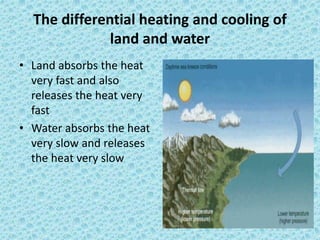
The differential heating and cooling of
land and water
• Land absorbs the heat
very fast and also
releases the heat very
fast
• Water absorbs the heat
very slow and releases
the heat very slow
The shift of the position of Inter Tropical
Convergence Zone (ITCZ)
• It is a broad trough of low pressure
• The belt is formed due to convergence of
Northeast and Southeast trade winds.
• It’s normal position is a equatorial latitude but
it moves North or South with the apparent
movement of the sun.
• Important point: the wind move during ITCZ is
trade wind.
YouTube link of ITCZ
https://www.youtube.com/watch?v=ZQSzzh0gX
0Q
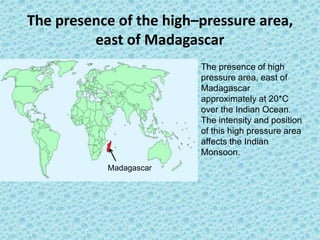
The presence of the high–pressure area,
east of Madagascar
The presence of high
pressure area, east of
Madagascar
approximately at 20*C
over the Indian Ocean.
The intensity and position
of this high pressure area
affects the Indian
Monsoon.
Madagascar
The Tibetan plateau gets intensely heated
• The Tibetan high level plateau gets intensely
heated during summers which results in
strong vertical currents and formation of high
pressure over the plateau at about 9km above
sea level.
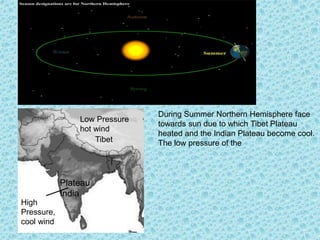
During Summer Northern Hemisphere face
towards sun due to which Tibet Plateau
heated and the Indian Plateau become cool.
The low pressure of theTibet
Plateau
India
High
Pressure,
cool wind
Low Pressure
hot wind
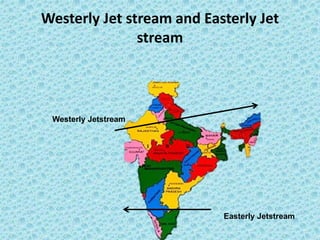
Westerly Jet stream and Easterly Jet
stream
Westerly Jetstream
Easterly Jetstream
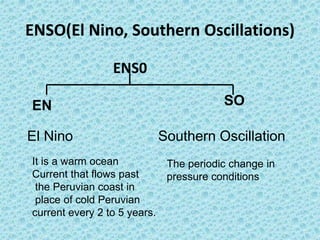
ENSO(El Nino, Southern Oscillations)
ENS0
El Nino
EN SO
Southern Oscillation
It is a warm ocean
Current that flows past
the Peruvian coast in
place of cold Peruvian
current every 2 to 5 years.
The periodic change in
pressure conditions
YouTube link of ENSO
https://www.youtube.com/watch?v=iVCviVp4rL
U
The Onset of the Monsoon and
Withdrawal
• Onset of monsoon: beginning of four month,
june to september monsoon
season over India.
• Duration of the monsoon: 100 to 120 days
• Burst of monsoon : When normal rainfall increases
suddenly and continues constantly for several days.
On Set of The Monsoon
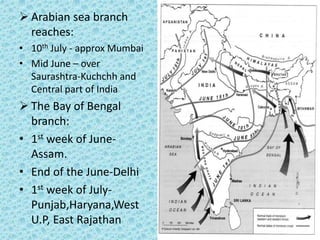
The monsoon divides into two – Arabian
sea branch and the Bay of Bengal branch
 Arabian sea branch
reaches:
• 10th July - approx Mumbai
• Mid June – over
Saurashtra-Kuchchh and
Central part of India
 The Bay of Bengal
branch:
• 1st week of June-
Assam.
• End of the June-Delhi
• 1st week of July-
Punjab,Haryana,West
U.P, East Rajathan
Retreating of Monsoon
• Early-Sep : Begins in Nothwestern state of
India.
• Mid-Oct : complete withdraws from Northern
part of peninsular
• Early-Dec : withdraw from rest of the country
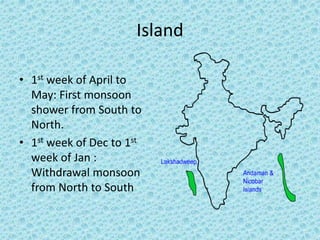
Island
• 1st week of April to
May: First monsoon
shower from South to
North.
• 1st week of Dec to 1st
week of Jan :
Withdrawal monsoon
from North to South
Four main season of India
1. The Cold Weather Season -Winter
2. The Hot Weather Season - Summer
3. Advancing Monsoon – The Rainy Season
4. Retreating Monsoon – The Transition Season
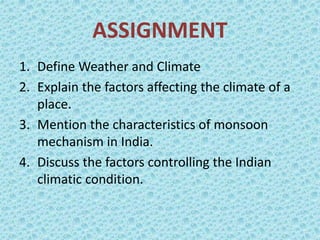
ASSIGNMENT
1. Define Weather and Climate
2. Explain the factors affecting the climate of a
place.
3. Mention the characteristics of monsoon
mechanism in India.
4. Discuss the factors controlling the Indian
climatic condition.
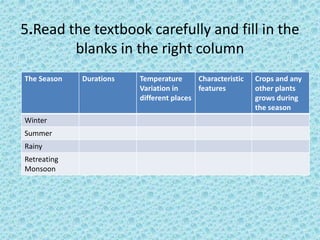
5.Read the textbook carefully and fill in the
blanks in the right column
The Season Durations Temperature
Variation in
different places
Characteristic
features
Crops and any
other plants
grows during
the season
Winter
Summer
Rainy
Retreating
Monsoon
Write a short note on
Monsoon as Unifying Bond
Climate 2

Climate 2

  • 2.
    WEATHER • It isthe condition of the atmosphere over a small area for a given period of time. • It keeps changing every few hours of the day. • For example: high temperature and high humidity make the weather sultry and uncomfortable.
  • 3.
  • 4.
    CLIMATE • It refersto the average weather conditions over a large area and for a longer period of time. • It remains constant for a longer duration, may be 3 months or 6 months or a year.
  • 5.
  • 6.
    MONSOON • derived fromthe Arabic word ‘mausim’ means season. • It refers to the seasonal reversal in the wind direction during a year. • India climate called the monsoon climate.
  • 7.
    • Two importantelements of Indian climate are: Temperature and precipitation 1.Temperature:- The degree of hotness or coldness of the air is called as temperature. 2. Precipitation:- Air has weight and it exerts weight as pressure on the surface of the Earth. This weight of the air is called atmospheric pressure. • Precipitation is in the form of snowfall in Himalaya rain over the rest of the country
  • 8.
    Rajathan 550C temperature inJune Tawang 190C in June J&K -450C in December night Tiruvanantapuram & Chennai 200C in December night Meghalaya 400cm rain Jaisalmer in Rajasthan receives less than 10cm rainfall
  • 9.
    Six major controlsof the climate 1. Latitude 2. Altitude 3. Pressure and wind system 4. Distance from the sea 5. Ocean currents 6. Relief features
  • 10.
  • 11.
    Altitude • Higher thealtitude, the lower is the temperature. • As one goes up, the density of the air becomes less and less. • Higher elevation- thinner air, therefore less air to hold heat makes it colder. • Lower pressure at higher altitudes causes the temperature to be colder on the top of the mountain.eg: Shimla is cooler than chandigarh
  • 12.
    As one goesup, the density of the air becomes less and less.
  • 13.
    Pressure and windsystem • The variations in air temperature control the pressure and wind system of a place. • Warm air rises, creating low pressure areas, while cold air sinks, creating high pressure areas. • As a result, winds blow outward from a high pressure location towards lower pressures.
  • 14.
  • 15.
    Pressure and windsystem • The variations in air temperature control the pressure and wind system of a place. • Warm air rises, creating low pressure areas, while cold air sinks, creating high pressure areas. • As a result, winds blow outward from a high pressure location towards lower pressures.
  • 16.
    Distance from thesea • The sea temperature changes slower than land temperature. • The sea keeps the coastal area warmer in winter and cooler in summer. • As the distance from the sea increases the weather conditions become extreme. • Places away from the sea have very hot summers and very cold winters. • This condition is known as continentality.
  • 17.
    Ocean Currents • Oceancurrents along with onshore winds affect the climate of the coastal areas. • Warm currents, such as the North Atlantic Drift keeps the coast warm. • Cold current, such as Canaries Current keep the area cold.
  • 18.
  • 19.
  • 20.
    Factor Affecting India’sClimate • Latitude • Altitude • Pressure and wind
  • 21.
  • 22.
  • 23.
    Pressure and Winds •Pressure and surface winds • Upper air circulation • Western cyclonic disturbances and tropical cyclones
  • 24.
    Coriolis force India –liesin the region of north easterly wind originated from the subtropical high pressure belt of NH. Due to Coriolis force- high pressure moves towards equatorial low pressure area. • As these winds originate and blow over land bring little or no rain. • Due to this reason India should have been arid land but not so…..
  • 26.
    Reason why Indianot an arid land despite Coriolis force of wind High Pressure area over southern indian ocean,in south east direction,cross equator,turn rights to the low pressure Low Pressure over interior Asia High Pressure over Himalaya ( Cold dry wind Low Pressure area over ocean to the south
  • 27.
    Jet Streams Westerly Jetstream blowwhole year except summer Tropical easterly jetstream, blows during summer
  • 28.
  • 29.
    The Indian Monsoon •The Monsoon – seasonal reversal of wind • Sailors:- first notice the phenomenon Benefited from the reversal of the wind • Word monsoon derived from Arabic word mausim. • Experience in the tropical area roughly between 20*N and 20*S
  • 30.
    Mechanism of IndianMonsoon • The differential heating and cooling of land and water • The shift of the position of Inter Tropical Convergence Zone (ITCZ) • The presence of the high –pressure area,east of Madagascar • The Tibetan plateau gets intensely heated • Westerly Jet stream and Easterly Jet stream
  • 31.
    The differential heatingand cooling of land and water • Land absorbs the heat very fast and also releases the heat very fast • Water absorbs the heat very slow and releases the heat very slow
  • 32.
    The shift ofthe position of Inter Tropical Convergence Zone (ITCZ) • It is a broad trough of low pressure • The belt is formed due to convergence of Northeast and Southeast trade winds. • It’s normal position is a equatorial latitude but it moves North or South with the apparent movement of the sun. • Important point: the wind move during ITCZ is trade wind.
  • 33.
    YouTube link ofITCZ https://www.youtube.com/watch?v=ZQSzzh0gX 0Q
  • 34.
    The presence ofthe high–pressure area, east of Madagascar The presence of high pressure area, east of Madagascar approximately at 20*C over the Indian Ocean. The intensity and position of this high pressure area affects the Indian Monsoon. Madagascar
  • 35.
    The Tibetan plateaugets intensely heated • The Tibetan high level plateau gets intensely heated during summers which results in strong vertical currents and formation of high pressure over the plateau at about 9km above sea level.
  • 36.
    During Summer NorthernHemisphere face towards sun due to which Tibet Plateau heated and the Indian Plateau become cool. The low pressure of theTibet Plateau India High Pressure, cool wind Low Pressure hot wind
  • 37.
    Westerly Jet streamand Easterly Jet stream Westerly Jetstream Easterly Jetstream
  • 38.
    ENSO(El Nino, SouthernOscillations) ENS0 El Nino EN SO Southern Oscillation It is a warm ocean Current that flows past the Peruvian coast in place of cold Peruvian current every 2 to 5 years. The periodic change in pressure conditions
  • 39.
    YouTube link ofENSO https://www.youtube.com/watch?v=iVCviVp4rL U
  • 40.
    The Onset ofthe Monsoon and Withdrawal • Onset of monsoon: beginning of four month, june to september monsoon season over India. • Duration of the monsoon: 100 to 120 days • Burst of monsoon : When normal rainfall increases suddenly and continues constantly for several days.
  • 41.
    On Set ofThe Monsoon
  • 42.
    The monsoon dividesinto two – Arabian sea branch and the Bay of Bengal branch
  • 43.
     Arabian seabranch reaches: • 10th July - approx Mumbai • Mid June – over Saurashtra-Kuchchh and Central part of India  The Bay of Bengal branch: • 1st week of June- Assam. • End of the June-Delhi • 1st week of July- Punjab,Haryana,West U.P, East Rajathan
  • 44.
    Retreating of Monsoon •Early-Sep : Begins in Nothwestern state of India. • Mid-Oct : complete withdraws from Northern part of peninsular • Early-Dec : withdraw from rest of the country
  • 45.
    Island • 1st weekof April to May: First monsoon shower from South to North. • 1st week of Dec to 1st week of Jan : Withdrawal monsoon from North to South
  • 46.
    Four main seasonof India 1. The Cold Weather Season -Winter 2. The Hot Weather Season - Summer 3. Advancing Monsoon – The Rainy Season 4. Retreating Monsoon – The Transition Season
  • 47.
    ASSIGNMENT 1. Define Weatherand Climate 2. Explain the factors affecting the climate of a place. 3. Mention the characteristics of monsoon mechanism in India. 4. Discuss the factors controlling the Indian climatic condition.
  • 48.
    5.Read the textbookcarefully and fill in the blanks in the right column The Season Durations Temperature Variation in different places Characteristic features Crops and any other plants grows during the season Winter Summer Rainy Retreating Monsoon
  • 49.
    Write a shortnote on Monsoon as Unifying Bond