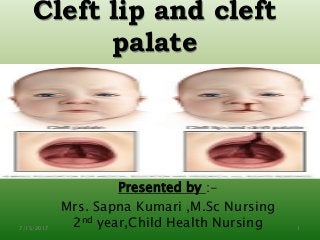










Cleft lip and cleft
palate
Presented by :-
Mrs. Sapna Kumari ,M.Sc Nursing
2nd year,Child Health Nursing7/15/2017 1
7/15/2017 2
Introduction
• It is congenital malformation.
• Cleft lip and cleft palate, also known as oro
facial cleft.
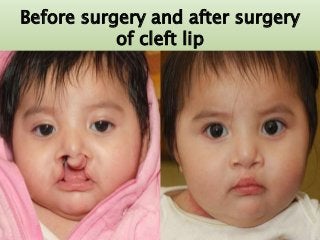
• A cleft lip contains an opening in the upper
lip that may extend into the nose. The
opening may be on one side, both sides, or
in the middle.
7/15/2017 3
Cont..
• A cleft palate is when the roof of the mouth
contains an opening into the nose.
7/15/2017 4
Cleft Lip
7/15/2017 5
cleft lip
It results from failure of maxillary process
to fuse with nasal elevations on frontal
prominence.
7/15/2017 6
7/15/2017 7
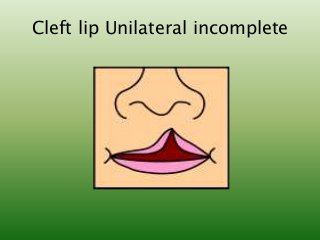
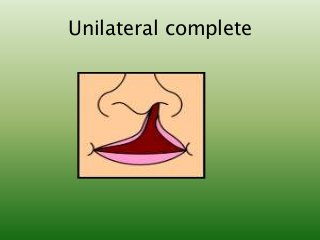
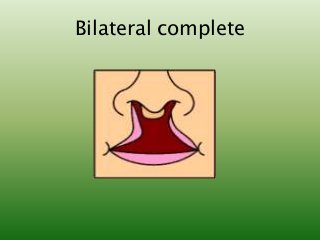
TYPES
Before surgery and after surgery
of cleft lip
7/15/2017 8
Cleft lip Unilateral incomplete
Unilateral complete
Bilateral complete
Cleft palate
7/15/2017 12
cleft palate
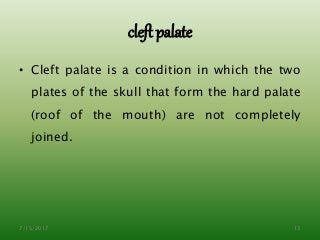
• Cleft palate is a condition in which the two
plates of the skull that form the hard palate
(roof of the mouth) are not completely
joined.
7/15/2017 13
7/15/2017 14
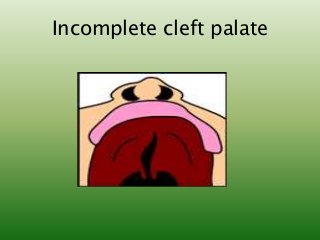
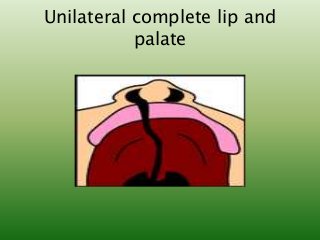
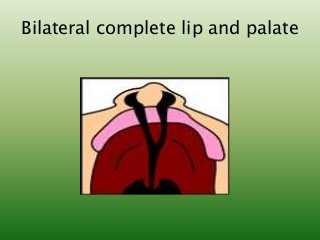
TYPES
Incomplete cleft palate
Unilateral complete lip and
palate
Bilateral complete lip and palate
7/15/2017 18
causes
Causes
• Genetic
• Maternal factors i.e viral infections during
5th to 12th weeks of gestation
• Exposure to X-ray
• The cause in most cases is unknown.
7/15/2017 19
Cont..
• Risk factors include smoking during
pregnancy, diabetes, an older mother,
obesity, and certain medications such as
some used to treat seizures.
7/15/2017 20
CLINICAL MANIFESTATIONS
7/15/2017 21
• Clinical manifestations in cleft lip and cleft palate
• In cleft lip:-
• Complete separation extending to the floor of the nose
• Separation mainly of 2 types:- Unilateral , Bilateral
• In cleft palate:-
• cleft palate defects are less obvious when they occur without a cleft lip and may not be detected at
birth.
• Cleft of the hard palate form a continuous opening between the mouth and nasal cavity. It also
may be of unilateral or bilateral .
• Common sign and symptoms:-
• Feeding problems
• Failure to gain weight
• Flow of milk through nasal passages during feeding
• Poor growth
• Repeated ear infections
• Speech difficulties
• Dental abnormalities
7/15/2017 22
PATHOPHYSIOLOGY
7/15/2017 23
Pathophysiology of Cleft lip
The embryological development of the upper lip
and nose occurring between the 3rd and 8th week of
gestation, with lip development between the 3rd
and 7th weeks
A cleft lip is formed when normal development is
interrupted before 7th week of gestation
7/15/2017 24
Pathophysiology of cleft palate
The development of the palate occurs between the
5th and 12th weeks of gestation.
Cleft palate is formed when normal palatal
development is interrupted before the 12th week of
gestation
7/15/2017 25
DIAGNOSTIC EVALUATION
7/15/2017 26
Diagnostic evaluation
7/15/2017 27
• Cleft lip and cleft palate are usually
diagnosed at birth or new born assessment.
• Cleft palate is identified through visual
examination of the oral cavity or when
examiner places a gloved finger in the
palate
THERAPEUTIC
MANAGEMENT
7/15/2017 28
Surgical management
In cleft–lip:-Surgical repair of the defect of
the lip is done, preferably at 2-3 months of
age. Most physicians adhere to the “rule of
ten”: the infant must be 10 weeks old,
weight 10 pounds, and have hemoglobin of
10.The operation termed as cheiloplasty.
7/15/2017 29
Cont..
The two most common procedures for repair
of cleft lip:-
• Tennison-Randall triangular flap(Z-Plasty)
• Millard rotationsl advancement technique
7/15/2017 30
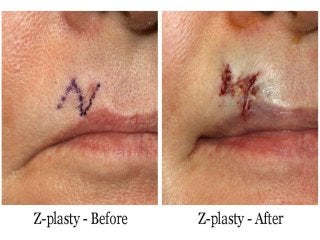
Z- Plasty
Z-plasty may be done to lengthen the soft palate
and decrease nasal escape of speech sounds. This
technique is used to improve the functional and
cosmetic appearance of the scars.
7/15/2017 31
7/15/2017 32
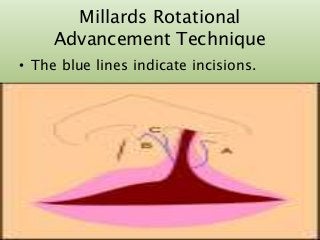
Millards Rotational
Advancement Technique
• The blue lines indicate incisions.
7/15/2017 33
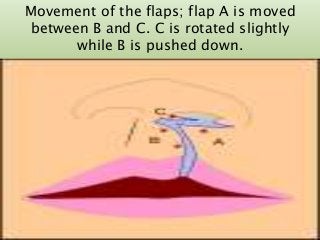
Movement of the flaps; flap A is moved
between B and C. C is rotated slightly
while B is pushed down.
7/15/2017 34
Cont….
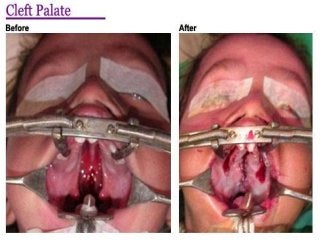
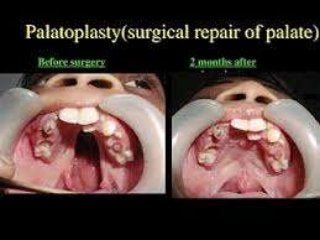
In cleft –palate:-
• Palatoplasty, the surgical reconstruction of
the palate is done with repair of the cleft, at
about age of 1-2 years of age. It should be
done before child develops defective
speech.
7/15/2017 35
7/15/2017 36
7/15/2017 37
Cont..
• The most common technique to repair cleft
palate :
• Veau-Wardill-Kilner V-Y pushback
procedure
• Furlow double- opposing Z-plasty
7/15/2017 38
Nursing management
• Carefully perform the head to toe assessment of
the child immediately after the birth.
• Assess the location and extent of the defect by
using gloved finger
• Assess the feeding pattern of child
• Assess the need for surgical correction
• Assess the parents understanding of the defect and
need for the surgery.
7/15/2017 39
Nursing diagnosis
• Altered nutrition less than body
requirements
• Risk for infection
• Risk for aspiration
• Ineffective breathing pattern
7/15/2017 40
Cont…
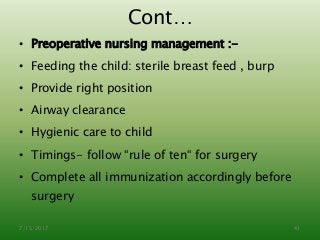
• Preoperative nursing management :-
• Feeding the child: sterile breast feed , burp
• Provide right position
• Airway clearance
• Hygienic care to child
• Timings- follow “rule of ten“ for surgery
• Complete all immunization accordingly before
surgery
7/15/2017 41
Cont…
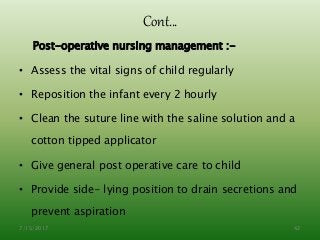
Post-operative nursing management :-
• Assess the vital signs of child regularly
• Reposition the infant every 2 hourly
• Clean the suture line with the saline solution and a
cotton tipped applicator
• Give general post operative care to child
• Provide side- lying position to drain secretions and
prevent aspiration
7/15/2017 42
cont..
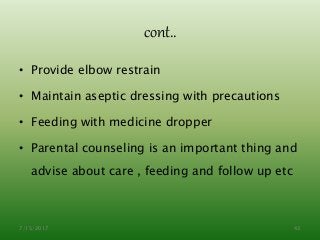
• Provide elbow restrain
• Maintain aseptic dressing with precautions
• Feeding with medicine dropper
• Parental counseling is an important thing and
advise about care , feeding and follow up etc
7/15/2017 43
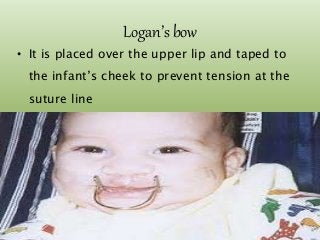
Logan’s bow
• It is placed over the upper lip and taped to
the infant’s cheek to prevent tension at the
suture line
7/15/2017 44
COMPLICATIONS
7/15/2017 45
• Complications
• Immediate problems:-
• feeding problem due to ineffective sucking resulting in under
nutrition
• Aspiration of feed resulting in respiratory infections
• Parental anxiety due to defective appearance of the infant
• Long term problems:-
• Recurrent infections especially otitis media.
• Disturbed parent child relationship and maladjustment with non
acceptance of the infant
• Impairment of speech
• Mal placement of teeth
• Hearing problems due to oral malformation especially in cleft palate.
• Impaired body image due to altered shape of face and oral
cavity.
7/15/2017 46
Summarization
Today I discussed about cleft lip and cleft
palate:-
• Introduction of cleft lip and cleft palate
• Definition of cleft lip and cleft palate
• Types of cleft lip and cleft palate
• Sign and symptoms
• Pathophysiology of cleft lip and cleft palate
• Diagnostic evaluation
• Therapeutic management
• Nursing management
• Complications
7/15/2017 47
Recaptualization
• Define cleft lip and cleft palate
• Mention the causes of cleft lip and cleft palate
• Enlist the sign and symptoms of cleft lip and cleft palate
• Explain patho physiology of cleft lip and cleft palate
• Enlist diagnostic evaluation done to identify cleft lip and cleft
palate
• Explain surgical management of cleft lip and cleft palate
• Mention the complications of cleft lip and palate
• Explain nursing management for cleft lip and cleft palate
7/15/2017 48
Bibliography
• Datta P. Pediatric nursing,2nd edition. Jaypee
Publishers, Pp.449-51.
• Bindler R.and Ball J. pediatric nursing and caring for
children,2nd edition,Appleton and lange Stamford,
Connecticut publisher,Pp.593-603.
• Wilson D. Hockenberry , J.Marilyn, Wongs essentials
of pediatric nursing, 1st edition , Elsevier
publishers, Pp.687-90.
7/15/2017 49
Thank you for cooperation 
7/15/2017 50

Cleft lip and cleft palate ppt

  • 1.
    Cleft lip andcleft palate Presented by :- Mrs. Sapna Kumari ,M.Sc Nursing 2nd year,Child Health Nursing7/15/2017 1
  • 2.
  • 3.
    Introduction • It iscongenital malformation. • Cleft lip and cleft palate, also known as oro facial cleft. • A cleft lip contains an opening in the upper lip that may extend into the nose. The opening may be on one side, both sides, or in the middle. 7/15/2017 3
  • 4.
    Cont.. • A cleftpalate is when the roof of the mouth contains an opening into the nose. 7/15/2017 4
  • 5.
  • 6.
    cleft lip It resultsfrom failure of maxillary process to fuse with nasal elevations on frontal prominence. 7/15/2017 6
  • 7.
  • 8.
    Before surgery andafter surgery of cleft lip 7/15/2017 8
  • 9.
  • 10.
  • 11.
  • 12.
  • 13.
    cleft palate • Cleftpalate is a condition in which the two plates of the skull that form the hard palate (roof of the mouth) are not completely joined. 7/15/2017 13
  • 14.
  • 15.
  • 16.
  • 17.
  • 18.
  • 19.
    Causes • Genetic • Maternalfactors i.e viral infections during 5th to 12th weeks of gestation • Exposure to X-ray • The cause in most cases is unknown. 7/15/2017 19
  • 20.
    Cont.. • Risk factorsinclude smoking during pregnancy, diabetes, an older mother, obesity, and certain medications such as some used to treat seizures. 7/15/2017 20
  • 21.
  • 22.
    • Clinical manifestationsin cleft lip and cleft palate • In cleft lip:- • Complete separation extending to the floor of the nose • Separation mainly of 2 types:- Unilateral , Bilateral • In cleft palate:- • cleft palate defects are less obvious when they occur without a cleft lip and may not be detected at birth. • Cleft of the hard palate form a continuous opening between the mouth and nasal cavity. It also may be of unilateral or bilateral . • Common sign and symptoms:- • Feeding problems • Failure to gain weight • Flow of milk through nasal passages during feeding • Poor growth • Repeated ear infections • Speech difficulties • Dental abnormalities 7/15/2017 22
  • 23.
  • 24.
    Pathophysiology of Cleftlip The embryological development of the upper lip and nose occurring between the 3rd and 8th week of gestation, with lip development between the 3rd and 7th weeks A cleft lip is formed when normal development is interrupted before 7th week of gestation 7/15/2017 24
  • 25.
    Pathophysiology of cleftpalate The development of the palate occurs between the 5th and 12th weeks of gestation. Cleft palate is formed when normal palatal development is interrupted before the 12th week of gestation 7/15/2017 25
  • 26.
  • 27.
    Diagnostic evaluation 7/15/2017 27 •Cleft lip and cleft palate are usually diagnosed at birth or new born assessment. • Cleft palate is identified through visual examination of the oral cavity or when examiner places a gloved finger in the palate
  • 28.
  • 29.
    Surgical management In cleft–lip:-Surgicalrepair of the defect of the lip is done, preferably at 2-3 months of age. Most physicians adhere to the “rule of ten”: the infant must be 10 weeks old, weight 10 pounds, and have hemoglobin of 10.The operation termed as cheiloplasty. 7/15/2017 29
  • 30.
    Cont.. The two mostcommon procedures for repair of cleft lip:- • Tennison-Randall triangular flap(Z-Plasty) • Millard rotationsl advancement technique 7/15/2017 30
  • 31.
    Z- Plasty Z-plasty maybe done to lengthen the soft palate and decrease nasal escape of speech sounds. This technique is used to improve the functional and cosmetic appearance of the scars. 7/15/2017 31
  • 32.
  • 33.
    Millards Rotational Advancement Technique •The blue lines indicate incisions. 7/15/2017 33
  • 34.
    Movement of theflaps; flap A is moved between B and C. C is rotated slightly while B is pushed down. 7/15/2017 34
  • 35.
    Cont…. In cleft –palate:- •Palatoplasty, the surgical reconstruction of the palate is done with repair of the cleft, at about age of 1-2 years of age. It should be done before child develops defective speech. 7/15/2017 35
  • 36.
  • 37.
  • 38.
    Cont.. • The mostcommon technique to repair cleft palate : • Veau-Wardill-Kilner V-Y pushback procedure • Furlow double- opposing Z-plasty 7/15/2017 38
  • 39.
    Nursing management • Carefullyperform the head to toe assessment of the child immediately after the birth. • Assess the location and extent of the defect by using gloved finger • Assess the feeding pattern of child • Assess the need for surgical correction • Assess the parents understanding of the defect and need for the surgery. 7/15/2017 39
  • 40.
    Nursing diagnosis • Alterednutrition less than body requirements • Risk for infection • Risk for aspiration • Ineffective breathing pattern 7/15/2017 40
  • 41.
    Cont… • Preoperative nursingmanagement :- • Feeding the child: sterile breast feed , burp • Provide right position • Airway clearance • Hygienic care to child • Timings- follow “rule of ten“ for surgery • Complete all immunization accordingly before surgery 7/15/2017 41
  • 42.
    Cont… Post-operative nursing management:- • Assess the vital signs of child regularly • Reposition the infant every 2 hourly • Clean the suture line with the saline solution and a cotton tipped applicator • Give general post operative care to child • Provide side- lying position to drain secretions and prevent aspiration 7/15/2017 42
  • 43.
    cont.. • Provide elbowrestrain • Maintain aseptic dressing with precautions • Feeding with medicine dropper • Parental counseling is an important thing and advise about care , feeding and follow up etc 7/15/2017 43
  • 44.
    Logan’s bow • Itis placed over the upper lip and taped to the infant’s cheek to prevent tension at the suture line 7/15/2017 44
  • 45.
  • 46.
    • Complications • Immediateproblems:- • feeding problem due to ineffective sucking resulting in under nutrition • Aspiration of feed resulting in respiratory infections • Parental anxiety due to defective appearance of the infant • Long term problems:- • Recurrent infections especially otitis media. • Disturbed parent child relationship and maladjustment with non acceptance of the infant • Impairment of speech • Mal placement of teeth • Hearing problems due to oral malformation especially in cleft palate. • Impaired body image due to altered shape of face and oral cavity. 7/15/2017 46
  • 47.
    Summarization Today I discussedabout cleft lip and cleft palate:- • Introduction of cleft lip and cleft palate • Definition of cleft lip and cleft palate • Types of cleft lip and cleft palate • Sign and symptoms • Pathophysiology of cleft lip and cleft palate • Diagnostic evaluation • Therapeutic management • Nursing management • Complications 7/15/2017 47
  • 48.
    Recaptualization • Define cleftlip and cleft palate • Mention the causes of cleft lip and cleft palate • Enlist the sign and symptoms of cleft lip and cleft palate • Explain patho physiology of cleft lip and cleft palate • Enlist diagnostic evaluation done to identify cleft lip and cleft palate • Explain surgical management of cleft lip and cleft palate • Mention the complications of cleft lip and palate • Explain nursing management for cleft lip and cleft palate 7/15/2017 48
  • 49.
    Bibliography • Datta P.Pediatric nursing,2nd edition. Jaypee Publishers, Pp.449-51. • Bindler R.and Ball J. pediatric nursing and caring for children,2nd edition,Appleton and lange Stamford, Connecticut publisher,Pp.593-603. • Wilson D. Hockenberry , J.Marilyn, Wongs essentials of pediatric nursing, 1st edition , Elsevier publishers, Pp.687-90. 7/15/2017 49
  • 50.
    Thank you forcooperation  7/15/2017 50

Editor's Notes

  • #4 These malformations are characterized by incomplete formation of structures seprating the nasal and oral cavity.
  • #8 Flash card……
  • #34 David Ralph Milliard who develop this surgery. This surgery involves the pulling both sides of lip together
  • #39 1.) two mucoperiostial flaps are raised from the hard palte and nasal layers are mobelized abnormal attachment of the palatel muscles.Suturing done anterior of the nasal layer and progressed toward Uvula. 2.)it is excillent procedure for repairing submucous cleft, it provides additional length to the palate and also realign the palatal musculature