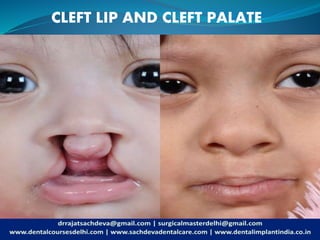
CLEFT LIP AND CLEFT PALATE
Cleft is one of the most common
birth defect highest in Asians with 1
in every 500 births.
Cleft lip is more common in male
and cleft palate is more common in
females.
Unilateral cases occur in 80% cases
with left side more common than
right side.
A cleft occurs when certain body fails to fuse during
fetal development and may occur in the lip or the palate
(roof of the mouth).
Cleft lip is formed at 7-9 weeks of gestation and cleft
palate is formed at 9-11 weeks of gestation.
Cleft lip can occur with or without cleft palate.
They are associated with various other anatomic
defects like clubfoot (talipes), etc.
Defective fusion of medial nasal processes with the
maxillary process leads to cleft lip
Failure of palatine shelves to fuse, leads to cleft
palate
The lateral facial cleft is caused by the lack of
fusion of maxillary & mandibular processes
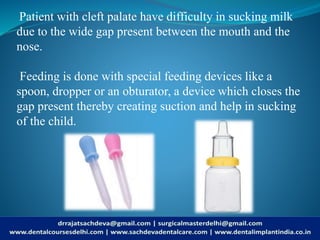
Patient with cleft palate have difficulty in sucking milk
due to the wide gap present between the mouth and the
nose.
Feeding is done with special feeding devices like a
spoon, dropper or an obturator, a device which closes the
gap present thereby creating suction and help in sucking
of the child.
As the child grows, they face difficulty in eating,
swallowing, breathing, etc.
Most of the children with cleft, live in isolation making
it hard to find friends at school or in neighbourhoods.
CAUSES OF CLEFT LIP AND CLEFT PALATE
The exact etiology of cleft is
unknown but studies show that cleft
is multifactorial in origin.
Poor health of the mother during
pregnancy has some effect on the
child. Main causes are listed below-
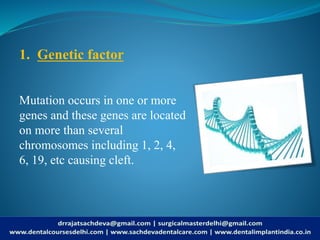
1. Genetic factor
Mutation occurs in one or more
genes and these genes are located
on more than several
chromosomes including 1, 2, 4,
6, 19, etc causing cleft.
2. Family history
Parents born with cleft are more likely to have
children with such defects.
20% chances if one parent have cleft lip, 14%
chances to the next child if a child is born with cleft
lip.
4% chances to the next child, if a non cleft parent
born with cleft lip.
3. Environmental factors
Insecticides and pesticides containing
hexachlorobenzene, cynizine, thiram, etc are known to
cause cleft.
4. Nutritional factors
Excessive vitamins A and deficiency of folic acid during
pregnancy increases the chances of baby born with cleft.
5. Medications
Drugs like tetracycline, metronidazole,
trimethoprime, sulphonamides,
phenytoin, warfarin, ethanol, etc taken
during pregnancy increases the chances
of cleft and other various anomalies.
6. Smoking and drinking
Smoking and drinking during pregnancy
doubles the risk of developing cleft in
new born.
CLASSIFICATION OF CLEFT
CLEFT LIP
Complete or incomplete cleft
Unilateral or bilateral cleft
CLEFT PALATE
Both hard and soft palate
Soft palate only
Bifid uvula
CLASSIFICATION OF CLEFT
COMBINE CLEFT LIPAND CLEFT
PALATE
Unilateral, incomplete or complete cleft lip and
cleft palate
Bilateral, incomplete or complete cleft lip and
cleft palate
DEFORMITIES IN CLEFT
Feeding Problems
Weak sucking, weak swallowing reflex, nasal
regurgitation.
Dental Problems
Number, shape, eruption, mineralization.
Nasal Problems
Flare ala, deviated nasal septum and columella to the
non cleft site.
Skeletal Problems
Maxillary deficiency, mandibular
prognathism.
Speech Problems
pronouncing consonants like g, b, f, etc are
distorted , nasal resonance and problems
with clarity of speech
Ear Problems
Middle ear infection, hearing
problems, possible deafness
Associated Anomalies
Congenital heart defects, mental
retardation
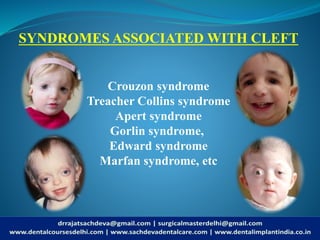
SYNDROMES ASSOCIATED WITH CLEFT
Crouzon syndrome
Treacher Collins syndrome
Apert syndrome
Gorlin syndrome,
Edward syndrome
Marfan syndrome, etc
Dental obturator
For severe cleft patients or those who refuse
for surgery
High rate of closure but the prosthesis need
to modify as the child grows.
TREATMENT
Non Surgical Treatment
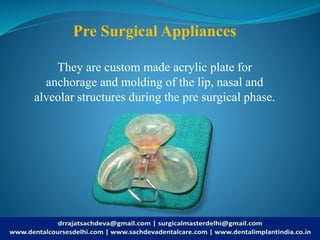
Pre Surgical Appliances
They are custom made acrylic plate for
anchorage and molding of the lip, nasal and
alveolar structures during the pre surgical phase.
SURGICAL MANAGEMENT
The timing and specific techniques used during each
stages of cleft reconstruction of cleft lip and cleft palate
are still controversial.
THE STAGES OF CLEFT REPAIR IN PATIENT WITH
CLEFT LIP AND CLEFT PALATE
Cleft Lip
Rule of 10’s
Hemoglobin = 10g
Weight = 10lbs
Age = 10 weeks
Timing = 6-8 weeks
Cleft Palate
Timing = 9-12 months
Pharyngeal Flap Or Pharyngoplasty
3-5 years or later based on speech development
Alveolar Reconstruction With Bone Grafting
6-9 years based on dental development
Orthognathic Surgery
14-16 years in girls and 16-18 years in boys
Rhinoplasty
After orthognathic surgery
The treatment of cleft lip and palate requires a
multidisciplinary approach by dedicated team of
dental and medical professionals.
The teams need to perform various surgeries over
several years to ensure comprehensive care and
treatment of the patient.
CONCLUSION
Give a smile and get a smile by changing the world
one smile at a time along with organizations like
smile train, cleft children international, smile angel
foundation, operation smile, facing the world,
thousand smiles foundation, etc.
They make them realize that cleft is no longer a
life sentence misery but can be treated effectively
by providing free cleft surgeries to those in needs.
SPREAD SMILE WITH DAYA FOUNDATION as
it is the window that tells others that there is
a caring, sharing person inside.
THANK YOU

Cleft lip/Cleft Palate | Cleft Lip, Cleft Palate: What is a cleft lip, cleft palate? How and when do you repair it?

  • 1.
    CLEFT LIP ANDCLEFT PALATE
  • 2.
    Cleft is oneof the most common birth defect highest in Asians with 1 in every 500 births. Cleft lip is more common in male and cleft palate is more common in females. Unilateral cases occur in 80% cases with left side more common than right side.
  • 3.
    A cleft occurswhen certain body fails to fuse during fetal development and may occur in the lip or the palate (roof of the mouth). Cleft lip is formed at 7-9 weeks of gestation and cleft palate is formed at 9-11 weeks of gestation.
  • 4.
    Cleft lip canoccur with or without cleft palate. They are associated with various other anatomic defects like clubfoot (talipes), etc.
  • 5.
    Defective fusion ofmedial nasal processes with the maxillary process leads to cleft lip Failure of palatine shelves to fuse, leads to cleft palate The lateral facial cleft is caused by the lack of fusion of maxillary & mandibular processes
  • 6.
    Patient with cleftpalate have difficulty in sucking milk due to the wide gap present between the mouth and the nose. Feeding is done with special feeding devices like a spoon, dropper or an obturator, a device which closes the gap present thereby creating suction and help in sucking of the child.
  • 7.
    As the childgrows, they face difficulty in eating, swallowing, breathing, etc. Most of the children with cleft, live in isolation making it hard to find friends at school or in neighbourhoods.
  • 8.
    CAUSES OF CLEFTLIP AND CLEFT PALATE The exact etiology of cleft is unknown but studies show that cleft is multifactorial in origin. Poor health of the mother during pregnancy has some effect on the child. Main causes are listed below-
  • 9.
    1. Genetic factor Mutationoccurs in one or more genes and these genes are located on more than several chromosomes including 1, 2, 4, 6, 19, etc causing cleft.
  • 10.
    2. Family history Parentsborn with cleft are more likely to have children with such defects. 20% chances if one parent have cleft lip, 14% chances to the next child if a child is born with cleft lip. 4% chances to the next child, if a non cleft parent born with cleft lip.
  • 11.
    3. Environmental factors Insecticidesand pesticides containing hexachlorobenzene, cynizine, thiram, etc are known to cause cleft. 4. Nutritional factors Excessive vitamins A and deficiency of folic acid during pregnancy increases the chances of baby born with cleft.
  • 12.
    5. Medications Drugs liketetracycline, metronidazole, trimethoprime, sulphonamides, phenytoin, warfarin, ethanol, etc taken during pregnancy increases the chances of cleft and other various anomalies. 6. Smoking and drinking Smoking and drinking during pregnancy doubles the risk of developing cleft in new born.
  • 13.
    CLASSIFICATION OF CLEFT CLEFTLIP Complete or incomplete cleft Unilateral or bilateral cleft CLEFT PALATE Both hard and soft palate Soft palate only Bifid uvula
  • 14.
    CLASSIFICATION OF CLEFT COMBINECLEFT LIPAND CLEFT PALATE Unilateral, incomplete or complete cleft lip and cleft palate Bilateral, incomplete or complete cleft lip and cleft palate
  • 16.
    DEFORMITIES IN CLEFT FeedingProblems Weak sucking, weak swallowing reflex, nasal regurgitation. Dental Problems Number, shape, eruption, mineralization. Nasal Problems Flare ala, deviated nasal septum and columella to the non cleft site.
  • 17.
    Skeletal Problems Maxillary deficiency,mandibular prognathism. Speech Problems pronouncing consonants like g, b, f, etc are distorted , nasal resonance and problems with clarity of speech
  • 18.
    Ear Problems Middle earinfection, hearing problems, possible deafness Associated Anomalies Congenital heart defects, mental retardation
  • 19.
    SYNDROMES ASSOCIATED WITHCLEFT Crouzon syndrome Treacher Collins syndrome Apert syndrome Gorlin syndrome, Edward syndrome Marfan syndrome, etc
  • 20.
    Dental obturator For severecleft patients or those who refuse for surgery High rate of closure but the prosthesis need to modify as the child grows. TREATMENT Non Surgical Treatment
  • 21.
    Pre Surgical Appliances Theyare custom made acrylic plate for anchorage and molding of the lip, nasal and alveolar structures during the pre surgical phase.
  • 22.
    SURGICAL MANAGEMENT The timingand specific techniques used during each stages of cleft reconstruction of cleft lip and cleft palate are still controversial.
  • 23.
    THE STAGES OFCLEFT REPAIR IN PATIENT WITH CLEFT LIP AND CLEFT PALATE Cleft Lip Rule of 10’s Hemoglobin = 10g Weight = 10lbs Age = 10 weeks Timing = 6-8 weeks Cleft Palate Timing = 9-12 months
  • 24.
    Pharyngeal Flap OrPharyngoplasty 3-5 years or later based on speech development Alveolar Reconstruction With Bone Grafting 6-9 years based on dental development Orthognathic Surgery 14-16 years in girls and 16-18 years in boys Rhinoplasty After orthognathic surgery
  • 25.
    The treatment ofcleft lip and palate requires a multidisciplinary approach by dedicated team of dental and medical professionals. The teams need to perform various surgeries over several years to ensure comprehensive care and treatment of the patient. CONCLUSION
  • 27.
    Give a smileand get a smile by changing the world one smile at a time along with organizations like smile train, cleft children international, smile angel foundation, operation smile, facing the world, thousand smiles foundation, etc. They make them realize that cleft is no longer a life sentence misery but can be treated effectively by providing free cleft surgeries to those in needs.
  • 28.
    SPREAD SMILE WITHDAYA FOUNDATION as it is the window that tells others that there is a caring, sharing person inside.
  • 31.