CONSERVATIVE
CARIES
MANAGMENT
D R : A H M E D I S M A I L
T E A C H E R A S S I S T A N T A T D E N T A L B I O M A T E R I A L S D E P A R T M E N T ,
A I N S H A M S U N I V E R S I T Y , C A I R O , E G Y P T
D R . A M E D I S M A I L E @ G M A I L . C O M
• Prevention is much better than
treatment but once the cavitation
occurs our only resort will be to
conservatively treat the existing carious
lesion
Minimally invasive (MI)
treatment of dental caries is an
approach that considers handling of
carious lesions with conservative
techniques to preserve as much tooth
structure as possible
Conservative strategies for
managing cavitations in
Enamel orand Dentin
A) Mechanical
B) Chemico-mechanical
C) Physical
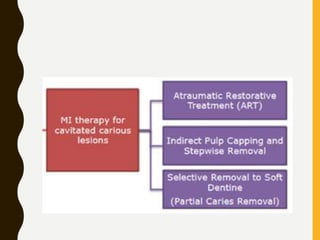
MECHANICAL:
stepwise removal, or selective
removal to soft dentine
1) ART
2) Indirect pulp caping
3) stepwise removal
4) selective removal to soft dentine
ART
partial removal of the involved tissues
with hand instruments and their
subsequent
restoration with high viscosity GI
Several studies with ART suggest that this
therapy has a comparable success rate than
traditional complete removal technique and
the subsequent restoration with composite
resin or
amalgam
ART
A meta-analysis on the survival of ART
restorations
found survival rates on one surface and
multiple
surfaces in primary teeth for more than 2 years
of 93% and 62%, respectively
In permanent teeth, ART restorations on one
surface exhibited survival at 3 and 5 years of
85%
ART
Similarly, another systematic review
showed a survival of ART
restorations on one surface of 95%
and 86% at 1 and 3 years,
respectively and of 72% at 6 years
after placement.
ART
The available evidence suggests that ART is a
scientifically-supported MI treatment. Since this
technique allows treatment in non-clinical
settings
at low cost, it may enhance access to care for
the community, especially in developing
countries
ART
Importantly, ART restorations on multiple
surfaces appear to be less successful and
would require more complex restorations
to ensure greater longevity.
IPC
 Involves leaving a thin layer of demineralized
tissue over the pulp which is covered by a
protective liner
 Final restoration is made in the same session
 The material used for pulp protection does
not appear to influence treatment success,
according to a Cochrane review.
IPC
Lesion arrest was reported in
primary teeth with a success rate of
78% at 4 years, with no difference
between an adhesive system and
calcium hydroxide used as liners
IPC
The main disadvantage of IPC is that
it involves procedures that are quite
close to the pulp, thereby increasing
the chances of pulp exposure
SW Excavation
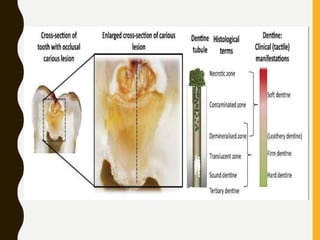
 involves lesion removal in 2 stages.
 Stepwise removal technique consists
of a first step involving partial carious
tissue removal, leaving soft carious
tissue on the pulpal cavity floor of a
deep carious lesion, in a vital tooth.
Teeth are temporarily restored for a
period of up to 12 months
A re-entry is then necessary to remove the
carious tissue to firm dentine, followed by a
permanent final restoration. During the
temporary sealing, the soft carious dentine,
which was intentionally left remaining,
becomes harder and drier, both characteristics
of inactive lesions, exhibiting a low level of
bacterial infection.
SW Excavation
SW Excavation
The objective of this procedure is to
facilitate the physiological reaction of the
pulp-dentine complex, including dentinal
sclerosis and tertiary dentine formation.
Thus a 2-step process ensures pulp
protection by minimizing the risk of
exposure.
Several studies have indicated that SW
is a highly successful procedure. A
recent meta-analysis has revealed a 56%
reduction in the incidence of pulp
exposure in SW excavation compared to
complete caries removal or non-
selective to hard dentine, as it is the
most recently agreed term
SW Excavation (Pros)
1- The risk of pulp exposure during re-entry
2- The failure of the temporary restoration
3- Increased costs resulting from the 2 sessions that are required to complete
treatment
4- some patients do not return for the final restoration due to the absence of
symptoms
SW Excavation (Cons)
Partial caries removal (Selective
removal to soft dentine)
In this strategy the final restoration
should be performed during the same
session, completing the procedure in a
single appointment. In fact, it has been
suggested that re-entering the cavity
after partial or selective removal in the
SW technique is unnecessary
Partial caries removal (Selective
removal to soft dentine)
In the selective removal of soft dentine
technique, selective removal to firm dentine
from the lateral walls of the lesion is
necessary, removing gently and without
pressure only the most outer layer of
softened dentine from the pulp wall with
manual or rotary instrumentation, and
placing the final restoration in the same
session.
A study that followed a cohort of patients
treated with selective removal to soft dentine
showed that 12 of 13 teeth with lesions
remained unchanged for 10 years.
The results showed a success rate of 91%
with selective removal to soft dentine
compared with 69% for the SW technique
Partial caries removal (Selective
removal to soft dentine)
Considering that selective removal to soft
dentine is even more MI and
conservative than IPC or SW, the risk of
pulp exposure was expected to be even
lower
Partial caries removal (Selective
removal to soft dentine)
B) Chemico-mech
chemomechanical caries removal is
generally considered as an effective
alternative to the traditional rotary
drilling method.
Chemico-mech
technique which removes infected dentin
through a chemical agent followed by
caries excavation with hand excavators
without pressure . It preserves healthy
structures, avoids pulp irritation, and
patient discomfort
Classification of products
1- GK-101 (1972)
2- Caridex (1984)
3- Caisolve (1998)
4- Pa-pacarie , Caricare (2003)
Chemico-mech
GK-101 in 1972 . It consisted of a non-specific
proteolytic agent, sodium hypo-chlorite in Sorensen’s
buffer
Caridex, uses three amino acids – lysine, leucine and
glutamic acid– to enhance the effect of sodium
hypochlorite on denatured collagen, and to decrease
the involvement of healthy hard dental tissue
Papacarie™, developed in 2003, has bactericidal,
bacteriostatic and anti-inflammatory characteristics
due to the presence of papain, chloramines and
toluidine blue salts in a thickening medium
Pros of chemico-mech
caries removal
Decreasing the level of patient’s fear and
anxiety caused by the use of rotary noise
and anesthesia
Cons of chemico-mech
caries removal
1- Taste of the liquid
2- Short shelf life
3- Requirement of special equipment
4- Heat evolution
5- Prolonged chair time
C) Physical (Photodynamic
antimicrobial
chemotherapy)
This therapy involves photosensitizing
agents, such as toluidine blue ortho (TBO),
which are activated by irradiation with light
of a specific wavelength to generate
cytotoxic species, including singlet oxygen
and free radicals capable of damaging
essential components of the cells or
modifying metabolic activities in an
irreversible way, resulting in a faster
bacterial killing effect
Pros
1) Rapid noninvasive topical
application of the photosensitizer in
the carious lesion
2) The bacterial killing after a short
exposure to light
3) No chance for resistance
development
Cons
1) Gap between what can be achieved
through a clinical intervention and
what is accomplished in pre-clinical
studies
2) Lack of outcomes for this therapy
under real situation factors (mixed
bacterial community enclosed within the
demineralized dentin structure)
Factors affecting success
of this TTT modlity
1) Structural proprieties of the
bacteria
2) The source of light used
3) The type of photosensitizers and
its concentration, solubility, and
polarity

Conservative caries management

  • 1.
    CONSERVATIVE CARIES MANAGMENT D R :A H M E D I S M A I L T E A C H E R A S S I S T A N T A T D E N T A L B I O M A T E R I A L S D E P A R T M E N T , A I N S H A M S U N I V E R S I T Y , C A I R O , E G Y P T D R . A M E D I S M A I L E @ G M A I L . C O M
  • 2.
    • Prevention ismuch better than treatment but once the cavitation occurs our only resort will be to conservatively treat the existing carious lesion
  • 3.
    Minimally invasive (MI) treatmentof dental caries is an approach that considers handling of carious lesions with conservative techniques to preserve as much tooth structure as possible
  • 4.
    Conservative strategies for managingcavitations in Enamel orand Dentin A) Mechanical B) Chemico-mechanical C) Physical
  • 5.
    MECHANICAL: stepwise removal, orselective removal to soft dentine 1) ART 2) Indirect pulp caping 3) stepwise removal 4) selective removal to soft dentine
  • 7.
    ART partial removal ofthe involved tissues with hand instruments and their subsequent restoration with high viscosity GI Several studies with ART suggest that this therapy has a comparable success rate than traditional complete removal technique and the subsequent restoration with composite resin or amalgam
  • 8.
    ART A meta-analysis onthe survival of ART restorations found survival rates on one surface and multiple surfaces in primary teeth for more than 2 years of 93% and 62%, respectively In permanent teeth, ART restorations on one surface exhibited survival at 3 and 5 years of 85%
  • 9.
    ART Similarly, another systematicreview showed a survival of ART restorations on one surface of 95% and 86% at 1 and 3 years, respectively and of 72% at 6 years after placement.
  • 10.
    ART The available evidencesuggests that ART is a scientifically-supported MI treatment. Since this technique allows treatment in non-clinical settings at low cost, it may enhance access to care for the community, especially in developing countries
  • 11.
    ART Importantly, ART restorationson multiple surfaces appear to be less successful and would require more complex restorations to ensure greater longevity.
  • 12.
    IPC  Involves leavinga thin layer of demineralized tissue over the pulp which is covered by a protective liner  Final restoration is made in the same session  The material used for pulp protection does not appear to influence treatment success, according to a Cochrane review.
  • 13.
    IPC Lesion arrest wasreported in primary teeth with a success rate of 78% at 4 years, with no difference between an adhesive system and calcium hydroxide used as liners
  • 14.
    IPC The main disadvantageof IPC is that it involves procedures that are quite close to the pulp, thereby increasing the chances of pulp exposure
  • 15.
    SW Excavation  involveslesion removal in 2 stages.  Stepwise removal technique consists of a first step involving partial carious tissue removal, leaving soft carious tissue on the pulpal cavity floor of a deep carious lesion, in a vital tooth. Teeth are temporarily restored for a period of up to 12 months
  • 17.
    A re-entry isthen necessary to remove the carious tissue to firm dentine, followed by a permanent final restoration. During the temporary sealing, the soft carious dentine, which was intentionally left remaining, becomes harder and drier, both characteristics of inactive lesions, exhibiting a low level of bacterial infection. SW Excavation
  • 18.
    SW Excavation The objectiveof this procedure is to facilitate the physiological reaction of the pulp-dentine complex, including dentinal sclerosis and tertiary dentine formation. Thus a 2-step process ensures pulp protection by minimizing the risk of exposure.
  • 19.
    Several studies haveindicated that SW is a highly successful procedure. A recent meta-analysis has revealed a 56% reduction in the incidence of pulp exposure in SW excavation compared to complete caries removal or non- selective to hard dentine, as it is the most recently agreed term SW Excavation (Pros)
  • 20.
    1- The riskof pulp exposure during re-entry 2- The failure of the temporary restoration 3- Increased costs resulting from the 2 sessions that are required to complete treatment 4- some patients do not return for the final restoration due to the absence of symptoms SW Excavation (Cons)
  • 21.
    Partial caries removal(Selective removal to soft dentine) In this strategy the final restoration should be performed during the same session, completing the procedure in a single appointment. In fact, it has been suggested that re-entering the cavity after partial or selective removal in the SW technique is unnecessary
  • 22.
    Partial caries removal(Selective removal to soft dentine) In the selective removal of soft dentine technique, selective removal to firm dentine from the lateral walls of the lesion is necessary, removing gently and without pressure only the most outer layer of softened dentine from the pulp wall with manual or rotary instrumentation, and placing the final restoration in the same session.
  • 23.
    A study thatfollowed a cohort of patients treated with selective removal to soft dentine showed that 12 of 13 teeth with lesions remained unchanged for 10 years. The results showed a success rate of 91% with selective removal to soft dentine compared with 69% for the SW technique Partial caries removal (Selective removal to soft dentine)
  • 24.
    Considering that selectiveremoval to soft dentine is even more MI and conservative than IPC or SW, the risk of pulp exposure was expected to be even lower Partial caries removal (Selective removal to soft dentine)
  • 25.
    B) Chemico-mech chemomechanical cariesremoval is generally considered as an effective alternative to the traditional rotary drilling method.
  • 26.
    Chemico-mech technique which removesinfected dentin through a chemical agent followed by caries excavation with hand excavators without pressure . It preserves healthy structures, avoids pulp irritation, and patient discomfort
  • 27.
    Classification of products 1-GK-101 (1972) 2- Caridex (1984) 3- Caisolve (1998) 4- Pa-pacarie , Caricare (2003)
  • 28.
    Chemico-mech GK-101 in 1972. It consisted of a non-specific proteolytic agent, sodium hypo-chlorite in Sorensen’s buffer Caridex, uses three amino acids – lysine, leucine and glutamic acid– to enhance the effect of sodium hypochlorite on denatured collagen, and to decrease the involvement of healthy hard dental tissue Papacarie™, developed in 2003, has bactericidal, bacteriostatic and anti-inflammatory characteristics due to the presence of papain, chloramines and toluidine blue salts in a thickening medium
  • 29.
    Pros of chemico-mech cariesremoval Decreasing the level of patient’s fear and anxiety caused by the use of rotary noise and anesthesia
  • 30.
    Cons of chemico-mech cariesremoval 1- Taste of the liquid 2- Short shelf life 3- Requirement of special equipment 4- Heat evolution 5- Prolonged chair time
  • 31.
    C) Physical (Photodynamic antimicrobial chemotherapy) Thistherapy involves photosensitizing agents, such as toluidine blue ortho (TBO), which are activated by irradiation with light of a specific wavelength to generate cytotoxic species, including singlet oxygen and free radicals capable of damaging essential components of the cells or modifying metabolic activities in an irreversible way, resulting in a faster bacterial killing effect
  • 32.
    Pros 1) Rapid noninvasivetopical application of the photosensitizer in the carious lesion 2) The bacterial killing after a short exposure to light 3) No chance for resistance development
  • 33.
    Cons 1) Gap betweenwhat can be achieved through a clinical intervention and what is accomplished in pre-clinical studies 2) Lack of outcomes for this therapy under real situation factors (mixed bacterial community enclosed within the demineralized dentin structure)
  • 34.
    Factors affecting success ofthis TTT modlity 1) Structural proprieties of the bacteria 2) The source of light used 3) The type of photosensitizers and its concentration, solubility, and polarity