Overview of the Tanzanian dairy industry
challenges and opportunities
Charles M.D. Mutagwaba
CLEANED Project East Africa Stakeholder Consultation on Dairy and Environment
Nairobi, Kenya, 18 September 2013
DAIRY DEVELOPMENT HISTORY
1961-1965 private commercial farms and
processing plants dominated the industry.
Farmers owned 25 – 40% shares in the
milk processing plants which were run
by zonal dairy Boards
1965 a dairy industry law was enacted that
created a government controlled national
dairy Board (NDB). The Board operated
until 1973.
• 1974 a Livestock Development Authority
(LIDA) was established and two
subsidiary companies DAFCO and TDL
were among several subsidiary
companies that were established under
LIDA.
• In mid 1980’s - The economic
liberalization of the public institutions
which led to privatization of all seven
TDL milk processing plants.
• 1998 nearly all milk plants and some
DAFCO farms as well had been
privatized.
• Informal milk marketing of milk
continued to dominate the market for
liquid milk
• 1998 during the 2nd
NDDC held in
Arusha observed that the industry
was uncoordinated and poorly
organized need an organ or a
Board as the Dairy Industry Act
Cap 590 of 1965 was moribund
and, there was no national
institution to regulate and co-
ordinate the orderly development of
the industry.
• 2004 the dairy industry bill was
enacted and provides for a dairy
board
MILK PRODUCTION
• Total milk production 2010/11
reported to 1.92 billion lts.(MLFD 2012/13)
• Total number of cattle 22.8 million
(MLFD 2012/13)
• Number of improved Dairy cattle is
about 740,000 kept by about 218,418
HH and produce 30% of total milk
produced (NBS)
• 70% of total milk produced comes
from local cattle kept by an
estimated 1.6 million HH
…Milk production contd
• 70% of milk produced by traditional
sector, 90% consumed on farm and 10
% sold (8% in informal market and 2%
in formal market)
• 30% of milk produced from ‘dairy herd’,
30% consumed at home and 70% sold
(60% informal market and 10% formal
market)
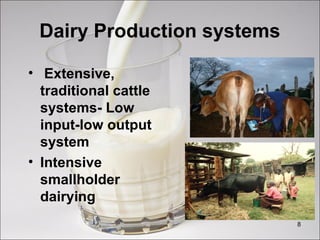
Dairy Production systems
• Extensive,
traditional cattle
systems- Low
input-low output
system
• Intensive
smallholder
dairying
8
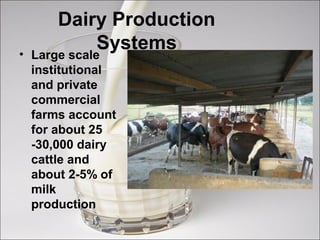
Dairy Production
Systems• Large scale
institutional
and private
commercial
farms account
for about 25
-30,000 dairy
cattle and
about 2-5% of
milk
production
10
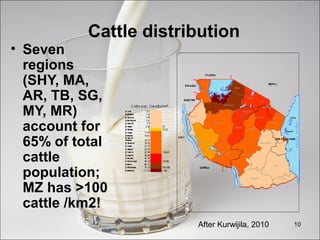
Cattle distribution
• Seven
regions
(SHY, MA,
AR, TB, SG,
MY, MR)
account for
65% of total
cattle
population;
MZ has >100
cattle /km2!
After Kurwijila, 2010
11
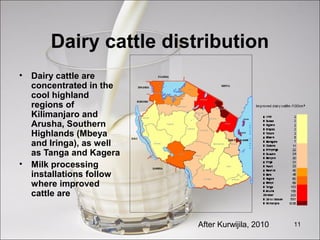
Dairy cattle distribution
• Dairy cattle are
concentrated in the
cool highland
regions of
Kilimanjaro and
Arusha, Southern
Highlands (Mbeya
and Iringa), as well
as Tanga and Kagera
• Milk processing
installations follow
where improved
cattle are
After Kurwijila, 2010
12
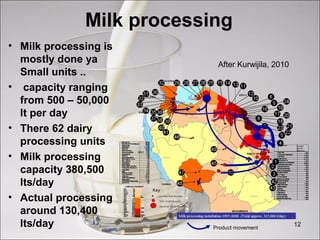
Milk processing
Product movement
• Milk processing is
mostly done ya
Small units ..
• capacity ranging
from 500 – 50,000
lt per day
• There 62 dairy
processing units
• Milk processing
capacity 380,500
lts/day
• Actual processing
around 130,400
lts/day
After Kurwijila, 2010
MILK PROCESSING
• Capacity utilisation 30%
• Range of products - Fresh (20%),Mala (70%), Ghee
(7%), Siagi (2%) Jibini (1%)
• Therefore, there is a shortage of value added
products
• Shortage of value added products is covered by
imports
• Tanzania imported US$ 5.0million worth of value
added products in 2006/07
• IMPORTS: 25-30 million Liquid milk equivalents i.e.
For every packet of locally processed milk on
Tanzania supermarket, there is one packet of
imported milk!!
MILK CONSUMPTION
• Per capita milk consumption 45.0
lts/annum
• Recommended level is 200 lts per head
per annum.
SUMMARY
• Milk production generally low due
shortage of dairy cattle,
• Seasonality in Milk Production (37-60%)
during the dry season
• Very little milk gets collected and
processed due to unorganised farmers
and scatterness of production units
• Per capita milk consumption very low,
due to low production, high cost, and
poor marketing
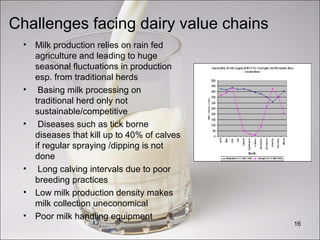
Challenges facing dairy value chains
• Milk production relies on rain fed
agriculture and leading to huge
seasonal fluctuations in production
esp. from traditional herds
• Basing milk processing on
traditional herd only not
sustainable/competitive
• Diseases such as tick borne
diseases that kill up to 40% of calves
if regular spraying /dipping is not
done
• Long calving intervals due to poor
breeding practices
• Low milk production density makes
milk collection uneconomical
• Poor milk handling equipment
16
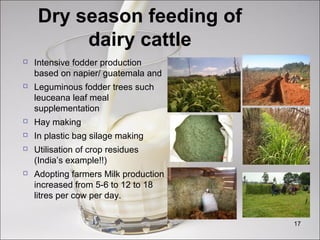
Dry season feeding of
dairy cattle
 Intensive fodder production
based on napier/ guatemala and
 Leguminous fodder trees such
leuceana leaf meal
supplementation
 Hay making
 In plastic bag silage making
 Utilisation of crop residues
(India’s example!!)
 Adopting farmers Milk production
increased from 5-6 to 12 to 18
litres per cow per day.
17
STRATEGIES NEEDED TO IMPROVE
PERFORMANCE OF THE DAIRY
SECTOR
Strategy 1: increase milk
production
- Improving skills of farmers on hygienic milk
production and better animal husbandry.
Farmer training using EA harmonised training manuals being
undertaken in Tanzania.
- Improving genetic potential of animals to
increase production per cow. AI facilities being
established in zonal centres in Tanzania
- Assuring milk market by improving milk
collection and prompt payment for the milk.
Milk pockets studies being undertaken to locate areas with
collectable milk
Strategy 2: Improve milk
processing
- Improving availability of finance for
long term low interest loans
- Investment in milk collection centres
and transportation facilities
- Market development by introducing
new products
- Lobby for favourable dairy business
environment
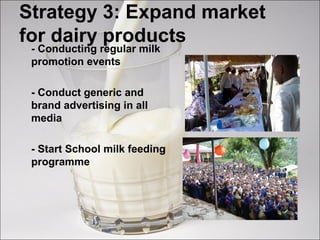
Strategy 3: Expand market
for dairy products
- Conducting regular milk
promotion events
- Conduct generic and
brand advertising in all
media
- Start School milk feeding
programme
Strategy 4: Strengthen dairy
development institutions
• Strengthen grassroots farmers
organisations
• Strengthening the Tanzania Dairy
Board
• Strengthening the stakeholder
organisations e.g. TAMPRODA and
TAMPA at all levels for a stronger
private sector public sector partnership
Strategy 4: CONTD
• Strengthen regional groups e.g.
EADRAC (East African Dairy Regulatory Authorities Council)
to be able to handle regional trade
disputes before getting out of control
• Initiate regional milk products
consumption promotion events to
expand market for value added
products.
Conclusions
• There is no doubt, in my view, that
successful dairy production, processing and
marketing is possible in many regions in
Tanzania if the right approaches and required
support for smallholders can be made
• Dairying can transform the lives of the poor
faster than any other commodity.
• Attention to the entire value chain is
important for success
24
THANK YOU FOR YOUR
ATTENTION

Overview of the Tanzanian dairy industry challenges and opportunities

  • 1.
    Overview of theTanzanian dairy industry challenges and opportunities Charles M.D. Mutagwaba CLEANED Project East Africa Stakeholder Consultation on Dairy and Environment Nairobi, Kenya, 18 September 2013
  • 2.
    DAIRY DEVELOPMENT HISTORY 1961-1965private commercial farms and processing plants dominated the industry. Farmers owned 25 – 40% shares in the milk processing plants which were run by zonal dairy Boards 1965 a dairy industry law was enacted that created a government controlled national dairy Board (NDB). The Board operated until 1973.
  • 3.
    • 1974 aLivestock Development Authority (LIDA) was established and two subsidiary companies DAFCO and TDL were among several subsidiary companies that were established under LIDA.
  • 4.
    • In mid1980’s - The economic liberalization of the public institutions which led to privatization of all seven TDL milk processing plants. • 1998 nearly all milk plants and some DAFCO farms as well had been privatized. • Informal milk marketing of milk continued to dominate the market for liquid milk
  • 5.
    • 1998 duringthe 2nd NDDC held in Arusha observed that the industry was uncoordinated and poorly organized need an organ or a Board as the Dairy Industry Act Cap 590 of 1965 was moribund and, there was no national institution to regulate and co- ordinate the orderly development of the industry. • 2004 the dairy industry bill was enacted and provides for a dairy board
  • 6.
    MILK PRODUCTION • Totalmilk production 2010/11 reported to 1.92 billion lts.(MLFD 2012/13) • Total number of cattle 22.8 million (MLFD 2012/13) • Number of improved Dairy cattle is about 740,000 kept by about 218,418 HH and produce 30% of total milk produced (NBS) • 70% of total milk produced comes from local cattle kept by an estimated 1.6 million HH
  • 7.
    …Milk production contd •70% of milk produced by traditional sector, 90% consumed on farm and 10 % sold (8% in informal market and 2% in formal market) • 30% of milk produced from ‘dairy herd’, 30% consumed at home and 70% sold (60% informal market and 10% formal market)
  • 8.
    Dairy Production systems •Extensive, traditional cattle systems- Low input-low output system • Intensive smallholder dairying 8
  • 9.
    Dairy Production Systems• Largescale institutional and private commercial farms account for about 25 -30,000 dairy cattle and about 2-5% of milk production
  • 10.
    10 Cattle distribution • Seven regions (SHY,MA, AR, TB, SG, MY, MR) account for 65% of total cattle population; MZ has >100 cattle /km2! After Kurwijila, 2010
  • 11.
    11 Dairy cattle distribution •Dairy cattle are concentrated in the cool highland regions of Kilimanjaro and Arusha, Southern Highlands (Mbeya and Iringa), as well as Tanga and Kagera • Milk processing installations follow where improved cattle are After Kurwijila, 2010
  • 12.
    12 Milk processing Product movement •Milk processing is mostly done ya Small units .. • capacity ranging from 500 – 50,000 lt per day • There 62 dairy processing units • Milk processing capacity 380,500 lts/day • Actual processing around 130,400 lts/day After Kurwijila, 2010
  • 13.
    MILK PROCESSING • Capacityutilisation 30% • Range of products - Fresh (20%),Mala (70%), Ghee (7%), Siagi (2%) Jibini (1%) • Therefore, there is a shortage of value added products • Shortage of value added products is covered by imports • Tanzania imported US$ 5.0million worth of value added products in 2006/07 • IMPORTS: 25-30 million Liquid milk equivalents i.e. For every packet of locally processed milk on Tanzania supermarket, there is one packet of imported milk!!
  • 14.
    MILK CONSUMPTION • Percapita milk consumption 45.0 lts/annum • Recommended level is 200 lts per head per annum.
  • 15.
    SUMMARY • Milk productiongenerally low due shortage of dairy cattle, • Seasonality in Milk Production (37-60%) during the dry season • Very little milk gets collected and processed due to unorganised farmers and scatterness of production units • Per capita milk consumption very low, due to low production, high cost, and poor marketing
  • 16.
    Challenges facing dairyvalue chains • Milk production relies on rain fed agriculture and leading to huge seasonal fluctuations in production esp. from traditional herds • Basing milk processing on traditional herd only not sustainable/competitive • Diseases such as tick borne diseases that kill up to 40% of calves if regular spraying /dipping is not done • Long calving intervals due to poor breeding practices • Low milk production density makes milk collection uneconomical • Poor milk handling equipment 16
  • 17.
    Dry season feedingof dairy cattle  Intensive fodder production based on napier/ guatemala and  Leguminous fodder trees such leuceana leaf meal supplementation  Hay making  In plastic bag silage making  Utilisation of crop residues (India’s example!!)  Adopting farmers Milk production increased from 5-6 to 12 to 18 litres per cow per day. 17
  • 18.
    STRATEGIES NEEDED TOIMPROVE PERFORMANCE OF THE DAIRY SECTOR
  • 19.
    Strategy 1: increasemilk production - Improving skills of farmers on hygienic milk production and better animal husbandry. Farmer training using EA harmonised training manuals being undertaken in Tanzania. - Improving genetic potential of animals to increase production per cow. AI facilities being established in zonal centres in Tanzania - Assuring milk market by improving milk collection and prompt payment for the milk. Milk pockets studies being undertaken to locate areas with collectable milk
  • 20.
    Strategy 2: Improvemilk processing - Improving availability of finance for long term low interest loans - Investment in milk collection centres and transportation facilities - Market development by introducing new products - Lobby for favourable dairy business environment
  • 21.
    Strategy 3: Expandmarket for dairy products - Conducting regular milk promotion events - Conduct generic and brand advertising in all media - Start School milk feeding programme
  • 22.
    Strategy 4: Strengthendairy development institutions • Strengthen grassroots farmers organisations • Strengthening the Tanzania Dairy Board • Strengthening the stakeholder organisations e.g. TAMPRODA and TAMPA at all levels for a stronger private sector public sector partnership
  • 23.
    Strategy 4: CONTD •Strengthen regional groups e.g. EADRAC (East African Dairy Regulatory Authorities Council) to be able to handle regional trade disputes before getting out of control • Initiate regional milk products consumption promotion events to expand market for value added products.
  • 24.
    Conclusions • There isno doubt, in my view, that successful dairy production, processing and marketing is possible in many regions in Tanzania if the right approaches and required support for smallholders can be made • Dairying can transform the lives of the poor faster than any other commodity. • Attention to the entire value chain is important for success 24
  • 25.
    THANK YOU FORYOUR ATTENTION