Doodh Ka Doodh Pani Ka Pani
An Interesting Fact

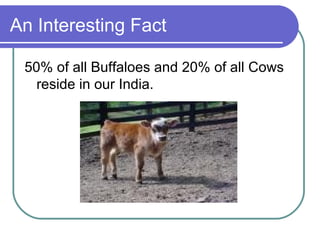
 50% of all Buffaloes and 20% of all Cows
   reside in our India.
Flash Back!


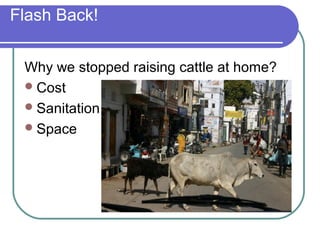
 Why we stopped raising cattle at home?
  Cost
  Sanitation
  Space
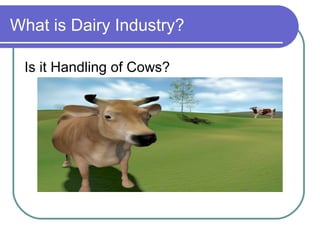
What is Dairy Industry?

 Is it Handling of Cows?
Dairy Industry

  Handling of Milk
  Handling of Milk Products
  Marketing of Milk and Milk Products
  Dairy Technology
Dairy Technology

 It’s a Science of :
  Milk processing
  Manufacture
Operation Flood

  Launched  in 1970
  Flood of Milk
  Augment Rural Income
  Ensuring Fair Prices
  Three Phases
First Phase (1970 – 1980)

  Supportfrom Europe through World
   Food Programme
  NDDB’s Role
  Connecting Milk sheds with consumers
Second Phase (1981 to 1985)

  Milksheds  increased to 136
  290 Urban Markets
  43000 Village Co-operatives
  4.25 Million Milk Producers
Third Phase

  Co-operatives    Expanded
  Infrastructure
  CattleHealth Care
  Education
  30,000 New Dairies
  Women Participation
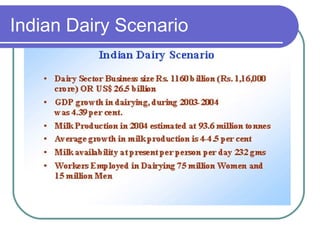
Indian Dairy Industry

  One   of the fastest growing sectors in
   India, with a total size of about INR1160
   billion (INR 1,16,000 crore) OR US$
   26.5 billion.
  In Dairying, 75 million women are
   engaged as against 15 million men.
Indian Dairy Scenario
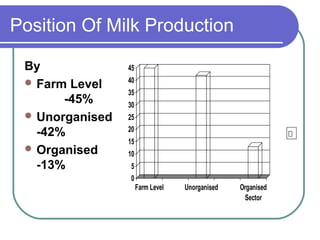
Position Of Milk Production

 By              45
  Farm Level    40
                 35
       -45%      30
  Unorganised   25
                 20
   -42%
                 15
  Organised     10
   -13%          5
                 0
                      Farm Level   Unorganised   Organised
                                                  Sector
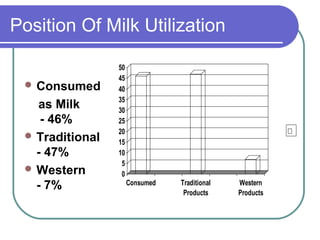
Position Of Milk Utilization

                 50
                 45
  Consumed      40
                 35
   as Milk       30
    - 46%        25
                 20
  Traditional
                 15
   - 47%         10
                  5
  Western        0
   - 7%               Consumed   Traditional
                                  Products
                                               Western
                                               Products
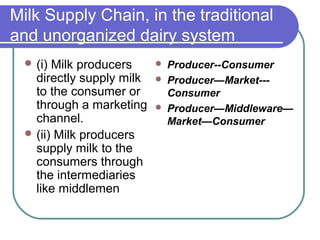
Milk Supply Chain, in the traditional
and unorganized dairy system
   (i) Milk producers        Producer--Consumer
    directly supply milk      Producer—Market---
    to the consumer or         Consumer
    through a marketing       Producer—Middleware—
    channel.                   Market—Consumer
   (ii) Milk producers
    supply milk to the
    consumers through
    the intermediaries
    like middlemen
Unorganized Dairy System
  Retailingof Milk in India is thoroughly
   unorganized.
  There is no supply chain management
   perspective.
  An overwhelming proportion of the Rs.
   400,000 crore retail market is
   UNORGANISED. In fact, only a Rs.
   20,000 crore segment of the market is
   organised.
Unorganized Dairy System

  As  much as 96 per cent of the 5 million-
   plus outlets are smaller than 500 square
   feet in area.
  India per capita retailing space is about
   2 square feet thus the lowest in the world
   .
  Just over 8 per cent of India's population
   is engaged in retailing.
Milk Supply Chain, in the traditional
and Organized dairy system
   (i) Producers’ milk reaches private
    processors directly and After Processing it
    reaches Consumer.
   (ii) Milk producers supply their milk to
    primary cooperative society, which inter
    alia supplies to secondary cooperative. The
    milk, after processing , reaches consumers
    via marketing channel, either directly or
    through apex cooperative.
Milk Supply Chain, in the traditional
and Organized dairy system
   Producer—Private   Processor—
    Consumer
   Producer—Middlemen—Market—
    Consumer
   Producer—Primary/Secondary
    Cooperative Society—Apex Society—
    Market—Consumer
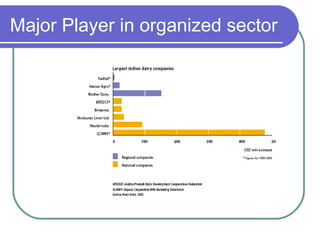
Major Player in organized sector
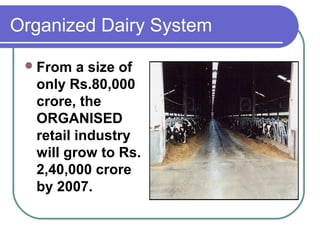
Organized Dairy System

  From  a size of
  only Rs.80,000
  crore, the
  ORGANISED
  retail industry
  will grow to Rs.
  2,40,000 crore
  by 2007.
Challenge for Organized Sector

  Competition   from the unorganised
   sector.
  Organised sector have big expenses to
   meet.
  Organised retailing also has to cope
   with the middle class psychology that the
   bigger and brighter a sales outlet is, the
   more expensive it will be.
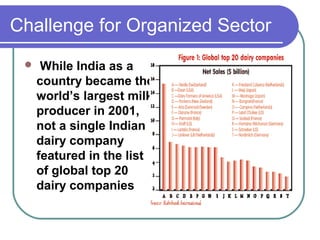
Challenge for Organized Sector
     While India as a
     country became the
     world’s largest milk
     producer in 2001,
     not a single Indian
     dairy company
     featured in the list
     of global top 20
     dairy companies
Opportunity for Organized Sector

  Economic   and demographic changes
  including rising disposable incomes.
  A growing proportion of working
  women becoming a part of the urban
  population.
  Greater awareness due to exposure to
  global trends
Turning Point for Organised Sector

  The  dairy industry was de-licensed in
   1991.
  No license is required for setting up of
   large-scale production facilities for
   manufacture of ice cream.
  The exemption limit is increased for
   compulsory registration of dairy plants,
   from the present 10,000 litres a day to
   20,000 litres.
Position Of Organized Sector

  There  are 678 manufacturing units
  registered with the Central and State
  Governments.
  The combined capacity of these units is
  73 million litres per day while they
  process about 29 million litres per day.
  Significant excess capacity.
New Activities

  Launching    of Venture Capital Fund
   for Dairy ----scheme is being implemented
   through NABARD to provide loans to
   entrepreneurs in dairy and poultry sectors at a
   lower rate of interest.
           -----The objectives are to encourage clean
   milk production, promote use of modern
   technology in dairy farms and to bring the milk
   produced in the unorganised sector to organised
   sector.
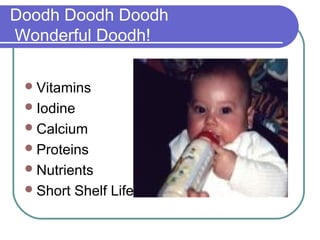
Doodh Doodh Doodh
Wonderful Doodh!

  Vitamins
  Iodine
  Calcium
  Proteins
  Nutrients
  Short   Shelf Life
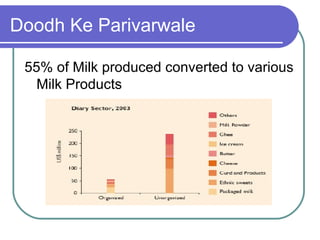
Doodh Ke Parivarwale

 55% of Milk produced converted to various
   Milk Products
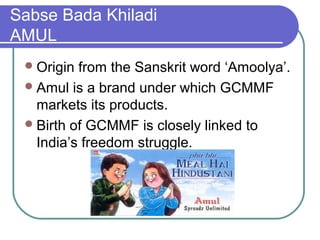
Sabse Bada Khiladi
AMUL
  Origin from the Sanskrit word ‘Amoolya’.
  Amul is a brand under which GCMMF
   markets its products.
  Birth of GCMMF is closely linked to
   India’s freedom struggle.
The Birth of Amul
  FirstCo-operative formed on 4th Jan 1946.
  Kaira District Co-operative Milk Producers
   Union Ltd. formed 14th Dec 1946.
  Gujarat Co-operative Milk Marketing
   Federation (GCMMF) was formed in 1973.
  Dr. Verghese Kurien was the architect of
   Amul’s success.
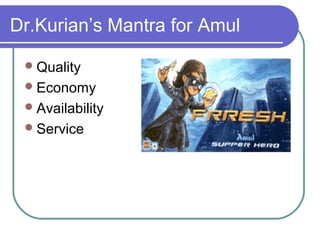
Dr.Kurian’s Mantra for Amul

  Quality
  Economy
  Availability
  Service
Aaj Ka Amul
  GCMMF      is India’s largest food products
   marketing organisation.
  12 district co-operative milk producers’
   union.
  2.5 million producer members.
  2.28 billion litres milk collected in 2005-
   2006.
  Sales turnover stands at Rs.37736
   million in 2005-06 (Rs.13790 million in
   1995-96)
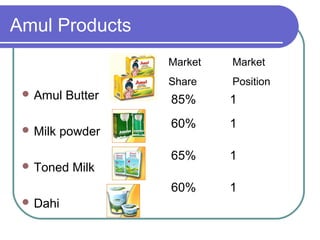
Amul Products
                   Market   Market
                   Share    Position
  Amul   Butter   85%      1

  Milk
                   60%      1
          powder
                   65%      1
  Toned   Milk
                   60%      1
  Dahi
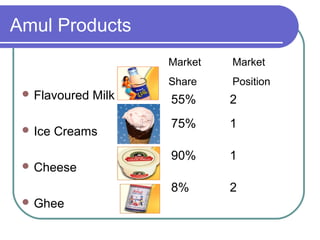
Amul Products
                      Market   Market
                      Share    Position
  Flavoured   Milk   55%      2

  Ice
                      75%      1
         Creams
                      90%      1
  Cheese

                      8%       2
  Ghee
Mother Dairy
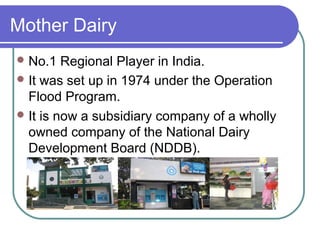
 No.1   Regional Player in India.
 It was set up in 1974 under the Operation
  Flood Program.
 It is now a subsidiary company of a wholly
  owned company of the National Dairy
  Development Board (NDDB).
Products

  Mother  Dairy markets & sells dairy
  products under the Mother Dairy brand
  (like Liquid Milk, Dahi, Ice Creams, Dairy
  Whitener and Butter)
  Mother Dairy sources its entire
  requirement of liquid milk from dairy
  cooperatives
Strengths
Strengths
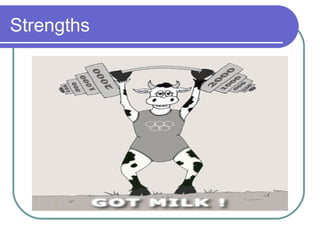
    Demand profile: Absolutely optimistic.
    Margins: Quite reasonable, even on packed liquid
     milk.
    Flexibility of product mix: Tremendous. With
     balancing equipment, you can keep on adding to your
     product line.
    Availability of raw material: Abundant. Presently,
     more than 80 per cent of milk produced is flowing into
     the unorganized sector, which requires proper
     channelization.
    Technical manpower: Professionally-trained,
     technical human resource pool, built over last 30
     years.
Weakness

  Perishability
  Lack of control over yield
  Logistics of procurement
  Problematic distribution
  Competition
Opportunity

  Valueaddition
     Areas of Value addition
           
               Value added products like
               Shrikhand,paneer,khoa,flavored milk, dairy
               sweets etc
           
               Addition of cultured products like yoghurt and
               cheese lend further strength in utilization of
               recourses and presence in the market place
           
               Export potential Amul is exporting to
               Bangladesh, Sri-Lanka, Nigiria and the Middle
               East
Threats
    Milk Vendors, the un-organized sector.

    Today milk vendors are occupying the pride of the
     place in the industry.

    Organized dissemination of the information about the
     harm that they are doing to producers and consumers
     should see a steady decline in the importance

    Operation Flood.

Indian dairy industry

  • 1.
    Doodh Ka DoodhPani Ka Pani
  • 2.
    An Interesting Fact 50% of all Buffaloes and 20% of all Cows reside in our India.
  • 3.
    Flash Back! Whywe stopped raising cattle at home?  Cost  Sanitation  Space
  • 4.
    What is DairyIndustry? Is it Handling of Cows?
  • 5.
    Dairy Industry Handling of Milk  Handling of Milk Products  Marketing of Milk and Milk Products  Dairy Technology
  • 6.
    Dairy Technology It’sa Science of :  Milk processing  Manufacture
  • 7.
    Operation Flood Launched in 1970  Flood of Milk  Augment Rural Income  Ensuring Fair Prices  Three Phases
  • 8.
    First Phase (1970– 1980)  Supportfrom Europe through World Food Programme  NDDB’s Role  Connecting Milk sheds with consumers
  • 9.
    Second Phase (1981to 1985)  Milksheds increased to 136  290 Urban Markets  43000 Village Co-operatives  4.25 Million Milk Producers
  • 10.
    Third Phase Co-operatives Expanded  Infrastructure  CattleHealth Care  Education  30,000 New Dairies  Women Participation
  • 11.
    Indian Dairy Industry  One of the fastest growing sectors in India, with a total size of about INR1160 billion (INR 1,16,000 crore) OR US$ 26.5 billion.  In Dairying, 75 million women are engaged as against 15 million men.
  • 12.
  • 13.
    Position Of MilkProduction By 45  Farm Level 40 35 -45% 30  Unorganised 25 20 -42% 15  Organised 10 -13% 5 0 Farm Level Unorganised Organised Sector
  • 14.
    Position Of MilkUtilization 50 45  Consumed 40 35 as Milk 30 - 46% 25 20  Traditional 15 - 47% 10 5  Western 0 - 7% Consumed Traditional Products Western Products
  • 15.
    Milk Supply Chain,in the traditional and unorganized dairy system  (i) Milk producers  Producer--Consumer directly supply milk  Producer—Market--- to the consumer or Consumer through a marketing  Producer—Middleware— channel. Market—Consumer  (ii) Milk producers supply milk to the consumers through the intermediaries like middlemen
  • 16.
    Unorganized Dairy System  Retailingof Milk in India is thoroughly unorganized.  There is no supply chain management perspective.  An overwhelming proportion of the Rs. 400,000 crore retail market is UNORGANISED. In fact, only a Rs. 20,000 crore segment of the market is organised.
  • 17.
    Unorganized Dairy System  As much as 96 per cent of the 5 million- plus outlets are smaller than 500 square feet in area.  India per capita retailing space is about 2 square feet thus the lowest in the world .  Just over 8 per cent of India's population is engaged in retailing.
  • 18.
    Milk Supply Chain,in the traditional and Organized dairy system  (i) Producers’ milk reaches private processors directly and After Processing it reaches Consumer.  (ii) Milk producers supply their milk to primary cooperative society, which inter alia supplies to secondary cooperative. The milk, after processing , reaches consumers via marketing channel, either directly or through apex cooperative.
  • 19.
    Milk Supply Chain,in the traditional and Organized dairy system  Producer—Private Processor— Consumer  Producer—Middlemen—Market— Consumer  Producer—Primary/Secondary Cooperative Society—Apex Society— Market—Consumer
  • 20.
    Major Player inorganized sector
  • 21.
    Organized Dairy System  From a size of only Rs.80,000 crore, the ORGANISED retail industry will grow to Rs. 2,40,000 crore by 2007.
  • 22.
    Challenge for OrganizedSector  Competition from the unorganised sector.  Organised sector have big expenses to meet.  Organised retailing also has to cope with the middle class psychology that the bigger and brighter a sales outlet is, the more expensive it will be.
  • 23.
    Challenge for OrganizedSector  While India as a country became the world’s largest milk producer in 2001, not a single Indian dairy company featured in the list of global top 20 dairy companies
  • 24.
    Opportunity for OrganizedSector  Economic and demographic changes including rising disposable incomes.  A growing proportion of working women becoming a part of the urban population.  Greater awareness due to exposure to global trends
  • 25.
    Turning Point forOrganised Sector  The dairy industry was de-licensed in 1991.  No license is required for setting up of large-scale production facilities for manufacture of ice cream.  The exemption limit is increased for compulsory registration of dairy plants, from the present 10,000 litres a day to 20,000 litres.
  • 26.
    Position Of OrganizedSector  There are 678 manufacturing units registered with the Central and State Governments.  The combined capacity of these units is 73 million litres per day while they process about 29 million litres per day.  Significant excess capacity.
  • 27.
    New Activities Launching of Venture Capital Fund for Dairy ----scheme is being implemented through NABARD to provide loans to entrepreneurs in dairy and poultry sectors at a lower rate of interest. -----The objectives are to encourage clean milk production, promote use of modern technology in dairy farms and to bring the milk produced in the unorganised sector to organised sector.
  • 28.
    Doodh Doodh Doodh WonderfulDoodh!  Vitamins  Iodine  Calcium  Proteins  Nutrients  Short Shelf Life
  • 29.
    Doodh Ke Parivarwale 55% of Milk produced converted to various Milk Products
  • 30.
    Sabse Bada Khiladi AMUL  Origin from the Sanskrit word ‘Amoolya’.  Amul is a brand under which GCMMF markets its products.  Birth of GCMMF is closely linked to India’s freedom struggle.
  • 31.
    The Birth ofAmul  FirstCo-operative formed on 4th Jan 1946.  Kaira District Co-operative Milk Producers Union Ltd. formed 14th Dec 1946.  Gujarat Co-operative Milk Marketing Federation (GCMMF) was formed in 1973.  Dr. Verghese Kurien was the architect of Amul’s success.
  • 32.
    Dr.Kurian’s Mantra forAmul  Quality  Economy  Availability  Service
  • 33.
    Aaj Ka Amul  GCMMF is India’s largest food products marketing organisation.  12 district co-operative milk producers’ union.  2.5 million producer members.  2.28 billion litres milk collected in 2005- 2006.  Sales turnover stands at Rs.37736 million in 2005-06 (Rs.13790 million in 1995-96)
  • 34.
    Amul Products Market Market Share Position  Amul Butter 85% 1  Milk 60% 1 powder 65% 1  Toned Milk 60% 1  Dahi
  • 35.
    Amul Products Market Market Share Position  Flavoured Milk 55% 2  Ice 75% 1 Creams 90% 1  Cheese 8% 2  Ghee
  • 36.
    Mother Dairy  No.1 Regional Player in India.  It was set up in 1974 under the Operation Flood Program.  It is now a subsidiary company of a wholly owned company of the National Dairy Development Board (NDDB).
  • 37.
    Products  Mother Dairy markets & sells dairy products under the Mother Dairy brand (like Liquid Milk, Dahi, Ice Creams, Dairy Whitener and Butter)  Mother Dairy sources its entire requirement of liquid milk from dairy cooperatives
  • 38.
  • 39.
    Strengths  Demand profile: Absolutely optimistic.  Margins: Quite reasonable, even on packed liquid milk.  Flexibility of product mix: Tremendous. With balancing equipment, you can keep on adding to your product line.  Availability of raw material: Abundant. Presently, more than 80 per cent of milk produced is flowing into the unorganized sector, which requires proper channelization.  Technical manpower: Professionally-trained, technical human resource pool, built over last 30 years.
  • 40.
    Weakness  Perishability  Lack of control over yield  Logistics of procurement  Problematic distribution  Competition
  • 41.
    Opportunity  Valueaddition Areas of Value addition  Value added products like Shrikhand,paneer,khoa,flavored milk, dairy sweets etc  Addition of cultured products like yoghurt and cheese lend further strength in utilization of recourses and presence in the market place  Export potential Amul is exporting to Bangladesh, Sri-Lanka, Nigiria and the Middle East
  • 42.
    Threats  Milk Vendors, the un-organized sector.  Today milk vendors are occupying the pride of the place in the industry.  Organized dissemination of the information about the harm that they are doing to producers and consumers should see a steady decline in the importance  Operation Flood.