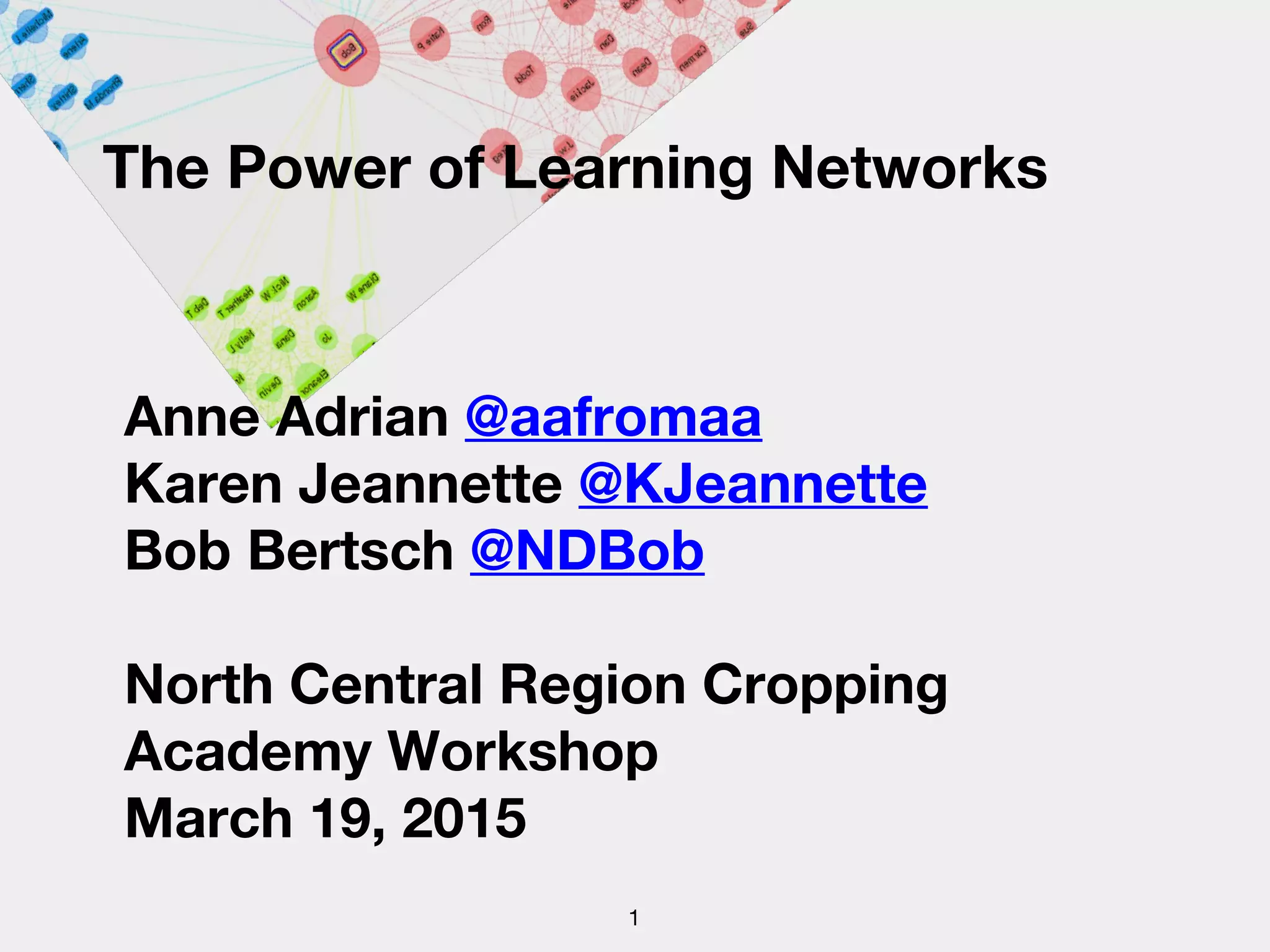
The Power of Learning Networks
Anne Adrian @aafromaa
Karen Jeannette @KJeannette
Bob Bertsch @NDBob
North Central Region Cropping
Academy Workshop
March 19, 2015
1
“… the thesis that knowledge is
distributed across a network of
connections, and therefore that
learning consists of the ability to
construct and traverse those
networks” (Stephen Downes, 2007,
para.)
and extend those networks, but first
let’s make the most of the network in an
open kind of way.
2
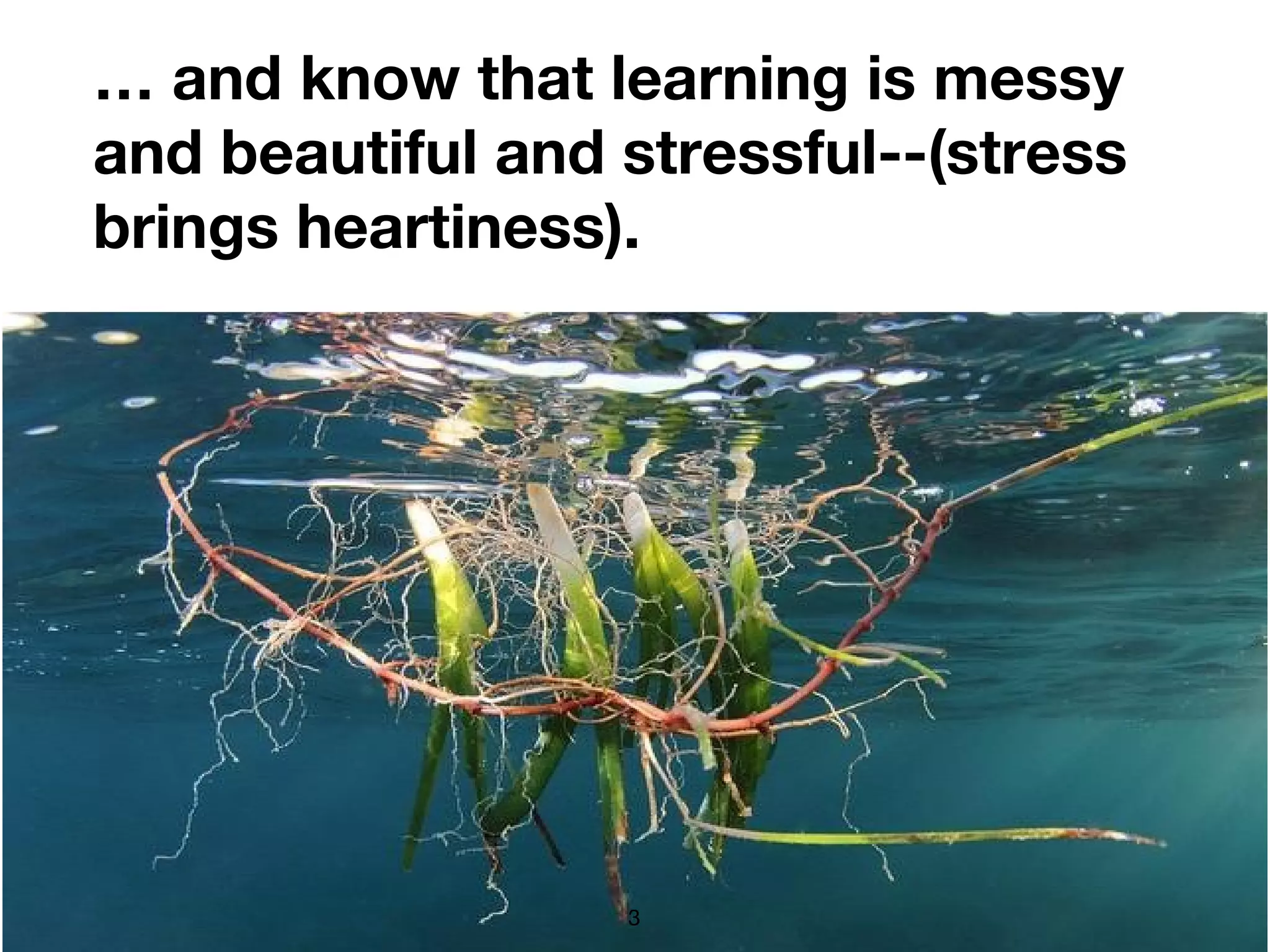
… and know that learning is messy
and beautiful and stressful--(stress
brings heartiness).
3
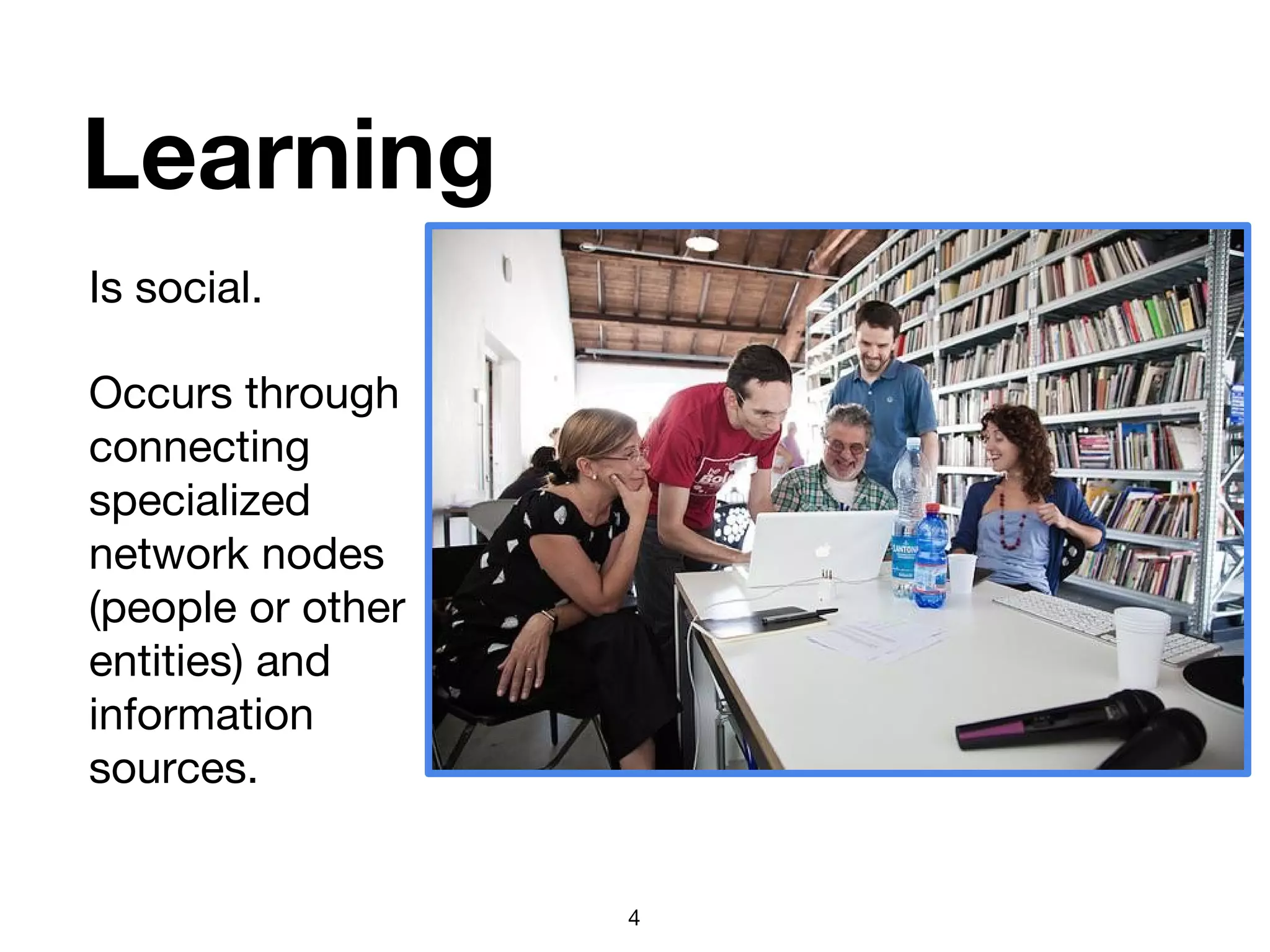
Learning
Is social.
Occurs through
connecting
specialized
network nodes
(people or other
entities) and
information
sources.
4
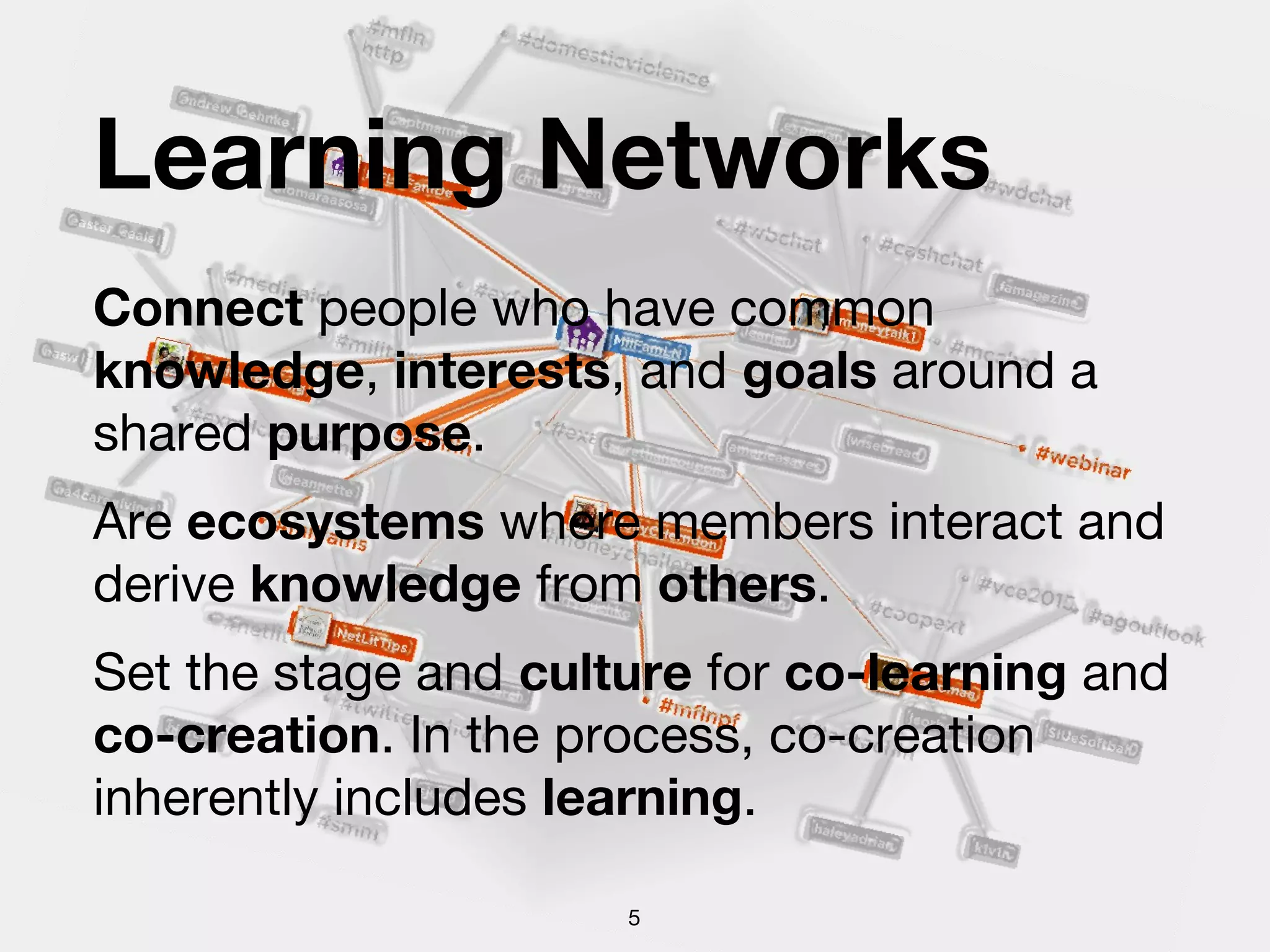
Learning Networks
Connect people who have common
knowledge, interests, and goals around a
shared purpose.
Are ecosystems where members interact and
derive knowledge from others.
Set the stage and culture for co-learning and
co-creation. In the process, co-creation
inherently includes learning.
5
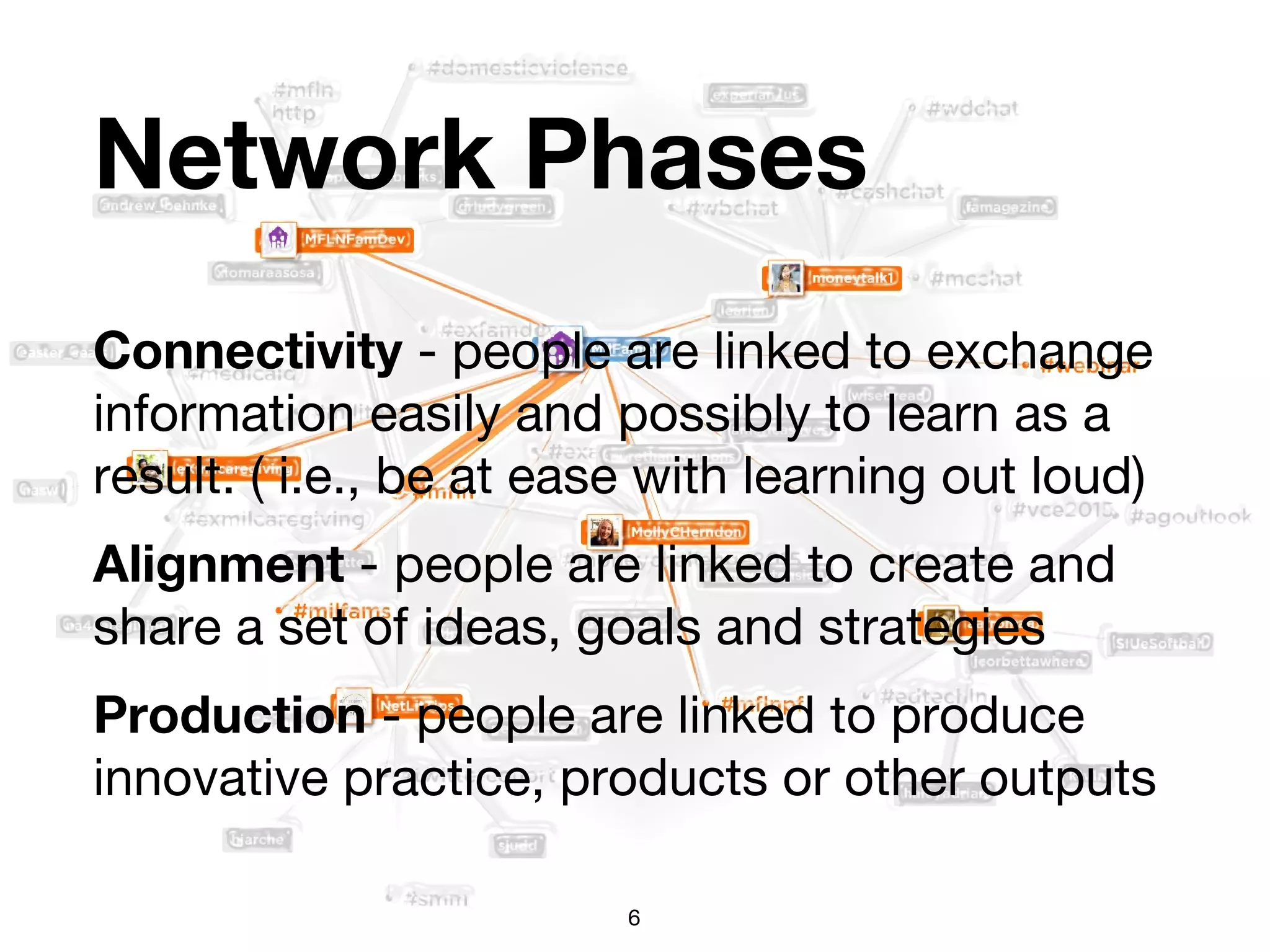
Network Phases
Connectivity - people are linked to exchange
information easily and possibly to learn as a
result. ( i.e., be at ease with learning out loud)
Alignment - people are linked to create and
share a set of ideas, goals and strategies
Production - people are linked to produce
innovative practice, products or other outputs
6
Learning Networks
Enable its members to draw new knowledge that
they would not normally have access to.
Allow for inquiry that would not normally occur.
Increase and scale individual and collective
capacity learning.
7
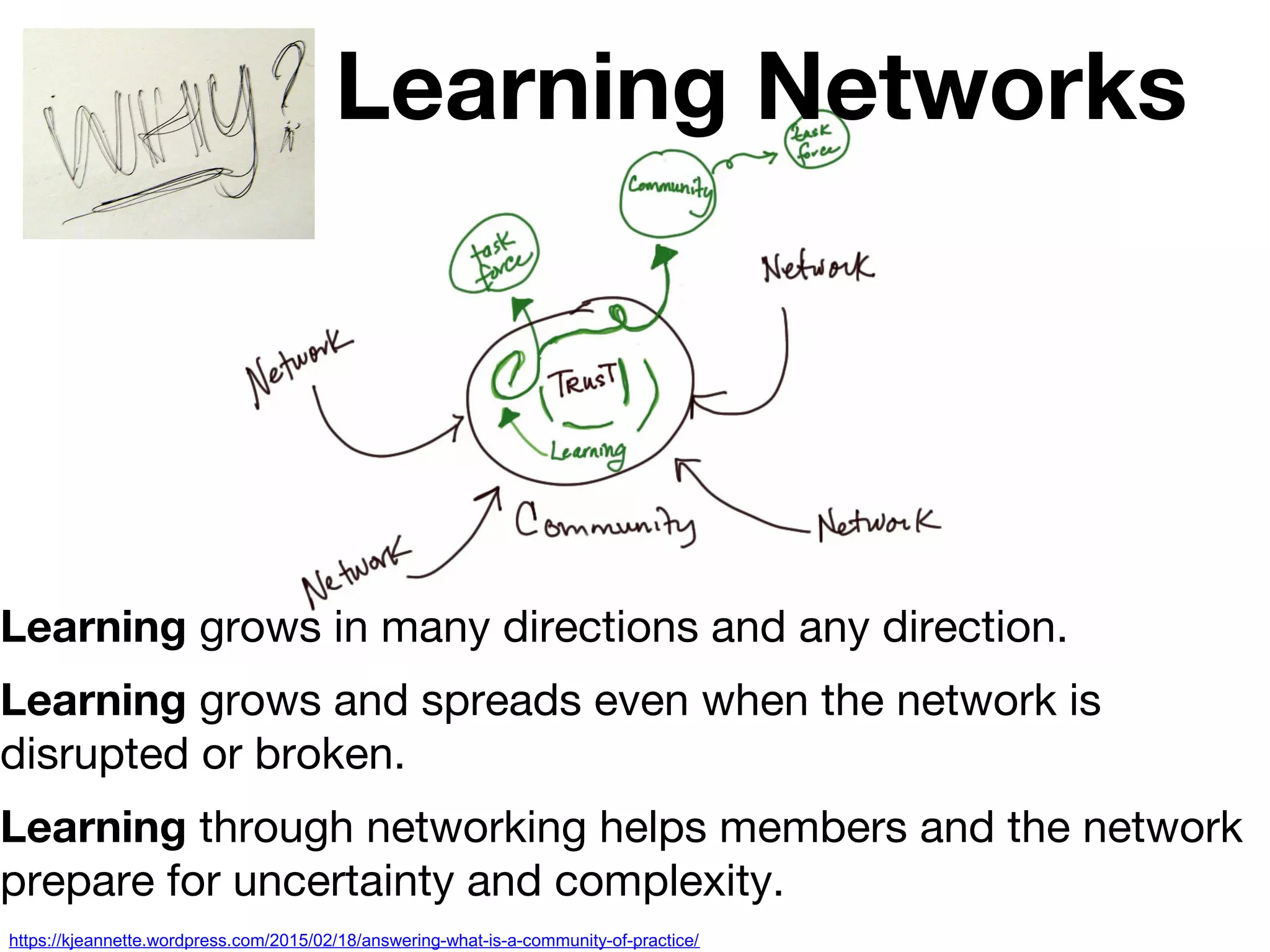
Learning Networks
Learning grows in many directions and any direction.
Learning grows and spreads even when the network is
disrupted or broken.
Learning through networking helps members and the network
prepare for uncertainty and complexity.
https://kjeannette.wordpress.com/2015/02/18/answering-what-is-a-community-of-practice/
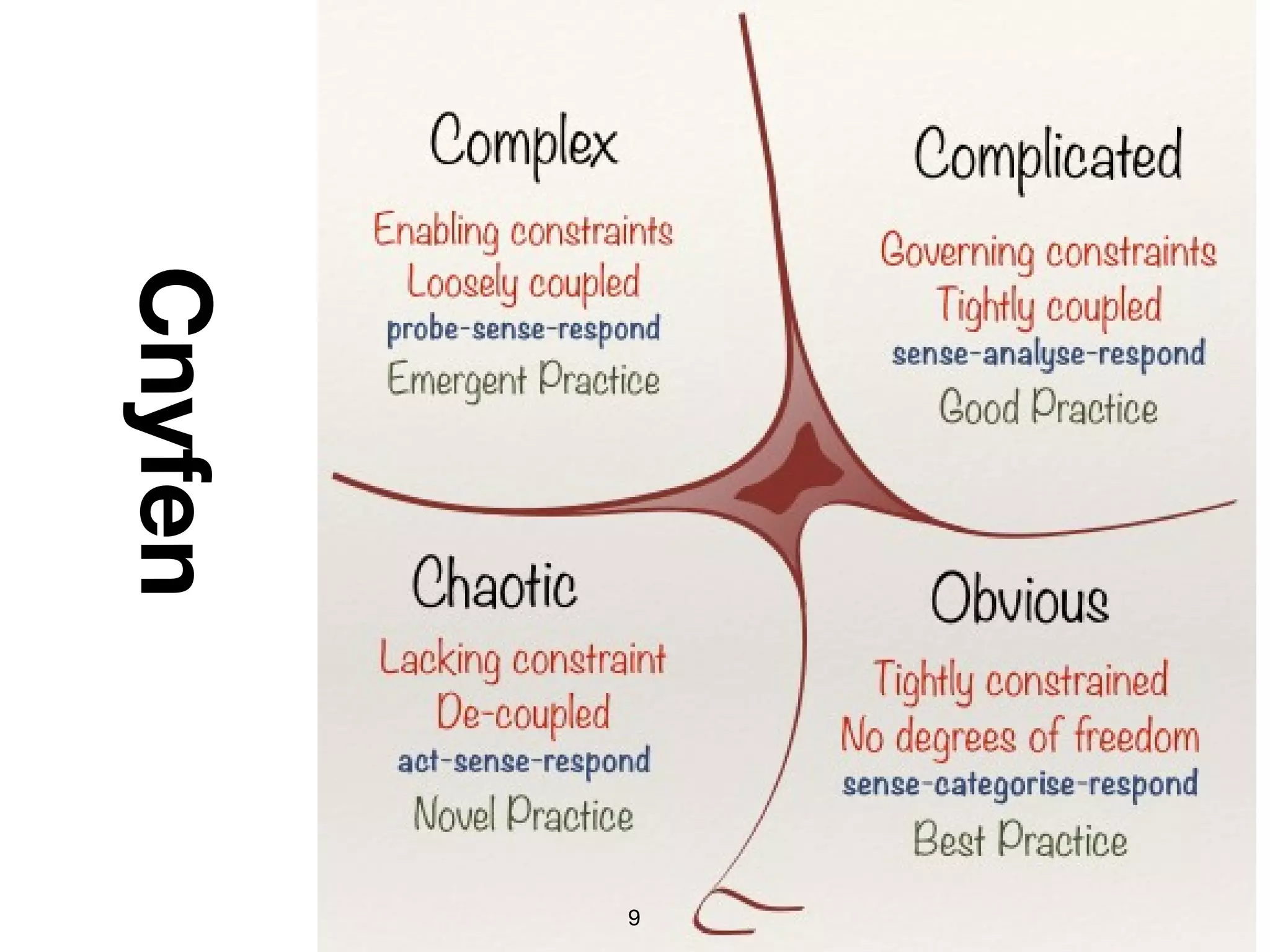
Cnyfen
9
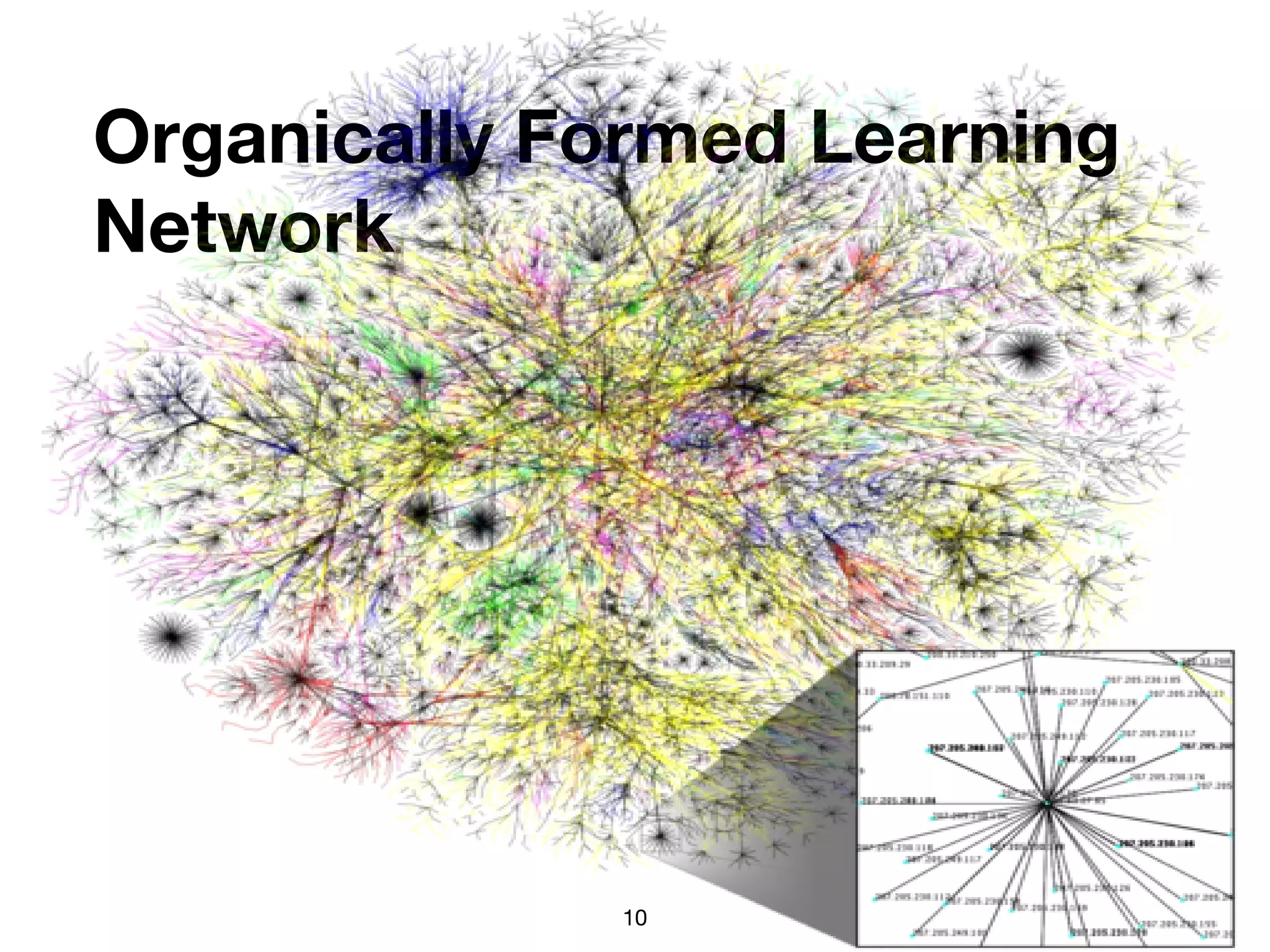
Organically Formed Learning
Network
10
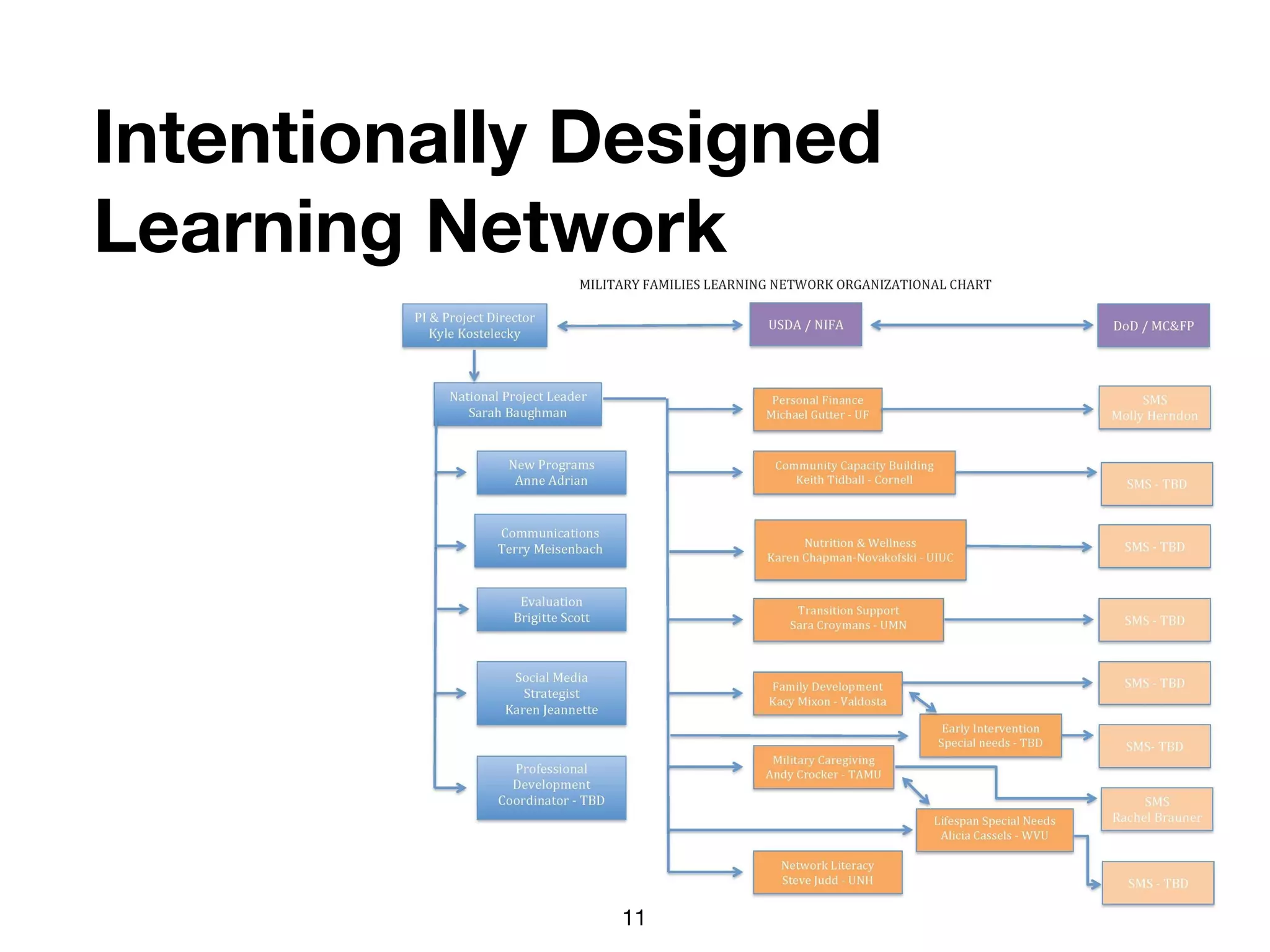
Intentionally Designed
Learning Network
11
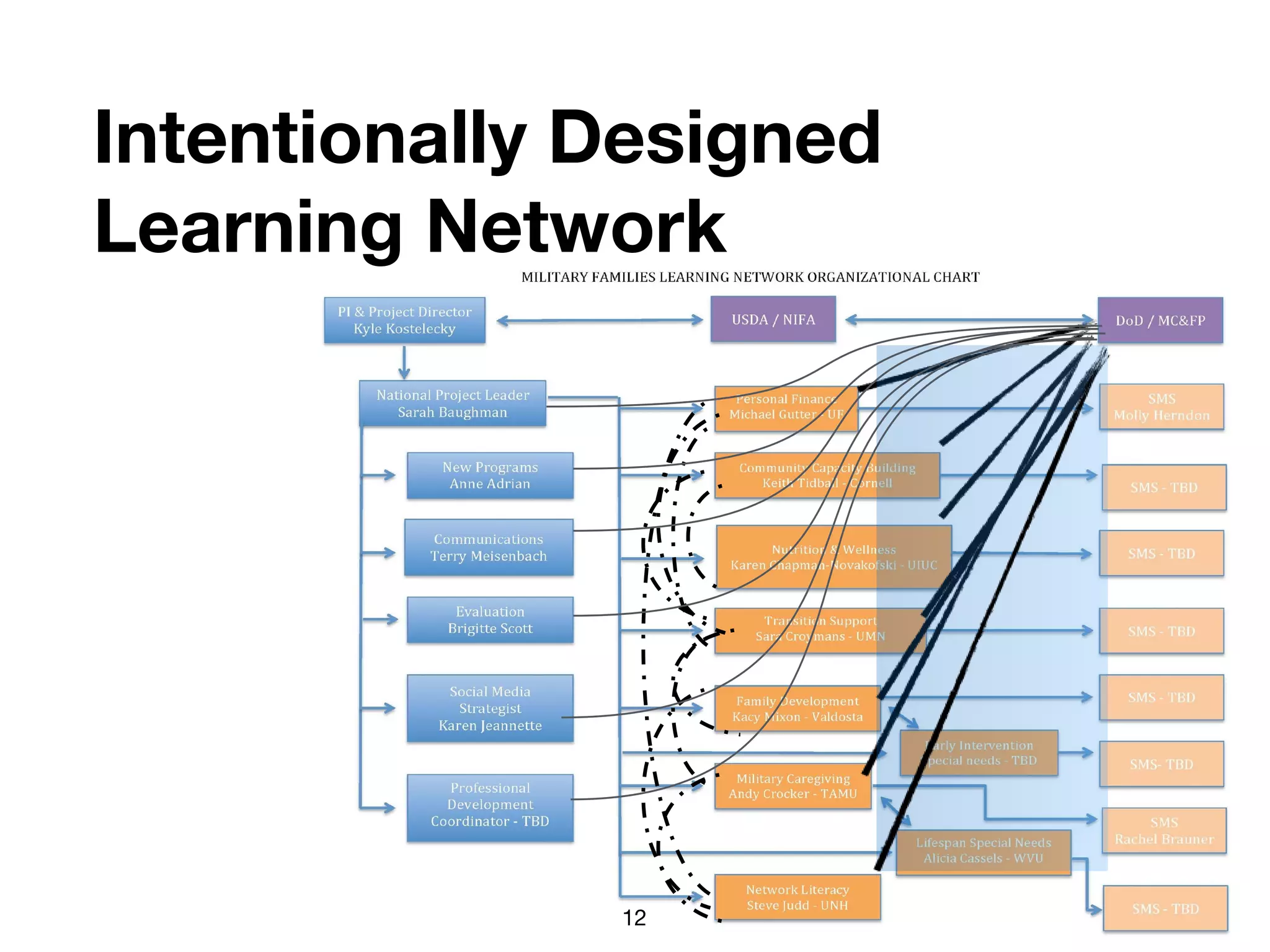
Intentionally Designed
Learning Network
12
Setting Up a Learning Network
Find the spark - people with common knowledge, interests,
and goals.
Define the purpose of the network - why does it exist.
Understand the value proposition of the network.
Focus on the defined network until that network is strong.
Allow and work at creating diversity and inclusive of others
Be adamant on creating a frequency of interaction.
Use a developmental evaluation approach to understand the
progress and impact (not a logic model--let us explain).
13
Setting Up a Learning Network
(much like setting up a MOOC)
Orient — materials and standard social media which will be
relied on.
Declare — developing an online credibility and reputation by
openly reflecting on learning.
Network — follow others and make connections with a
diverse expertise, opinions, thoughts and behaviors.
Cluster — cluster with people with shared specific interests
and expertise.
Focus — plan open projects, opportunities.
14
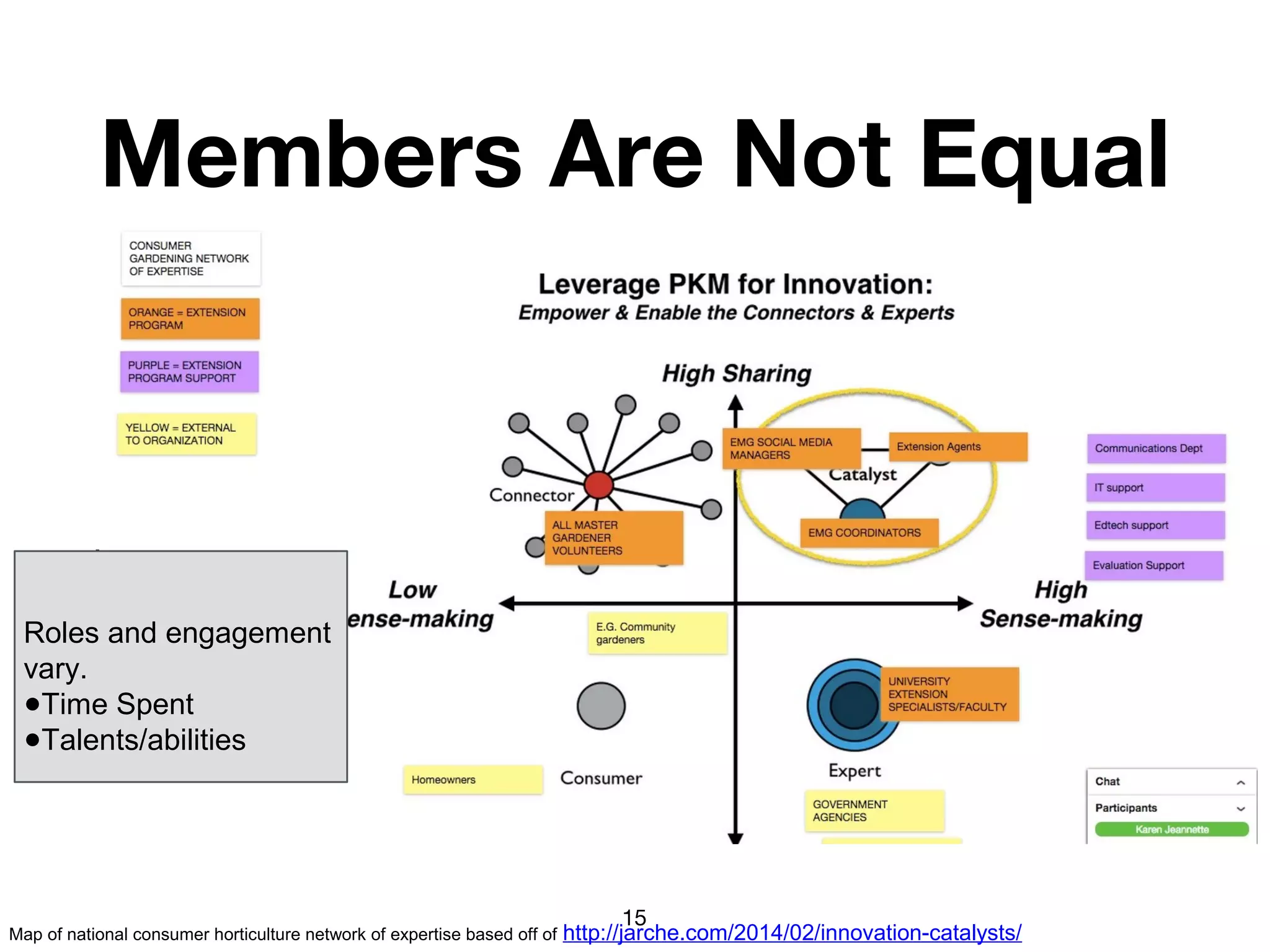
Members Are Not Equal
Karen will add roles of LN reference here
15
Map of national consumer horticulture network of expertise based off of http://jarche.com/2014/02/innovation-catalysts/
Roles and engagement
vary.
●Time Spent
●Talents/abilities
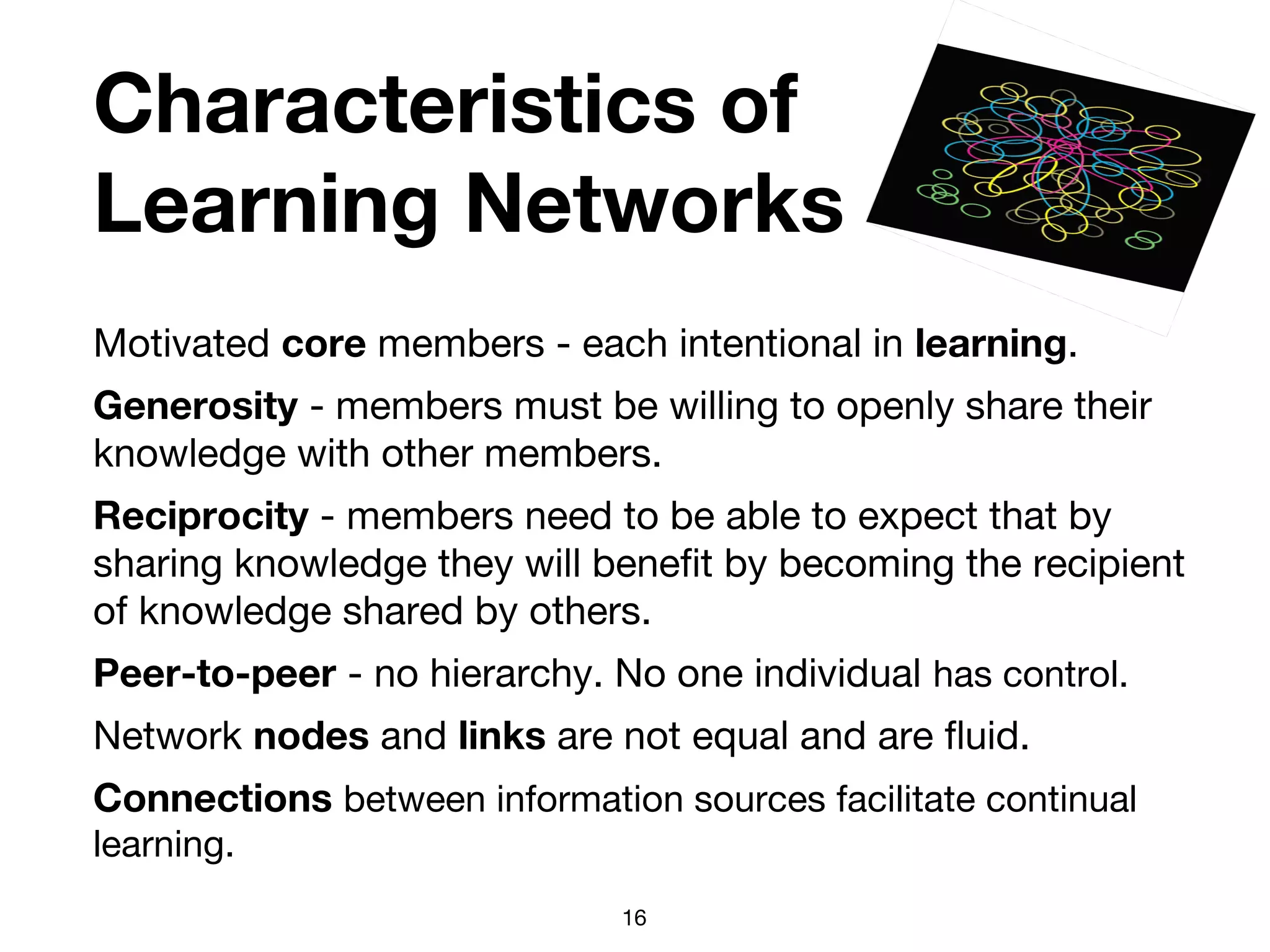
Characteristics of
Learning Networks
Motivated core members - each intentional in learning.
Generosity - members must be willing to openly share their
knowledge with other members.
Reciprocity - members need to be able to expect that by
sharing knowledge they will benefit by becoming the recipient
of knowledge shared by others.
Peer-to-peer - no hierarchy. No one individual has control.
Network nodes and links are not equal and are fluid.
Connections between information sources facilitate continual
learning.
16
Characteristics of Learning Networks
Shared identity.
Engaging.
Diverse members.
Sharing openly.
Learning out loud.
Inclusive -- beyond the academic world.
Open licenses (Creative Commons--remix).
Test and seek new approaches, innovations, and
possibly funding.  
17
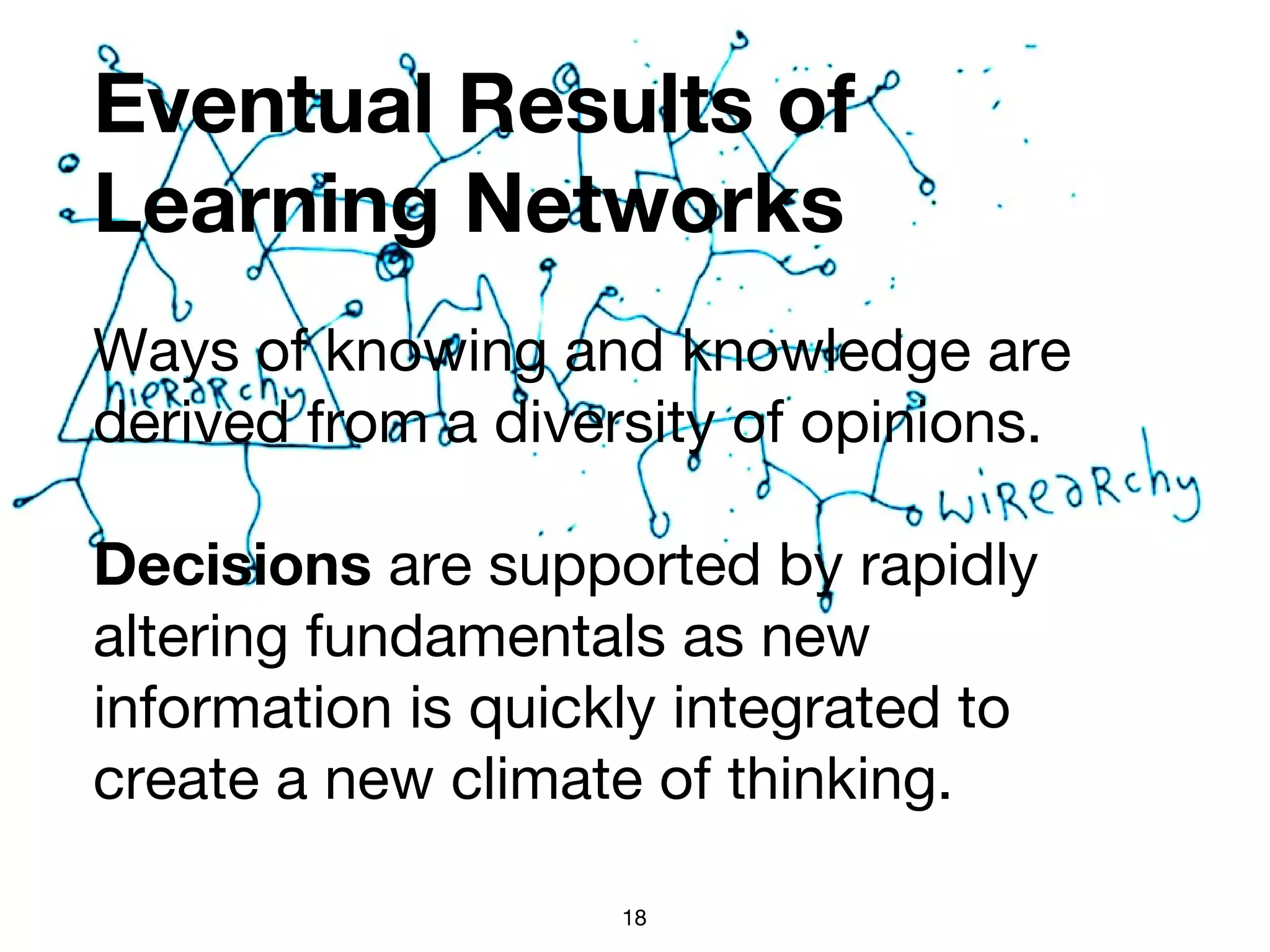
Eventual Results of
Learning Networks
Ways of knowing and knowledge are
derived from a diversity of opinions.
Decisions are supported by rapidly
altering fundamentals as new
information is quickly integrated to
create a new climate of thinking.
18
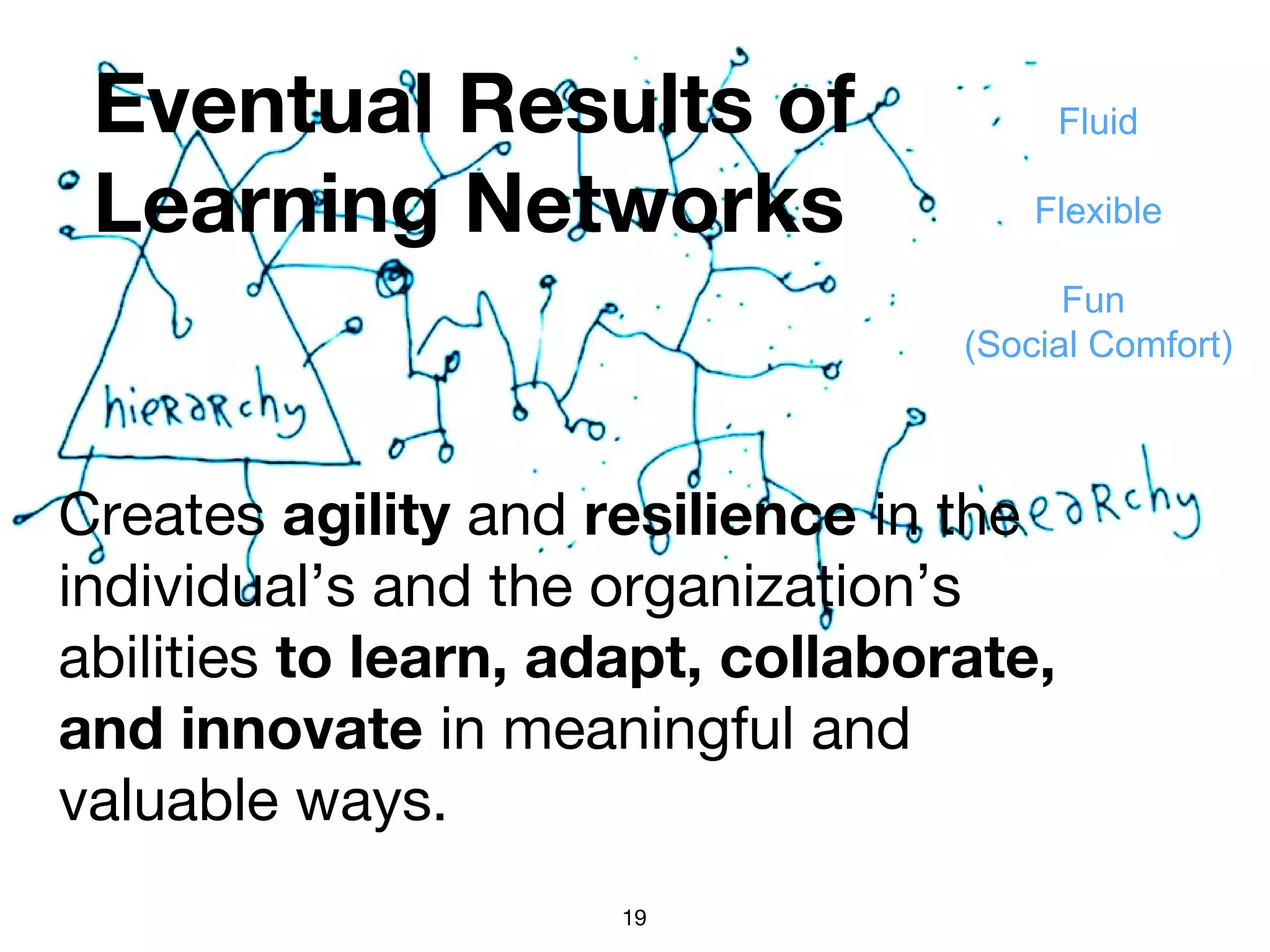
Eventual Results of
Learning Networks
Creates agility and resilience in the
individual’s and the organization’s
abilities to learn, adapt, collaborate,
and innovate in meaningful and
valuable ways.
19
Fluid
Flexible
Fun
(Social Comfort)
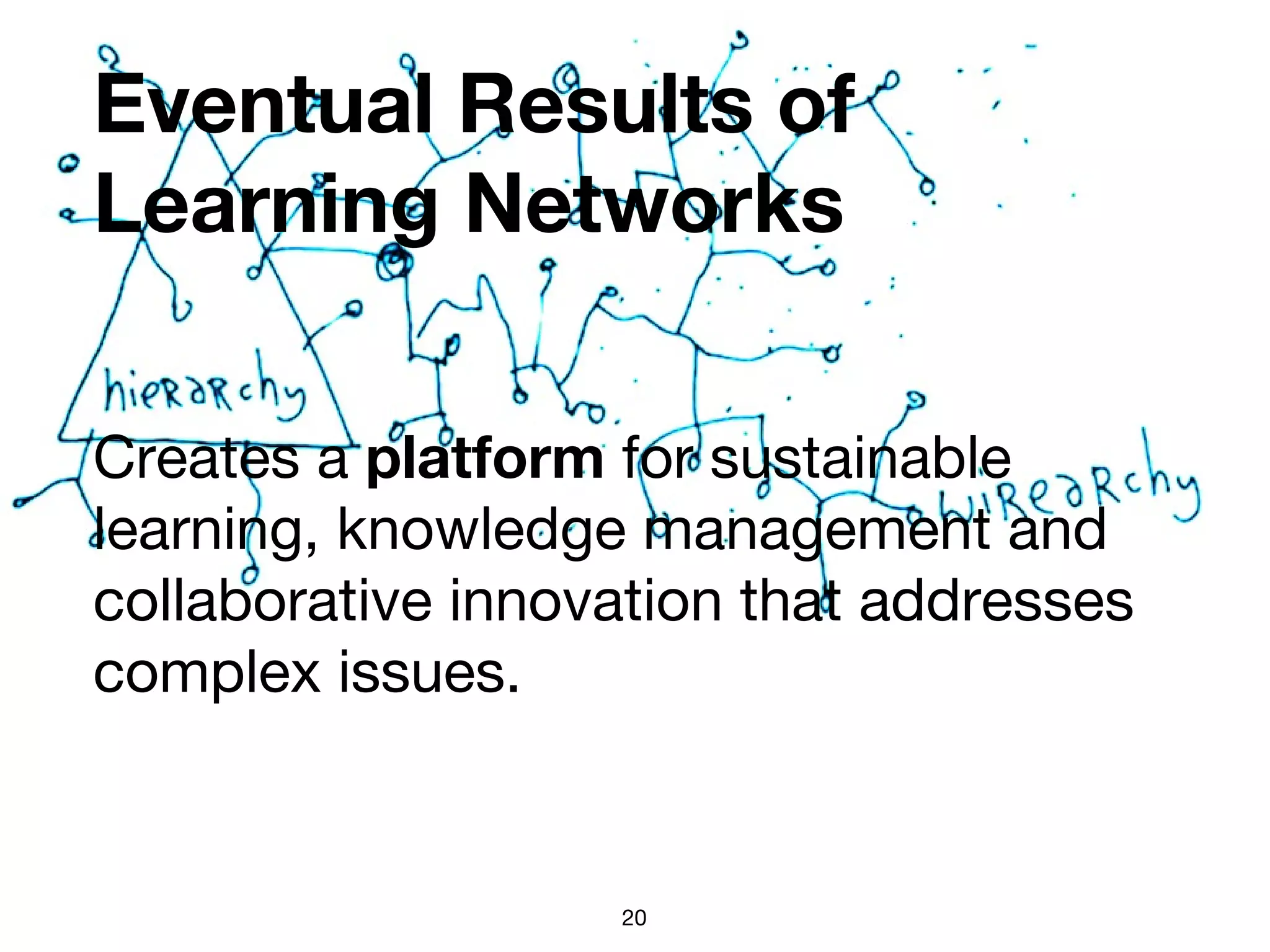
Eventual Results of
Learning Networks
Creates a platform for sustainable
learning, knowledge management and
collaborative innovation that addresses
complex issues.
20
Innovation RFAs
http://about.extension.org/2015/03/02/extensi
Due April 17, 2015
21
References and Resources
Connectivism as a Learning Theory for the Digital Age
https://www.hetl.org/wp-content/uploads/gravity_forms/2-298b245759ca2b0fab82a867d719cbae/
https://www.hetl.org/wp-content/uploads/2013/09/HETLReview2013SpecialIssue.pdf
Connecting to Change the World - Peter Plastrik and Madeleine Taylor
http://en.wikipedia.org/wiki/Cynefin
Answering: What is a community of practice?
https://kjeannette.wordpress.com/2015/02/18/answering-what-is-a-community-of-practice/
Measuring community or network growth http://www.joe.org/joe/2012october/a1.php
Innovation catalysts (in a network of expertise)
http://jarche.com/2014/02/innovation-catalysts/
Engaging Citizens in Co-creation of public services
http://www.participedia.net/en/news/2014/01/30/new-report-engaging-citizens-co-creation-public-s
Setting up a MOOC https://www.youtube.com/watch?v=r8avYQ5ZqM0&feature=kp
http://lytics.stanford.edu/wordpress/wp-content/uploads/2013/04/Kizilcec-Piech-Schneider-201
22
Photo and Image Credits
Image https://flic.kr/p/oYTVuV
Image https://flic.kr/p/avqhL8
Image https://flic.kr/p/71ynw9
Image Citation:(?) Ohio State Weed Lab Archive, The Ohio State University,
Bugwood.org
See more at:
http://www.forestryimages.org/browse/detail.cfm?imgnum=1550121#sthash.J48RsVhq.dpuf
Image Citation:(?) Ohio State Weed Lab Archive, The Ohio State University,
Bugwood.org
See more at:
http://www.forestryimages.org/browse/detail.cfm?imgnum=1550121#sthash.J48RsVhq.dpuf
Wirearchy www.hjarche.com
23

The Power of Learning Networks

  • 1.
    The Power ofLearning Networks Anne Adrian @aafromaa Karen Jeannette @KJeannette Bob Bertsch @NDBob North Central Region Cropping Academy Workshop March 19, 2015 1
  • 2.
    “… the thesisthat knowledge is distributed across a network of connections, and therefore that learning consists of the ability to construct and traverse those networks” (Stephen Downes, 2007, para.) and extend those networks, but first let’s make the most of the network in an open kind of way. 2
  • 3.
    … and knowthat learning is messy and beautiful and stressful--(stress brings heartiness). 3
  • 4.
    Learning Is social. Occurs through connecting specialized networknodes (people or other entities) and information sources. 4
  • 5.
    Learning Networks Connect peoplewho have common knowledge, interests, and goals around a shared purpose. Are ecosystems where members interact and derive knowledge from others. Set the stage and culture for co-learning and co-creation. In the process, co-creation inherently includes learning. 5
  • 6.
    Network Phases Connectivity -people are linked to exchange information easily and possibly to learn as a result. ( i.e., be at ease with learning out loud) Alignment - people are linked to create and share a set of ideas, goals and strategies Production - people are linked to produce innovative practice, products or other outputs 6
  • 7.
    Learning Networks Enable itsmembers to draw new knowledge that they would not normally have access to. Allow for inquiry that would not normally occur. Increase and scale individual and collective capacity learning. 7
  • 8.
    Learning Networks Learning growsin many directions and any direction. Learning grows and spreads even when the network is disrupted or broken. Learning through networking helps members and the network prepare for uncertainty and complexity. https://kjeannette.wordpress.com/2015/02/18/answering-what-is-a-community-of-practice/
  • 9.
  • 10.
  • 11.
  • 12.
  • 13.
    Setting Up aLearning Network Find the spark - people with common knowledge, interests, and goals. Define the purpose of the network - why does it exist. Understand the value proposition of the network. Focus on the defined network until that network is strong. Allow and work at creating diversity and inclusive of others Be adamant on creating a frequency of interaction. Use a developmental evaluation approach to understand the progress and impact (not a logic model--let us explain). 13
  • 14.
    Setting Up aLearning Network (much like setting up a MOOC) Orient — materials and standard social media which will be relied on. Declare — developing an online credibility and reputation by openly reflecting on learning. Network — follow others and make connections with a diverse expertise, opinions, thoughts and behaviors. Cluster — cluster with people with shared specific interests and expertise. Focus — plan open projects, opportunities. 14
  • 15.
    Members Are NotEqual Karen will add roles of LN reference here 15 Map of national consumer horticulture network of expertise based off of http://jarche.com/2014/02/innovation-catalysts/ Roles and engagement vary. ●Time Spent ●Talents/abilities
  • 16.
    Characteristics of Learning Networks Motivatedcore members - each intentional in learning. Generosity - members must be willing to openly share their knowledge with other members. Reciprocity - members need to be able to expect that by sharing knowledge they will benefit by becoming the recipient of knowledge shared by others. Peer-to-peer - no hierarchy. No one individual has control. Network nodes and links are not equal and are fluid. Connections between information sources facilitate continual learning. 16
  • 17.
    Characteristics of LearningNetworks Shared identity. Engaging. Diverse members. Sharing openly. Learning out loud. Inclusive -- beyond the academic world. Open licenses (Creative Commons--remix). Test and seek new approaches, innovations, and possibly funding.   17
  • 18.
    Eventual Results of LearningNetworks Ways of knowing and knowledge are derived from a diversity of opinions. Decisions are supported by rapidly altering fundamentals as new information is quickly integrated to create a new climate of thinking. 18
  • 19.
    Eventual Results of LearningNetworks Creates agility and resilience in the individual’s and the organization’s abilities to learn, adapt, collaborate, and innovate in meaningful and valuable ways. 19 Fluid Flexible Fun (Social Comfort)
  • 20.
    Eventual Results of LearningNetworks Creates a platform for sustainable learning, knowledge management and collaborative innovation that addresses complex issues. 20
  • 21.
  • 22.
    References and Resources Connectivismas a Learning Theory for the Digital Age https://www.hetl.org/wp-content/uploads/gravity_forms/2-298b245759ca2b0fab82a867d719cbae/ https://www.hetl.org/wp-content/uploads/2013/09/HETLReview2013SpecialIssue.pdf Connecting to Change the World - Peter Plastrik and Madeleine Taylor http://en.wikipedia.org/wiki/Cynefin Answering: What is a community of practice? https://kjeannette.wordpress.com/2015/02/18/answering-what-is-a-community-of-practice/ Measuring community or network growth http://www.joe.org/joe/2012october/a1.php Innovation catalysts (in a network of expertise) http://jarche.com/2014/02/innovation-catalysts/ Engaging Citizens in Co-creation of public services http://www.participedia.net/en/news/2014/01/30/new-report-engaging-citizens-co-creation-public-s Setting up a MOOC https://www.youtube.com/watch?v=r8avYQ5ZqM0&feature=kp http://lytics.stanford.edu/wordpress/wp-content/uploads/2013/04/Kizilcec-Piech-Schneider-201 22
  • 23.
    Photo and ImageCredits Image https://flic.kr/p/oYTVuV Image https://flic.kr/p/avqhL8 Image https://flic.kr/p/71ynw9 Image Citation:(?) Ohio State Weed Lab Archive, The Ohio State University, Bugwood.org See more at: http://www.forestryimages.org/browse/detail.cfm?imgnum=1550121#sthash.J48RsVhq.dpuf Image Citation:(?) Ohio State Weed Lab Archive, The Ohio State University, Bugwood.org See more at: http://www.forestryimages.org/browse/detail.cfm?imgnum=1550121#sthash.J48RsVhq.dpuf Wirearchy www.hjarche.com 23

Editor's Notes

  • #2 https://flic.kr/p/71ynw9
  • #3 https://www.hetl.org/wp-content/uploads/gravity_forms/2-298b245759ca2b0fab82a867d719cbae/2013/01/Connectivism-hand-out.pdf https://flic.kr/p/96famb
  • #4 Image https://flic.kr/p/oYTVuV
  • #5 https://flic.kr/p/avqhL8
  • #7 Connecting to Change the World - Peter Plastrik and Madeleine Taylor
  • #8 https://flic.kr/p/6t9vst https://flic.kr/p/71ynw9
  • #9 Image Citation:(?) Ohio State Weed Lab Archive, The Ohio State University, Bugwood.org - See more at: http://www.forestryimages.org/browse/detail.cfm?imgnum=1550121#sthash.J48RsVhq.dpuf
  • #10 http://en.wikipedia.org/wiki/Cynefin
  • #11 http://commons.wikimedia.org/wiki/File:Internet_map_1024_-_transparent.png#mediaviewer/File:Internet_map_1024_-_transparent.png "Internet map 1024 - transparent" by The Opte Project - Originally from the English Wikipedia; description page is/was here.. Licensed under CC BY 2.5 via Wikimedia Commons - http://commons.wikimedia.org/wiki/File:Internet_map_1024_-_transparent.png#mediaviewer/File:Internet_map_1024_-_transparent.png
  • #15 https://www.youtube.com/watch?v=r8avYQ5ZqM0&feature=kp
  • #16 Expect participation to take shape in many forms. Ask: “What can I do to help you learn?” rather than “What can I know what you know?” Ask: “Who are the people that can help us make decision and move forward to a common goal?” Game On! Applying game design principles to research, teaching, and outreach strategies https://learn.extension.org/events/243
  • #17 http://www.flickr.com/photos/aafromaa/4476928956/ Node Affiliation: Bugwood - UGA - See more at: http://www.forestryimages.org/browse/detail.cfm?imgnum=1459939#sthash.jtWBrODD.dpuf
  • #18 www.hjarche.com Node Affiliation: Bugwood - UGA - See more at: http://www.forestryimages.org/browse/detail.cfm?imgnum=1459939#sthash.jtWBrODD.dpuf
  • #19 https://www.hetl.org/wp-content/uploads/2013/09/HETLReview2013SpecialIssue.pdf
  • #21 Building Smart Communities Through Network Weaving - http://www.orgnet.com/BuildingNetworks.pdf
  • #23 https://www.hetl.org/wp-content/uploads/2013/09/HETLReview2013SpecialIssue.pdf