Good Morning
Everyone!
Presentors:
Prachi Anokar AnushkaRajput
Let’s start with a fun fact..D
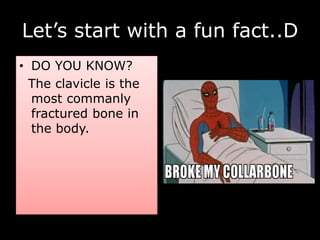
• DO YOU KNOW?
The clavicle is the
most commanly
fractured bone in
the body.
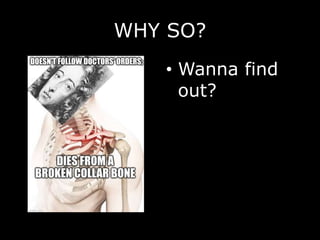
WHY SO?
• Wanna find
out?
Today’s Objectives
Introduction to bones [Basics]
Introduction to clavicle
Side determination
Peculiarities
Features of clavicle
Attachments
Ossification
Let’s know about bones..
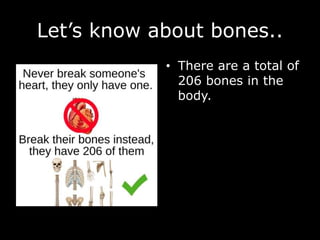
• There are a total of
206 bones in the
body.
What’s so special about
clavicles?
Pecularities
• 1.Only long bone
that lies horizontally
• 2. subcutaneous
throughout.
• 3. FIRST ONE TO
START OSSIFYING.
• 4.Only long bone
which ossifies in
membrane.
• 5.only long bone to
have two primary
centres.
• 6. No medullary
cavity.
• 7.Occasionally
pierced by the
middle
supraclavicular
nerve.
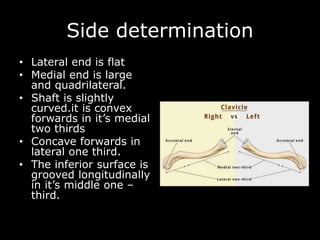
Side determination
• Lateral end is flat
• Medial end is large
and quadrilateral.
• Shaft is slightly
curved.it is convex
forwards in it’s medial
two thirds
• Concave forwards in
lateral one third.
• The inferior surface is
grooved longitudinally
in it’s middle one –
third.
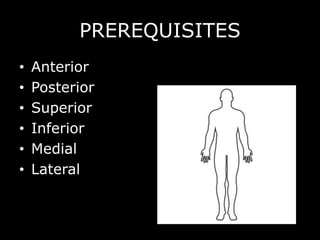
PREREQUISITES
• Anterior
• Posterior
• Superior
• Inferior
• Medial
• Lateral
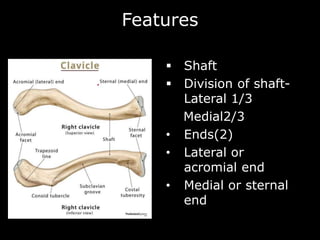
Features
 Shaft
 Division of shaft-
Lateral 1/3
Medial2/3
• Ends(2)
• Lateral or
acromial end
• Medial or sternal
end
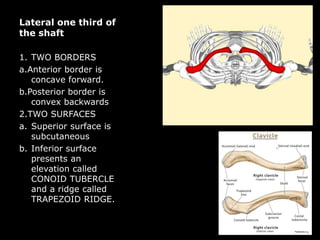
Lateral one third of
the shaft
1. TWO BORDERS
a.Anterior border is
concave forward.
b.Posterior border is
convex backwards
2.TWO SURFACES
a. Superior surface is
subcutaneous
b. Inferior surface
presents an
elevation called
CONOID TUBERCLE
and a ridge called
TRAPEZOID RIDGE.
Medial two third of
the shaft
a) ROUNDED
b) FOUR SURFACES
i)ANTERIOR- Convex forwards
ii)POSTERIOR-Concave
backwards, smooth
iii)SUPERIOR- Rough
iv)INFERIOR- Rough oval
impression at the medial
end.
c)SUBCLAVIAN GROOVE
-Longitudinal, Inferior surface
on the lateral side
-at the lateral end, nutrient
forament.
Lateral and medial
ends
LATERAL
-Bears a facet that
articulates with the
acromion process
Of the scapula to
form the
acromioclavicular
joint.
MEDIAL
-Quadrangular, and
articulates with the
clavicular notch of the
manubrium sterni to
form the
sternoclavicular joint
.
ATTACHMENTS OF MUSCLES
• Origin • Insertion
Features
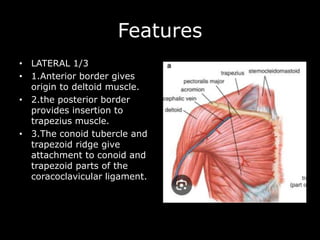
• LATERAL 1/3
• 1.Anterior border gives
origin to deltoid muscle.
• 2.the posterior border
provides insertion to
trapezius muscle.
• 3.The conoid tubercle and
trapezoid ridge give
attachment to conoid and
trapezoid parts of the
coracoclavicular ligament.
Features
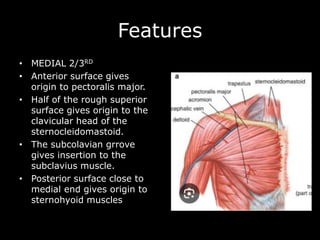
• MEDIAL 2/3RD
• Anterior surface gives
origin to pectoralis major.
• Half of the rough superior
surface gives origin to the
clavicular head of the
sternocleidomastoid.
• The subcolavian grrove
gives insertion to the
subclavius muscle.
• Posterior surface close to
medial end gives origin to
sternohyoid muscles
OSSIFICATION
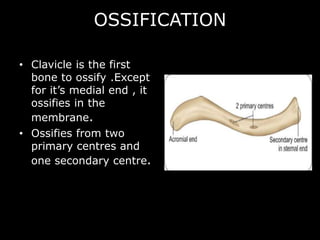
• Clavicle is the first
bone to ossify .Except
for it’s medial end , it
ossifies in the
membrane.
• Ossifies from two
primary centres and
one secondary centre.
Two centres
• PRIMARY
CENTRES(2)
- Appear in the shaft
between the fifth
and sixth weeks of
intrauterine life.
- fuse about the 45th
day.
• SECONDARY
CENTRE
- Medial end appears
during 15 to 17
years.
- Fuses with shaft
during 21-22 years.
- Occasionally,There
maybe a secondary
centre for the
acromial end.
THE ANSWER
• The middle third of
your clavicle is its
thinnest and
outermost part and
has a lack of
support by muscles
and ligaments, so
it's more
vulnerable to injury
• the critical location
of the clavicle, any
severe force on the
shoulder, such as
falling directly onto
the shoulder or
falling on an
outstretched arm,
transfers force to
the clavicle.
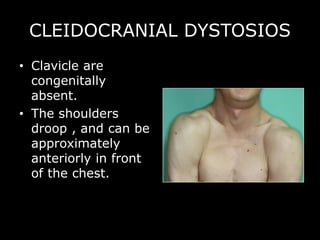
CLEIDOCRANIAL DYSTOSIOS
• Clavicle are
congenitally
absent.
• The shoulders
droop , and can be
approximately
anteriorly in front
of the chest.
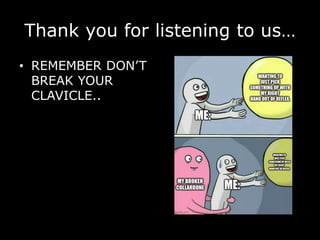
Thank you for listening to us…
• REMEMBER DON’T
BREAK YOUR
CLAVICLE..

CLAVICLE PPT.pptx Presentation on clavicle

  • 1.
  • 2.
    Let’s start witha fun fact..D • DO YOU KNOW? The clavicle is the most commanly fractured bone in the body.
  • 3.
  • 4.
    Today’s Objectives Introduction tobones [Basics] Introduction to clavicle Side determination Peculiarities Features of clavicle Attachments Ossification
  • 5.
    Let’s know aboutbones.. • There are a total of 206 bones in the body.
  • 6.
    What’s so specialabout clavicles?
  • 7.
    Pecularities • 1.Only longbone that lies horizontally • 2. subcutaneous throughout. • 3. FIRST ONE TO START OSSIFYING. • 4.Only long bone which ossifies in membrane. • 5.only long bone to have two primary centres. • 6. No medullary cavity. • 7.Occasionally pierced by the middle supraclavicular nerve.
  • 8.
    Side determination • Lateralend is flat • Medial end is large and quadrilateral. • Shaft is slightly curved.it is convex forwards in it’s medial two thirds • Concave forwards in lateral one third. • The inferior surface is grooved longitudinally in it’s middle one – third.
  • 9.
    PREREQUISITES • Anterior • Posterior •Superior • Inferior • Medial • Lateral
  • 10.
    Features  Shaft  Divisionof shaft- Lateral 1/3 Medial2/3 • Ends(2) • Lateral or acromial end • Medial or sternal end
  • 11.
    Lateral one thirdof the shaft 1. TWO BORDERS a.Anterior border is concave forward. b.Posterior border is convex backwards 2.TWO SURFACES a. Superior surface is subcutaneous b. Inferior surface presents an elevation called CONOID TUBERCLE and a ridge called TRAPEZOID RIDGE.
  • 12.
    Medial two thirdof the shaft a) ROUNDED b) FOUR SURFACES i)ANTERIOR- Convex forwards ii)POSTERIOR-Concave backwards, smooth iii)SUPERIOR- Rough iv)INFERIOR- Rough oval impression at the medial end. c)SUBCLAVIAN GROOVE -Longitudinal, Inferior surface on the lateral side -at the lateral end, nutrient forament.
  • 13.
    Lateral and medial ends LATERAL -Bearsa facet that articulates with the acromion process Of the scapula to form the acromioclavicular joint. MEDIAL -Quadrangular, and articulates with the clavicular notch of the manubrium sterni to form the sternoclavicular joint .
  • 14.
    ATTACHMENTS OF MUSCLES •Origin • Insertion
  • 15.
    Features • LATERAL 1/3 •1.Anterior border gives origin to deltoid muscle. • 2.the posterior border provides insertion to trapezius muscle. • 3.The conoid tubercle and trapezoid ridge give attachment to conoid and trapezoid parts of the coracoclavicular ligament.
  • 16.
    Features • MEDIAL 2/3RD •Anterior surface gives origin to pectoralis major. • Half of the rough superior surface gives origin to the clavicular head of the sternocleidomastoid. • The subcolavian grrove gives insertion to the subclavius muscle. • Posterior surface close to medial end gives origin to sternohyoid muscles
  • 17.
    OSSIFICATION • Clavicle isthe first bone to ossify .Except for it’s medial end , it ossifies in the membrane. • Ossifies from two primary centres and one secondary centre.
  • 18.
    Two centres • PRIMARY CENTRES(2) -Appear in the shaft between the fifth and sixth weeks of intrauterine life. - fuse about the 45th day. • SECONDARY CENTRE - Medial end appears during 15 to 17 years. - Fuses with shaft during 21-22 years. - Occasionally,There maybe a secondary centre for the acromial end.
  • 19.
    THE ANSWER • Themiddle third of your clavicle is its thinnest and outermost part and has a lack of support by muscles and ligaments, so it's more vulnerable to injury • the critical location of the clavicle, any severe force on the shoulder, such as falling directly onto the shoulder or falling on an outstretched arm, transfers force to the clavicle.
  • 20.
    CLEIDOCRANIAL DYSTOSIOS • Clavicleare congenitally absent. • The shoulders droop , and can be approximately anteriorly in front of the chest.
  • 21.
    Thank you forlistening to us… • REMEMBER DON’T BREAK YOUR CLAVICLE..