Clauses
Sentence Level Work


                      1
Aims
 What is a clause?
 What is a subordinate clause?
 How can we use them correctly?


                                   2
Task 1

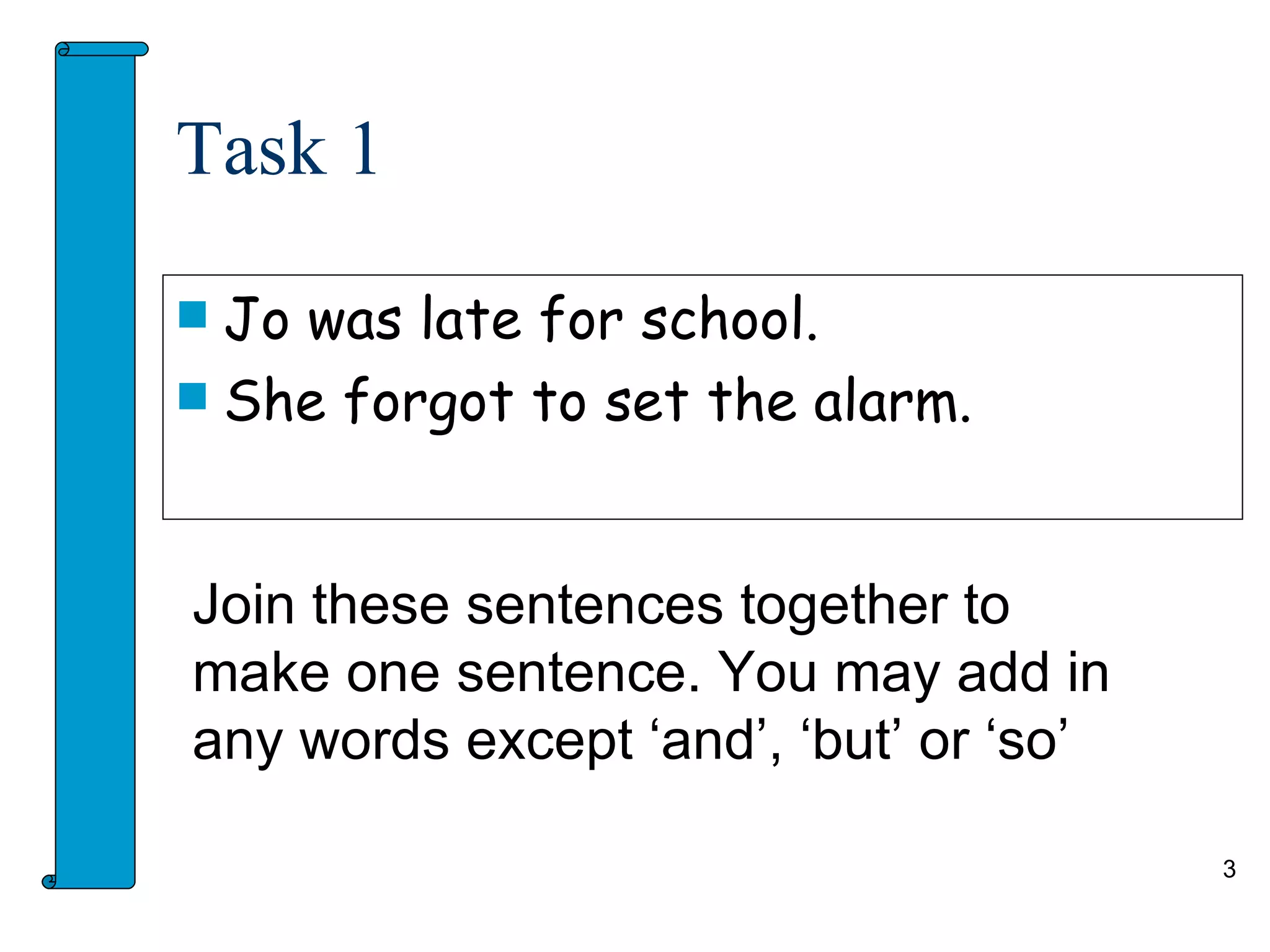
 Jo was late for school.
 She forgot to set the alarm.


Join these sentences together to
make one sentence. You may add in
any words except ‘and’, ‘but’ or ‘so’

                                        3
Examples

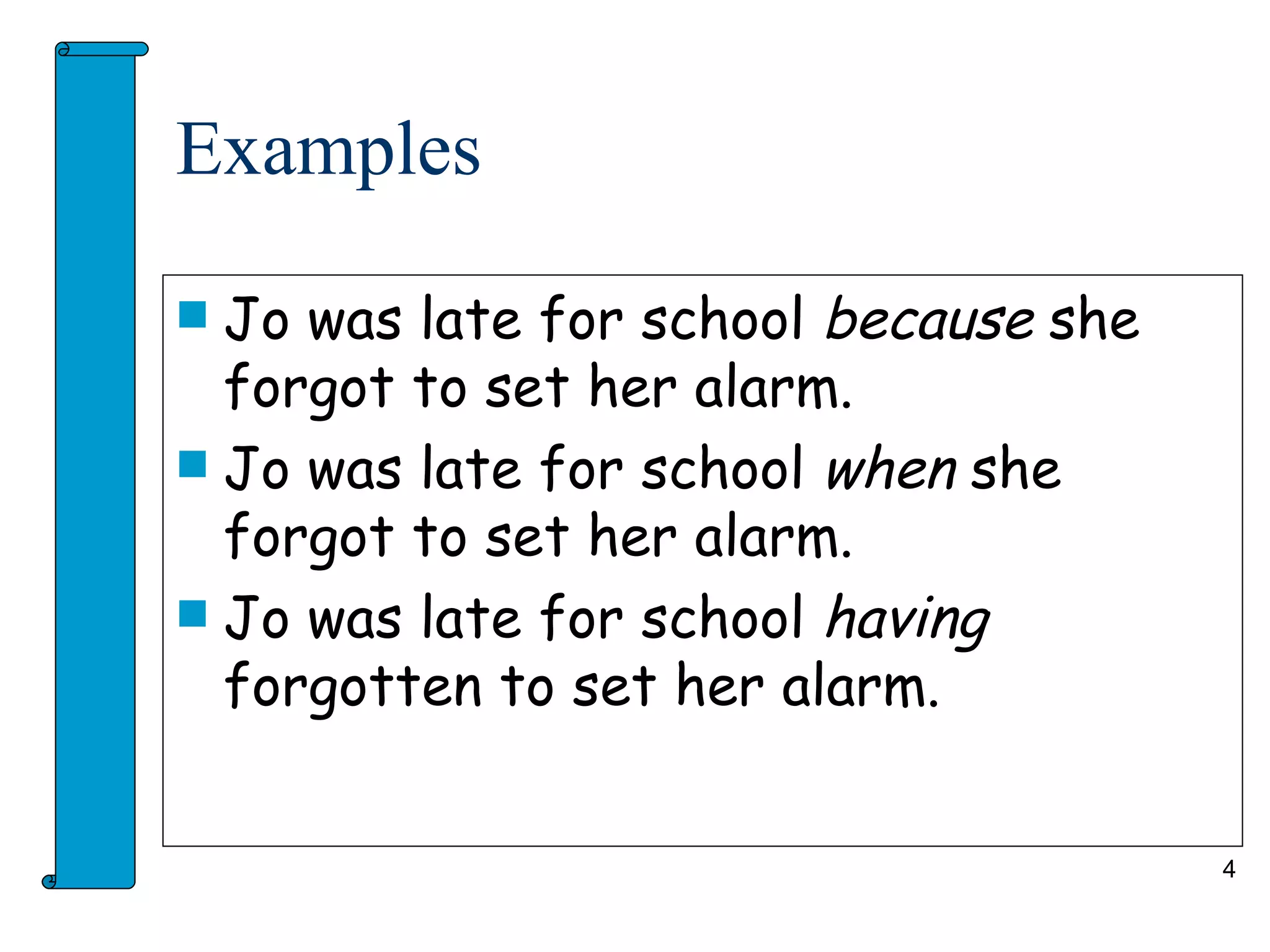
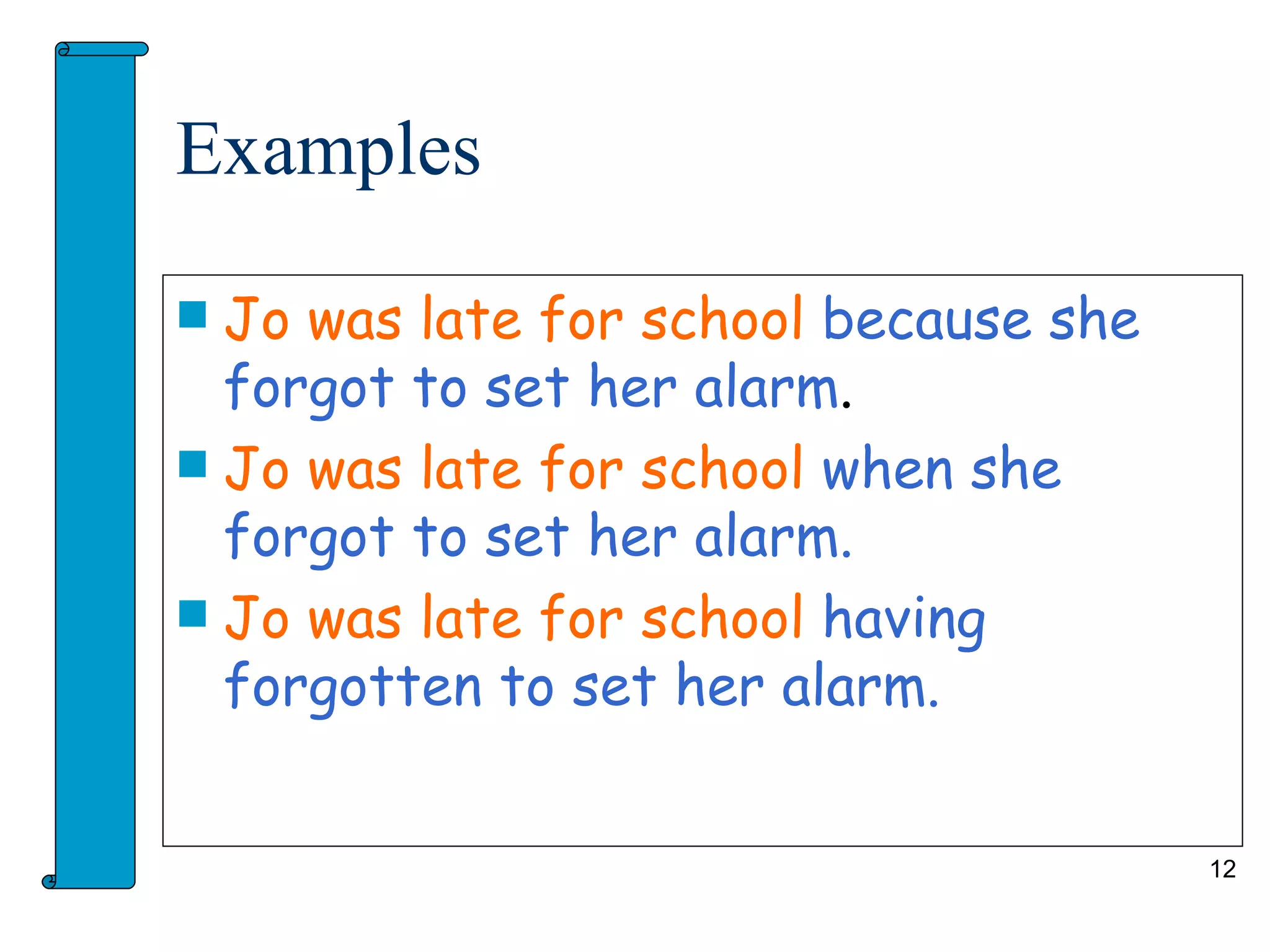
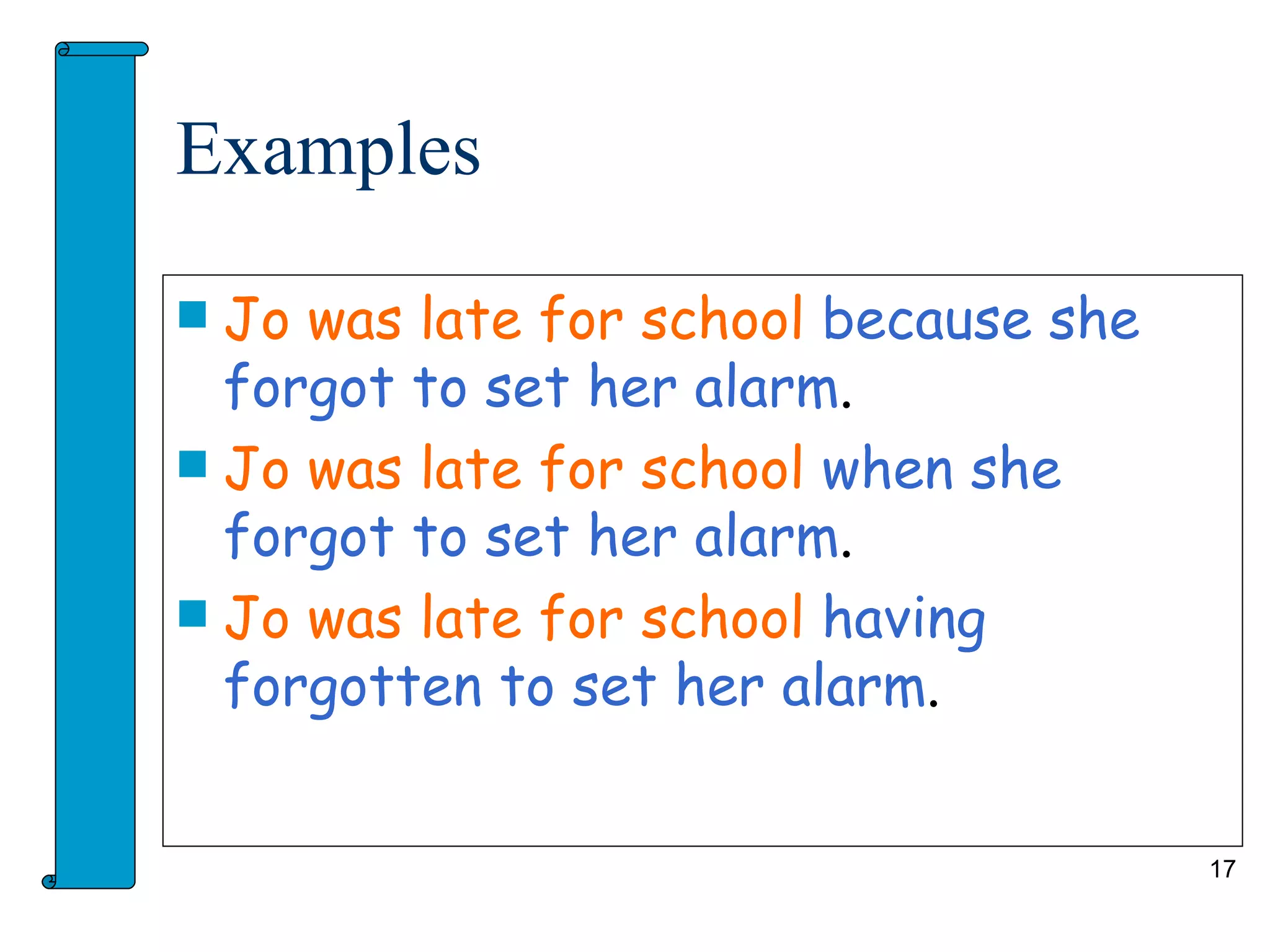
 Jo was late for school because she
  forgot to set her alarm.
 Jo was late for school when she
  forgot to set her alarm.
 Jo was late for school having
  forgotten to set her alarm.


                                       4
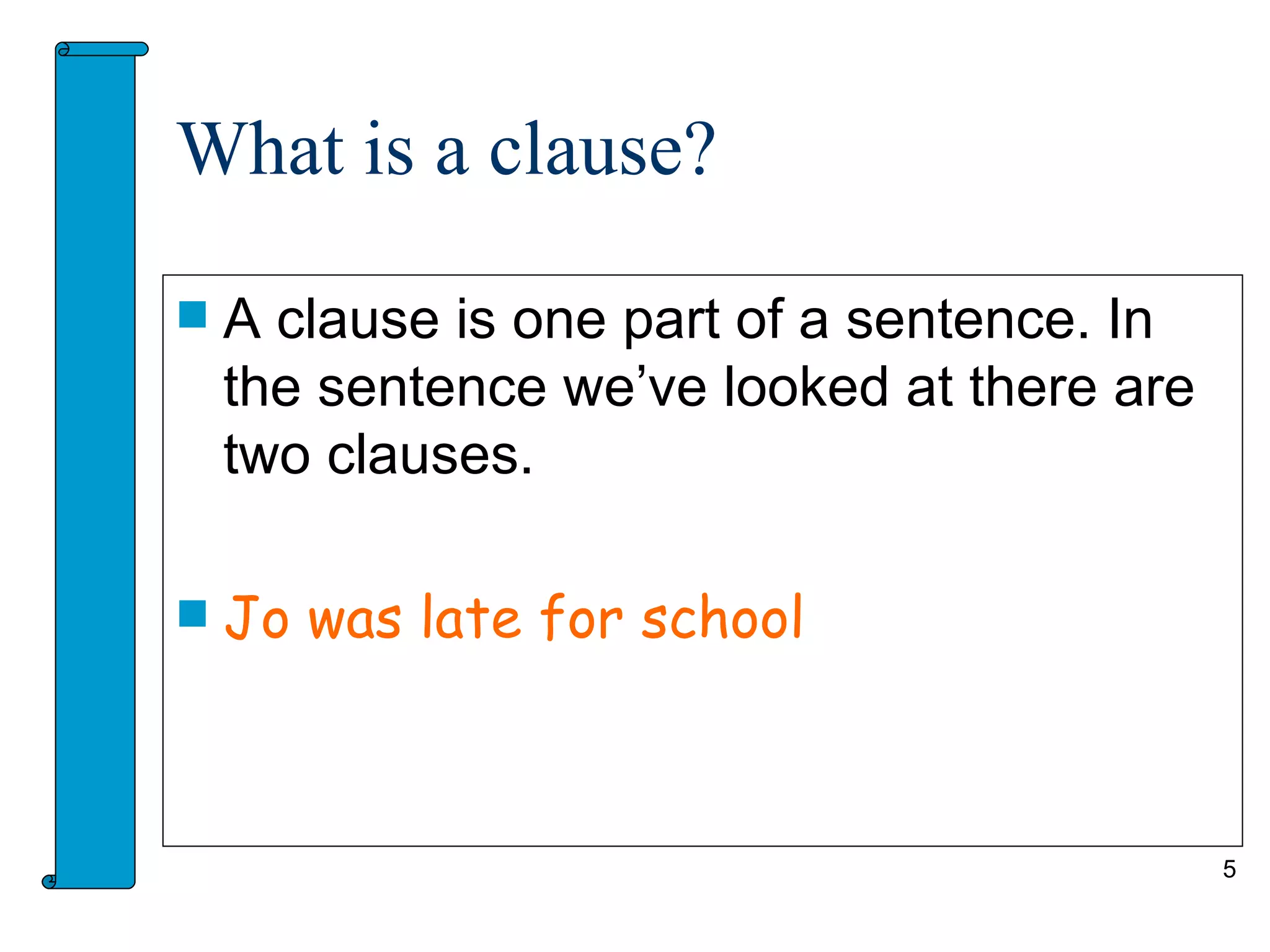
What is a clause?

   A clause is one part of a sentence. In
    the sentence we’ve looked at there are
    two clauses.

   Jo was late for school


                                             5
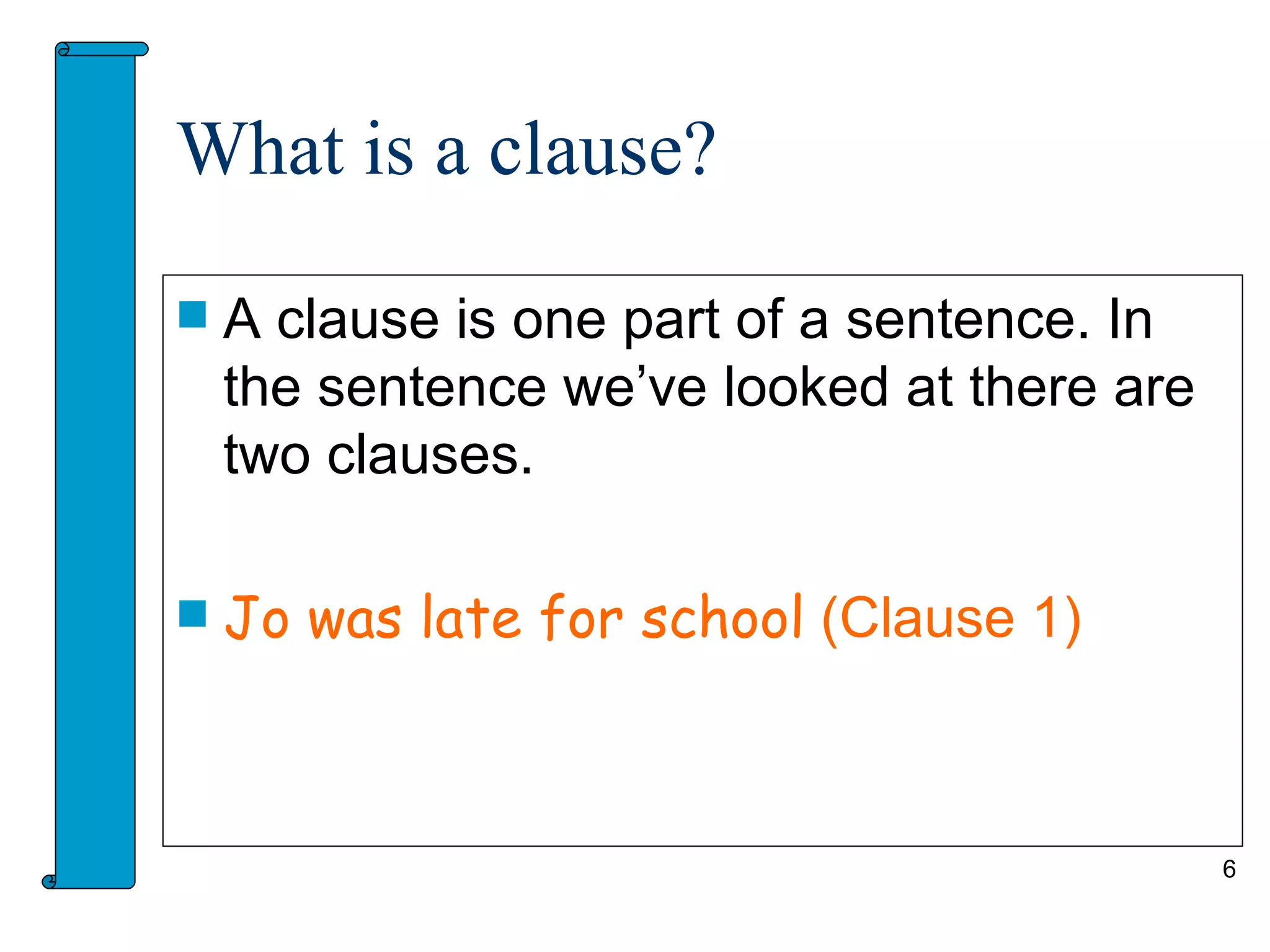
What is a clause?

   A clause is one part of a sentence. In
    the sentence we’ve looked at there are
    two clauses.

   Jo was late for school (Clause 1)


                                             6
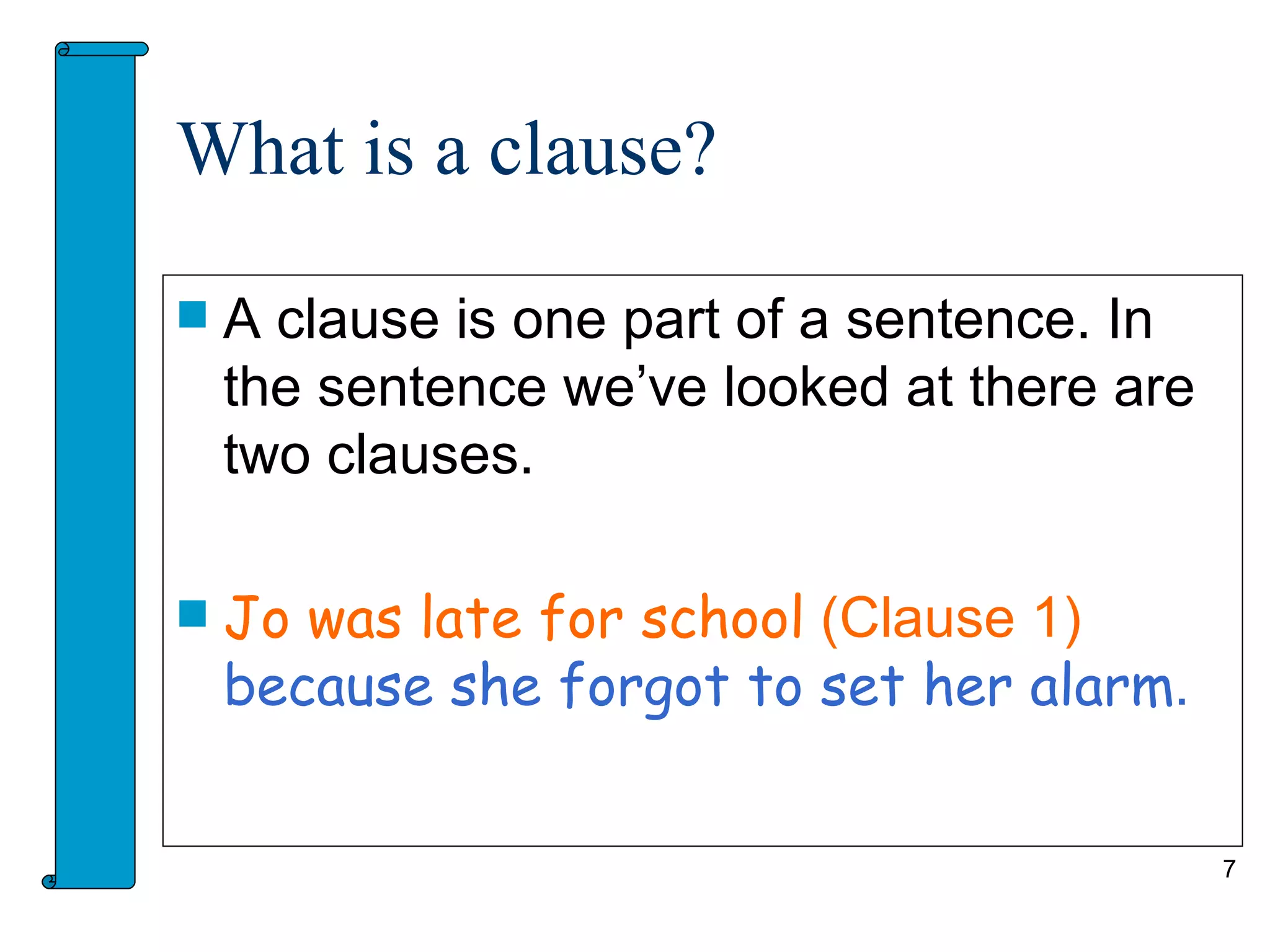
What is a clause?

   A clause is one part of a sentence. In
    the sentence we’ve looked at there are
    two clauses.

   Jo was late for school (Clause 1)
    because she forgot to set her alarm.


                                             7
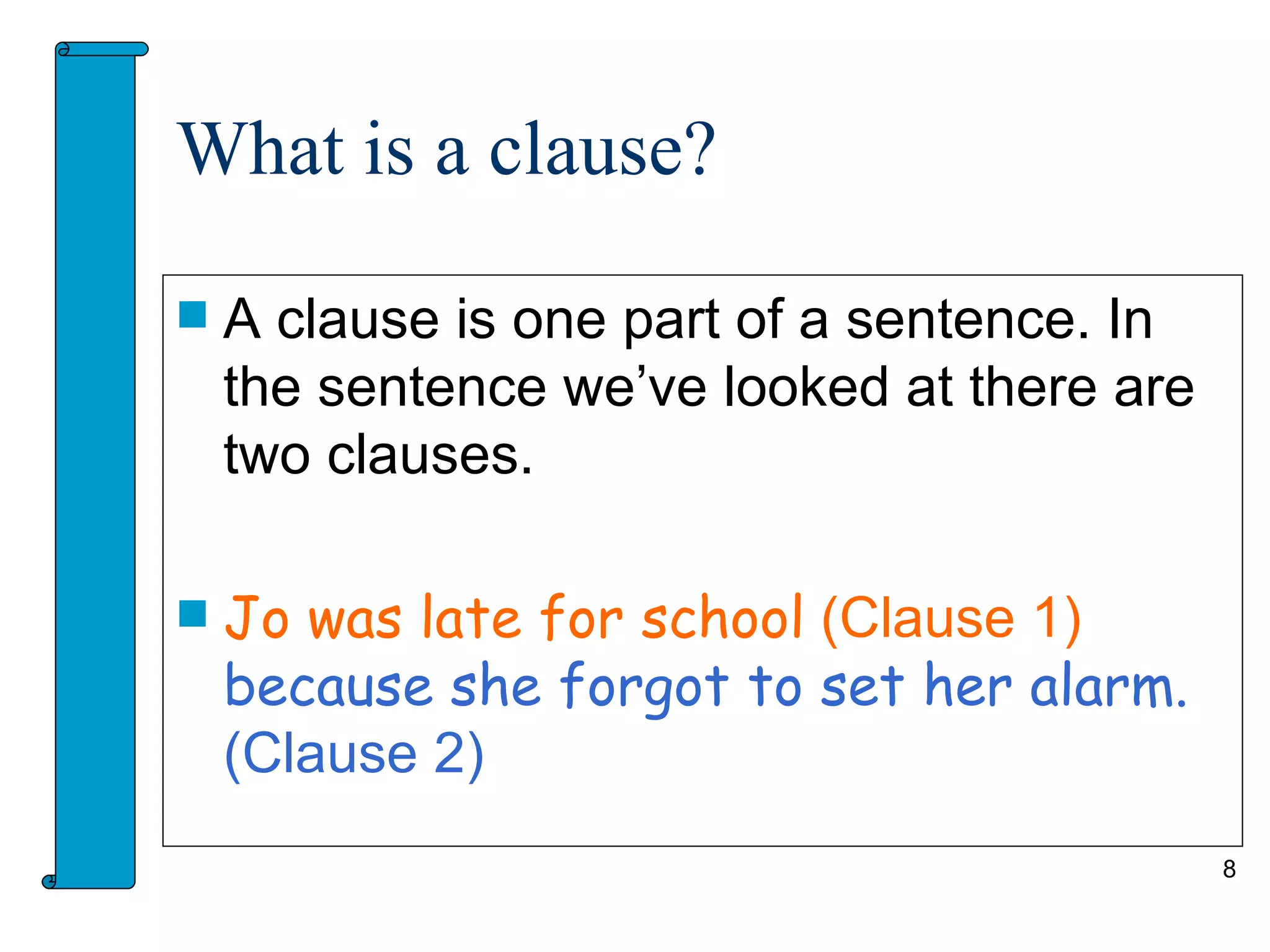
What is a clause?

   A clause is one part of a sentence. In
    the sentence we’ve looked at there are
    two clauses.

   Jo was late for school (Clause 1)
    because she forgot to set her alarm.
    (Clause 2)
                                             8
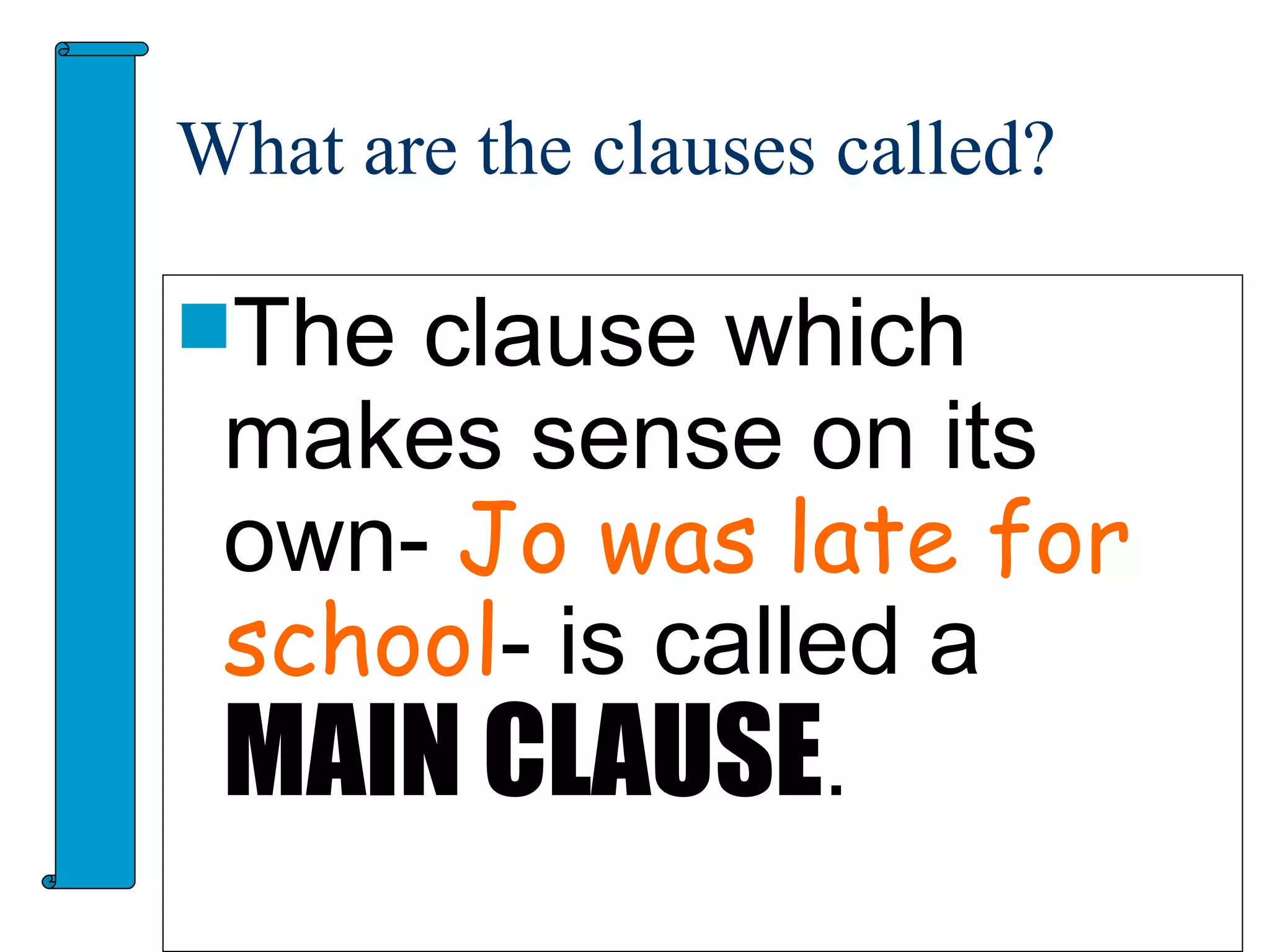
What are the clauses called?

The clause which
 makes sense on its
 own- Jo was late for
 school- is called a
 MAIN CLAUSE.
                               9
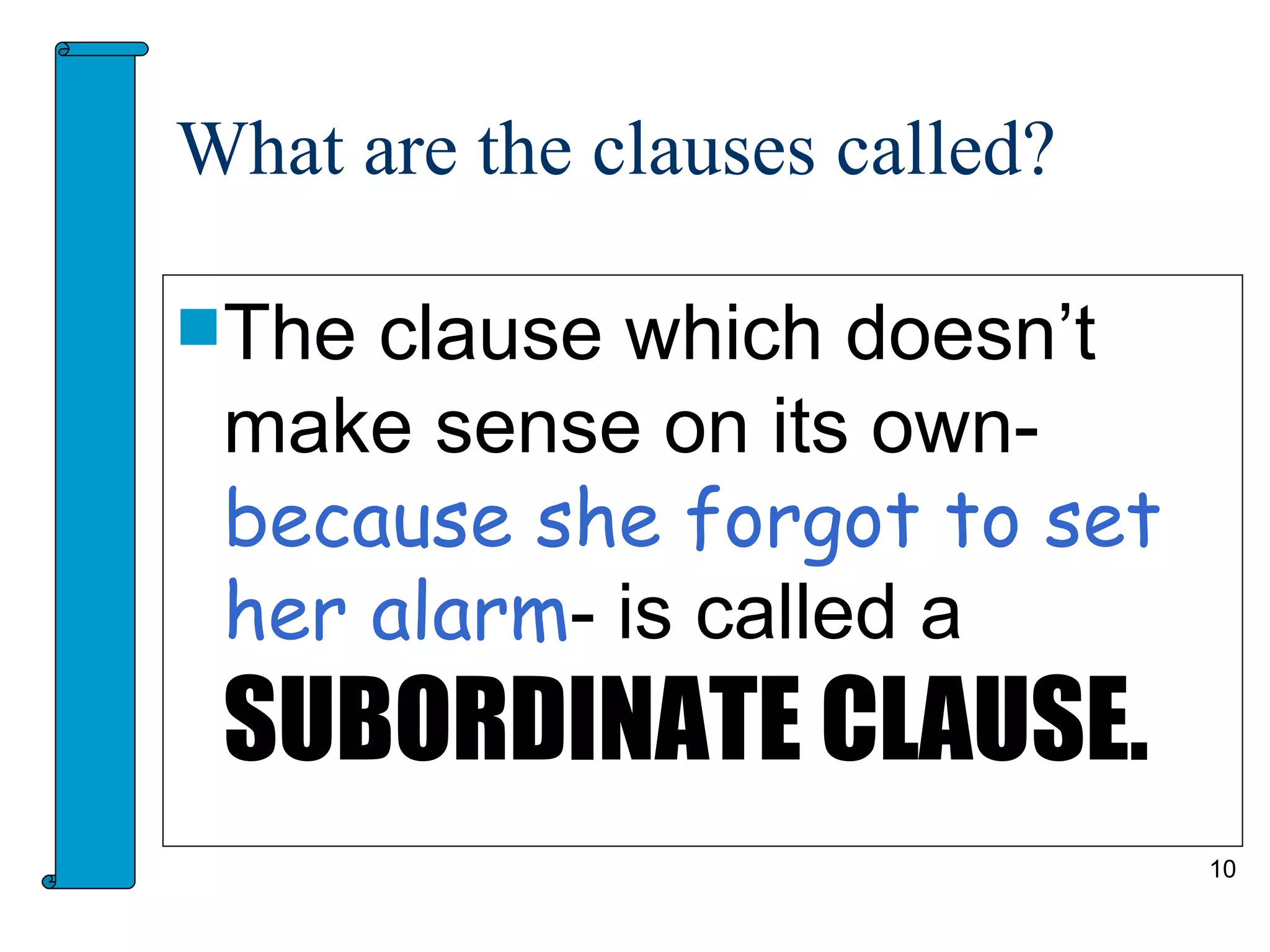
What are the clauses called?

The clause which doesn’t
 make sense on its own-
 because she forgot to set
 her alarm- is called a
 SUBORDINATE CLAUSE.
                               10
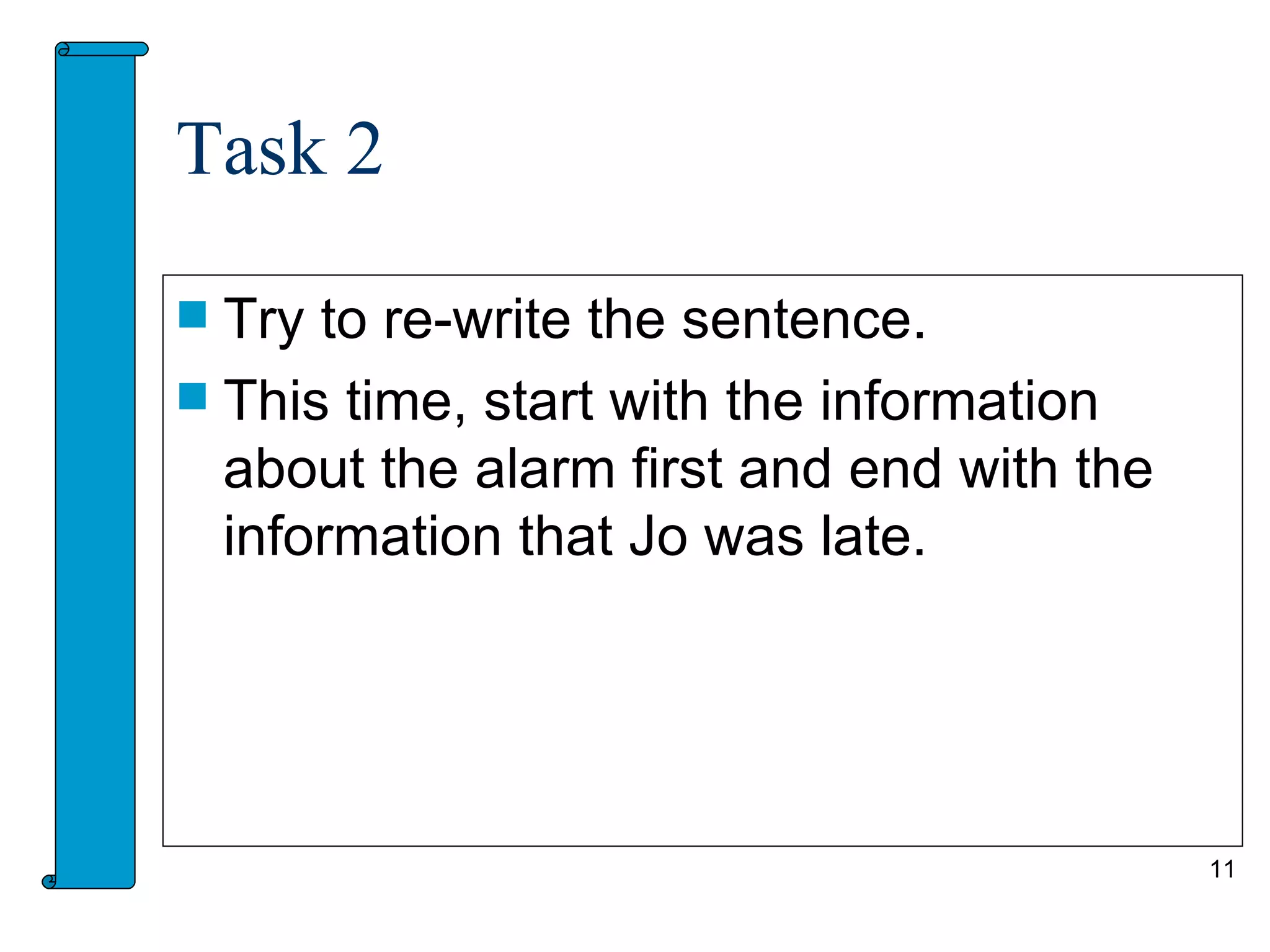
Task 2

 Try to re-write the sentence.
 This time, start with the information
  about the alarm first and end with the
  information that Jo was late.


                                           11
Examples

 Jo was late for school because she
  forgot to set her alarm.
 Jo was late for school when she
  forgot to set her alarm.
 Jo was late for school having
  forgotten to set her alarm.


                                       12
Examples

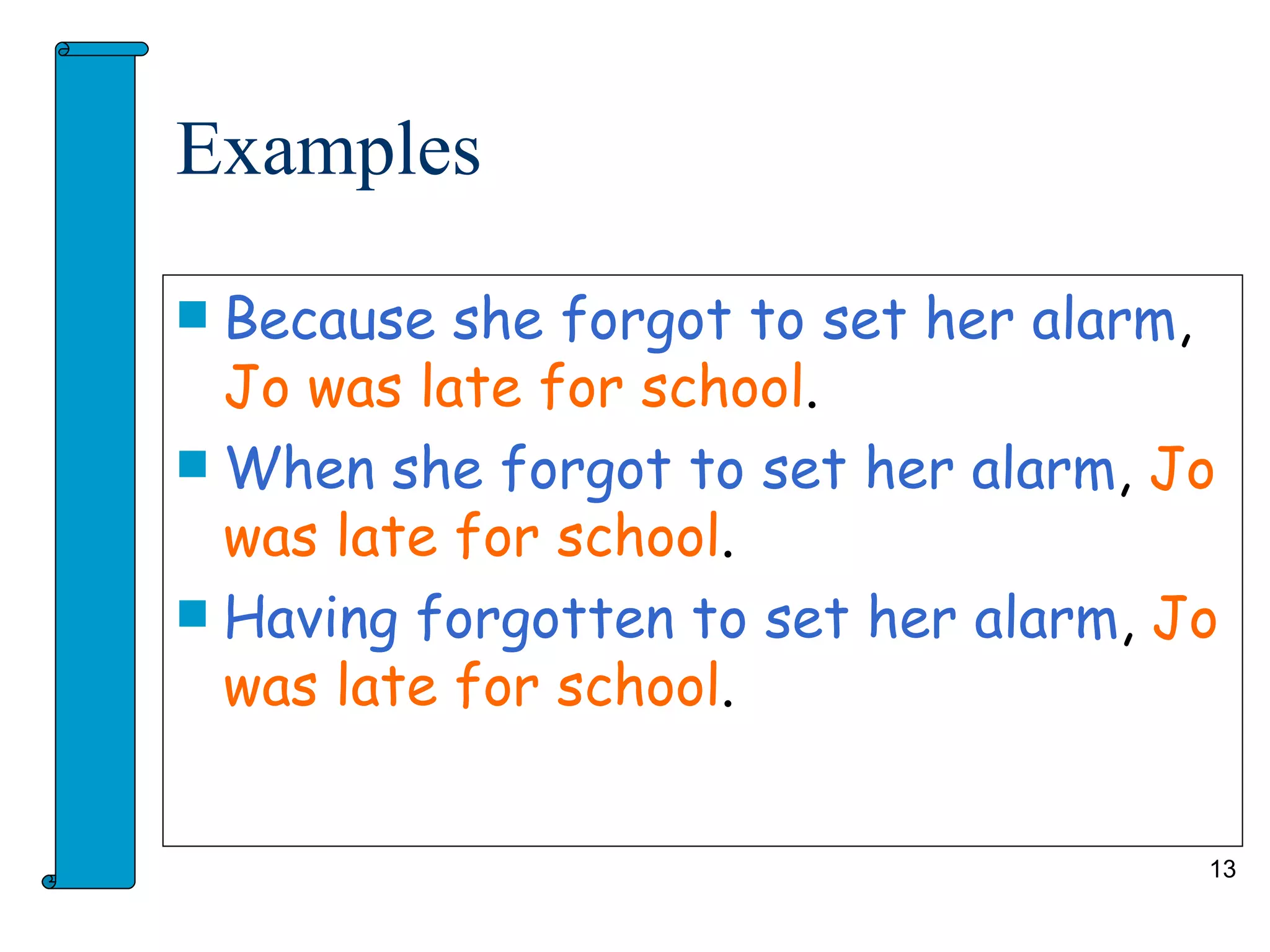
 Because she forgot to set her alarm,
  Jo was late for school.
 When she forgot to set her alarm, Jo
  was late for school.
 Having forgotten to set her alarm, Jo
  was late for school.


                                      13
Examples
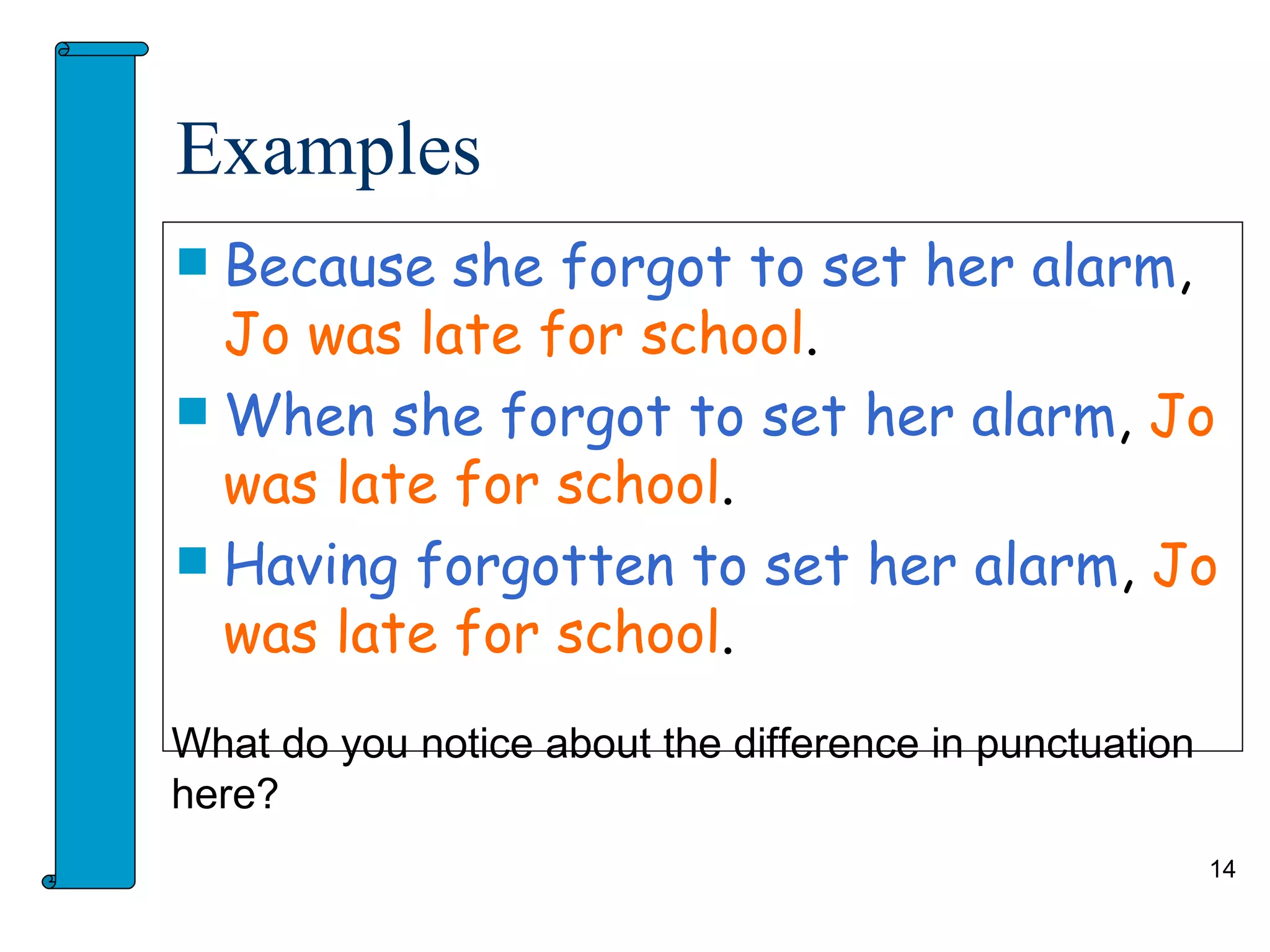
 Because she forgot to set her alarm,
  Jo was late for school.
 When she forgot to set her alarm, Jo
  was late for school.
 Having forgotten to set her alarm, Jo
  was late for school.
What do you notice about the difference in punctuation
here?
                                                         14
Rule

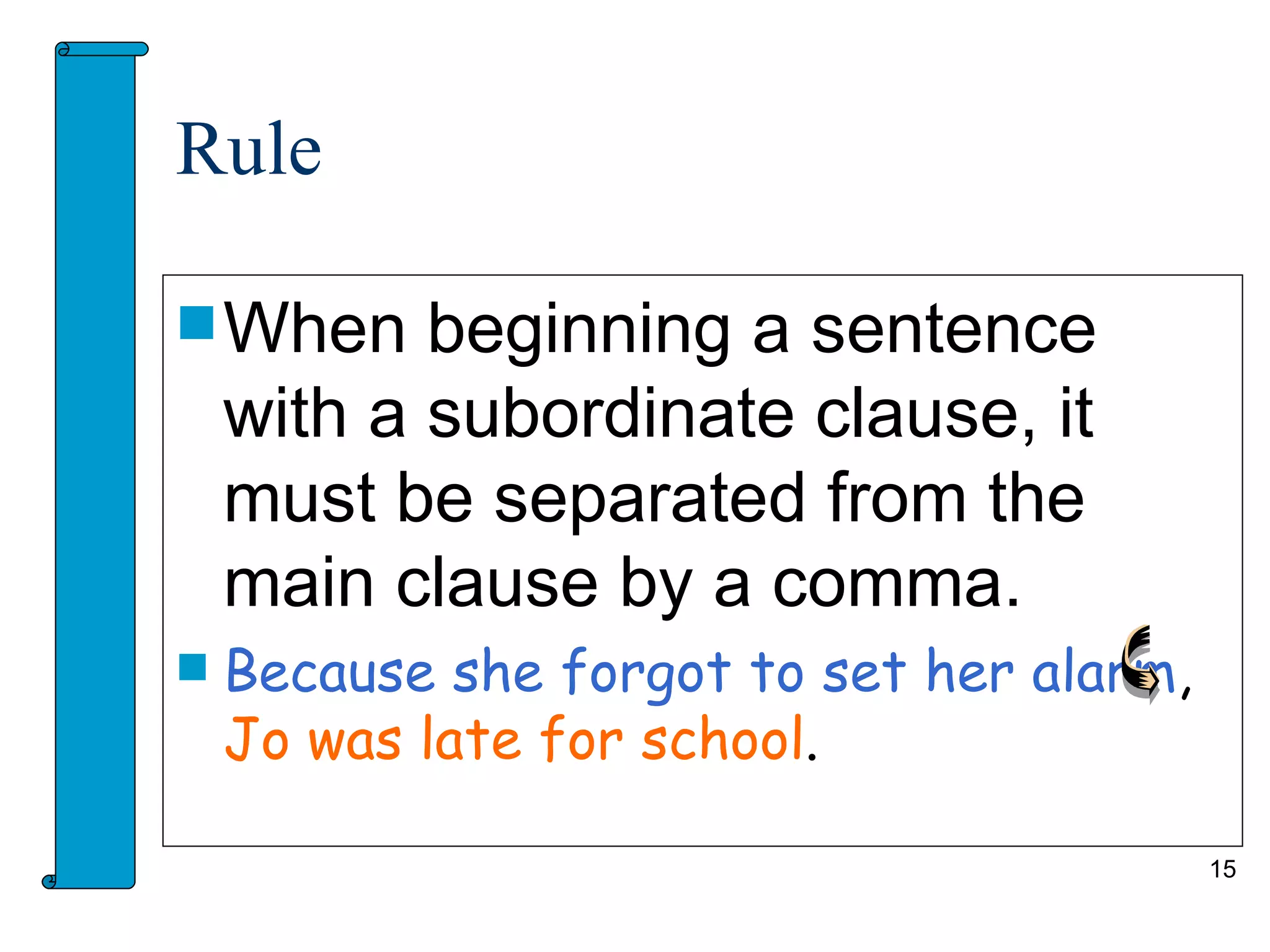
 When     beginning a sentence
    with a subordinate clause, it
    must be separated from the
    main clause by a comma.
   Because she forgot to set her alarm,
    Jo was late for school.

                                           15
Task 3

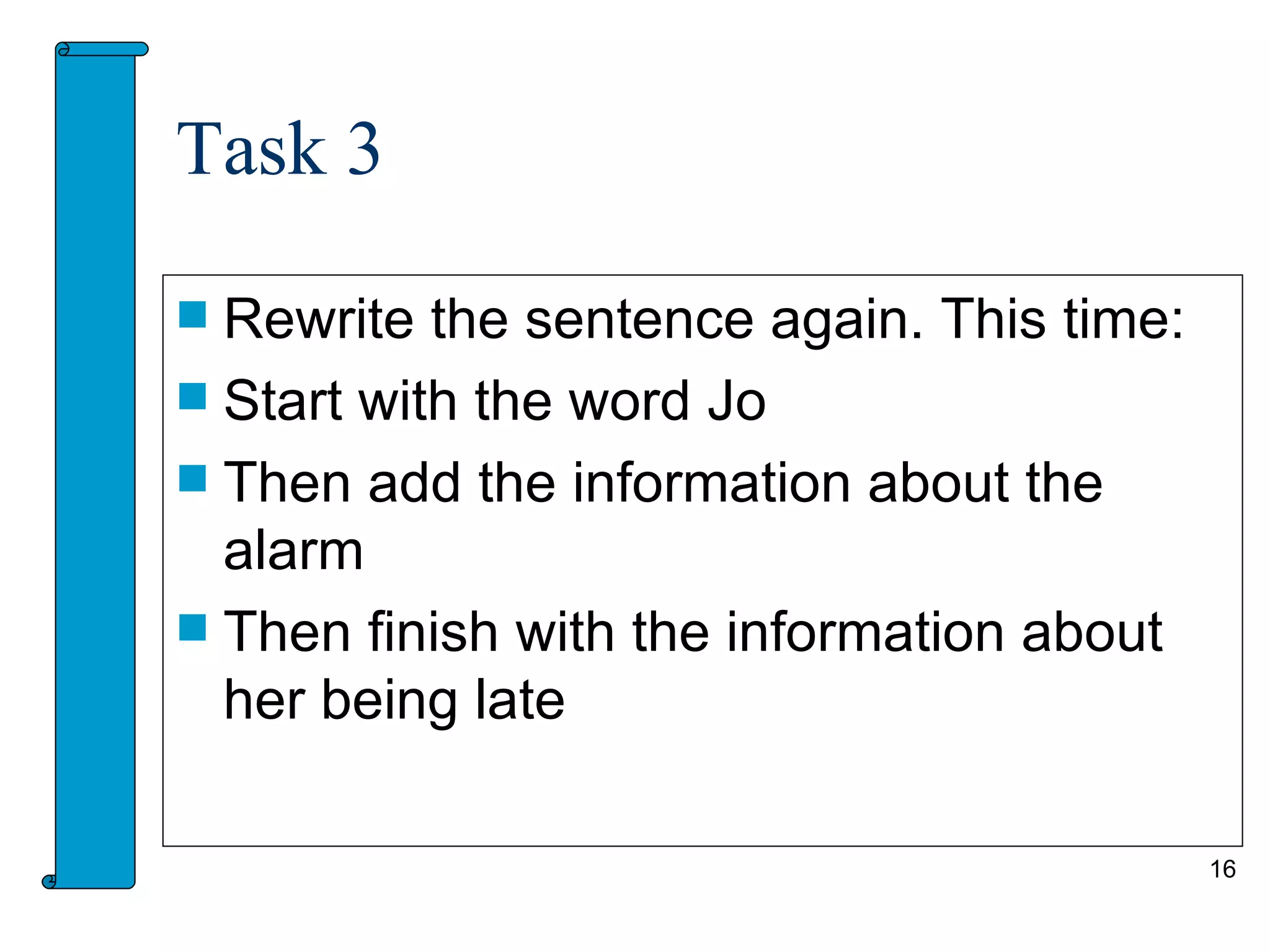
 Rewrite the sentence again. This time:
 Start with the word Jo
 Then add the information about the
  alarm
 Then finish with the information about
  her being late

                                           16
Examples

 Jo was late for school because she
  forgot to set her alarm.
 Jo was late for school when she
  forgot to set her alarm.
 Jo was late for school having
  forgotten to set her alarm.


                                       17
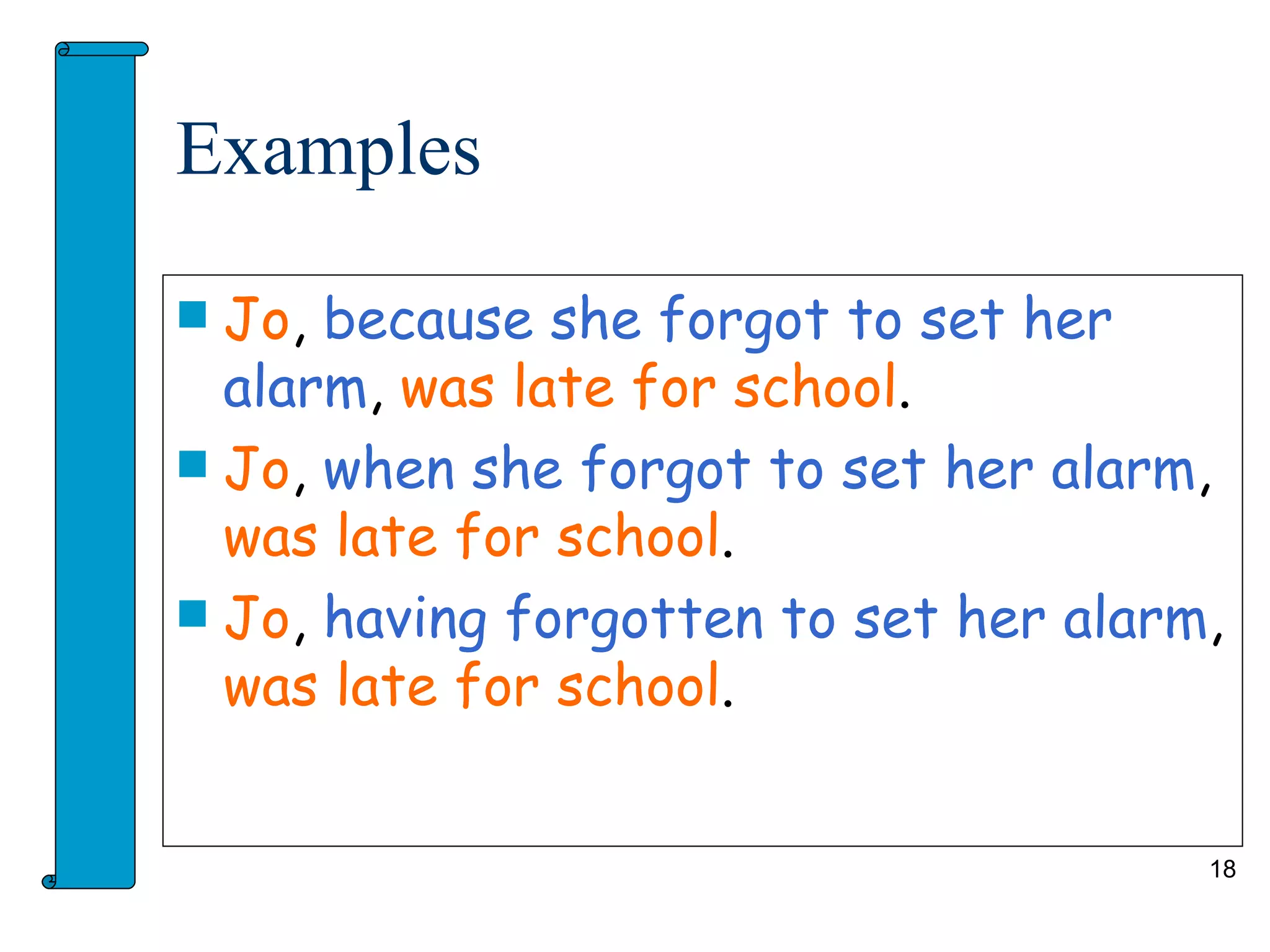
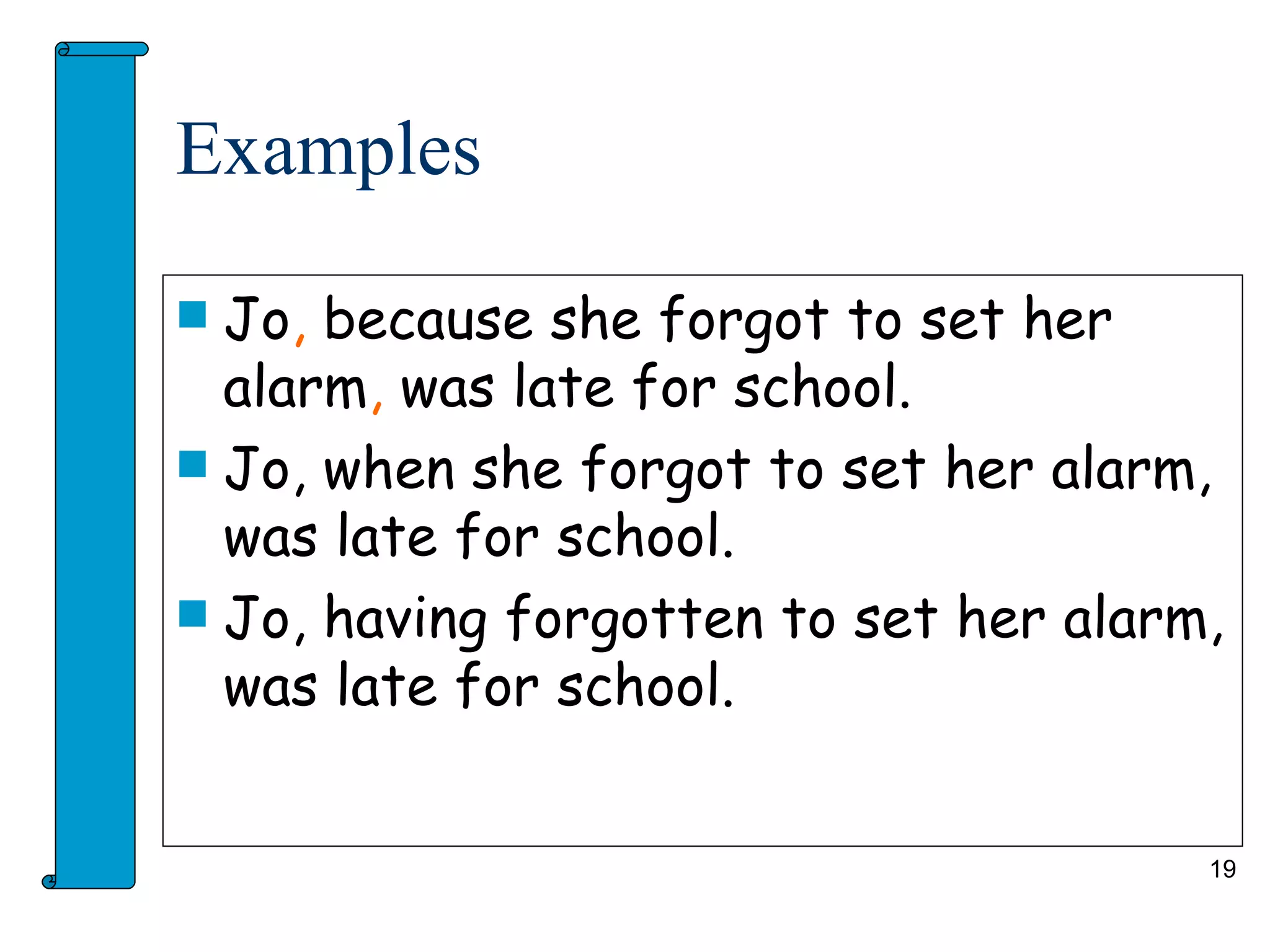
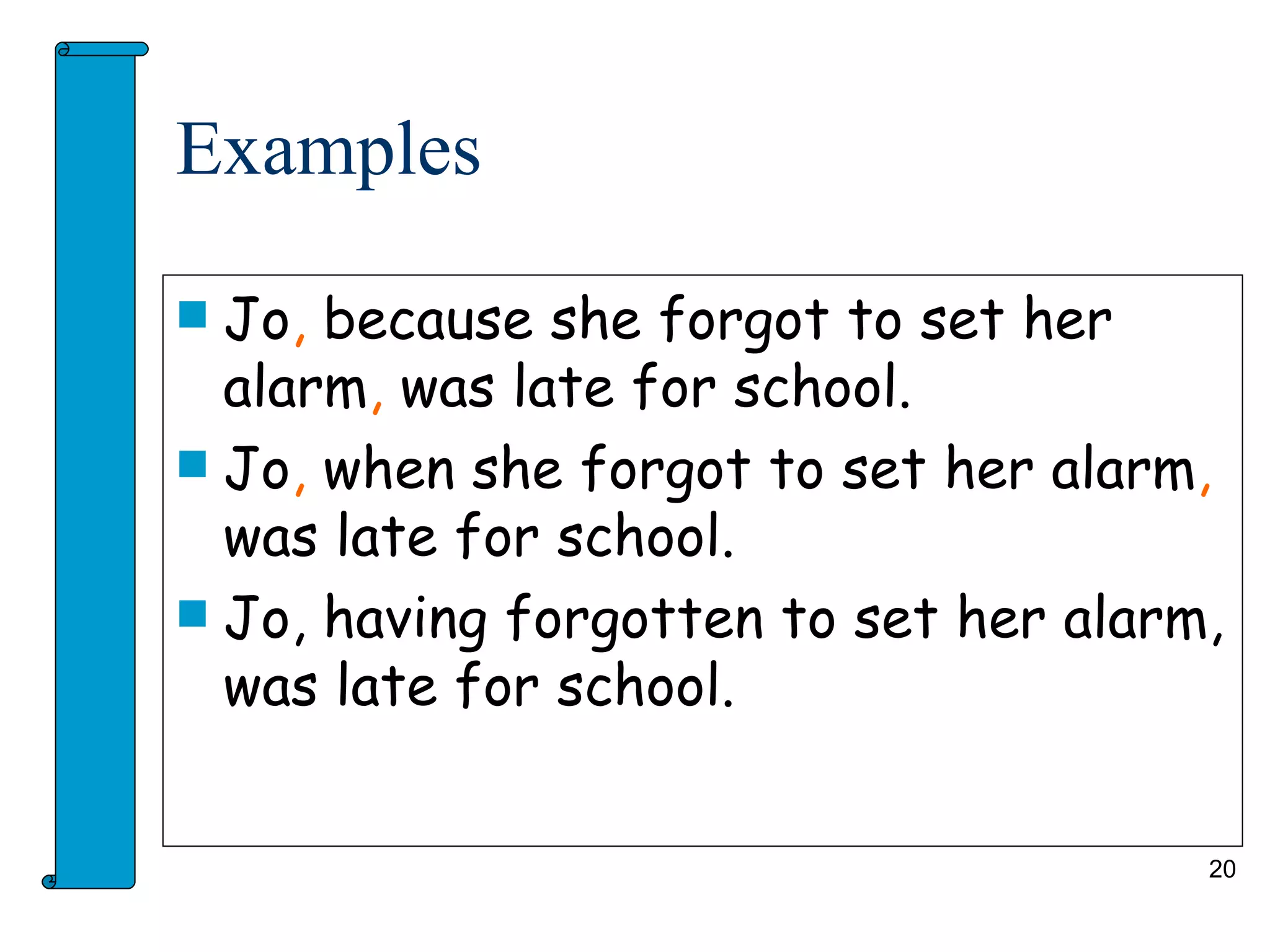
Examples

 Jo, because she forgot to set her
  alarm, was late for school.
 Jo, when she forgot to set her alarm,
  was late for school.
 Jo, having forgotten to set her alarm,
  was late for school.


                                       18
Examples

 Jo, because she forgot to set her
  alarm, was late for school.
 Jo, when she forgot to set her alarm,
  was late for school.
 Jo, having forgotten to set her alarm,
  was late for school.


                                       19
Examples

 Jo, because she forgot to set her
  alarm, was late for school.
 Jo, when she forgot to set her alarm,
  was late for school.
 Jo, having forgotten to set her alarm,
  was late for school.


                                       20
Examples

 Jo, because she forgot to set her
  alarm, was late for school.
 Jo, when she forgot to set her alarm,
  was late for school.
 Jo, having forgotten to set her alarm,
  was late for school.


                                       21
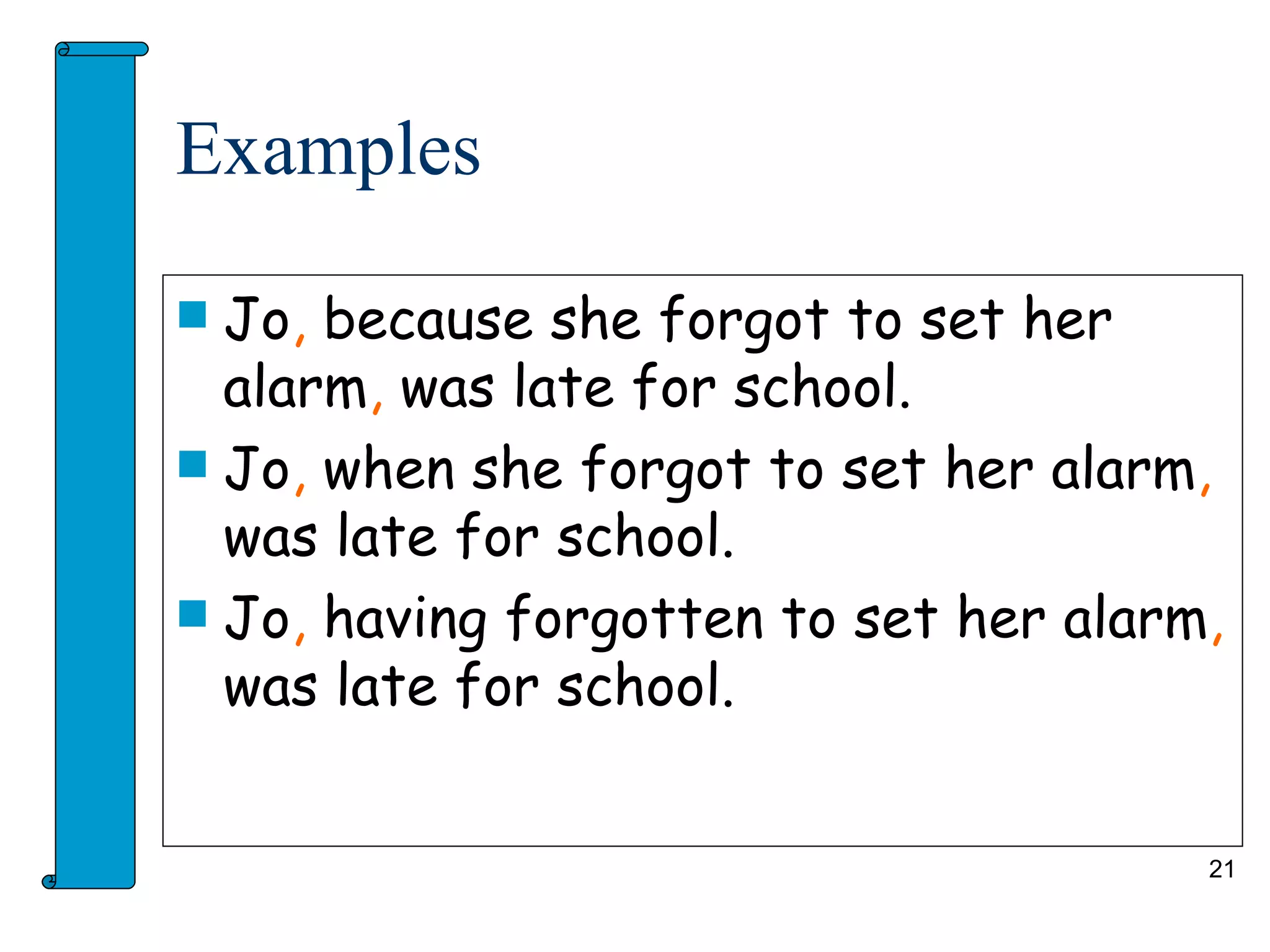
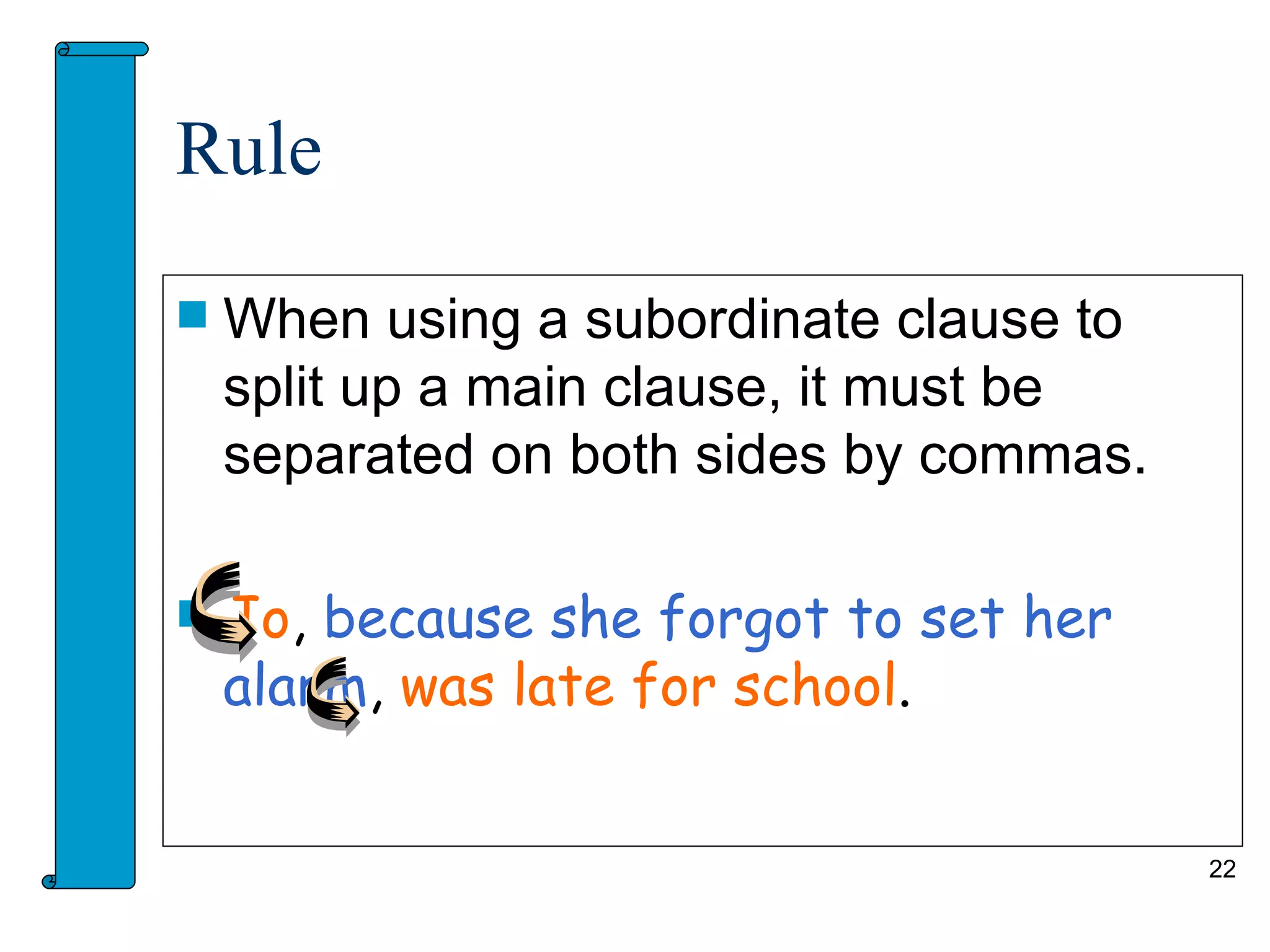
Rule

   When using a subordinate clause to
    split up a main clause, it must be
    separated on both sides by commas.

   Jo, because she forgot to set her
    alarm, was late for school.


                                         22
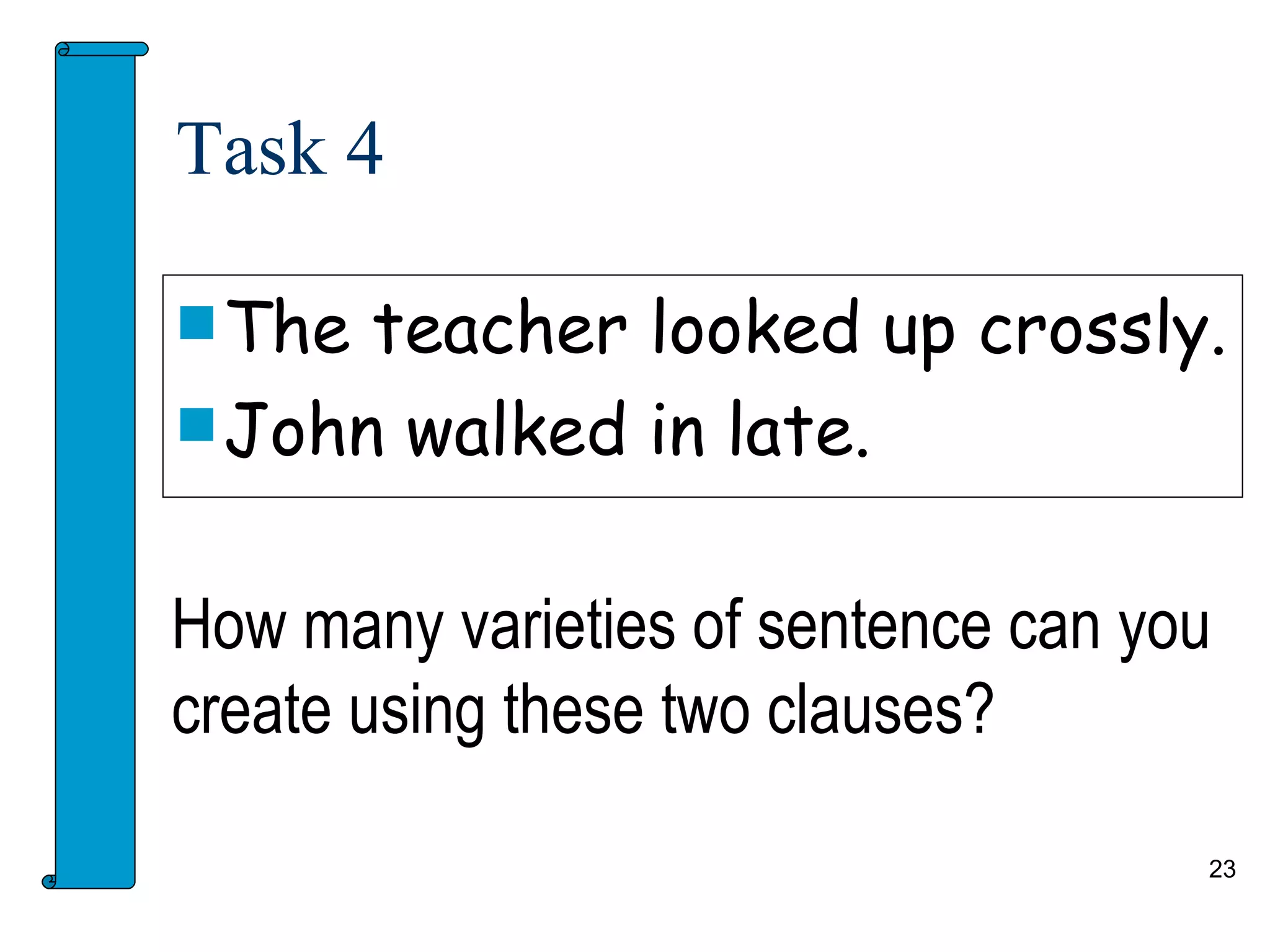
Task 4

 The teacher looked up crossly.
 John walked in late.


How many varieties of sentence can you
create using these two clauses?

                                     23

Clauses Main And Subord

  • 1.
  • 2.
    Aims  What isa clause?  What is a subordinate clause?  How can we use them correctly? 2
  • 3.
    Task 1  Jowas late for school.  She forgot to set the alarm. Join these sentences together to make one sentence. You may add in any words except ‘and’, ‘but’ or ‘so’ 3
  • 4.
    Examples  Jo waslate for school because she forgot to set her alarm.  Jo was late for school when she forgot to set her alarm.  Jo was late for school having forgotten to set her alarm. 4
  • 5.
    What is aclause?  A clause is one part of a sentence. In the sentence we’ve looked at there are two clauses.  Jo was late for school 5
  • 6.
    What is aclause?  A clause is one part of a sentence. In the sentence we’ve looked at there are two clauses.  Jo was late for school (Clause 1) 6
  • 7.
    What is aclause?  A clause is one part of a sentence. In the sentence we’ve looked at there are two clauses.  Jo was late for school (Clause 1) because she forgot to set her alarm. 7
  • 8.
    What is aclause?  A clause is one part of a sentence. In the sentence we’ve looked at there are two clauses.  Jo was late for school (Clause 1) because she forgot to set her alarm. (Clause 2) 8
  • 9.
    What are theclauses called? The clause which makes sense on its own- Jo was late for school- is called a MAIN CLAUSE. 9
  • 10.
    What are theclauses called? The clause which doesn’t make sense on its own- because she forgot to set her alarm- is called a SUBORDINATE CLAUSE. 10
  • 11.
    Task 2  Tryto re-write the sentence.  This time, start with the information about the alarm first and end with the information that Jo was late. 11
  • 12.
    Examples  Jo waslate for school because she forgot to set her alarm.  Jo was late for school when she forgot to set her alarm.  Jo was late for school having forgotten to set her alarm. 12
  • 13.
    Examples  Because sheforgot to set her alarm, Jo was late for school.  When she forgot to set her alarm, Jo was late for school.  Having forgotten to set her alarm, Jo was late for school. 13
  • 14.
    Examples  Because sheforgot to set her alarm, Jo was late for school.  When she forgot to set her alarm, Jo was late for school.  Having forgotten to set her alarm, Jo was late for school. What do you notice about the difference in punctuation here? 14
  • 15.
    Rule  When beginning a sentence with a subordinate clause, it must be separated from the main clause by a comma.  Because she forgot to set her alarm, Jo was late for school. 15
  • 16.
    Task 3  Rewritethe sentence again. This time:  Start with the word Jo  Then add the information about the alarm  Then finish with the information about her being late 16
  • 17.
    Examples  Jo waslate for school because she forgot to set her alarm.  Jo was late for school when she forgot to set her alarm.  Jo was late for school having forgotten to set her alarm. 17
  • 18.
    Examples  Jo, becauseshe forgot to set her alarm, was late for school.  Jo, when she forgot to set her alarm, was late for school.  Jo, having forgotten to set her alarm, was late for school. 18
  • 19.
    Examples  Jo, becauseshe forgot to set her alarm, was late for school.  Jo, when she forgot to set her alarm, was late for school.  Jo, having forgotten to set her alarm, was late for school. 19
  • 20.
    Examples  Jo, becauseshe forgot to set her alarm, was late for school.  Jo, when she forgot to set her alarm, was late for school.  Jo, having forgotten to set her alarm, was late for school. 20
  • 21.
    Examples  Jo, becauseshe forgot to set her alarm, was late for school.  Jo, when she forgot to set her alarm, was late for school.  Jo, having forgotten to set her alarm, was late for school. 21
  • 22.
    Rule  When using a subordinate clause to split up a main clause, it must be separated on both sides by commas.  Jo, because she forgot to set her alarm, was late for school. 22
  • 23.
    Task 4  Theteacher looked up crossly.  John walked in late. How many varieties of sentence can you create using these two clauses? 23