Clause and Conjunctions : An Introduction 1
Clause and
Conjunctions: An
Introduction
Clause and Conjunctions : An Introduction 2
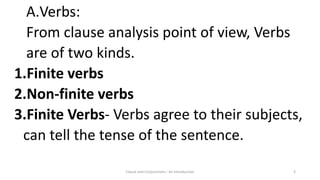
A.Verbs:
From clause analysis point of view, Verbs
are of two kinds.
1.Finite verbs
2.Non-finite verbs
3.Finite Verbs- Verbs agree to their subjects,
can tell the tense of the sentence.
Clause and Conjunctions : An Introduction 3
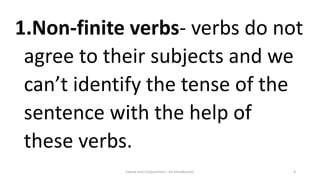
1.Non-finite verbs- verbs do not
agree to their subjects and we
can’t identify the tense of the
sentence with the help of
these verbs.
Clause and Conjunctions : An Introduction 4
Clause and Conjunctions : An Introduction 5
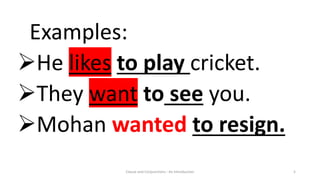
Examples:
He likes to play cricket.
They want to see you.
Mohan wanted to resign.
Clause and Conjunctions : An Introduction 6
B-Types of Sentences:
1)Simple Sentence
2)Compound Sentence
3)Complex Sentence
Clause and Conjunctions : An Introduction 7
1.Simple Sentence- The sentence
which has a subject and a
predicate and the predicate has
only one finite verb is called a
Simple sentence.
Clause and Conjunctions : An Introduction 8
Examples:
1-She writes a letter.
2-You played cricket.
3-We are teaching English.
4-He will have been sleeping.
•5-We like to play basketball.
•6-He wanted to visit you.
•7-He went to market and bought
a book.
•8-Ram and Shyam are friends.
Clause and Conjunctions : An Introduction 9
•Conjunctions: Those words
which are used to join two or
more than two words or
sentences are called
conjunctions.
Clause and Conjunctions : An Introduction 10
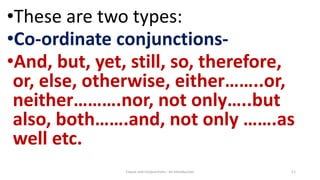
•These are two types:
•Co-ordinate conjunctions-
•And, but, yet, still, so, therefore,
or, else, otherwise, either……..or,
neither……….nor, not only…..but
also, both…….and, not only …….as
well etc.
Clause and Conjunctions : An Introduction 11
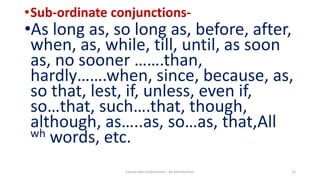
•Sub-ordinate conjunctions-
•As long as, so long as, before, after,
when, as, while, till, until, as soon
as, no sooner …….than,
hardly…….when, since, because, as,
so that, lest, if, unless, even if,
so…that, such….that, though,
although, as…..as, so…as, that,All
wh words, etc.
Clause and Conjunctions : An Introduction 12
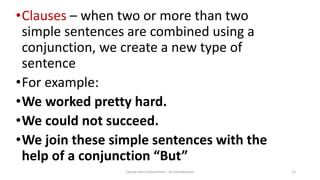
•Clauses – when two or more than two
simple sentences are combined using a
conjunction, we create a new type of
sentence
•For example:
•We worked pretty hard.
•We could not succeed.
•We join these simple sentences with the
help of a conjunction “But”
Clause and Conjunctions : An Introduction 13
We worked pretty hared but we
could not succeed.
What are these parts of this sentence
called?
Clause and Conjunctions : An Introduction 14
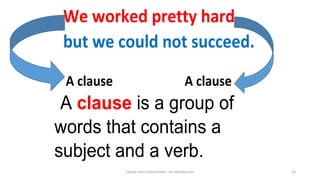
We worked pretty hard
but we could not succeed.
A clause A clause
A clause is a group of
words that contains a
subject and a verb.
Clause and Conjunctions : An Introduction 15
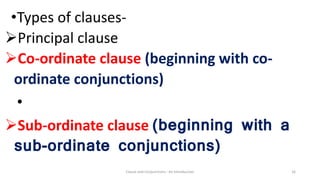
•Types of clauses-
Principal clause
Co-ordinate clause (beginning with co-
ordinate conjunctions)
•
Sub-ordinate clause (beginning with a
sub-ordinate conjunctions)
Clause and Conjunctions : An Introduction 16
Clause and Conjunctions : An Introduction 17
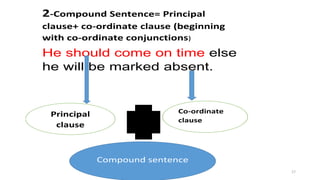
2-Compound Sentence= Principal
clause+ co-ordinate clause (beginning
with co-ordinate conjunctions)
He should come on time else
he will be marked absent.
Principal
clause
Co-ordinate
clause
Compound sentence
Clause and Conjunctions : An Introduction 18
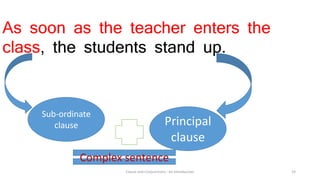
3-Complex sentence =
principal clause+ sub-
ordinate clause (beginning
with a sub-ordinate
conjunction)
Clause and Conjunctions : An Introduction 19
As soon as the teacher enters the
class, the students stand up.
Sub-ordinate
clause Principal
clause
Complex sentence
Clause and Conjunctions : An Introduction 20
Clause and Conjunctions : An Introduction 21
Clause and Conjunctions : An Introduction 22
By Hare Ram Joshi
(Varishtha Adhyapak)
Govt.H.S.School,Paganvisi,Gwalior
Mobile no.--9826208009

Clause and conjunctions

  • 1.
    Clause and Conjunctions: An Introduction 1
  • 2.
    Clause and Conjunctions: An Introduction Clauseand Conjunctions : An Introduction 2
  • 3.
    A.Verbs: From clause analysispoint of view, Verbs are of two kinds. 1.Finite verbs 2.Non-finite verbs 3.Finite Verbs- Verbs agree to their subjects, can tell the tense of the sentence. Clause and Conjunctions : An Introduction 3
  • 4.
    1.Non-finite verbs- verbsdo not agree to their subjects and we can’t identify the tense of the sentence with the help of these verbs. Clause and Conjunctions : An Introduction 4
  • 5.
    Clause and Conjunctions: An Introduction 5 Examples: He likes to play cricket. They want to see you. Mohan wanted to resign.
  • 6.
    Clause and Conjunctions: An Introduction 6 B-Types of Sentences: 1)Simple Sentence 2)Compound Sentence 3)Complex Sentence
  • 7.
    Clause and Conjunctions: An Introduction 7 1.Simple Sentence- The sentence which has a subject and a predicate and the predicate has only one finite verb is called a Simple sentence.
  • 8.
    Clause and Conjunctions: An Introduction 8 Examples: 1-She writes a letter. 2-You played cricket. 3-We are teaching English. 4-He will have been sleeping.
  • 9.
    •5-We like toplay basketball. •6-He wanted to visit you. •7-He went to market and bought a book. •8-Ram and Shyam are friends. Clause and Conjunctions : An Introduction 9
  • 10.
    •Conjunctions: Those words whichare used to join two or more than two words or sentences are called conjunctions. Clause and Conjunctions : An Introduction 10
  • 11.
    •These are twotypes: •Co-ordinate conjunctions- •And, but, yet, still, so, therefore, or, else, otherwise, either……..or, neither……….nor, not only…..but also, both…….and, not only …….as well etc. Clause and Conjunctions : An Introduction 11
  • 12.
    •Sub-ordinate conjunctions- •As longas, so long as, before, after, when, as, while, till, until, as soon as, no sooner …….than, hardly…….when, since, because, as, so that, lest, if, unless, even if, so…that, such….that, though, although, as…..as, so…as, that,All wh words, etc. Clause and Conjunctions : An Introduction 12
  • 13.
    •Clauses – whentwo or more than two simple sentences are combined using a conjunction, we create a new type of sentence •For example: •We worked pretty hard. •We could not succeed. •We join these simple sentences with the help of a conjunction “But” Clause and Conjunctions : An Introduction 13
  • 14.
    We worked prettyhared but we could not succeed. What are these parts of this sentence called? Clause and Conjunctions : An Introduction 14
  • 15.
    We worked prettyhard but we could not succeed. A clause A clause A clause is a group of words that contains a subject and a verb. Clause and Conjunctions : An Introduction 15
  • 16.
    •Types of clauses- Principalclause Co-ordinate clause (beginning with co- ordinate conjunctions) • Sub-ordinate clause (beginning with a sub-ordinate conjunctions) Clause and Conjunctions : An Introduction 16
  • 17.
    Clause and Conjunctions: An Introduction 17 2-Compound Sentence= Principal clause+ co-ordinate clause (beginning with co-ordinate conjunctions) He should come on time else he will be marked absent. Principal clause Co-ordinate clause Compound sentence
  • 18.
    Clause and Conjunctions: An Introduction 18 3-Complex sentence = principal clause+ sub- ordinate clause (beginning with a sub-ordinate conjunction)
  • 19.
    Clause and Conjunctions: An Introduction 19 As soon as the teacher enters the class, the students stand up. Sub-ordinate clause Principal clause Complex sentence
  • 20.
    Clause and Conjunctions: An Introduction 20
  • 21.
    Clause and Conjunctions: An Introduction 21
  • 22.
    Clause and Conjunctions: An Introduction 22 By Hare Ram Joshi (Varishtha Adhyapak) Govt.H.S.School,Paganvisi,Gwalior Mobile no.--9826208009