Sentence Transformation
Part - 5
Simple-Compound-Complex
By Anil Kumar
The sentences are classed in three
categories depending on the number and
types of finite
clauses.
i. Simple Sentence
ii. Compound Sentence
iii. Complex Sentence
Before we discuss about
kinds of sentences, let’s
learn about principal
clause and subordinate
clause.
Principal or Main Clause
Does express a complete thought
Can stand alone as a sentence
Has a subject and a verb
Main/independent clause
Subordinate Clause
Does not express a complete thought
Cannot stand alone as a sentence
Has a subject and a verb
Starts with relative pronoun or a subordinate conjunction
3 types- Noun, Adjective and Adverb
Dependent clause
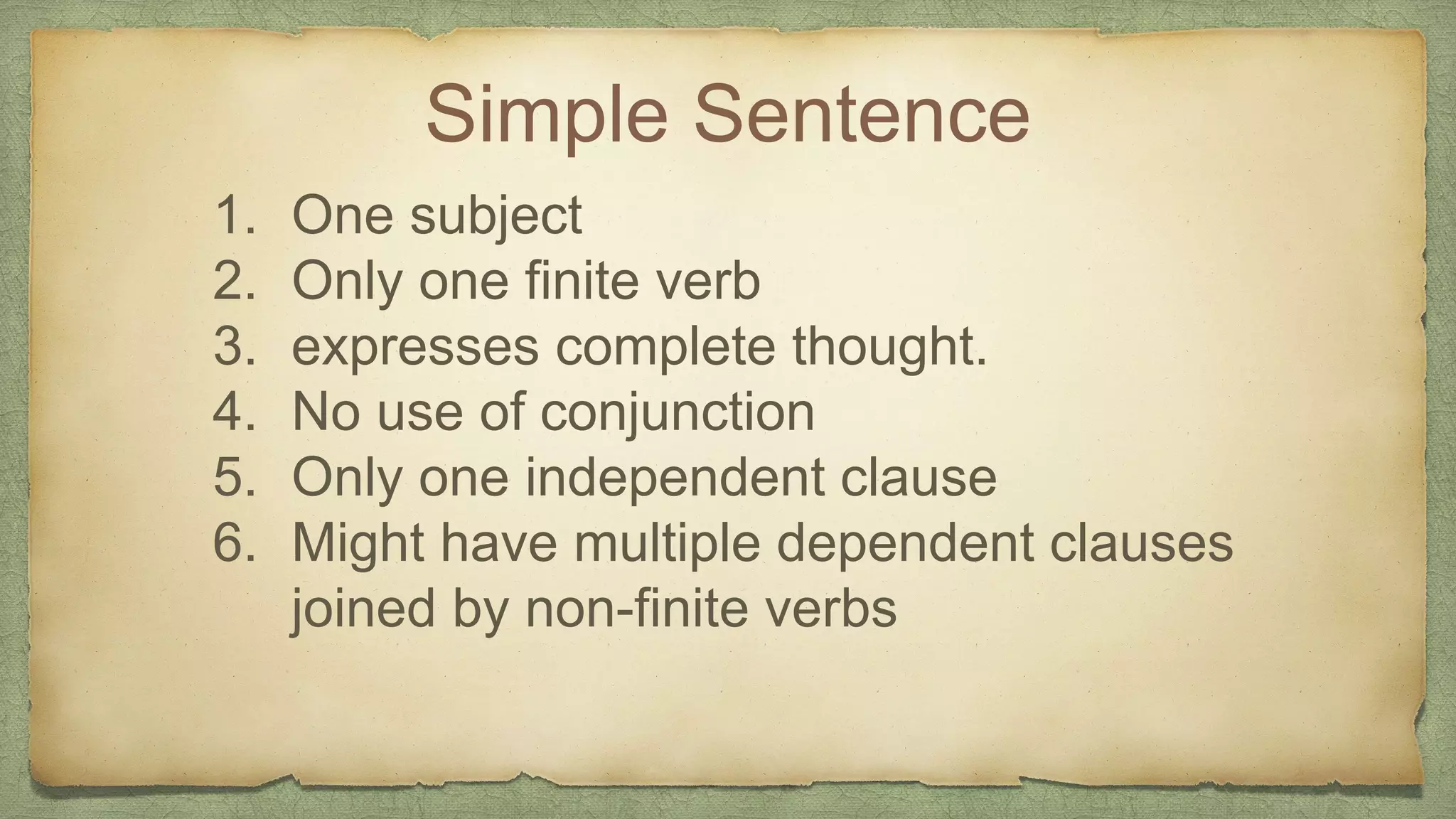
Simple Sentence
1. One subject
2. Only one finite verb
3. expresses complete thought.
4. No use of conjunction
5. Only one independent clause
6. Might have multiple dependent clauses
joined by non-finite verbs
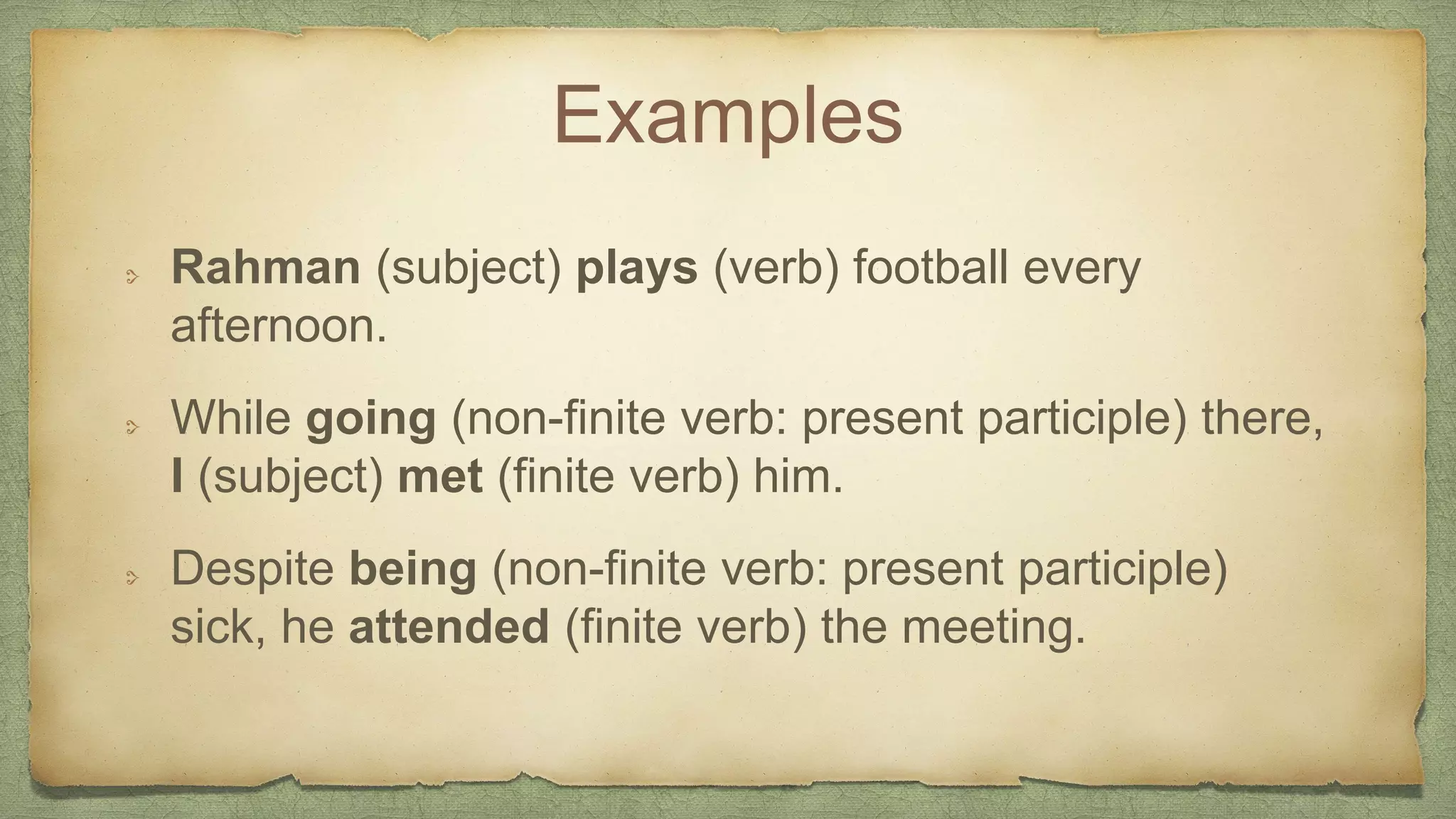
Examples
Rahman (subject) plays (verb) football every
afternoon.
While going (non-finite verb: present participle) there,
I (subject) met (finite verb) him.
Despite being (non-finite verb: present participle)
sick, he attended (finite verb) the meeting.
Compound Sentence
1. Multiple independent clauses
2. No dependent clause
3. Two finite verbs
4. Two subjects
5. Clauses are joined together by
coordinating conjunctions
And-But-Nor-Or-So-Yet
Examples
I (subject) tried (finite verb) to speak
Spanish, and my friend (subject) tried (finite
verb) to speak English.
Rahman (subject) played (finite verb)
football, so Ria (subject) went (finite verb) for
shopping.
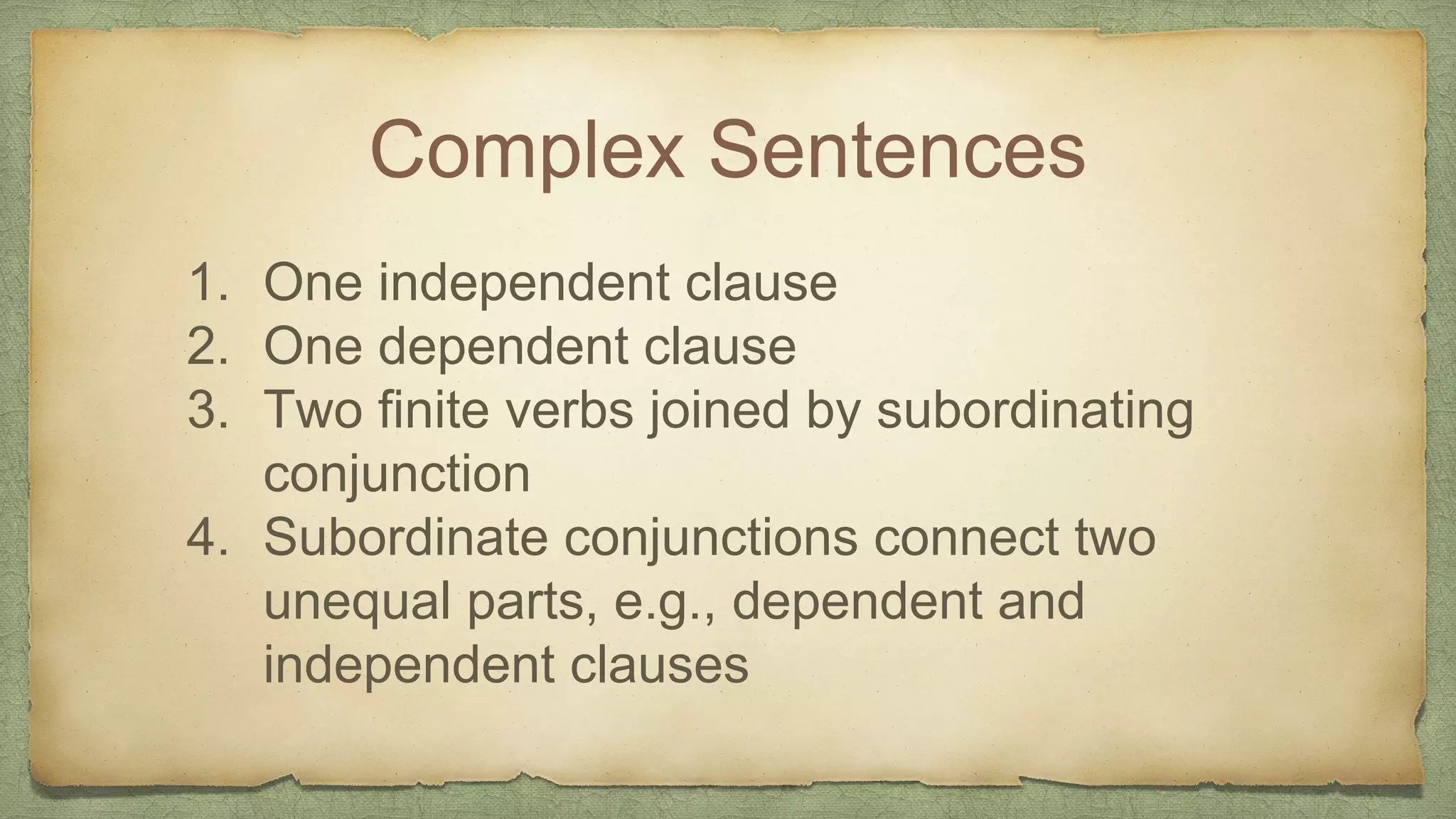
Complex Sentences
1. One independent clause
2. One dependent clause
3. Two finite verbs joined by subordinating
conjunction
4. Subordinate conjunctions connect two
unequal parts, e.g., dependent and
independent clauses
List of subordinating
conjunctions
Since, as, when, though, although,
so that, whenever, because, than,
whereas, that, wherever, that,
whether, if, though, which, till,
while, unless, who, until, why, how,
what
Examples
When (subordinator) he (subject) handed (finite verb) in his homework, he
(subject) forgot (finite verb) to give the teacher the last page.
The teacher (subject) returned (finite verb) the homework after
(subordinator) she (subject) noticed (finite verb) the error.
The students (subject) are studying (finite verb) because (subordinator)
they (subject) have (finite verb) a test tomorrow.
Roy (subject) and Rahman (subject) went (finite verb) to the movies after
(subordinator) they (subject) finished (verb) studying.
Transform into Simple Sentence
Use non-finite verb
Don’t use any conjunction.
Always maintain the meaning of the
given sentence
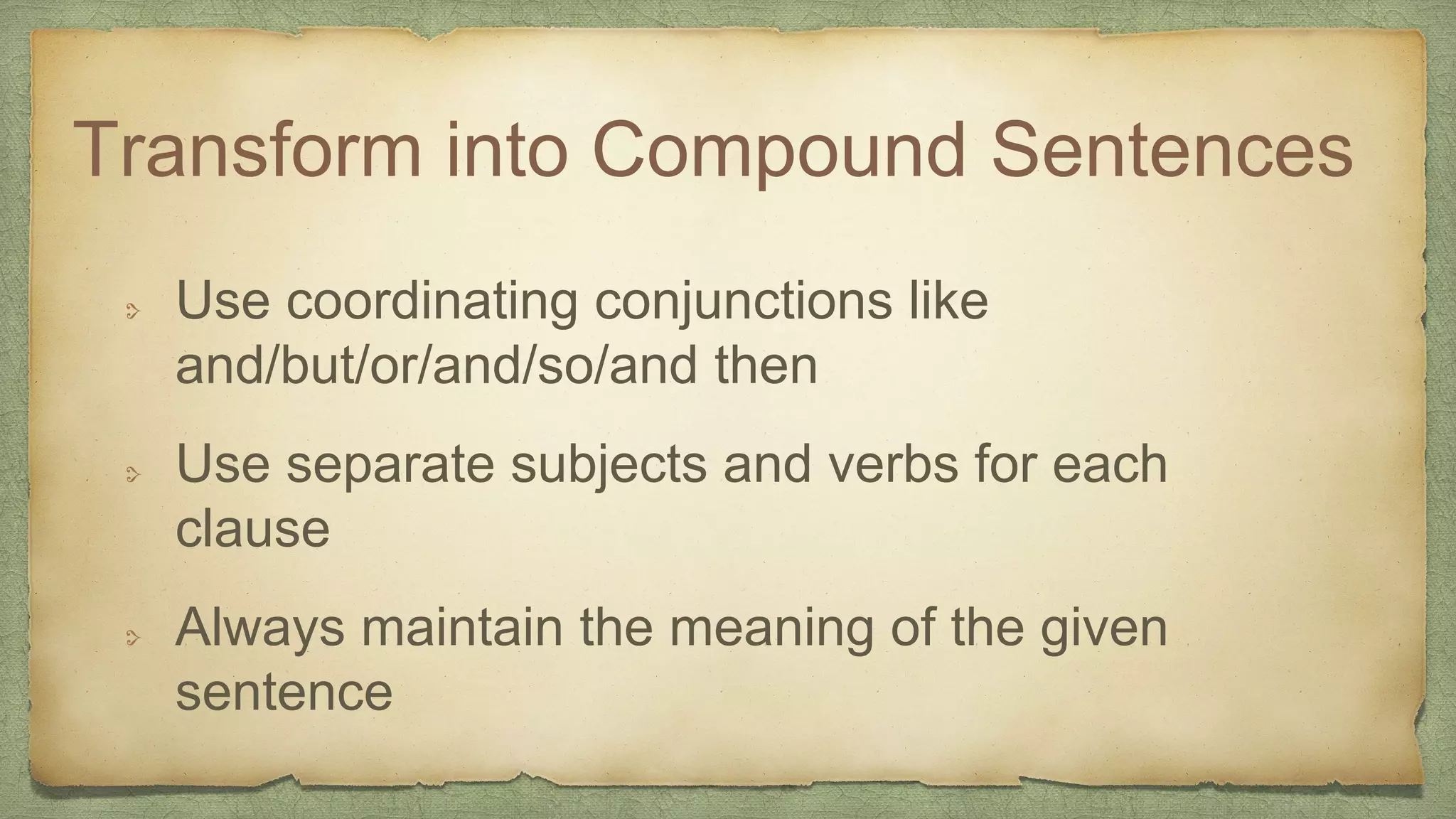
Transform into Compound Sentences
Use coordinating conjunctions like
and/but/or/and/so/and then
Use separate subjects and verbs for each
clause
Always maintain the meaning of the given
sentence
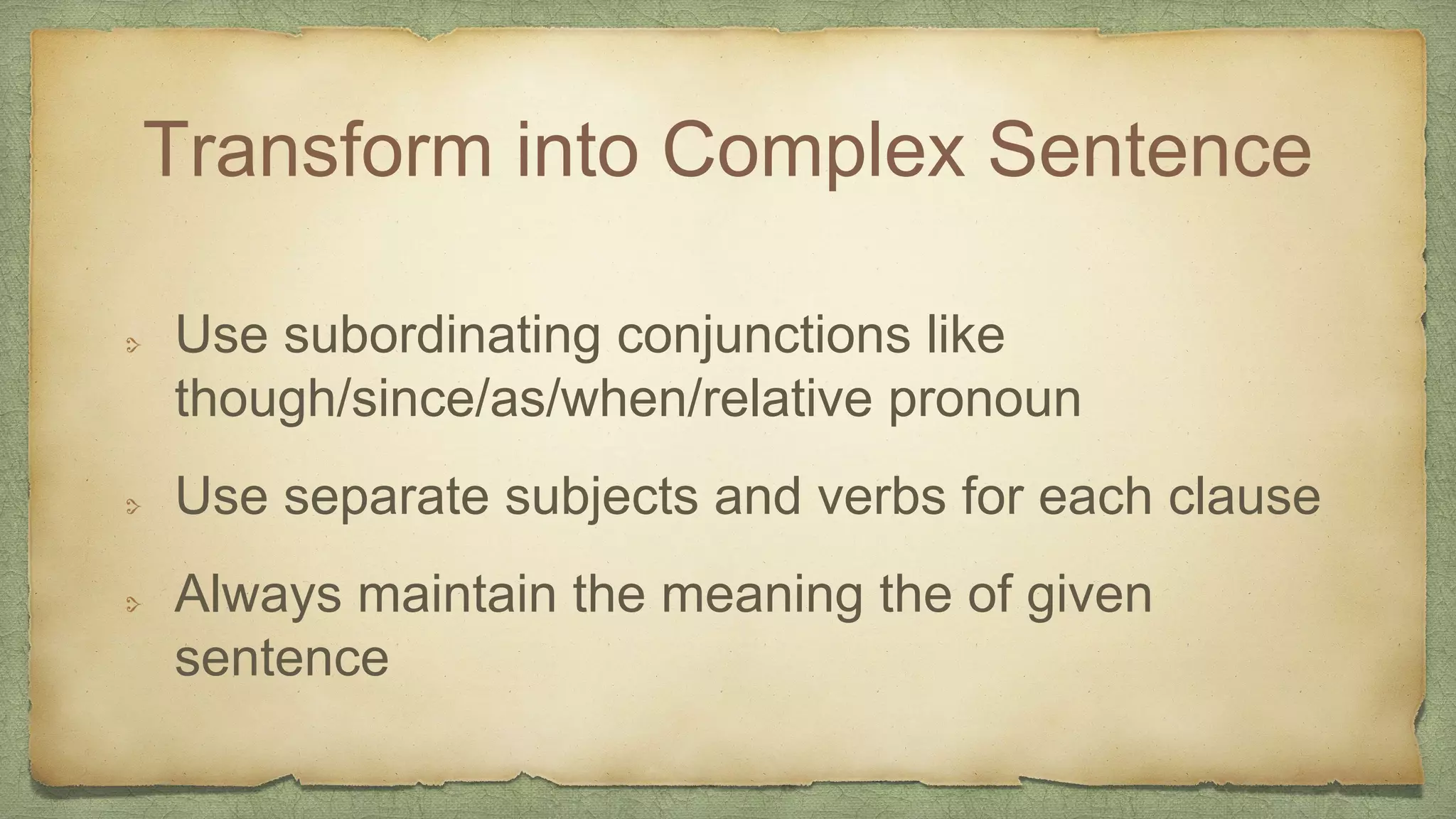
Transform into Complex Sentence
Use subordinating conjunctions like
though/since/as/when/relative pronoun
Use separate subjects and verbs for each clause
Always maintain the meaning the of given
sentence
Complex Simple Compound
When/as/since/becau
se
verb+ing or being+v3
or because of
and
Example:
Complex: When he saw the police, he ran away.
Simple: Seeing the police he ran away.
Compound: He saw the police and ran away.
Complex: As he was ill, he could not come.
Simple: Being ill, he could not come. / Because of his illness, he could
not come.
Compound: He was ill and so he could not come.
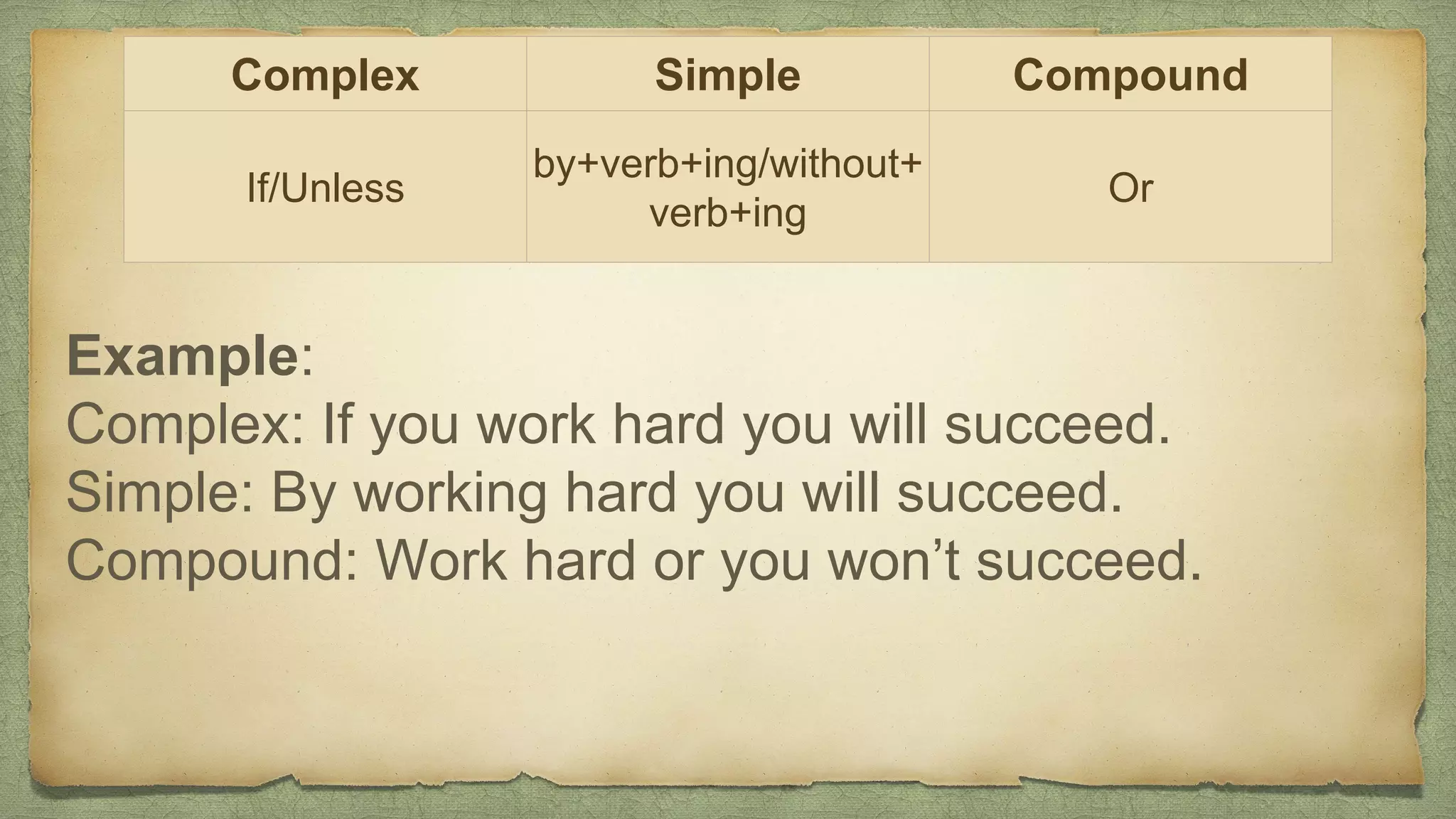
Complex Simple Compound
If/Unless
by+verb+ing/without+
verb+ing
Or
Example:
Complex: If you work hard you will succeed.
Simple: By working hard you will succeed.
Compound: Work hard or you won’t succeed.
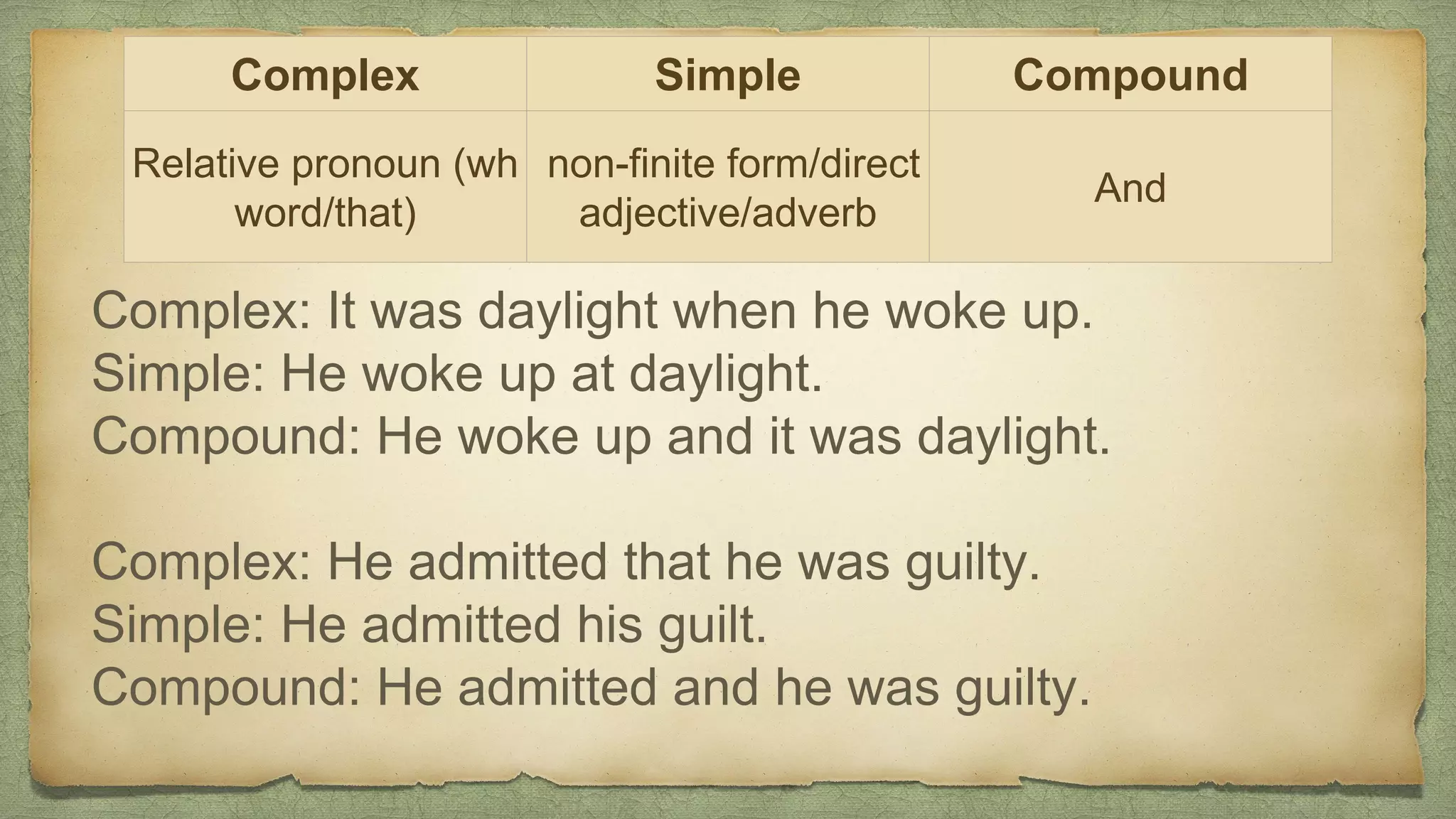
Complex Simple Compound
Relative pronoun (wh
word/that)
non-finite form/direct
adjective/adverb
And
Complex: It was daylight when he woke up.
Simple: He woke up at daylight.
Compound: He woke up and it was daylight.
Complex: He admitted that he was guilty.
Simple: He admitted his guilt.
Compound: He admitted and he was guilty.
Complex Simple Compound
Though/Although inspite of/despite But
Example:
Complex: Though he tried hard, he failed.
Simple: In spite of trying hard, he failed.
Compound: He tried hard but failed.
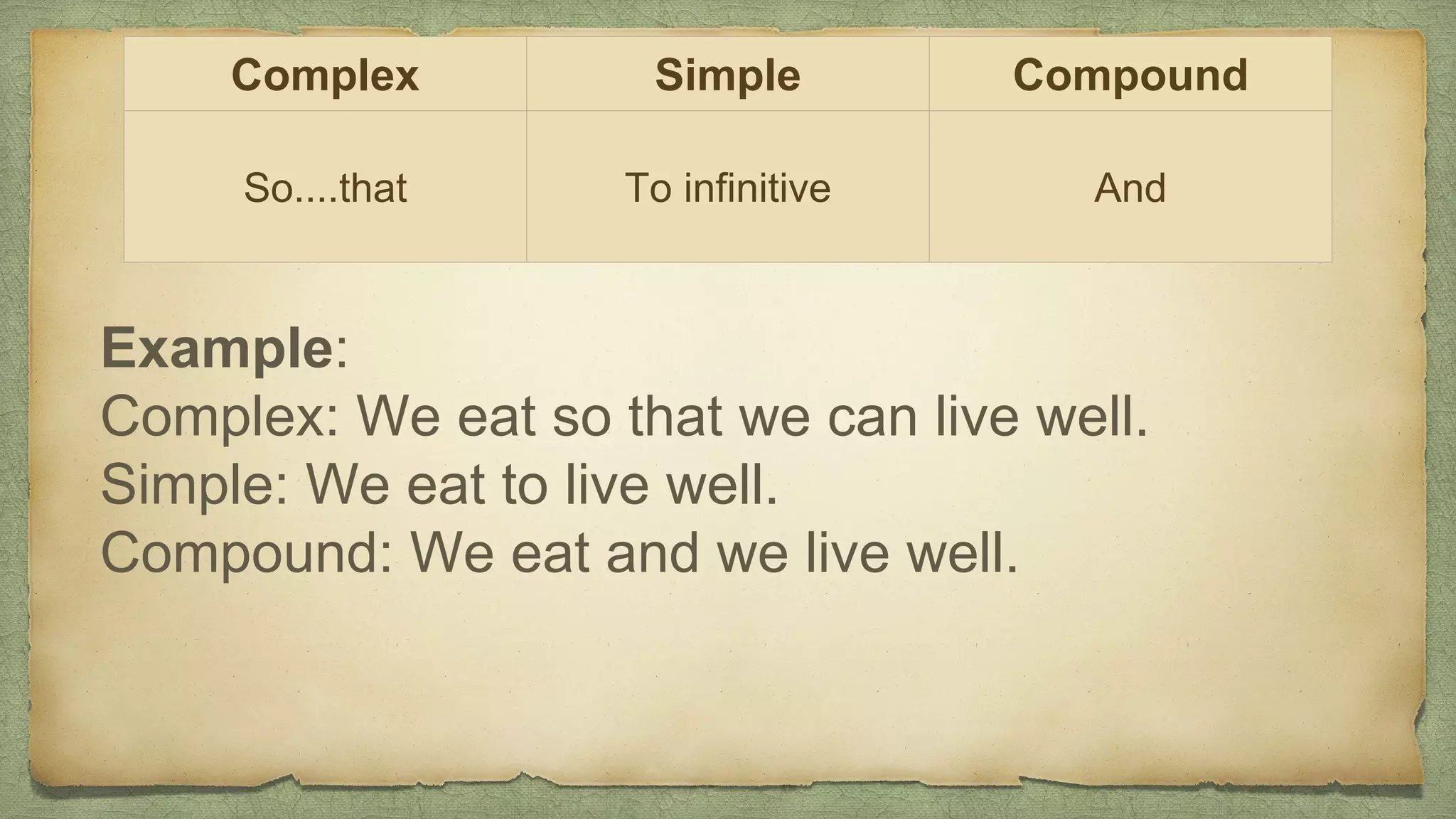
Complex Simple Compound
So....that To infinitive And
Example:
Complex: We eat so that we can live well.
Simple: We eat to live well.
Compound: We eat and we live well.
The End
Thank You

Sentence transformation part 5

  • 1.
    Sentence Transformation Part -5 Simple-Compound-Complex By Anil Kumar
  • 2.
    The sentences areclassed in three categories depending on the number and types of finite clauses. i. Simple Sentence ii. Compound Sentence iii. Complex Sentence
  • 4.
    Before we discussabout kinds of sentences, let’s learn about principal clause and subordinate clause.
  • 5.
    Principal or MainClause Does express a complete thought Can stand alone as a sentence Has a subject and a verb Main/independent clause
  • 6.
    Subordinate Clause Does notexpress a complete thought Cannot stand alone as a sentence Has a subject and a verb Starts with relative pronoun or a subordinate conjunction 3 types- Noun, Adjective and Adverb Dependent clause
  • 7.
    Simple Sentence 1. Onesubject 2. Only one finite verb 3. expresses complete thought. 4. No use of conjunction 5. Only one independent clause 6. Might have multiple dependent clauses joined by non-finite verbs
  • 8.
    Examples Rahman (subject) plays(verb) football every afternoon. While going (non-finite verb: present participle) there, I (subject) met (finite verb) him. Despite being (non-finite verb: present participle) sick, he attended (finite verb) the meeting.
  • 9.
    Compound Sentence 1. Multipleindependent clauses 2. No dependent clause 3. Two finite verbs 4. Two subjects 5. Clauses are joined together by coordinating conjunctions And-But-Nor-Or-So-Yet
  • 10.
    Examples I (subject) tried(finite verb) to speak Spanish, and my friend (subject) tried (finite verb) to speak English. Rahman (subject) played (finite verb) football, so Ria (subject) went (finite verb) for shopping.
  • 11.
    Complex Sentences 1. Oneindependent clause 2. One dependent clause 3. Two finite verbs joined by subordinating conjunction 4. Subordinate conjunctions connect two unequal parts, e.g., dependent and independent clauses
  • 12.
    List of subordinating conjunctions Since,as, when, though, although, so that, whenever, because, than, whereas, that, wherever, that, whether, if, though, which, till, while, unless, who, until, why, how, what
  • 13.
    Examples When (subordinator) he(subject) handed (finite verb) in his homework, he (subject) forgot (finite verb) to give the teacher the last page. The teacher (subject) returned (finite verb) the homework after (subordinator) she (subject) noticed (finite verb) the error. The students (subject) are studying (finite verb) because (subordinator) they (subject) have (finite verb) a test tomorrow. Roy (subject) and Rahman (subject) went (finite verb) to the movies after (subordinator) they (subject) finished (verb) studying.
  • 14.
    Transform into SimpleSentence Use non-finite verb Don’t use any conjunction. Always maintain the meaning of the given sentence
  • 15.
    Transform into CompoundSentences Use coordinating conjunctions like and/but/or/and/so/and then Use separate subjects and verbs for each clause Always maintain the meaning of the given sentence
  • 16.
    Transform into ComplexSentence Use subordinating conjunctions like though/since/as/when/relative pronoun Use separate subjects and verbs for each clause Always maintain the meaning the of given sentence
  • 17.
    Complex Simple Compound When/as/since/becau se verb+ingor being+v3 or because of and Example: Complex: When he saw the police, he ran away. Simple: Seeing the police he ran away. Compound: He saw the police and ran away. Complex: As he was ill, he could not come. Simple: Being ill, he could not come. / Because of his illness, he could not come. Compound: He was ill and so he could not come.
  • 18.
    Complex Simple Compound If/Unless by+verb+ing/without+ verb+ing Or Example: Complex:If you work hard you will succeed. Simple: By working hard you will succeed. Compound: Work hard or you won’t succeed.
  • 19.
    Complex Simple Compound Relativepronoun (wh word/that) non-finite form/direct adjective/adverb And Complex: It was daylight when he woke up. Simple: He woke up at daylight. Compound: He woke up and it was daylight. Complex: He admitted that he was guilty. Simple: He admitted his guilt. Compound: He admitted and he was guilty.
  • 20.
    Complex Simple Compound Though/Althoughinspite of/despite But Example: Complex: Though he tried hard, he failed. Simple: In spite of trying hard, he failed. Compound: He tried hard but failed.
  • 21.
    Complex Simple Compound So....thatTo infinitive And Example: Complex: We eat so that we can live well. Simple: We eat to live well. Compound: We eat and we live well.
  • 22.