CLASSIFICATION OF VEGETABLES
ACCORDING TO PARTS OF PLANTS
By:Bantolio&Rubin
CLASSIFICATION OF VEGETABLES
• Vegetables are classified according to
which part of the plant is eaten. Some
vegetables fit into more than one
category when several different parts of
the plant are edible, e.g. both the roots
and leaves of beetroot can be eaten.
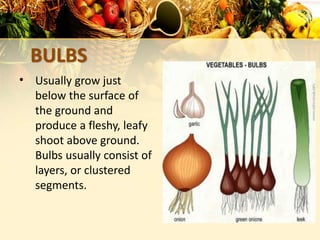
BULBS
• Usually grow just
below the surface of
the ground and
produce a fleshy, leafy
shoot above ground.
Bulbs usually consist of
layers, or clustered
segments.
FLOWERS
• The edible flowers of certain vegetables.
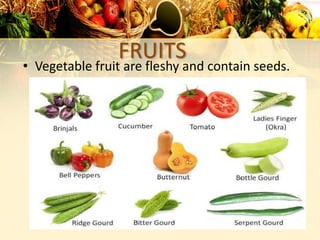
FRUITS
• Vegetable fruit are fleshy and contain seeds.
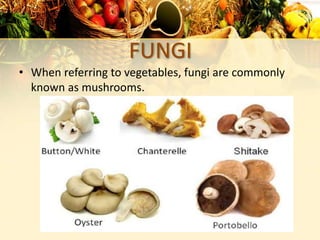
FUNGI
• When referring to vegetables, fungi are commonly
known as mushrooms.
LEAVES
• The edible leaves of plants.
ROOTS
• Usually a long or round-shaped taproot.
SEEDS
• (Legumes) apart from sweet corn, seeds grow in pods
which are sometimes eaten along with the seed.
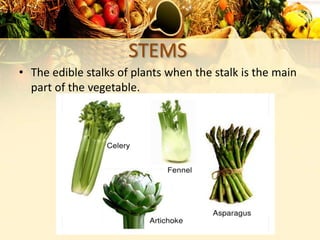
STEMS
• The edible stalks of plants when the stalk is the main
part of the vegetable.
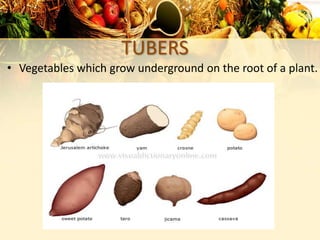
TUBERS
• Vegetables which grow underground on the root of a plant.
CLASSIFICATION OF VEGETABLES
ACCORDING TO CHEMICAL COMPOSITION
By:Bantolio&Rubin
1.MINERAL SUBSTANCES
• Mineral substances are present in salts of
organicor inorganic acids or as complex
organic combinations
(chlorophyll,lecithin,etc.);they are in many
cases dissolved in cellular juice.
• Vegetables are more rich in mineral
substances as compared with fruits.The
mineral substance content is normally
between 0.60% and 1.80% and more than
60 elements are presents; the major
elements are:K,Na,Ca,Mg,Fe,Mn,Al,P.Cl,S.
• Among the vegetables which are especially rich in
mineral substances are: Spinach,Carrots,Cabbage and
Tomatoes.
2.CARBOHYDRATES
• Carbohydrates are the main
components of fruit and vegetables
and represent more than 90% of
their dry matter.
• Carbohydrates plays a major role in
biological systems and in foods.
3.FATS
• Is one of the three main Macronutrients,along
with Carbohydrate and protein.
4.PROTEIN
• Though the word “protein” usually
conjures up images of
meat,fruits,and vegetables can also
be good sources of protein;they
lower in saturated fat and higher in
dietary fiber than animal sources and
when regularly eaten can help lower
cholesterol and reduce the risk heart
disease,diabetes and certain cancers.
CLASSIFICATION OF VEGETABLES
ACCORDING TO NUTRITIVE
VALUE
By:Bantolio&Rubin
• Vegetables may be classified to the portion of the plant used
for food and its specific nutritive value
A.Leaf Vegetables
• They are a valuable source of minerals (iro and
calcium),vitamins (A,C,K and riboflavin) and cellulose.
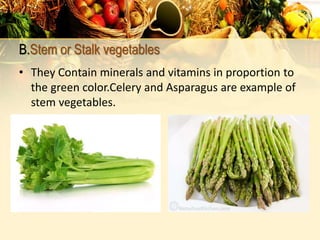
B.Stem or Stalk vegetables
• They Contain minerals and vitamins in proportion to
the green color.Celery and Asparagus are example of
stem vegetables.
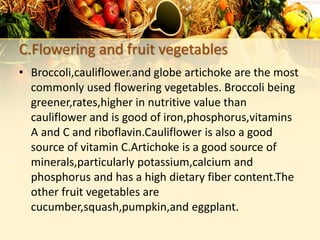
C.Flowering and fruit vegetables
• Broccoli,cauliflower.and globe artichoke are the most
commonly used flowering vegetables. Broccoli being
greener,rates,higher in nutritive value than
cauliflower and is good of iron,phosphorus,vitamins
A and C and riboflavin.Cauliflower is also a good
source of vitamin C.Artichoke is a good source of
minerals,particularly potassium,calcium and
phosphorus and has a high dietary fiber content.The
other fruit vegetables are
cucumber,squash,pumpkin,and eggplant.
BROCCOLI CAULIFLOWER
GLOBE ARTICHOKE
D.Root vegetables
• Carrot,beet,Turnip,and potato are examples of root
vegetables.
• Good source of thiamin and minerals.Potato contains
some vitamins C.Onion is an outstanding of a bulb
vegetable,and contains a moderate amount of
vitamin C.
Beet Turnip
Potato Carrots
FLAVOR COMPONENTS
OF VEGETABLES
By:Bantolio&Rubin
• SUGAR
• Is the generic name for sweet,
soluble carbohydrates, many of which
are used in food. There are various
types of sugar derived from different
sources. Simple sugars are
called monosaccharides and
include glucose(also known as
dextrose), fructose, and galactose.
• Pure, dry fructose is a very sweet, white, odorless,
crystalline solid and is the most water-soluble of
all the sugars.fructose is found in honey, tree and
vine fruits, flowers, berries, and most root
vegetables.
FRUCTOSE
• A natural sugar that provides the sweetness in
vegetables.
GLUTAMIC ACID
• This forms a product called monosodium
glutamate when combined with salt.
• It is found in large amount from young
and fresh vegetables.
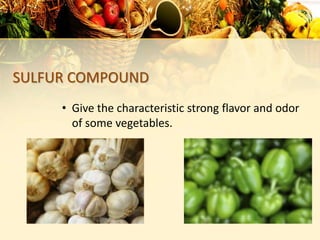
SULFUR COMPOUND
• Give the characteristic strong flavor and odor
of some vegetables.
COLOR COMPONENTS
OF VEGETABLES
By:Bantolio&Rubin
PIGMENTS
The different fruit colors are a result of different pigments
and each one of which offers different health benefits.
• A pigment is a material that changes the color.
CHLOROPHYLL
• A fat soluble compounds responsible
for the green color of plants.When
combined with acid,it forms
pheophytin which produces an olive
green color.
CAROTENES
• This pigment gives colour to yellow and orange
vegetables such as carrot, corn, winter squash,
sweet potato, tomato, and red pepper. This is the
most stable of the colour pigments.
FLAVONES
• It is the pigment present in white vegetables. It is
present in potato, onion, cauliflower, white cabbage,
cucumber, zucchini, and the white of celery.
ANTHOCYANIN
• This pigment is present in red vegetables and it
gives them their colour. It is present in very few
vegetables, primarily in red cabbage, purple
peppers, purple potatoes, etc.
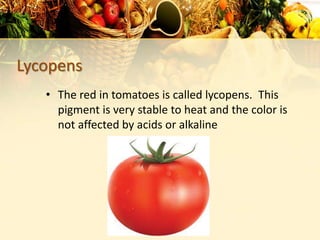
Lycopens
• The red in tomatoes is called lycopens. This
pigment is very stable to heat and the color is
not affected by acids or alkaline
FACTORS TO CONSIDER
IN CHOOSING GOOD QUALITY OF
VEGETABLES
By:Bantolio&Rubin
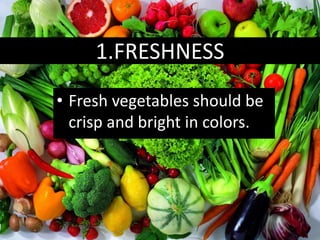
1.FRESHNESS
• Fresh vegetables should be
crisp and bright in colors.
2.Absence of decay and insect infestation
3.NO CHEMICAL DAMAGE
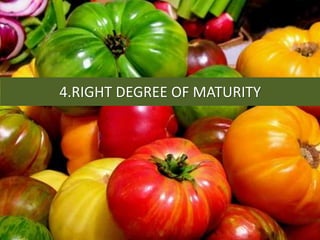
4.RIGHT DEGREE OF MATURITY
BASIC KNIFE CUTS
1.LARGE DICE
• The large dice is a culinary knife cut
measuring ¾ inch × ¾ inch × ¾ inch.
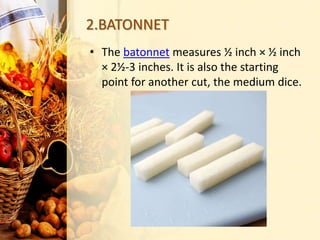
2.BATONNET
• The batonnet measures ½ inch × ½ inch
× 2½-3 inches. It is also the starting
point for another cut, the medium dice.
3.MEDIUM DICE
• The medium dice measures ½ inch × ½
inch × ½ inch.
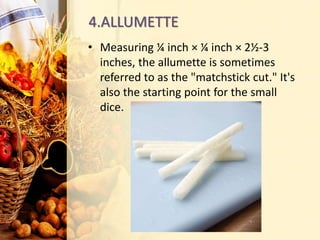
4.ALLUMETTE
• Measuring ¼ inch × ¼ inch × 2½-3
inches, the allumette is sometimes
referred to as the "matchstick cut." It's
also the starting point for the small
dice.
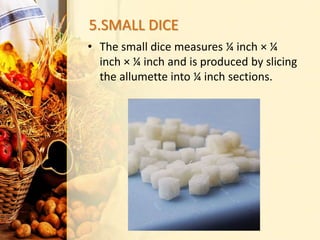
5.SMALL DICE
• The small dice measures ¼ inch × ¼
inch × ¼ inch and is produced by slicing
the allumette into ¼ inch sections.
6.JULIENNE
• The julienne cut measures 1/8 inch ×
1/8 inch × 2½ inches.
7.BRUNOISE
• The brunoise knife cut (pronounced
BROON-wahz) measures 1/8 inch × 1/8
inch × 1/8 inch.
8.FINE JULIENNE
• The fine julienne knife cut measures 1/16
inch × 1/16 inch × 2 inches. It's also the
starting point for the fine brunoise cut.
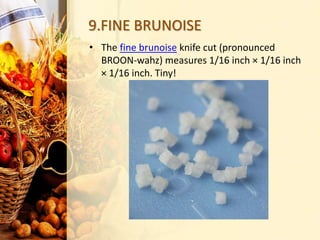
9.FINE BRUNOISE
• The fine brunoise knife cut (pronounced
BROON-wahz) measures 1/16 inch × 1/16 inch
× 1/16 inch. Tiny!

classificationofvegetablesgr-10unit3-171026151334.pdf

  • 2.
    CLASSIFICATION OF VEGETABLES ACCORDINGTO PARTS OF PLANTS By:Bantolio&Rubin
  • 3.
    CLASSIFICATION OF VEGETABLES •Vegetables are classified according to which part of the plant is eaten. Some vegetables fit into more than one category when several different parts of the plant are edible, e.g. both the roots and leaves of beetroot can be eaten.
  • 4.
    BULBS • Usually growjust below the surface of the ground and produce a fleshy, leafy shoot above ground. Bulbs usually consist of layers, or clustered segments.
  • 5.
    FLOWERS • The edibleflowers of certain vegetables.
  • 6.
    FRUITS • Vegetable fruitare fleshy and contain seeds.
  • 7.
    FUNGI • When referringto vegetables, fungi are commonly known as mushrooms.
  • 8.
    LEAVES • The edibleleaves of plants.
  • 9.
    ROOTS • Usually along or round-shaped taproot.
  • 10.
    SEEDS • (Legumes) apartfrom sweet corn, seeds grow in pods which are sometimes eaten along with the seed.
  • 11.
    STEMS • The ediblestalks of plants when the stalk is the main part of the vegetable.
  • 12.
    TUBERS • Vegetables whichgrow underground on the root of a plant.
  • 13.
    CLASSIFICATION OF VEGETABLES ACCORDINGTO CHEMICAL COMPOSITION By:Bantolio&Rubin
  • 14.
    1.MINERAL SUBSTANCES • Mineralsubstances are present in salts of organicor inorganic acids or as complex organic combinations (chlorophyll,lecithin,etc.);they are in many cases dissolved in cellular juice. • Vegetables are more rich in mineral substances as compared with fruits.The mineral substance content is normally between 0.60% and 1.80% and more than 60 elements are presents; the major elements are:K,Na,Ca,Mg,Fe,Mn,Al,P.Cl,S.
  • 15.
    • Among thevegetables which are especially rich in mineral substances are: Spinach,Carrots,Cabbage and Tomatoes.
  • 16.
    2.CARBOHYDRATES • Carbohydrates arethe main components of fruit and vegetables and represent more than 90% of their dry matter. • Carbohydrates plays a major role in biological systems and in foods.
  • 18.
    3.FATS • Is oneof the three main Macronutrients,along with Carbohydrate and protein.
  • 19.
    4.PROTEIN • Though theword “protein” usually conjures up images of meat,fruits,and vegetables can also be good sources of protein;they lower in saturated fat and higher in dietary fiber than animal sources and when regularly eaten can help lower cholesterol and reduce the risk heart disease,diabetes and certain cancers.
  • 21.
    CLASSIFICATION OF VEGETABLES ACCORDINGTO NUTRITIVE VALUE By:Bantolio&Rubin
  • 22.
    • Vegetables maybe classified to the portion of the plant used for food and its specific nutritive value A.Leaf Vegetables • They are a valuable source of minerals (iro and calcium),vitamins (A,C,K and riboflavin) and cellulose.
  • 23.
    B.Stem or Stalkvegetables • They Contain minerals and vitamins in proportion to the green color.Celery and Asparagus are example of stem vegetables.
  • 24.
    C.Flowering and fruitvegetables • Broccoli,cauliflower.and globe artichoke are the most commonly used flowering vegetables. Broccoli being greener,rates,higher in nutritive value than cauliflower and is good of iron,phosphorus,vitamins A and C and riboflavin.Cauliflower is also a good source of vitamin C.Artichoke is a good source of minerals,particularly potassium,calcium and phosphorus and has a high dietary fiber content.The other fruit vegetables are cucumber,squash,pumpkin,and eggplant.
  • 25.
  • 26.
    D.Root vegetables • Carrot,beet,Turnip,andpotato are examples of root vegetables. • Good source of thiamin and minerals.Potato contains some vitamins C.Onion is an outstanding of a bulb vegetable,and contains a moderate amount of vitamin C.
  • 27.
  • 29.
  • 30.
    • SUGAR • Isthe generic name for sweet, soluble carbohydrates, many of which are used in food. There are various types of sugar derived from different sources. Simple sugars are called monosaccharides and include glucose(also known as dextrose), fructose, and galactose.
  • 31.
    • Pure, dryfructose is a very sweet, white, odorless, crystalline solid and is the most water-soluble of all the sugars.fructose is found in honey, tree and vine fruits, flowers, berries, and most root vegetables. FRUCTOSE • A natural sugar that provides the sweetness in vegetables.
  • 32.
    GLUTAMIC ACID • Thisforms a product called monosodium glutamate when combined with salt. • It is found in large amount from young and fresh vegetables.
  • 33.
    SULFUR COMPOUND • Givethe characteristic strong flavor and odor of some vegetables.
  • 34.
  • 35.
    PIGMENTS The different fruitcolors are a result of different pigments and each one of which offers different health benefits. • A pigment is a material that changes the color.
  • 36.
    CHLOROPHYLL • A fatsoluble compounds responsible for the green color of plants.When combined with acid,it forms pheophytin which produces an olive green color.
  • 37.
    CAROTENES • This pigmentgives colour to yellow and orange vegetables such as carrot, corn, winter squash, sweet potato, tomato, and red pepper. This is the most stable of the colour pigments.
  • 38.
    FLAVONES • It isthe pigment present in white vegetables. It is present in potato, onion, cauliflower, white cabbage, cucumber, zucchini, and the white of celery.
  • 39.
    ANTHOCYANIN • This pigmentis present in red vegetables and it gives them their colour. It is present in very few vegetables, primarily in red cabbage, purple peppers, purple potatoes, etc.
  • 40.
    Lycopens • The redin tomatoes is called lycopens. This pigment is very stable to heat and the color is not affected by acids or alkaline
  • 41.
    FACTORS TO CONSIDER INCHOOSING GOOD QUALITY OF VEGETABLES By:Bantolio&Rubin
  • 42.
    1.FRESHNESS • Fresh vegetablesshould be crisp and bright in colors.
  • 43.
    2.Absence of decayand insect infestation
  • 44.
  • 45.
  • 46.
  • 47.
    1.LARGE DICE • Thelarge dice is a culinary knife cut measuring ¾ inch × ¾ inch × ¾ inch.
  • 48.
    2.BATONNET • The batonnetmeasures ½ inch × ½ inch × 2½-3 inches. It is also the starting point for another cut, the medium dice.
  • 49.
    3.MEDIUM DICE • Themedium dice measures ½ inch × ½ inch × ½ inch.
  • 50.
    4.ALLUMETTE • Measuring ¼inch × ¼ inch × 2½-3 inches, the allumette is sometimes referred to as the "matchstick cut." It's also the starting point for the small dice.
  • 51.
    5.SMALL DICE • Thesmall dice measures ¼ inch × ¼ inch × ¼ inch and is produced by slicing the allumette into ¼ inch sections.
  • 52.
    6.JULIENNE • The juliennecut measures 1/8 inch × 1/8 inch × 2½ inches.
  • 53.
    7.BRUNOISE • The brunoiseknife cut (pronounced BROON-wahz) measures 1/8 inch × 1/8 inch × 1/8 inch.
  • 54.
    8.FINE JULIENNE • Thefine julienne knife cut measures 1/16 inch × 1/16 inch × 2 inches. It's also the starting point for the fine brunoise cut.
  • 55.
    9.FINE BRUNOISE • Thefine brunoise knife cut (pronounced BROON-wahz) measures 1/16 inch × 1/16 inch × 1/16 inch. Tiny!