Prepare Vegetable Dishes
Objectives:
At the end of the lesson, you are expected to:
1. Identify the classification of vegetables
and their nutritional value;
2. Know the characteristics of quality
vegetables;
3. Follow the procedure in preparing
vegetables.
CLASSIFICATION
OF VEGETABLES
Vegetables are parts of plants
like leaves, fruits, tubers, roots,
bulbs, stems, and flower used in a
dish either raw or cooked.
Vegetables give color, texture and
flavor to our meals. They also give
vitamins and minerals.
A. Classification of Vegetables according
to parts of plants
Gourd Family
Seeds and pods
Fruit Vegetables
Roots and Tubers
Onion Family
Leafy Greens Stalks, Stems, & Shoots
Cabbage Family
Mushrooms
Gourd Family
Characterized by tendril-bearing vines, either
trailing or climbing and having alternate, palmately
lobed leaves, often large yellow or greenish flowers,
and many-seeded, fleshy fruit with a hard rind, and
including the cucumber, gourd, melon, pumpkin, and
squash.
Seeds and pods
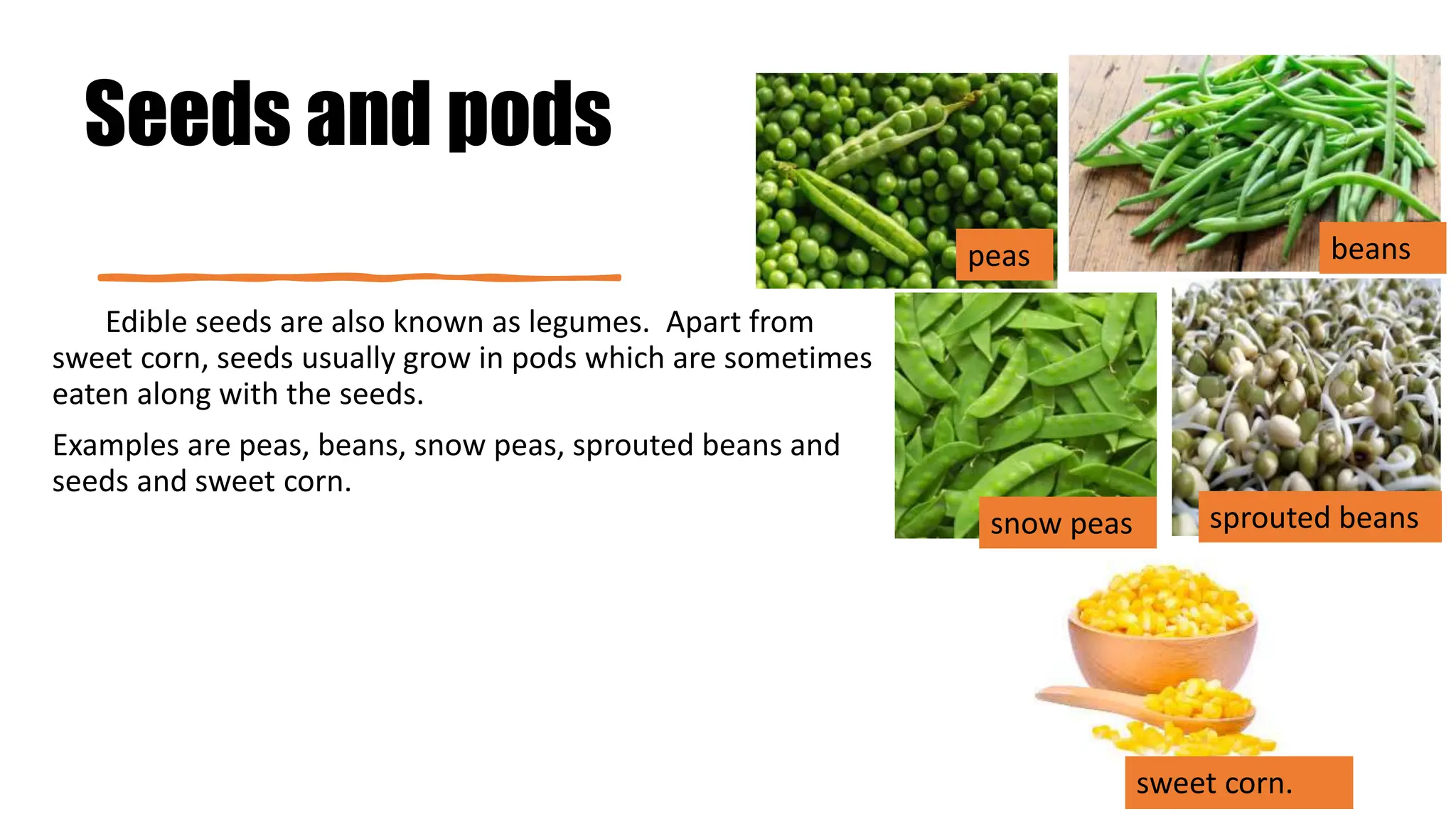
Edible seeds are also known as legumes. Apart from
sweet corn, seeds usually grow in pods which are sometimes
eaten along with the seeds.
Examples are peas, beans, snow peas, sprouted beans and
seeds and sweet corn.
peas beans
snow peas sprouted beans
sweet corn.
Fruit Vegetables
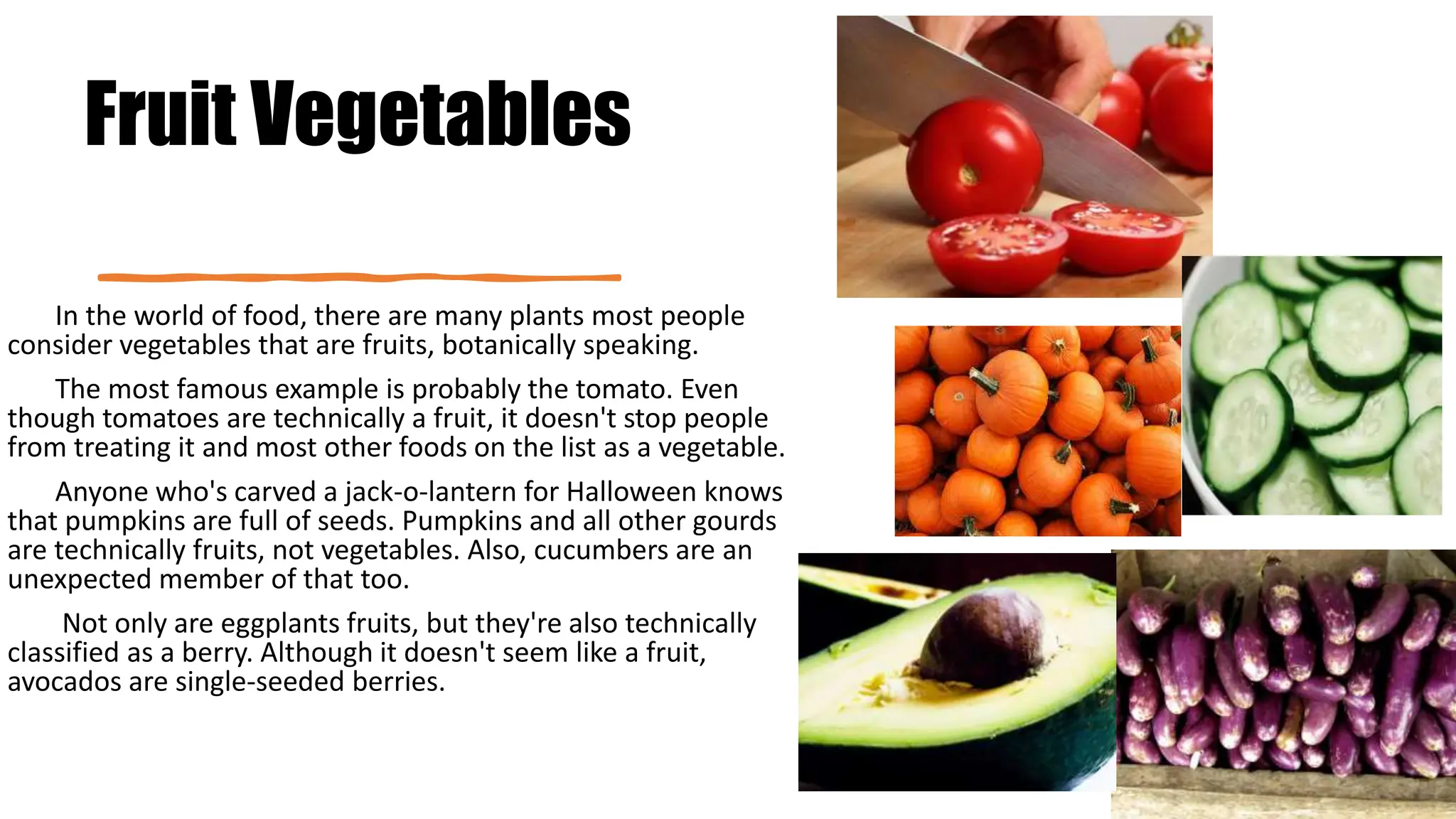
In the world of food, there are many plants most people
consider vegetables that are fruits, botanically speaking.
The most famous example is probably the tomato. Even
though tomatoes are technically a fruit, it doesn't stop people
from treating it and most other foods on the list as a vegetable.
Anyone who's carved a jack-o-lantern for Halloween knows
that pumpkins are full of seeds. Pumpkins and all other gourds
are technically fruits, not vegetables. Also, cucumbers are an
unexpected member of that too.
Not only are eggplants fruits, but they're also technically
classified as a berry. Although it doesn't seem like a fruit,
avocados are single-seeded berries.
Roots and Tubers
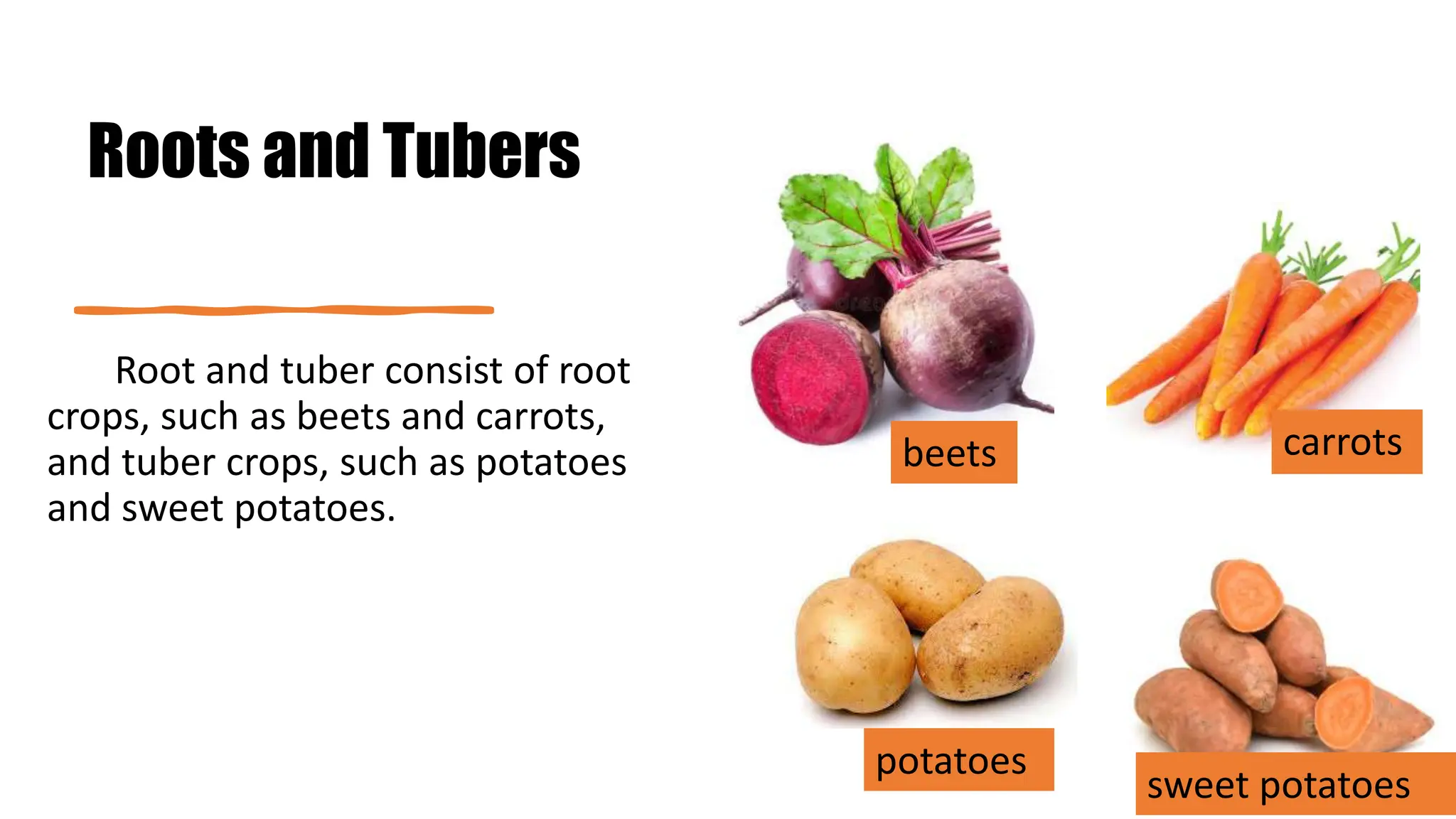
Root and tuber consist of root
crops, such as beets and carrots,
and tuber crops, such as potatoes
and sweet potatoes.
beets carrots
potatoes
sweet potatoes
Cabbage Family
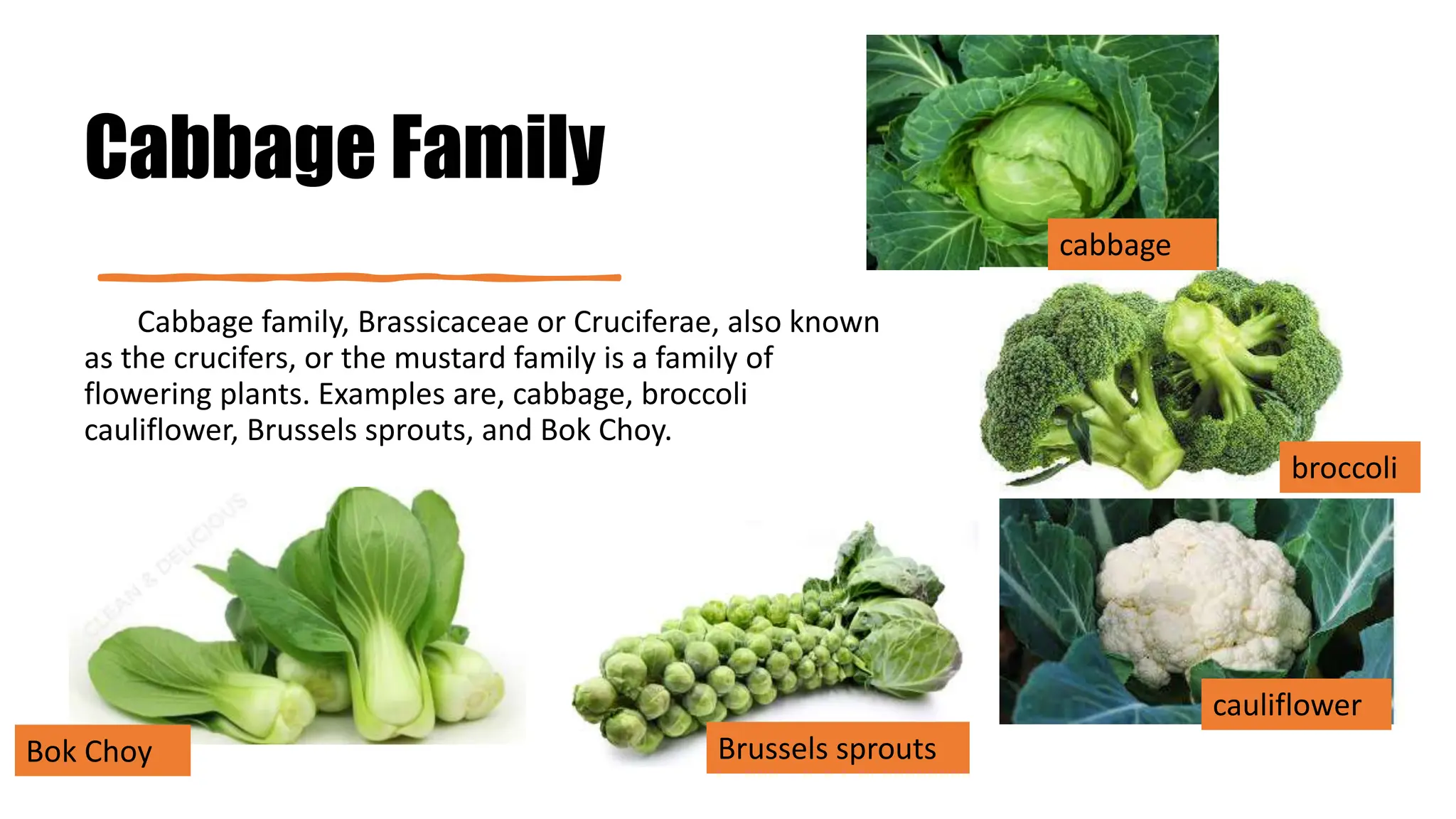
Cabbage family, Brassicaceae or Cruciferae, also known
as the crucifers, or the mustard family is a family of
flowering plants. Examples are, cabbage, broccoli
cauliflower, Brussels sprouts, and Bok Choy.
cabbage
broccoli
cauliflower
Brussels sprouts
Bok Choy
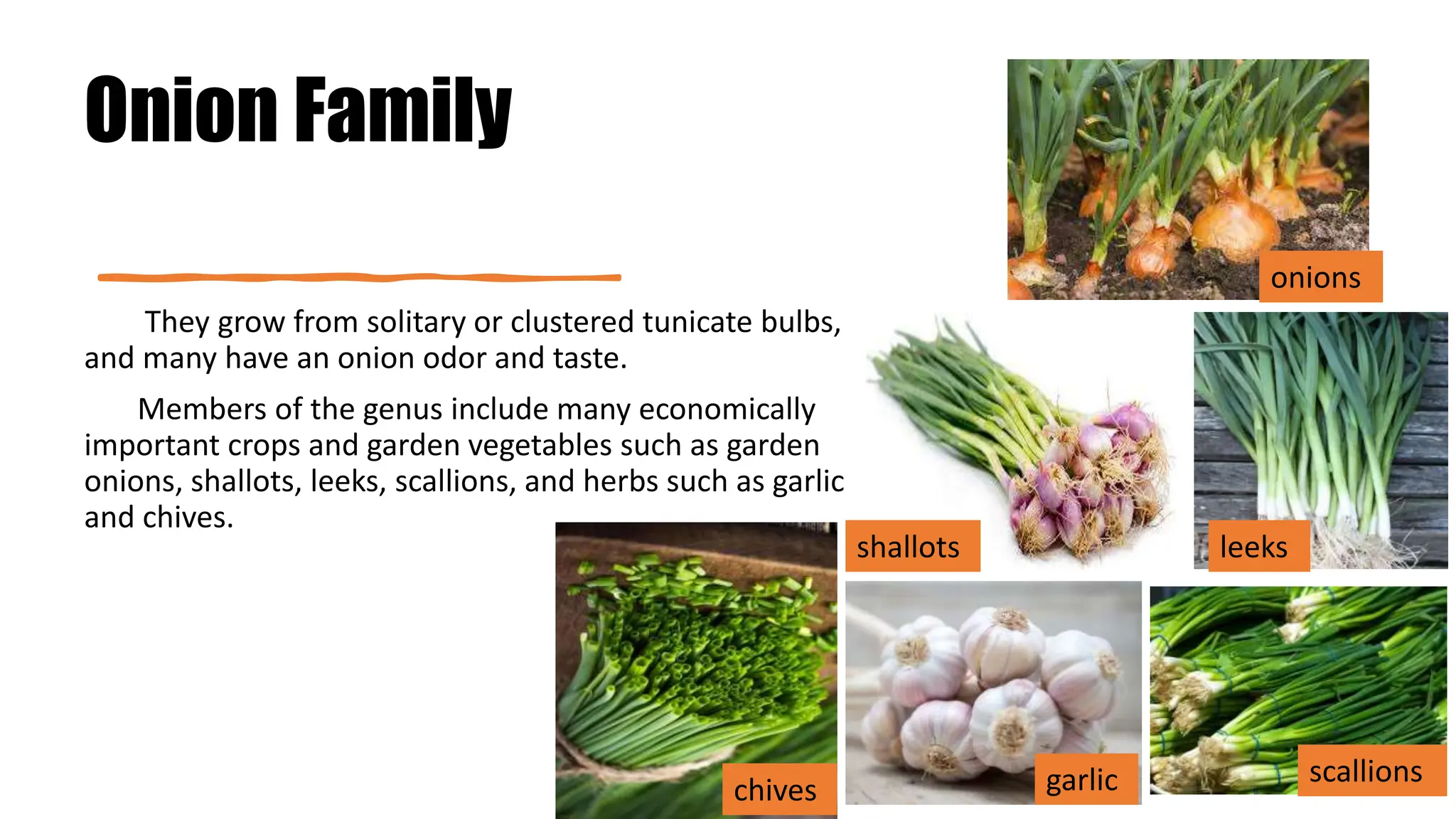
Onion Family
They grow from solitary or clustered tunicate bulbs,
and many have an onion odor and taste.
Members of the genus include many economically
important crops and garden vegetables such as garden
onions, shallots, leeks, scallions, and herbs such as garlic
and chives.
onions
shallots leeks
scallions
garlic
chives
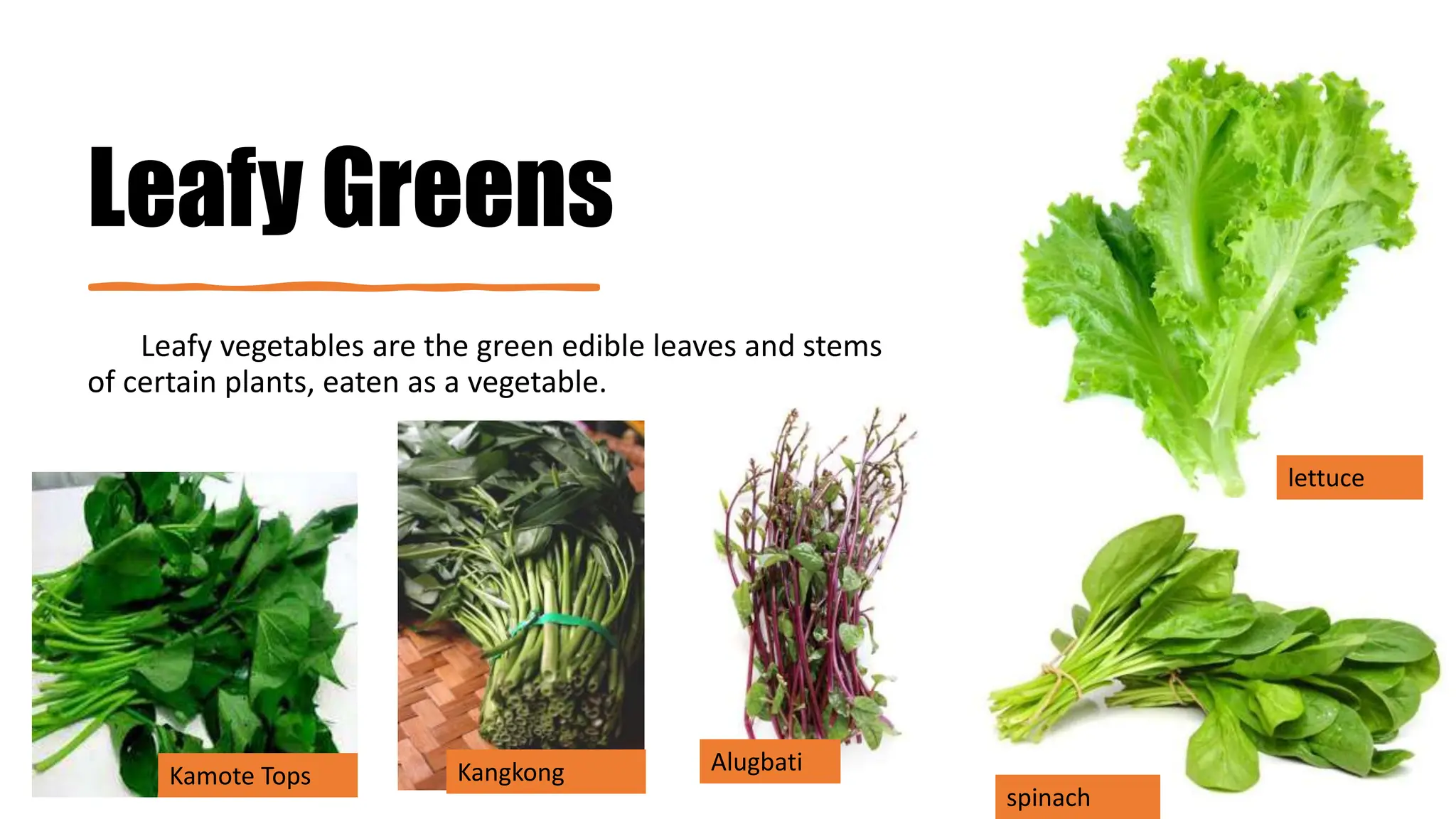
Leafy Greens
Leafy vegetables are the green edible leaves and stems
of certain plants, eaten as a vegetable.
lettuce
spinach
Alugbati
Kangkong
Kamote Tops
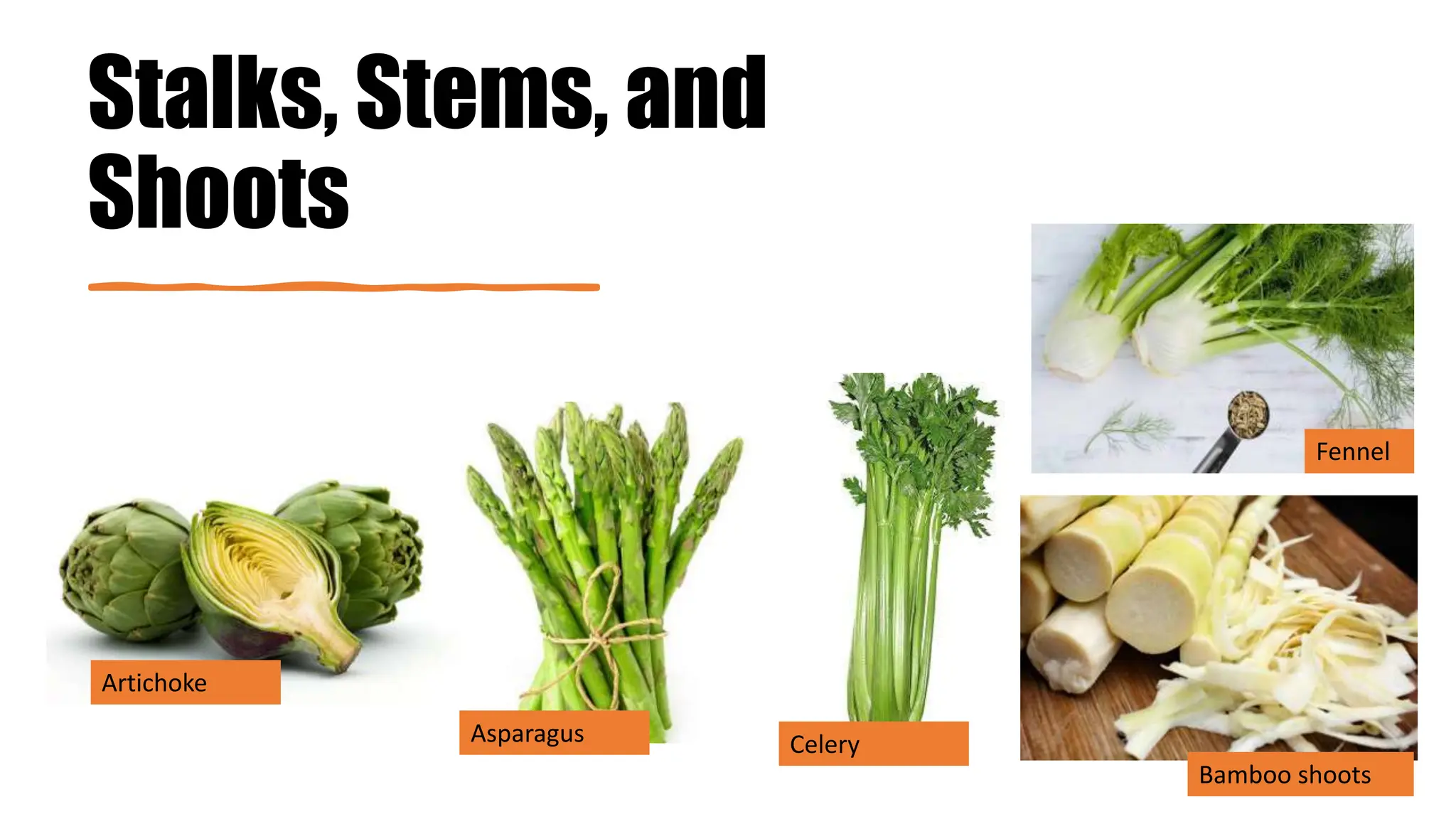
Stalks, Stems, and
Shoots
Artichoke
Asparagus Celery
Fennel
Bamboo shoots
Mushrooms
Fleshy, spore-bearing
fruiting body of a fungus,
typically produced above
the ground on soil or on its
food source.
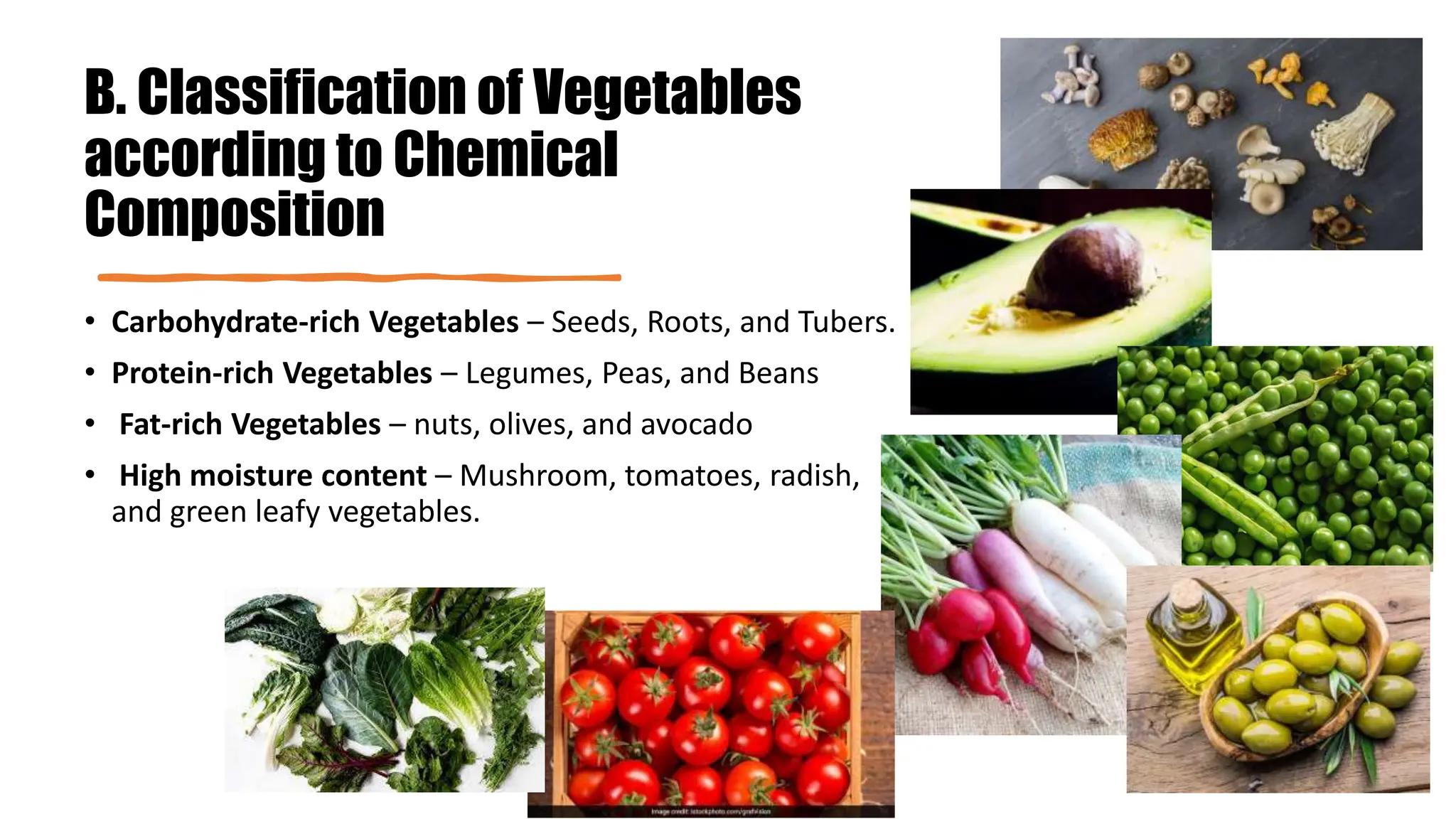
B. Classification of Vegetables
according to Chemical
Composition
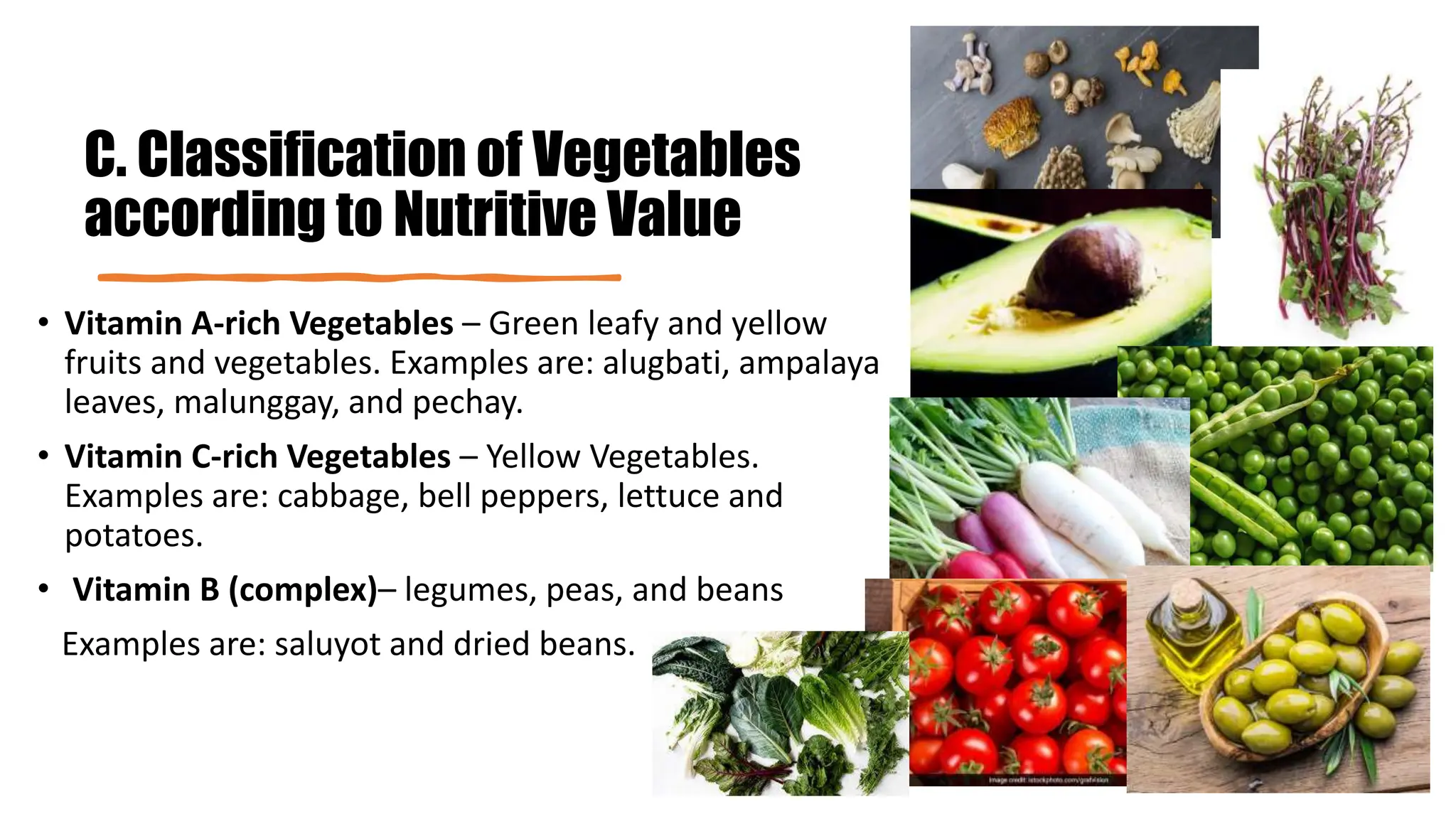
• Carbohydrate-rich Vegetables – Seeds, Roots, and Tubers.
• Protein-rich Vegetables – Legumes, Peas, and Beans
• Fat-rich Vegetables – nuts, olives, and avocado
• High moisture content – Mushroom, tomatoes, radish,
and green leafy vegetables.
C. Classification of Vegetables
according to Nutritive Value
• Vitamin A-rich Vegetables – Green leafy and yellow
fruits and vegetables. Examples are: alugbati, ampalaya
leaves, malunggay, and pechay.
• Vitamin C-rich Vegetables – Yellow Vegetables.
Examples are: cabbage, bell peppers, lettuce and
potatoes.
• Vitamin B (complex)– legumes, peas, and beans
Examples are: saluyot and dried beans.
Nutritional Value
of Vegetables
• Vitamin A – Green leafy vegetables are
sources of vitamin A. Examples are: alugbati,
ampalaya leaves, malunggay, pechay and sili
leaves.
• Vitamin C-rich Vegetables – Yellow Vegetables.
Examples are: cabbage, bell peppers, lettuce
and potatoes.
• Vitamin B (complex)– legumes, peas, and
beans
Examples are: saluyot and dried beans.
• Complex Carbohydrates – are carbohydrate
molecules with more than 20 sugar residue.
They are called the polysaccharides.
Carbohydrates are source of energy and B-
vitamins for metabolism.
Vegetables are good sources of food nutrients
that are very important in everyday meals
Flavor Components of
Vegetables
Color Components of
Vegetables
1. Sugar- Fructose is the natural that provides the
sweetness in vegetables.
1. Chlorophyll- A fat soluble compound responsible
for the green color of plants.
2. Glutamic Acid- This forms a product called
monosodium glutamate when combine with salt. It is
found in large amounts in young and fresh vegetables .
2. Carotenoids - The yellow, orange to red soluble
pigments found in plants.
a) beta carotene form carrots and squash
b) lycopene, from tomatoes
3. Sulfur Compounds- Give the characteristic of strong
flavor and odor of some vegetables like onions, leeks,
garlic, chives, cabbage and broccoli.
3. Flavonoids
a) Anthoxanthin – is responsible for yellow pigments
b) Anthocyanins – is responsible for red and blue to
violet pigments.
Factors to Consider in Choosing Good Quality
Vegetables
1. Freshness should be crisp and bright in color.
5. Variety of texture and sometimes
flavor
Preparing Vegetables
1. Washing
• Wash all vegetable thoroughly.
• Scrub well unpeeled vegetables like potatoes and carrots
• Wash green leafy vegetables in several changes of cold water
• After washing, drain well and refrigerate lightly covered to
prevent drying .
2. Soaking
• Do not soak vegetables for long periods to prevent flavor and nutrient loss
• Cabbage, broccoli, cauliflower may be soaked for 30mins. In cold salted
water to eliminate insects.
• Limp vegetables can be soak briefly in cold water to restore crispiness.
3. Peeling and Cutting
• Peel vegetables as thinly as possible.
• Cut vegetables into uniform pieces for even cooking
• Treat vegetables that are brown easily with acid or hold under water until
ready to use.
• Save edible trim for soups, stocks and purees.
Basic Cutting
Techniques
2. Chiffonade (Shredding)- Making very fine
parallel cuts
1. Chopping – done with a straight,
downward cutting motion.
3. Dicing – producing cubes
shapes
Basic Cutting
Techniques
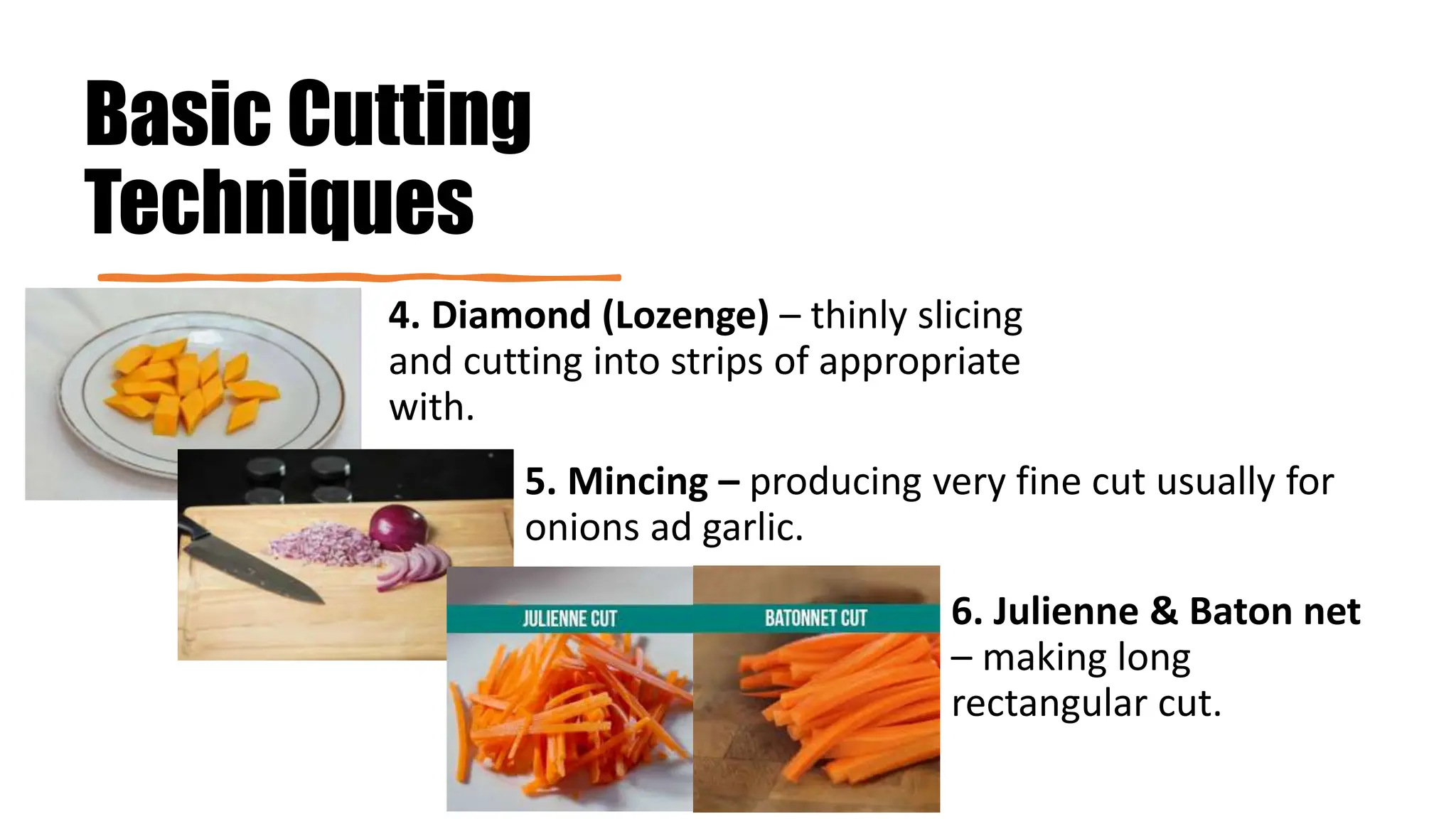
5. Mincing – producing very fine cut usually for
onions ad garlic.
4. Diamond (Lozenge) – thinly slicing
and cutting into strips of appropriate
with.
6. Julienne & Baton net
– making long
rectangular cut.
Basic Cutting
Techniques
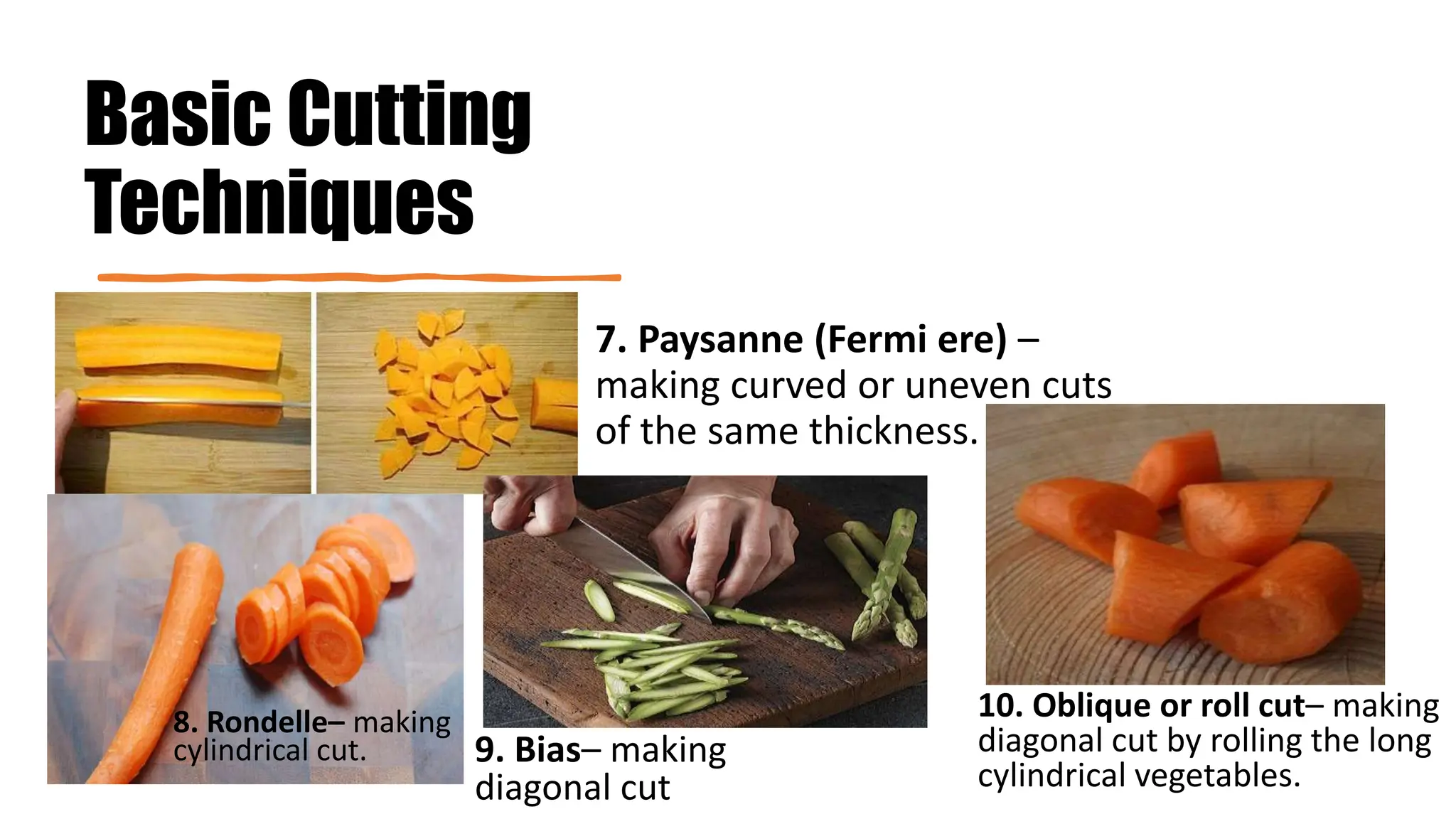
7. Paysanne (Fermi ere) –
making curved or uneven cuts
of the same thickness.
9. Bias– making
diagonal cut
8. Rondelle– making
cylindrical cut.
10. Oblique or roll cut– making
diagonal cut by rolling the long
cylindrical vegetables.
Ways of cooking Vegetables
1. Boiling and Steaming- vegetables are
drained as soon as they are cooked and
then cool quickly.
2. Sautéing and Pan-frying- both methods
may be used to complete cooking or
precooked or blanched vegetables.
3. Braising- the blanched or raw vegetable
is, placed in the pan then liquid is added to
cover vegetables, then cooked slowly.
4. Baking- Cooking starchy vegetables using
heat of the oven, rather than range top.
Starchy vegetables are baked because the
dry heat produces a desirable texture.
5. Deep-frying – Vegetables large enough to
coat with breading or batter may be fried.
Boiling and Steaming
Sautéing Braising
Baking Deep-frying
General Rules in Cooking
Vegetables
• Don’t over cooked
• Prepare vegetables as close to service time
as possible and in small quantities.
• If the vegetables must be cooked ahead,
undercooked slightly and chill rapidly.
Reheat at service time.
• Never use baking soda with green
vegetables.
• Cut vegetables uniformly for even cooking.
• Cooking green vegetables and strong
flavored vegetables uncovered.
Cooking Frozen and
Canned Vegetables
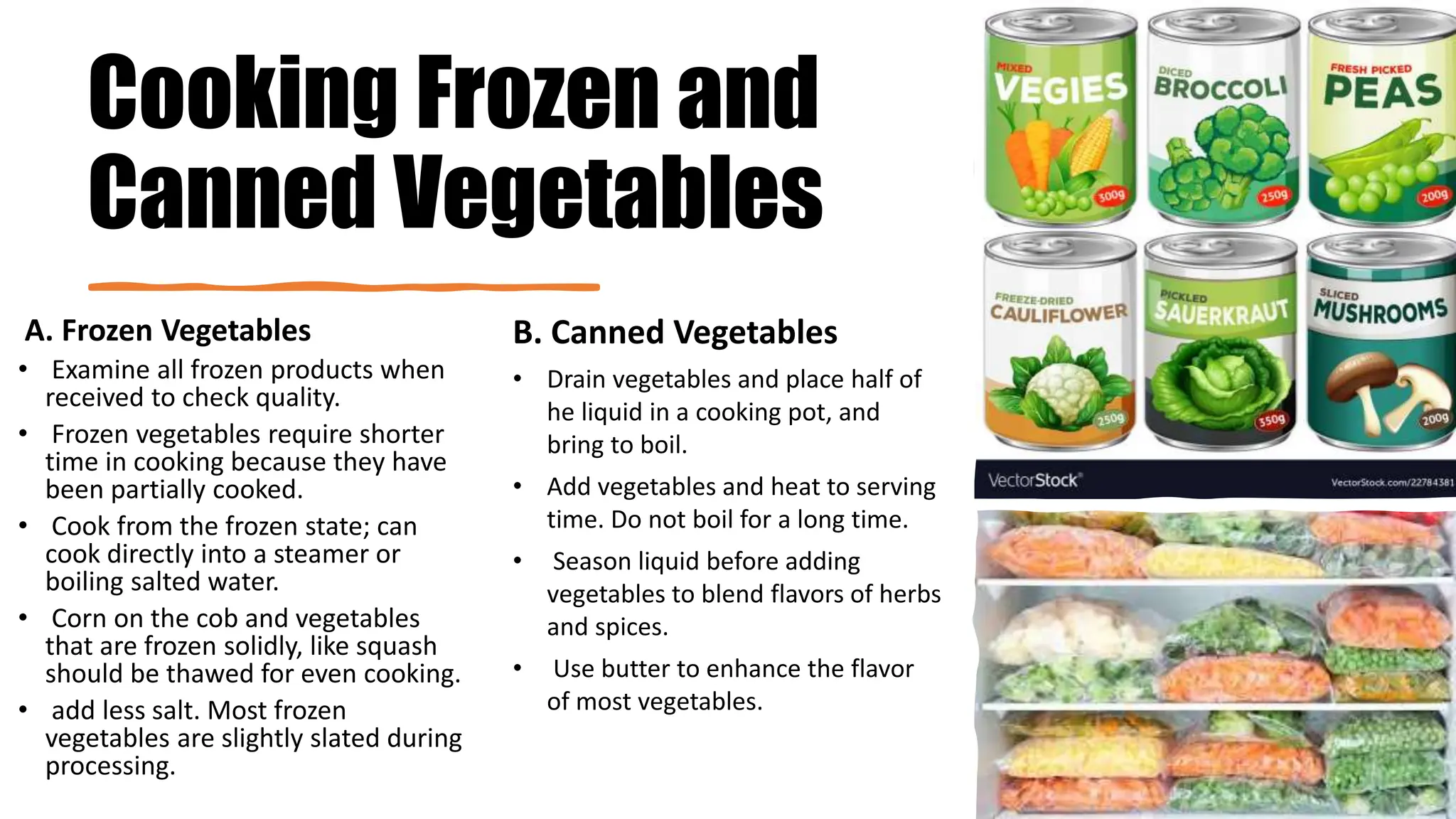
A. Frozen Vegetables
• Examine all frozen products when
received to check quality.
• Frozen vegetables require shorter
time in cooking because they have
been partially cooked.
• Cook from the frozen state; can
cook directly into a steamer or
boiling salted water.
• Corn on the cob and vegetables
that are frozen solidly, like squash
should be thawed for even cooking.
• add less salt. Most frozen
vegetables are slightly slated during
processing.
B. Canned Vegetables
• Drain vegetables and place half of
he liquid in a cooking pot, and
bring to boil.
• Add vegetables and heat to serving
time. Do not boil for a long time.
• Season liquid before adding
vegetables to blend flavors of herbs
and spices.
• Use butter to enhance the flavor
of most vegetables.
Standard Quality
of Cooked
Vegetables
1. Color- should be bright and natural color.
2. Appearance on plate- cut neatly and uniformly.
Attractively arranged with appropriate combinations
and garnishes.
3. Texture- Cooked to the right degree of doneness. Crisp
tender, not overcooked and mushy.
4. Flavor – natural flavor and sweetness. Strong flavored
vegetables should be pleasantly mild, with off flavors or
bitterness.
5. Seasonings should not mask the natural flavors.
6. Sauces – Do not se heavily. Vegetables should not be
greasy.
7. Vegetable combinations – Vegetables should e cooked
separately for different cooking times, and then
combined. Combined acid vegetables like tomatoes, to
green vegetables just before service to prevent
discoloration of greens.
Hands-on Activity
Creatively present Vegetable dish. Demonstrate the general rules in preparing
vegetable dish. Please have a documentation using your smart phone by taking
video and pictures while doing the task and send it to may messenger account.
You can choose from the suggested recipe from our lesson.
Your performance will be rated using the rubrics below:
Criteria Highest Score
1. Learner keeps working orderly while preparing the
ingredients.
5
2. Learner follows proper preparation and cooking
procedures.
5
3. Learner is well-groomed and properly dressed for
cooking.
5
Sautéed Sitaw
Ingredients:
2 tbsp Cooking Oil
4 cloves Garlic
1 pc Onion
2 pcs Tomato
1 cup Water
6 tbsp Oyster Sauce
1/4 tsp Ground Pepper
1/2 kg Sitaw
1 tbsp Toasted Garlic
Step1
Sauté garlic, onion and tomato in oil. Then add string
beans.
Step2
Pour water and Oyster Sauce. Season and pepper.
Simmer for about 5mins.
Step3
Transfer into a serving plate, garnish with toasted
garlic and serve.
Procedure:
STIR-FRY CAMOTE
TOPS W/ OYSTER
SAUCE
Ingredients:
2 teaspoons cooking oil
1/4 cup liempo, thin strips
1 tablespoon garlic, sliced
1/4 cup tomato, big dice
1/2 cup camote tops, stem, trimmed
2 cups camote tops
1 tablespoon water
1 pack (30g) Oyster Sauce
1.SAUTÉ. In a hot wok or pan add oil and saute liempo until brown then add garlic,
tomato, and camote tops until vegetables are soften.
2.STIR-FRY. Add camote tops leaves together with water and Oyster Sauce. Cook
until desired consistency of sauce is achieved. Serve hot.
Procedure:
Thank you
References:
• https://www.collinsdictionary.com/dictionary/english/gourd-family
• https://www.vegetables.co.nz/vegetable-
classification/seeds/#:~:text=Apart%20from%20sweet%20corn%2C%
20seeds,and%20seeds%20and%20sweet%20corn.
• https://www.businessinsider.com/fruits-and-vegetables-difference-
2018-6
• https://sites.google.com/site/knowyourvegetables/about-vegetable-
families/cabbage-family
• https://en.wikipedia.org/wiki/Mushroom

Prepare Vegetable Dishes.pptx*Classification of vegetables * Guidelines in preparing vegetables * Plating vegetables

  • 1.
  • 2.
    Objectives: At the endof the lesson, you are expected to: 1. Identify the classification of vegetables and their nutritional value; 2. Know the characteristics of quality vegetables; 3. Follow the procedure in preparing vegetables.
  • 3.
    CLASSIFICATION OF VEGETABLES Vegetables areparts of plants like leaves, fruits, tubers, roots, bulbs, stems, and flower used in a dish either raw or cooked. Vegetables give color, texture and flavor to our meals. They also give vitamins and minerals.
  • 4.
    A. Classification ofVegetables according to parts of plants Gourd Family Seeds and pods Fruit Vegetables Roots and Tubers Onion Family Leafy Greens Stalks, Stems, & Shoots Cabbage Family Mushrooms
  • 5.
    Gourd Family Characterized bytendril-bearing vines, either trailing or climbing and having alternate, palmately lobed leaves, often large yellow or greenish flowers, and many-seeded, fleshy fruit with a hard rind, and including the cucumber, gourd, melon, pumpkin, and squash.
  • 6.
    Seeds and pods Edibleseeds are also known as legumes. Apart from sweet corn, seeds usually grow in pods which are sometimes eaten along with the seeds. Examples are peas, beans, snow peas, sprouted beans and seeds and sweet corn. peas beans snow peas sprouted beans sweet corn.
  • 7.
    Fruit Vegetables In theworld of food, there are many plants most people consider vegetables that are fruits, botanically speaking. The most famous example is probably the tomato. Even though tomatoes are technically a fruit, it doesn't stop people from treating it and most other foods on the list as a vegetable. Anyone who's carved a jack-o-lantern for Halloween knows that pumpkins are full of seeds. Pumpkins and all other gourds are technically fruits, not vegetables. Also, cucumbers are an unexpected member of that too. Not only are eggplants fruits, but they're also technically classified as a berry. Although it doesn't seem like a fruit, avocados are single-seeded berries.
  • 8.
    Roots and Tubers Rootand tuber consist of root crops, such as beets and carrots, and tuber crops, such as potatoes and sweet potatoes. beets carrots potatoes sweet potatoes
  • 9.
    Cabbage Family Cabbage family,Brassicaceae or Cruciferae, also known as the crucifers, or the mustard family is a family of flowering plants. Examples are, cabbage, broccoli cauliflower, Brussels sprouts, and Bok Choy. cabbage broccoli cauliflower Brussels sprouts Bok Choy
  • 10.
    Onion Family They growfrom solitary or clustered tunicate bulbs, and many have an onion odor and taste. Members of the genus include many economically important crops and garden vegetables such as garden onions, shallots, leeks, scallions, and herbs such as garlic and chives. onions shallots leeks scallions garlic chives
  • 11.
    Leafy Greens Leafy vegetablesare the green edible leaves and stems of certain plants, eaten as a vegetable. lettuce spinach Alugbati Kangkong Kamote Tops
  • 12.
  • 13.
    Mushrooms Fleshy, spore-bearing fruiting bodyof a fungus, typically produced above the ground on soil or on its food source.
  • 14.
    B. Classification ofVegetables according to Chemical Composition • Carbohydrate-rich Vegetables – Seeds, Roots, and Tubers. • Protein-rich Vegetables – Legumes, Peas, and Beans • Fat-rich Vegetables – nuts, olives, and avocado • High moisture content – Mushroom, tomatoes, radish, and green leafy vegetables.
  • 15.
    C. Classification ofVegetables according to Nutritive Value • Vitamin A-rich Vegetables – Green leafy and yellow fruits and vegetables. Examples are: alugbati, ampalaya leaves, malunggay, and pechay. • Vitamin C-rich Vegetables – Yellow Vegetables. Examples are: cabbage, bell peppers, lettuce and potatoes. • Vitamin B (complex)– legumes, peas, and beans Examples are: saluyot and dried beans.
  • 16.
    Nutritional Value of Vegetables •Vitamin A – Green leafy vegetables are sources of vitamin A. Examples are: alugbati, ampalaya leaves, malunggay, pechay and sili leaves. • Vitamin C-rich Vegetables – Yellow Vegetables. Examples are: cabbage, bell peppers, lettuce and potatoes. • Vitamin B (complex)– legumes, peas, and beans Examples are: saluyot and dried beans. • Complex Carbohydrates – are carbohydrate molecules with more than 20 sugar residue. They are called the polysaccharides. Carbohydrates are source of energy and B- vitamins for metabolism. Vegetables are good sources of food nutrients that are very important in everyday meals
  • 17.
    Flavor Components of Vegetables ColorComponents of Vegetables 1. Sugar- Fructose is the natural that provides the sweetness in vegetables. 1. Chlorophyll- A fat soluble compound responsible for the green color of plants. 2. Glutamic Acid- This forms a product called monosodium glutamate when combine with salt. It is found in large amounts in young and fresh vegetables . 2. Carotenoids - The yellow, orange to red soluble pigments found in plants. a) beta carotene form carrots and squash b) lycopene, from tomatoes 3. Sulfur Compounds- Give the characteristic of strong flavor and odor of some vegetables like onions, leeks, garlic, chives, cabbage and broccoli. 3. Flavonoids a) Anthoxanthin – is responsible for yellow pigments b) Anthocyanins – is responsible for red and blue to violet pigments.
  • 18.
    Factors to Considerin Choosing Good Quality Vegetables 1. Freshness should be crisp and bright in color. 5. Variety of texture and sometimes flavor
  • 19.
    Preparing Vegetables 1. Washing •Wash all vegetable thoroughly. • Scrub well unpeeled vegetables like potatoes and carrots • Wash green leafy vegetables in several changes of cold water • After washing, drain well and refrigerate lightly covered to prevent drying . 2. Soaking • Do not soak vegetables for long periods to prevent flavor and nutrient loss • Cabbage, broccoli, cauliflower may be soaked for 30mins. In cold salted water to eliminate insects. • Limp vegetables can be soak briefly in cold water to restore crispiness. 3. Peeling and Cutting • Peel vegetables as thinly as possible. • Cut vegetables into uniform pieces for even cooking • Treat vegetables that are brown easily with acid or hold under water until ready to use. • Save edible trim for soups, stocks and purees.
  • 20.
    Basic Cutting Techniques 2. Chiffonade(Shredding)- Making very fine parallel cuts 1. Chopping – done with a straight, downward cutting motion. 3. Dicing – producing cubes shapes
  • 21.
    Basic Cutting Techniques 5. Mincing– producing very fine cut usually for onions ad garlic. 4. Diamond (Lozenge) – thinly slicing and cutting into strips of appropriate with. 6. Julienne & Baton net – making long rectangular cut.
  • 22.
    Basic Cutting Techniques 7. Paysanne(Fermi ere) – making curved or uneven cuts of the same thickness. 9. Bias– making diagonal cut 8. Rondelle– making cylindrical cut. 10. Oblique or roll cut– making diagonal cut by rolling the long cylindrical vegetables.
  • 23.
    Ways of cookingVegetables 1. Boiling and Steaming- vegetables are drained as soon as they are cooked and then cool quickly. 2. Sautéing and Pan-frying- both methods may be used to complete cooking or precooked or blanched vegetables. 3. Braising- the blanched or raw vegetable is, placed in the pan then liquid is added to cover vegetables, then cooked slowly. 4. Baking- Cooking starchy vegetables using heat of the oven, rather than range top. Starchy vegetables are baked because the dry heat produces a desirable texture. 5. Deep-frying – Vegetables large enough to coat with breading or batter may be fried. Boiling and Steaming Sautéing Braising Baking Deep-frying
  • 24.
    General Rules inCooking Vegetables • Don’t over cooked • Prepare vegetables as close to service time as possible and in small quantities. • If the vegetables must be cooked ahead, undercooked slightly and chill rapidly. Reheat at service time. • Never use baking soda with green vegetables. • Cut vegetables uniformly for even cooking. • Cooking green vegetables and strong flavored vegetables uncovered.
  • 25.
    Cooking Frozen and CannedVegetables A. Frozen Vegetables • Examine all frozen products when received to check quality. • Frozen vegetables require shorter time in cooking because they have been partially cooked. • Cook from the frozen state; can cook directly into a steamer or boiling salted water. • Corn on the cob and vegetables that are frozen solidly, like squash should be thawed for even cooking. • add less salt. Most frozen vegetables are slightly slated during processing. B. Canned Vegetables • Drain vegetables and place half of he liquid in a cooking pot, and bring to boil. • Add vegetables and heat to serving time. Do not boil for a long time. • Season liquid before adding vegetables to blend flavors of herbs and spices. • Use butter to enhance the flavor of most vegetables.
  • 26.
    Standard Quality of Cooked Vegetables 1.Color- should be bright and natural color. 2. Appearance on plate- cut neatly and uniformly. Attractively arranged with appropriate combinations and garnishes. 3. Texture- Cooked to the right degree of doneness. Crisp tender, not overcooked and mushy. 4. Flavor – natural flavor and sweetness. Strong flavored vegetables should be pleasantly mild, with off flavors or bitterness. 5. Seasonings should not mask the natural flavors. 6. Sauces – Do not se heavily. Vegetables should not be greasy. 7. Vegetable combinations – Vegetables should e cooked separately for different cooking times, and then combined. Combined acid vegetables like tomatoes, to green vegetables just before service to prevent discoloration of greens.
  • 27.
    Hands-on Activity Creatively presentVegetable dish. Demonstrate the general rules in preparing vegetable dish. Please have a documentation using your smart phone by taking video and pictures while doing the task and send it to may messenger account. You can choose from the suggested recipe from our lesson. Your performance will be rated using the rubrics below: Criteria Highest Score 1. Learner keeps working orderly while preparing the ingredients. 5 2. Learner follows proper preparation and cooking procedures. 5 3. Learner is well-groomed and properly dressed for cooking. 5
  • 28.
    Sautéed Sitaw Ingredients: 2 tbspCooking Oil 4 cloves Garlic 1 pc Onion 2 pcs Tomato 1 cup Water 6 tbsp Oyster Sauce 1/4 tsp Ground Pepper 1/2 kg Sitaw 1 tbsp Toasted Garlic Step1 Sauté garlic, onion and tomato in oil. Then add string beans. Step2 Pour water and Oyster Sauce. Season and pepper. Simmer for about 5mins. Step3 Transfer into a serving plate, garnish with toasted garlic and serve. Procedure:
  • 29.
    STIR-FRY CAMOTE TOPS W/OYSTER SAUCE Ingredients: 2 teaspoons cooking oil 1/4 cup liempo, thin strips 1 tablespoon garlic, sliced 1/4 cup tomato, big dice 1/2 cup camote tops, stem, trimmed 2 cups camote tops 1 tablespoon water 1 pack (30g) Oyster Sauce 1.SAUTÉ. In a hot wok or pan add oil and saute liempo until brown then add garlic, tomato, and camote tops until vegetables are soften. 2.STIR-FRY. Add camote tops leaves together with water and Oyster Sauce. Cook until desired consistency of sauce is achieved. Serve hot. Procedure:
  • 30.
  • 31.
    References: • https://www.collinsdictionary.com/dictionary/english/gourd-family • https://www.vegetables.co.nz/vegetable- classification/seeds/#:~:text=Apart%20from%20sweet%20corn%2C% 20seeds,and%20seeds%20and%20sweet%20corn. •https://www.businessinsider.com/fruits-and-vegetables-difference- 2018-6 • https://sites.google.com/site/knowyourvegetables/about-vegetable- families/cabbage-family • https://en.wikipedia.org/wiki/Mushroom