THE PROCESS OF
SALTING AND
CURING
A. SALTING
• Salting as a method of preservation of meat is very important
since salted products generally have to be leached to get off
most of the salt before eating and cooking. Some proteins,
aromatic substances, vitamins and other nutrients are lost.
Salting is dependent on the removal of moisture in foods.
• Salt preserves fish by lowering the moisture content in the body
of fish, while salt enters through the skin. The flow of water is
from lesser to greater concentration, thus, when fish is soaked
in brine, the water inside, flows out rapidly through the skin.
METHOD OF SALTING
• 1. KENCH SALTING – this is locally called as “binuro”. The fish is
heavily salted with a ratio of 1:7 or 1 part salt and 7 parts fish.
Before they are salted they are soaked in a ten percent of Brine
solution to leach the blood and then half dried for 2 hours.
They are packed in newspaper and in wooden boxes for
commercial purposes. The weight of salt depends on the
volume or weight of fish to be salted.
• if the volume of fish to be salted is 7OO grams, applying the
ratio 1:7
METHOD OF SALTING
• 2. DRY SALTING- in this method, the fishery product dried first
before salting it. Fresh small shrimp are dried first before salting
them.
• 3. DRY SALTING TO MAKE BRINE- this product is locally known
as “TINABAL” to the Cebuanos. Fish are salted and the liquid is
allowed to cover the fish. The ratio of salt to fish is 1:4 or 1 part
salt to 4 parts fish.
METHOD OF SALTING
• 4. BRINE SALTING- this method is locally known by the
Cebuanos as “GUINAMOS”. The brine salted fish are stored for
one month or two and usually eaten with kalamansi juice or
vinegar. The brine of this salted product is called “UNA” which
is used as seasoning for broth and vegetables.
• 10 % brine- 1:9 ratio ( one part salt and nine parts of water)
• 20 % brine- 1:4 ratio ( one part salt and 4 parts water)
• 25 % brine- 1:3 ratio ( one part salt and 3 parts water)
SAMPLE COMPUTATION
10 % brine consists of part salt and 9 parts water. If 1 cup salt is 250 grams
then for 9 cups of water is 2250 rams or millimeters of water.
to weigh the solution dissolve 250 grams of salt in 2250 g/ml of water,
therefore the weight of solution is 2500 ml.
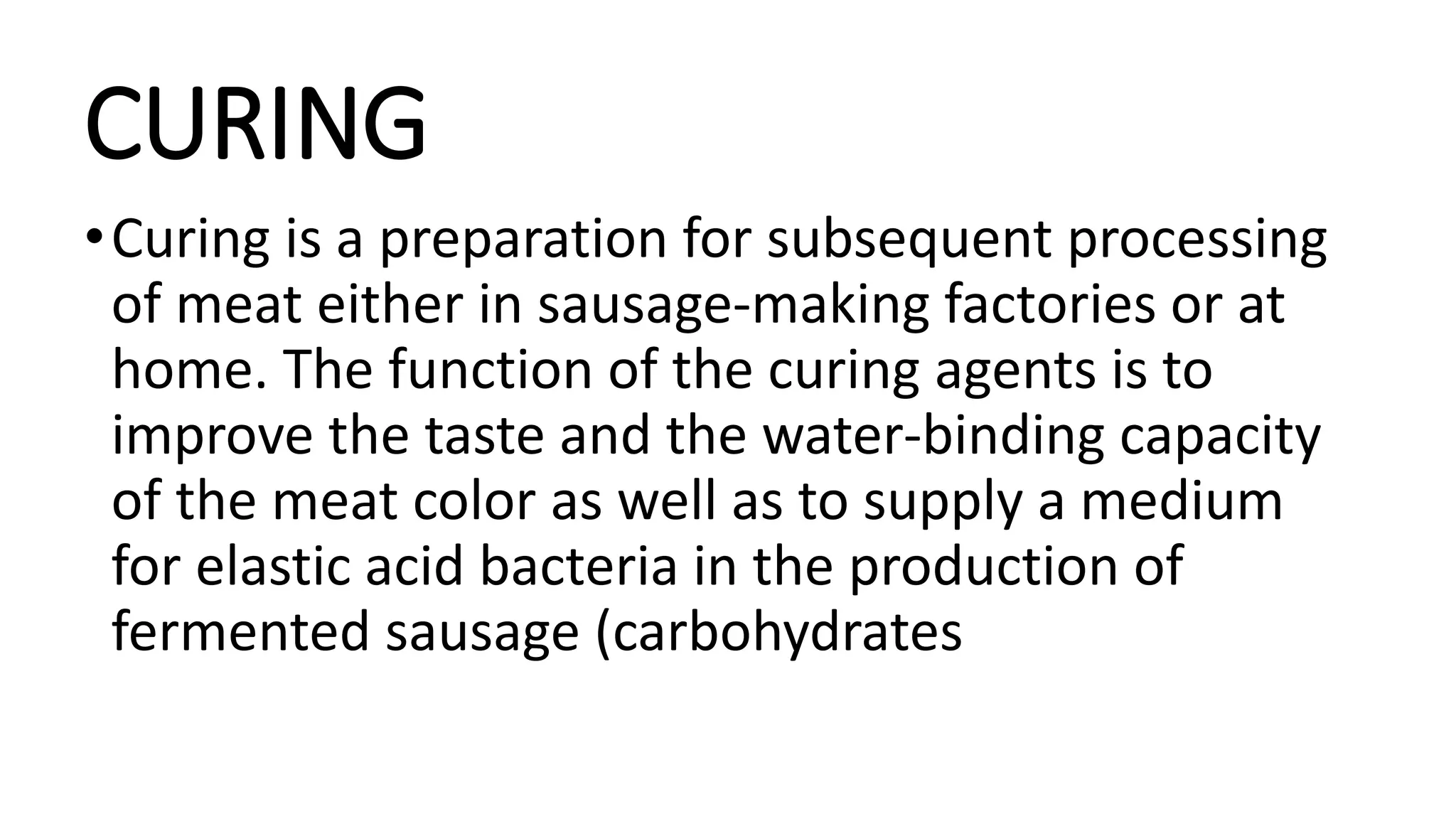
CURING
•Curing is a preparation for subsequent processing
of meat either in sausage-making factories or at
home. The function of the curing agents is to
improve the taste and the water-binding capacity
of the meat color as well as to supply a medium
for elastic acid bacteria in the production of
fermented sausage (carbohydrates
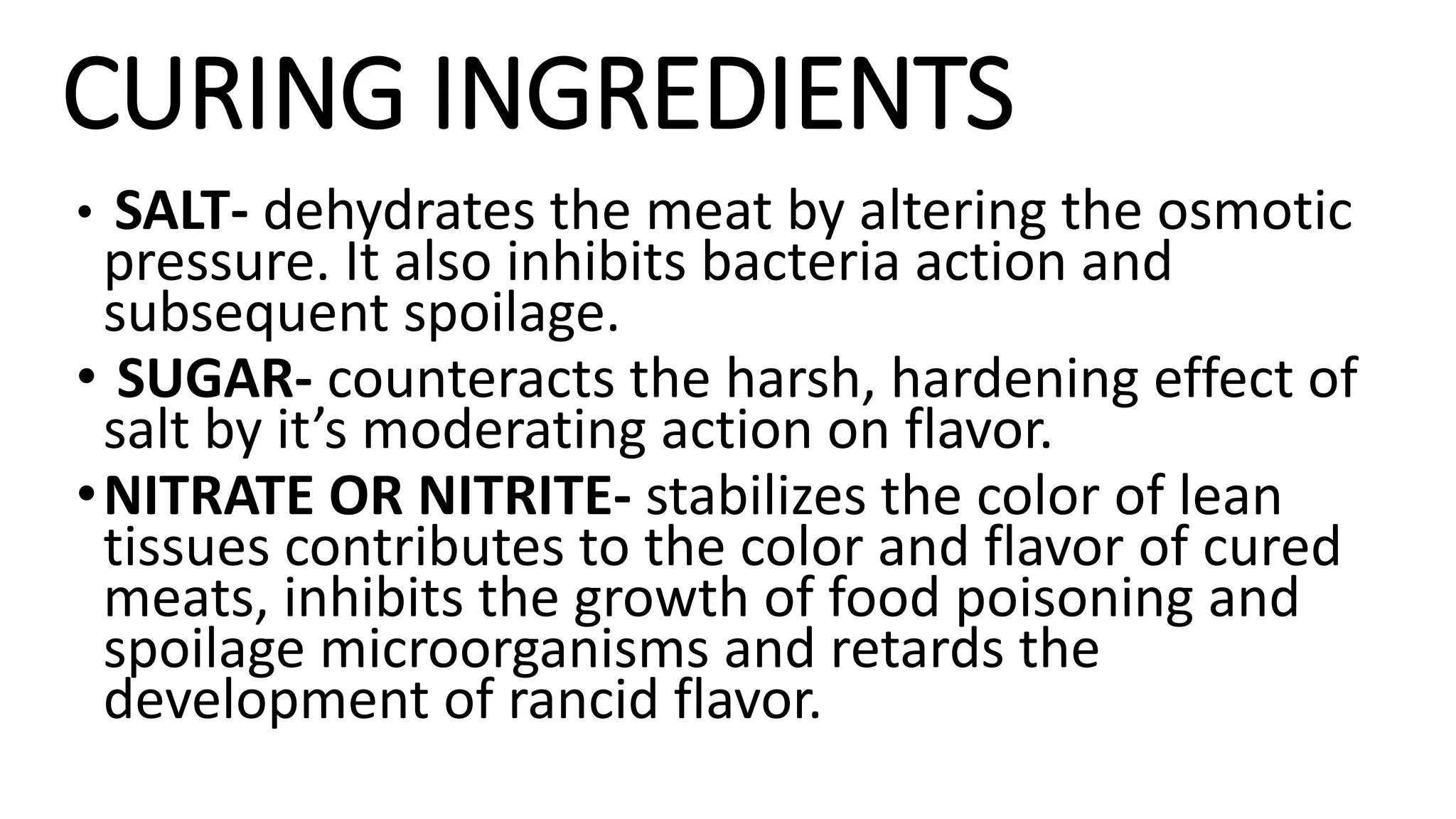
CURING INGREDIENTS
• SALT- dehydrates the meat by altering the osmotic
pressure. It also inhibits bacteria action and
subsequent spoilage.
• SUGAR- counteracts the harsh, hardening effect of
salt by it’s moderating action on flavor.
•NITRATE OR NITRITE- stabilizes the color of lean
tissues contributes to the color and flavor of cured
meats, inhibits the growth of food poisoning and
spoilage microorganisms and retards the
development of rancid flavor.
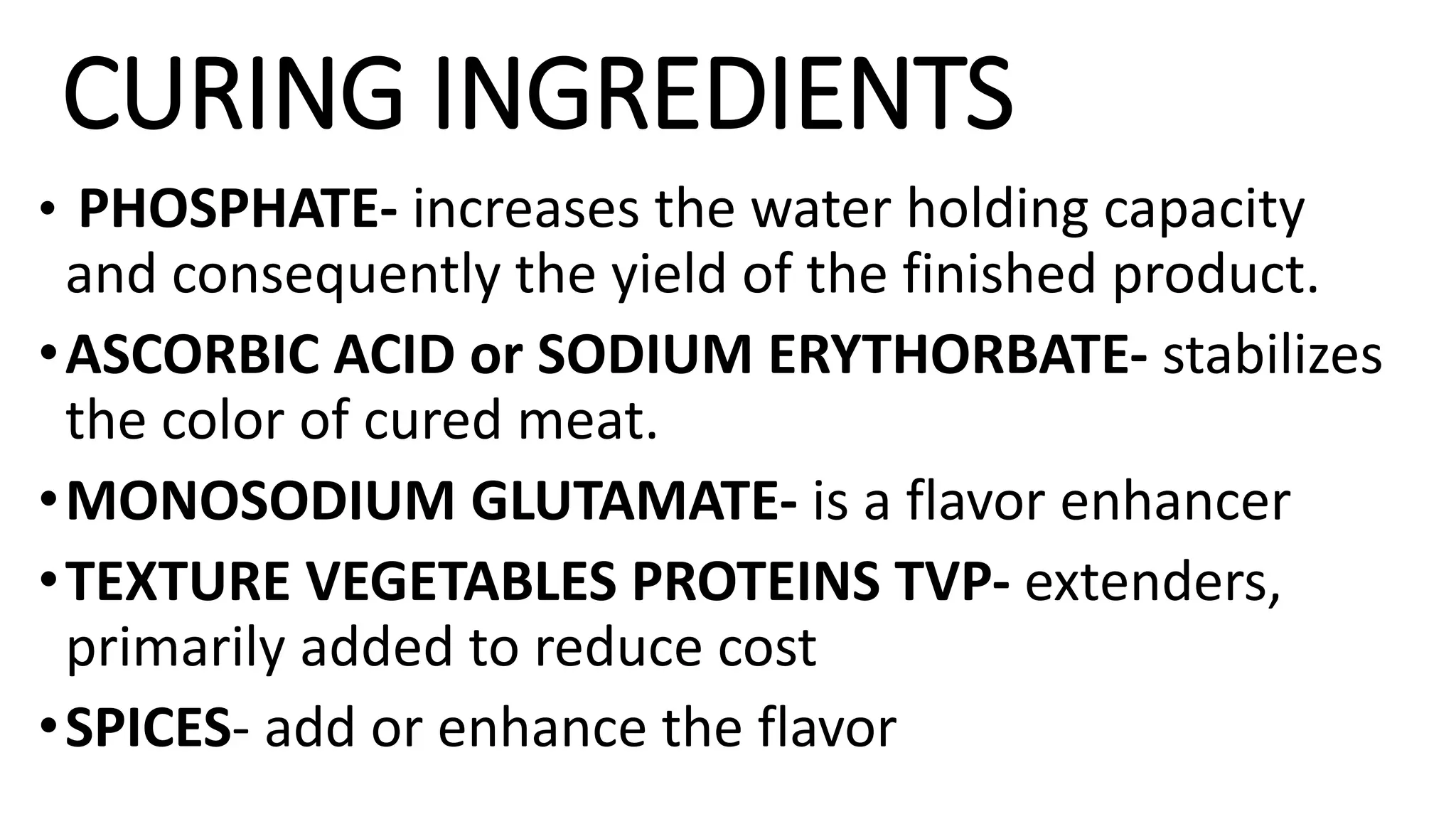
CURING INGREDIENTS
• PHOSPHATE- increases the water holding capacity
and consequently the yield of the finished product.
•ASCORBIC ACID or SODIUM ERYTHORBATE- stabilizes
the color of cured meat.
•MONOSODIUM GLUTAMATE- is a flavor enhancer
•TEXTURE VEGETABLES PROTEINS TVP- extenders,
primarily added to reduce cost
•SPICES- add or enhance the flavor
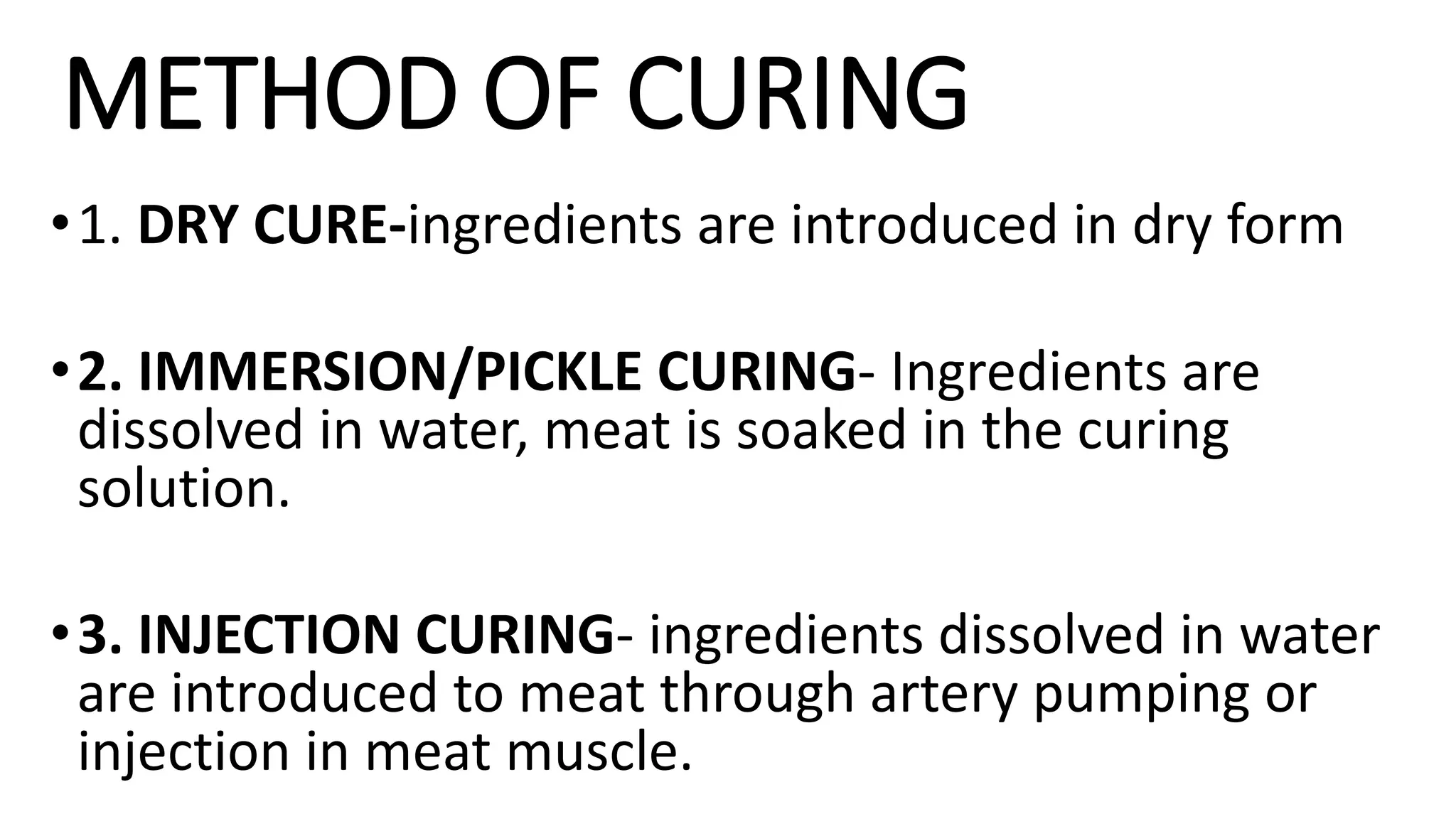
METHOD OF CURING
•1. DRY CURE-ingredients are introduced in dry form
•2. IMMERSION/PICKLE CURING- Ingredients are
dissolved in water, meat is soaked in the curing
solution.
•3. INJECTION CURING- ingredients dissolved in water
are introduced to meat through artery pumping or
injection in meat muscle.

THE PROCESS OF SALTING AND CURING...pptx

  • 1.
  • 2.
    A. SALTING • Saltingas a method of preservation of meat is very important since salted products generally have to be leached to get off most of the salt before eating and cooking. Some proteins, aromatic substances, vitamins and other nutrients are lost. Salting is dependent on the removal of moisture in foods. • Salt preserves fish by lowering the moisture content in the body of fish, while salt enters through the skin. The flow of water is from lesser to greater concentration, thus, when fish is soaked in brine, the water inside, flows out rapidly through the skin.
  • 3.
    METHOD OF SALTING •1. KENCH SALTING – this is locally called as “binuro”. The fish is heavily salted with a ratio of 1:7 or 1 part salt and 7 parts fish. Before they are salted they are soaked in a ten percent of Brine solution to leach the blood and then half dried for 2 hours. They are packed in newspaper and in wooden boxes for commercial purposes. The weight of salt depends on the volume or weight of fish to be salted. • if the volume of fish to be salted is 7OO grams, applying the ratio 1:7
  • 4.
    METHOD OF SALTING •2. DRY SALTING- in this method, the fishery product dried first before salting it. Fresh small shrimp are dried first before salting them. • 3. DRY SALTING TO MAKE BRINE- this product is locally known as “TINABAL” to the Cebuanos. Fish are salted and the liquid is allowed to cover the fish. The ratio of salt to fish is 1:4 or 1 part salt to 4 parts fish.
  • 5.
    METHOD OF SALTING •4. BRINE SALTING- this method is locally known by the Cebuanos as “GUINAMOS”. The brine salted fish are stored for one month or two and usually eaten with kalamansi juice or vinegar. The brine of this salted product is called “UNA” which is used as seasoning for broth and vegetables. • 10 % brine- 1:9 ratio ( one part salt and nine parts of water) • 20 % brine- 1:4 ratio ( one part salt and 4 parts water) • 25 % brine- 1:3 ratio ( one part salt and 3 parts water)
  • 6.
    SAMPLE COMPUTATION 10 %brine consists of part salt and 9 parts water. If 1 cup salt is 250 grams then for 9 cups of water is 2250 rams or millimeters of water. to weigh the solution dissolve 250 grams of salt in 2250 g/ml of water, therefore the weight of solution is 2500 ml.
  • 7.
    CURING •Curing is apreparation for subsequent processing of meat either in sausage-making factories or at home. The function of the curing agents is to improve the taste and the water-binding capacity of the meat color as well as to supply a medium for elastic acid bacteria in the production of fermented sausage (carbohydrates
  • 8.
    CURING INGREDIENTS • SALT-dehydrates the meat by altering the osmotic pressure. It also inhibits bacteria action and subsequent spoilage. • SUGAR- counteracts the harsh, hardening effect of salt by it’s moderating action on flavor. •NITRATE OR NITRITE- stabilizes the color of lean tissues contributes to the color and flavor of cured meats, inhibits the growth of food poisoning and spoilage microorganisms and retards the development of rancid flavor.
  • 9.
    CURING INGREDIENTS • PHOSPHATE-increases the water holding capacity and consequently the yield of the finished product. •ASCORBIC ACID or SODIUM ERYTHORBATE- stabilizes the color of cured meat. •MONOSODIUM GLUTAMATE- is a flavor enhancer •TEXTURE VEGETABLES PROTEINS TVP- extenders, primarily added to reduce cost •SPICES- add or enhance the flavor
  • 10.
    METHOD OF CURING •1.DRY CURE-ingredients are introduced in dry form •2. IMMERSION/PICKLE CURING- Ingredients are dissolved in water, meat is soaked in the curing solution. •3. INJECTION CURING- ingredients dissolved in water are introduced to meat through artery pumping or injection in meat muscle.