PARTS OF A
FISH
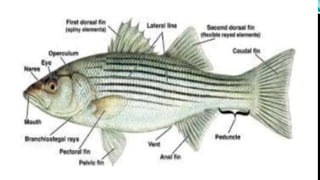
Caudal fin
The fish primarily uses its caudal fins to achieve a quick
speed.
Anal fin
The marlin has two dorsal fins and two anal fins.
Pelvic fin
The fish also has red tail, dorsal, and pelvic fins.
Pectoral fin
The fish uses these pectoral fins to clamber along the
sea bottom.
Gill
The bichir, in fact, not only has gills like any other fish, but
a lung as well.
Gill cover
They were sunfish, beautiful gold and green fish with a
bright red spot on the edge of each gill cover.
Mouth
Sucker mouths are a common feature in fish with inferior
mouths.
Eye
Fish eyes are similar to the eyes of terrestrial vertebrates like birds
and mammals, but have a more spherical lens.
Nostril
The nostrils of fish are used for the sense of smell.
Dorsal fins
The shark has a pair of dorsal fins and pectoral fins.
Scales
The skin of most fishes is covered with scales, which, in many
cases, are animal reflectors or produce animal coloration.
Lateral line
There are 63 to 75 scales in a lateral line.
COMPOSITION AND STRUCTURE:
A fish is made up of water, protein, fats and small
amount of minerals and vitamins. It has very little
connective tissue. This means that:
1. Fish cooks very quickly, even at low heat.
2.Fish is naturally tender. High heat will result to
toughening of protein.
3. Moist-heat methods are used not to create tenderness
but to preserve moistness ad provide variety.
4. Cooked fish must be handled very carefully.
HANDLE FISH AND
SEAFOOD
CHECKING THE FRESHNESS OF FISH
1. Fresh and mild color.
2.Eyes are clear, shiny and bulging
3.Red or pink gills
4.Texture of flesh is firm or elastic
5.Shiny scales, and tightly cling, on skin
FIN FISH
SHELLFISH
1. Oysters, clams, mussels in the shell and tightly
closes shells when jostled.
2. Live or shucked oysters must have a very mild,
sweet smell.
3. Discard any mussels that are very light in weight
or seem to be hollow.
4. Strong fishy odor or brownish color is a sign of age
or spoilage
5. Live lobsters must be alive when cooked. The
meat will be firm and the tail springs back when
straightened.
6. Frozen shrimps should be solidly frozen when
received.
7. Glazed shrimps should be shiny with no freezer
burn.
8. All shrimps should smell fresh and sweet. A
strong fishy or iodine smell indicates age or
spoilage.
9. Live crabs should be kept alive until cooked.
10. Frozen crabmeat should be treated like any
other frozen fish
•How do we check the freshness of fish?
•Why is it important to select fresh fish/shellfish?
•Why is it not advisable to eat shellfish caught
during low tide?
•What are the parts of a fish?
•What is the part of fish that is rich in
calcium?
•What are the nutrients that we can get
from eating fish?
•Are these nutrients important to us?
EVALUATION: 20 PTS
• Draw and label the parts of a fish