Prepare Vegetable Dishes
– Vegetables are plants or parts of plants like leaves,
fruits, tubers, roots, bulbs, stems, shoots, and flower
used in a dish either raw or cooked. Vegetables give
color , texture and flavor to our meals. They also give
vitamins and minerals.
– Vegetables provide nutrients vital for health and
maintenance of your body. Eating vegetables provides
health benefits to people like reduced risk of some
chronic diseases including heart attack and stroke ,
protect them against certain types of cancers , reduce
obesity and type two diabetes , lower blood pressures ,
reduce the risk of developing kidney stones and help
decrease bone loss.
Vegetables are important sources of many nutrients,
including potassium , dietary fiber, folate (folic acid) ,
vitamin A , and vitamin C.
• Diets rich in potassium may help maintain normal
blood pressure. Vegetable sources of potassium
include sweet potatoes , white potatoes , white beans ,
tomato products (paste , sauce , and juice), beet
greens , soybeans , lima beans , spinach , lentils , and
kidney beans.
• Dietary fiber from vegetables , as part of an overall
healthy diet , helps reduce blood cholesterol levels
and may lower risk of heart disease. Fiber is important
for proper bowel function. It helps reduce constipation.
Fiber-containing foods such as vegetable help provide
a feeling of fullness with fewer calories.
• Folate (folic acid) helps the body from red
bloods cells. Women of childbearing age who
may become pregnant should consume
adequate folate from foods , and in addition ,
400 mcg of synthetic folic acid from fortified
foods or supplements. This reduces the risk of
neural tube defects , spinal bifida , and
anencephaly during fetal development.
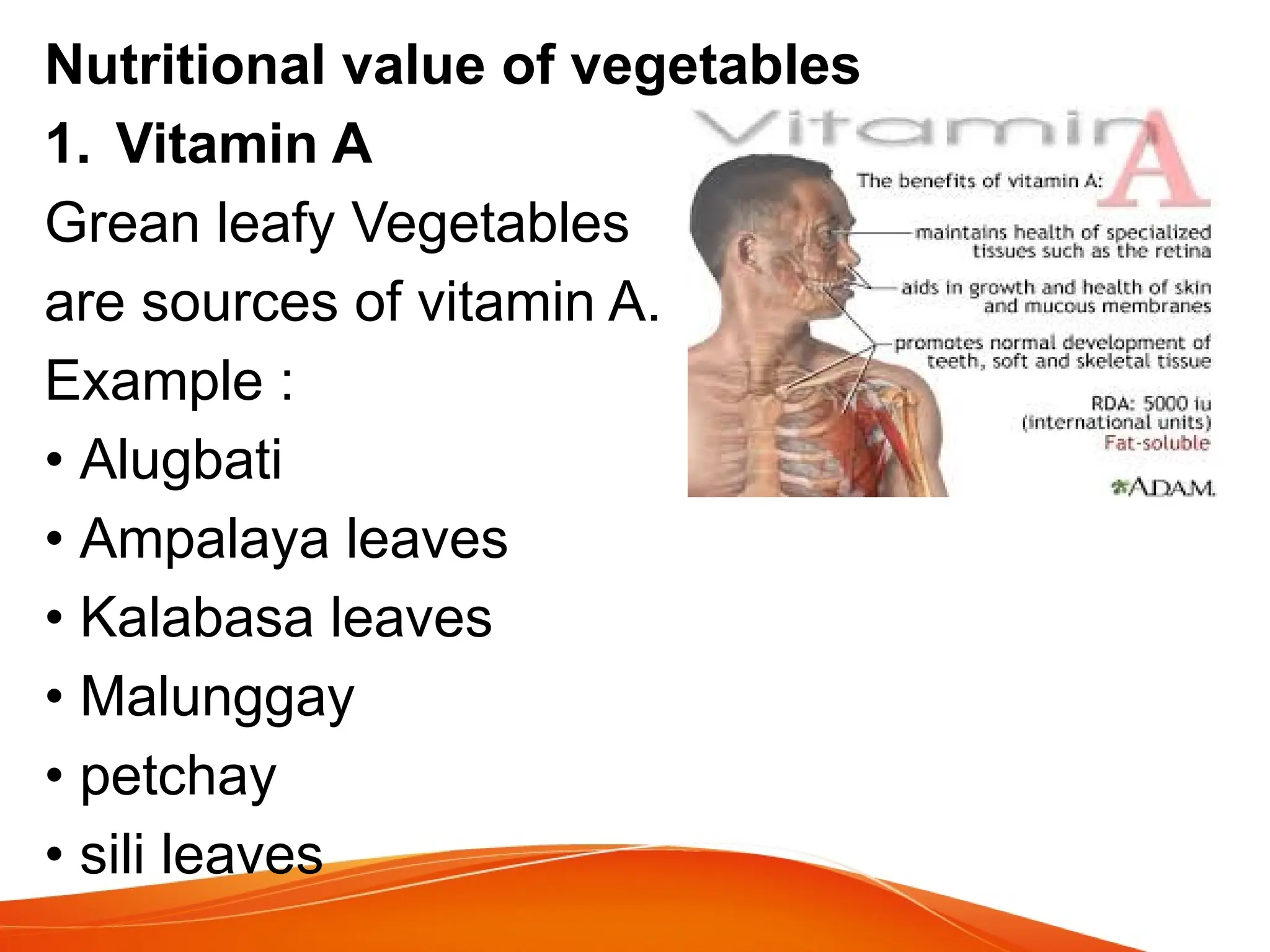
• Vitamin A keeps eyes and skin healthy and
helps to protect against infections.
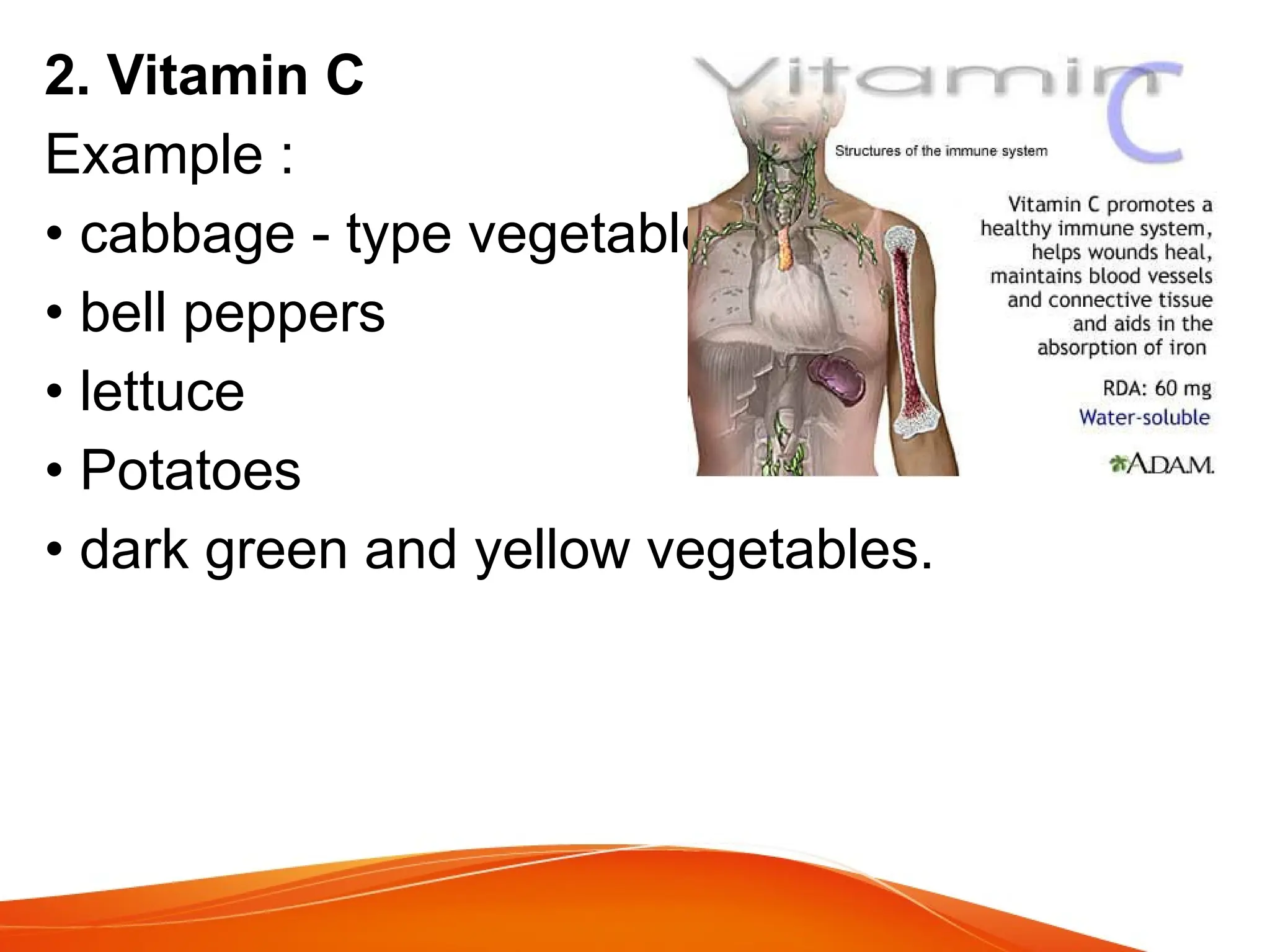
• Vitamin C helps heal cuts , and wounds , and
keeps teeth and gums healthy. Vitamin C aids
in iron absorption.
Vegetables need to be prepared before
they are ready to serve or used as an
ingredient in a cooked dish. Prior to
preparation you need to identify the various
kinds of vegetables and different tools and
equipment needed in the preparation of
vegetables and different tools and equipment
needed in the preparation of vegetables. It is
an important factor to consider in the
preparation of vegetables.
Classifications of vegetables
A. According to parts of plants
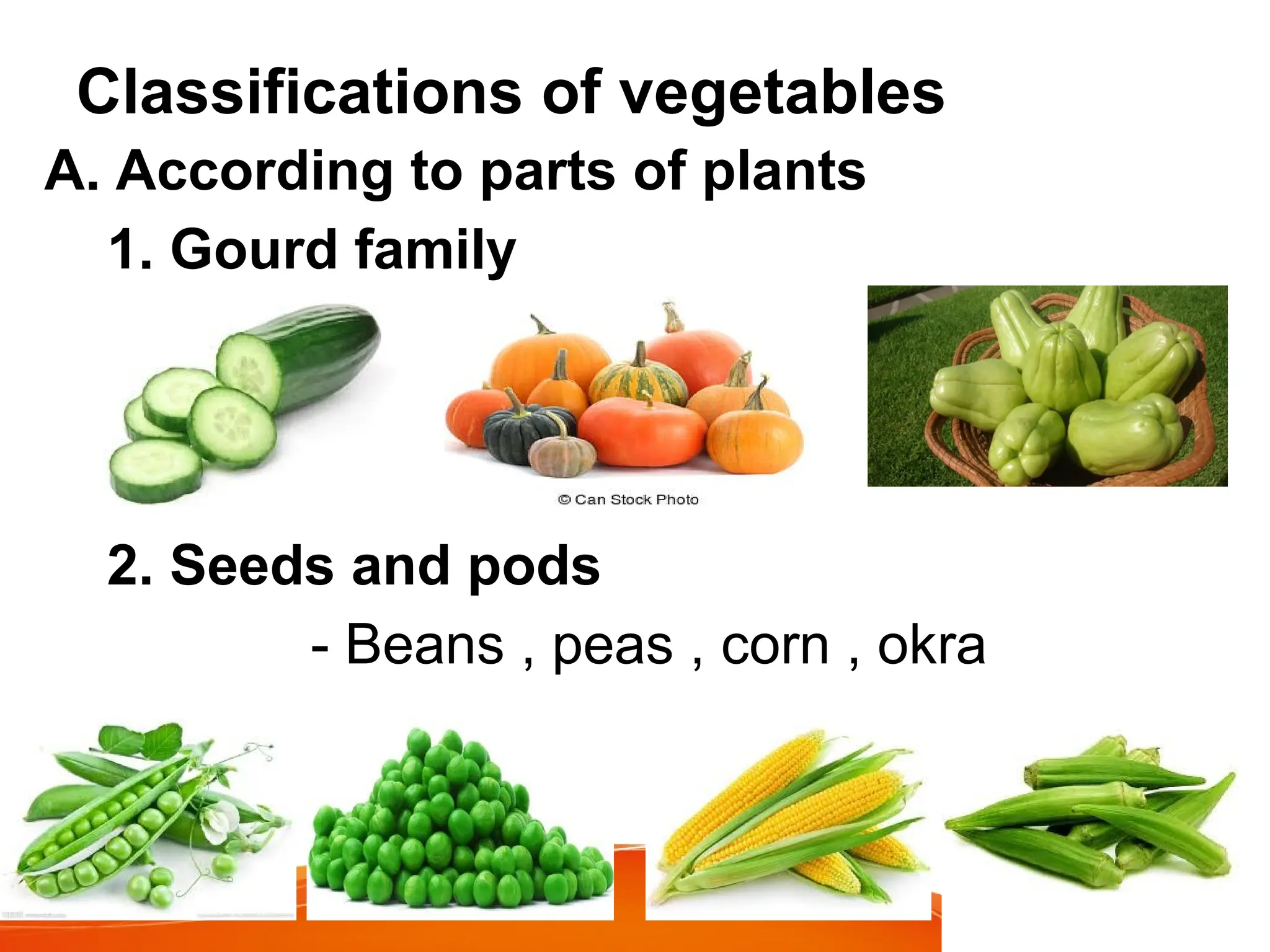
1. Gourd family
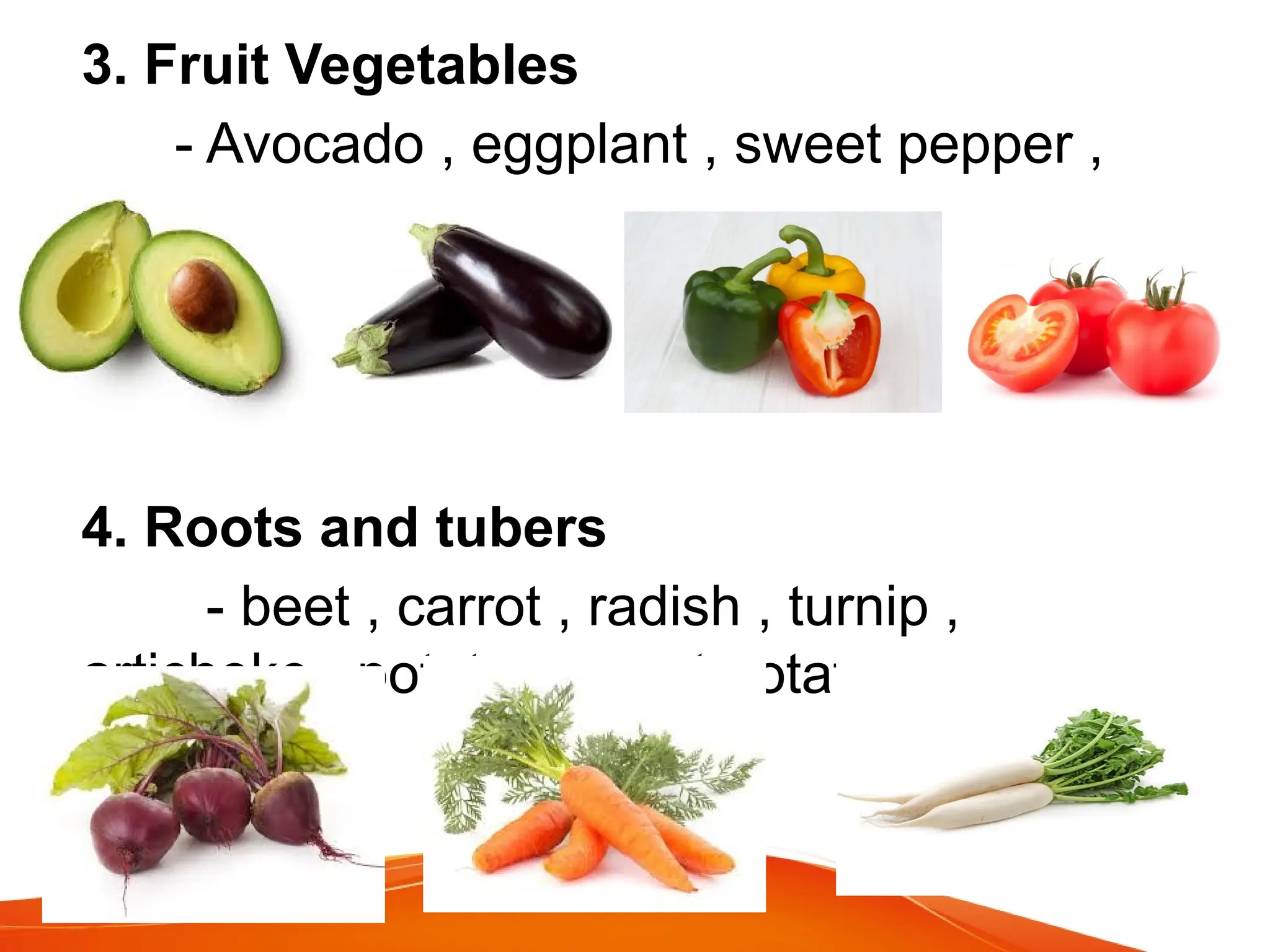
2. Seeds and pods
- Beans , peas , corn , okra
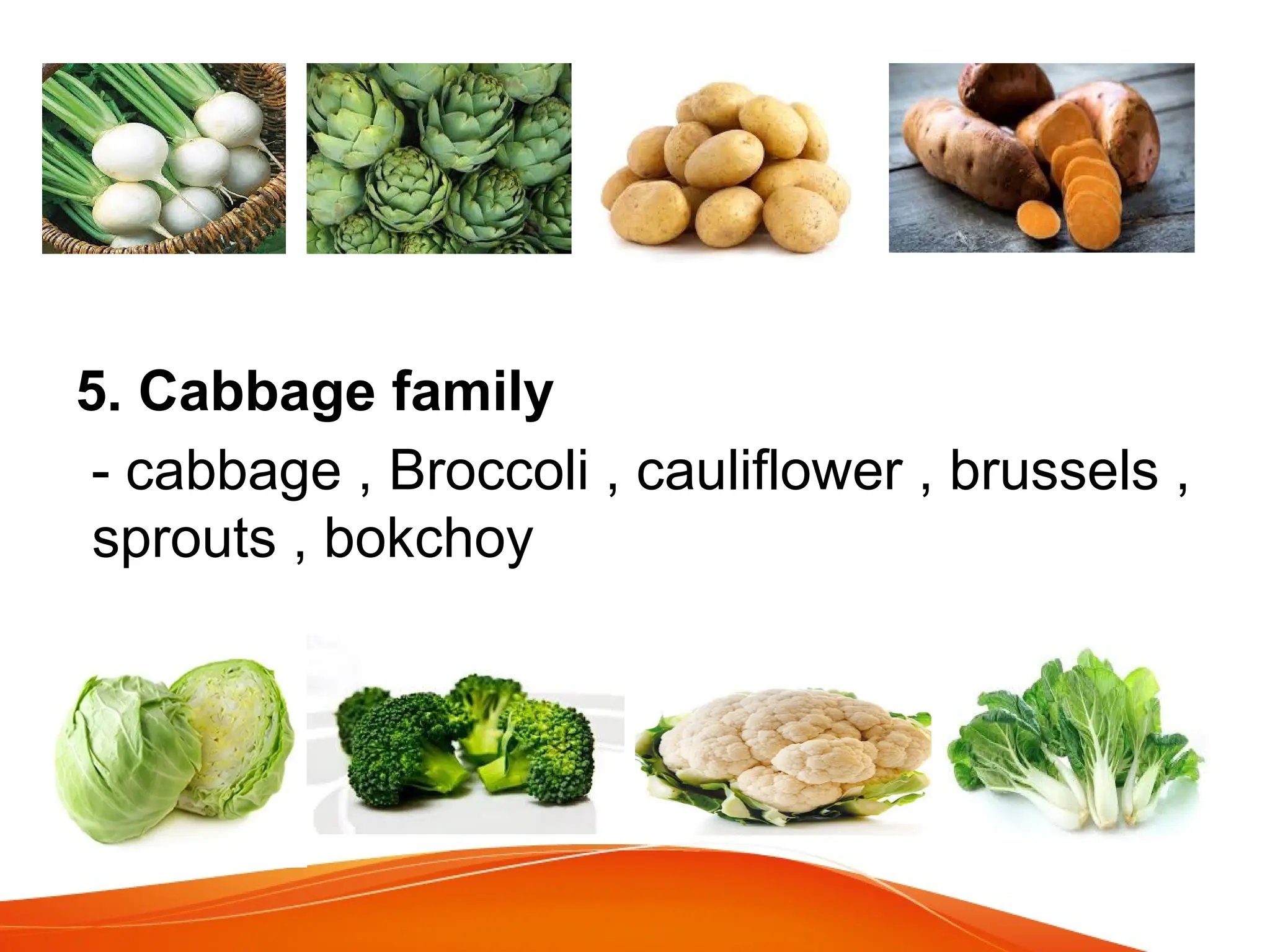
3. Fruit Vegetables
- Avocado , eggplant , sweet pepper ,
tomato
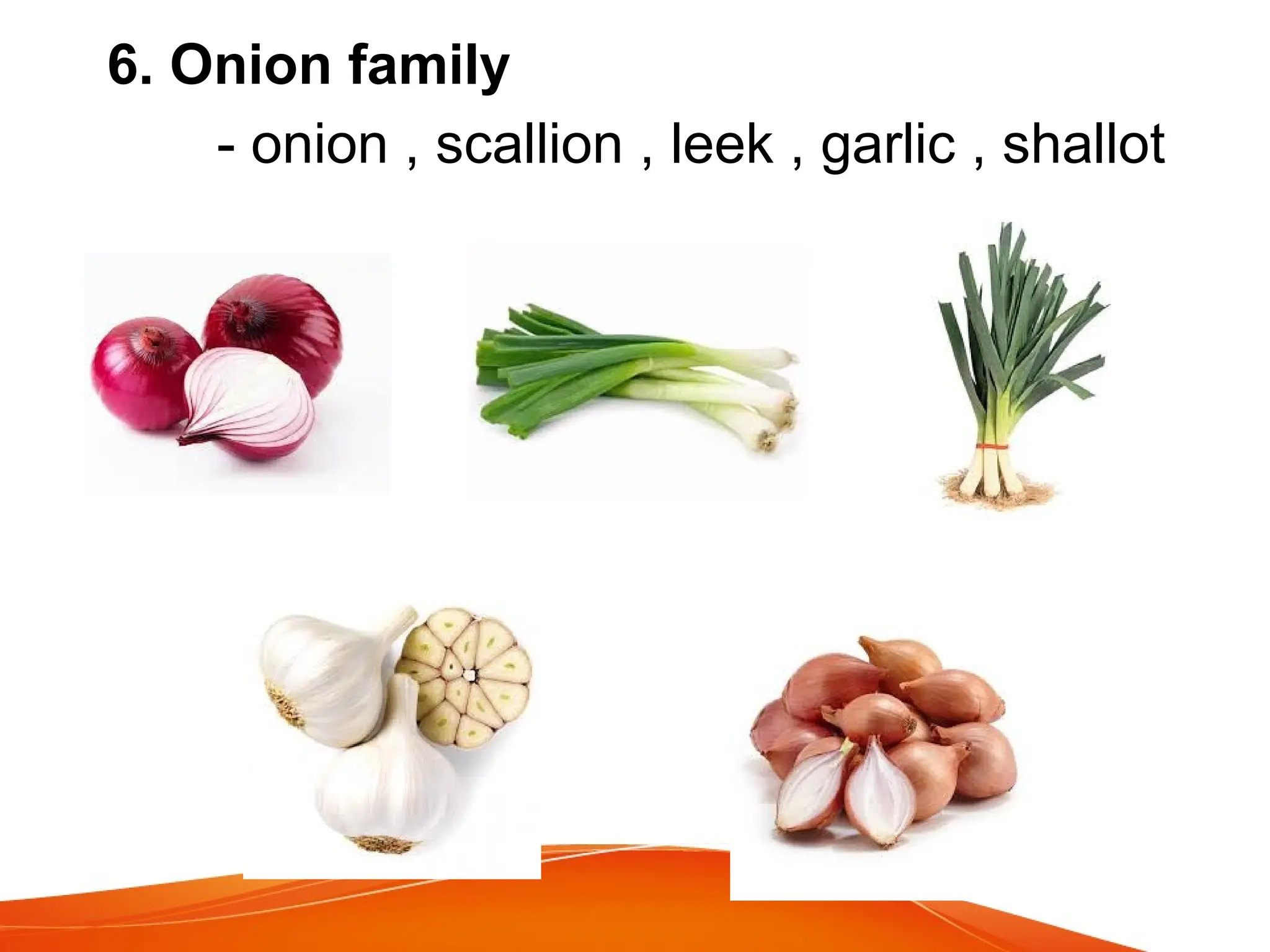
4. Roots and tubers
- beet , carrot , radish , turnip ,
artichoke , potato , sweet potato
5. Cabbage family
- cabbage , Broccoli , cauliflower , brussels ,
sprouts , bokchoy
6. Onion family
- onion , scallion , leek , garlic , shallot
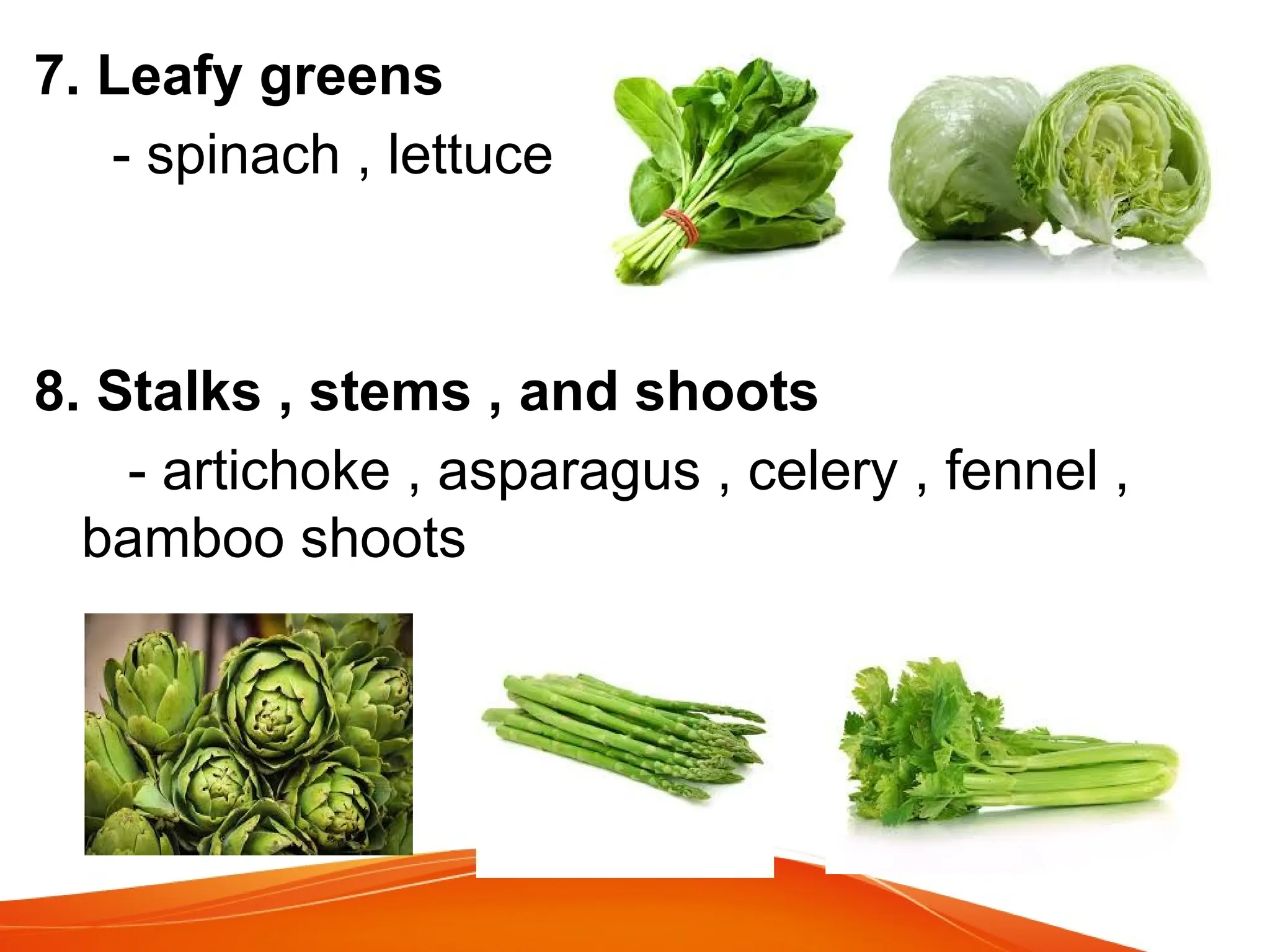
7. Leafy greens
- spinach , lettuce
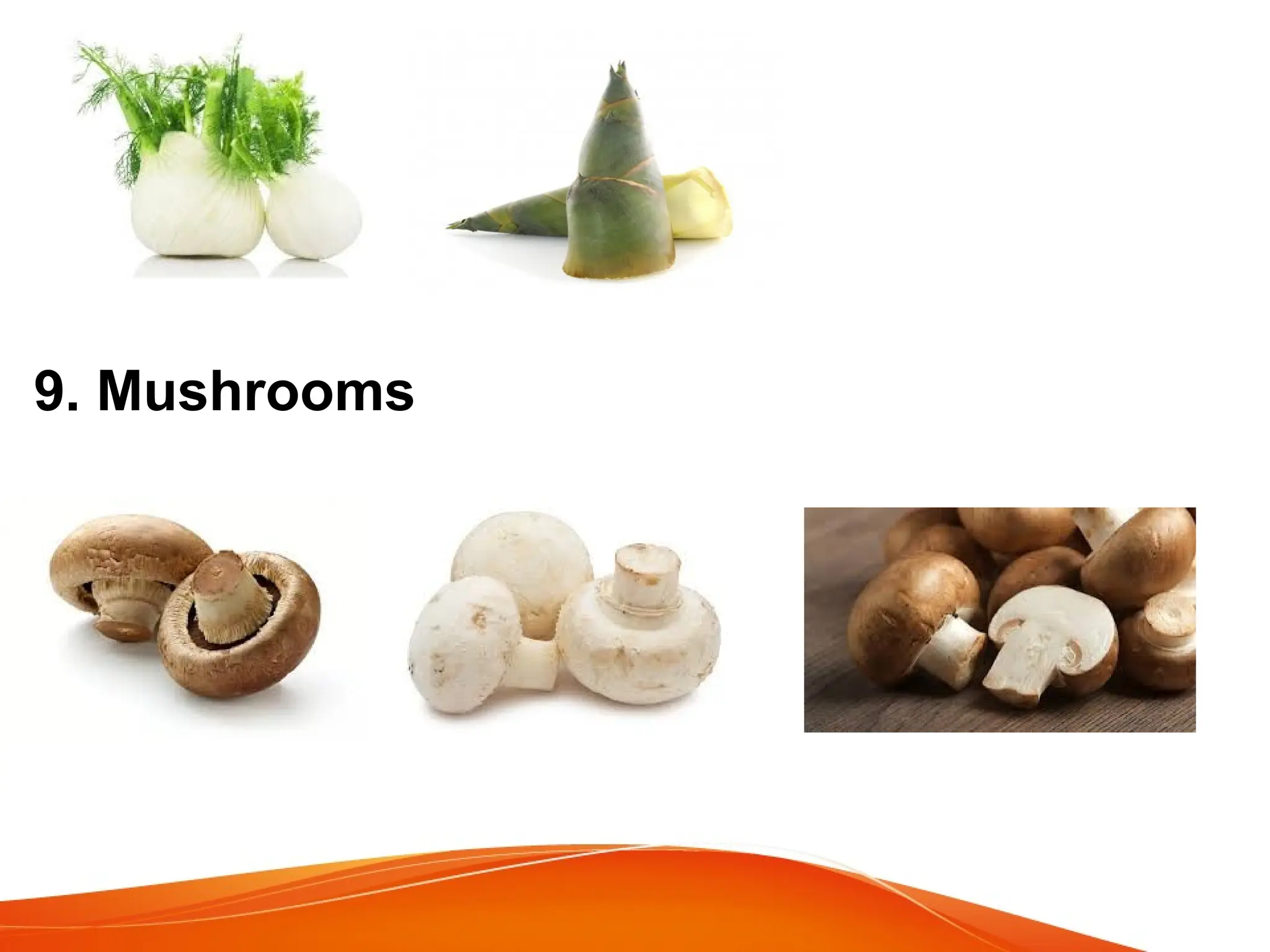
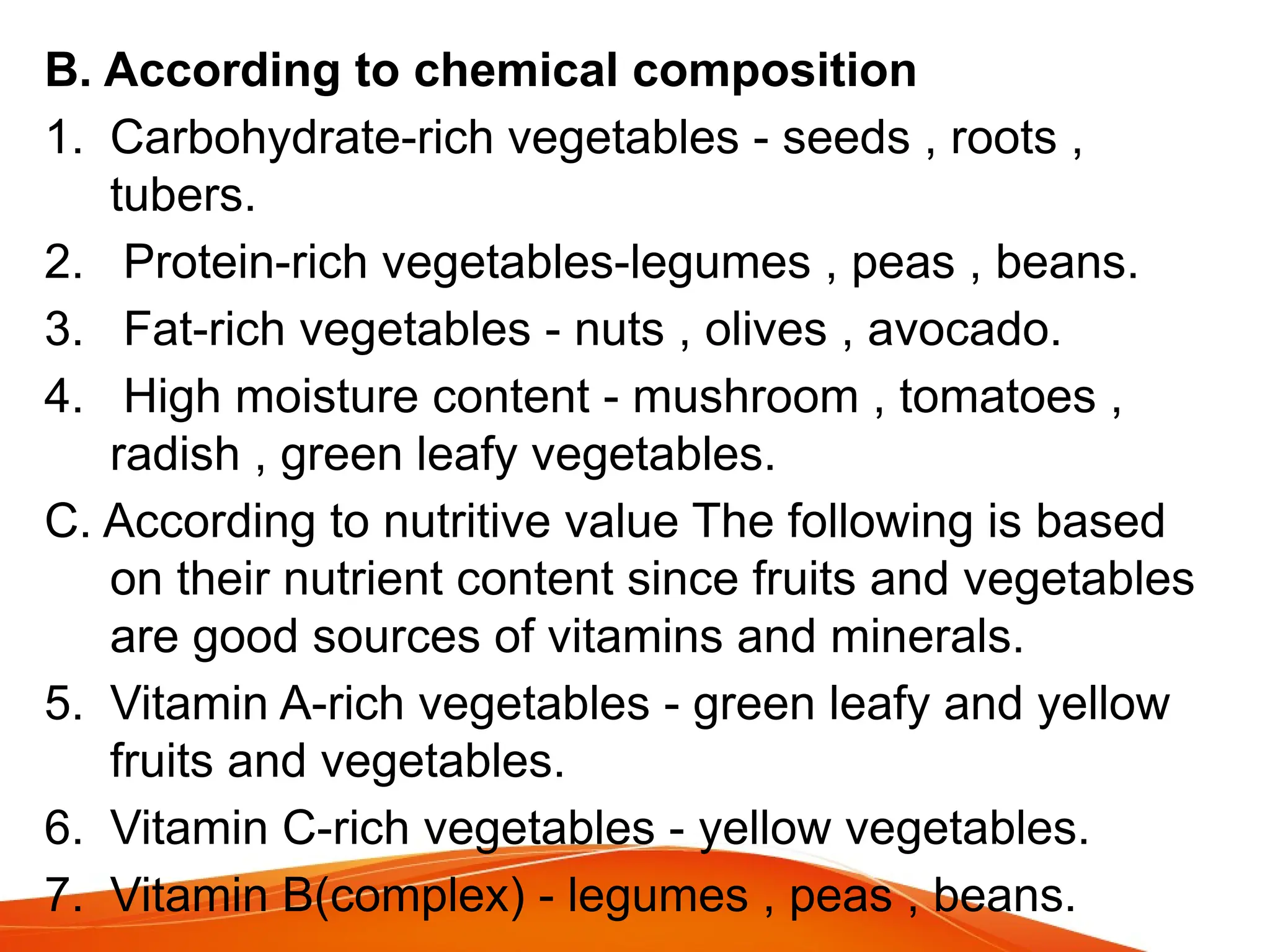
8. Stalks , stems , and shoots
- artichoke , asparagus , celery , fennel ,
bamboo shoots
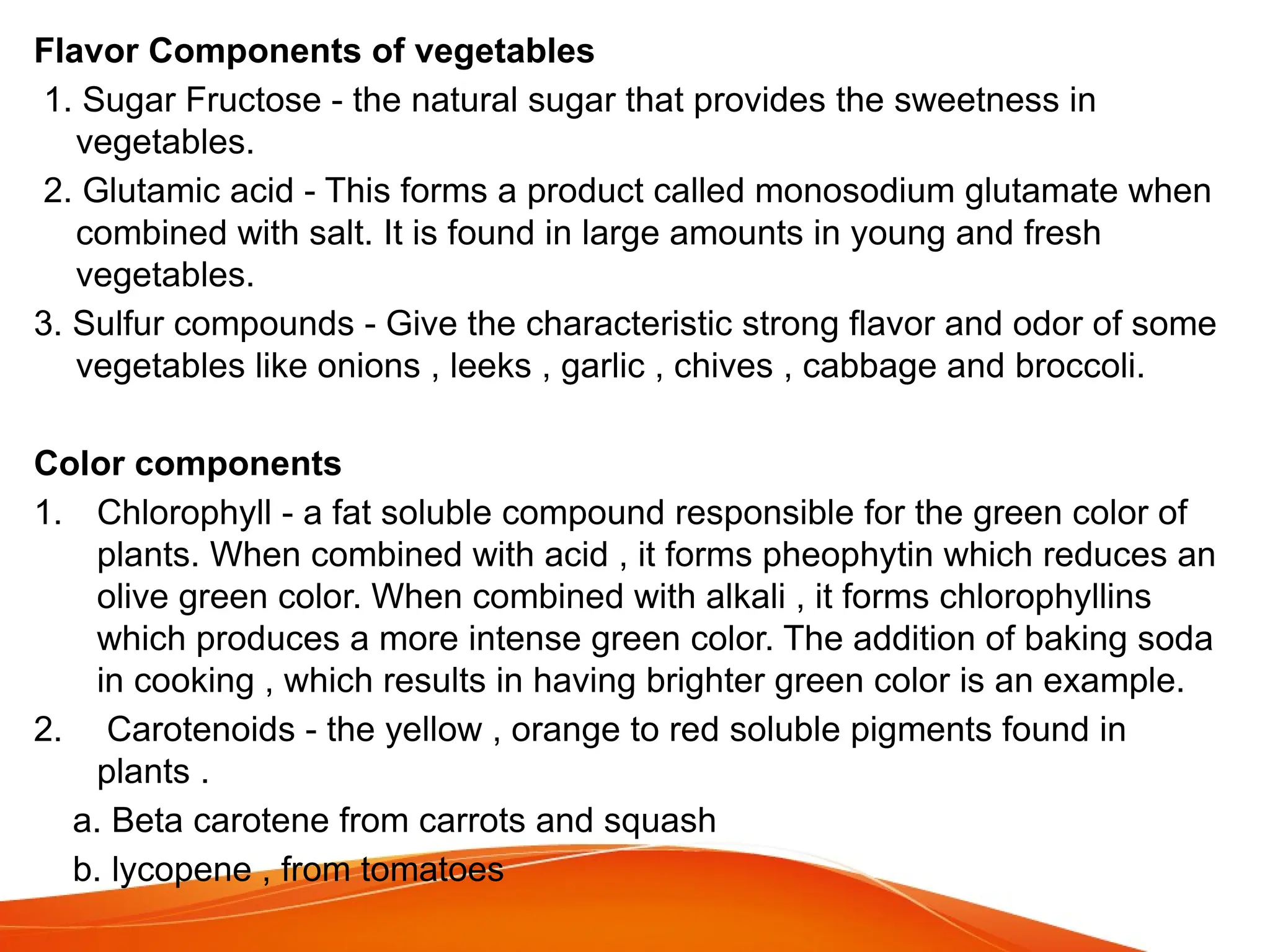
9. Mushrooms
B. According to chemical composition
1. Carbohydrate-rich vegetables - seeds , roots ,
tubers.
2. Protein-rich vegetables-legumes , peas , beans.
3. Fat-rich vegetables - nuts , olives , avocado.
4. High moisture content - mushroom , tomatoes ,
radish , green leafy vegetables.
C. According to nutritive value The following is based
on their nutrient content since fruits and vegetables
are good sources of vitamins and minerals.
5. Vitamin A-rich vegetables - green leafy and yellow
fruits and vegetables.
6. Vitamin C-rich vegetables - yellow vegetables.
7. Vitamin B(complex) - legumes , peas , beans.
Flavor Components of vegetables
1. Sugar Fructose - the natural sugar that provides the sweetness in
vegetables.
2. Glutamic acid - This forms a product called monosodium glutamate when
combined with salt. It is found in large amounts in young and fresh
vegetables.
3. Sulfur compounds - Give the characteristic strong flavor and odor of some
vegetables like onions , leeks , garlic , chives , cabbage and broccoli.
Color components
1. Chlorophyll - a fat soluble compound responsible for the green color of
plants. When combined with acid , it forms pheophytin which reduces an
olive green color. When combined with alkali , it forms chlorophyllins
which produces a more intense green color. The addition of baking soda
in cooking , which results in having brighter green color is an example.
2. Carotenoids - the yellow , orange to red soluble pigments found in
plants .
a. Beta carotene from carrots and squash
b. lycopene , from tomatoes
3. Flavonoids
a. Anthoxanthin - responsible for the yellow
pigments.
b. Anthocyanins - responsible for red and blue to
violet pigments (beets) tube , eggplants.
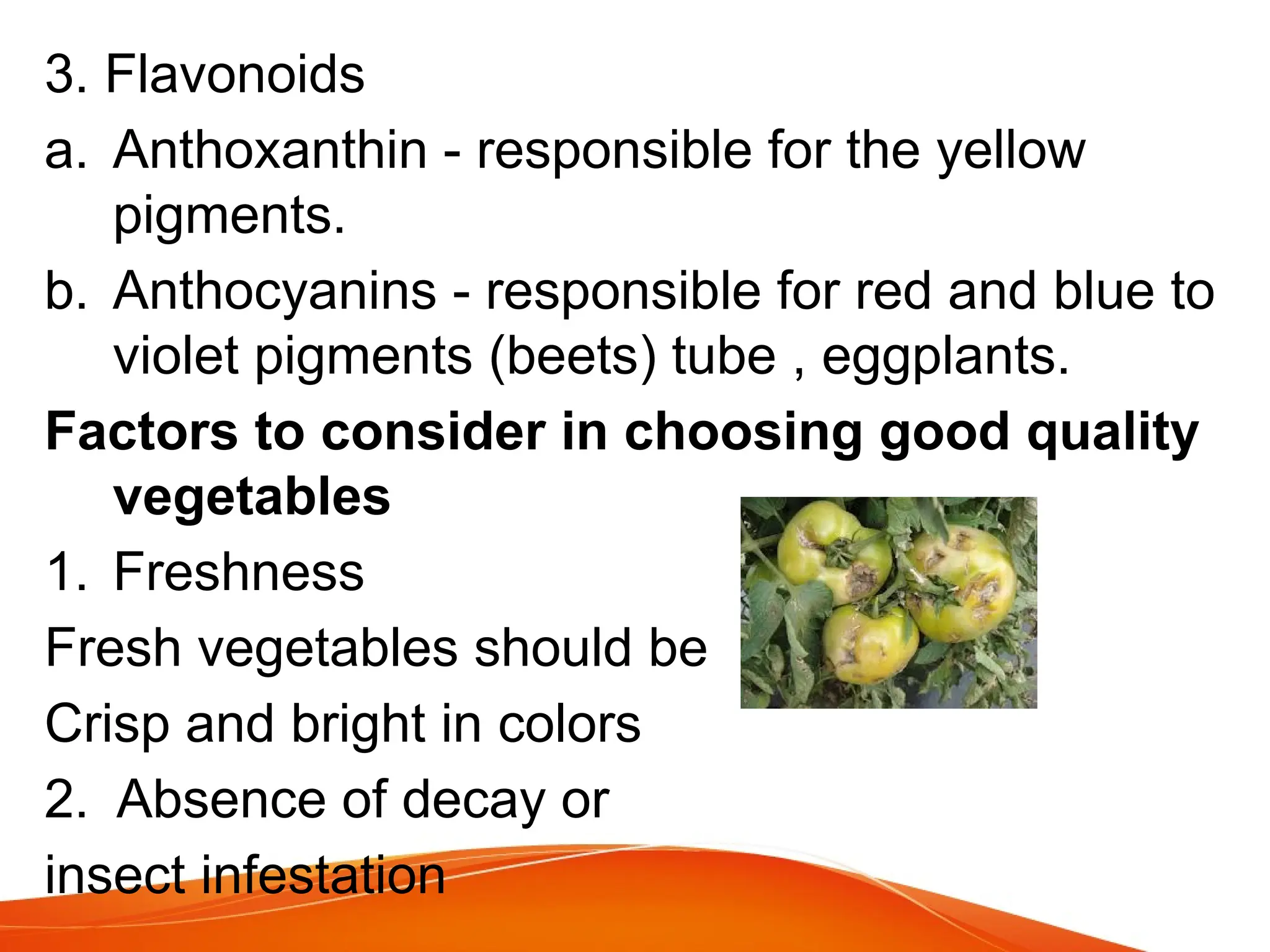
Factors to consider in choosing good quality
vegetables
1. Freshness
Fresh vegetables should be
Crisp and bright in colors
2. Absence of decay or
insect infestation
3. No mechanical damage or injury
4. Right degree of maturity
5. Variety of texture and sometimes flavor.
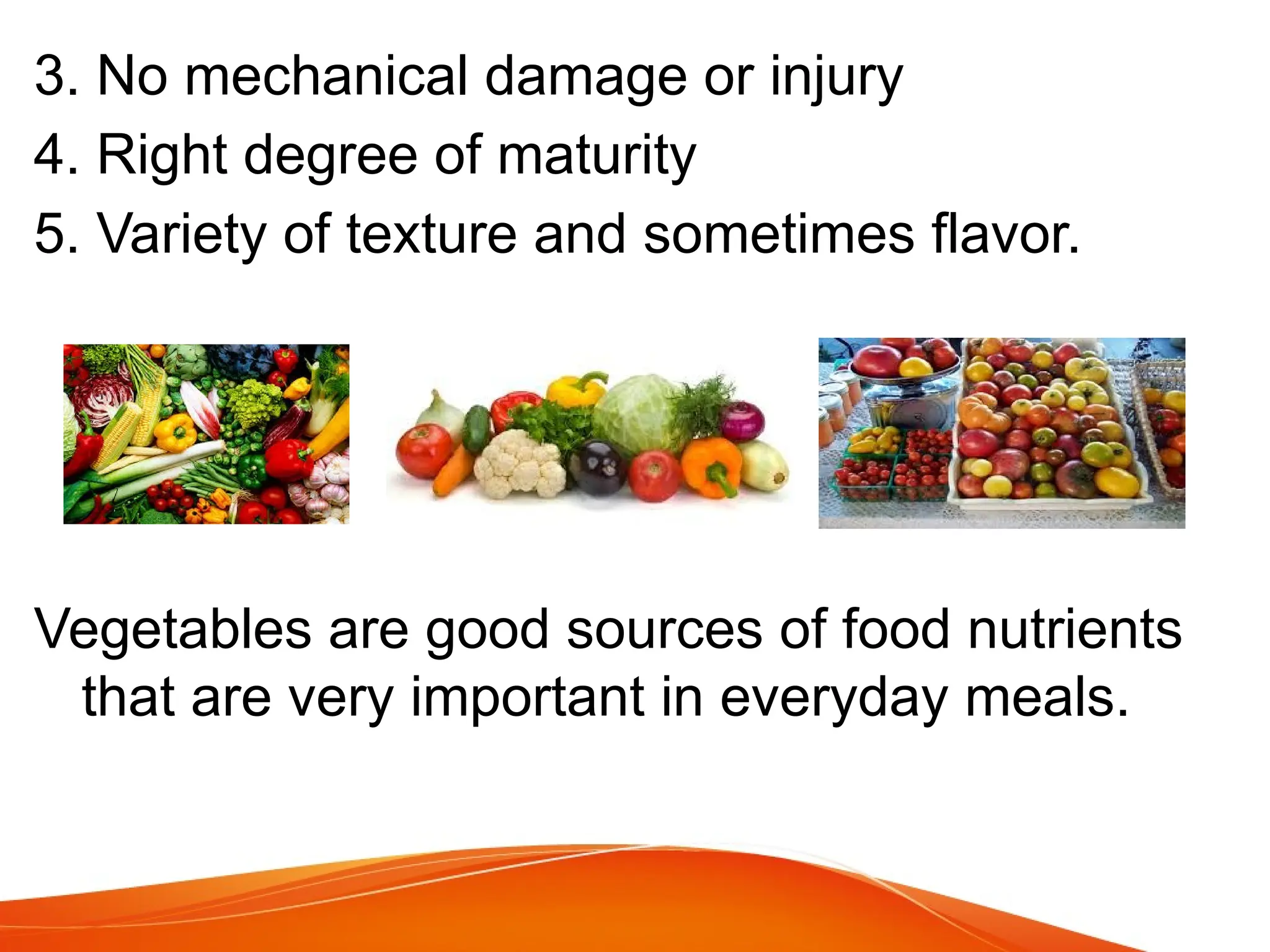
Vegetables are good sources of food nutrients
that are very important in everyday meals.
Nutritional value of vegetables
1. Vitamin A
Grean leafy Vegetables
are sources of vitamin A.
Example :
• Alugbati
• Ampalaya leaves
• Kalabasa leaves
• Malunggay
• petchay
• sili leaves
2. Vitamin C
Example :
• cabbage - type vegetables
• bell peppers
• lettuce
• Potatoes
• dark green and yellow vegetables.
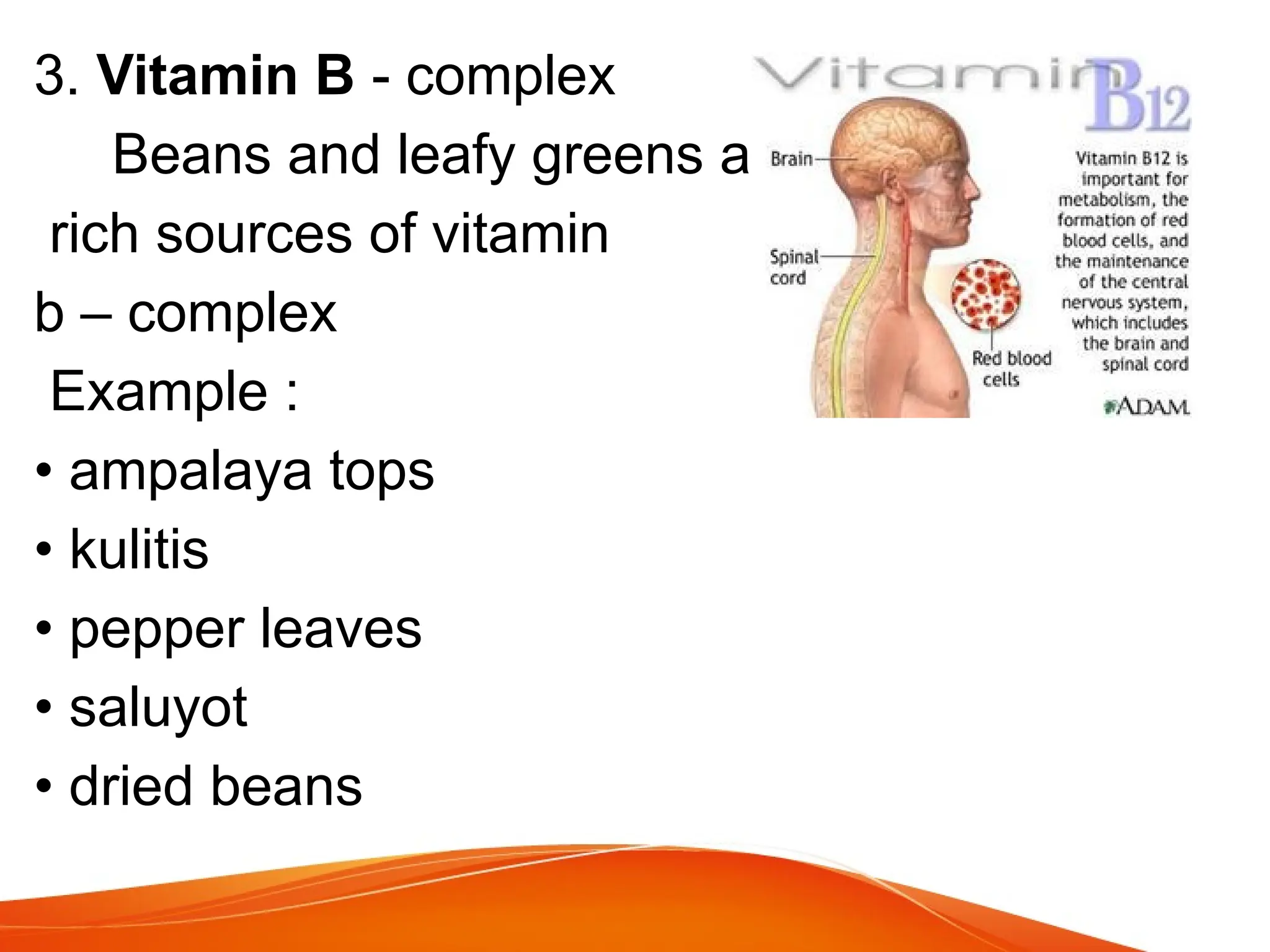
3. Vitamin B - complex
Beans and leafy greens are
rich sources of vitamin
b – complex
Example :
• ampalaya tops
• kulitis
• pepper leaves
• saluyot
• dried beans
4. Complex carbohydrates
Complex carbohydrates are carbohydrate molecules with more
than 20 - sugar residue. They are called as polysaccharides.
Functions of carbohydrate :
1. Source of energy ( protein sparing and prevents ketosis )
2. Source of B- vitamins for CHO metabolism.
3. Type of carbohydrate chosen determines :
• Fiber content
• Glycemic load of diet
• Nutrient density and phytochemical content.
Examples :
• wheat bran
• whole grain breads and cereals
• cabbage
• carrots
• Brussels sprouts
Preparing fresh vegetables
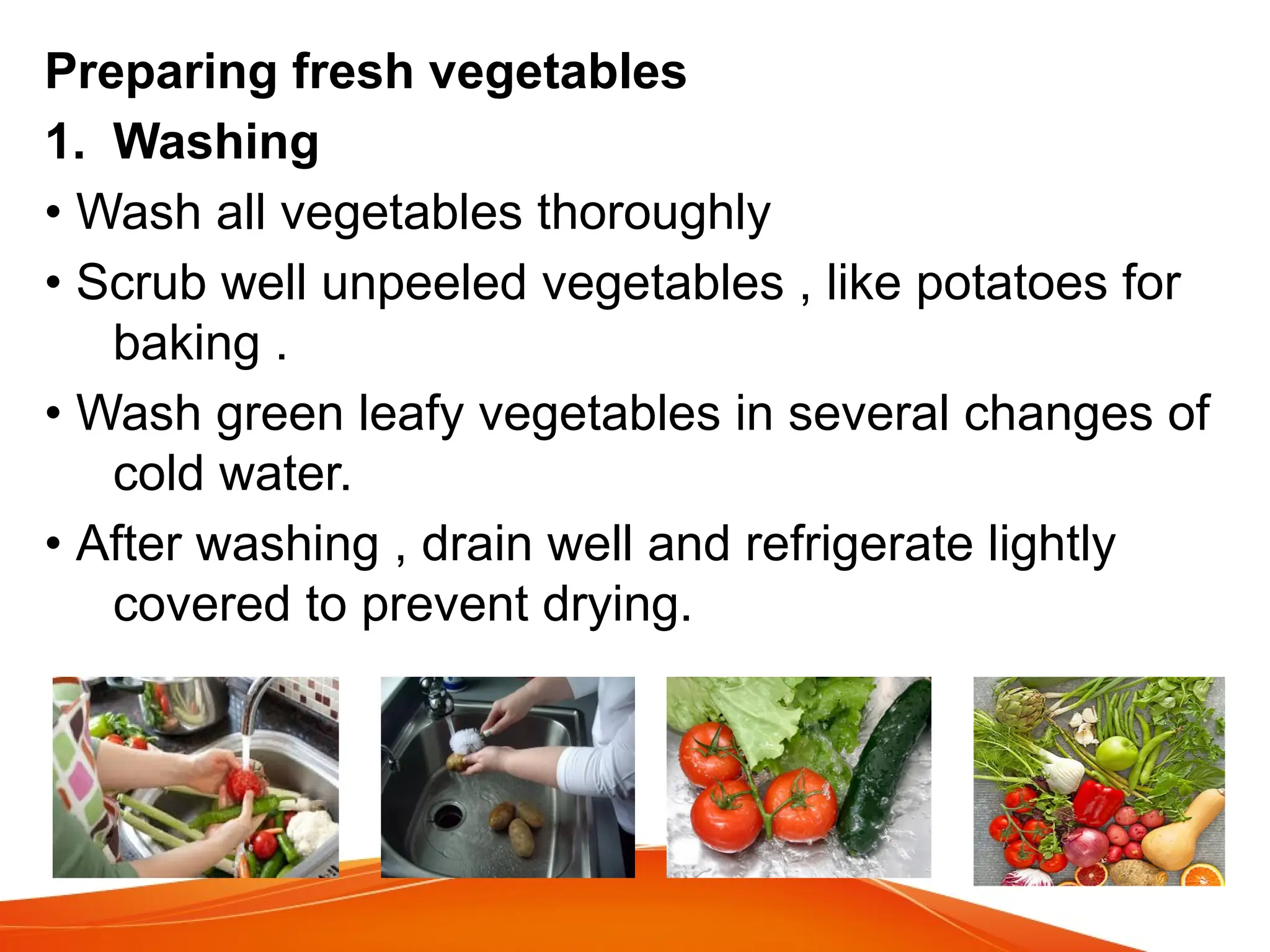
1. Washing
• Wash all vegetables thoroughly
• Scrub well unpeeled vegetables , like potatoes for
baking .
• Wash green leafy vegetables in several changes of
cold water.
• After washing , drain well and refrigerate lightly
covered to prevent drying.
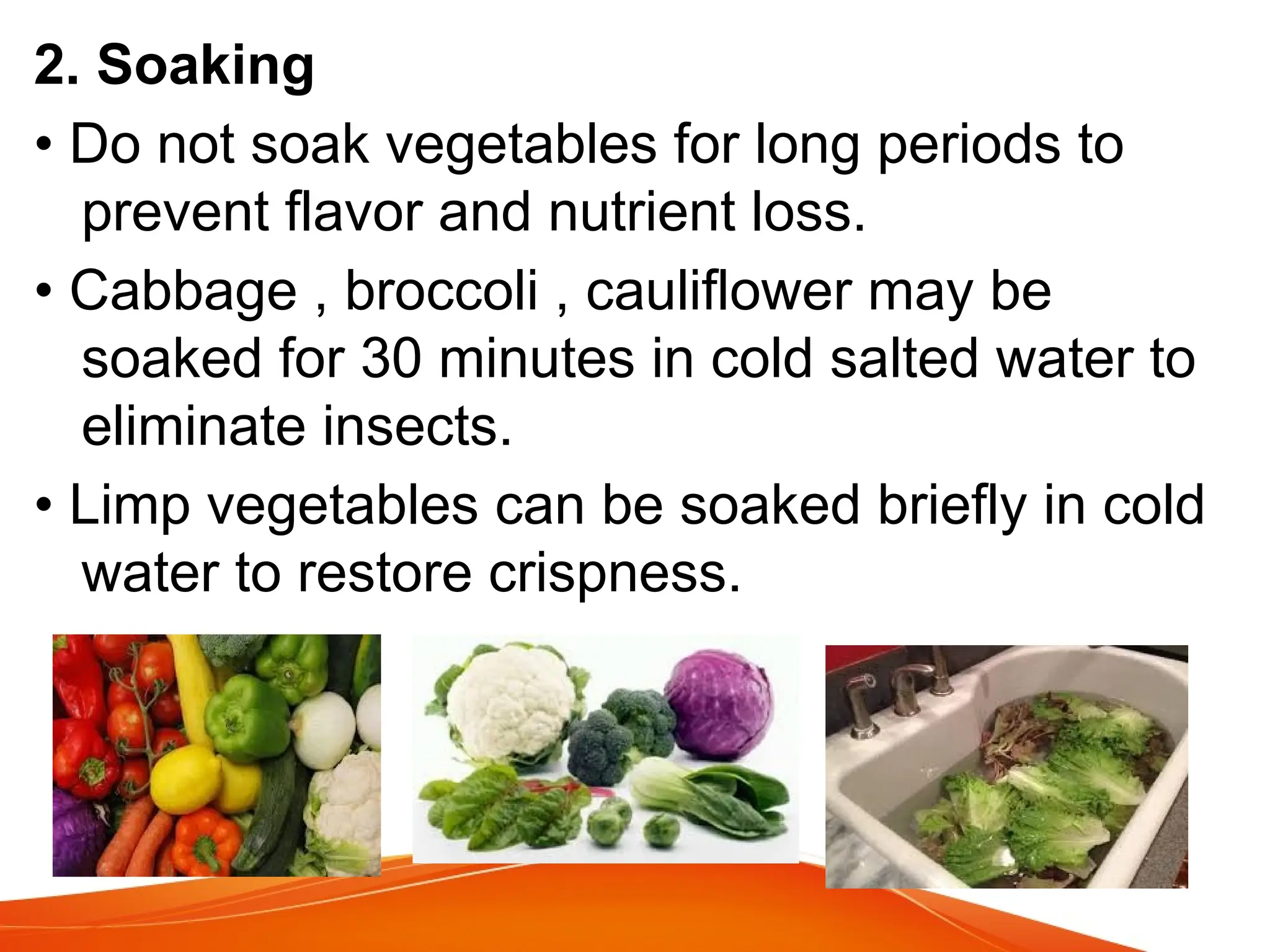
2. Soaking
• Do not soak vegetables for long periods to
prevent flavor and nutrient loss.
• Cabbage , broccoli , cauliflower may be
soaked for 30 minutes in cold salted water to
eliminate insects.
• Limp vegetables can be soaked briefly in cold
water to restore crispness.
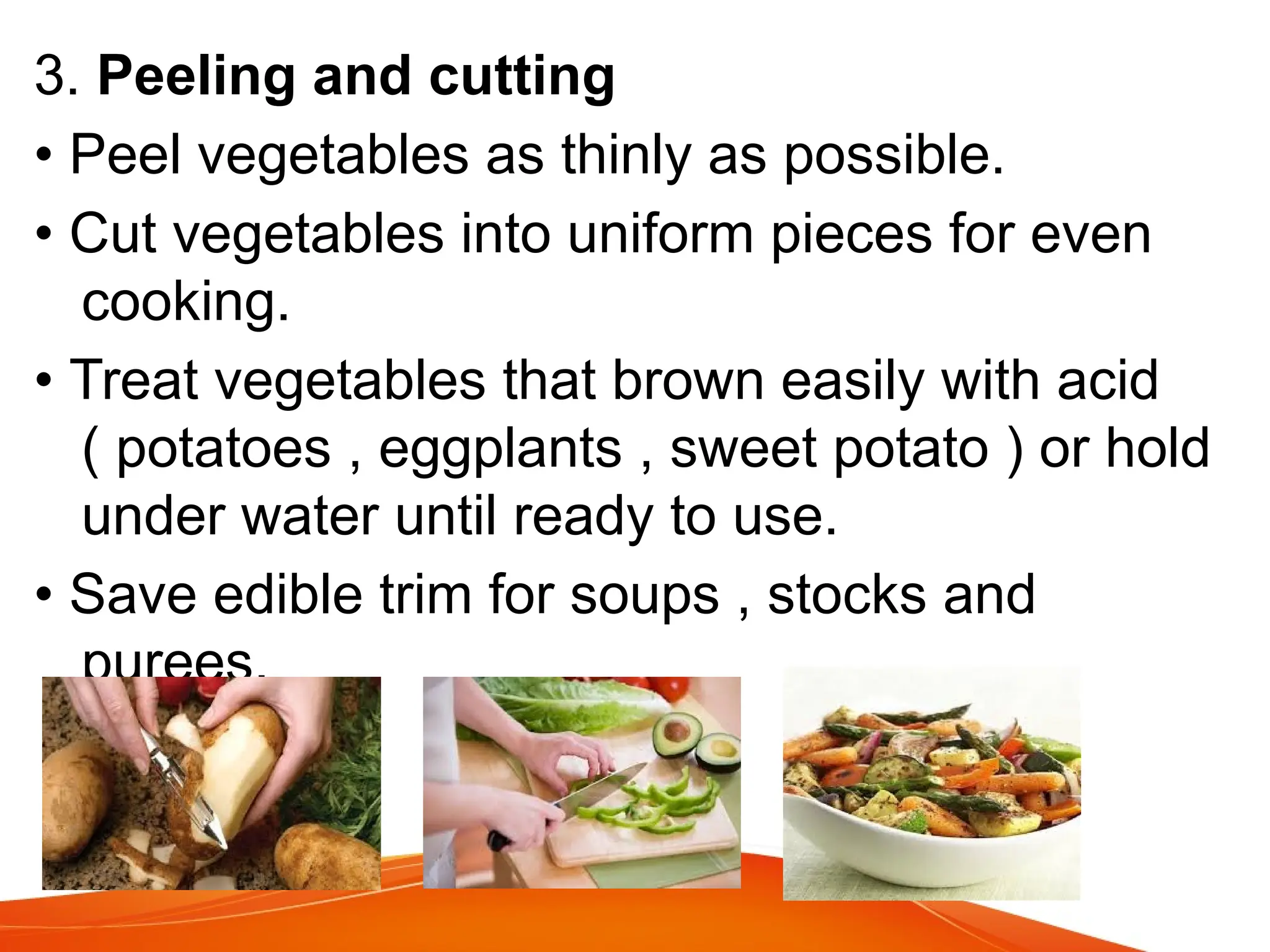
3. Peeling and cutting
• Peel vegetables as thinly as possible.
• Cut vegetables into uniform pieces for even
cooking.
• Treat vegetables that brown easily with acid
( potatoes , eggplants , sweet potato ) or hold
under water until ready to use.
• Save edible trim for soups , stocks and
purees.
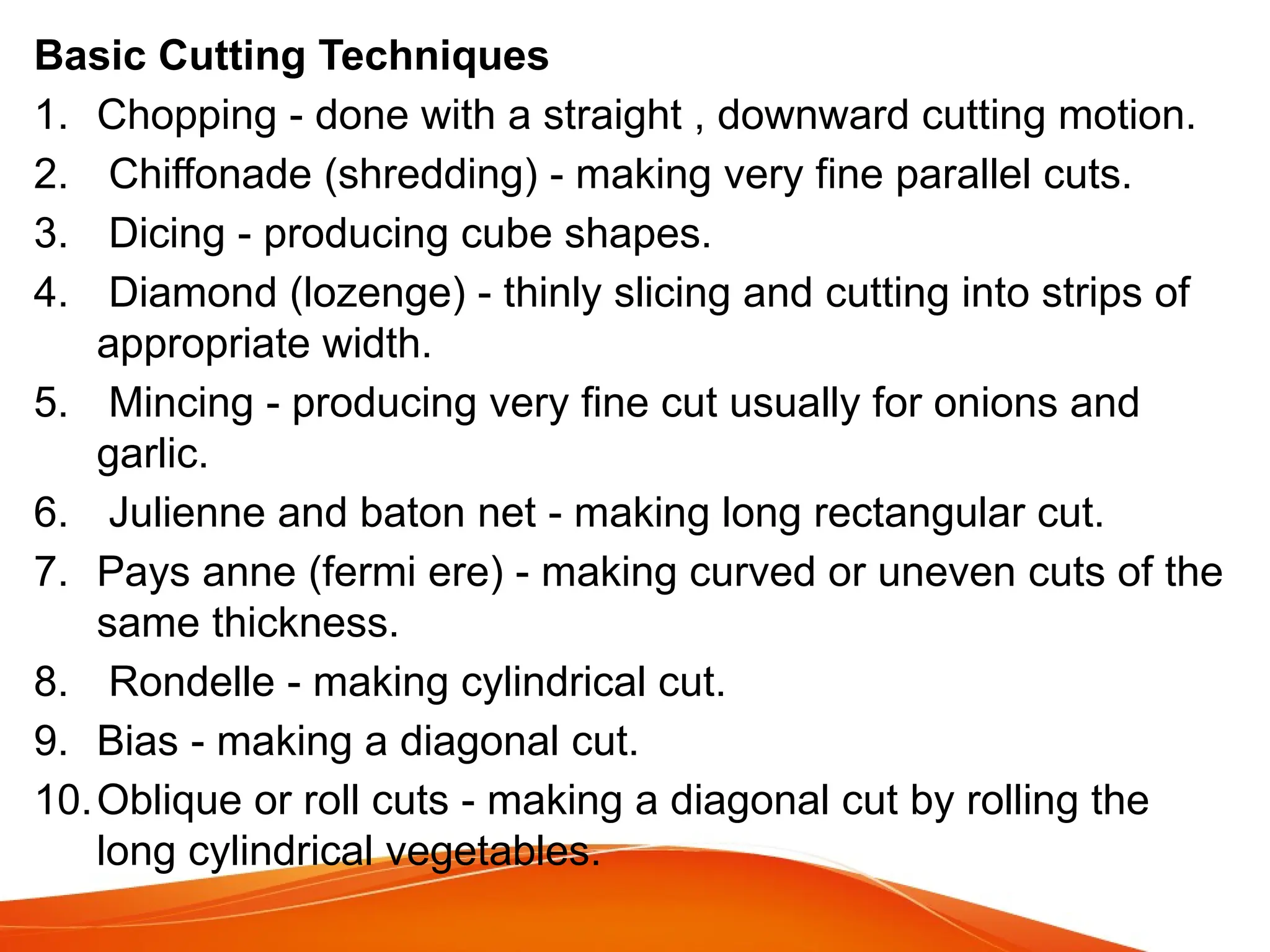
Basic Cutting Techniques
1. Chopping - done with a straight , downward cutting motion.
2. Chiffonade (shredding) - making very fine parallel cuts.
3. Dicing - producing cube shapes.
4. Diamond (lozenge) - thinly slicing and cutting into strips of
appropriate width.
5. Mincing - producing very fine cut usually for onions and
garlic.
6. Julienne and baton net - making long rectangular cut.
7. Pays anne (fermi ere) - making curved or uneven cuts of the
same thickness.
8. Rondelle - making cylindrical cut.
9. Bias - making a diagonal cut.
10.Oblique or roll cuts - making a diagonal cut by rolling the
long cylindrical vegetables.
Apply safe and accurate cutting techniques in
preparing vegetables according to enterprise
standards.
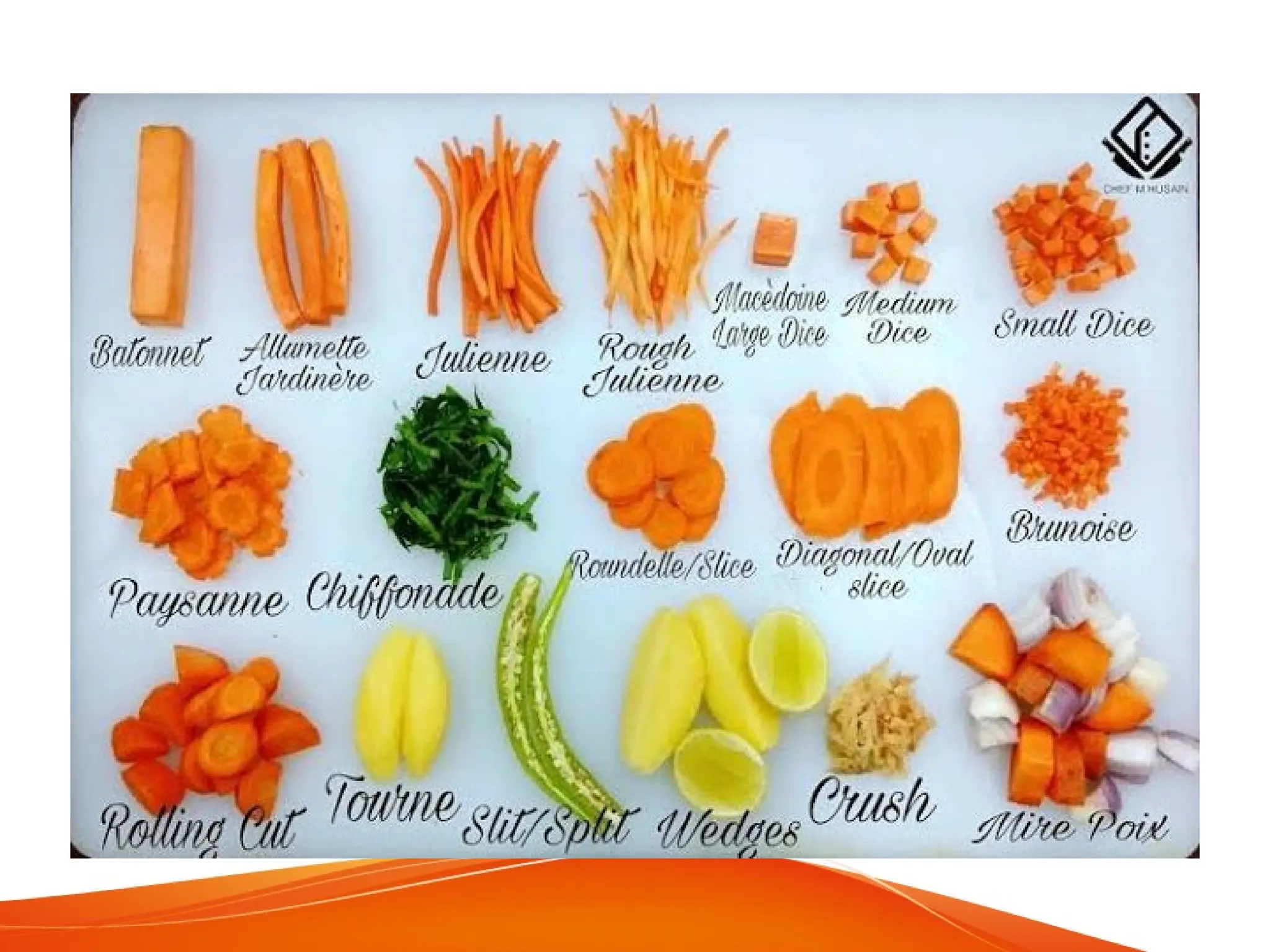
A. Trimming Artichoke
Bottoms 1. Start by filling a bowl
with cold water and lemon
into it. ( you could also use
a dash of vinegar ) this will
slow the browning on the
surface of the artichoke
when it is cut and exposed
to
air.
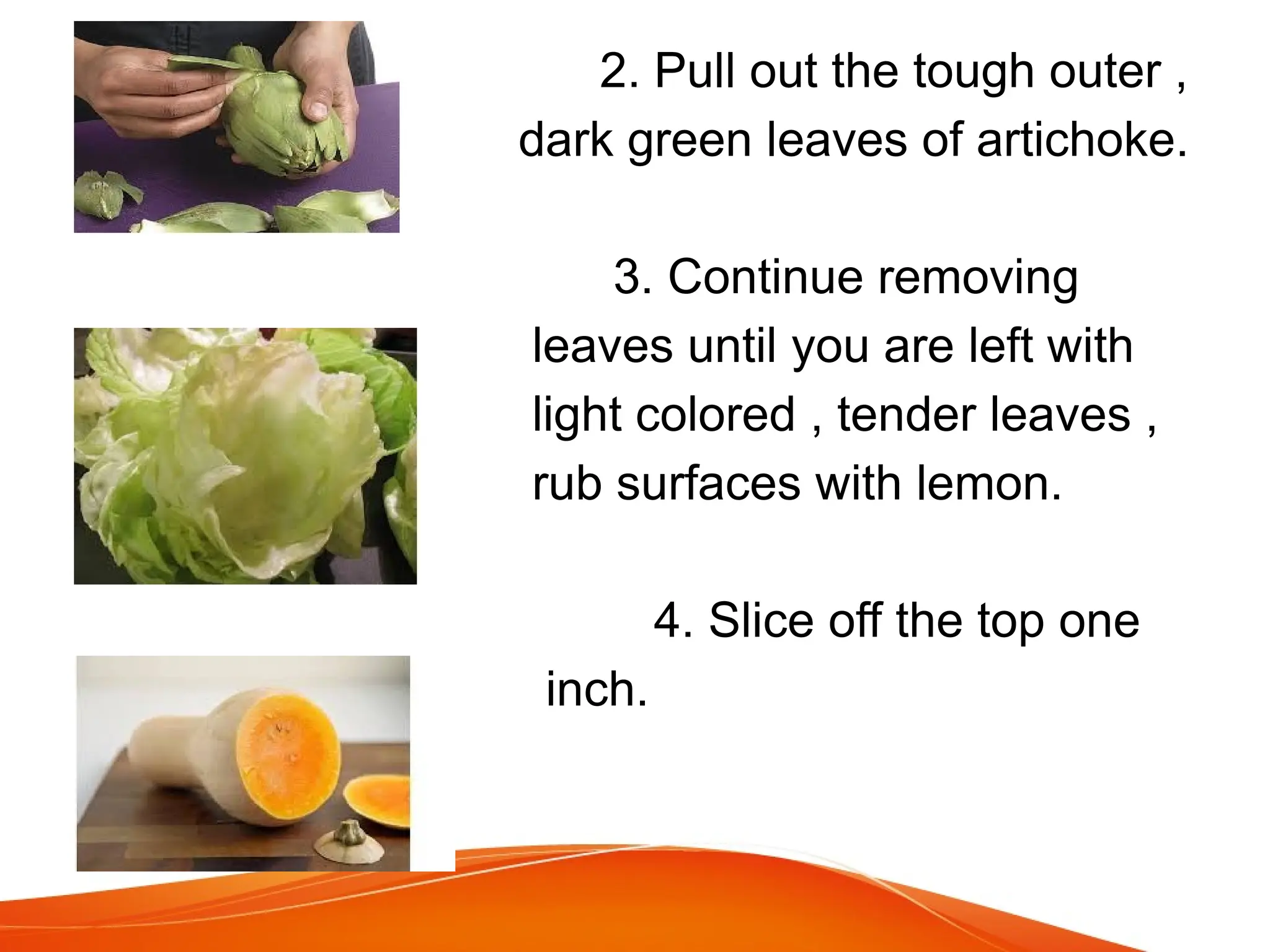
2. Pull out the tough outer ,
dark green leaves of artichoke.
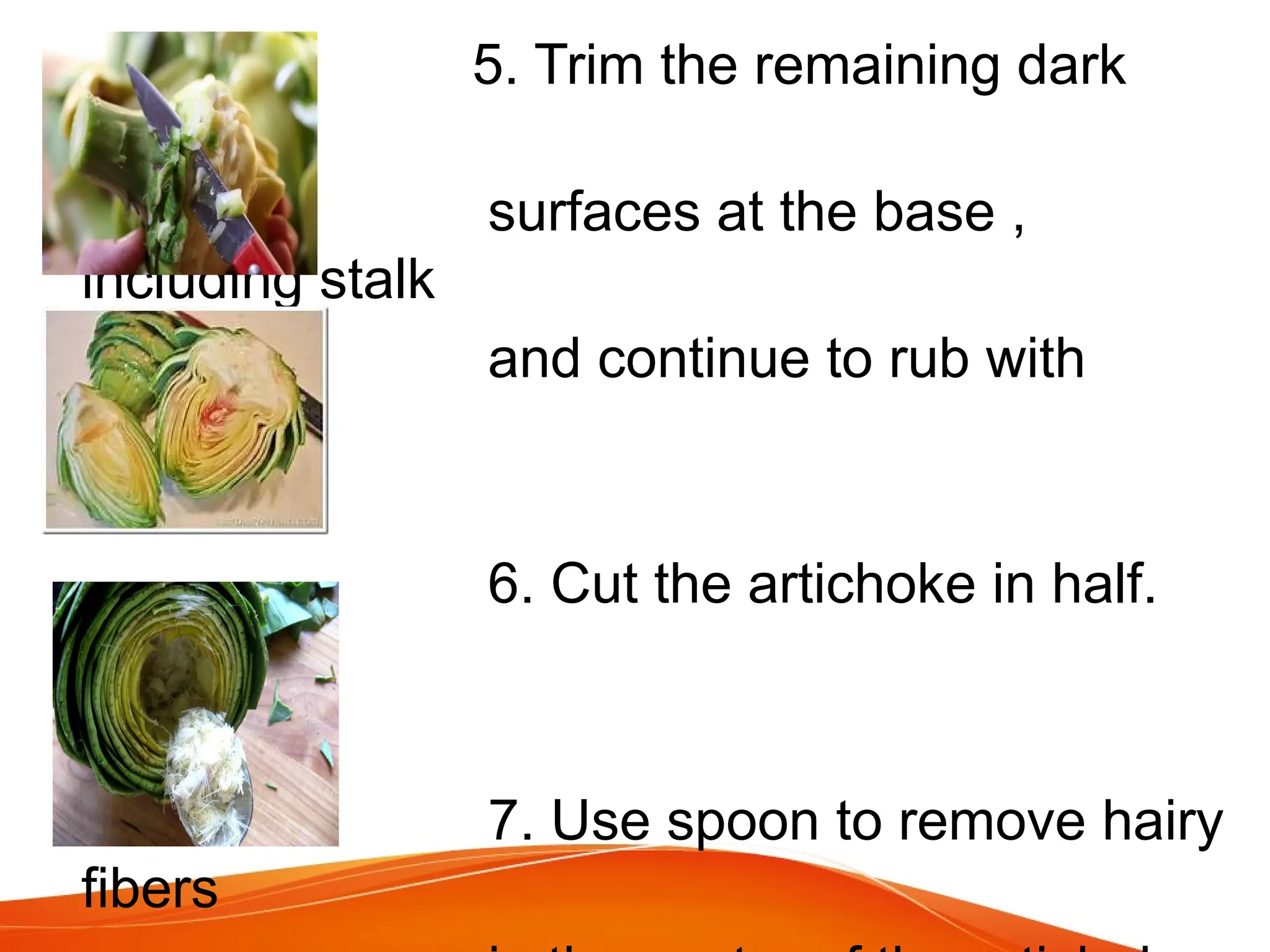
3. Continue removing
leaves until you are left with
light colored , tender leaves ,
rub surfaces with lemon.
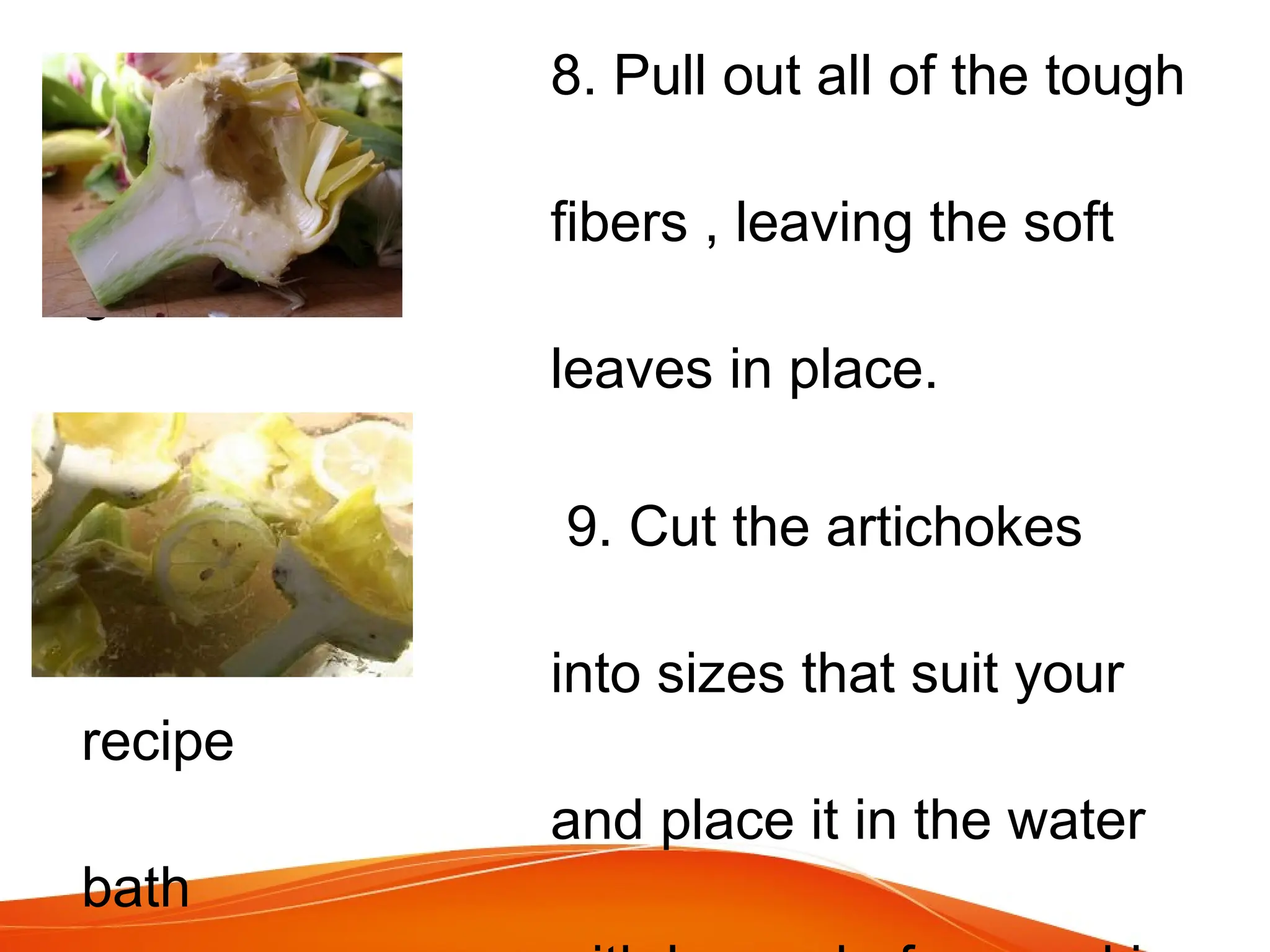
4. Slice off the top one
inch.
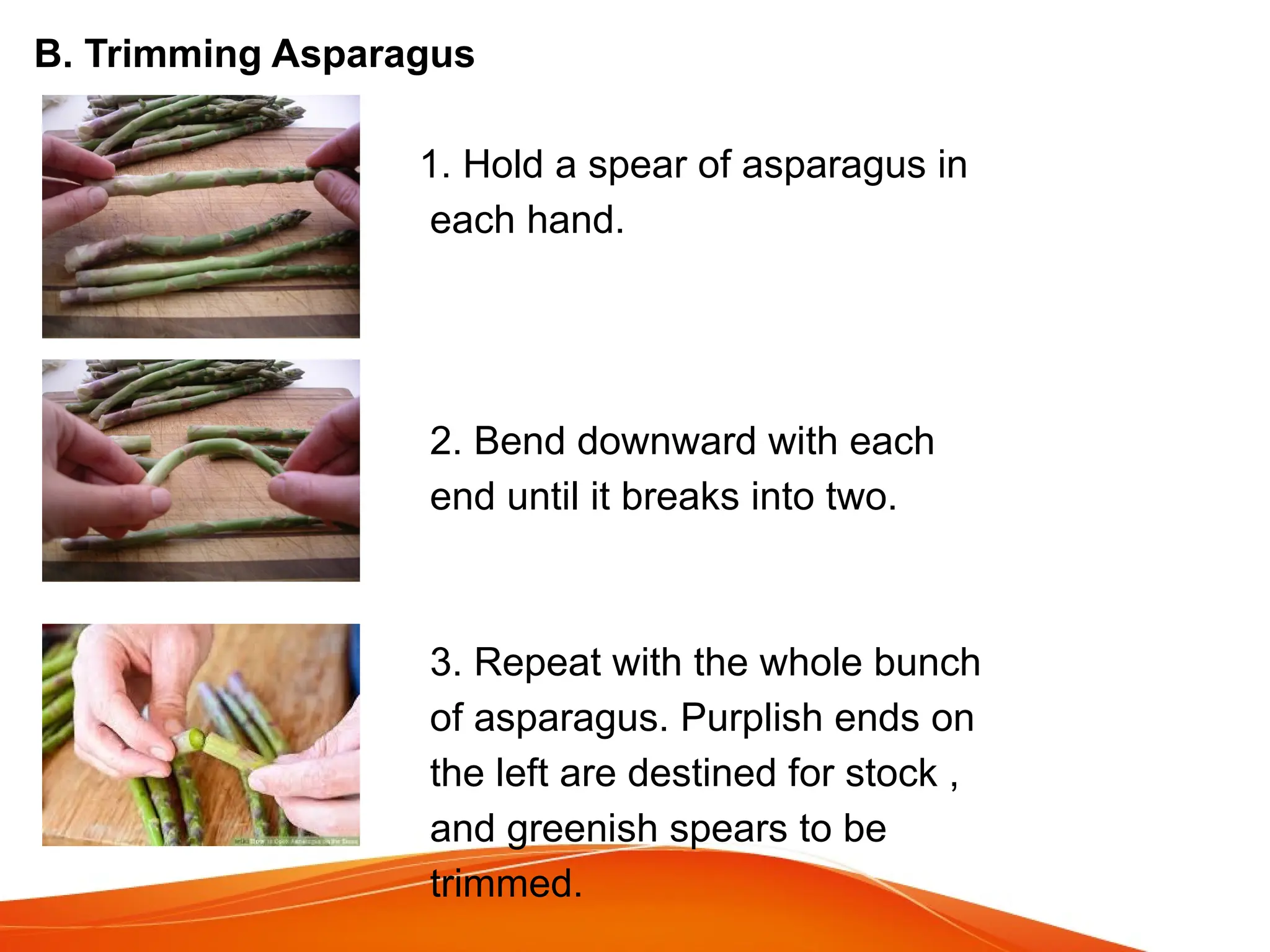
5. Trim the remaining dark
green
surfaces at the base ,
including stalk
and continue to rub with
lemon.
6. Cut the artichoke in half.
7. Use spoon to remove hairy
fibers
8. Pull out all of the tough
red
fibers , leaving the soft
green
leaves in place.
9. Cut the artichokes
lengthwise
into sizes that suit your
recipe
and place it in the water
bath
B. Trimming Asparagus
1. Hold a spear of asparagus in
each hand.
2. Bend downward with each
end until it breaks into two.
3. Repeat with the whole bunch
of asparagus. Purplish ends on
the left are destined for stock ,
and greenish spears to be
trimmed.
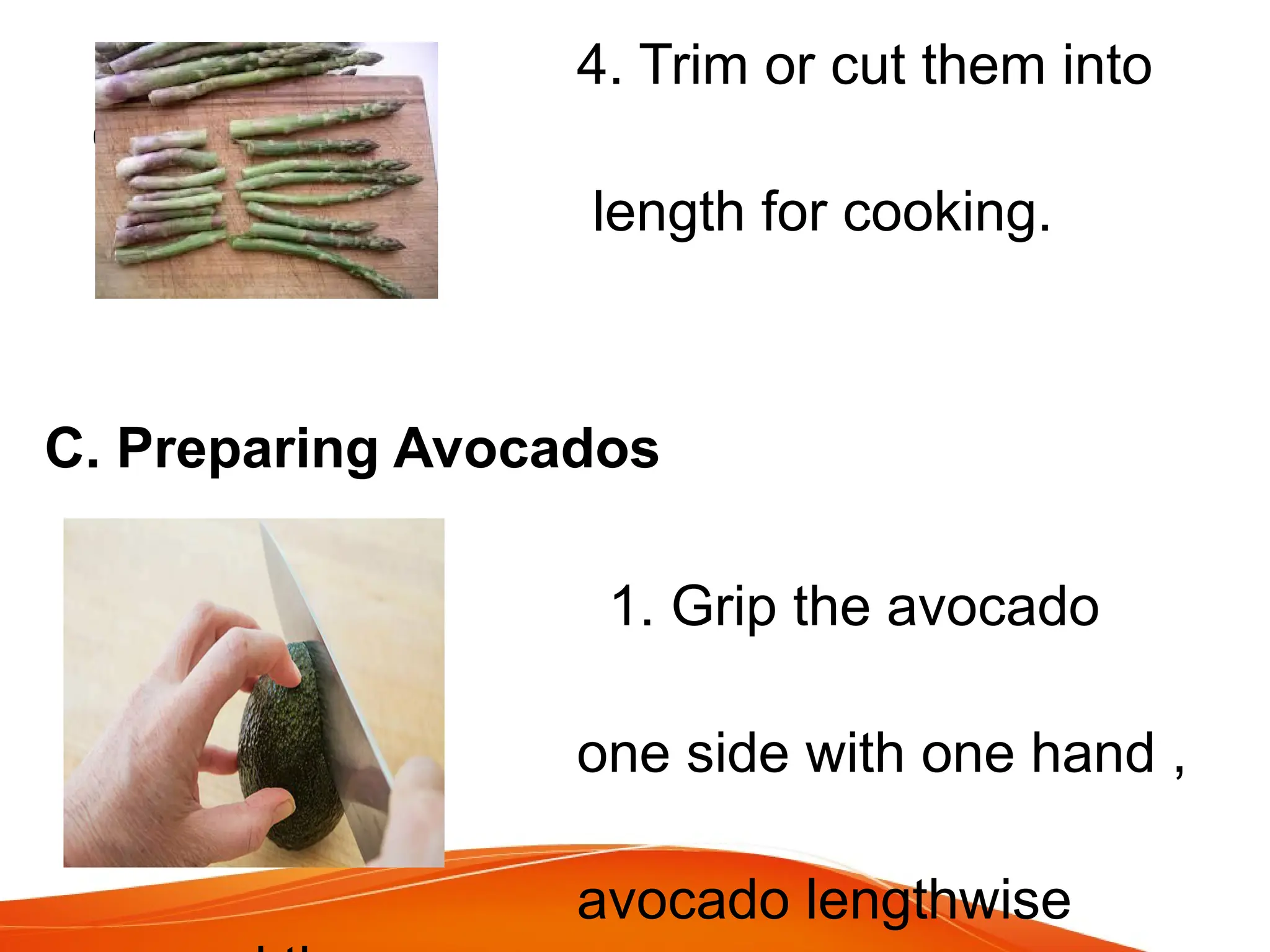
4. Trim or cut them into
one inch
length for cooking.
C. Preparing Avocados
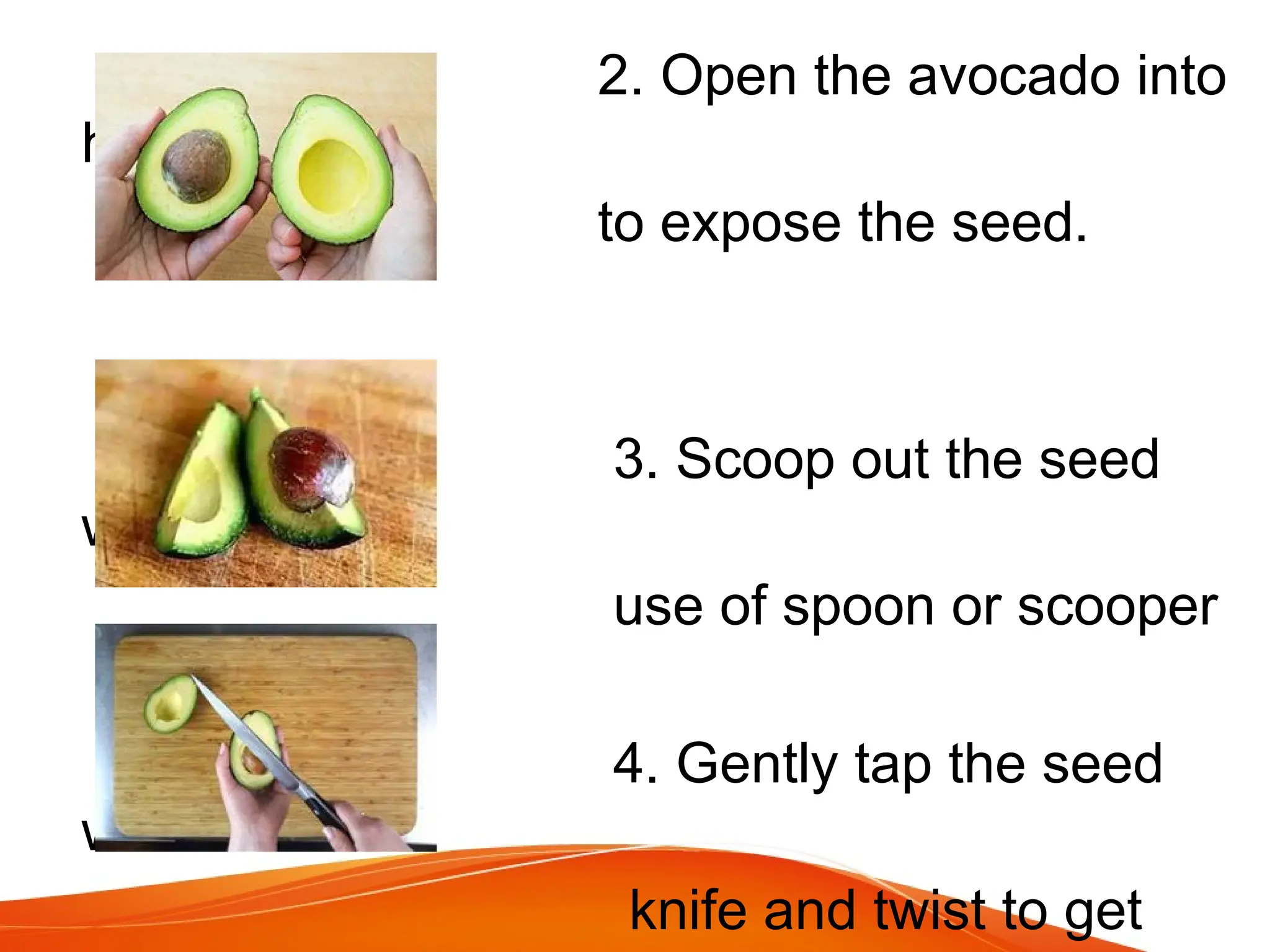
1. Grip the avocado
gently on
one side with one hand ,
cut the
avocado lengthwise
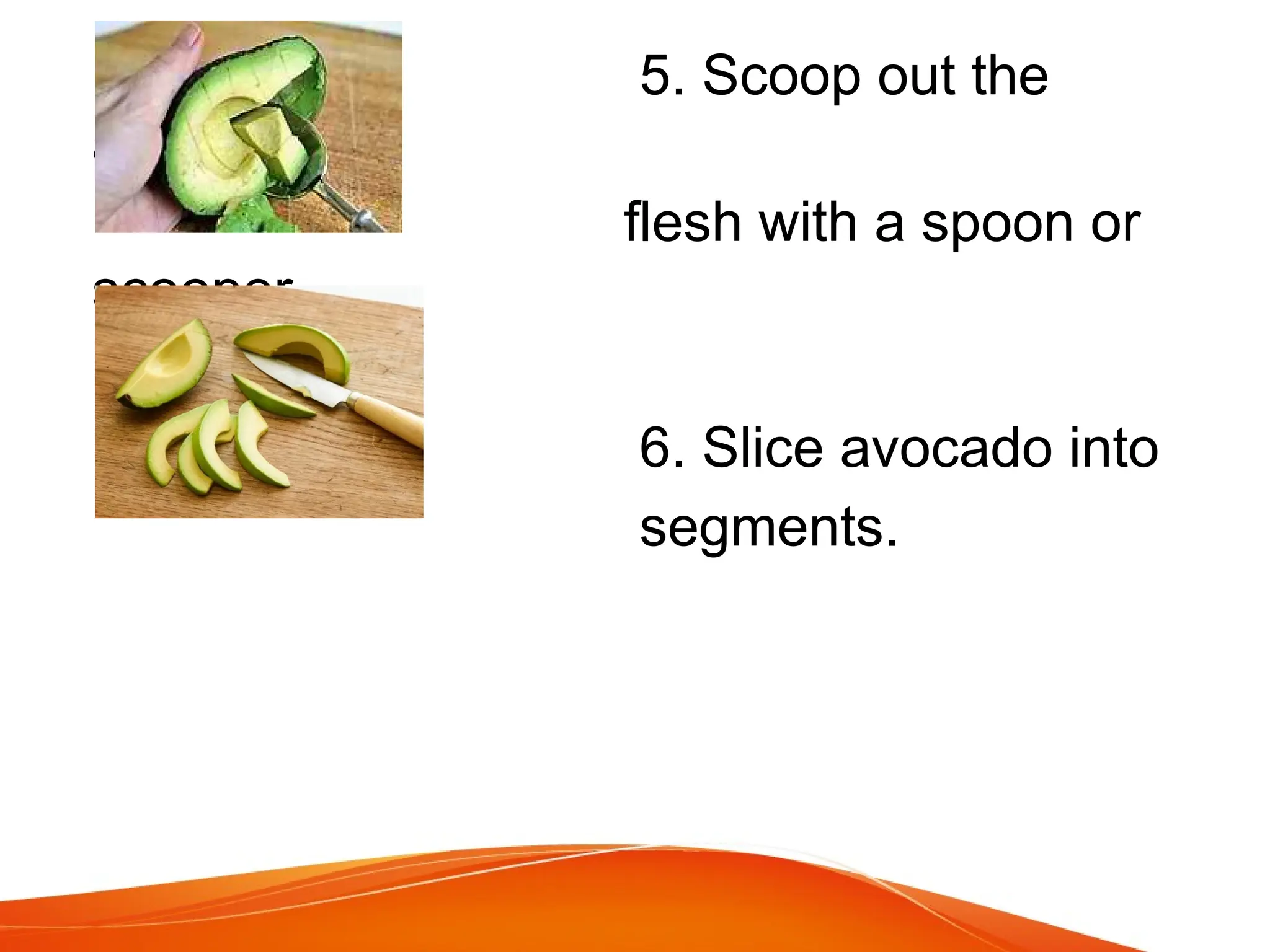
2. Open the avocado into
halves
to expose the seed.
3. Scoop out the seed
with the
use of spoon or scooper
4. Gently tap the seed
with a
knife and twist to get
5. Scoop out the
avocado
flesh with a spoon or
scooper
6. Slice avocado into
segments.
D. Cutting and shredding cabbage
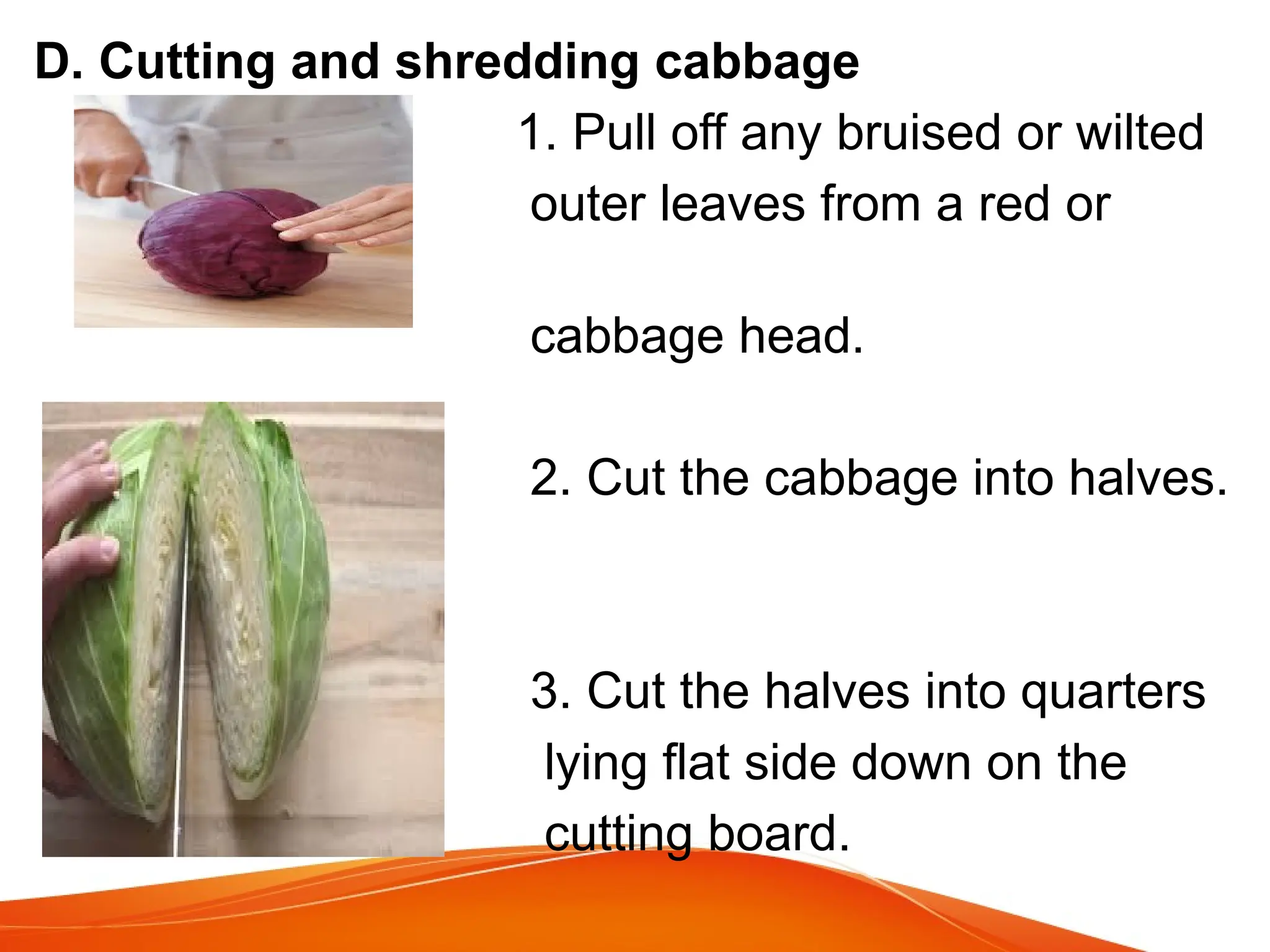
1. Pull off any bruised or wilted
outer leaves from a red or
green
cabbage head.
2. Cut the cabbage into halves.
3. Cut the halves into quarters
lying flat side down on the
cutting board.
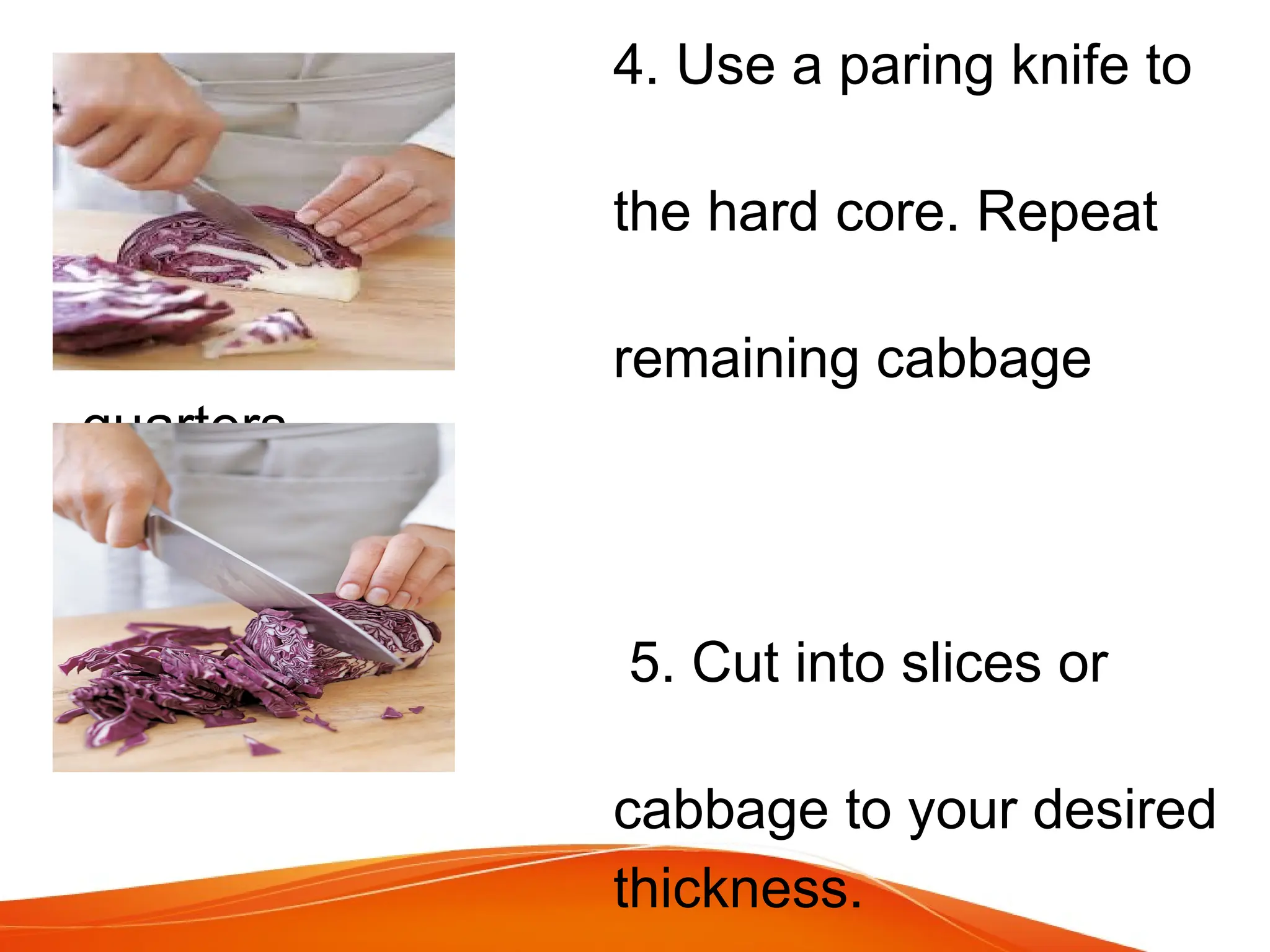
4. Use a paring knife to
remove
the hard core. Repeat
with
remaining cabbage
quarters.
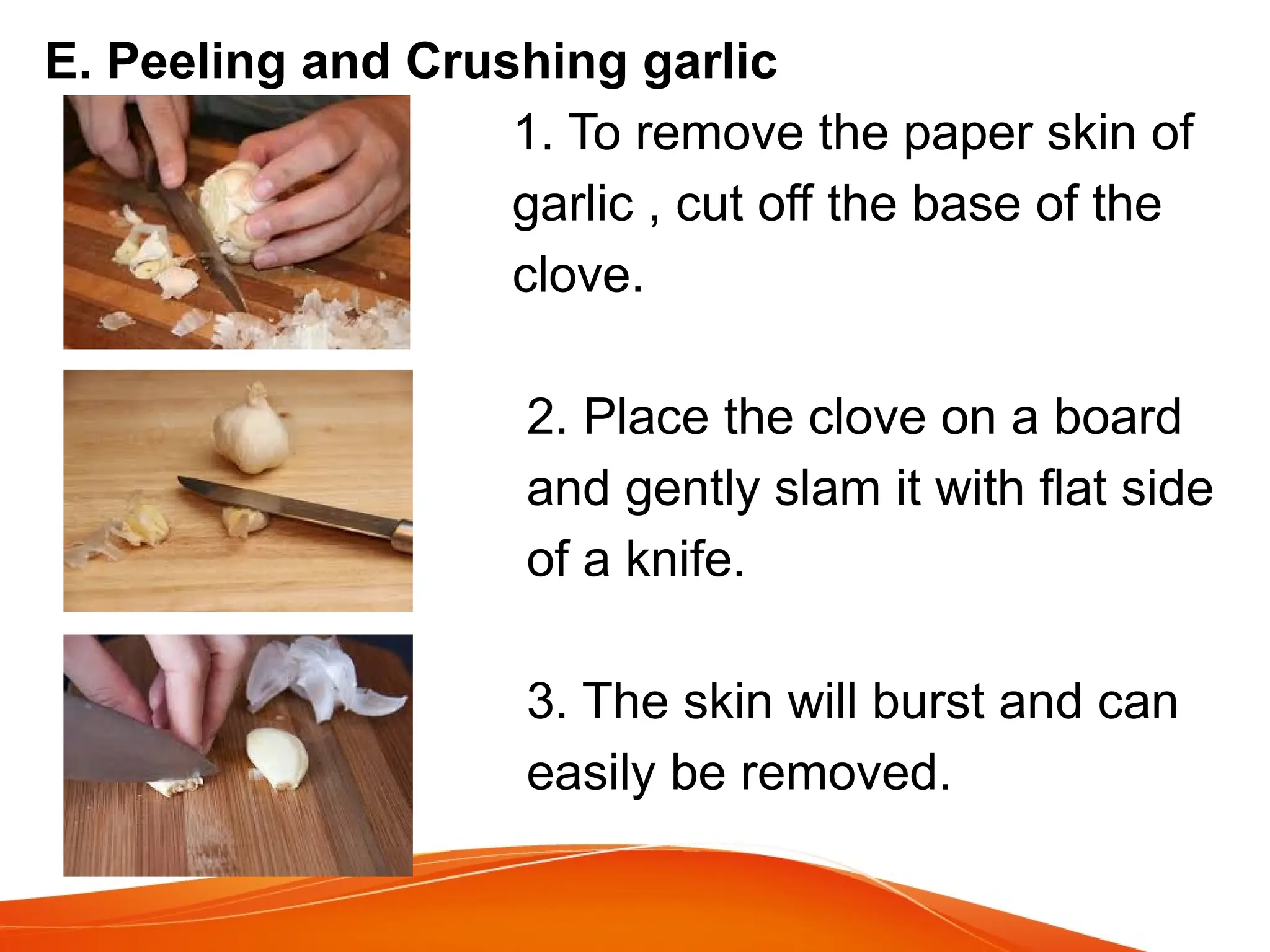
5. Cut into slices or
shread the
cabbage to your desired
thickness.
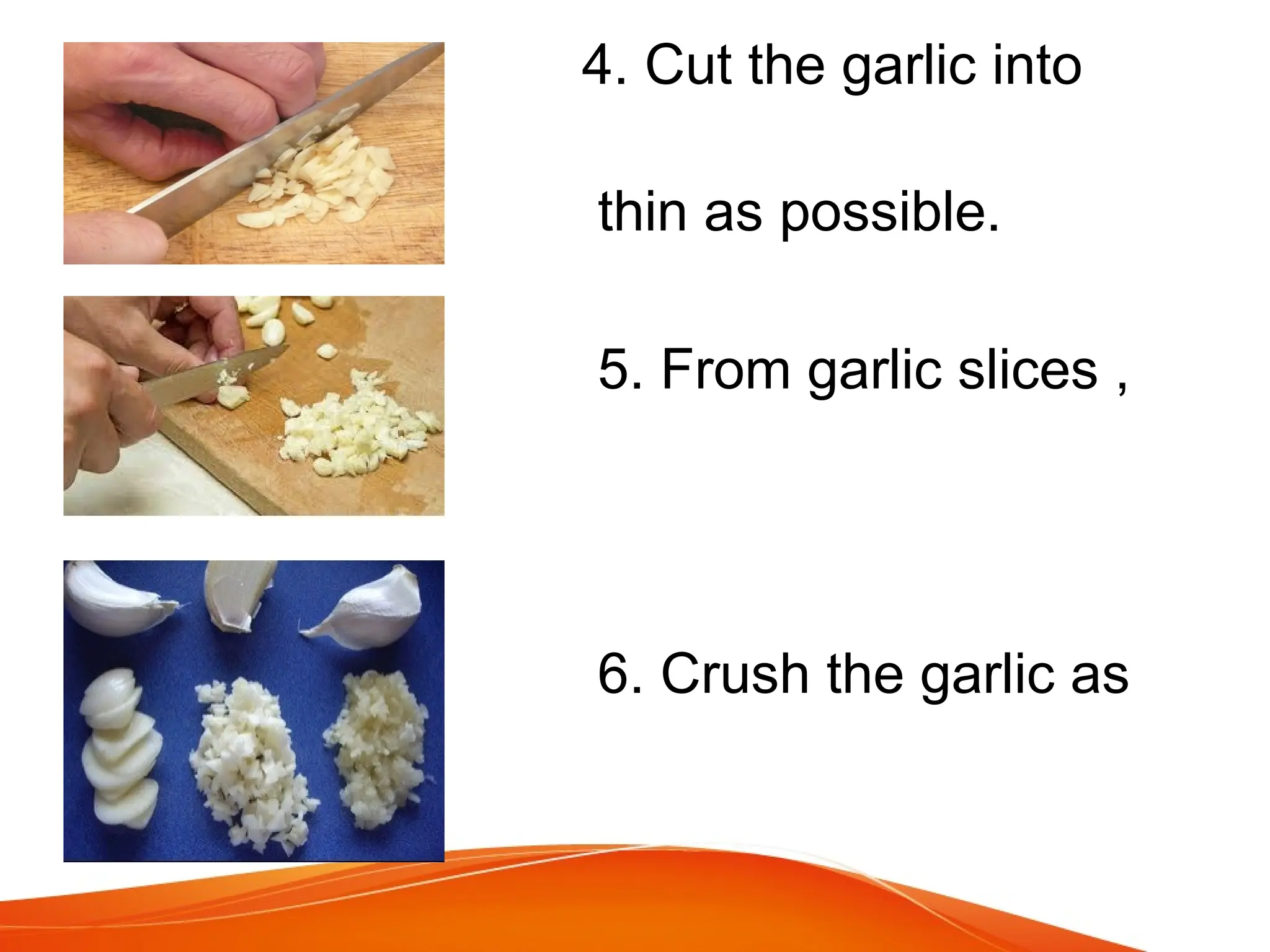
E. Peeling and Crushing garlic
1. To remove the paper skin of
garlic , cut off the base of the
clove.
2. Place the clove on a board
and gently slam it with flat side
of a knife.
3. The skin will burst and can
easily be removed.
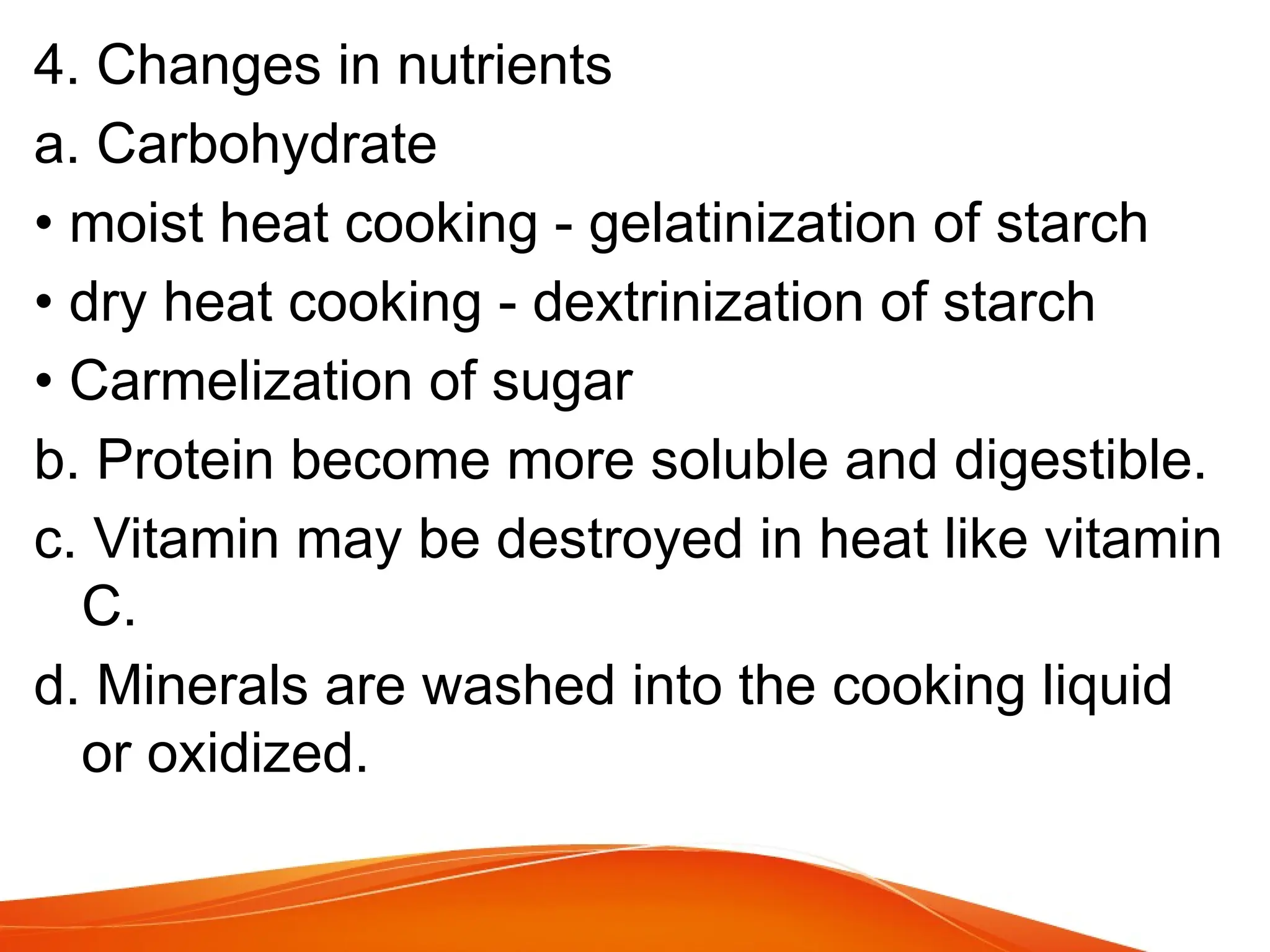
4. Cut the garlic into
slices as
thin as possible.
5. From garlic slices ,
mince it.
6. Crush the garlic as
you want.
F. Cleaning leeks
1. Cut off and discard the
dark
green leaves. Trim and
discard
the roots.
2. Cut the stalk into half
lengthwise.
3. Slice them crosswise.
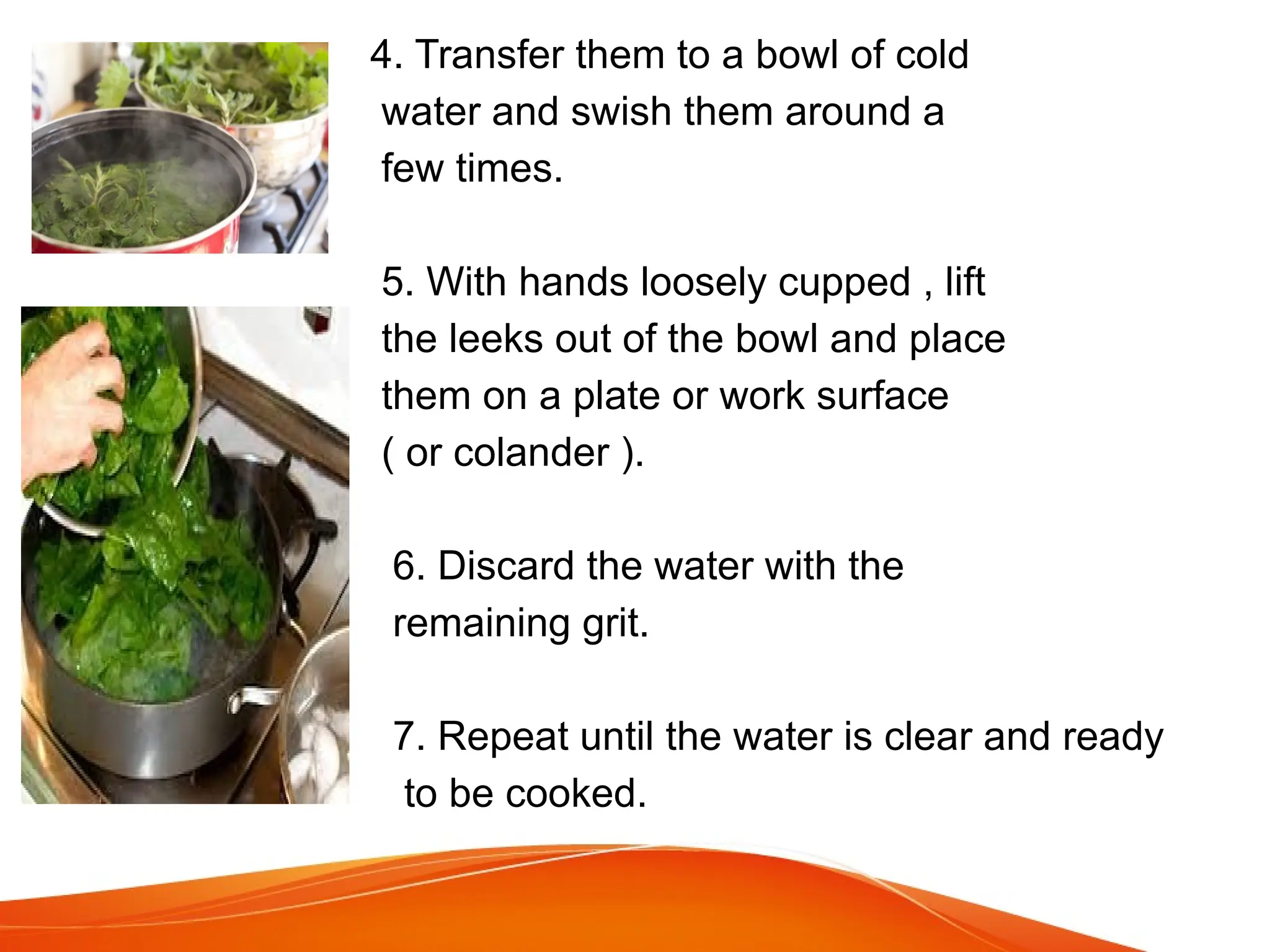
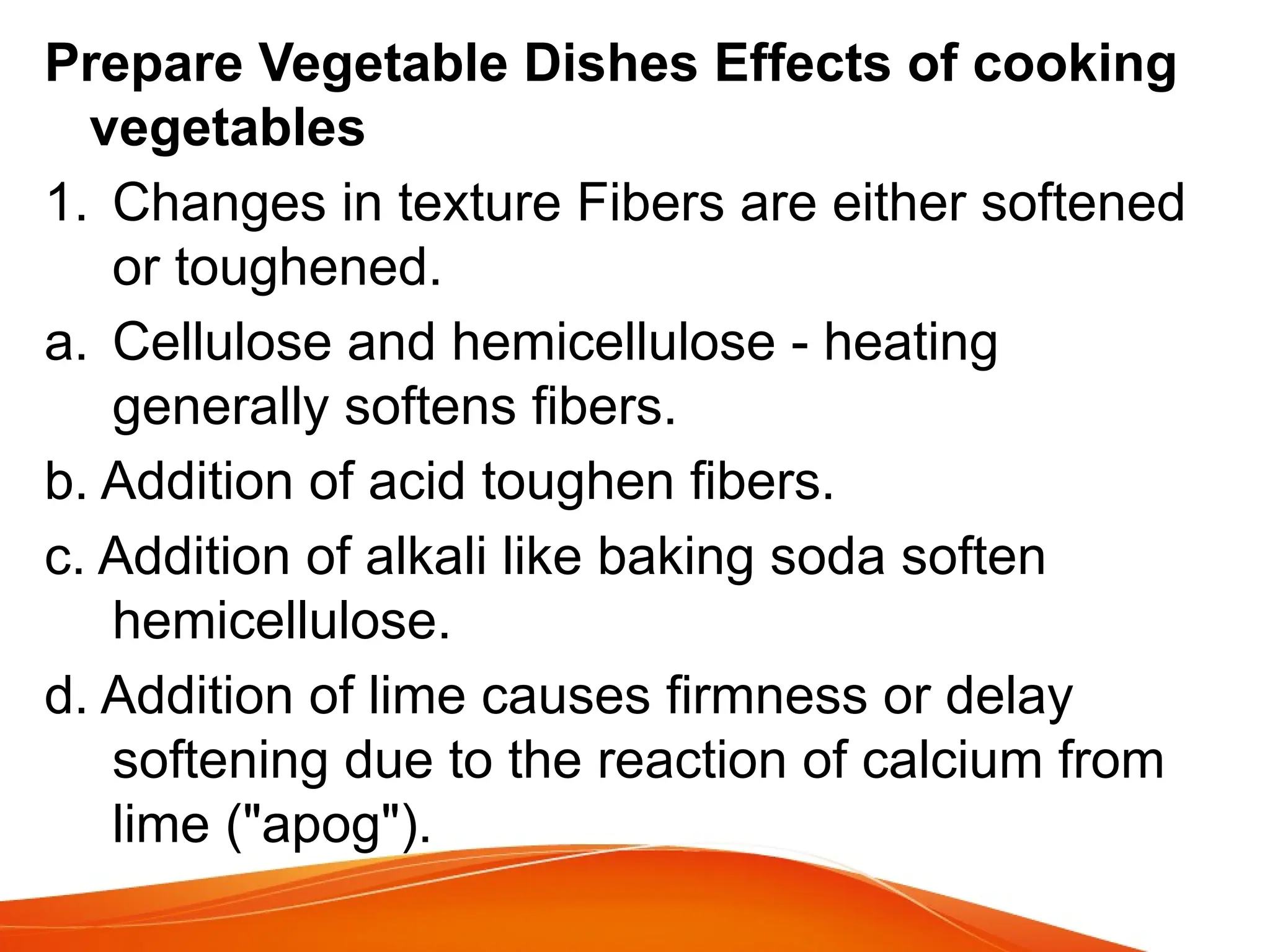
4. Transfer them to a bowl of cold
water and swish them around a
few times.
5. With hands loosely cupped , lift
the leeks out of the bowl and place
them on a plate or work surface
( or colander ).
6. Discard the water with the
remaining grit.
7. Repeat until the water is clear and ready
to be cooked.
Prepare Vegetable Dishes Effects of cooking
vegetables
1. Changes in texture Fibers are either softened
or toughened.
a. Cellulose and hemicellulose - heating
generally softens fibers.
b. Addition of acid toughen fibers.
c. Addition of alkali like baking soda soften
hemicellulose.
d. Addition of lime causes firmness or delay
softening due to the reaction of calcium from
lime ("apog").
2. Water is either lost or absorbed.
a. Vegetables contain high amount of water ,
leafy and succulent vegetables lose water
and become limp.
b. Vegetables with significant amount of starch
(dried beans , root crops , tubers ) absorb
water because of the hygroscopic property
of starch.
3. Changes in color Cooking for a short time ,
helps maintain color.
4. Changes in nutrients
a. Carbohydrate
• moist heat cooking - gelatinization of starch
• dry heat cooking - dextrinization of starch
• Carmelization of sugar
b. Protein become more soluble and digestible.
c. Vitamin may be destroyed in heat like vitamin
C.
d. Minerals are washed into the cooking liquid
or oxidized.
General rules of vegetable cookery
• Don't overcook.
• Prepare vegetables as close to service time as
possible and in small quantities.
• If the vegetable must be cooked ahead ,
undercook slightly and chill rapidly. Reheat at
service them.
• Never use baking soda with green vegetables.
• Cut vegetables uniformly for even cooking.
• Cook green vegetables and strong flavored
vegetables uncovered.
Standard quality of cooked vegetables
1. Color Bright , natural color
2. Appearance on plate Cut neatly and
uniformly Attractively arranged with
appropriate combinations and garnishes.
3. Texture Cooked to the right degree of
doneness Crisp tender , not overcooked
and mushy Potatoes , squash , sweet
potatoes , tomatoes should be cooked
through with smooth texture.
4. Flavor Natural flavor and sweetness Strong
flavored vegetables should be pleasantly
mild , with no off flavors or bitterness.
5. Seasonings should not mask the natural
flavors.
6. Sauces Do not use heavily. Vegetable should
not be greasy.
7. Vegetable combinations Vegetables should
be cooked separately for different cooking
times , and then combined.
Combined acid vegetables like tomatoes ,
to green vegetables just before service to
prevent discoloration of greens.
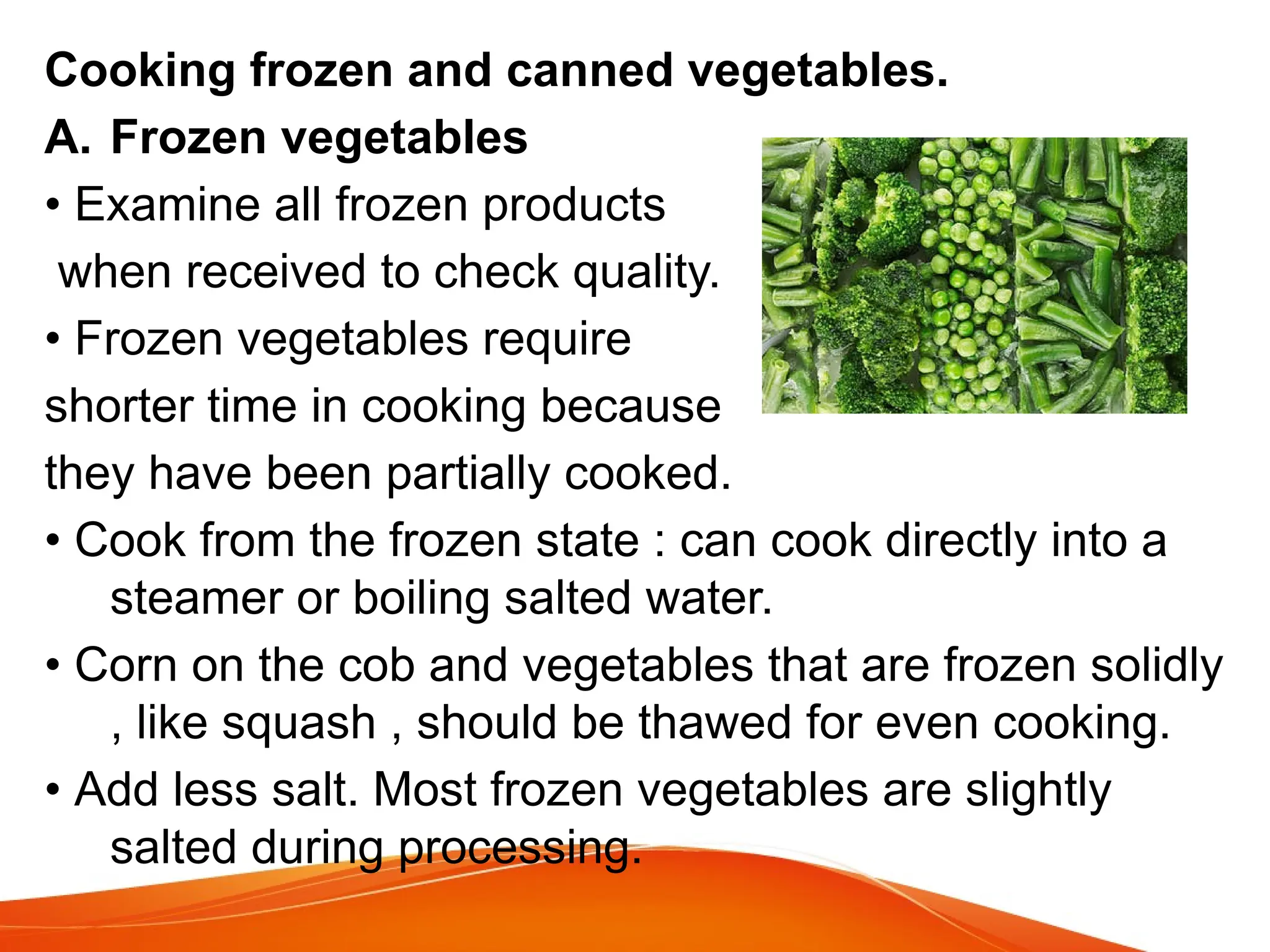
Cooking frozen and canned vegetables.
A. Frozen vegetables
• Examine all frozen products
when received to check quality.
• Frozen vegetables require
shorter time in cooking because
they have been partially cooked.
• Cook from the frozen state : can cook directly into a
steamer or boiling salted water.
• Corn on the cob and vegetables that are frozen solidly
, like squash , should be thawed for even cooking.
• Add less salt. Most frozen vegetables are slightly
salted during processing.
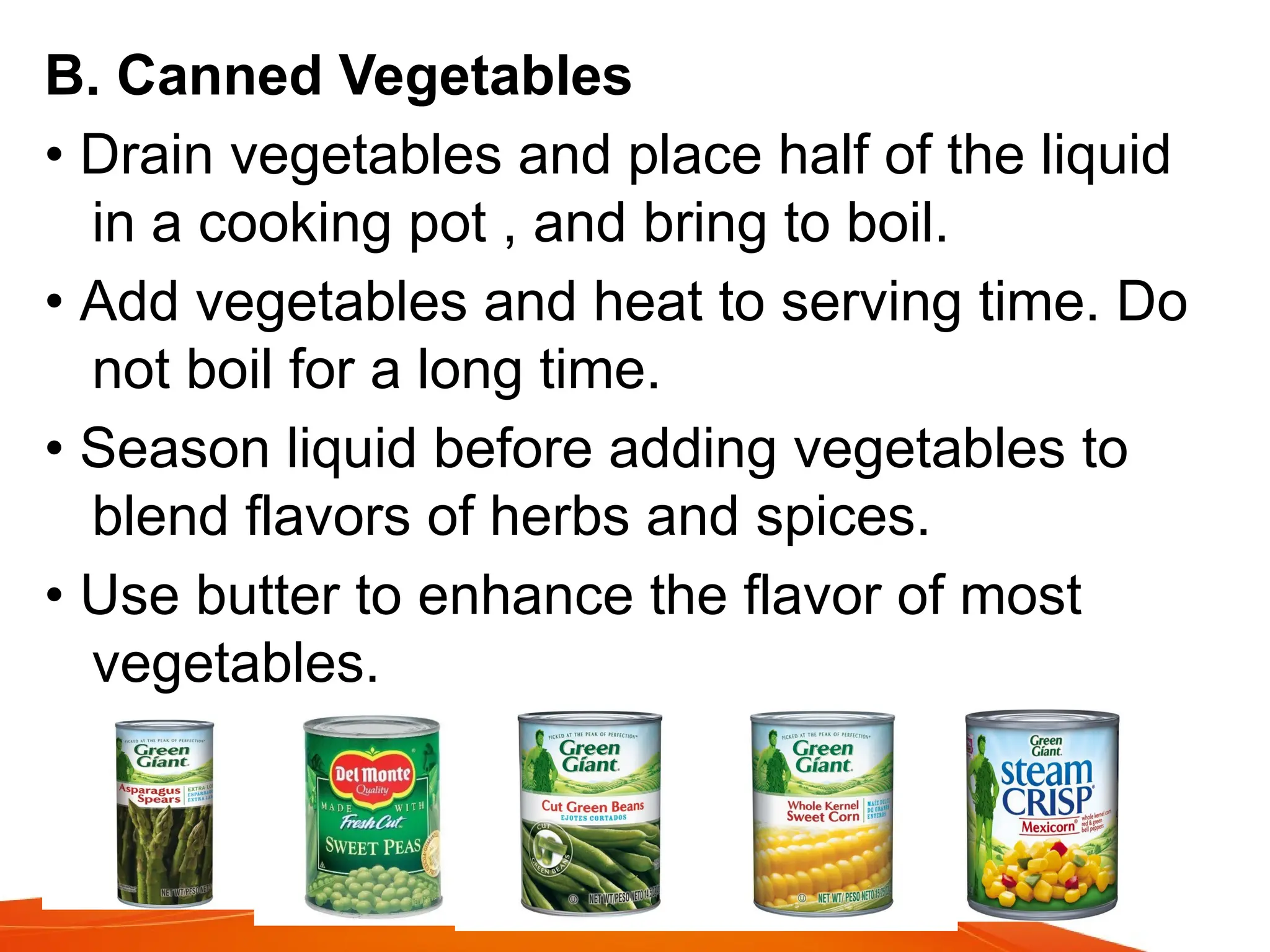
B. Canned Vegetables
• Drain vegetables and place half of the liquid
in a cooking pot , and bring to boil.
• Add vegetables and heat to serving time. Do
not boil for a long time.
• Season liquid before adding vegetables to
blend flavors of herbs and spices.
• Use butter to enhance the flavor of most
vegetables.
Terms used for vegetables
Here are terms used for an assortment of fresh
vegetables including carrots , turnips , peas , pearl
onions , green beans , cauliflower , asparagus and
artichokes that are often used as garnish or
accompaniment to meat dishes.
Bouquetiere - bouquet of vegetables
Printaniere - Spring vegetables
Jardiniere - garden vegetables
Primeurs - first spring vegetables
Clamart - peas
Crecy – carrots
Doria - cucumbers cooked in butter
DuBarry - cauliflower
Fermiere - carrots, turnips, onions, celery
cut
into uniform slices
Florentine - spinach
Florestiere - mushrooms
Judic - braised lettuce
Lyonnaise - onions
Nicoise - tomatoes concase cooked with
garlic Parmentier - potatoes
Princesse - asparagus
Provencale - tomatoes with garlic, parsley
and
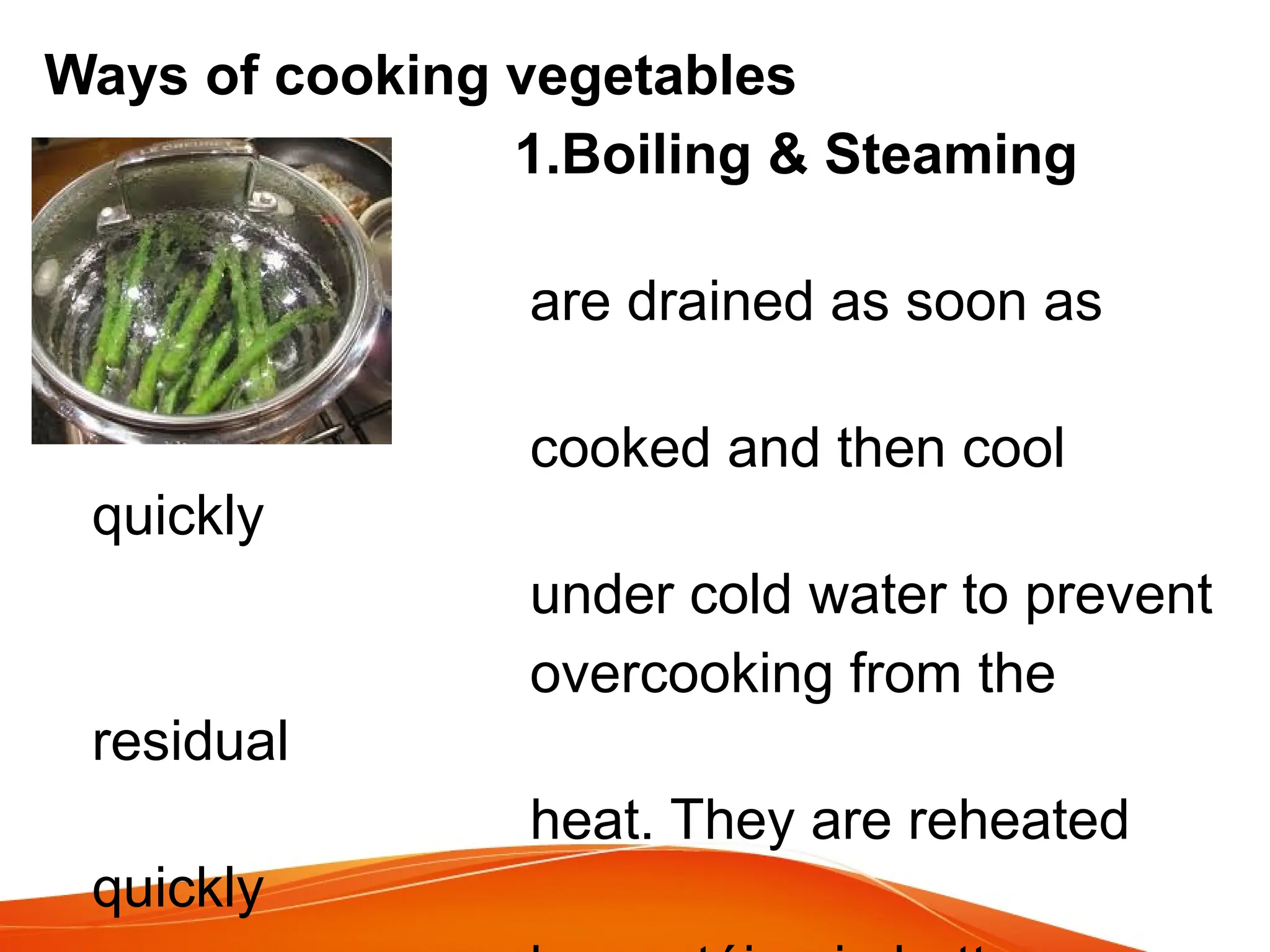
Ways of cooking vegetables
1.Boiling & Steaming
vegetables
are drained as soon as
they are
cooked and then cool
quickly
under cold water to prevent
overcooking from the
residual
heat. They are reheated
quickly
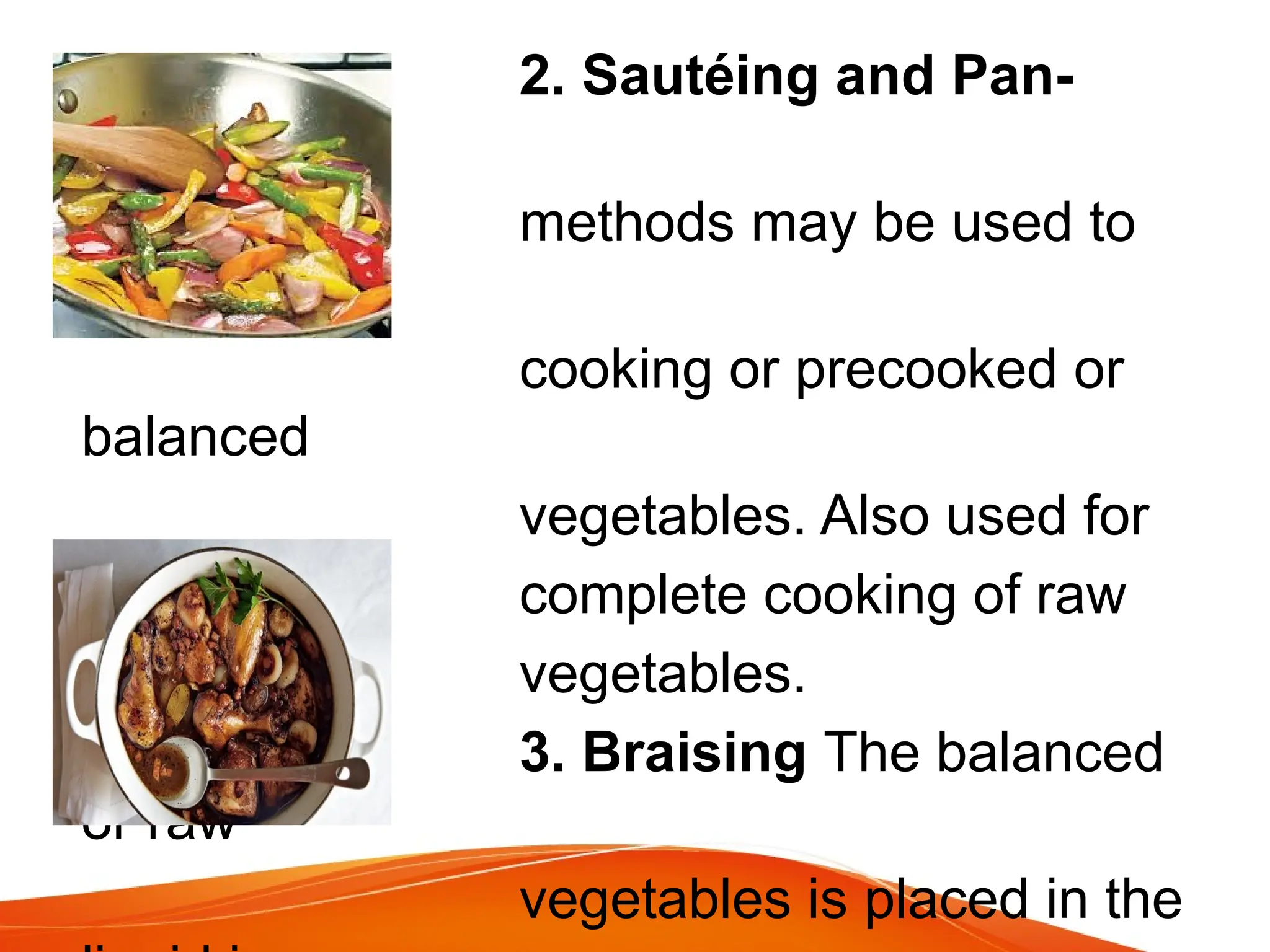
2. Sautéing and Pan-
Frying Both
methods may be used to
complete
cooking or precooked or
balanced
vegetables. Also used for
complete cooking of raw
vegetables.
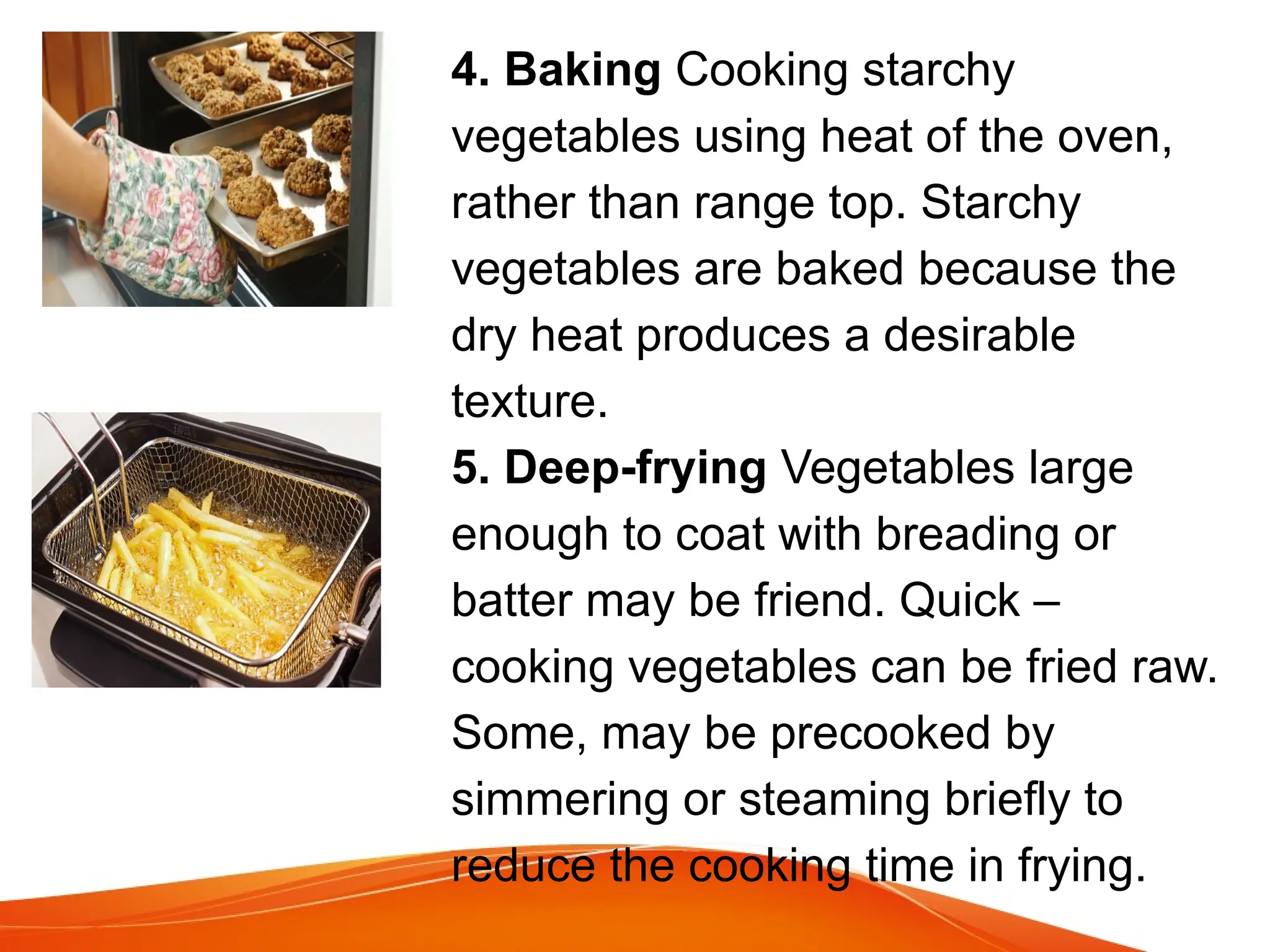
3. Braising The balanced
or raw
vegetables is placed in the
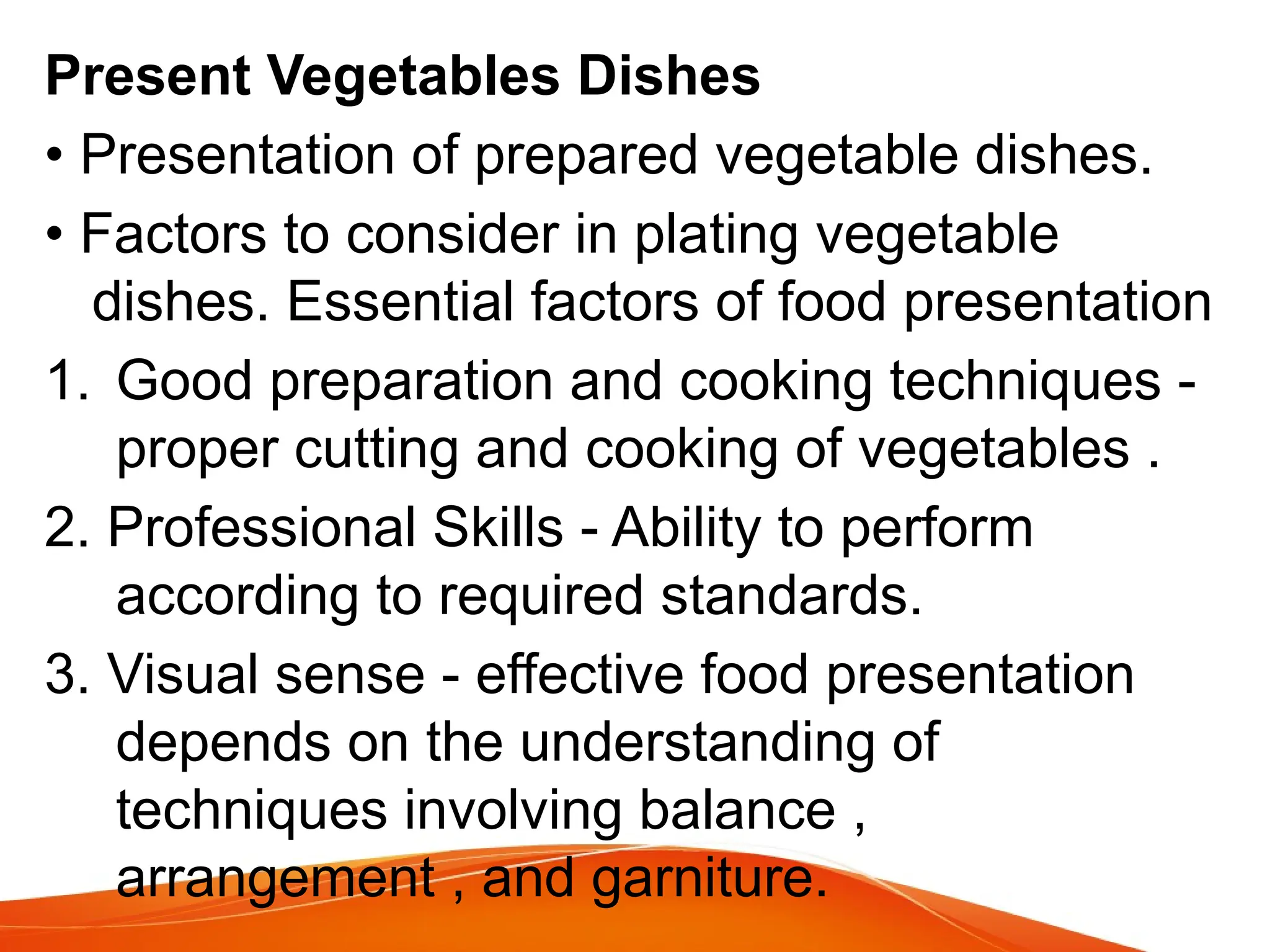
4. Baking Cooking starchy
vegetables using heat of the oven,
rather than range top. Starchy
vegetables are baked because the
dry heat produces a desirable
texture.
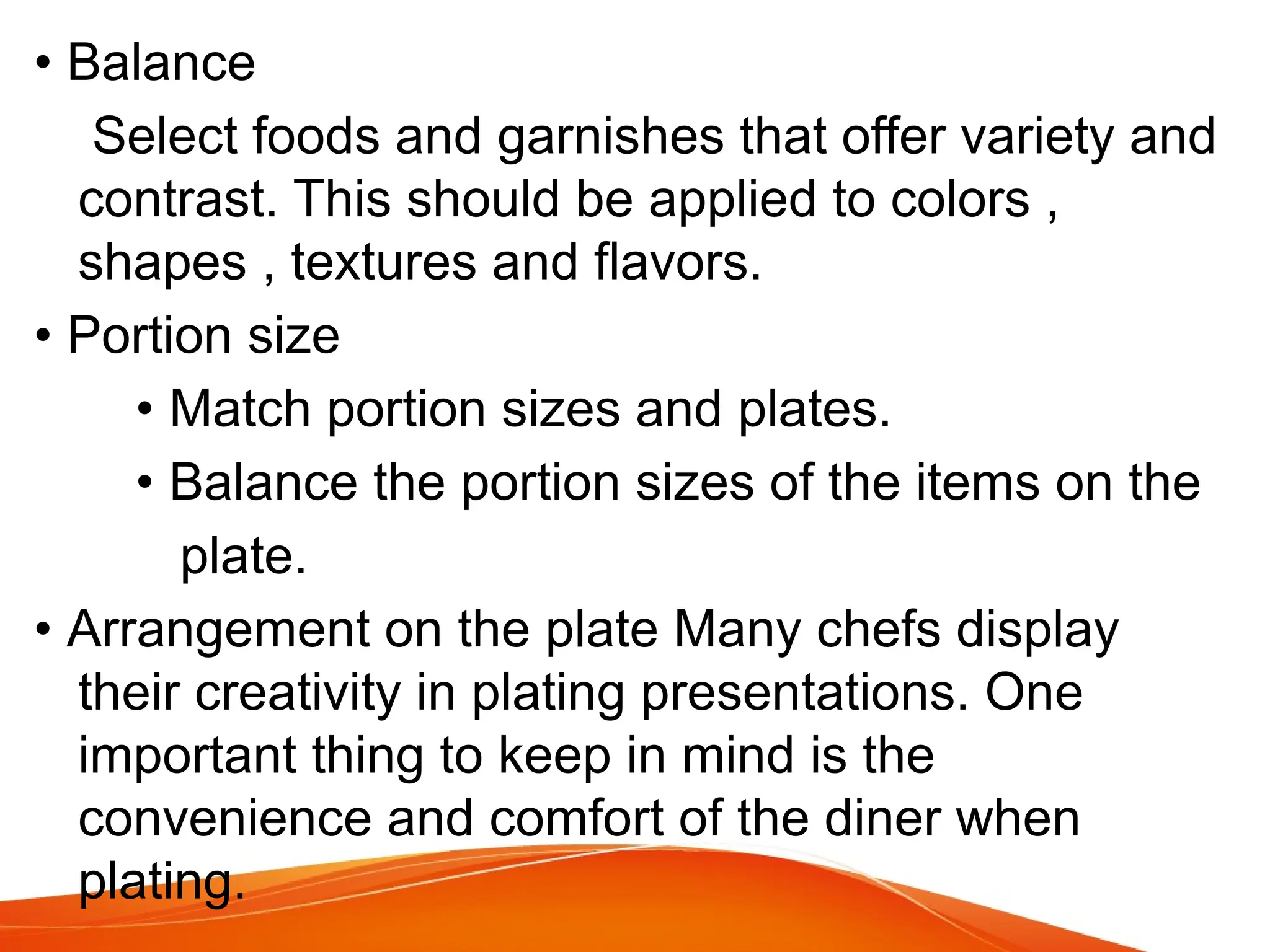
5. Deep-frying Vegetables large
enough to coat with breading or
batter may be friend. Quick –
cooking vegetables can be fried raw.
Some, may be precooked by
simmering or steaming briefly to
reduce the cooking time in frying.
Present Vegetables Dishes
• Presentation of prepared vegetable dishes.
• Factors to consider in plating vegetable
dishes. Essential factors of food presentation
1. Good preparation and cooking techniques -
proper cutting and cooking of vegetables .
2. Professional Skills - Ability to perform
according to required standards.
3. Visual sense - effective food presentation
depends on the understanding of
techniques involving balance ,
arrangement , and garniture.
• Balance
Select foods and garnishes that offer variety and
contrast. This should be applied to colors ,
shapes , textures and flavors.
• Portion size
• Match portion sizes and plates.
• Balance the portion sizes of the items on the
plate.
• Arrangement on the plate Many chefs display
their creativity in plating presentations. One
important thing to keep in mind is the
convenience and comfort of the diner when
plating.
Plating styles with vegetable dishes
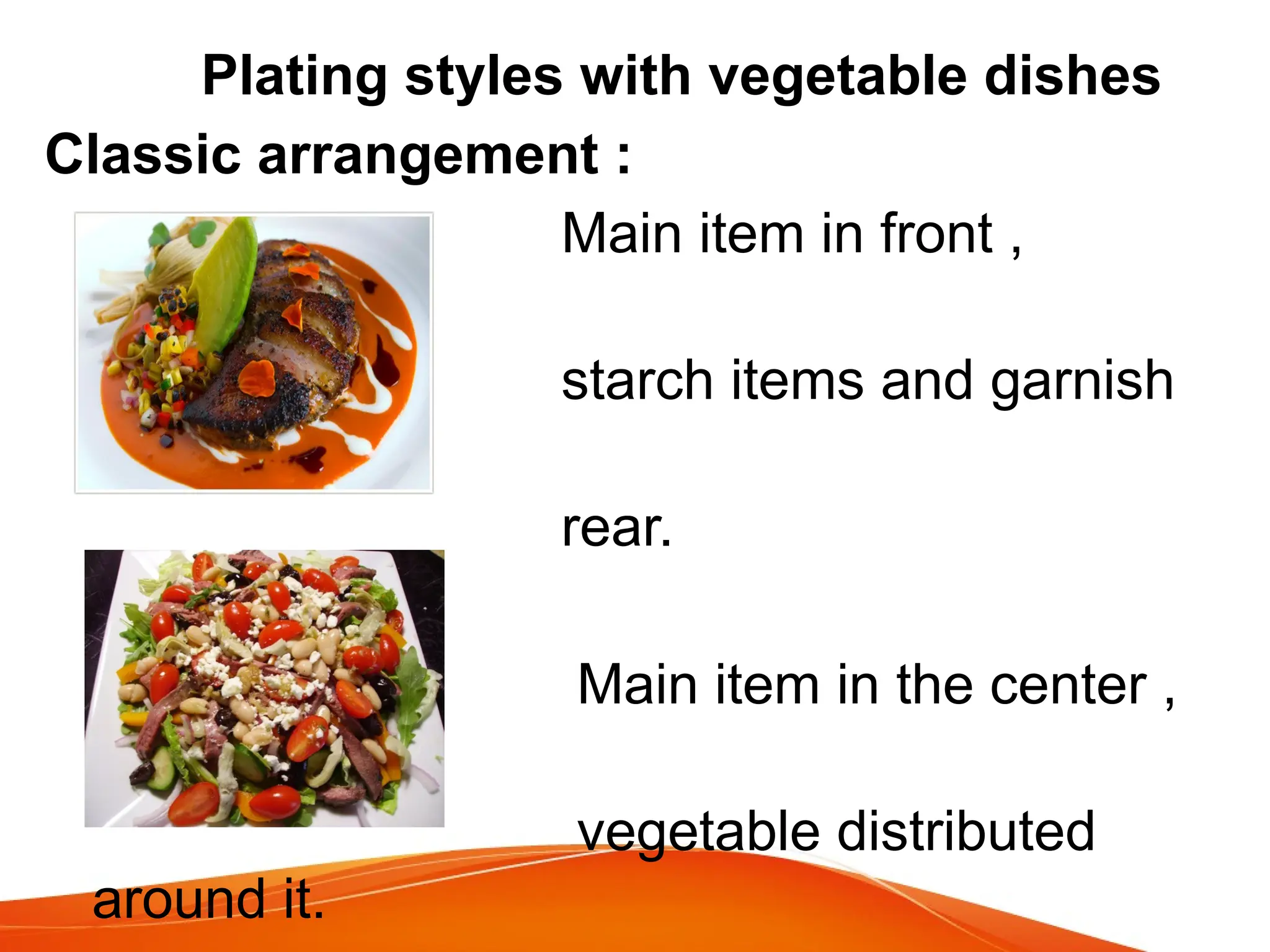
Classic arrangement :
Main item in front ,
vegetables ,
starch items and garnish
at the
rear.
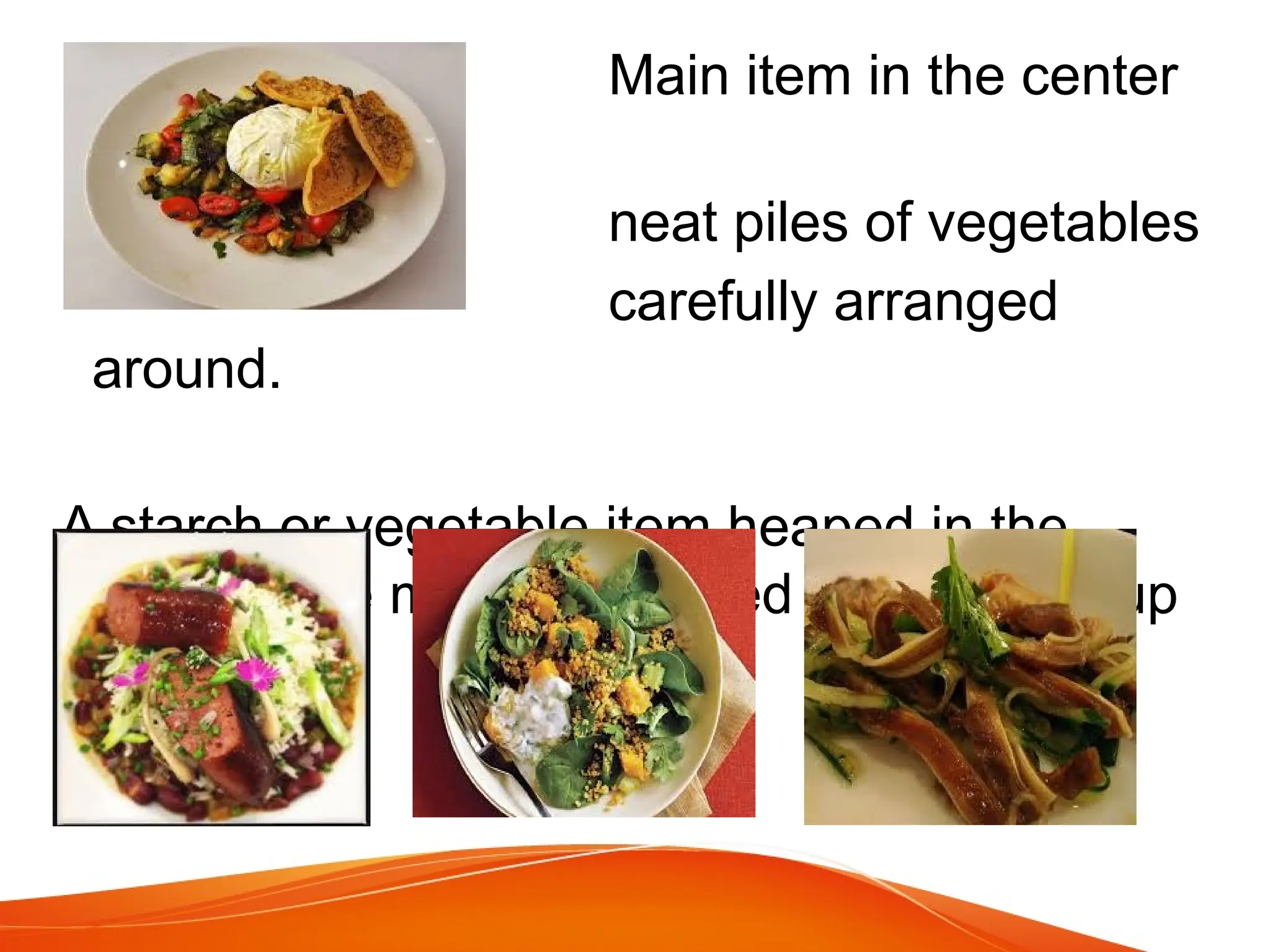
Main item in the center ,
with
vegetable distributed
around it.
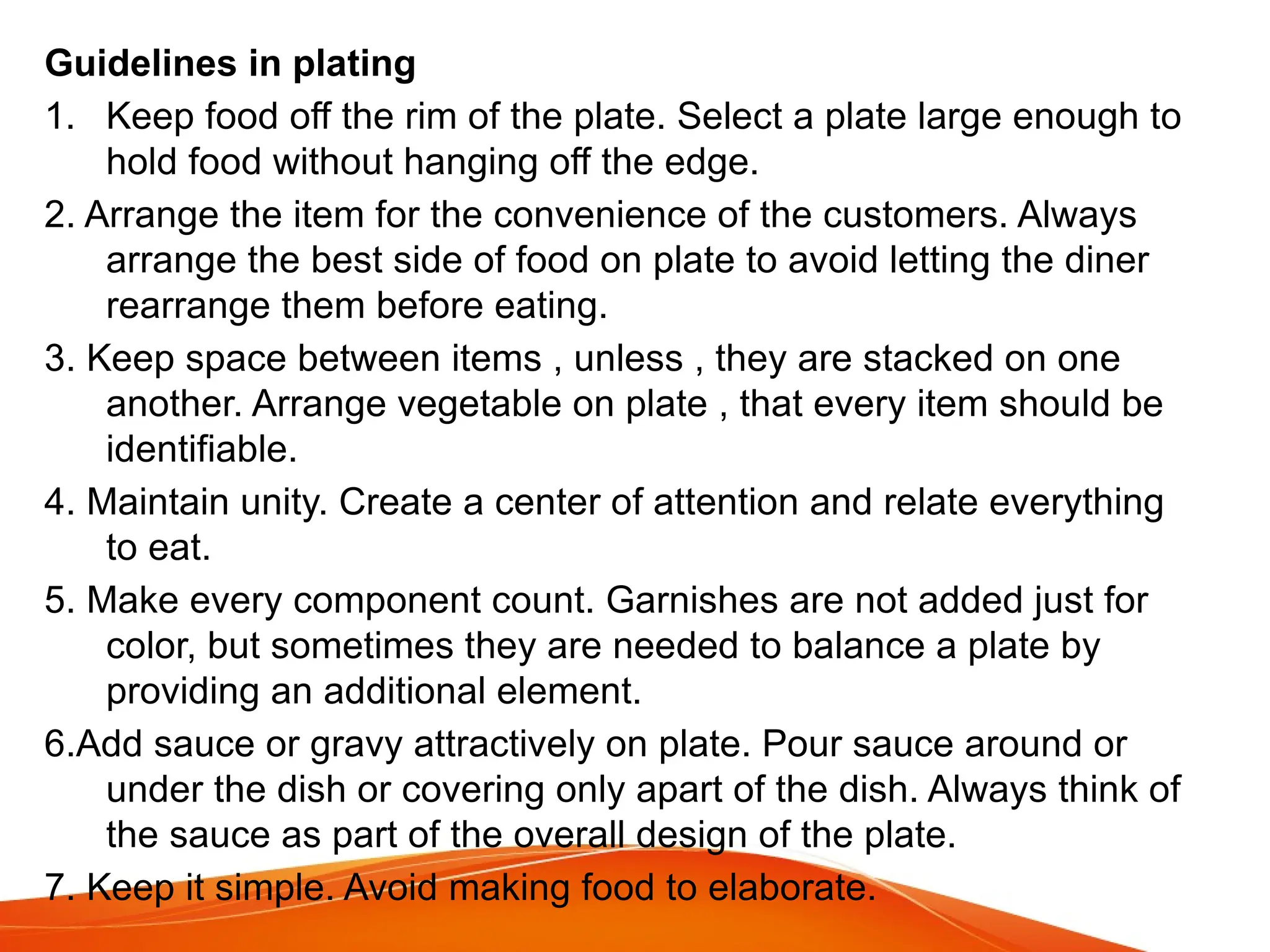
Main item in the center
with
neat piles of vegetables
carefully arranged
around.
A starch or vegetable item heaped in the
center , the main item sliced and leaning up
against it.
Guidelines in plating
1. Keep food off the rim of the plate. Select a plate large enough to
hold food without hanging off the edge.
2. Arrange the item for the convenience of the customers. Always
arrange the best side of food on plate to avoid letting the diner
rearrange them before eating.
3. Keep space between items , unless , they are stacked on one
another. Arrange vegetable on plate , that every item should be
identifiable.
4. Maintain unity. Create a center of attention and relate everything
to eat.
5. Make every component count. Garnishes are not added just for
color, but sometimes they are needed to balance a plate by
providing an additional element.
6.Add sauce or gravy attractively on plate. Pour sauce around or
under the dish or covering only apart of the dish. Always think of
the sauce as part of the overall design of the plate.
7. Keep it simple. Avoid making food to elaborate.
Creative presentation techniques
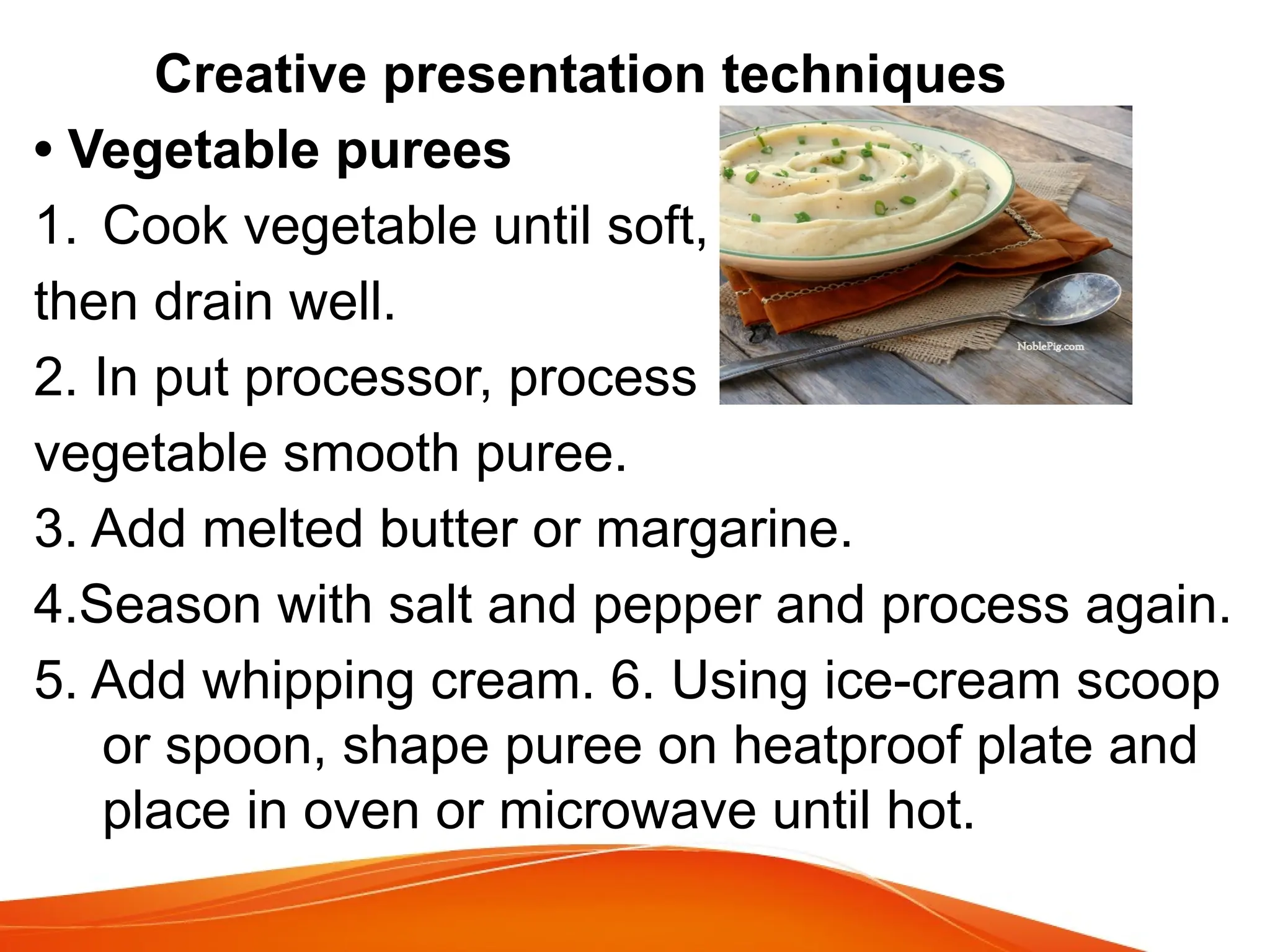
• Vegetable purees
1. Cook vegetable until soft,
then drain well.
2. In put processor, process
vegetable smooth puree.
3. Add melted butter or margarine.
4.Season with salt and pepper and process again.
5. Add whipping cream. 6. Using ice-cream scoop
or spoon, shape puree on heatproof plate and
place in oven or microwave until hot.
• Ribbon vegetables
1. With vegetable peeler,
shred carrot, corvette and
radish into long ribbons,
about 2.5 cm wide, pressing
lightly with peeler so ribbons will be very thin.
2. Toss vegetables with melted butter
or margarine.
3. Cook until tender crisp.
• Vegetable rings
1.with sharp knife, cut 3 peppers,
(green,yellow,red) and
onion into rings.
2. Remove core, seeds and
membranes from peppers.
3. Toss vegetables with melted butter
or margarine.
4. Cook until tender crisp.
5. Serve hot or refrigerate to serve chilled.
Store vegetable dishes Fresh vegetables
1. Potatoes and onions are stored at cool
temperature. ( 50 - 65 F ) in a dry , dark place.
2. Other vegetables must be refrigerated. To prevent
drying they should be kept covered or wrapped.
3. Peeled and cut vegetables should be covered or
wrapped , and use quickly to prevent spoilage.
4. Potatoes , eggplants and other vegetables that
brown when cut should be treated with an acid or
blanched them to inactivate the enzyme that cause
browning. Raw , cut potatoes are held in cold water
for a short time.
5. Store all fresh vegetables for a short time.
Frozen vegetables
1. Store at 0 F (-18 C ). Or colder in original
container until ready for use.
2. Do not refreeze thawed vegetables.
Dried vegetables
2. Store in a cool ( less than 75 F ) dry , well
ventilated place.
2. Keep well sealed and off the floor.
Canned vegetables
3. Keep in a cool dry place , away from sunlight
and off the floor.
2. Discard cans that show signs of damage
( swollen , badly dented rusted cans ).
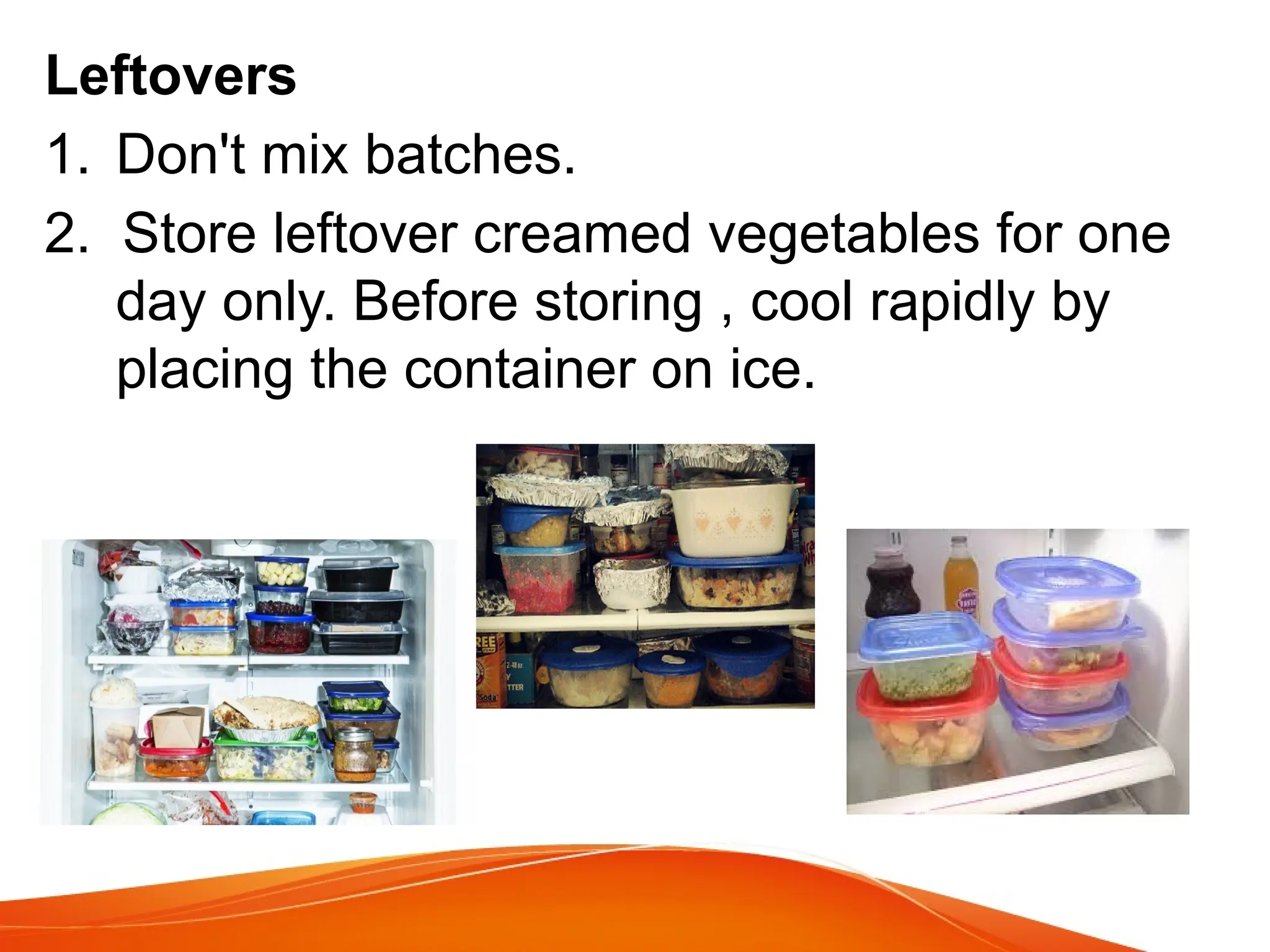
Leftovers
1. Don't mix batches.
2. Store leftover creamed vegetables for one
day only. Before storing , cool rapidly by
placing the container on ice.

LESSON PRINCIPLES IN PREPARING VEGETABLES

  • 1.
    Prepare Vegetable Dishes –Vegetables are plants or parts of plants like leaves, fruits, tubers, roots, bulbs, stems, shoots, and flower used in a dish either raw or cooked. Vegetables give color , texture and flavor to our meals. They also give vitamins and minerals. – Vegetables provide nutrients vital for health and maintenance of your body. Eating vegetables provides health benefits to people like reduced risk of some chronic diseases including heart attack and stroke , protect them against certain types of cancers , reduce obesity and type two diabetes , lower blood pressures , reduce the risk of developing kidney stones and help decrease bone loss.
  • 2.
    Vegetables are importantsources of many nutrients, including potassium , dietary fiber, folate (folic acid) , vitamin A , and vitamin C. • Diets rich in potassium may help maintain normal blood pressure. Vegetable sources of potassium include sweet potatoes , white potatoes , white beans , tomato products (paste , sauce , and juice), beet greens , soybeans , lima beans , spinach , lentils , and kidney beans. • Dietary fiber from vegetables , as part of an overall healthy diet , helps reduce blood cholesterol levels and may lower risk of heart disease. Fiber is important for proper bowel function. It helps reduce constipation. Fiber-containing foods such as vegetable help provide a feeling of fullness with fewer calories.
  • 3.
    • Folate (folicacid) helps the body from red bloods cells. Women of childbearing age who may become pregnant should consume adequate folate from foods , and in addition , 400 mcg of synthetic folic acid from fortified foods or supplements. This reduces the risk of neural tube defects , spinal bifida , and anencephaly during fetal development. • Vitamin A keeps eyes and skin healthy and helps to protect against infections. • Vitamin C helps heal cuts , and wounds , and keeps teeth and gums healthy. Vitamin C aids in iron absorption.
  • 4.
    Vegetables need tobe prepared before they are ready to serve or used as an ingredient in a cooked dish. Prior to preparation you need to identify the various kinds of vegetables and different tools and equipment needed in the preparation of vegetables and different tools and equipment needed in the preparation of vegetables. It is an important factor to consider in the preparation of vegetables.
  • 5.
    Classifications of vegetables A.According to parts of plants 1. Gourd family 2. Seeds and pods - Beans , peas , corn , okra
  • 6.
    3. Fruit Vegetables -Avocado , eggplant , sweet pepper , tomato 4. Roots and tubers - beet , carrot , radish , turnip , artichoke , potato , sweet potato
  • 7.
    5. Cabbage family -cabbage , Broccoli , cauliflower , brussels , sprouts , bokchoy
  • 8.
    6. Onion family -onion , scallion , leek , garlic , shallot
  • 9.
    7. Leafy greens -spinach , lettuce 8. Stalks , stems , and shoots - artichoke , asparagus , celery , fennel , bamboo shoots
  • 10.
  • 11.
    B. According tochemical composition 1. Carbohydrate-rich vegetables - seeds , roots , tubers. 2. Protein-rich vegetables-legumes , peas , beans. 3. Fat-rich vegetables - nuts , olives , avocado. 4. High moisture content - mushroom , tomatoes , radish , green leafy vegetables. C. According to nutritive value The following is based on their nutrient content since fruits and vegetables are good sources of vitamins and minerals. 5. Vitamin A-rich vegetables - green leafy and yellow fruits and vegetables. 6. Vitamin C-rich vegetables - yellow vegetables. 7. Vitamin B(complex) - legumes , peas , beans.
  • 12.
    Flavor Components ofvegetables 1. Sugar Fructose - the natural sugar that provides the sweetness in vegetables. 2. Glutamic acid - This forms a product called monosodium glutamate when combined with salt. It is found in large amounts in young and fresh vegetables. 3. Sulfur compounds - Give the characteristic strong flavor and odor of some vegetables like onions , leeks , garlic , chives , cabbage and broccoli. Color components 1. Chlorophyll - a fat soluble compound responsible for the green color of plants. When combined with acid , it forms pheophytin which reduces an olive green color. When combined with alkali , it forms chlorophyllins which produces a more intense green color. The addition of baking soda in cooking , which results in having brighter green color is an example. 2. Carotenoids - the yellow , orange to red soluble pigments found in plants . a. Beta carotene from carrots and squash b. lycopene , from tomatoes
  • 13.
    3. Flavonoids a. Anthoxanthin- responsible for the yellow pigments. b. Anthocyanins - responsible for red and blue to violet pigments (beets) tube , eggplants. Factors to consider in choosing good quality vegetables 1. Freshness Fresh vegetables should be Crisp and bright in colors 2. Absence of decay or insect infestation
  • 14.
    3. No mechanicaldamage or injury 4. Right degree of maturity 5. Variety of texture and sometimes flavor. Vegetables are good sources of food nutrients that are very important in everyday meals.
  • 15.
    Nutritional value ofvegetables 1. Vitamin A Grean leafy Vegetables are sources of vitamin A. Example : • Alugbati • Ampalaya leaves • Kalabasa leaves • Malunggay • petchay • sili leaves
  • 16.
    2. Vitamin C Example: • cabbage - type vegetables • bell peppers • lettuce • Potatoes • dark green and yellow vegetables.
  • 17.
    3. Vitamin B- complex Beans and leafy greens are rich sources of vitamin b – complex Example : • ampalaya tops • kulitis • pepper leaves • saluyot • dried beans
  • 18.
    4. Complex carbohydrates Complexcarbohydrates are carbohydrate molecules with more than 20 - sugar residue. They are called as polysaccharides. Functions of carbohydrate : 1. Source of energy ( protein sparing and prevents ketosis ) 2. Source of B- vitamins for CHO metabolism. 3. Type of carbohydrate chosen determines : • Fiber content • Glycemic load of diet • Nutrient density and phytochemical content. Examples : • wheat bran • whole grain breads and cereals • cabbage • carrots • Brussels sprouts
  • 19.
    Preparing fresh vegetables 1.Washing • Wash all vegetables thoroughly • Scrub well unpeeled vegetables , like potatoes for baking . • Wash green leafy vegetables in several changes of cold water. • After washing , drain well and refrigerate lightly covered to prevent drying.
  • 20.
    2. Soaking • Donot soak vegetables for long periods to prevent flavor and nutrient loss. • Cabbage , broccoli , cauliflower may be soaked for 30 minutes in cold salted water to eliminate insects. • Limp vegetables can be soaked briefly in cold water to restore crispness.
  • 21.
    3. Peeling andcutting • Peel vegetables as thinly as possible. • Cut vegetables into uniform pieces for even cooking. • Treat vegetables that brown easily with acid ( potatoes , eggplants , sweet potato ) or hold under water until ready to use. • Save edible trim for soups , stocks and purees.
  • 22.
    Basic Cutting Techniques 1.Chopping - done with a straight , downward cutting motion. 2. Chiffonade (shredding) - making very fine parallel cuts. 3. Dicing - producing cube shapes. 4. Diamond (lozenge) - thinly slicing and cutting into strips of appropriate width. 5. Mincing - producing very fine cut usually for onions and garlic. 6. Julienne and baton net - making long rectangular cut. 7. Pays anne (fermi ere) - making curved or uneven cuts of the same thickness. 8. Rondelle - making cylindrical cut. 9. Bias - making a diagonal cut. 10.Oblique or roll cuts - making a diagonal cut by rolling the long cylindrical vegetables.
  • 24.
    Apply safe andaccurate cutting techniques in preparing vegetables according to enterprise standards. A. Trimming Artichoke Bottoms 1. Start by filling a bowl with cold water and lemon into it. ( you could also use a dash of vinegar ) this will slow the browning on the surface of the artichoke when it is cut and exposed to air.
  • 25.
    2. Pull outthe tough outer , dark green leaves of artichoke. 3. Continue removing leaves until you are left with light colored , tender leaves , rub surfaces with lemon. 4. Slice off the top one inch.
  • 26.
    5. Trim theremaining dark green surfaces at the base , including stalk and continue to rub with lemon. 6. Cut the artichoke in half. 7. Use spoon to remove hairy fibers
  • 27.
    8. Pull outall of the tough red fibers , leaving the soft green leaves in place. 9. Cut the artichokes lengthwise into sizes that suit your recipe and place it in the water bath
  • 28.
    B. Trimming Asparagus 1.Hold a spear of asparagus in each hand. 2. Bend downward with each end until it breaks into two. 3. Repeat with the whole bunch of asparagus. Purplish ends on the left are destined for stock , and greenish spears to be trimmed.
  • 29.
    4. Trim orcut them into one inch length for cooking. C. Preparing Avocados 1. Grip the avocado gently on one side with one hand , cut the avocado lengthwise
  • 30.
    2. Open theavocado into halves to expose the seed. 3. Scoop out the seed with the use of spoon or scooper 4. Gently tap the seed with a knife and twist to get
  • 31.
    5. Scoop outthe avocado flesh with a spoon or scooper 6. Slice avocado into segments.
  • 32.
    D. Cutting andshredding cabbage 1. Pull off any bruised or wilted outer leaves from a red or green cabbage head. 2. Cut the cabbage into halves. 3. Cut the halves into quarters lying flat side down on the cutting board.
  • 33.
    4. Use aparing knife to remove the hard core. Repeat with remaining cabbage quarters. 5. Cut into slices or shread the cabbage to your desired thickness.
  • 34.
    E. Peeling andCrushing garlic 1. To remove the paper skin of garlic , cut off the base of the clove. 2. Place the clove on a board and gently slam it with flat side of a knife. 3. The skin will burst and can easily be removed.
  • 35.
    4. Cut thegarlic into slices as thin as possible. 5. From garlic slices , mince it. 6. Crush the garlic as you want.
  • 36.
    F. Cleaning leeks 1.Cut off and discard the dark green leaves. Trim and discard the roots. 2. Cut the stalk into half lengthwise. 3. Slice them crosswise.
  • 37.
    4. Transfer themto a bowl of cold water and swish them around a few times. 5. With hands loosely cupped , lift the leeks out of the bowl and place them on a plate or work surface ( or colander ). 6. Discard the water with the remaining grit. 7. Repeat until the water is clear and ready to be cooked.
  • 38.
    Prepare Vegetable DishesEffects of cooking vegetables 1. Changes in texture Fibers are either softened or toughened. a. Cellulose and hemicellulose - heating generally softens fibers. b. Addition of acid toughen fibers. c. Addition of alkali like baking soda soften hemicellulose. d. Addition of lime causes firmness or delay softening due to the reaction of calcium from lime ("apog").
  • 39.
    2. Water iseither lost or absorbed. a. Vegetables contain high amount of water , leafy and succulent vegetables lose water and become limp. b. Vegetables with significant amount of starch (dried beans , root crops , tubers ) absorb water because of the hygroscopic property of starch. 3. Changes in color Cooking for a short time , helps maintain color.
  • 40.
    4. Changes innutrients a. Carbohydrate • moist heat cooking - gelatinization of starch • dry heat cooking - dextrinization of starch • Carmelization of sugar b. Protein become more soluble and digestible. c. Vitamin may be destroyed in heat like vitamin C. d. Minerals are washed into the cooking liquid or oxidized.
  • 41.
    General rules ofvegetable cookery • Don't overcook. • Prepare vegetables as close to service time as possible and in small quantities. • If the vegetable must be cooked ahead , undercook slightly and chill rapidly. Reheat at service them. • Never use baking soda with green vegetables. • Cut vegetables uniformly for even cooking. • Cook green vegetables and strong flavored vegetables uncovered.
  • 42.
    Standard quality ofcooked vegetables 1. Color Bright , natural color 2. Appearance on plate Cut neatly and uniformly Attractively arranged with appropriate combinations and garnishes. 3. Texture Cooked to the right degree of doneness Crisp tender , not overcooked and mushy Potatoes , squash , sweet potatoes , tomatoes should be cooked through with smooth texture. 4. Flavor Natural flavor and sweetness Strong flavored vegetables should be pleasantly mild , with no off flavors or bitterness.
  • 43.
    5. Seasonings shouldnot mask the natural flavors. 6. Sauces Do not use heavily. Vegetable should not be greasy. 7. Vegetable combinations Vegetables should be cooked separately for different cooking times , and then combined. Combined acid vegetables like tomatoes , to green vegetables just before service to prevent discoloration of greens.
  • 44.
    Cooking frozen andcanned vegetables. A. Frozen vegetables • Examine all frozen products when received to check quality. • Frozen vegetables require shorter time in cooking because they have been partially cooked. • Cook from the frozen state : can cook directly into a steamer or boiling salted water. • Corn on the cob and vegetables that are frozen solidly , like squash , should be thawed for even cooking. • Add less salt. Most frozen vegetables are slightly salted during processing.
  • 45.
    B. Canned Vegetables •Drain vegetables and place half of the liquid in a cooking pot , and bring to boil. • Add vegetables and heat to serving time. Do not boil for a long time. • Season liquid before adding vegetables to blend flavors of herbs and spices. • Use butter to enhance the flavor of most vegetables.
  • 46.
    Terms used forvegetables Here are terms used for an assortment of fresh vegetables including carrots , turnips , peas , pearl onions , green beans , cauliflower , asparagus and artichokes that are often used as garnish or accompaniment to meat dishes. Bouquetiere - bouquet of vegetables Printaniere - Spring vegetables Jardiniere - garden vegetables Primeurs - first spring vegetables Clamart - peas Crecy – carrots Doria - cucumbers cooked in butter DuBarry - cauliflower
  • 47.
    Fermiere - carrots,turnips, onions, celery cut into uniform slices Florentine - spinach Florestiere - mushrooms Judic - braised lettuce Lyonnaise - onions Nicoise - tomatoes concase cooked with garlic Parmentier - potatoes Princesse - asparagus Provencale - tomatoes with garlic, parsley and
  • 48.
    Ways of cookingvegetables 1.Boiling & Steaming vegetables are drained as soon as they are cooked and then cool quickly under cold water to prevent overcooking from the residual heat. They are reheated quickly
  • 49.
    2. Sautéing andPan- Frying Both methods may be used to complete cooking or precooked or balanced vegetables. Also used for complete cooking of raw vegetables. 3. Braising The balanced or raw vegetables is placed in the
  • 50.
    4. Baking Cookingstarchy vegetables using heat of the oven, rather than range top. Starchy vegetables are baked because the dry heat produces a desirable texture. 5. Deep-frying Vegetables large enough to coat with breading or batter may be friend. Quick – cooking vegetables can be fried raw. Some, may be precooked by simmering or steaming briefly to reduce the cooking time in frying.
  • 51.
    Present Vegetables Dishes •Presentation of prepared vegetable dishes. • Factors to consider in plating vegetable dishes. Essential factors of food presentation 1. Good preparation and cooking techniques - proper cutting and cooking of vegetables . 2. Professional Skills - Ability to perform according to required standards. 3. Visual sense - effective food presentation depends on the understanding of techniques involving balance , arrangement , and garniture.
  • 52.
    • Balance Select foodsand garnishes that offer variety and contrast. This should be applied to colors , shapes , textures and flavors. • Portion size • Match portion sizes and plates. • Balance the portion sizes of the items on the plate. • Arrangement on the plate Many chefs display their creativity in plating presentations. One important thing to keep in mind is the convenience and comfort of the diner when plating.
  • 53.
    Plating styles withvegetable dishes Classic arrangement : Main item in front , vegetables , starch items and garnish at the rear. Main item in the center , with vegetable distributed around it.
  • 54.
    Main item inthe center with neat piles of vegetables carefully arranged around. A starch or vegetable item heaped in the center , the main item sliced and leaning up against it.
  • 55.
    Guidelines in plating 1.Keep food off the rim of the plate. Select a plate large enough to hold food without hanging off the edge. 2. Arrange the item for the convenience of the customers. Always arrange the best side of food on plate to avoid letting the diner rearrange them before eating. 3. Keep space between items , unless , they are stacked on one another. Arrange vegetable on plate , that every item should be identifiable. 4. Maintain unity. Create a center of attention and relate everything to eat. 5. Make every component count. Garnishes are not added just for color, but sometimes they are needed to balance a plate by providing an additional element. 6.Add sauce or gravy attractively on plate. Pour sauce around or under the dish or covering only apart of the dish. Always think of the sauce as part of the overall design of the plate. 7. Keep it simple. Avoid making food to elaborate.
  • 56.
    Creative presentation techniques •Vegetable purees 1. Cook vegetable until soft, then drain well. 2. In put processor, process vegetable smooth puree. 3. Add melted butter or margarine. 4.Season with salt and pepper and process again. 5. Add whipping cream. 6. Using ice-cream scoop or spoon, shape puree on heatproof plate and place in oven or microwave until hot.
  • 57.
    • Ribbon vegetables 1.With vegetable peeler, shred carrot, corvette and radish into long ribbons, about 2.5 cm wide, pressing lightly with peeler so ribbons will be very thin. 2. Toss vegetables with melted butter or margarine. 3. Cook until tender crisp.
  • 58.
    • Vegetable rings 1.withsharp knife, cut 3 peppers, (green,yellow,red) and onion into rings. 2. Remove core, seeds and membranes from peppers. 3. Toss vegetables with melted butter or margarine. 4. Cook until tender crisp. 5. Serve hot or refrigerate to serve chilled.
  • 59.
    Store vegetable dishesFresh vegetables 1. Potatoes and onions are stored at cool temperature. ( 50 - 65 F ) in a dry , dark place. 2. Other vegetables must be refrigerated. To prevent drying they should be kept covered or wrapped. 3. Peeled and cut vegetables should be covered or wrapped , and use quickly to prevent spoilage. 4. Potatoes , eggplants and other vegetables that brown when cut should be treated with an acid or blanched them to inactivate the enzyme that cause browning. Raw , cut potatoes are held in cold water for a short time. 5. Store all fresh vegetables for a short time.
  • 60.
    Frozen vegetables 1. Storeat 0 F (-18 C ). Or colder in original container until ready for use. 2. Do not refreeze thawed vegetables. Dried vegetables 2. Store in a cool ( less than 75 F ) dry , well ventilated place. 2. Keep well sealed and off the floor. Canned vegetables 3. Keep in a cool dry place , away from sunlight and off the floor. 2. Discard cans that show signs of damage ( swollen , badly dented rusted cans ).
  • 61.
    Leftovers 1. Don't mixbatches. 2. Store leftover creamed vegetables for one day only. Before storing , cool rapidly by placing the container on ice.