
KLASIFIKASI
MIKROORGANISME


27/02/2012   Masdiana Padaga   1
Taxonomy

a   Organizing, classifying and
    naming living things
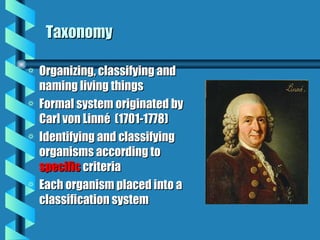
a   Formal system originated by
    Carl von Linné (1701-1778)
a   Identifying and classifying
    organisms according to
    specific criteria
a   Each organism placed into a
    classification system
Taxonomy
a Domain
a Kingdom
a Phylum
a Class
a Order
a Family
a Genus
a species
Bacterial Phylogeny


          Insert figure 1.15
            Woese-Fox System
BACTERIA
a   ARCHAEBACTERIA
    • Introns in DNA                  a   EUBACTERIA
    • Lack peptidogycan in                     • Includes most
      cell walls                                 bacteria
    • Live in extreme                          • Most have one of three
      environments                               shapes
                                               • May be divided into up
                                                 to 12 phyla
                                               • Classification is
                                                 controversial

      27/02/2012             Masdiana Padaga                          6
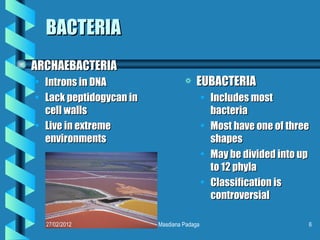
TYPES OF ARCHAEBACTERIA

                                         Methanogens
                                              living in
 Thermoacidophilies                         sewage
 Living in hot springs


  Extreme halophile
  living in the Great Salt Lake Padaga
27/02/2012                 Masdiana                       7
Bacteria Morphological Diversity


   27/02/2012                                Masdiana Padaga                    8
                From http://ag.arizona.edu/plp/courses/plp329/micdivintro.ppt
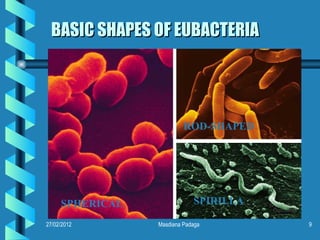
BASIC SHAPES OF EUBACTERIA


                          ROD-SHAPED


     SPHERICAL               SPIRILLA

27/02/2012       Masdiana Padaga        9
Most Species of Eubacteria may be
Grouped Based on Staining
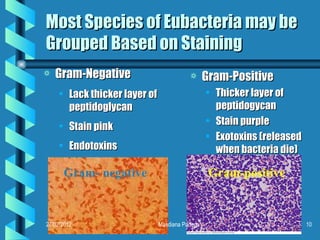
a   Gram-Negative                         a      Gram-Positive
     • Lack thicker layer of                     • Thicker layer of
       peptidoglycan                               peptidogycan
                                                 • Stain purple
     • Stain pink
                                                 • Exotoxins (released
     • Endotoxins                                  when bacteria die)

      Gram- negative                              Gram-positive


27/02/2012                     Masdiana Padaga                           10
Archaebacteria


 27/02/2012   Masdiana Padaga   11
Archaebacteria


 27/02/2012   Masdiana Padaga   12
Bacterial Taxonomy Based on
Bergey’s Manual

a   B ergey’s M anual of D eterminative B acteriology
    – five volume resource covering all known
    procaryotes
    • classification based on genetic information –
      p h y lo g e n e t ic
    • two domains: Archaea and Bacteria
    • five major subgroups with 25 different phyla
Major Taxonomic Groups of Bacteria
a   V o l 1A : D o m a i n A r c h a e a
    • primitive, adapted to extreme habitats and
      modes of nutrition
a V o l 1B : D o m a i n B a c t e r i a
a Vol 2-5:
    • P h y l u m P r o t e o b a c t e r i a – Gram-
      negative cell walls
    • P h y l u m F i r m i c u t e s – mainly Gram-
      positive with low G + C content
    • P h y l u m A c t i n o b a c t e r i a – Gram-
      positive with high G + C content
Naming and Classifying
microorganisms

      • Linnaeus system for scientific nomenclature


      • Each organism has two names:

              1) Genus
              2) Specific epithet


 27/02/2012                     Masdiana Padaga       15
Scientific Names
a   Italicized or underlined.
    The genus is capitalized, and the specific epithet is with lowercase

a   Could be as an honor for the scientist

a   A Latin origin
    e.g. Escherichia coli (E. coli)
    - discoverer: Theodor Escherich              In
    - describes the habitat (colon/intestine)    intestine


    e.g. Staphylococcus aureus (S. aureus)
    - Clustered (staphylo), spherical (cocci)      On skin
    - 27/02/2012
      Gold colored colonies (aureus) Padaga
                                  Masdiana                             16
Binomial Nomenclature
Examples: Escherichia coli, E. coli, Escherichia spp., and
“the genus Escherichia”
 The genus name (Escherichia) is always capitalized
 The species name (coli) is never capitalized
 The species name is never used without the genus name
 (e.g., coli standing alone, by itself, is a mistake!)
  The genus name may be used without the species
  name (e.g., Escherichia may stand alone, though when
  doing so it no longer actually describes a species)
  When both genus and species names are present, the
  genus name always comes first (e.g., Escherichia coli,
  not coli Escherichia)
  27/02/2012            Masdiana Padaga                      17
Binomial Nomenclature
Both the genus and species names are always italicized
(or underlined)—always underline if writing binomials by
hand
The first time a binomial is used in a work, it must be
spelled out in its entirety (e.g., E. coli standing alone in a
manuscript is not acceptable unless you have already
written Escherichia coli in the manuscript)

The next time a biniomial is used it may be abbreviated
(e.g., E. for Escherichia) though this is done typically only
when used in combination with the species name (e.g.,
E. coli)
The species name is never abbreviated
 27/02/2012            Masdiana Padaga                           18
Binomial Nomenclature

It is a good idea to abbreviate unambiguously if there is
any potential for confusion (e.g., Enterococcus vs.
Escherichia)

  These rules are to be followed when employing binomial
  nomenclature even in your speech. It is proper to refer
  to Escherichia coli as E. coli or even as Escherichia, but
  it is not proper to call it coli or E.C.!

 When in doubt, write the whole thing out (and underline)!

27/02/2012               Masdiana Padaga                 19
Types of Eukaryotes
    Protozoa                             Algae
a   Unicellular eukaryote          a    Unicellular/multicellular
a   Absorb or ingest organic            eukaryote
    chemicals                      a    Has cellulose cell walls
a   May move using                 a    Gain energy through
    pseudopods, cilia or                photosynthesis
    flagella                       a    Produce molecular and
a   e.g. Amoeba                         organic compounds


     27/02/2012                Masdiana Padaga                      20
Fungi (singular: Fungus)
a   Eukaryotes
a   Chitin cell walls
a   Use organic chemicals for
    energy
a   Molds and mushrooms are
    multicellular, consists of
    mycelia (composed of
    filaments called hyphae)
a   Yeasts are unicellular
      27/02/2012           Masdiana Padaga   21
Multicellular animal
    parasites

a   Helminths: flatworms and
    roundworms
a   Multicellular


27/02/2012                Masdiana Padaga   22
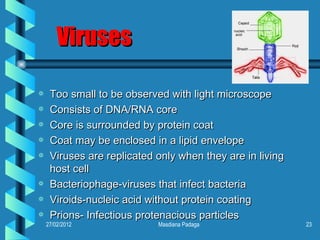
Viruses

a    Too small to be observed with light microscope
a    Consists of DNA/RNA core
a    Core is surrounded by protein coat
a    Coat may be enclosed in a lipid envelope
a    Viruses are replicated only when they are in living
     host cell
a    Bacteriophage-viruses that infect bacteria
a    Viroids-nucleic acid without protein coating
a    Prions- Infectious protenacious particles
    27/02/2012              Masdiana Padaga                23

Classification week2

  • 1.
  • 3.
    Taxonomy a Organizing, classifying and naming living things a Formal system originated by Carl von Linné (1701-1778) a Identifying and classifying organisms according to specific criteria a Each organism placed into a classification system
  • 4.
    Taxonomy a Domain a Kingdom aPhylum a Class a Order a Family a Genus a species
  • 5.
    Bacterial Phylogeny Insert figure 1.15 Woese-Fox System
  • 6.
    BACTERIA a ARCHAEBACTERIA • Introns in DNA a EUBACTERIA • Lack peptidogycan in • Includes most cell walls bacteria • Live in extreme • Most have one of three environments shapes • May be divided into up to 12 phyla • Classification is controversial 27/02/2012 Masdiana Padaga 6
  • 7.
    TYPES OF ARCHAEBACTERIA Methanogens living in Thermoacidophilies sewage Living in hot springs Extreme halophile living in the Great Salt Lake Padaga 27/02/2012 Masdiana 7
  • 8.
    Bacteria Morphological Diversity 27/02/2012 Masdiana Padaga 8 From http://ag.arizona.edu/plp/courses/plp329/micdivintro.ppt
  • 9.
    BASIC SHAPES OFEUBACTERIA ROD-SHAPED SPHERICAL SPIRILLA 27/02/2012 Masdiana Padaga 9
  • 10.
    Most Species ofEubacteria may be Grouped Based on Staining a Gram-Negative a Gram-Positive • Lack thicker layer of • Thicker layer of peptidoglycan peptidogycan • Stain purple • Stain pink • Exotoxins (released • Endotoxins when bacteria die) Gram- negative Gram-positive 27/02/2012 Masdiana Padaga 10
  • 11.
    Archaebacteria 27/02/2012 Masdiana Padaga 11
  • 12.
    Archaebacteria 27/02/2012 Masdiana Padaga 12
  • 13.
    Bacterial Taxonomy Basedon Bergey’s Manual a B ergey’s M anual of D eterminative B acteriology – five volume resource covering all known procaryotes • classification based on genetic information – p h y lo g e n e t ic • two domains: Archaea and Bacteria • five major subgroups with 25 different phyla
  • 14.
    Major Taxonomic Groupsof Bacteria a V o l 1A : D o m a i n A r c h a e a • primitive, adapted to extreme habitats and modes of nutrition a V o l 1B : D o m a i n B a c t e r i a a Vol 2-5: • P h y l u m P r o t e o b a c t e r i a – Gram- negative cell walls • P h y l u m F i r m i c u t e s – mainly Gram- positive with low G + C content • P h y l u m A c t i n o b a c t e r i a – Gram- positive with high G + C content
  • 15.
    Naming and Classifying microorganisms • Linnaeus system for scientific nomenclature • Each organism has two names: 1) Genus 2) Specific epithet 27/02/2012 Masdiana Padaga 15
  • 16.
    Scientific Names a Italicized or underlined. The genus is capitalized, and the specific epithet is with lowercase a Could be as an honor for the scientist a A Latin origin e.g. Escherichia coli (E. coli) - discoverer: Theodor Escherich In - describes the habitat (colon/intestine) intestine e.g. Staphylococcus aureus (S. aureus) - Clustered (staphylo), spherical (cocci) On skin - 27/02/2012 Gold colored colonies (aureus) Padaga Masdiana 16
  • 17.
    Binomial Nomenclature Examples: Escherichiacoli, E. coli, Escherichia spp., and “the genus Escherichia” The genus name (Escherichia) is always capitalized The species name (coli) is never capitalized The species name is never used without the genus name (e.g., coli standing alone, by itself, is a mistake!) The genus name may be used without the species name (e.g., Escherichia may stand alone, though when doing so it no longer actually describes a species) When both genus and species names are present, the genus name always comes first (e.g., Escherichia coli, not coli Escherichia) 27/02/2012 Masdiana Padaga 17
  • 18.
    Binomial Nomenclature Both thegenus and species names are always italicized (or underlined)—always underline if writing binomials by hand The first time a binomial is used in a work, it must be spelled out in its entirety (e.g., E. coli standing alone in a manuscript is not acceptable unless you have already written Escherichia coli in the manuscript) The next time a biniomial is used it may be abbreviated (e.g., E. for Escherichia) though this is done typically only when used in combination with the species name (e.g., E. coli) The species name is never abbreviated 27/02/2012 Masdiana Padaga 18
  • 19.
    Binomial Nomenclature It isa good idea to abbreviate unambiguously if there is any potential for confusion (e.g., Enterococcus vs. Escherichia) These rules are to be followed when employing binomial nomenclature even in your speech. It is proper to refer to Escherichia coli as E. coli or even as Escherichia, but it is not proper to call it coli or E.C.! When in doubt, write the whole thing out (and underline)! 27/02/2012 Masdiana Padaga 19
  • 20.
    Types of Eukaryotes Protozoa Algae a Unicellular eukaryote a Unicellular/multicellular a Absorb or ingest organic eukaryote chemicals a Has cellulose cell walls a May move using a Gain energy through pseudopods, cilia or photosynthesis flagella a Produce molecular and a e.g. Amoeba organic compounds 27/02/2012 Masdiana Padaga 20
  • 21.
    Fungi (singular: Fungus) a Eukaryotes a Chitin cell walls a Use organic chemicals for energy a Molds and mushrooms are multicellular, consists of mycelia (composed of filaments called hyphae) a Yeasts are unicellular 27/02/2012 Masdiana Padaga 21
  • 22.
    Multicellular animal parasites a Helminths: flatworms and roundworms a Multicellular 27/02/2012 Masdiana Padaga 22
  • 23.
    Viruses a Too small to be observed with light microscope a Consists of DNA/RNA core a Core is surrounded by protein coat a Coat may be enclosed in a lipid envelope a Viruses are replicated only when they are in living host cell a Bacteriophage-viruses that infect bacteria a Viroids-nucleic acid without protein coating a Prions- Infectious protenacious particles 27/02/2012 Masdiana Padaga 23