CLASSIFICATION OF VOLCANOES
INSTITUTE OF HYDROCARBON ,ENERGY AND GEO-
RESOURCES ONCE CENTRE FOR ADVANCED STUDIES
M.Sc APPLIED GEOLOGY
SEMESTER-I
PAPER-1:BASICS OF EARTH SCIENCE
UNIVERSITY OF LUCKNOW
SUBMITTED BY-
SHAKSHI SINGH
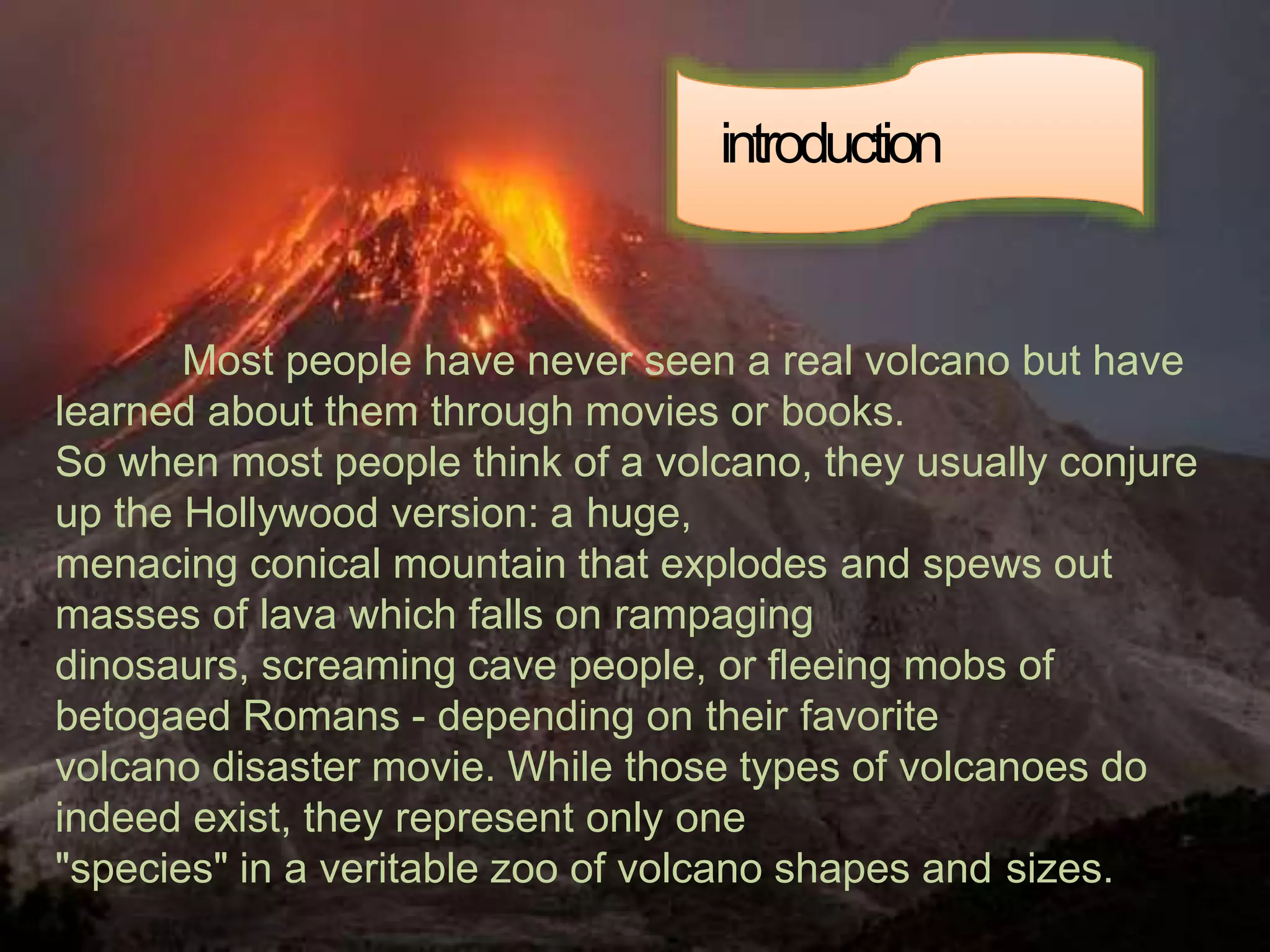
Most people have never seen a real volcano but have
learned about them through movies or books.
So when most people think of a volcano, they usually conjure
up the Hollywood version: a huge,
menacing conical mountain that explodes and spews out
masses of lava which falls on rampaging
dinosaurs, screaming cave people, or fleeing mobs of
betogaed Romans - depending on their favorite
volcano disaster movie. While those types of volcanoes do
indeed exist, they represent only one
"species" in a veritable zoo of volcano shapes and sizes.
introduction
typesof
Volcano
• Fissure
Volcanoes
• Composite
Volcanoes
• Shield Volcanoes
• Cinder cones
Volcanoes
• Lava domes
Volcanoes
• Supervolcano
• Submarine
Volcanoes
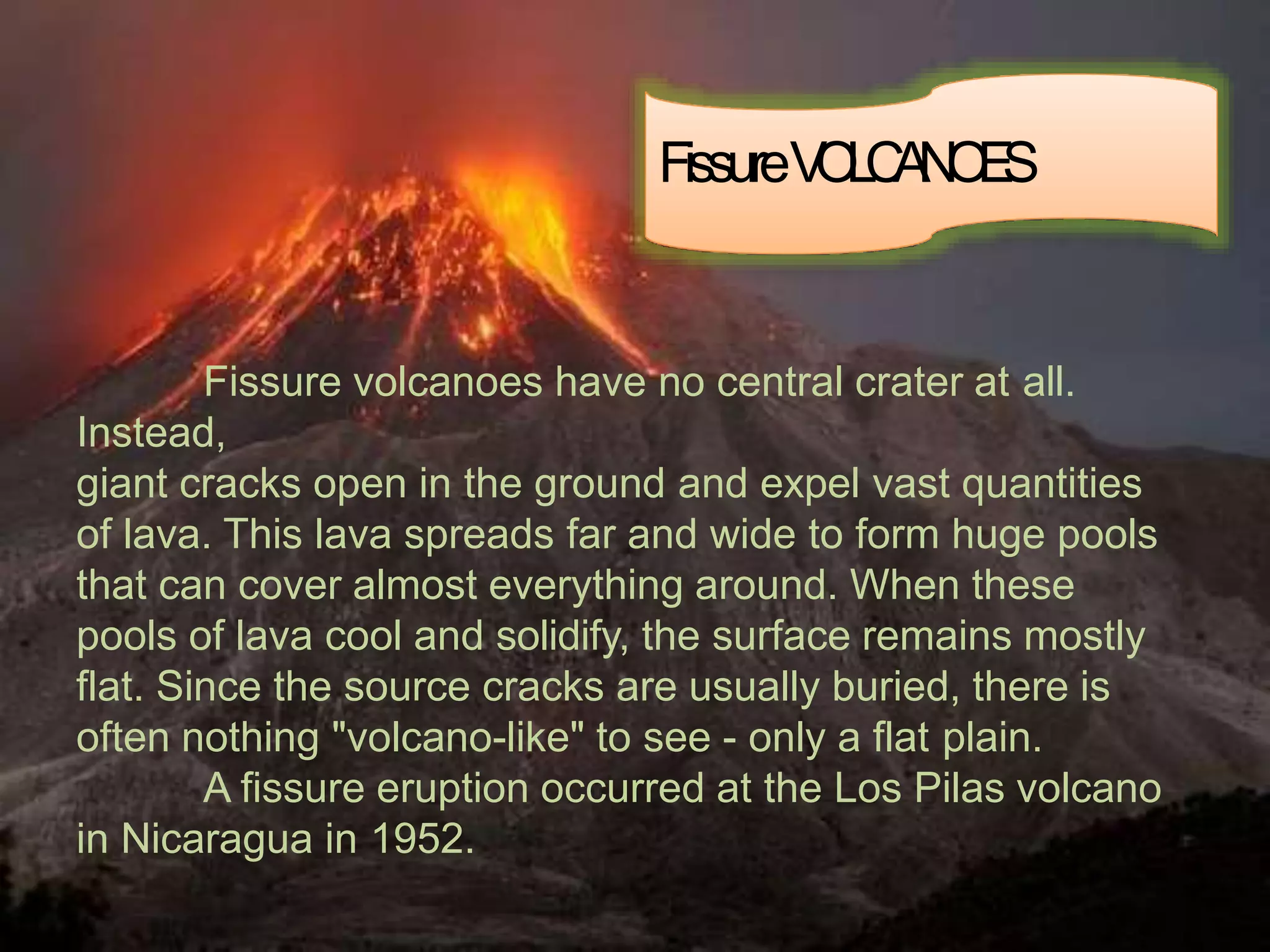
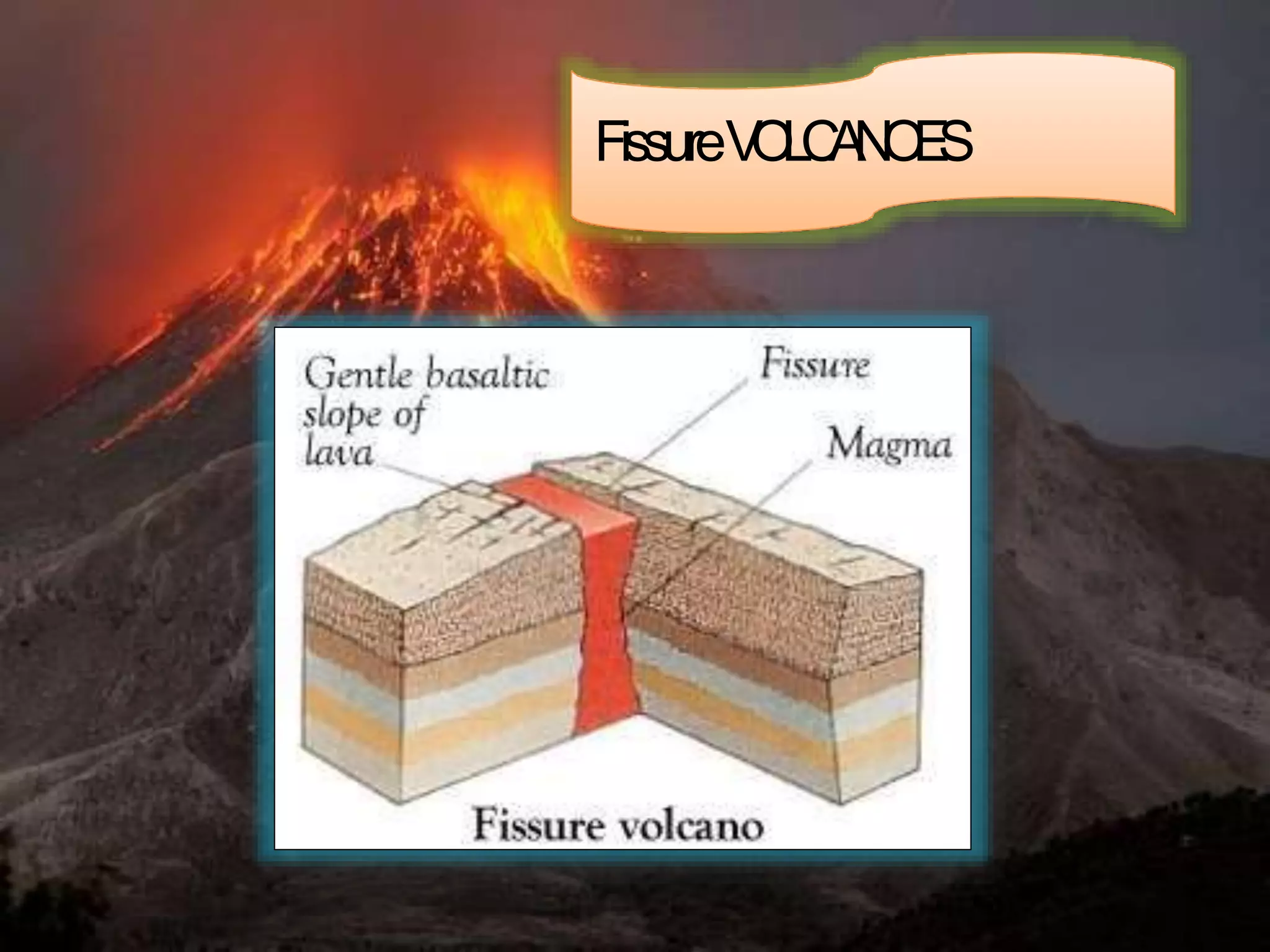
Fissure volcanoes have no central crater at all.
Instead,
giant cracks open in the ground and expel vast quantities
of lava. This lava spreads far and wide to form huge pools
that can cover almost everything around. When these
pools of lava cool and solidify, the surface remains mostly
flat. Since the source cracks are usually buried, there is
often nothing "volcano-like" to see - only a flat plain.
A fissure eruption occurred at the Los Pilas volcano
in Nicaragua in 1952.
FissureV
O
L
C
A
N
O
E
S
FissureV
O
L
C
A
N
O
E
S
C
O
M
P
O
S
I
T
EV
O
L
C
A
N
O
E
S
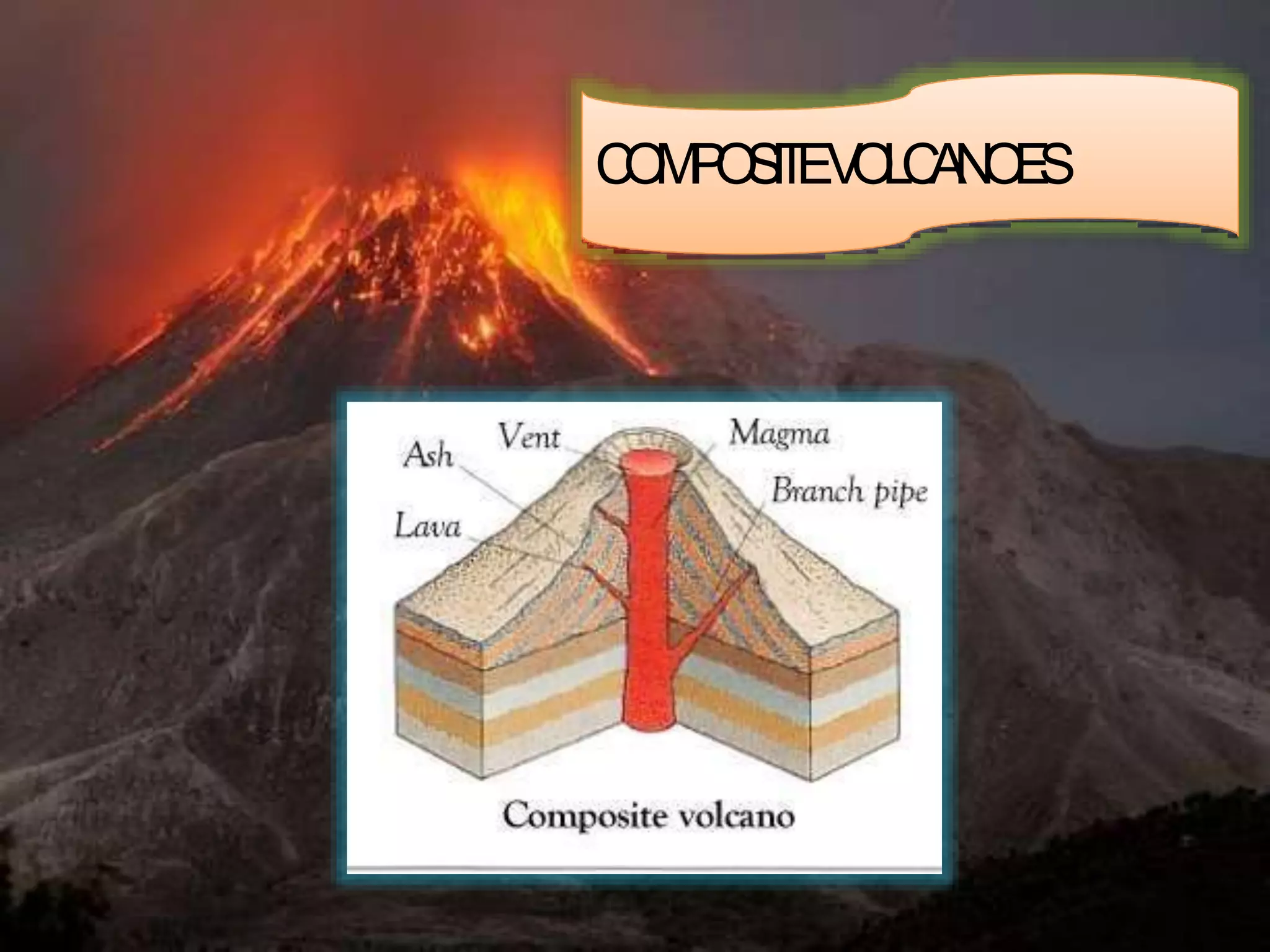
The most majestic of the volcanoes are
composite volcanoes, also known as strato-volcanoes.
Composite volcanoes are tall, symetrically shaped,
with steep sides, sometimes rising 10,000 feet high.
They are built of alternating layers of lava flows,
volcanic ash, and cinders.
Famous composite volcanoes include Mount
Fuji in Japan, Mount Shasta and Mount Lassen in
California, Mount St. Helens and Mount Rainier in
Washington State, Mount Hood in Oregon, and Mount
Etna in Italy.
C
O
M
P
O
S
I
T
EV
O
L
C
A
N
O
E
S
Shield volcanoes can grow to be very big. In fact,
the oldest continental regions of Earth may be the remains
of ancient shield volcanoes.
Shield volcanoes are tall and broad with flat,
rounded shapes. They have low slopes and almost always
have large craters at their summits. The Hawaiian
volcanoes exemplify the common type of shield volcano.
They are built by countless outpourings of lava that
advance great distances from a central summit vent or
group of vents.
SHIELDV
O
L
C
A
N
O
E
S
SHIELDV
O
L
C
A
N
O
E
S
The outpourings of lava are typically not
accompanied by pyroclastic material, which make the
shield volcanoes relatively safe during eruptions.
Mauna Loa, a shield volcano on the "big" island of
Hawaii, is the largest single mountain in the world, rising
over 30,000 feet above the ocean floor and reaching
almost 100 miles across at its base. Other famous shield
volcanoes include Kilauea, also in Hawaii, and Olympus
Mons of Mars.
SHIELDV
O
L
C
A
N
O
E
S
Cinderco
n
e
s
V
O
L
C
A
N
O
E
S
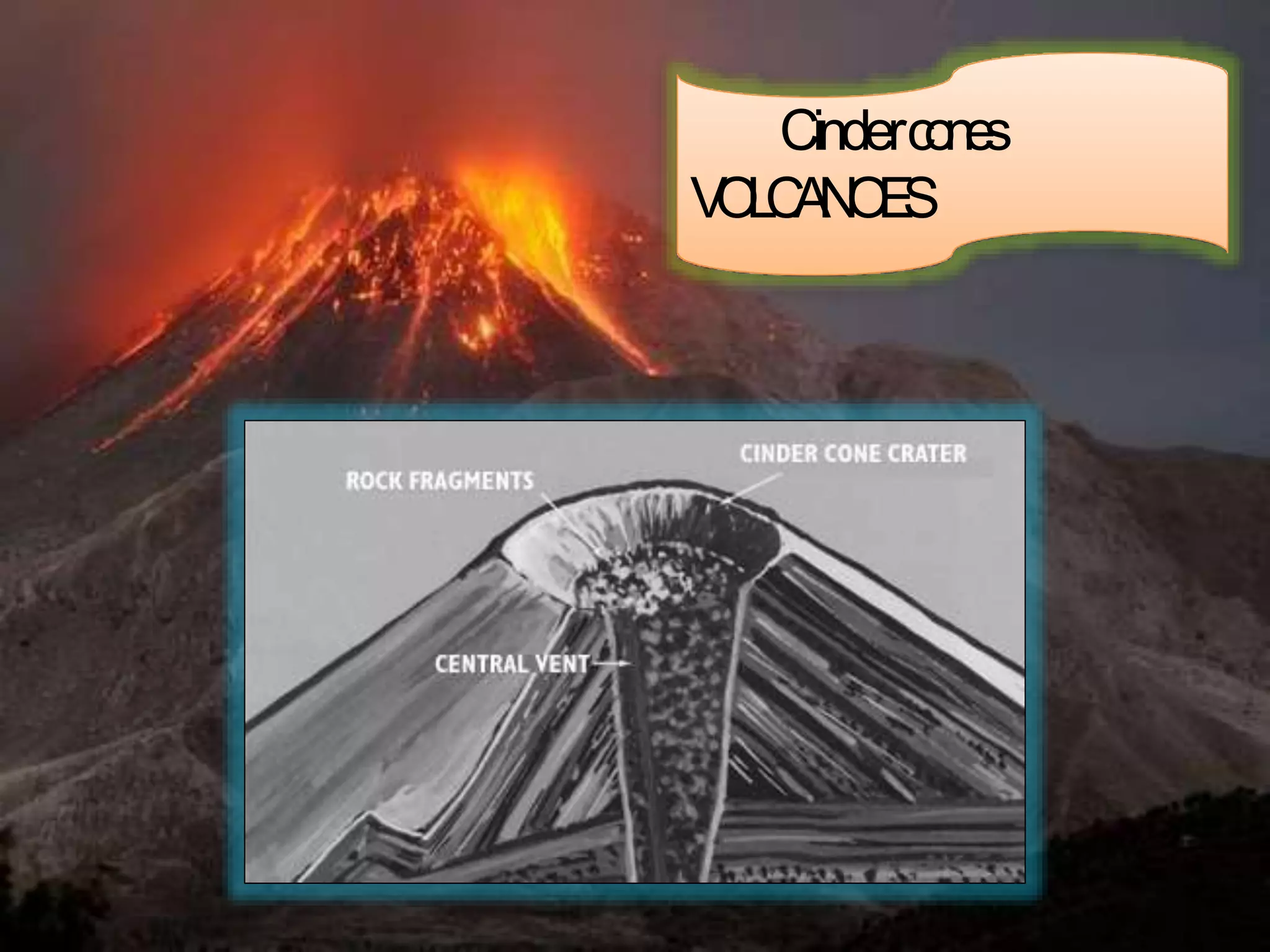
Cinder cones are simple volcanoes which have a
bowl-shaped crater at the summit and steep sides. They
only grow to about a thousand feet, the size of a hill.
They usually are created of eruptions from a single
opening, unlike a strato-volcano or shield volcano which
can erupt from many different openings. Cinder cones
are typically are made of piles of lava, not ash. A cinder
cone or scoria cone is a steep conical hill of tephra
(volcanic debris) that accumulates around and
downwind from a volcanic vent .
They consist of loose pyroclastic debris formed by
explosive eruptions or lava fountains from a single,
typically cylindrical, vent. As the gas-charged lava is
blown violently into the air, it breaks into small
fragments that solidify and fall as either cinders,
clinkers, or scoria around the vent to form a cone that
often is beautifully symmetrical; with slopes between
30-40°; and a nearly circular ground
Cinderco
n
e
s
V
O
L
C
A
N
O
E
S
Cinderco
n
e
s
V
O
L
C
A
N
O
E
S
plan. Most cinder cones have a bowl-
shaped crater at the summit. During the eruption,
blobs ("cinders") of lava are blown into the air and
break into small fragments that fall around the
opening of the volcano. The pile forms an oval-
shaped small volcano.
Famous cinder cones include Paricutin in
Mexico and the one in the middle of Crater Lake in
Oregon
Cinderco
n
e
s
V
O
L
C
A
N
O
E
S
Volcanic or lava domes are formed by relatively
small, bulbous masses of lava too viscous to flow any
great distance; consequently, on extrusion, the lava piles
over and around its vent. A dome grows largely by
expansion from within. As it grows its outer surface cools
and hardens, then shatters, spilling loose fragments down
its sides. Some domes form craggy knobs or spines over
the volcanic vent, whereas others form short, steep-sided
lava flows known as “coulees.”
Volcanic domes commonly occur within the craters
or on the flanks of large composite volcanoes.
Lavad
o
m
e
s
V
O
L
C
A
N
O
E
S
Lavad
o
m
e
s
V
O
L
C
A
N
O
E
S
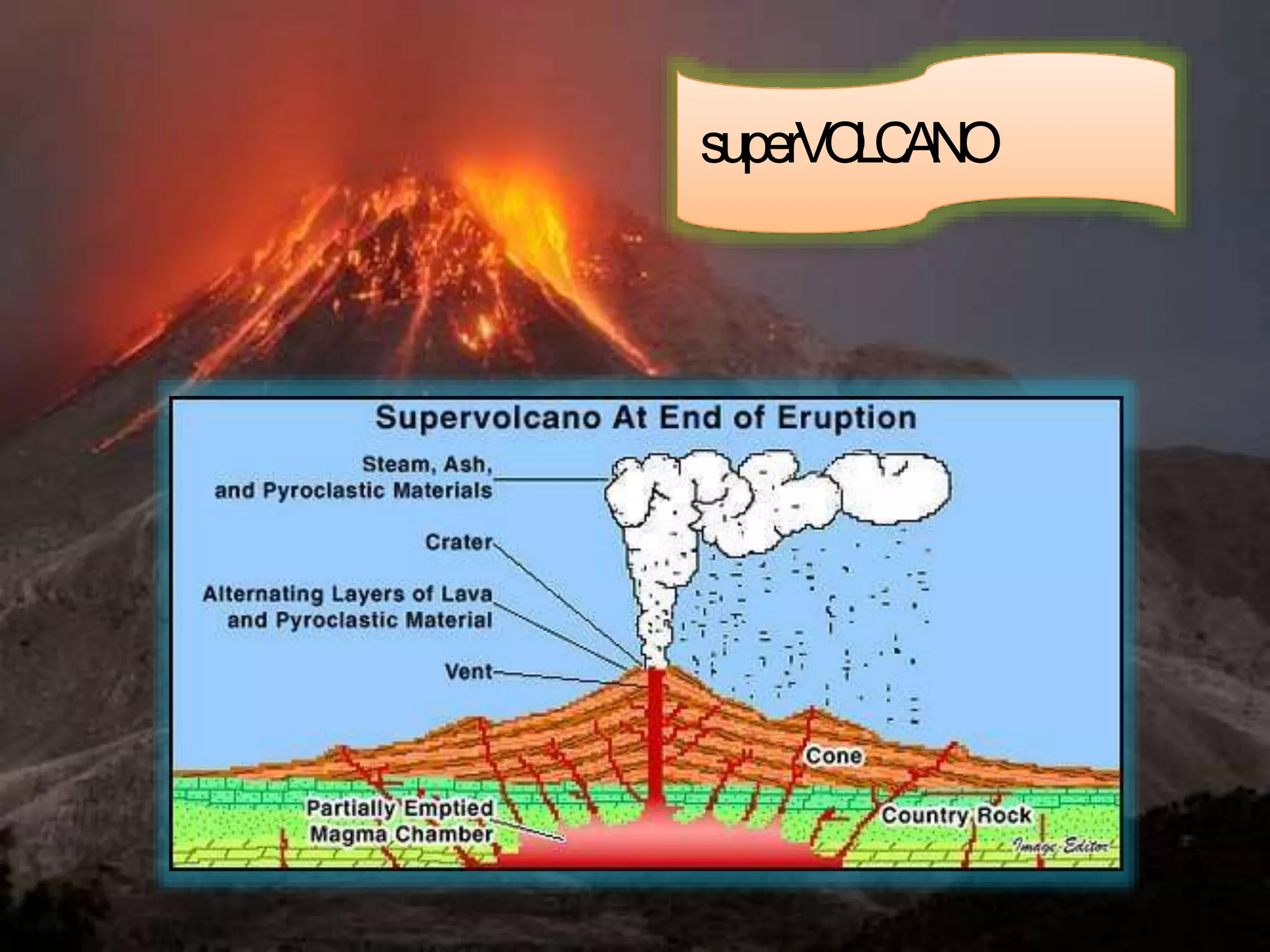
A supervolcano usually has a large caldera and
can produce devastation on an enormous, sometimes
continental, scale. Such volcanoes are able to severely
cool global temperatures for many years after the
eruption due to the huge volumes of sulfur and ash
released into the atmosphere. They are the most
dangerous type of volcano. Examples
include: Yellowstone Caldera in Yellowstone
National and Valles Caldera in New Mexico (both
western United States);
superVO
L
C
A
N
O
Lake Taupo in New Zealand; Lake Toba in Sumatra,
Indonesia; Ngorongoro Crater in Tanzania;
and Krakatoa near Java and Sumatra, Indonesia.
Because of the enormous area they may cover,
supervolcanoes are hard to identify centuries after an
eruption. Similarly, large igneous provinces are also
considered supervolcanoes because of the vast
amount of basalt lava erupted (even though the lava
flow is non-explosive).
superVO
L
C
A
N
O
superVO
L
C
A
N
O
Submarine volcanoes are common features of the
ocean floor. In shallow water, active volcanoes disclose
their presence by blasting steam and rocky debris high
above the ocean's surface. In the ocean's deep, the
tremendous weight of the water above prevents the
explosive release of steam and gases; however, they can
be detected by hydrophones and discoloration of water
because of volcanic gases . Pillow lava is a common
eruptive product of submarine volcanoes and is
characterized by thick sequences of discontinuous pillow-
shaped masses which form under water.
submarin
eV
O
L
C
A
N
O
Even large submarine eruptions may not disturb the
ocean surface due to the rapid cooling effect and
increased buoyancy of water (as compared to air)
which often causes volcanic vents to form steep pillars
on the ocean floor . Hydrothermal vents are common
near these volcanoes, and some support peculiar
ecosystems based on dissolved minerals. Over time,
the formations created by submarine volcanoes may
become so large that they break the ocean surface as
new islands or floating pumice rafts .
submarin
eV
O
L
C
A
N
O
submarin
eV
O
L
C
A
N
O
questions:
sides.
feet high.
1. cones are simple volcanoes which have a bowl-
shaped crater at the summit and steep
2. volcanoes are tall, symmetrically
shaped, with steep sides, sometimes rising 10,000
3. A usually has a
large caldera and can produce devastation on
an enormous, sometimes continental, scale.
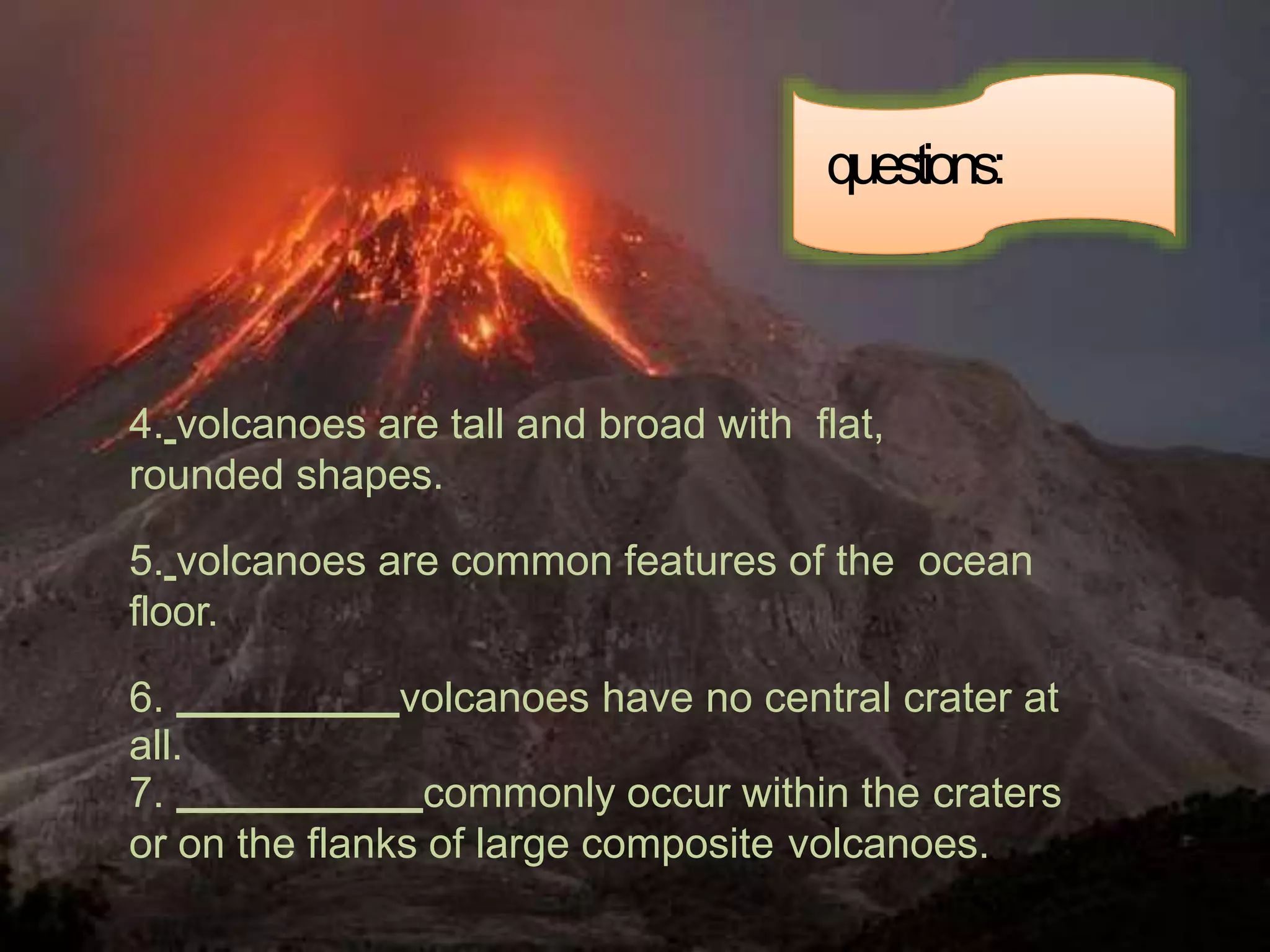
questions:
4. volcanoes are tall and broad with flat,
rounded shapes.
5. volcanoes are common features of the ocean
floor.
6. volcanoes have no central crater at
all.
7. commonly occur within the craters
or on the flanks of large composite volcanoes.
SUBMITTED BY
: FERRERA, RUTH C.
: DORIMAN, CHERRELYN A.
SUBMITTED TO
: MRS. NORA
PEDROSO
Classification of volcanoes

Classification of volcanoes

  • 1.
    CLASSIFICATION OF VOLCANOES INSTITUTEOF HYDROCARBON ,ENERGY AND GEO- RESOURCES ONCE CENTRE FOR ADVANCED STUDIES M.Sc APPLIED GEOLOGY SEMESTER-I PAPER-1:BASICS OF EARTH SCIENCE UNIVERSITY OF LUCKNOW SUBMITTED BY- SHAKSHI SINGH
  • 3.
    Most people havenever seen a real volcano but have learned about them through movies or books. So when most people think of a volcano, they usually conjure up the Hollywood version: a huge, menacing conical mountain that explodes and spews out masses of lava which falls on rampaging dinosaurs, screaming cave people, or fleeing mobs of betogaed Romans - depending on their favorite volcano disaster movie. While those types of volcanoes do indeed exist, they represent only one "species" in a veritable zoo of volcano shapes and sizes. introduction
  • 4.
    typesof Volcano • Fissure Volcanoes • Composite Volcanoes •Shield Volcanoes • Cinder cones Volcanoes • Lava domes Volcanoes • Supervolcano • Submarine Volcanoes
  • 5.
    Fissure volcanoes haveno central crater at all. Instead, giant cracks open in the ground and expel vast quantities of lava. This lava spreads far and wide to form huge pools that can cover almost everything around. When these pools of lava cool and solidify, the surface remains mostly flat. Since the source cracks are usually buried, there is often nothing "volcano-like" to see - only a flat plain. A fissure eruption occurred at the Los Pilas volcano in Nicaragua in 1952. FissureV O L C A N O E S
  • 6.
  • 7.
    C O M P O S I T EV O L C A N O E S The most majesticof the volcanoes are composite volcanoes, also known as strato-volcanoes. Composite volcanoes are tall, symetrically shaped, with steep sides, sometimes rising 10,000 feet high. They are built of alternating layers of lava flows, volcanic ash, and cinders. Famous composite volcanoes include Mount Fuji in Japan, Mount Shasta and Mount Lassen in California, Mount St. Helens and Mount Rainier in Washington State, Mount Hood in Oregon, and Mount Etna in Italy.
  • 8.
  • 9.
    Shield volcanoes cangrow to be very big. In fact, the oldest continental regions of Earth may be the remains of ancient shield volcanoes. Shield volcanoes are tall and broad with flat, rounded shapes. They have low slopes and almost always have large craters at their summits. The Hawaiian volcanoes exemplify the common type of shield volcano. They are built by countless outpourings of lava that advance great distances from a central summit vent or group of vents. SHIELDV O L C A N O E S
  • 10.
    SHIELDV O L C A N O E S The outpourings oflava are typically not accompanied by pyroclastic material, which make the shield volcanoes relatively safe during eruptions. Mauna Loa, a shield volcano on the "big" island of Hawaii, is the largest single mountain in the world, rising over 30,000 feet above the ocean floor and reaching almost 100 miles across at its base. Other famous shield volcanoes include Kilauea, also in Hawaii, and Olympus Mons of Mars.
  • 11.
  • 12.
    Cinderco n e s V O L C A N O E S Cinder cones aresimple volcanoes which have a bowl-shaped crater at the summit and steep sides. They only grow to about a thousand feet, the size of a hill. They usually are created of eruptions from a single opening, unlike a strato-volcano or shield volcano which can erupt from many different openings. Cinder cones are typically are made of piles of lava, not ash. A cinder cone or scoria cone is a steep conical hill of tephra (volcanic debris) that accumulates around and
  • 13.
    downwind from avolcanic vent . They consist of loose pyroclastic debris formed by explosive eruptions or lava fountains from a single, typically cylindrical, vent. As the gas-charged lava is blown violently into the air, it breaks into small fragments that solidify and fall as either cinders, clinkers, or scoria around the vent to form a cone that often is beautifully symmetrical; with slopes between 30-40°; and a nearly circular ground Cinderco n e s V O L C A N O E S
  • 14.
    Cinderco n e s V O L C A N O E S plan. Most cindercones have a bowl- shaped crater at the summit. During the eruption, blobs ("cinders") of lava are blown into the air and break into small fragments that fall around the opening of the volcano. The pile forms an oval- shaped small volcano. Famous cinder cones include Paricutin in Mexico and the one in the middle of Crater Lake in Oregon
  • 15.
  • 16.
    Volcanic or lavadomes are formed by relatively small, bulbous masses of lava too viscous to flow any great distance; consequently, on extrusion, the lava piles over and around its vent. A dome grows largely by expansion from within. As it grows its outer surface cools and hardens, then shatters, spilling loose fragments down its sides. Some domes form craggy knobs or spines over the volcanic vent, whereas others form short, steep-sided lava flows known as “coulees.” Volcanic domes commonly occur within the craters or on the flanks of large composite volcanoes. Lavad o m e s V O L C A N O E S
  • 17.
  • 18.
    A supervolcano usuallyhas a large caldera and can produce devastation on an enormous, sometimes continental, scale. Such volcanoes are able to severely cool global temperatures for many years after the eruption due to the huge volumes of sulfur and ash released into the atmosphere. They are the most dangerous type of volcano. Examples include: Yellowstone Caldera in Yellowstone National and Valles Caldera in New Mexico (both western United States); superVO L C A N O
  • 19.
    Lake Taupo inNew Zealand; Lake Toba in Sumatra, Indonesia; Ngorongoro Crater in Tanzania; and Krakatoa near Java and Sumatra, Indonesia. Because of the enormous area they may cover, supervolcanoes are hard to identify centuries after an eruption. Similarly, large igneous provinces are also considered supervolcanoes because of the vast amount of basalt lava erupted (even though the lava flow is non-explosive). superVO L C A N O
  • 20.
  • 21.
    Submarine volcanoes arecommon features of the ocean floor. In shallow water, active volcanoes disclose their presence by blasting steam and rocky debris high above the ocean's surface. In the ocean's deep, the tremendous weight of the water above prevents the explosive release of steam and gases; however, they can be detected by hydrophones and discoloration of water because of volcanic gases . Pillow lava is a common eruptive product of submarine volcanoes and is characterized by thick sequences of discontinuous pillow- shaped masses which form under water. submarin eV O L C A N O
  • 22.
    Even large submarineeruptions may not disturb the ocean surface due to the rapid cooling effect and increased buoyancy of water (as compared to air) which often causes volcanic vents to form steep pillars on the ocean floor . Hydrothermal vents are common near these volcanoes, and some support peculiar ecosystems based on dissolved minerals. Over time, the formations created by submarine volcanoes may become so large that they break the ocean surface as new islands or floating pumice rafts . submarin eV O L C A N O
  • 23.
  • 24.
    questions: sides. feet high. 1. conesare simple volcanoes which have a bowl- shaped crater at the summit and steep 2. volcanoes are tall, symmetrically shaped, with steep sides, sometimes rising 10,000 3. A usually has a large caldera and can produce devastation on an enormous, sometimes continental, scale.
  • 25.
    questions: 4. volcanoes aretall and broad with flat, rounded shapes. 5. volcanoes are common features of the ocean floor. 6. volcanoes have no central crater at all. 7. commonly occur within the craters or on the flanks of large composite volcanoes.
  • 26.
    SUBMITTED BY : FERRERA,RUTH C. : DORIMAN, CHERRELYN A. SUBMITTED TO : MRS. NORA PEDROSO