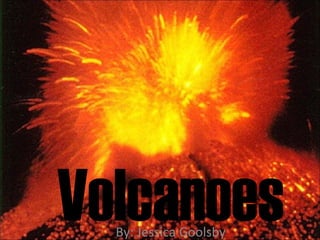
Volcanoes By: Jessica Goolsby
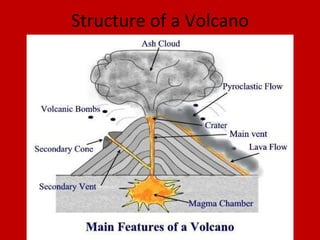
Definitions Viscosity - the property of a fluid that resists the force tending to cause the fluid to flow Magma - molten material beneath or within the earth's crust, from which igneous rock is formed Lava - the molten, fluid rock that issues from a volcano or volcanic vent Ash - the powdery residue of matter that remains after burning Caldera - A large crater formed by volcanic explosion or by collapse of a volcanic cone.
What is a volcano? A volcano is an opening in the Earth’s crust, which allows hot magma, ash and gases to escape from below the surface.
Structure of a Volcano
What Greeks Believed Volcano is from the Latin word vulcan Thought it was an entrance to the fiery underworld. Thought the god of Fire, Hephaestus, lived beneath Mt. Etna
Ring of Fire!! 90% of volcanoes are in the Ring of Fire which is band of volcanoes circling the Pacific Ocean
Largest Volcano in the World Mauna Loa, on Hawaii’s Big Island Shield Volcano Made by several lava flows Top to bottom 56,000 ft Last eruption in 1984
Classify Active -  has erupted since the last ice age Dormant – hasn’t erupted in the last 10,000 years, but is expected to erupt again Extinct – no one ever expects it to erupt again
Types of Volcanoes Shield volcano Stratovolcano Supervolcano Submarine volcano Subglacial volcano Mud volcano
Shield Volcano Broad, shield like profile Formed by the eruption of low-viscosity lava that can flow a great distance from a vent Since low-viscosity magma is typically low in silica, shield volcanoes are more common in oceanic than continental settings.  Found in Hawaii and Iceland
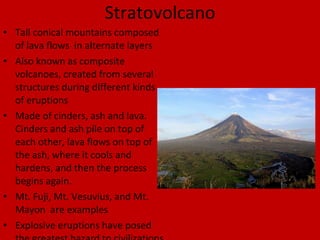
Stratovolcano Tall conical mountains composed of lava flows  in alternate layers Also known as composite volcanoes, created from several structures during different kinds of eruptions Made of cinders, ash and lava. Cinders and ash pile on top of each other, lava flows on top of the ash, where it cools and hardens, and then the process begins again.  Mt. Fuji, Mt. Vesuvius, and Mt. Mayon  are examples Explosive eruptions have posed the greatest hazard to civilizations
Supervolcano Large volcano that usually has a large  caldera  and can potentially produce devastation on an enormous, sometimes continental, scale Such eruptions would be able to cause severe cooling of global temperatures for many years afterwards because of the huge volumes of  sulfur  and ash erupted They are the most dangerous type  Examples include  Yellowstone Caldera  in  Yellowstone National Park  and  Valles Caldera  in  New Mexico   Hard to identify centuries later, given the enormous areas they cover.
Submarine Volcano Common features on the ocean floor.  Some are active and, in shallow water, blast steam and rocky debris high above the surface of the sea.  Many others lie at such great depths that the tremendous weight of the water above them prevents the explosive release of steam and gases, although they can be detected by  hydrophones  and discoloration of water because of  volcanic gases .  Pumice rafts  may also appear. Even large submarine eruptions may not disturb the ocean surface. Because of the rapid cooling effect of water as compared to air, and increased buoyancy, submarine volcanoes often form rather steep pillars over their volcanic vents as compared to above-surface volcanoes. They may become so large that they break the ocean surface as new islands.
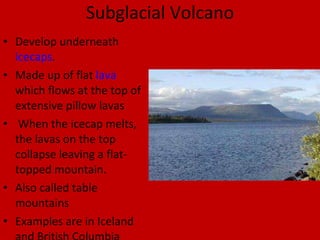
Subglacial Volcano Develop underneath  icecaps .  Made up of flat  lava  which flows at the top of extensive pillow lavas When the icecap melts, the lavas on the top collapse leaving a flat-topped mountain.  Also called table mountains  Examples are in Iceland and British Columbia
Mud Volcano Formations created by geo-excreted liquids and gases, although there are several different processes which may cause such activity.  The largest structures are 10 kilometers in diameter and reach 700 meters high.
Mt. St. Helens Located in Washington Stratovolcano Most famous for eruption on May 18, 1980 Most active volcano in United States
May 18, 1980 Most catastrophic eruption 57 people killed, 250 homes, 47 bridges, 15 miles of railway, and 185 miles of highway were destroyed Caused a mass debris avalanche bringing the elevation from 9,667ft to 8,365ft Made a horseshoe shaped crater
Volcano Benefits Provide valuable mineral deposits Fertile soils  Geothermal energy Lava can build new land, like in Hawaii
Movie Starring Tommy Lee Jones, Anne Heche and Don Cheadle Released on April 25, 1997 About an earthquake hitting L. A. and that causes a volcano
Books
Resources www.wikipedia.com http://blogs.oregonstate.edu/volcanofaq/ http://www.nationalgeographic.com/forcesofnature/interactive/index.html http://dictionary.reference.com/ http://en.wikipedia.org/wiki/Volcano_(film) http://facts.randomhistory.com/2009/01/30_volcanoes.html www.amazon.com

Volcanoes

  • 1.
  • 2.
    Definitions Viscosity -the property of a fluid that resists the force tending to cause the fluid to flow Magma - molten material beneath or within the earth's crust, from which igneous rock is formed Lava - the molten, fluid rock that issues from a volcano or volcanic vent Ash - the powdery residue of matter that remains after burning Caldera - A large crater formed by volcanic explosion or by collapse of a volcanic cone.
  • 3.
    What is avolcano? A volcano is an opening in the Earth’s crust, which allows hot magma, ash and gases to escape from below the surface.
  • 4.
  • 5.
    What Greeks BelievedVolcano is from the Latin word vulcan Thought it was an entrance to the fiery underworld. Thought the god of Fire, Hephaestus, lived beneath Mt. Etna
  • 6.
    Ring of Fire!!90% of volcanoes are in the Ring of Fire which is band of volcanoes circling the Pacific Ocean
  • 7.
    Largest Volcano inthe World Mauna Loa, on Hawaii’s Big Island Shield Volcano Made by several lava flows Top to bottom 56,000 ft Last eruption in 1984
  • 8.
    Classify Active - has erupted since the last ice age Dormant – hasn’t erupted in the last 10,000 years, but is expected to erupt again Extinct – no one ever expects it to erupt again
  • 9.
    Types of VolcanoesShield volcano Stratovolcano Supervolcano Submarine volcano Subglacial volcano Mud volcano
  • 10.
    Shield Volcano Broad,shield like profile Formed by the eruption of low-viscosity lava that can flow a great distance from a vent Since low-viscosity magma is typically low in silica, shield volcanoes are more common in oceanic than continental settings. Found in Hawaii and Iceland
  • 11.
    Stratovolcano Tall conicalmountains composed of lava flows in alternate layers Also known as composite volcanoes, created from several structures during different kinds of eruptions Made of cinders, ash and lava. Cinders and ash pile on top of each other, lava flows on top of the ash, where it cools and hardens, and then the process begins again. Mt. Fuji, Mt. Vesuvius, and Mt. Mayon are examples Explosive eruptions have posed the greatest hazard to civilizations
  • 12.
    Supervolcano Large volcanothat usually has a large caldera and can potentially produce devastation on an enormous, sometimes continental, scale Such eruptions would be able to cause severe cooling of global temperatures for many years afterwards because of the huge volumes of sulfur and ash erupted They are the most dangerous type Examples include Yellowstone Caldera in Yellowstone National Park and Valles Caldera in New Mexico Hard to identify centuries later, given the enormous areas they cover.
  • 13.
    Submarine Volcano Commonfeatures on the ocean floor. Some are active and, in shallow water, blast steam and rocky debris high above the surface of the sea. Many others lie at such great depths that the tremendous weight of the water above them prevents the explosive release of steam and gases, although they can be detected by hydrophones and discoloration of water because of volcanic gases . Pumice rafts may also appear. Even large submarine eruptions may not disturb the ocean surface. Because of the rapid cooling effect of water as compared to air, and increased buoyancy, submarine volcanoes often form rather steep pillars over their volcanic vents as compared to above-surface volcanoes. They may become so large that they break the ocean surface as new islands.
  • 14.
    Subglacial Volcano Developunderneath icecaps . Made up of flat lava which flows at the top of extensive pillow lavas When the icecap melts, the lavas on the top collapse leaving a flat-topped mountain. Also called table mountains Examples are in Iceland and British Columbia
  • 15.
    Mud Volcano Formationscreated by geo-excreted liquids and gases, although there are several different processes which may cause such activity. The largest structures are 10 kilometers in diameter and reach 700 meters high.
  • 16.
    Mt. St. HelensLocated in Washington Stratovolcano Most famous for eruption on May 18, 1980 Most active volcano in United States
  • 17.
    May 18, 1980Most catastrophic eruption 57 people killed, 250 homes, 47 bridges, 15 miles of railway, and 185 miles of highway were destroyed Caused a mass debris avalanche bringing the elevation from 9,667ft to 8,365ft Made a horseshoe shaped crater
  • 18.
    Volcano Benefits Providevaluable mineral deposits Fertile soils Geothermal energy Lava can build new land, like in Hawaii
  • 19.
    Movie Starring TommyLee Jones, Anne Heche and Don Cheadle Released on April 25, 1997 About an earthquake hitting L. A. and that causes a volcano
  • 20.
  • 21.
    Resources www.wikipedia.com http://blogs.oregonstate.edu/volcanofaq/http://www.nationalgeographic.com/forcesofnature/interactive/index.html http://dictionary.reference.com/ http://en.wikipedia.org/wiki/Volcano_(film) http://facts.randomhistory.com/2009/01/30_volcanoes.html www.amazon.com