Volcano :  an  opening  in the earth’s surface through which lava, hot gases, and rock fragments  erupt Introduction to volcanoes
Magma  50-100  miles below the earth’s surface slowly begins to  rise  to the surface As the magma rises it melts  gaps  in the surrounding rock As more magma rises a  large reservoir  forms as close as 2 miles below the surface (magma chamber) How do they form?
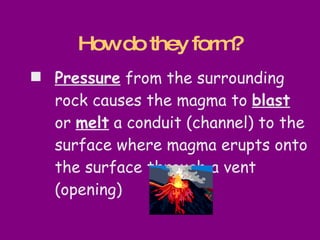
Pressure  from the surrounding rock causes the magma to  blast  or  melt  a conduit (channel) to the surface where magma erupts onto the surface through a vent (opening) How do they form?
The magma, now called lava,  builds  up at the  vent  forming a volcano How do they form?
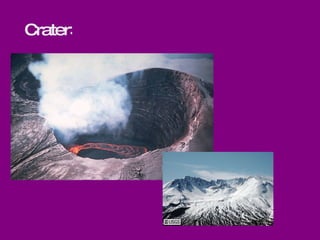
Often the volcano sides will be higher than the vent forming a depression called a  crater How do they Form?
Crater :
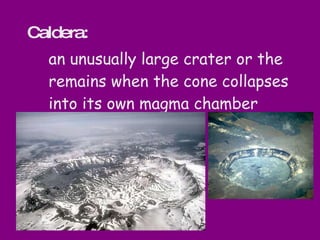
Caldera:   an unusually large crater or the remains when the cone collapses into its own magma chamber
Anatomy of a Volcano Cone :  the  above  ground structure built from  lava and/or tephra
Conduit :  the path that magma takes from the  magma chamber  to the  vent
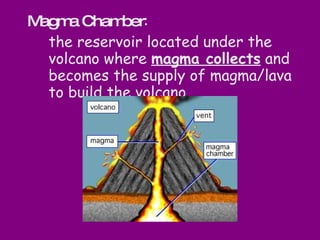
Magma Chamber :  the reservoir located under the volcano where  magma collects  and becomes the supply of magma/lava to build the volcano
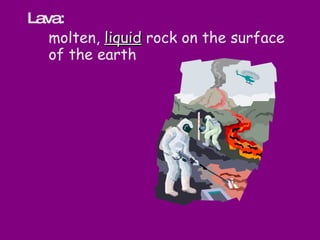
Lava:  molten,  liquid  rock on the surface of the earth
Parasitic Cone:  a smaller secondary volcano built on the side of or near the main volcano, but sharing the same  conduit  to the magma chamber
Fumarole:  a secondary vent that emits only  gases
Fissure :  a long fissure ( crack ) from which lava flows
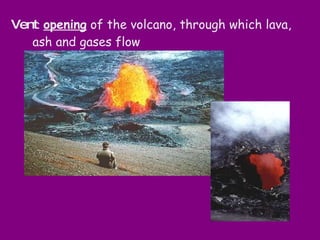
Vent :  opening  of the volcano, through which lava, ash and gases flow
What comes out of volcanoes? Lava Tephra Gases
Lava— 3 kinds:
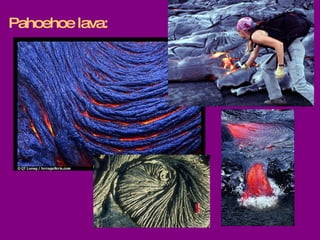
Pahoehoe lava:  Hot, thin, fast flowing  harden with a relatively smooth surface  Often has a  ropy  or  wrinkled  appearance
Pahoehoe lava:
Aa lava:  Cooler,  thicker , slow moving Hardens with a rough, jagged, sharp edge surface
Pillow Lava:  Lava suddenly cooled by  water shows sack-like segments (stuffed pillows)
Tephra Basically,  rock  fragments Also known as  pyroclastic  rock fragments. There are many different possible sizes, from very  small  (volcanic  ash  or  dust  to much  larger  rocks (called volcanic  bombs )
Ash & dust
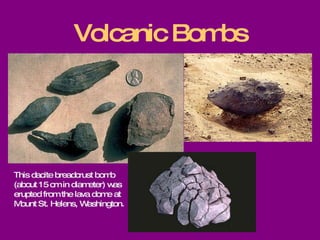
Volcanic Bombs This dacite breadcrust bomb (about 15 cm in diameter) was erupted from the lava dome at Mount St. Helens, Washington.
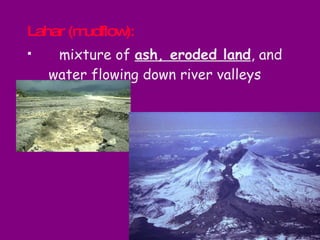
Lahar (mudflow):   mixture of  ash, eroded land , and water flowing down river valleys
Lahar (mudflow):
GASES water vapor,  carbon dioxide , nitrogen,  sulfur dioxide , hydrogen sulfide,  chlorine
Where do Volcanoes Occur?
Where do Volcanoes Occur? location Examples Divergent Boundaries :  where plates move  APART Iceland
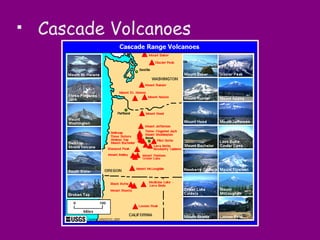
Where do Volcanoes Occur? location Examples convergent Boundaries :  where plates  come together Cascade range volcanoes, Andes
Cascade Volcanoes
Where do Volcanoes Occur? location Examples Hot Spots :  plates riding over an especially hot place in the mantle   Hawaii, Yellowstone, Iceland
Hot Spots
Two factors determine the type of eruption :  Amount of  water vapor  & other  gases  in the magma   The  chemical composition  of the magma Types of  Volcanic Eruptions
Trapped gases under  high  pressure will violently explode when the magma reaches the  lower  pressure of the surface. Explosive Eruptions
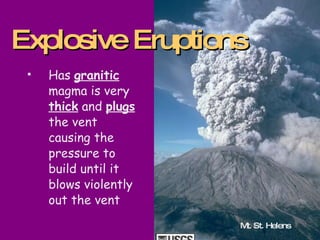
Has  granitic  magma is very  thick  and  plugs  the vent causing the pressure to build until it blows violently out the vent  Explosive Eruptions Mt. St. Helens
The  high  water content of the magma produces more water vapor which when mixed in granitic magma produces explosive eruptions Explosive Eruptions Mont serrat
Low pressure gas Quiet Eruptions
Has  basaltic  magma (is more fluid and will flow instead of explode) Quiet Eruptions
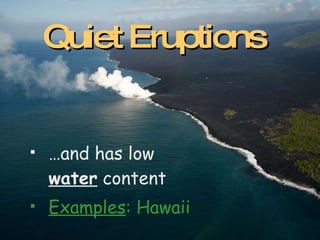
… and has low  water  content Examples : Hawaii Quiet Eruptions
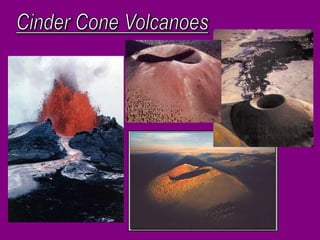
Cinder cones Small base,  steep-sided, loosely consolidated Up to 1000 feet tall Life span of a  few  years Commonly built from gravel size lava rock fragments called  cinders Violent  eruptions, dangerous when close---High pressure gas bubbles causes thick lava to explode into the air, lava begins to cool as it rises and falls becoming very sticky When lava hits the ground it  sticks  rather than flows This builds a steep cone with a small base
 
Cinder Cones :  Cinder Cones
Shield volcanoes Large base,  gentle slope , lava rock layers A few  miles  high Life span of a  million  years or more The lava is hot, thin, very  fluid  often  basaltic   Example: Hawaiian Islands, Iceland
Shield volcano on Mars; Taken from space Take a look at these examples: http://www.volcano.si.edu/world/tpgallery.cfm?category=Shield%20Volcanoes   The Mauna Loa volcano in Hawaii—the largest volcano on Earth—has the broad expanse characteristic of shield volcanoes. It spreads across half the island of Hawaii.
Shield Volcanoes   Mauna Kea Shield volcanoes
Composite or strato Large mountain volcano often  snow capped , a few miles high Life span of million years or more
Composite or strato Have alternating eruptions of  tephra  (air-borne) and  lava .  The tephra adds  height  to the volcano and the lava  cements  the tephra together and adds to the  base .  Found mostly in  subduction  zones and have violent eruptions.
STrato/Composite Llaima Volcano, Chile.
Composite (strato) Volcanoes examples:  Mt. Rainier Mt. Fuji Mt. Kilimanjaro
Composite/strato volcanoes
Active (awake):  Has erupted within recent time and can erupt again at  any time .  Pre-eruption activities :  Increase in  earthquake  activity under the cone increase in temperature of cone, melting  of ice/snow in the crater swelling of the cone steam  eruptions minor  ash  eruptions Volcano Activity Levels (Stages)
Mt St. Helens
Dormant (sleeping):  No  eruption within recent times, but there is record of past eruptions  Can become  active  and erupt again after a  “wake up”  period  Example : Mt. Rainier
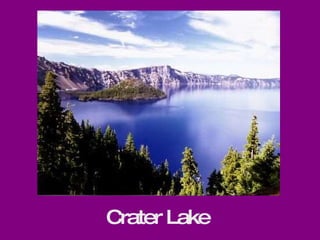
Extinct:  No eruption within recorded history Not expected to  ever erupt again Example: Mount Mazama  (Crater Lake)
Crater Lake
Mount Rainier The most  dangerous  volcano in the US The danger is mostly from  lahars  traveling down river valleys at a speed of 25mph and destroying everything in its path 100,000 people live on the solidified mudflows of previous eruptions
Mount Rainier The mountain is dangerously  unstable , a tall, steep heap of loose rock held together by the force of gravity and a cubic mile of glacier ice that could be melted or shaken loose Lahar flows average every  500 years  and have gone as far as the Puget Sound lowlands Mount Rainier has erupted  4 times  in the last 4000 years with the last eruption 200 years ago
 

Volcanoes2009

  • 1.
  • 2.
    Volcano : an opening in the earth’s surface through which lava, hot gases, and rock fragments erupt Introduction to volcanoes
  • 3.
    Magma 50-100 miles below the earth’s surface slowly begins to rise to the surface As the magma rises it melts gaps in the surrounding rock As more magma rises a large reservoir forms as close as 2 miles below the surface (magma chamber) How do they form?
  • 4.
    Pressure fromthe surrounding rock causes the magma to blast or melt a conduit (channel) to the surface where magma erupts onto the surface through a vent (opening) How do they form?
  • 5.
    The magma, nowcalled lava, builds up at the vent forming a volcano How do they form?
  • 6.
    Often the volcanosides will be higher than the vent forming a depression called a crater How do they Form?
  • 7.
  • 8.
    Caldera: an unusually large crater or the remains when the cone collapses into its own magma chamber
  • 9.
    Anatomy of aVolcano Cone : the above ground structure built from lava and/or tephra
  • 10.
    Conduit : the path that magma takes from the magma chamber to the vent
  • 11.
    Magma Chamber : the reservoir located under the volcano where magma collects and becomes the supply of magma/lava to build the volcano
  • 12.
    Lava: molten, liquid rock on the surface of the earth
  • 13.
    Parasitic Cone: a smaller secondary volcano built on the side of or near the main volcano, but sharing the same conduit to the magma chamber
  • 14.
    Fumarole: asecondary vent that emits only gases
  • 15.
    Fissure : a long fissure ( crack ) from which lava flows
  • 16.
    Vent : opening of the volcano, through which lava, ash and gases flow
  • 17.
    What comes outof volcanoes? Lava Tephra Gases
  • 18.
  • 19.
    Pahoehoe lava: Hot, thin, fast flowing harden with a relatively smooth surface Often has a ropy or wrinkled appearance
  • 20.
  • 21.
    Aa lava: Cooler, thicker , slow moving Hardens with a rough, jagged, sharp edge surface
  • 22.
    Pillow Lava: Lava suddenly cooled by water shows sack-like segments (stuffed pillows)
  • 23.
    Tephra Basically, rock fragments Also known as pyroclastic rock fragments. There are many different possible sizes, from very small (volcanic ash or dust to much larger rocks (called volcanic bombs )
  • 24.
  • 25.
    Volcanic Bombs Thisdacite breadcrust bomb (about 15 cm in diameter) was erupted from the lava dome at Mount St. Helens, Washington.
  • 26.
    Lahar (mudflow): mixture of ash, eroded land , and water flowing down river valleys
  • 27.
  • 28.
    GASES water vapor, carbon dioxide , nitrogen, sulfur dioxide , hydrogen sulfide, chlorine
  • 29.
  • 30.
    Where do VolcanoesOccur? location Examples Divergent Boundaries : where plates move APART Iceland
  • 31.
    Where do VolcanoesOccur? location Examples convergent Boundaries : where plates come together Cascade range volcanoes, Andes
  • 32.
  • 33.
    Where do VolcanoesOccur? location Examples Hot Spots : plates riding over an especially hot place in the mantle Hawaii, Yellowstone, Iceland
  • 34.
  • 35.
    Two factors determinethe type of eruption : Amount of water vapor & other gases in the magma The chemical composition of the magma Types of Volcanic Eruptions
  • 36.
    Trapped gases under high pressure will violently explode when the magma reaches the lower pressure of the surface. Explosive Eruptions
  • 37.
    Has granitic magma is very thick and plugs the vent causing the pressure to build until it blows violently out the vent Explosive Eruptions Mt. St. Helens
  • 38.
    The high water content of the magma produces more water vapor which when mixed in granitic magma produces explosive eruptions Explosive Eruptions Mont serrat
  • 39.
    Low pressure gasQuiet Eruptions
  • 40.
    Has basaltic magma (is more fluid and will flow instead of explode) Quiet Eruptions
  • 41.
    … and haslow water content Examples : Hawaii Quiet Eruptions
  • 42.
    Cinder cones Smallbase, steep-sided, loosely consolidated Up to 1000 feet tall Life span of a few years Commonly built from gravel size lava rock fragments called cinders Violent eruptions, dangerous when close---High pressure gas bubbles causes thick lava to explode into the air, lava begins to cool as it rises and falls becoming very sticky When lava hits the ground it sticks rather than flows This builds a steep cone with a small base
  • 43.
  • 44.
    Cinder Cones : Cinder Cones
  • 45.
    Shield volcanoes Largebase, gentle slope , lava rock layers A few miles high Life span of a million years or more The lava is hot, thin, very fluid often basaltic Example: Hawaiian Islands, Iceland
  • 46.
    Shield volcano onMars; Taken from space Take a look at these examples: http://www.volcano.si.edu/world/tpgallery.cfm?category=Shield%20Volcanoes The Mauna Loa volcano in Hawaii—the largest volcano on Earth—has the broad expanse characteristic of shield volcanoes. It spreads across half the island of Hawaii.
  • 47.
    Shield Volcanoes Mauna Kea Shield volcanoes
  • 48.
    Composite or stratoLarge mountain volcano often snow capped , a few miles high Life span of million years or more
  • 49.
    Composite or stratoHave alternating eruptions of tephra (air-borne) and lava . The tephra adds height to the volcano and the lava cements the tephra together and adds to the base . Found mostly in subduction zones and have violent eruptions.
  • 50.
  • 51.
    Composite (strato) Volcanoesexamples: Mt. Rainier Mt. Fuji Mt. Kilimanjaro
  • 52.
  • 53.
    Active (awake): Has erupted within recent time and can erupt again at any time . Pre-eruption activities : Increase in earthquake activity under the cone increase in temperature of cone, melting of ice/snow in the crater swelling of the cone steam eruptions minor ash eruptions Volcano Activity Levels (Stages)
  • 54.
  • 55.
    Dormant (sleeping): No eruption within recent times, but there is record of past eruptions Can become active and erupt again after a “wake up” period Example : Mt. Rainier
  • 56.
    Extinct: Noeruption within recorded history Not expected to ever erupt again Example: Mount Mazama (Crater Lake)
  • 57.
  • 58.
    Mount Rainier Themost dangerous volcano in the US The danger is mostly from lahars traveling down river valleys at a speed of 25mph and destroying everything in its path 100,000 people live on the solidified mudflows of previous eruptions
  • 59.
    Mount Rainier Themountain is dangerously unstable , a tall, steep heap of loose rock held together by the force of gravity and a cubic mile of glacier ice that could be melted or shaken loose Lahar flows average every 500 years and have gone as far as the Puget Sound lowlands Mount Rainier has erupted 4 times in the last 4000 years with the last eruption 200 years ago
  • 60.