TOPIC : HERNIAS
BY
DR OGBUANYA A, U
INTRODUCTION
• Defined as an abnormal protrusion of an organ or
tissue through a defect in its surrounding wall
• More than 600,000 hernias are repaired annually
in USA, making hernia repair one of the most
common operations performed by general
surgeons
• Abdominal wall hernias occur only at sites at
which the aponeurosis and fasciae are not
covered by striated muscles
• These sites most commonly include the
inguinal, femoral, umbilical area,linea
alba,lower portion of the semilunar line and
sites of prior incisions
• The majority of abd wall hernias occur in the
groin, accounting for about 75% of d total
incidence
• 90% of inguinal hernia repair occur in males.
TYPES/CLASSIFICATION
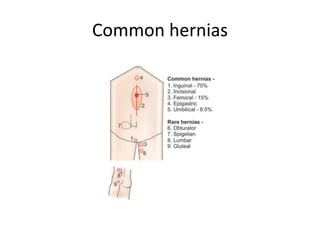
• [1] Based on site
• (a) Inguinal
• (b) Femoral
• (c) Umbilical
• (d) Para-umbilical
• (e) Epigastric
• (f) Spigellian
• (g) Lumbar
linea semilunaris) hernia passes through the Spigelian zone, the
zone of transition between the muscular fibres and aponeurosis
of the transversus abdominis, lateral to the rectus
• [2] Based on Clinical features
• (a) Reducible
• (b) Irreducible
• (c) Complete
• (d) Incomplete
• (e) Obstructed
• (f) Strangulated
• (g) Pantaloon- both direct and indirect sites
• [3] Based on origin
• (a) Congenital
• (b) Acquired including incisional hernias
• [4] Based on content
• (a) Omentocele-omentum
• (b) Enterocele –intestine
• ( c) Cystocele-urinary bladder
• (d) Littre’s hernia-Meckel’s diverticulum
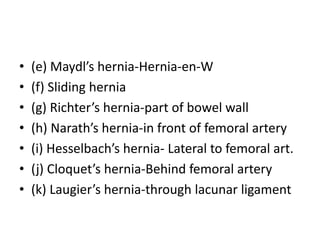
• (e) Maydl’s hernia-Hernia-en-W
• (f) Sliding hernia
• (g) Richter’s hernia-part of bowel wall
• (h) Narath’s hernia-in front of femoral artery
• (i) Hesselbach’s hernia- Lateral to femoral art.
• (j) Cloquet’s hernia-Behind femoral artery
• (k) Laugier’s hernia-through lacunar ligament
Newer Classification of inguinal
hernias
• [1] Nyhus
• Type I-Indirect hernia with normal deep ring
• Type II-Indirect hernia with dilated deep ring
• Type III- Posterior wall defect
• a-Direct hernia,Sliding hernia
• b-Pantaloon hernia
• c – Femoral
• Type IV-Recurrent herniza
• [2] Gilbert
• [3] Bendavid
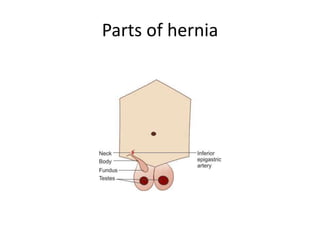
Parts of hernia
Common hernias
AETIOLOGY
• Two main factors
• [1] Defect or weakness in the abdominal wall
• [2] Repeated increased intra-abdominal
pressure
• DEFECT OR WEAKNESS OF THE WALL
• -sites of penetration of a blood vessel
• -Defect may be embryological or anatomical in
origin eg internal inguinal ring,femoral ring,
• -weakness may be due to ageing,infection
with resulting weak scars as in infected
umbilicus or abd incisions,frequent or multiple
pregnancies or deposition of fat between
muscle fibres or aponeur as in obesity
• Injury of nerves to muscles eg Gridiron incisn
• Straining may cause tear of muscular fibres
• INCREASED INTRA-ABDOMINAL PRESSURE
• -Chronic cough
• -Chronic urinary obstruction
• -Chronic constipation
• -Heavy manual work
• -Weight lifting
• -Frequent pregnancies
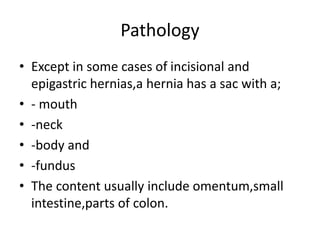
Pathology
• Except in some cases of incisional and
epigastric hernias,a hernia has a sac with a;
• - mouth
• -neck
• -body and
• -fundus
• The content usually include omentum,small
intestine,parts of colon.
Relative distribution
• MALES AND FEMALES
• TYPES GHANA USA
• [1] Inguinal 92% 82.5%
• [2] Femoral 2% 4.5%
• [3] Umbil+pa 4% 3.5%
• [4] Incisional 1% 6.5%
• [5] Others 1% 3%
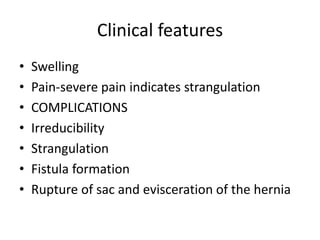
Clinical features
• Swelling
• Pain-severe pain indicates strangulation
• COMPLICATIONS
• Irreducibility
• Strangulation
• Fistula formation
• Rupture of sac and evisceration of the hernia
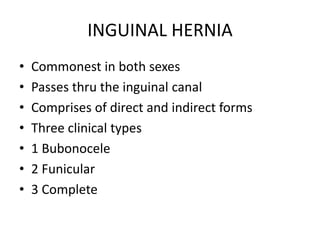
INGUINAL HERNIA
• Commonest in both sexes
• Passes thru the inguinal canal
• Comprises of direct and indirect forms
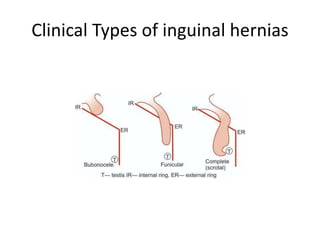
• Three clinical types
• 1 Bubonocele
• 2 Funicular
• 3 Complete
Clinical Types of inguinal hernias
Differential diagnosis of inguinal
hernia
• Femoral hernia
• Vaginal hydrocele
• Saphena varix
• Cyst of epididymis
• Inguinal lymphadenopathy
• Ectopic or undescended testis
• Encysted hydrocele of the cord
• Malgaigne’s Bulges
• Sebaceous cyst
• Cyst of canal of Nuck
• Lipoma
Treatment
• Operative treatment [Herniorrhaphy]
• Open or Laparoscopic
• Anatomic or prosthetic
• Anterior or preperitoneal
Surgeries for inguinal Hernia
• [1] Modified Bassini with Tanner slide
• [2]Shouldice
• [3]Darning
• [4]Tension free repair[Lichtenstein] is the gold
standard
Operations for femoral hernias
• [1]High approach- McEvedy
• [2]Transinguinal approach-Lotheissen
• [3]Low approach -Lockwood
Operation for inguinal hernia in
childhood
• Herniotomy is the surgery of choice
• Umbilical,paraumbilical,incisional and
epigatric hernias
• Simple or overlapping repair transversely or
vertically
• Mesh repair especially when the defect is
large
Postoperative complications
• Retention of urine
• Heamatoma
• Scrotal edema
• Wound infection
• Testicular infarction or atrophy
• Pain
• Impotence
• Recurrence

HERNIAS-1.pptx

  • 1.
    TOPIC : HERNIAS BY DROGBUANYA A, U
  • 2.
    INTRODUCTION • Defined asan abnormal protrusion of an organ or tissue through a defect in its surrounding wall • More than 600,000 hernias are repaired annually in USA, making hernia repair one of the most common operations performed by general surgeons • Abdominal wall hernias occur only at sites at which the aponeurosis and fasciae are not covered by striated muscles
  • 3.
    • These sitesmost commonly include the inguinal, femoral, umbilical area,linea alba,lower portion of the semilunar line and sites of prior incisions • The majority of abd wall hernias occur in the groin, accounting for about 75% of d total incidence • 90% of inguinal hernia repair occur in males.
  • 4.
    TYPES/CLASSIFICATION • [1] Basedon site • (a) Inguinal • (b) Femoral • (c) Umbilical • (d) Para-umbilical • (e) Epigastric • (f) Spigellian • (g) Lumbar linea semilunaris) hernia passes through the Spigelian zone, the zone of transition between the muscular fibres and aponeurosis of the transversus abdominis, lateral to the rectus
  • 5.
    • [2] Basedon Clinical features • (a) Reducible • (b) Irreducible • (c) Complete • (d) Incomplete • (e) Obstructed • (f) Strangulated • (g) Pantaloon- both direct and indirect sites
  • 6.
    • [3] Basedon origin • (a) Congenital • (b) Acquired including incisional hernias • [4] Based on content • (a) Omentocele-omentum • (b) Enterocele –intestine • ( c) Cystocele-urinary bladder • (d) Littre’s hernia-Meckel’s diverticulum
  • 7.
    • (e) Maydl’shernia-Hernia-en-W • (f) Sliding hernia • (g) Richter’s hernia-part of bowel wall • (h) Narath’s hernia-in front of femoral artery • (i) Hesselbach’s hernia- Lateral to femoral art. • (j) Cloquet’s hernia-Behind femoral artery • (k) Laugier’s hernia-through lacunar ligament
  • 8.
    Newer Classification ofinguinal hernias • [1] Nyhus • Type I-Indirect hernia with normal deep ring • Type II-Indirect hernia with dilated deep ring • Type III- Posterior wall defect • a-Direct hernia,Sliding hernia • b-Pantaloon hernia • c – Femoral • Type IV-Recurrent herniza
  • 9.
    • [2] Gilbert •[3] Bendavid
  • 10.
  • 11.
  • 12.
    AETIOLOGY • Two mainfactors • [1] Defect or weakness in the abdominal wall • [2] Repeated increased intra-abdominal pressure • DEFECT OR WEAKNESS OF THE WALL • -sites of penetration of a blood vessel • -Defect may be embryological or anatomical in origin eg internal inguinal ring,femoral ring,
  • 13.
    • -weakness maybe due to ageing,infection with resulting weak scars as in infected umbilicus or abd incisions,frequent or multiple pregnancies or deposition of fat between muscle fibres or aponeur as in obesity • Injury of nerves to muscles eg Gridiron incisn • Straining may cause tear of muscular fibres
  • 14.
    • INCREASED INTRA-ABDOMINALPRESSURE • -Chronic cough • -Chronic urinary obstruction • -Chronic constipation • -Heavy manual work • -Weight lifting • -Frequent pregnancies
  • 15.
    Pathology • Except insome cases of incisional and epigastric hernias,a hernia has a sac with a; • - mouth • -neck • -body and • -fundus • The content usually include omentum,small intestine,parts of colon.
  • 16.
    Relative distribution • MALESAND FEMALES • TYPES GHANA USA • [1] Inguinal 92% 82.5% • [2] Femoral 2% 4.5% • [3] Umbil+pa 4% 3.5% • [4] Incisional 1% 6.5% • [5] Others 1% 3%
  • 17.
    Clinical features • Swelling •Pain-severe pain indicates strangulation • COMPLICATIONS • Irreducibility • Strangulation • Fistula formation • Rupture of sac and evisceration of the hernia
  • 18.
    INGUINAL HERNIA • Commonestin both sexes • Passes thru the inguinal canal • Comprises of direct and indirect forms • Three clinical types • 1 Bubonocele • 2 Funicular • 3 Complete
  • 19.
    Clinical Types ofinguinal hernias
  • 20.
    Differential diagnosis ofinguinal hernia • Femoral hernia • Vaginal hydrocele • Saphena varix • Cyst of epididymis • Inguinal lymphadenopathy • Ectopic or undescended testis • Encysted hydrocele of the cord • Malgaigne’s Bulges
  • 21.
    • Sebaceous cyst •Cyst of canal of Nuck • Lipoma
  • 22.
    Treatment • Operative treatment[Herniorrhaphy] • Open or Laparoscopic • Anatomic or prosthetic • Anterior or preperitoneal
  • 23.
    Surgeries for inguinalHernia • [1] Modified Bassini with Tanner slide • [2]Shouldice • [3]Darning • [4]Tension free repair[Lichtenstein] is the gold standard
  • 24.
    Operations for femoralhernias • [1]High approach- McEvedy • [2]Transinguinal approach-Lotheissen • [3]Low approach -Lockwood
  • 25.
    Operation for inguinalhernia in childhood • Herniotomy is the surgery of choice
  • 26.
    • Umbilical,paraumbilical,incisional and epigatrichernias • Simple or overlapping repair transversely or vertically • Mesh repair especially when the defect is large
  • 27.
    Postoperative complications • Retentionof urine • Heamatoma • Scrotal edema • Wound infection • Testicular infarction or atrophy • Pain • Impotence • Recurrence