Beyond Budget and Scope Managing Client Expectations and Delivering Value Vanessa Turke Solution Architect ImageX Media
agenda & goals of this presentation Why a Drupal project may fall short of client expectations Defining customer satisfaction, quality and value Setting the stage for understanding client expectations Techniques for optimizing project communications Pursuing the goal of delivering value with every project
drupal firm  | user experience
drupal firm user   experience "How do customers perceive us?"
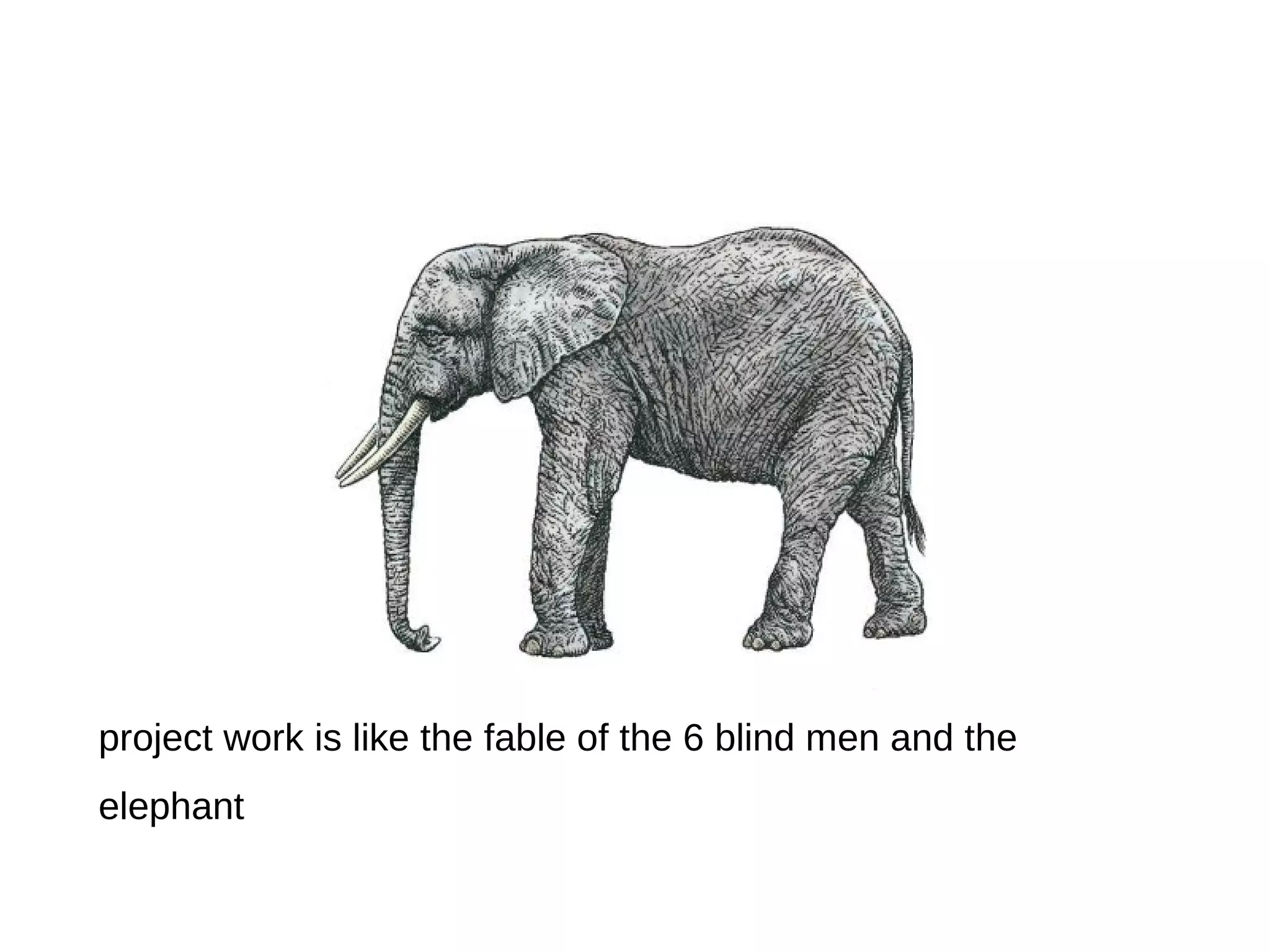
project work is like the fable of the 6 blind men and the elephant
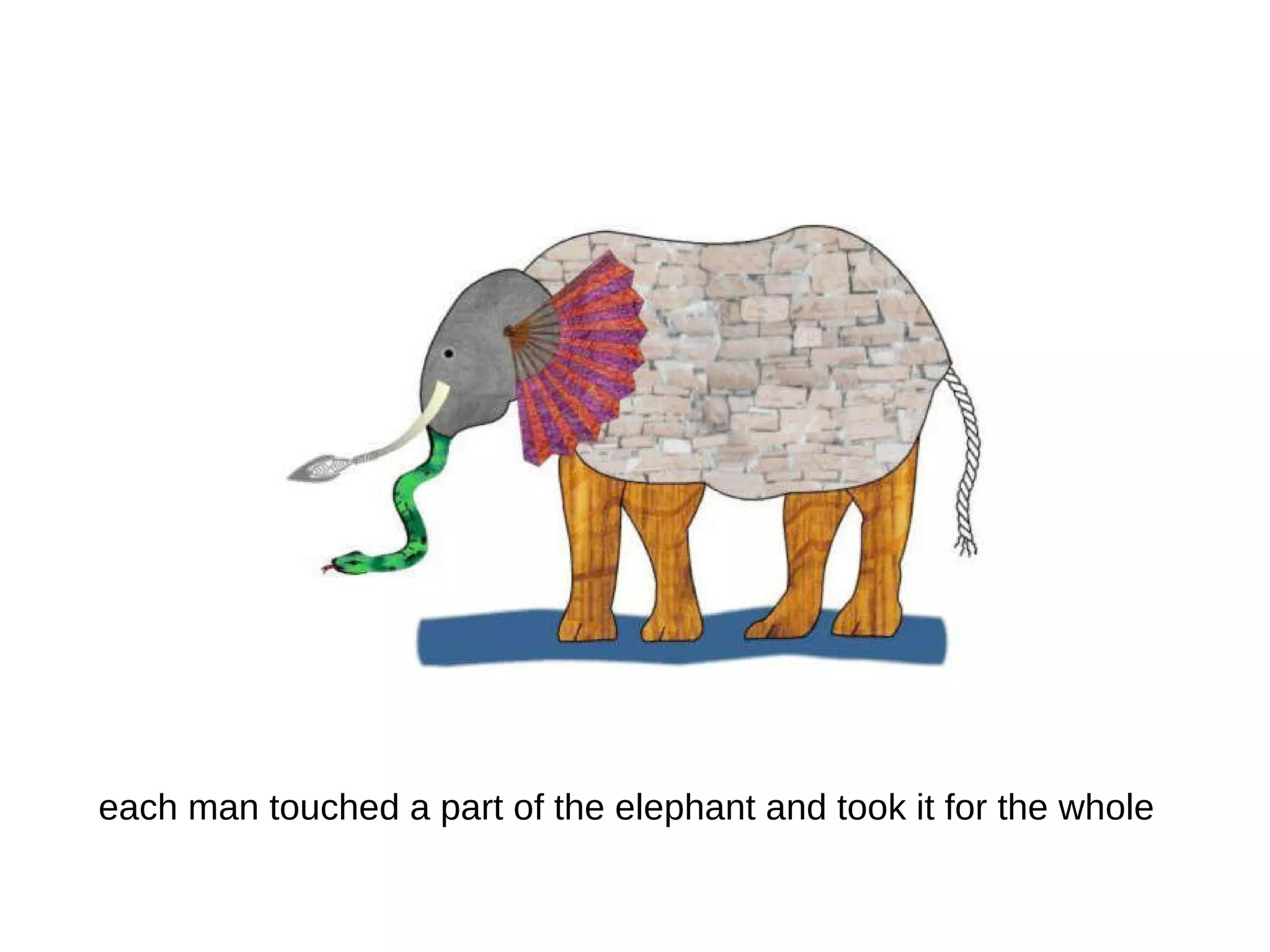
each man touched a part of the elephant and took it for the whole
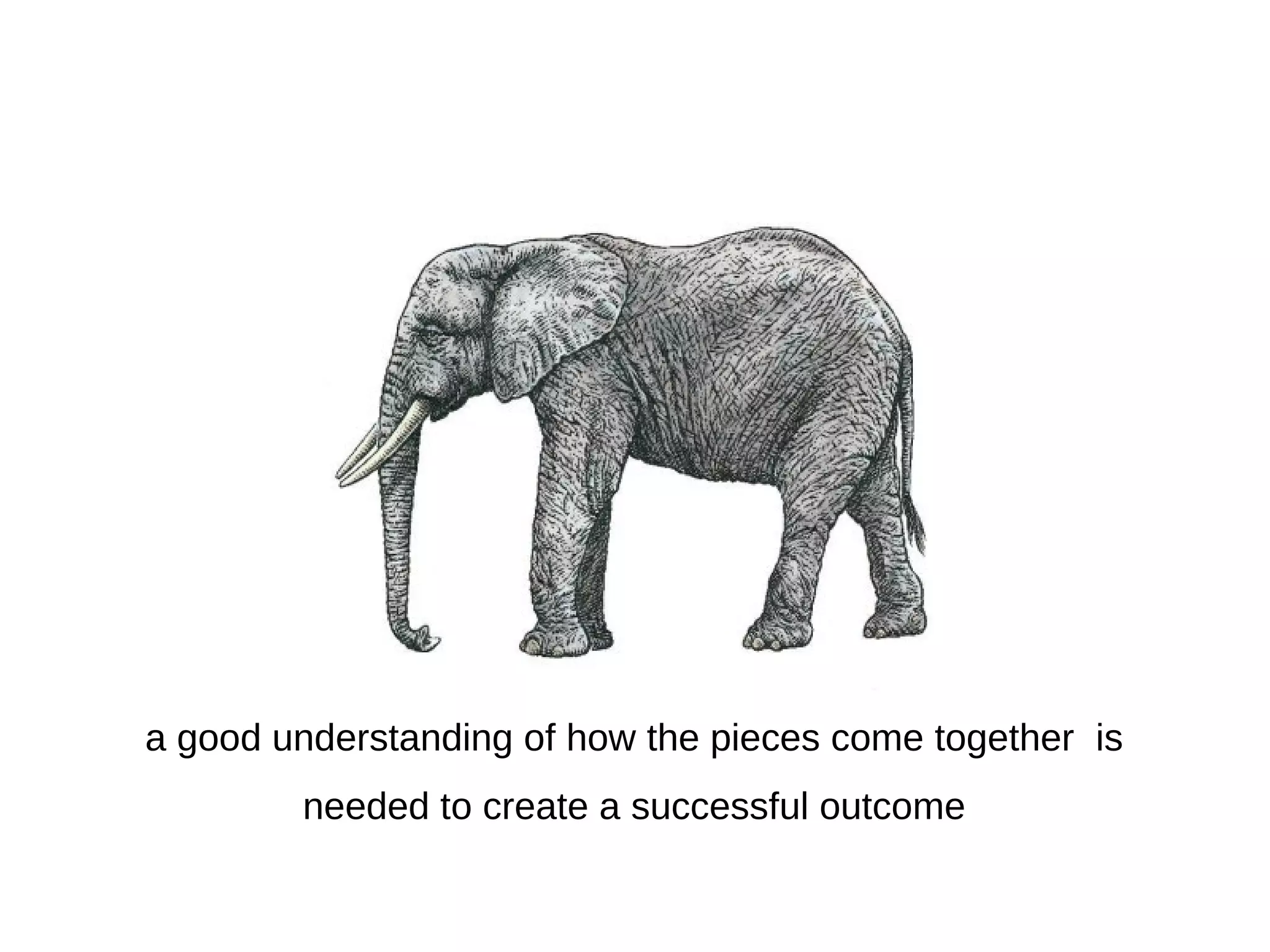
a good understanding of how the pieces come together  is needed to create a successful outcome
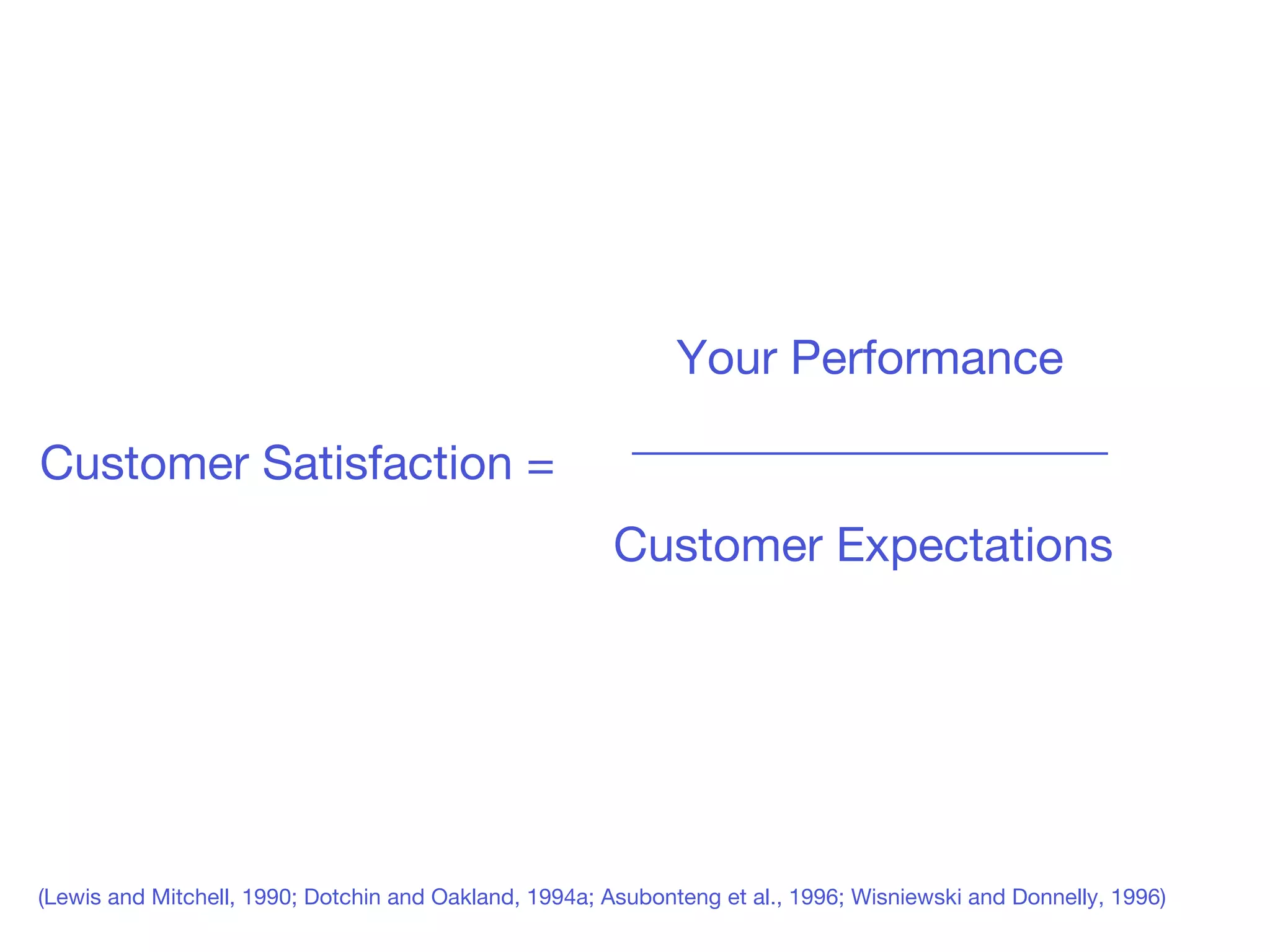
Customer Satisfaction =  Your Performance ____________________ Customer Expectations  (Lewis and Mitchell, 1990; Dotchin and Oakland, 1994a; Asubonteng et al., 1996; Wisniewski and Donnelly, 1996)
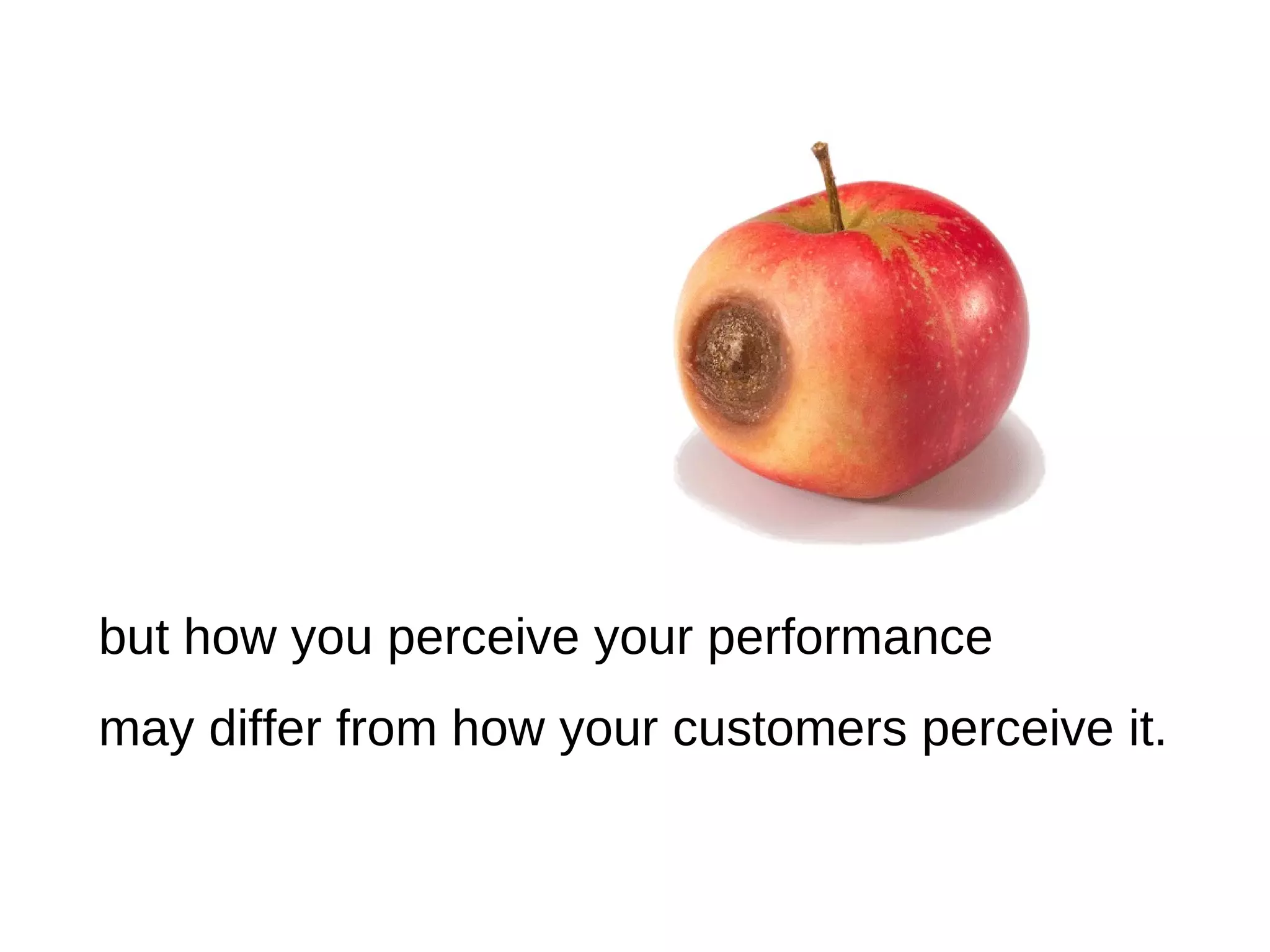
but how you perceive your performance  may differ from how your customers perceive it.
have you ever been happy with a product or service, but would never deal with that particular service provider again because of how you were treated?
a study that author Naomi Karten talks about in her presentations shows that that this happens more than we think
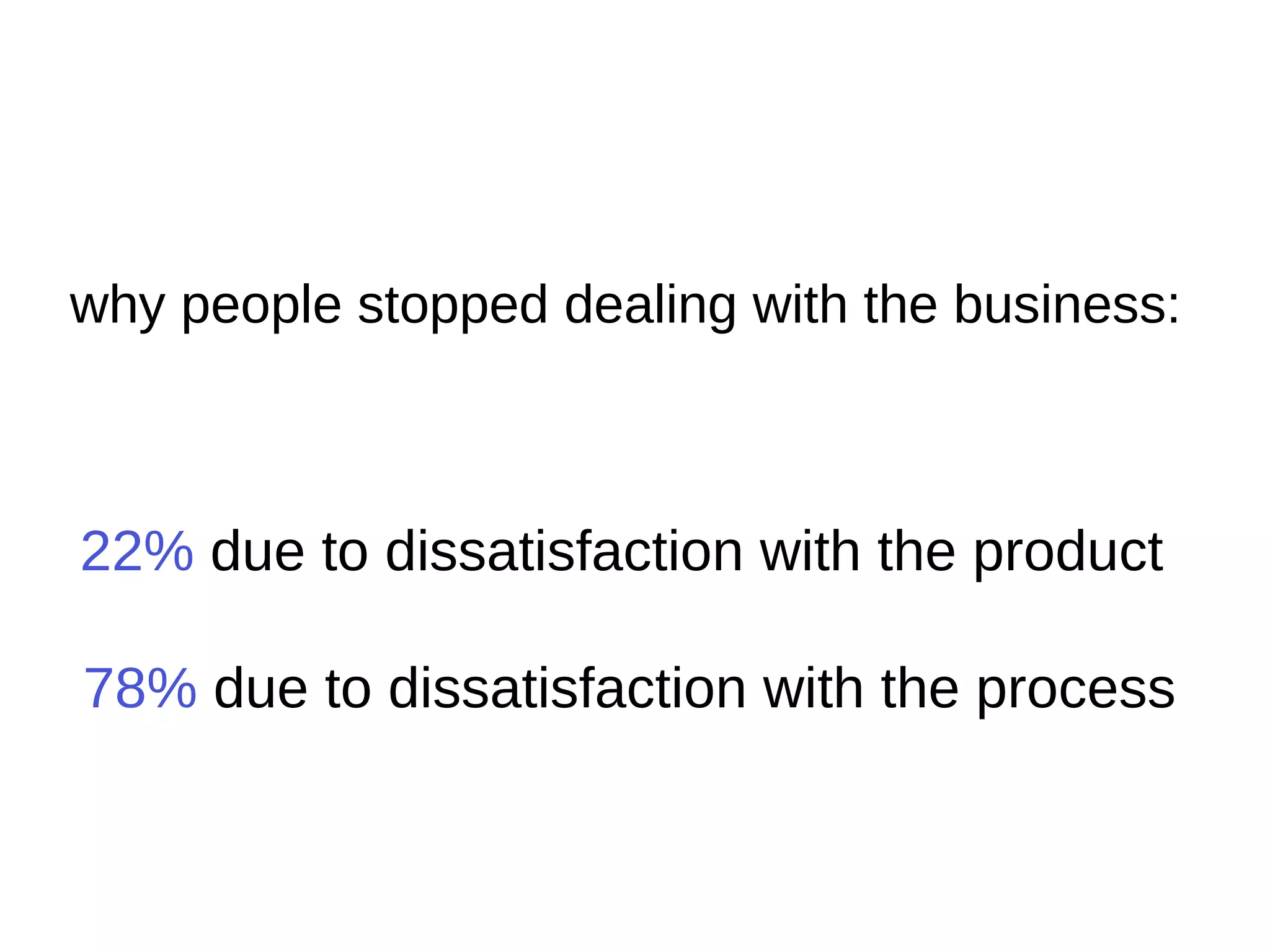
22%  due to dissatisfaction with the  product   78%  due to dissatisfaction with the  process why people stopped dealing with the business:
conceptualization of service quality Tangibles  - equipment, facilities & appearances Assurance  - competence, credibility, security, trust Reliability  - dependable, accurate, on time & on budget Responsiveness  - service, communication & helpfulness Empathy  - attention, caring & understanding (SERVQUAL methodology based factors)
project processes or stages Initiation Planning Execution Monitoring and Controlling Closure
what do clients expect? “ In a competitive and depressed economic climate, [your customers] want to know that any IT project they undertake will deliver a significant return on investment.” (Project management researchers, Reich, Gemino, Sauer (2010) SFU)
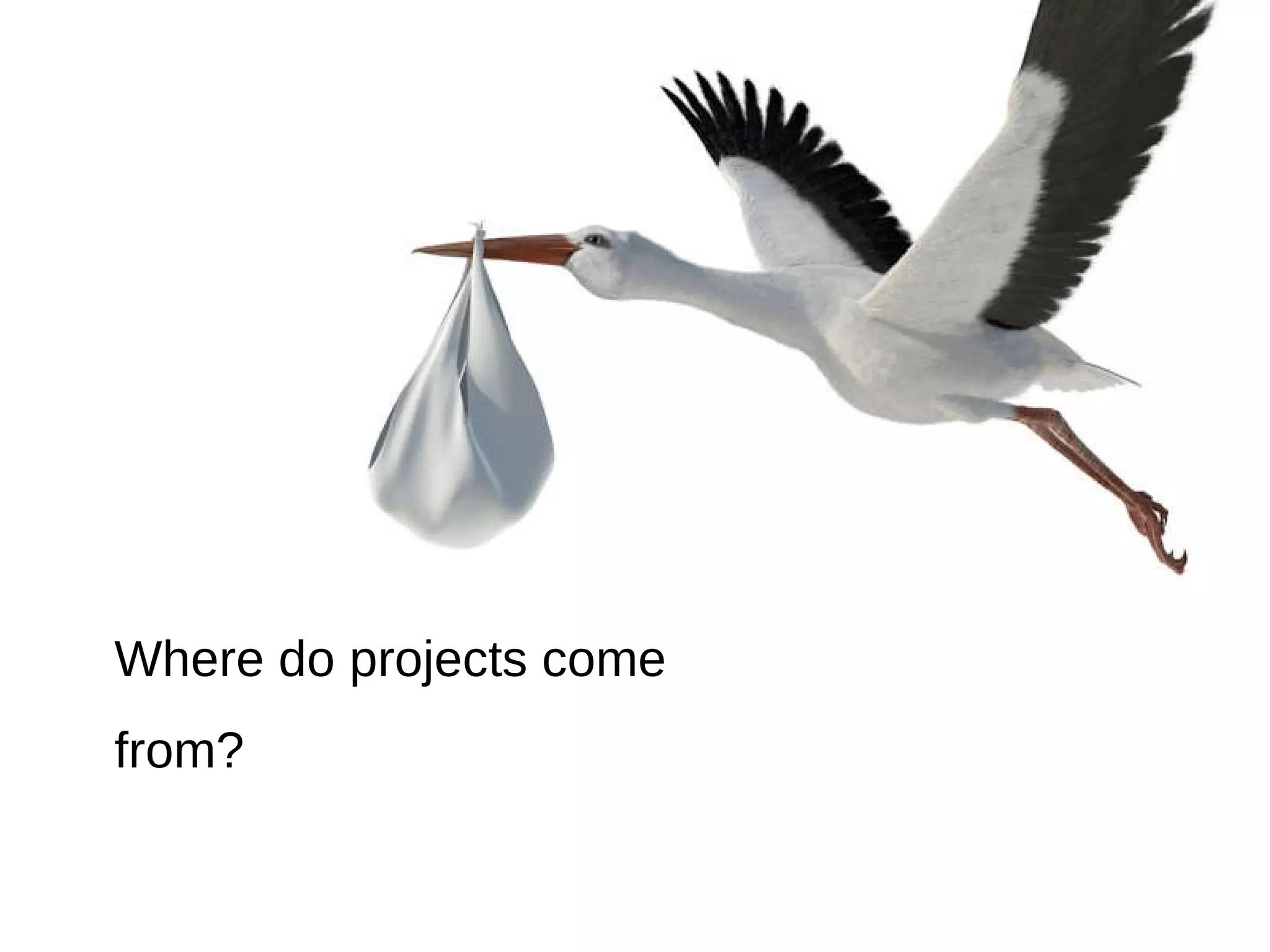
Where do projects come from?
organizational culture Organizational structure Level of technical ability Philosophy Technologies Communication style Decision-making style Flexibility and constraints
creating a project strategy What is the business goal of the website? What is the mission critical task for a user to complete?
why do people start web projects? Site looks outdated Company President said we need one Marketing Department launching new product Extra funding to be spent by year-end Tech-guy quit and no one else can update the site Adding social media features Everyone should have a website The next great idea
website type Brand Presence Marketing Campaign Content Source Task-based application E-Commerce E-Learning Social Network
what is value? “ [value is] the relationship between the consumer's perceived benefits in relation to the perceived costs of receiving these benefits.”  ~wikipedia
quality is a loaded word... Quality  is goodness, luxury or expense Quality  intangible and not measurable Quality  leads excessive expense Quality  problems arise from sloppy work or lack of employee concern Quality  is the responsibility of the quality assurance department
what is the cost of poor quality? Dissatisfied customers Declining revenue Excessive number of defects & delays Excessively long timeline Excessive costs: rework, late deliveries, loss of customers High conversion costs Under utilization of capacity Multiple or inconsistent problem-solving approaches Employee dissatisfaction and low morale
what is quality? "Quality is the degree to which a specific product satisfies the wants of a specific consumer." "Quality is the degree to which a specific product conforms to a design or specification." (H.L. Gilmore, "Product Conformance Cost," Quality Progress, June 1974, p.16).
“ I’ll know it when I see it...”
what is a quality product? One that meets customer standards,  Meets and fulfills customer needs,  Meets customer expectations, and  Will meet unanticipated future needs and aspirations (Gitlow et al., 1989 or Ozeki and Asaka, 1990)
what is quality? "Quality is fitness for use."   ~ J.M Juran (1988)
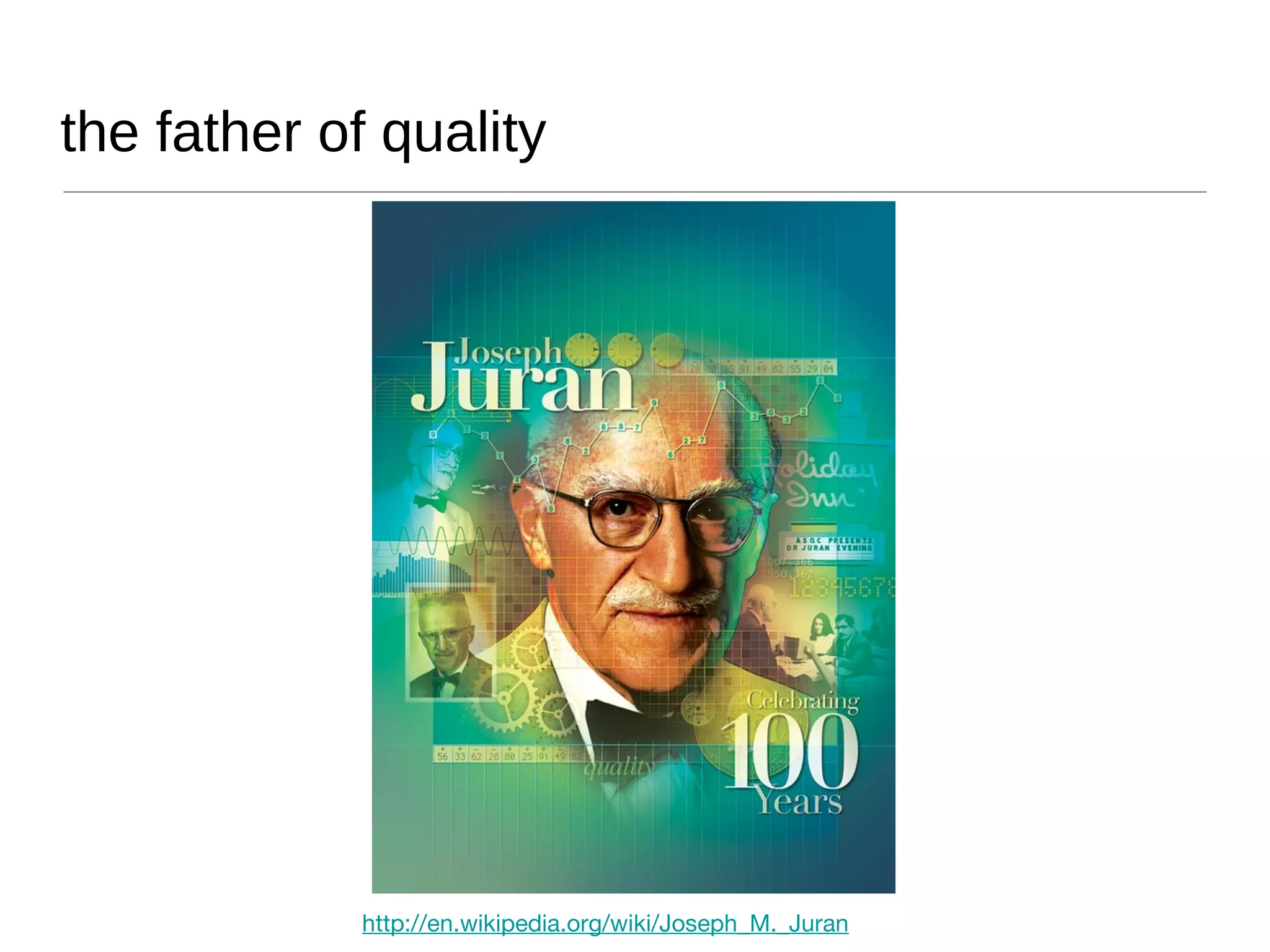
the father of quality http://en.wikipedia.org/wiki/Joseph_M._Juran
perfect is the enemy of the good "Le mieux est l'ennemi du bien." ~ from Voltaire's Dictionnaire Philosophique (1764)
Initiating Sales, Contracts Defining the project Creating initial documentation, RFP, SOW, etc. Relationship building Putting together the project team Identifying project goals and objectives
kickoff meeting Introductions & overview of the project Identifying current site challenges Identifying Stakeholders Overview of the process so far Role the website plays in the organization Defining project objectives discussion Identifying success criteria for stakeholders
process overview Overview of the process Typical roadblocks encountered Communications plan discussion Managing scope discussion Identifying risks and constraints Reviewing scheduling issues Review initial timeline & milestones
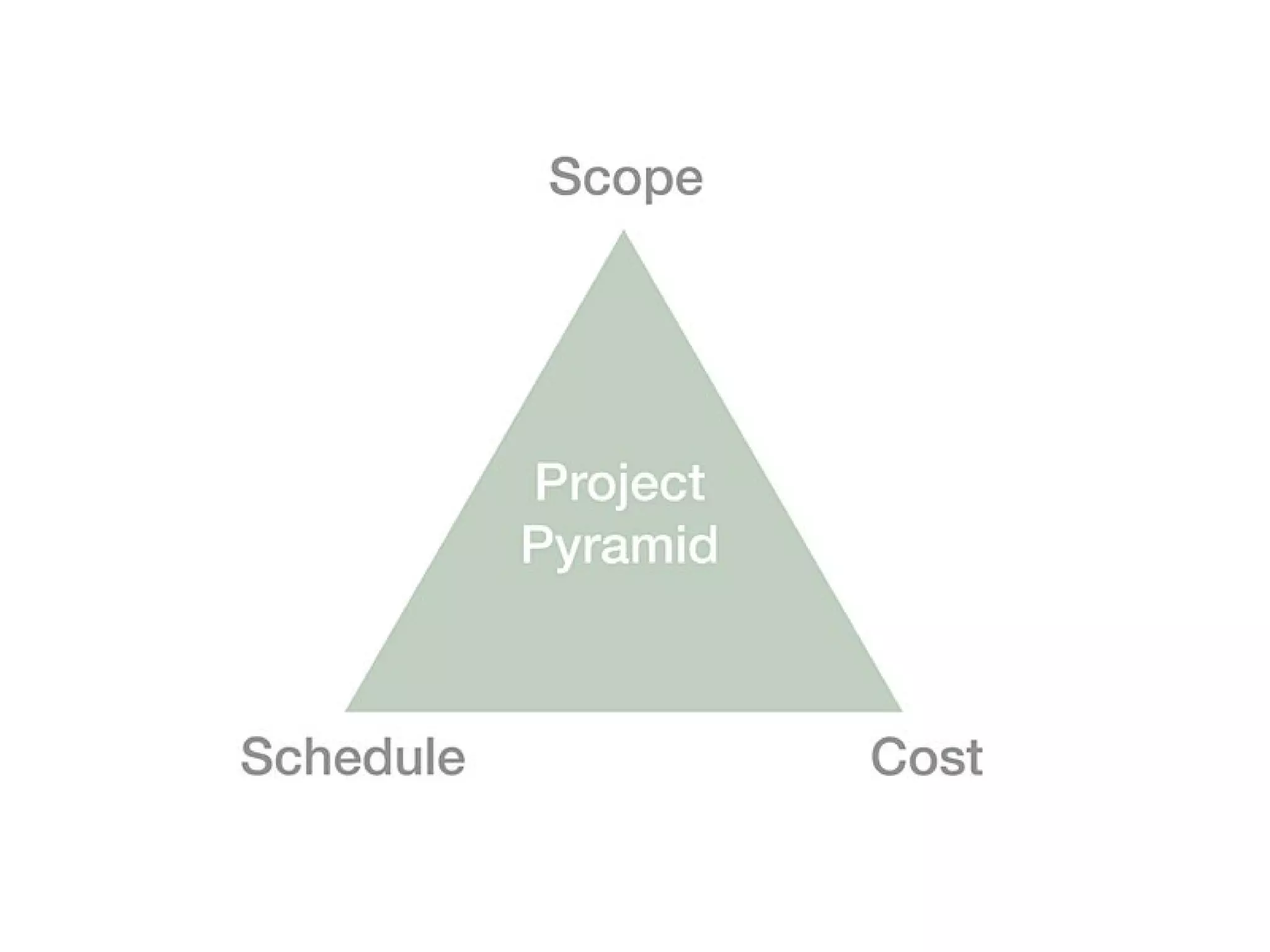
scope schedule  cost
planning for slippage in advance Should features be deferred? Can the schedule be allowed to slip? By how much? Can you add staff or pay for overtime to meet the new schedule? Can quality slip because sound processes and quality control practices are neglected in the press to ship?
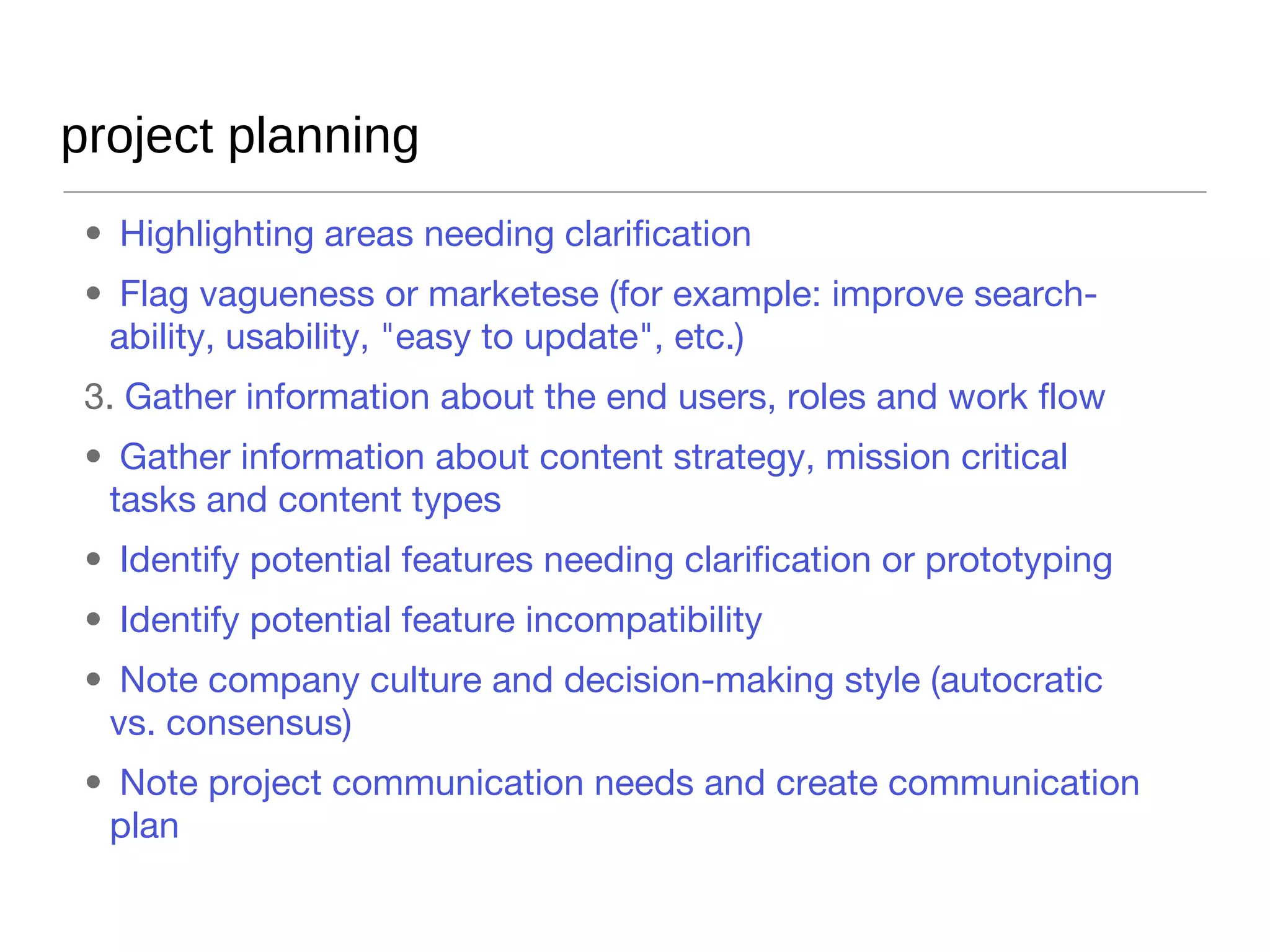
project planning Highlighting areas needing clarification Flag vagueness or marketese (for example: improve search-ability, usability, "easy to update", etc.) Gather information about the end users, roles and work flow Gather information about content strategy, mission critical tasks and content types Identify potential features needing clarification or prototyping Identify potential feature incompatibility Note company culture and decision-making style (autocratic vs. consensus) Note project communication needs and create communication plan
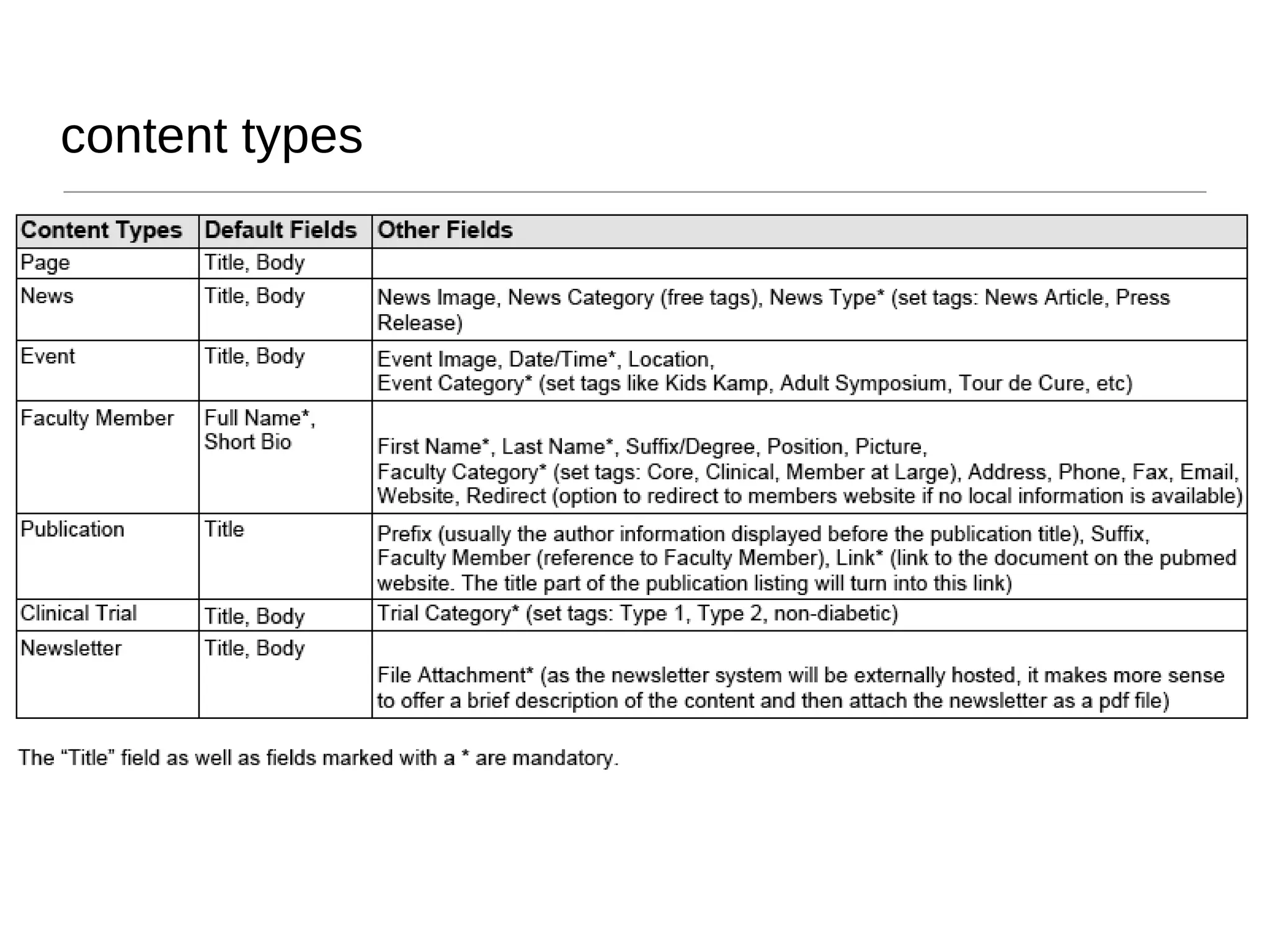
content types
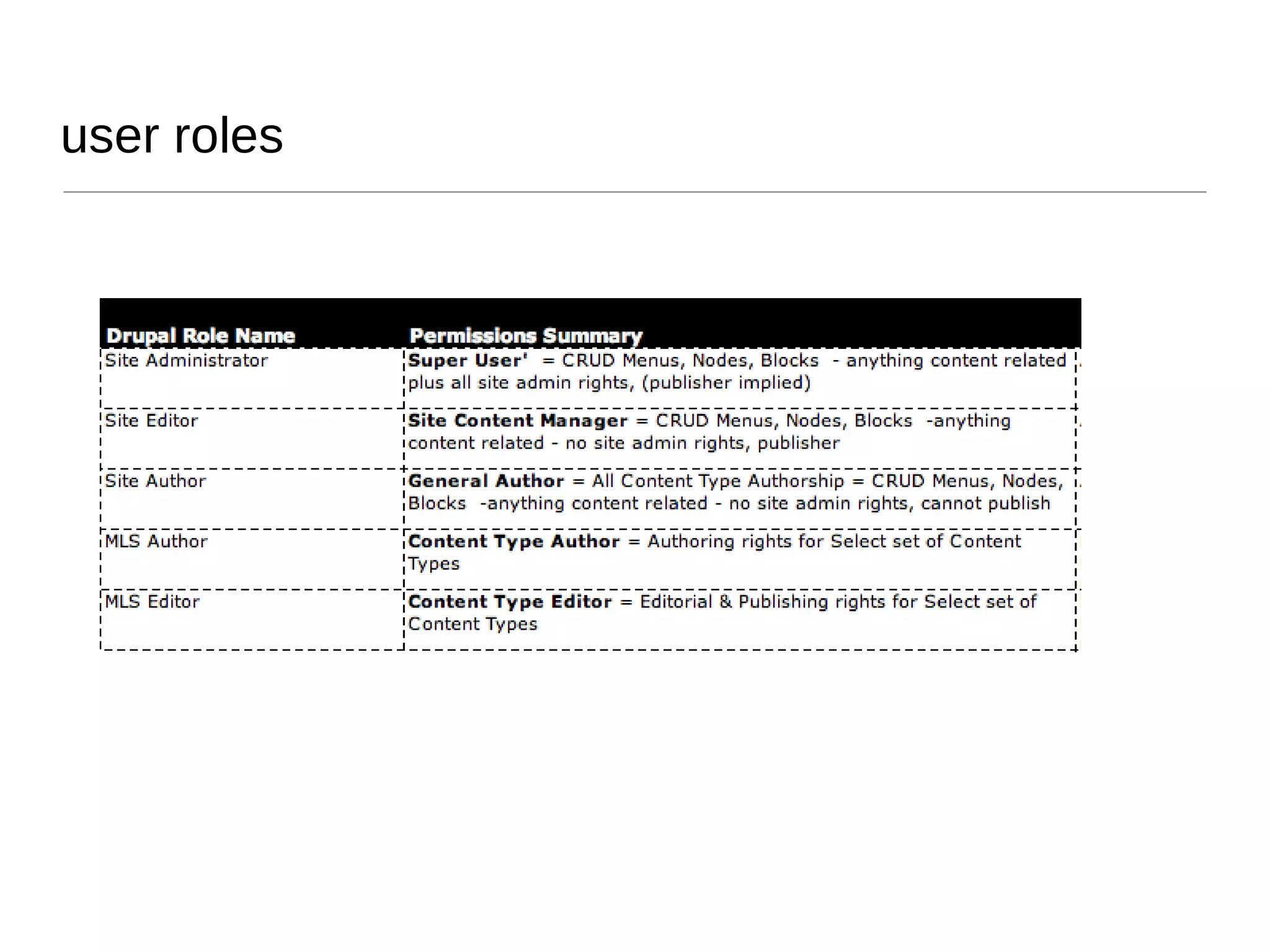
user roles
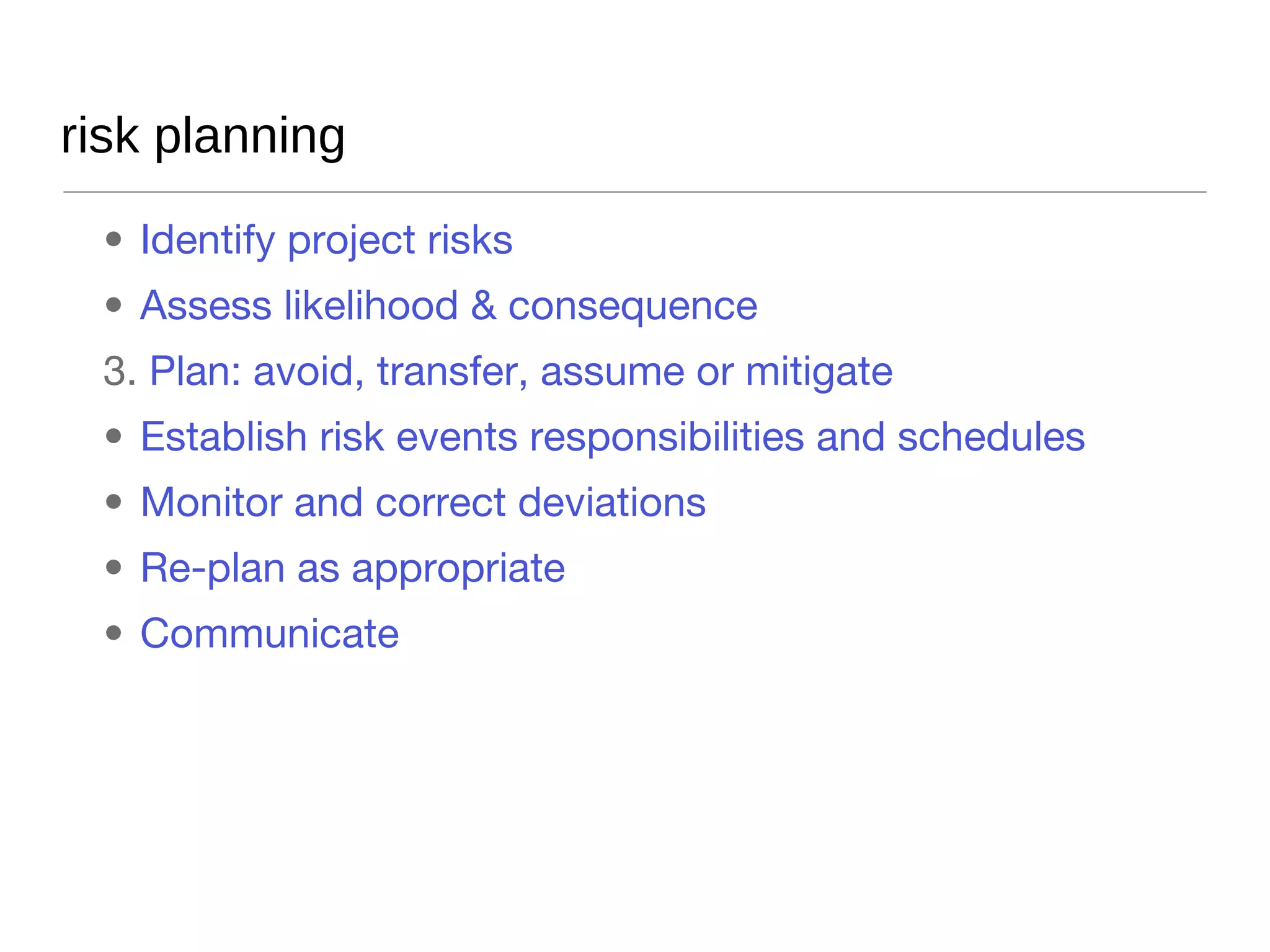
risk planning Identify project risks Assess likelihood & consequence Plan: avoid, transfer, assume or mitigate Establish risk events responsibilities and schedules Monitor and correct deviations Re-plan as appropriate Communicate
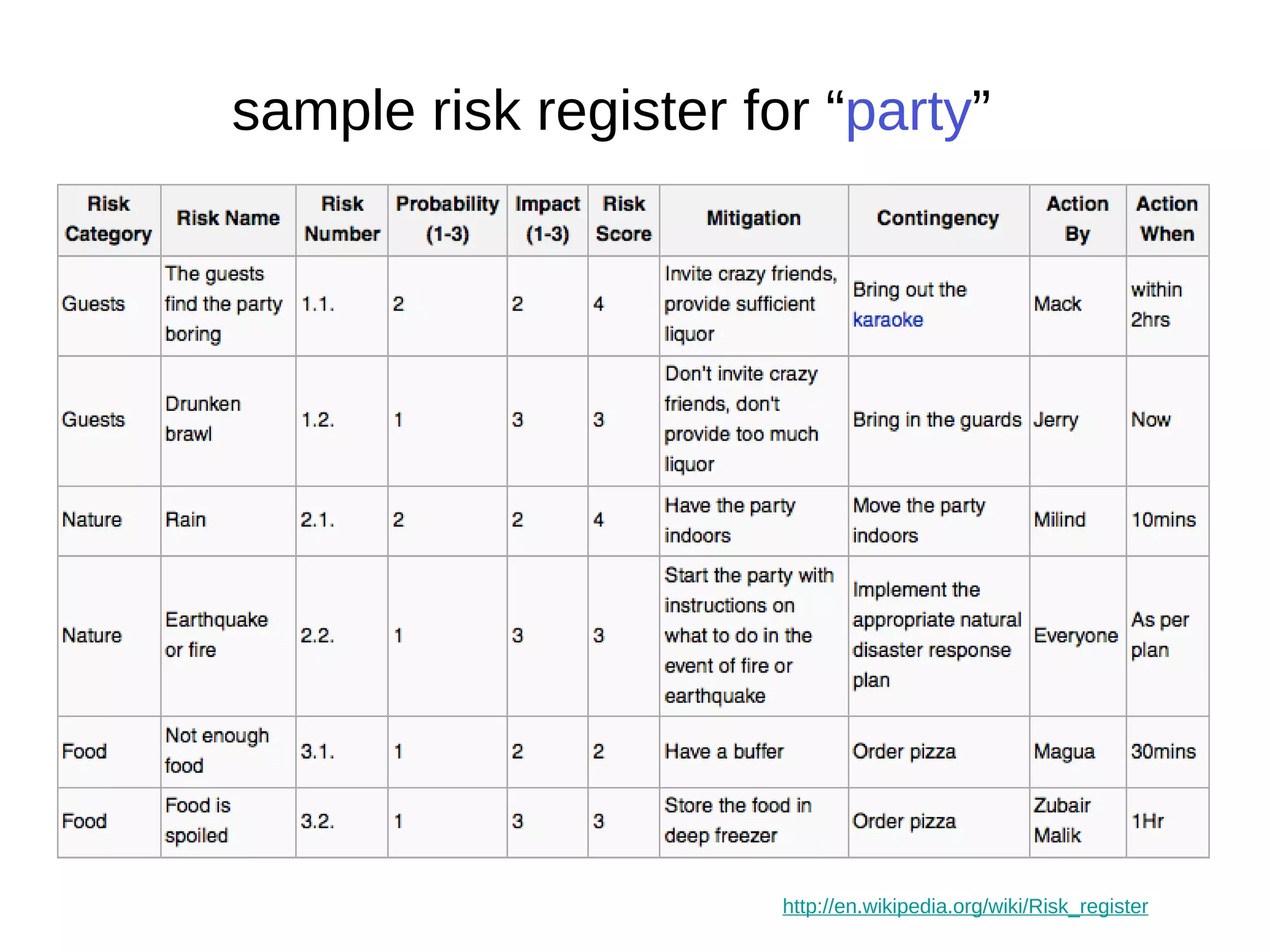
sample risk register for “ party ” http://en.wikipedia.org/wiki/Risk_register
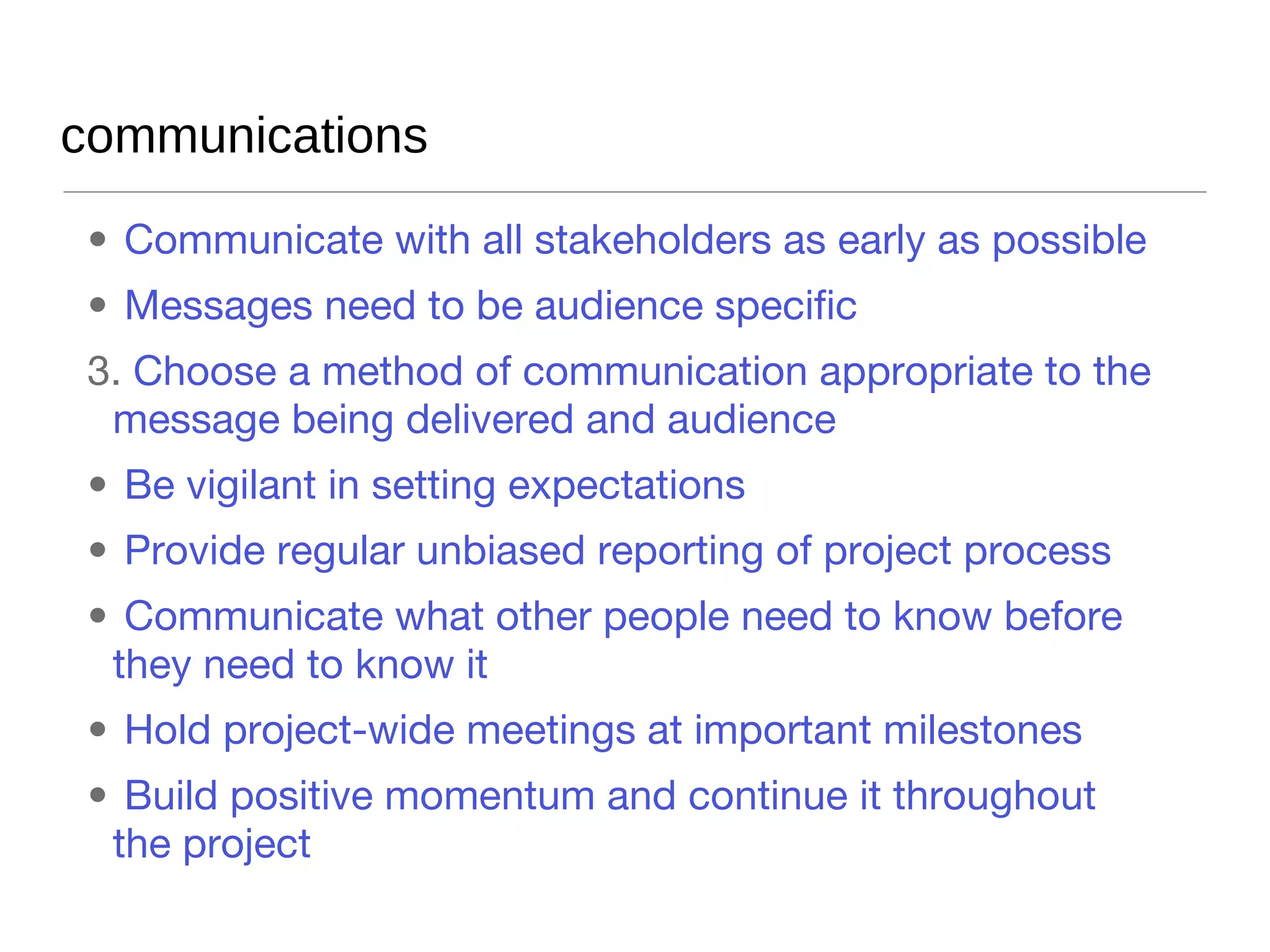
communications  Communicate with all stakeholders as early as possible  Messages need to be audience specific Choose a method of communication appropriate to the message being delivered and audience Be vigilant in setting expectations Provide regular unbiased reporting of project process Communicate what other people need to know before they need to know it Hold project-wide meetings at important milestones Build positive momentum and continue it throughout the project
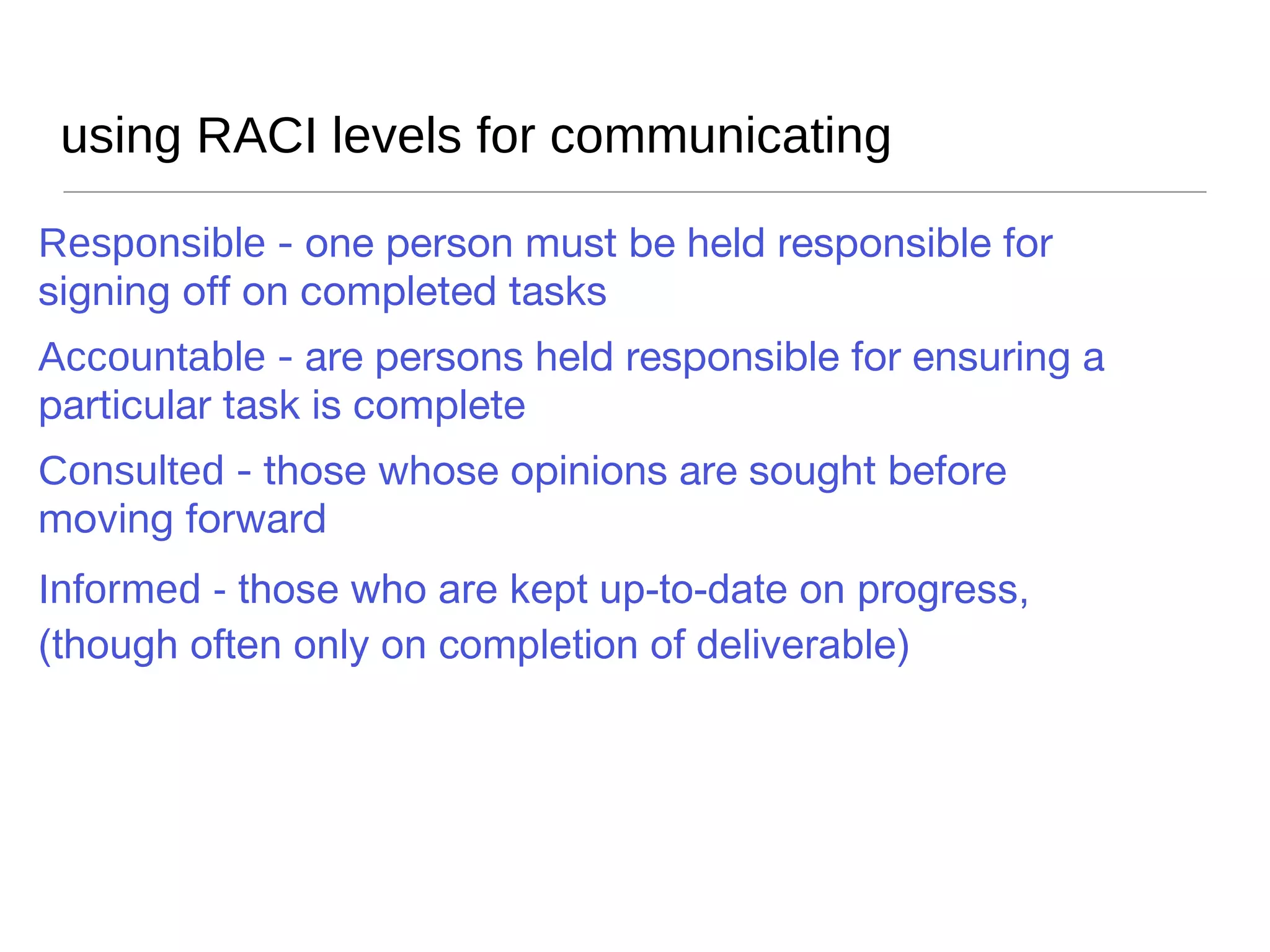
using RACI levels for communicating  Responsible  - one person must be held responsible for signing off on completed tasks Accountable  - are persons held responsible for ensuring a particular task is complete Consulted  - those whose opinions are sought before moving forward Informed -  those who are kept up-to-date on progress, (though often only on completion of deliverable)
monitoring & controlling Communicate with stakeholders as per expectations  Use tools you are comfortable with to monitor effort, duration, budget and schedule  Provide regular unbiased reporting of project process  Report slippage immediately  Review process and progress at important milestones
resistance is common (drupal can be scary) Even if its good, change can feel bad Do not expect or demand an instantaneous adjustment Accept that a certain amount of pushback is inevitable, and allow for it Acknowledge the turbulence people are experiencing and empathize with their concerns Do not focus entirely on the technical aspects of the change, ignoring the human aspects
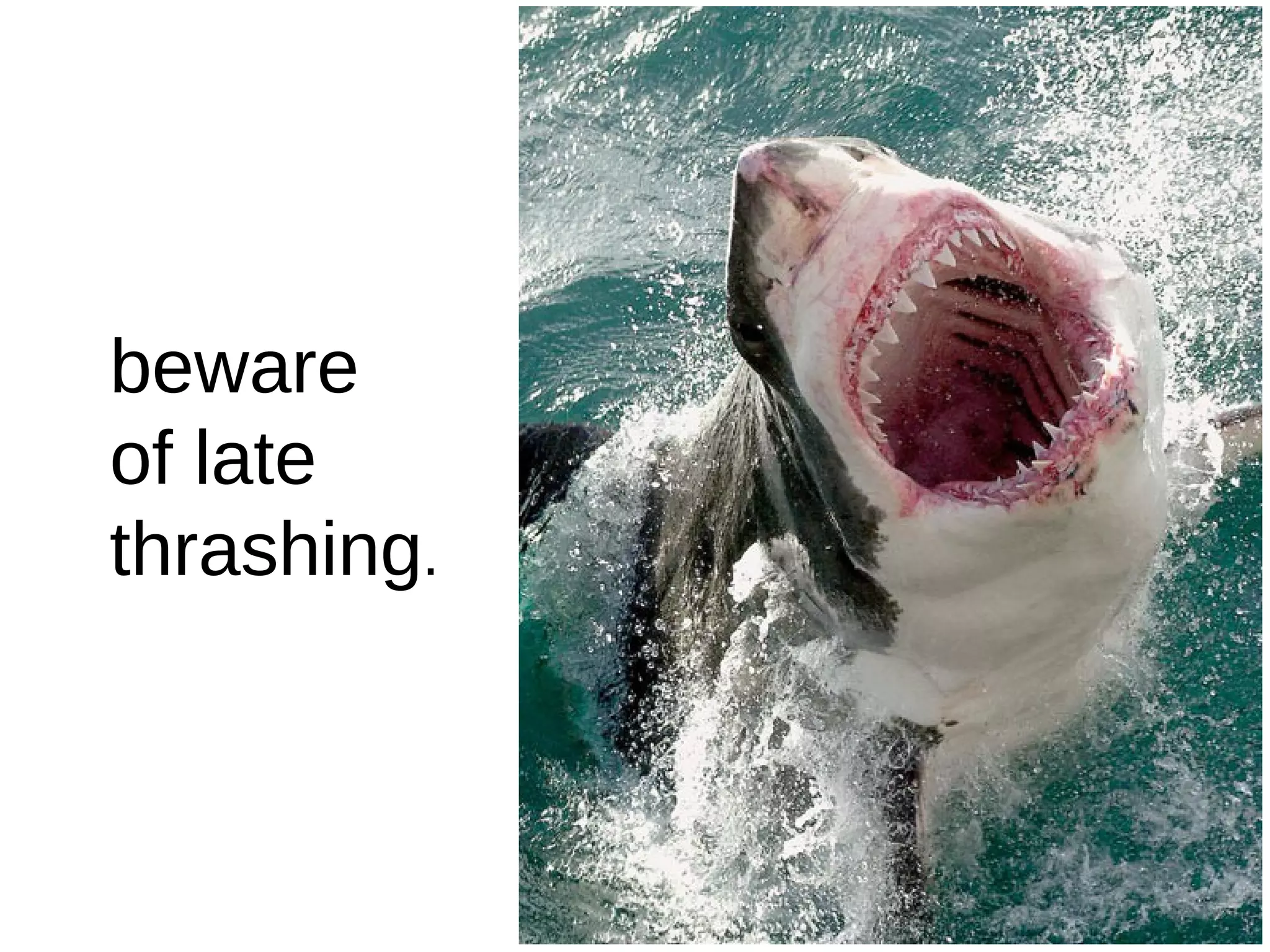
beware of late thrashing .
the tendency, that as a project comes together... More people will want to have influence in the final product  People will want to change the product People will want to make last minute revisions and tweaks People will want to please as many people as possible People want the project to be a success and want to make it “perfect” Godin, Seth.  Linchpin, Are You Indispensable . New York: Portfolio, 2010
thrashing is normal and helpful if you... Thrash early (the earlier the better) Make some ground rules that everyone from the top down has to follow Set goals, priorities to bring the project to its full potential Allow fewer and fewer decision makers as the process continues Godin, Seth.  Linchpin, Are You Indispensable . New York: Portfolio, 2010
types of scope changes Uncontested scope changes Contested scope changes Scope creep Constructive scope changes
sources of scope changes Overt client requests Covert client requests Smuggled requirements Project team enthusiasm
controlling scope changes During kickoff meeting review the scope, including what has been identified as  out of scope Ensure scope is included in orientation materials Make sure scope remains easily accessible to team members throughout the project Review scope on a regular basis When a critical decision is to be made regarding the project, ensure it is weighed against the scope
uh oh .
overruns Schedule  - The project will finish late Effort  - The project will need more resources Cost  - The project will exceed it's budget
bearing bad news Problem  - present the issue in an unbiased way Solution(s)  - present the possible solutions Action  - suggest a recommended solution (and next steps)
teamwork & finding purpose "Without explicit purpose, project work tends to shift from raging enthusiasm into utter meaninglessness... imperceptibly"  ~ David Schmaltz, The Blind Men and the Elephant
closing the project “ Some projects end simply because people have stopped working on them.”
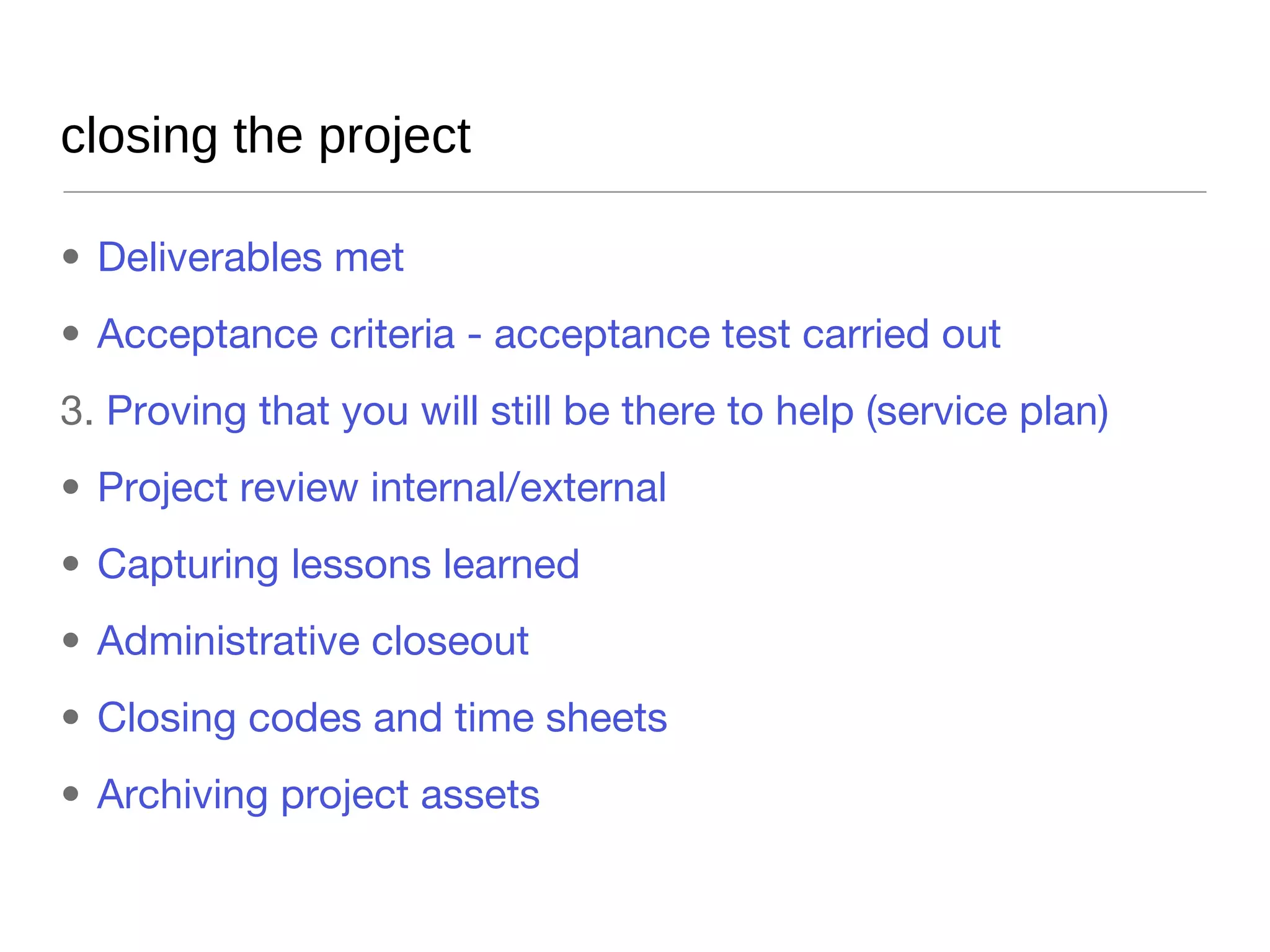
closing the project Deliverables met Acceptance criteria - acceptance test carried out Proving that you will still be there to help (service plan) Project review internal/external Capturing lessons learned Administrative closeout Closing codes and time sheets Archiving project assets
creating value “ There’s more to it than wireframes, logos, sitemaps, or stationary systems. A good brand is resultant upon aligning an organization’s values realistically and building something around this that resonates and holds value for potential customers” smashLAB's, Eric Karjaluoto
presentation references Karten, Naomi.  Managing Expectations . New York: Dorset House Publishing, 1994 Glen, Paul.  Leading Geeks, How to Manage and Lead People Who Deliver Technology . San Francisco: Jossey-Bass, 2003 Godin, Seth.  Linchpin, Are You Indispensable . New York: Portfolio, 2010 Whitely, Richard.  The Customer Driven Company . Wakefield, MA, 1991 http://mot.vuse.vanderbilt.edu/mt322/Whatis.htm http://en.wikipedia.org/wiki/Value_(marketing) http://www.juran.com/solutions_improve_processes_lean_sigma_six.html http://www.pmperspectives.org/article.php?aid=28&view=full&sid=cb3ede47cb17de6e050d4a8f6863714b http://continuingeducation.construction.com/article.php?L=104&C=384&P=3 Carolyn Chandler & Unger, Russ. Project Guide to UX Design, A: For user experience designers in the field or in the making: New Riders, the Voices That Matter series, 2009 http://www.scribd.com/doc/3777628/Service-Gaps-and-SERVQUAL
thank you! Vanessa Turke http://imagexmedia.com/vanessa http://vanessaturke.net/

Beyond Budget and Scope: Managing Client Expectations and Delivering Value

  • 1.
    Beyond Budget andScope Managing Client Expectations and Delivering Value Vanessa Turke Solution Architect ImageX Media
  • 2.
    agenda & goalsof this presentation Why a Drupal project may fall short of client expectations Defining customer satisfaction, quality and value Setting the stage for understanding client expectations Techniques for optimizing project communications Pursuing the goal of delivering value with every project
  • 3.
    drupal firm | user experience
  • 4.
    drupal firm user experience "How do customers perceive us?"
  • 5.
    project work islike the fable of the 6 blind men and the elephant
  • 6.
    each man toucheda part of the elephant and took it for the whole
  • 7.
    a good understandingof how the pieces come together is needed to create a successful outcome
  • 8.
    Customer Satisfaction = Your Performance ____________________ Customer Expectations (Lewis and Mitchell, 1990; Dotchin and Oakland, 1994a; Asubonteng et al., 1996; Wisniewski and Donnelly, 1996)
  • 9.
    but how youperceive your performance may differ from how your customers perceive it.
  • 10.
    have you everbeen happy with a product or service, but would never deal with that particular service provider again because of how you were treated?
  • 11.
    a study thatauthor Naomi Karten talks about in her presentations shows that that this happens more than we think
  • 12.
    22% dueto dissatisfaction with the product 78% due to dissatisfaction with the process why people stopped dealing with the business:
  • 13.
    conceptualization of servicequality Tangibles - equipment, facilities & appearances Assurance - competence, credibility, security, trust Reliability - dependable, accurate, on time & on budget Responsiveness - service, communication & helpfulness Empathy - attention, caring & understanding (SERVQUAL methodology based factors)
  • 14.
    project processes orstages Initiation Planning Execution Monitoring and Controlling Closure
  • 15.
    what do clientsexpect? “ In a competitive and depressed economic climate, [your customers] want to know that any IT project they undertake will deliver a significant return on investment.” (Project management researchers, Reich, Gemino, Sauer (2010) SFU)
  • 16.
  • 17.
    organizational culture Organizationalstructure Level of technical ability Philosophy Technologies Communication style Decision-making style Flexibility and constraints
  • 18.
    creating a projectstrategy What is the business goal of the website? What is the mission critical task for a user to complete?
  • 19.
    why do peoplestart web projects? Site looks outdated Company President said we need one Marketing Department launching new product Extra funding to be spent by year-end Tech-guy quit and no one else can update the site Adding social media features Everyone should have a website The next great idea
  • 20.
    website type BrandPresence Marketing Campaign Content Source Task-based application E-Commerce E-Learning Social Network
  • 21.
    what is value?“ [value is] the relationship between the consumer's perceived benefits in relation to the perceived costs of receiving these benefits.” ~wikipedia
  • 22.
    quality is aloaded word... Quality is goodness, luxury or expense Quality intangible and not measurable Quality leads excessive expense Quality problems arise from sloppy work or lack of employee concern Quality is the responsibility of the quality assurance department
  • 23.
    what is thecost of poor quality? Dissatisfied customers Declining revenue Excessive number of defects & delays Excessively long timeline Excessive costs: rework, late deliveries, loss of customers High conversion costs Under utilization of capacity Multiple or inconsistent problem-solving approaches Employee dissatisfaction and low morale
  • 24.
    what is quality?"Quality is the degree to which a specific product satisfies the wants of a specific consumer." "Quality is the degree to which a specific product conforms to a design or specification." (H.L. Gilmore, "Product Conformance Cost," Quality Progress, June 1974, p.16).
  • 25.
    “ I’ll knowit when I see it...”
  • 26.
    what is aquality product? One that meets customer standards, Meets and fulfills customer needs, Meets customer expectations, and Will meet unanticipated future needs and aspirations (Gitlow et al., 1989 or Ozeki and Asaka, 1990)
  • 27.
    what is quality?"Quality is fitness for use." ~ J.M Juran (1988)
  • 28.
    the father ofquality http://en.wikipedia.org/wiki/Joseph_M._Juran
  • 29.
    perfect is theenemy of the good "Le mieux est l'ennemi du bien." ~ from Voltaire's Dictionnaire Philosophique (1764)
  • 30.
    Initiating Sales, ContractsDefining the project Creating initial documentation, RFP, SOW, etc. Relationship building Putting together the project team Identifying project goals and objectives
  • 31.
    kickoff meeting Introductions& overview of the project Identifying current site challenges Identifying Stakeholders Overview of the process so far Role the website plays in the organization Defining project objectives discussion Identifying success criteria for stakeholders
  • 32.
    process overview Overviewof the process Typical roadblocks encountered Communications plan discussion Managing scope discussion Identifying risks and constraints Reviewing scheduling issues Review initial timeline & milestones
  • 33.
  • 34.
    planning for slippagein advance Should features be deferred? Can the schedule be allowed to slip? By how much? Can you add staff or pay for overtime to meet the new schedule? Can quality slip because sound processes and quality control practices are neglected in the press to ship?
  • 35.
    project planning Highlightingareas needing clarification Flag vagueness or marketese (for example: improve search-ability, usability, "easy to update", etc.) Gather information about the end users, roles and work flow Gather information about content strategy, mission critical tasks and content types Identify potential features needing clarification or prototyping Identify potential feature incompatibility Note company culture and decision-making style (autocratic vs. consensus) Note project communication needs and create communication plan
  • 36.
  • 37.
  • 38.
    risk planning Identifyproject risks Assess likelihood & consequence Plan: avoid, transfer, assume or mitigate Establish risk events responsibilities and schedules Monitor and correct deviations Re-plan as appropriate Communicate
  • 39.
    sample risk registerfor “ party ” http://en.wikipedia.org/wiki/Risk_register
  • 40.
    communications Communicatewith all stakeholders as early as possible Messages need to be audience specific Choose a method of communication appropriate to the message being delivered and audience Be vigilant in setting expectations Provide regular unbiased reporting of project process Communicate what other people need to know before they need to know it Hold project-wide meetings at important milestones Build positive momentum and continue it throughout the project
  • 41.
    using RACI levelsfor communicating Responsible - one person must be held responsible for signing off on completed tasks Accountable - are persons held responsible for ensuring a particular task is complete Consulted - those whose opinions are sought before moving forward Informed - those who are kept up-to-date on progress, (though often only on completion of deliverable)
  • 42.
    monitoring & controllingCommunicate with stakeholders as per expectations Use tools you are comfortable with to monitor effort, duration, budget and schedule Provide regular unbiased reporting of project process Report slippage immediately Review process and progress at important milestones
  • 43.
    resistance is common(drupal can be scary) Even if its good, change can feel bad Do not expect or demand an instantaneous adjustment Accept that a certain amount of pushback is inevitable, and allow for it Acknowledge the turbulence people are experiencing and empathize with their concerns Do not focus entirely on the technical aspects of the change, ignoring the human aspects
  • 44.
    beware of latethrashing .
  • 45.
    the tendency, thatas a project comes together... More people will want to have influence in the final product People will want to change the product People will want to make last minute revisions and tweaks People will want to please as many people as possible People want the project to be a success and want to make it “perfect” Godin, Seth. Linchpin, Are You Indispensable . New York: Portfolio, 2010
  • 46.
    thrashing is normaland helpful if you... Thrash early (the earlier the better) Make some ground rules that everyone from the top down has to follow Set goals, priorities to bring the project to its full potential Allow fewer and fewer decision makers as the process continues Godin, Seth. Linchpin, Are You Indispensable . New York: Portfolio, 2010
  • 47.
    types of scopechanges Uncontested scope changes Contested scope changes Scope creep Constructive scope changes
  • 48.
    sources of scopechanges Overt client requests Covert client requests Smuggled requirements Project team enthusiasm
  • 49.
    controlling scope changesDuring kickoff meeting review the scope, including what has been identified as out of scope Ensure scope is included in orientation materials Make sure scope remains easily accessible to team members throughout the project Review scope on a regular basis When a critical decision is to be made regarding the project, ensure it is weighed against the scope
  • 50.
  • 51.
    overruns Schedule - The project will finish late Effort - The project will need more resources Cost - The project will exceed it's budget
  • 52.
    bearing bad newsProblem - present the issue in an unbiased way Solution(s) - present the possible solutions Action - suggest a recommended solution (and next steps)
  • 53.
    teamwork & findingpurpose "Without explicit purpose, project work tends to shift from raging enthusiasm into utter meaninglessness... imperceptibly" ~ David Schmaltz, The Blind Men and the Elephant
  • 54.
    closing the project“ Some projects end simply because people have stopped working on them.”
  • 55.
    closing the projectDeliverables met Acceptance criteria - acceptance test carried out Proving that you will still be there to help (service plan) Project review internal/external Capturing lessons learned Administrative closeout Closing codes and time sheets Archiving project assets
  • 56.
    creating value “There’s more to it than wireframes, logos, sitemaps, or stationary systems. A good brand is resultant upon aligning an organization’s values realistically and building something around this that resonates and holds value for potential customers” smashLAB's, Eric Karjaluoto
  • 57.
    presentation references Karten,Naomi. Managing Expectations . New York: Dorset House Publishing, 1994 Glen, Paul. Leading Geeks, How to Manage and Lead People Who Deliver Technology . San Francisco: Jossey-Bass, 2003 Godin, Seth. Linchpin, Are You Indispensable . New York: Portfolio, 2010 Whitely, Richard. The Customer Driven Company . Wakefield, MA, 1991 http://mot.vuse.vanderbilt.edu/mt322/Whatis.htm http://en.wikipedia.org/wiki/Value_(marketing) http://www.juran.com/solutions_improve_processes_lean_sigma_six.html http://www.pmperspectives.org/article.php?aid=28&view=full&sid=cb3ede47cb17de6e050d4a8f6863714b http://continuingeducation.construction.com/article.php?L=104&C=384&P=3 Carolyn Chandler & Unger, Russ. Project Guide to UX Design, A: For user experience designers in the field or in the making: New Riders, the Voices That Matter series, 2009 http://www.scribd.com/doc/3777628/Service-Gaps-and-SERVQUAL
  • 58.
    thank you! VanessaTurke http://imagexmedia.com/vanessa http://vanessaturke.net/