Class, Status, PartyMax Weber (1864-1920)
Economically Determined Power and the Social Order:Economic power is a recognized social honor.Example of  Social Honor: A boss at work.Man wants to strive for power because of the social “honor” it entails.Classes, Status groups, andParties are phenomena  of the distribution of powerWithin a community.
Distribution of Class-Situation by Market-Situation:Social class is based on economically determined relationship to the market (owner, renter, employee etc.)Status is based on non-economical qualities like honor prestige and religion.Party refers to affiliations in the political domain.
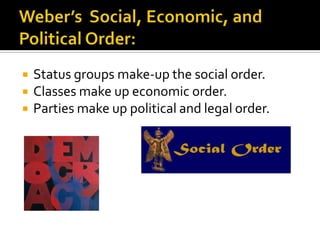
Weber’s  Social, Economic, and Political Order:Status groups make-up the social order.Classes make up economic order.Parties make up political and legal order.
Political SociologySociety could better be understood if by taking away the myths and ideological assertions (or assumptions) that often cover economically and politically motivated action. Weber suggests that in order for class action to take place, class consciousness must already exist.
Political Sociology continued…Weber believed in three types of ideal political leadership:-Charismatic domination (religious)-Traditional domination (patriarchs, feudalism)- Legal domination- (modern state and law (bureaucracy)
Status and Class:For Weber: status, class, and party are three overlapping identifications. People from different economic class, can be in the same status group if they share the same specific style of life. The idea that your status doesn’t reflect your class, but your social honor can reflect and influence your status & class situation.
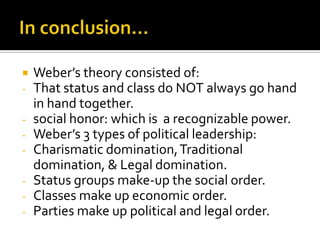
In conclusion…Weber’s theory consisted of:That status and class do NOT always go hand in hand together.
social honor: which is  a recognizable power.

Class, Satus, Party - By Fatima Ashaq

  • 1.
    Class, Status, PartyMaxWeber (1864-1920)
  • 2.
    Economically Determined Powerand the Social Order:Economic power is a recognized social honor.Example of Social Honor: A boss at work.Man wants to strive for power because of the social “honor” it entails.Classes, Status groups, andParties are phenomena of the distribution of powerWithin a community.
  • 3.
    Distribution of Class-Situationby Market-Situation:Social class is based on economically determined relationship to the market (owner, renter, employee etc.)Status is based on non-economical qualities like honor prestige and religion.Party refers to affiliations in the political domain.
  • 4.
    Weber’s Social,Economic, and Political Order:Status groups make-up the social order.Classes make up economic order.Parties make up political and legal order.
  • 5.
    Political SociologySociety couldbetter be understood if by taking away the myths and ideological assertions (or assumptions) that often cover economically and politically motivated action. Weber suggests that in order for class action to take place, class consciousness must already exist.
  • 6.
    Political Sociology continued…Weberbelieved in three types of ideal political leadership:-Charismatic domination (religious)-Traditional domination (patriarchs, feudalism)- Legal domination- (modern state and law (bureaucracy)
  • 7.
    Status and Class:ForWeber: status, class, and party are three overlapping identifications. People from different economic class, can be in the same status group if they share the same specific style of life. The idea that your status doesn’t reflect your class, but your social honor can reflect and influence your status & class situation.
  • 8.
    In conclusion…Weber’s theoryconsisted of:That status and class do NOT always go hand in hand together.
  • 9.
    social honor: whichis a recognizable power.