Reading material on Coal and Petroleum
Introduction
We use various materials for our basic needs. Some of them are found in nature
and some have been made by human efforts.
Natural resources
Definition
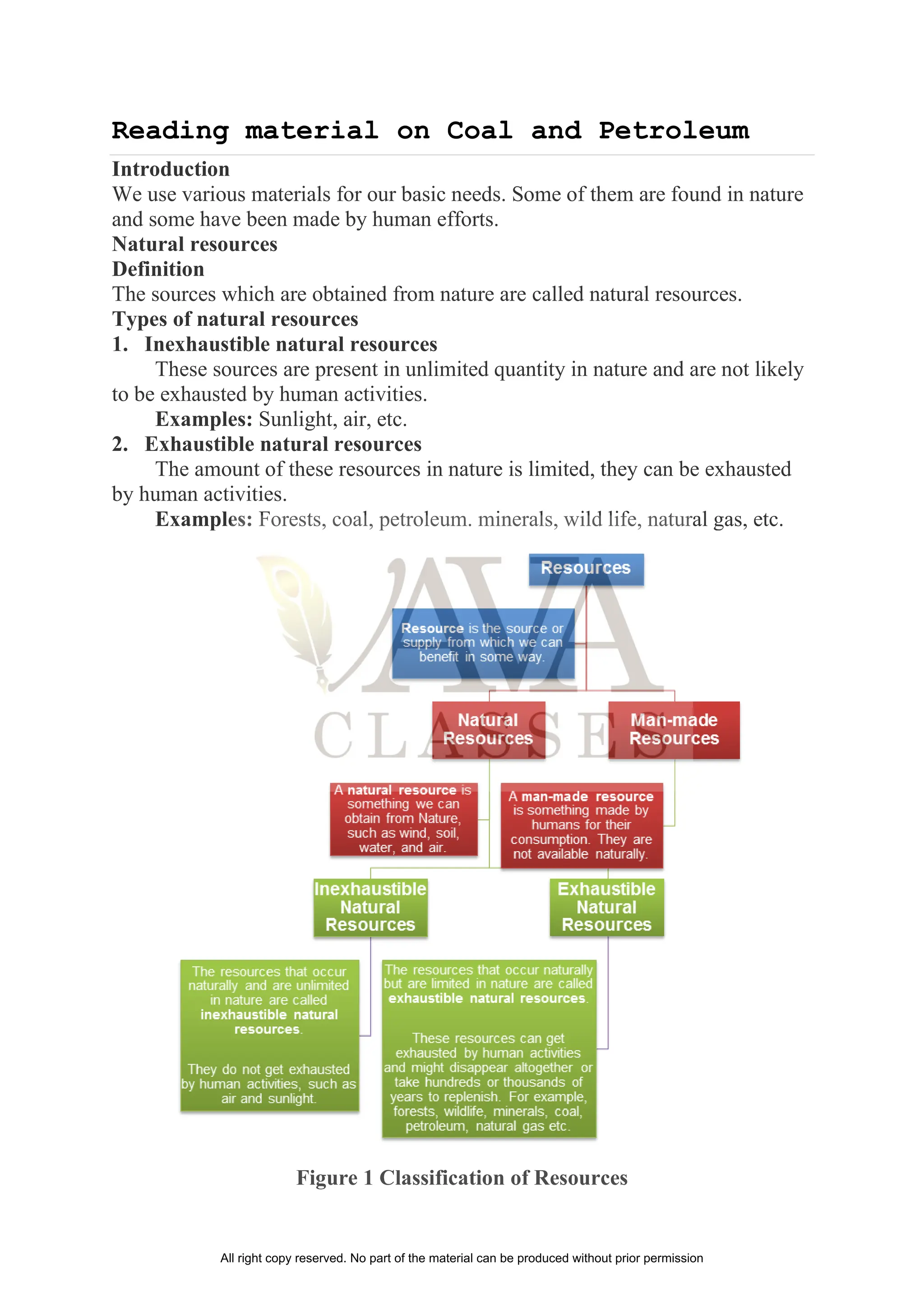
The sources which are obtained from nature are called natural resources.
Types of natural resources
1. Inexhaustible natural resources
These sources are present in unlimited quantity in nature and are not likely
to be exhausted by human activities.
Examples: Sunlight, air, etc.
2. Exhaustible natural resources
The amount of these resources in nature is limited, they can be exhausted
by human activities.
Examples: Forests, coal, petroleum. minerals, wild life, natural gas, etc.
Figure 1 Classification of Resources
All right copy reserved. No part of the material can be produced without prior permission
Coal, Petroleum and Natural Gas are exhaustible natural resources. They are
fossil fuels.
Fossil fuels are fuels that are formed by fossils (or dead remains) of living
organisms.
What are fuels?
Fuels
A fuel is a substance, which bums In air to produce energy without
releasing harmful gases in large quantities.
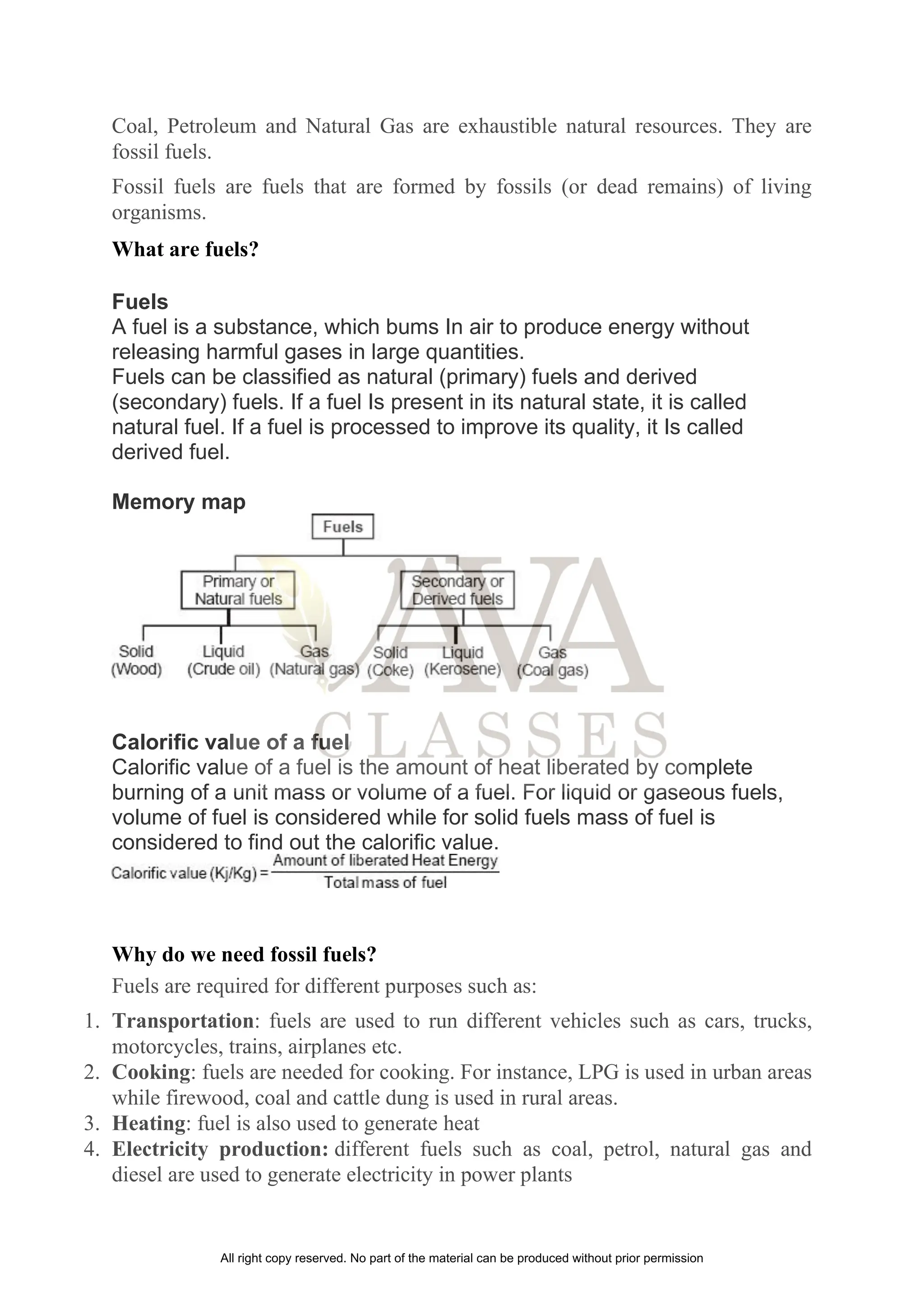
Fuels can be classified as natural (primary) fuels and derived
(secondary) fuels. If a fuel Is present in its natural state, it is called
natural fuel. If a fuel is processed to improve its quality, it Is called
derived fuel.
Memory map
Calorific value of a fuel
Calorific value of a fuel is the amount of heat liberated by complete
burning of a unit mass or volume of a fuel. For liquid or gaseous fuels,
volume of fuel is considered while for solid fuels mass of fuel is
considered to find out the calorific value.
Why do we need fossil fuels?
Fuels are required for different purposes such as:
1. Transportation: fuels are used to run different vehicles such as cars, trucks,
motorcycles, trains, airplanes etc.
2. Cooking: fuels are needed for cooking. For instance, LPG is used in urban areas
while firewood, coal and cattle dung is used in rural areas.
3. Heating: fuel is also used to generate heat
4. Electricity production: different fuels such as coal, petrol, natural gas and
diesel are used to generate electricity in power plants
All right copy reserved. No part of the material can be produced without prior permission
5. Industrial usage: many industries use fuels for different purposes such as
producing electricity, running their machinery and heating
6. Rockets and other space vehicles: fuels called propellants are used in rockets
that help in launching the space vehicles
What are the characteristics of a good fuel?
The characteristics of good fuel are:
1. It should be economical.
2. It should be available easily
3. It should not emit poisonous gases on burning
4. It should produce large amounts of heat with respect to its mass (it should have
a high calorific value)
5. It should be easy to transport and handle
6. It should not produce a bad odour
7. It should be clean and should not produce many ashes
8. It should not ignite easily at room temperature
Coal
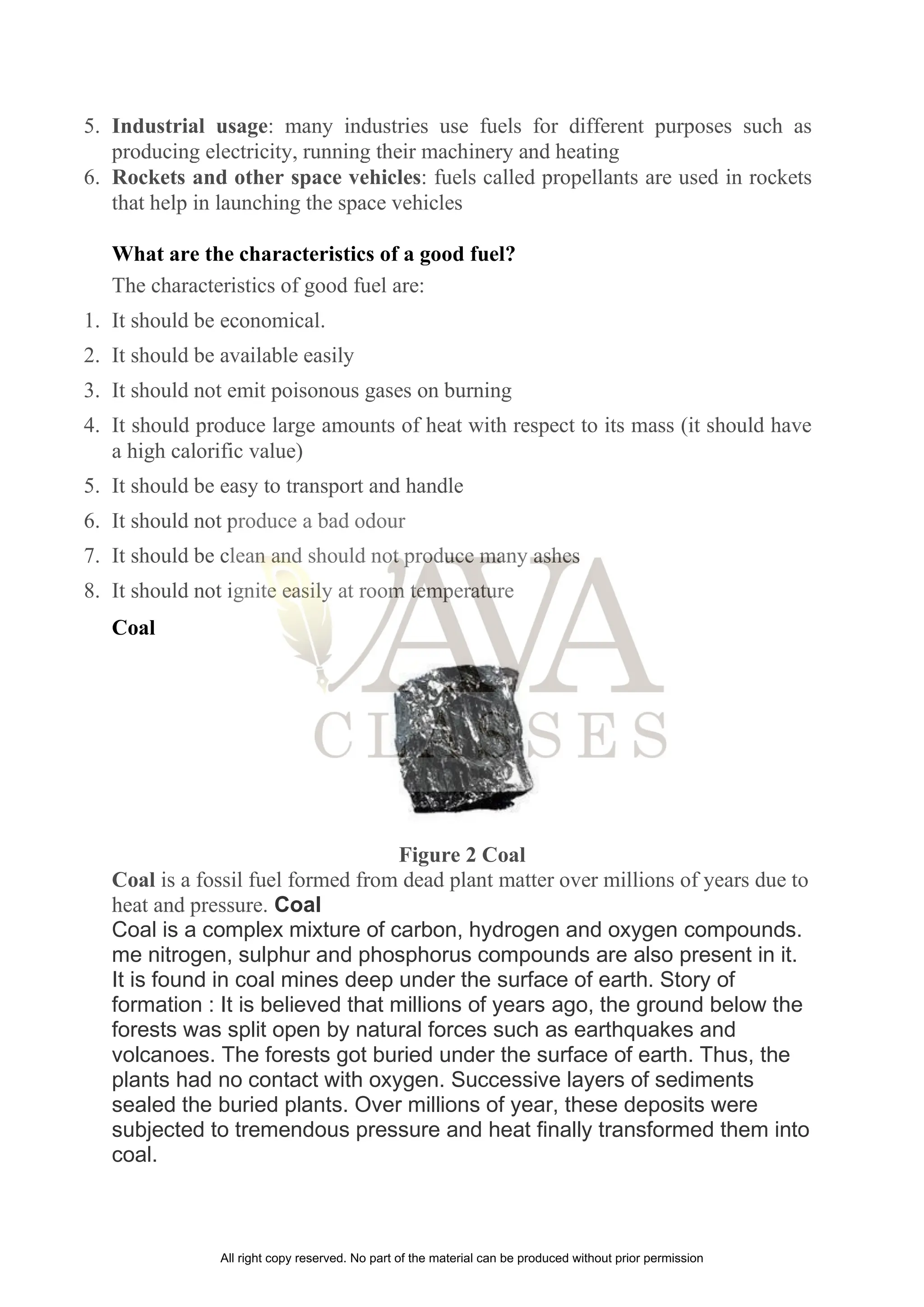
Figure 2 Coal
Coal is a fossil fuel formed from dead plant matter over millions of years due to
heat and pressure. Coal
Coal is a complex mixture of carbon, hydrogen and oxygen compounds.
me nitrogen, sulphur and phosphorus compounds are also present in it.
It is found in coal mines deep under the surface of earth. Story of
formation : It is believed that millions of years ago, the ground below the
forests was split open by natural forces such as earthquakes and
volcanoes. The forests got buried under the surface of earth. Thus, the
plants had no contact with oxygen. Successive layers of sediments
sealed the buried plants. Over millions of year, these deposits were
subjected to tremendous pressure and heat finally transformed them into
coal.
All right copy reserved. No part of the material can be produced without prior permission
How is Coal formed?
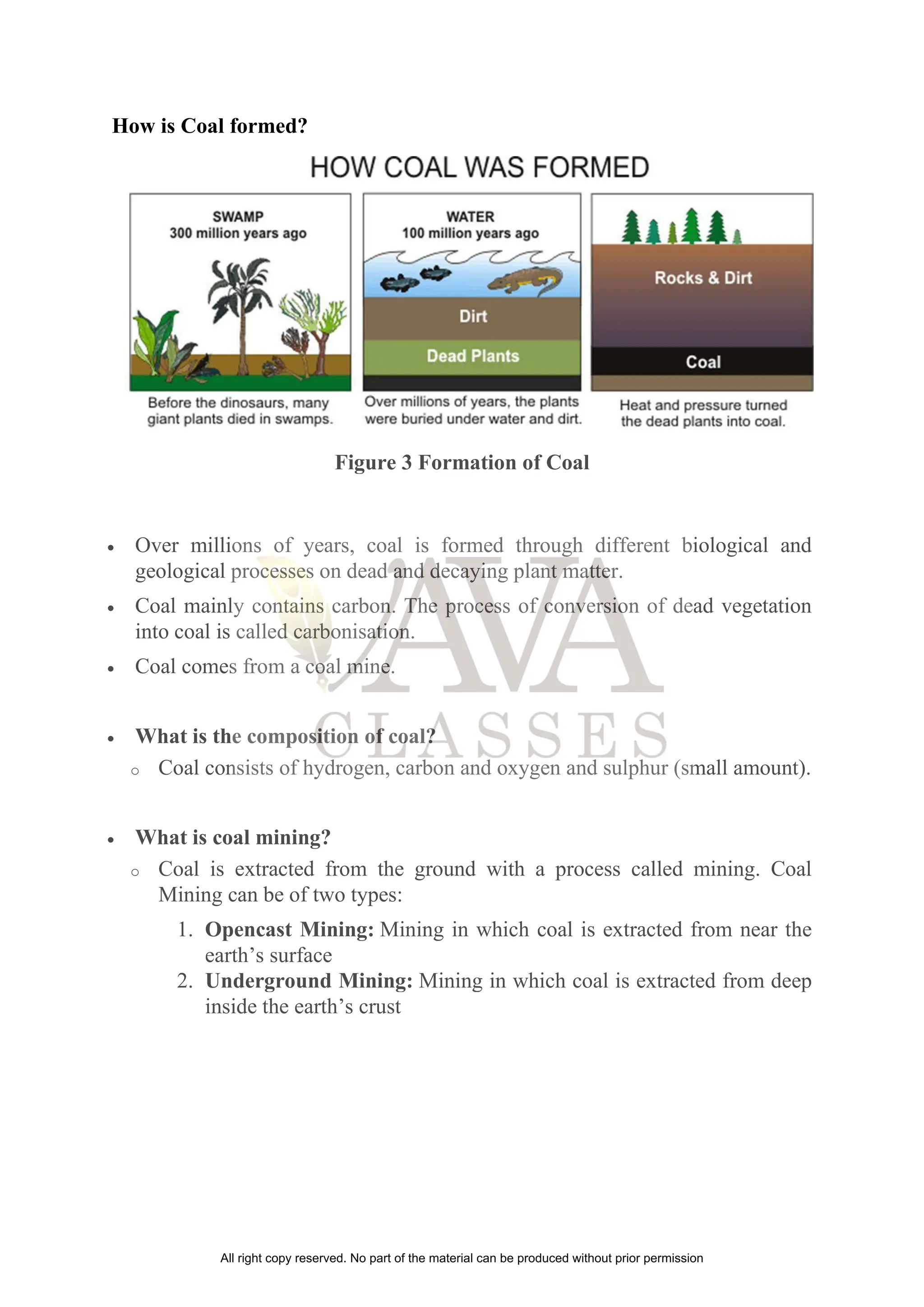
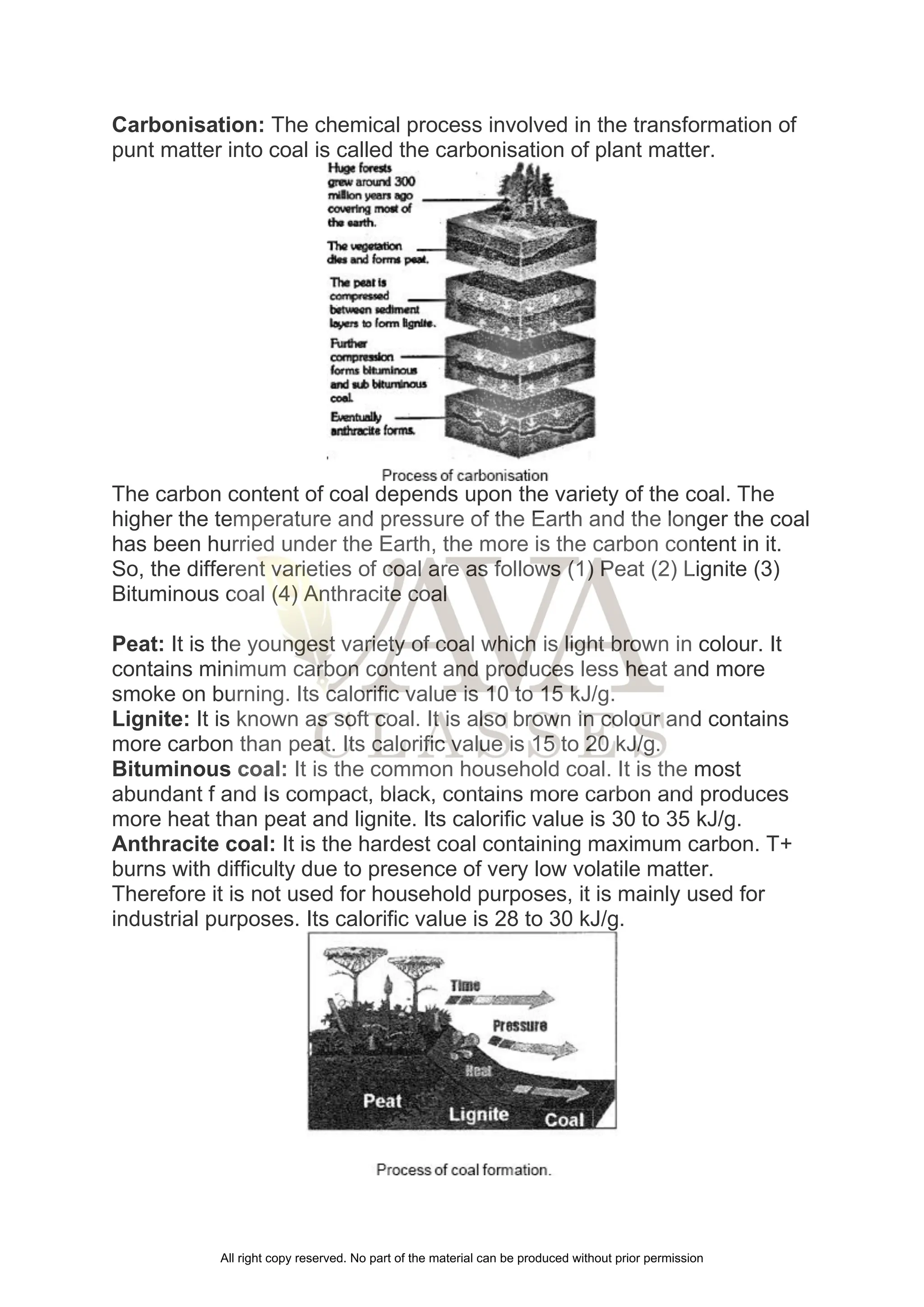
Figure 3 Formation of Coal
• Over millions of years, coal is formed through different biological and
geological processes on dead and decaying plant matter.
• Coal mainly contains carbon. The process of conversion of dead vegetation
into coal is called carbonisation.
• Coal comes from a coal mine.
• What is the composition of coal?
o Coal consists of hydrogen, carbon and oxygen and sulphur (small amount).
• What is coal mining?
o Coal is extracted from the ground with a process called mining. Coal
Mining can be of two types:
1. Opencast Mining: Mining in which coal is extracted from near the
earth’s surface
2. Underground Mining: Mining in which coal is extracted from deep
inside the earth’s crust
All right copy reserved. No part of the material can be produced without prior permission
Carbonisation: The chemical process involved in the transformation of
punt matter into coal is called the carbonisation of plant matter.
The carbon content of coal depends upon the variety of the coal. The
higher the temperature and pressure of the Earth and the longer the coal
has been hurried under the Earth, the more is the carbon content in it.
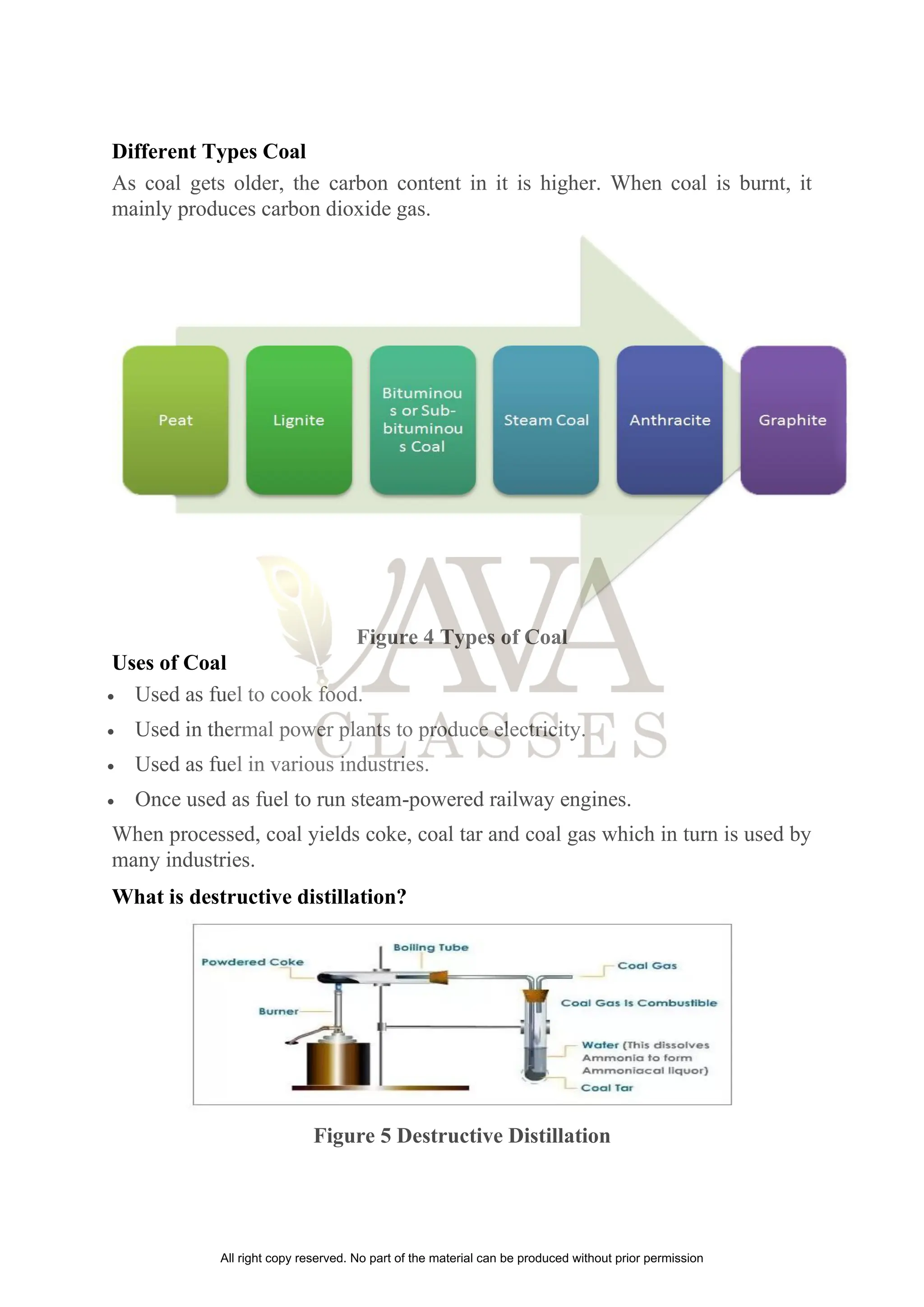
So, the different varieties of coal are as follows (1) Peat (2) Lignite (3)
Bituminous coal (4) Anthracite coal
Peat: It is the youngest variety of coal which is light brown in colour. It
contains minimum carbon content and produces less heat and more
smoke on burning. Its calorific value is 10 to 15 kJ/g.
Lignite: It is known as soft coal. It is also brown in colour and contains
more carbon than peat. Its calorific value is 15 to 20 kJ/g.
Bituminous coal: It is the common household coal. It is the most
abundant f and Is compact, black, contains more carbon and produces
more heat than peat and lignite. Its calorific value is 30 to 35 kJ/g.
Anthracite coal: It is the hardest coal containing maximum carbon. T+
burns with difficulty due to presence of very low volatile matter.
Therefore it is not used for household purposes, it is mainly used for
industrial purposes. Its calorific value is 28 to 30 kJ/g.
All right copy reserved. No part of the material can be produced without prior permission
Different Types Coal
As coal gets older, the carbon content in it is higher. When coal is burnt, it
mainly produces carbon dioxide gas.
Figure 4 Types of Coal
Uses of Coal
• Used as fuel to cook food.
• Used in thermal power plants to produce electricity.
• Used as fuel in various industries.
• Once used as fuel to run steam-powered railway engines.
When processed, coal yields coke, coal tar and coal gas which in turn is used by
many industries.
What is destructive distillation?
Figure 5 Destructive Distillation
All right copy reserved. No part of the material can be produced without prior permission
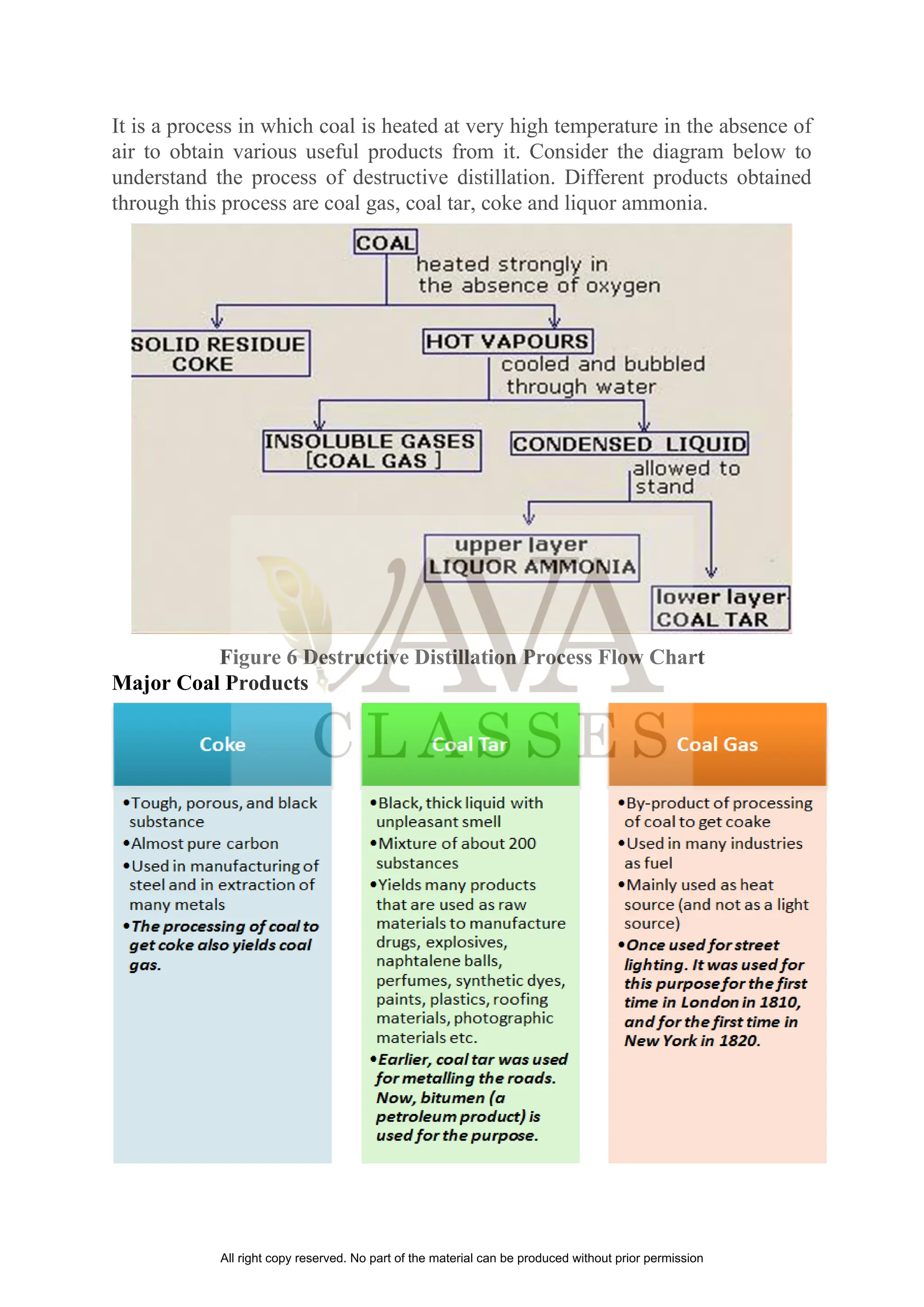
It is a process in which coal is heated at very high temperature in the absence of
air to obtain various useful products from it. Consider the diagram below to
understand the process of destructive distillation. Different products obtained
through this process are coal gas, coal tar, coke and liquor ammonia.
Figure 6 Destructive Distillation Process Flow Chart
Major Coal Products
All right copy reserved. No part of the material can be produced without prior permission
Figure 7. Coal products
What are hydrocarbons?
Hydrocarbons are the substances that consist of only carbon and hydrogen.
Compounds like methane, butane, and hexane are hydrocarbons that are
produced on burning of the fossil fuels.
What will happen if the coal reserves get depleted?
• Coal is being used as a major source of energy in industries as well as rural
areas.
• Not only this, it serves various other purposes like the synthesis of synthetic
oil, natural gas, coke, coal tar and coal gas.
• If the amount of coal gets depleted it would become much difficult for us to
produce energy for various purposes. Hence, we must use coal in an efficient
way.
What substances are released on the burning of coal?
1. Carbon dioxide
2. Carbon monoxide
3. Sulphur Dioxide
4. Nitrogen
5. Lead
6. Arsenic
7. Mercury
Petroleum
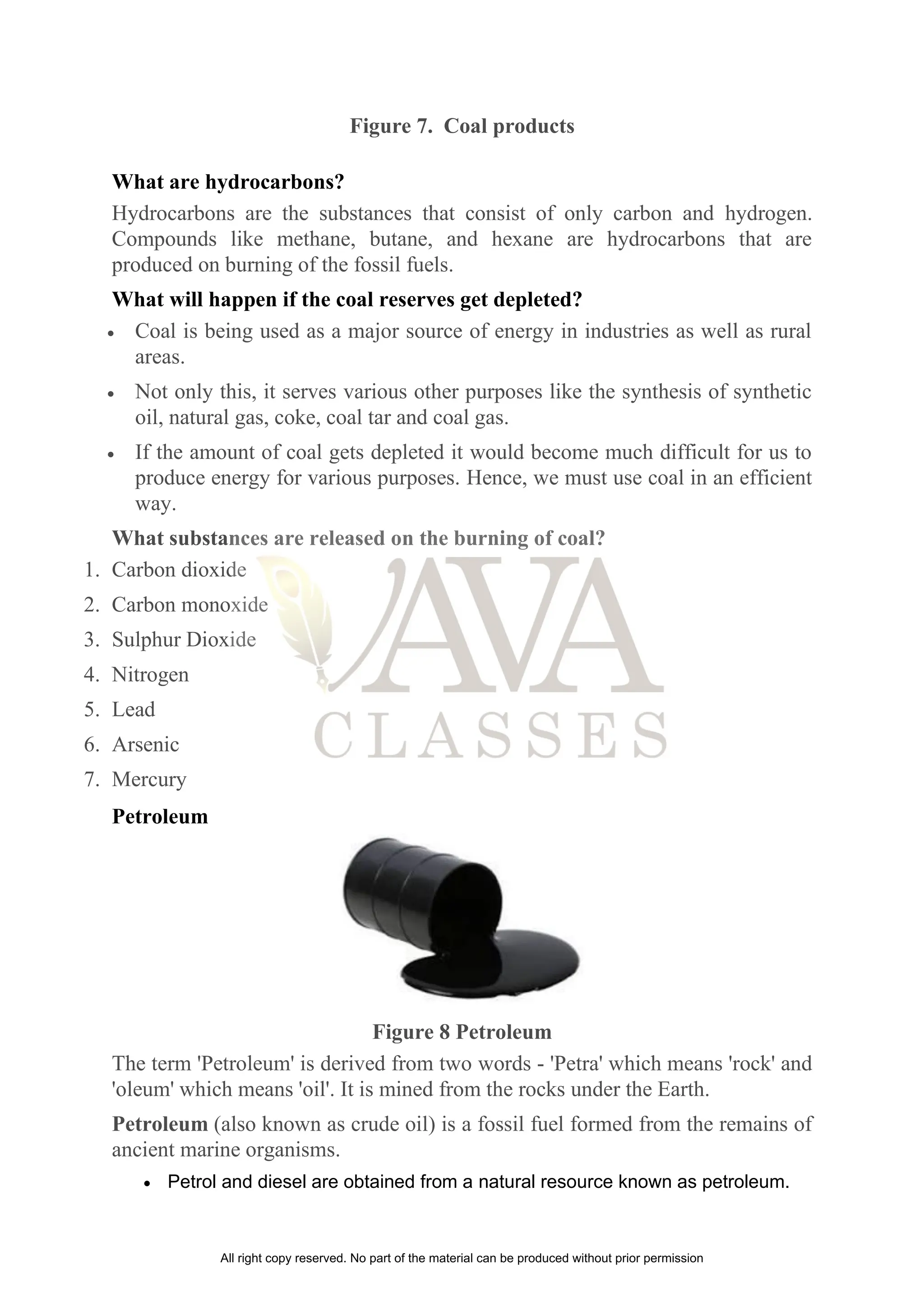
Figure 8 Petroleum
The term 'Petroleum' is derived from two words - 'Petra' which means 'rock' and
'oleum' which means 'oil'. It is mined from the rocks under the Earth.
Petroleum (also known as crude oil) is a fossil fuel formed from the remains of
ancient marine organisms.
• Petrol and diesel are obtained from a natural resource known as petroleum.
All right copy reserved. No part of the material can be produced without prior permission
• Petroleum was formed from the organisms living in the sea.
• Over millions of years (the dead organisms buried inside the earth), in the
presence high temperature, high pressure, and in the absence of air, the
dead organisms transformed into petroleum and natural gas.
• In 1859, the world’s first oil well was drilled in Pennsylvania, USA.
• In 1867, oil was stuck at Makum in Assam, India.
• In India, petroleum is largely found in Assam, Gujarat, Mumbai High,
Maharashtra, and in the river basins of Godavari and Krishna.
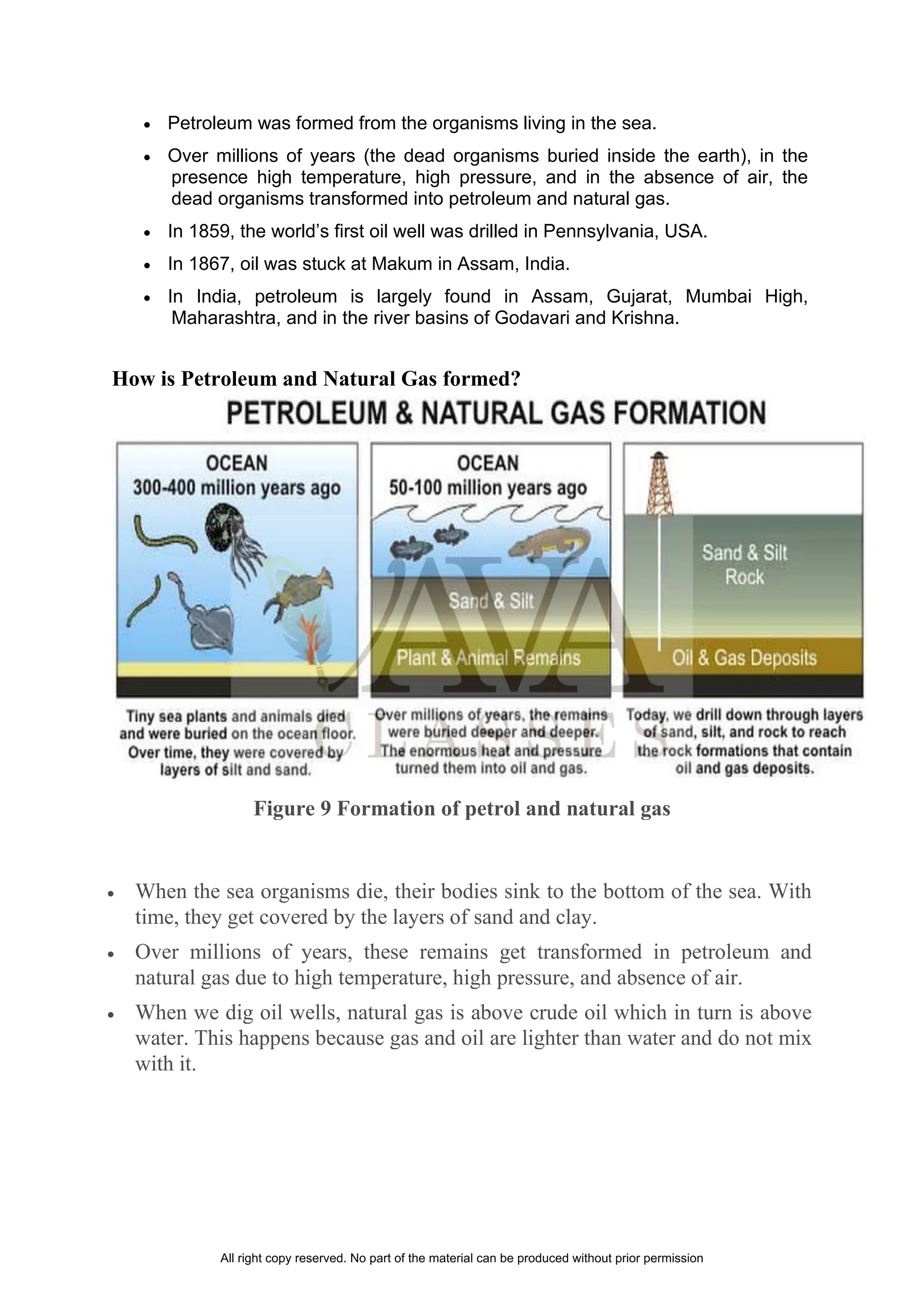
How is Petroleum and Natural Gas formed?
Figure 9 Formation of petrol and natural gas
• When the sea organisms die, their bodies sink to the bottom of the sea. With
time, they get covered by the layers of sand and clay.
• Over millions of years, these remains get transformed in petroleum and
natural gas due to high temperature, high pressure, and absence of air.
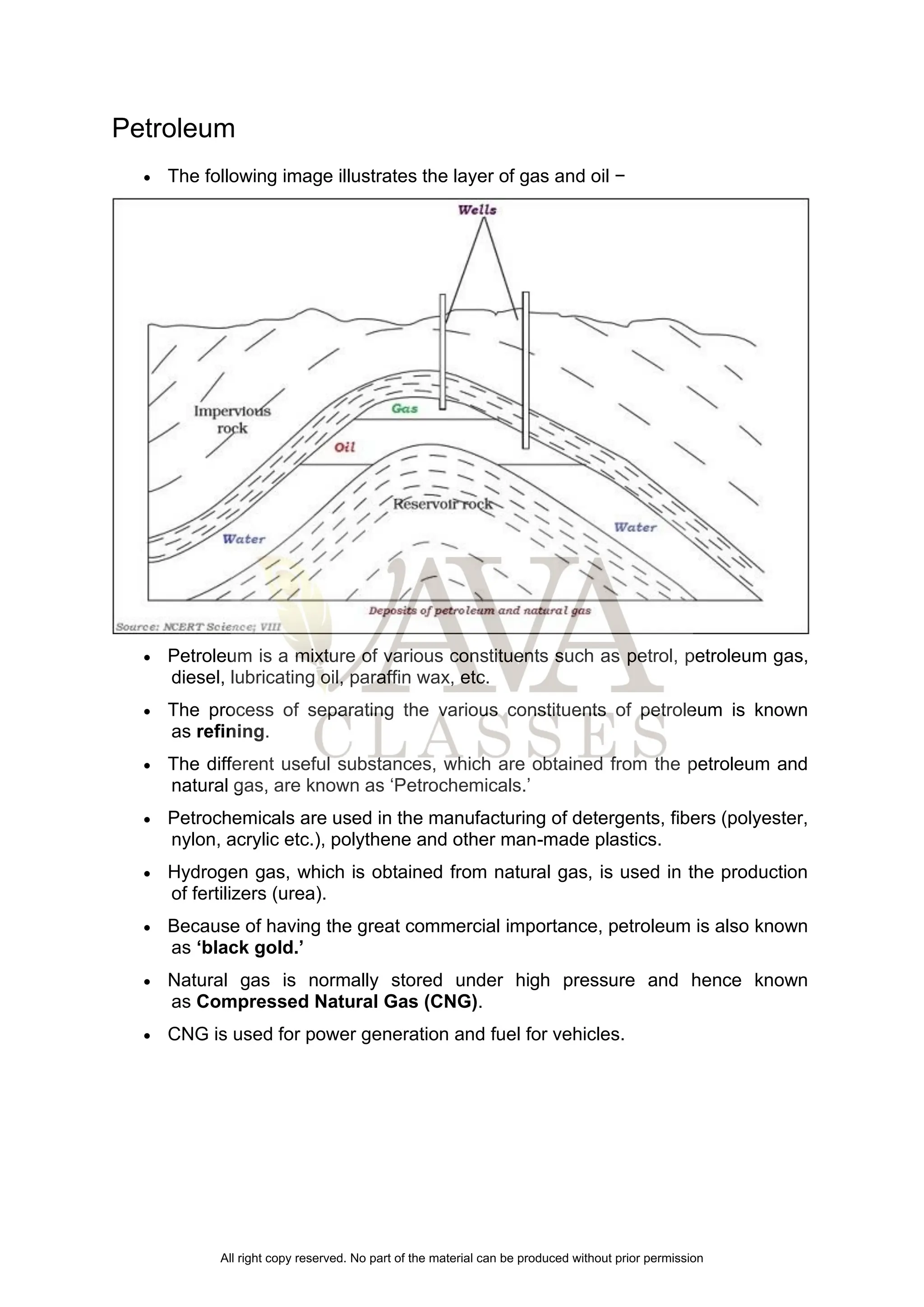
• When we dig oil wells, natural gas is above crude oil which in turn is above
water. This happens because gas and oil are lighter than water and do not mix
with it.
All right copy reserved. No part of the material can be produced without prior permission
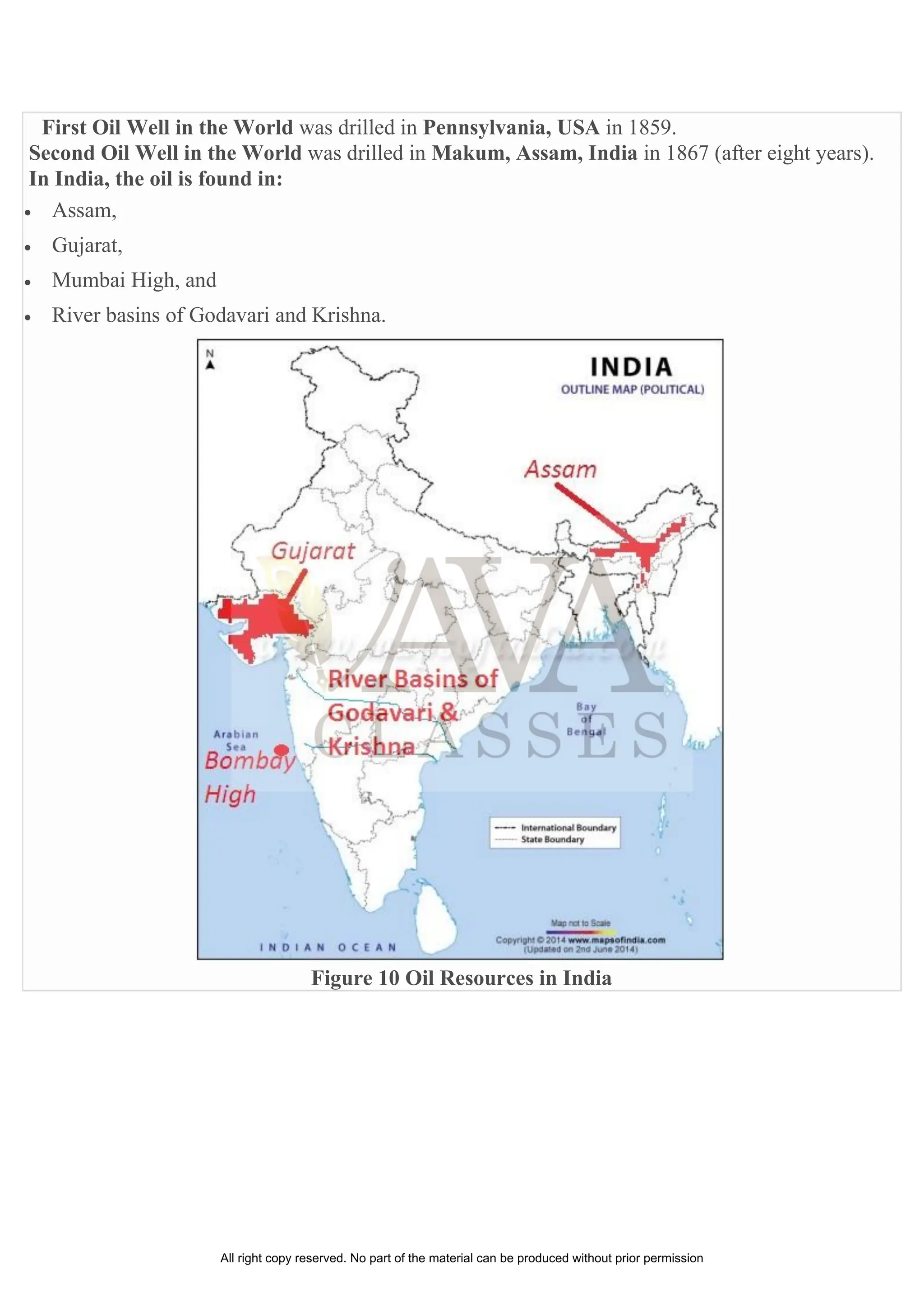
First Oil Well in the World was drilled in Pennsylvania, USA in 1859.
Second Oil Well in the World was drilled in Makum, Assam, India in 1867 (after eight years).
In India, the oil is found in:
• Assam,
• Gujarat,
• Mumbai High, and
• River basins of Godavari and Krishna.
Figure 10 Oil Resources in India
All right copy reserved. No part of the material can be produced without prior permission
Petroleum
• The following image illustrates the layer of gas and oil −
• Petroleum is a mixture of various constituents such as petrol, petroleum gas,
diesel, lubricating oil, paraffin wax, etc.
• The process of separating the various constituents of petroleum is known
as refining.
• The different useful substances, which are obtained from the petroleum and
natural gas, are known as ‘Petrochemicals.’
• Petrochemicals are used in the manufacturing of detergents, fibers (polyester,
nylon, acrylic etc.), polythene and other man-made plastics.
• Hydrogen gas, which is obtained from natural gas, is used in the production
of fertilizers (urea).
• Because of having the great commercial importance, petroleum is also known
as ‘black gold.’
• Natural gas is normally stored under high pressure and hence known
as Compressed Natural Gas (CNG).
• CNG is used for power generation and fuel for vehicles.
All right copy reserved. No part of the material can be produced without prior permission
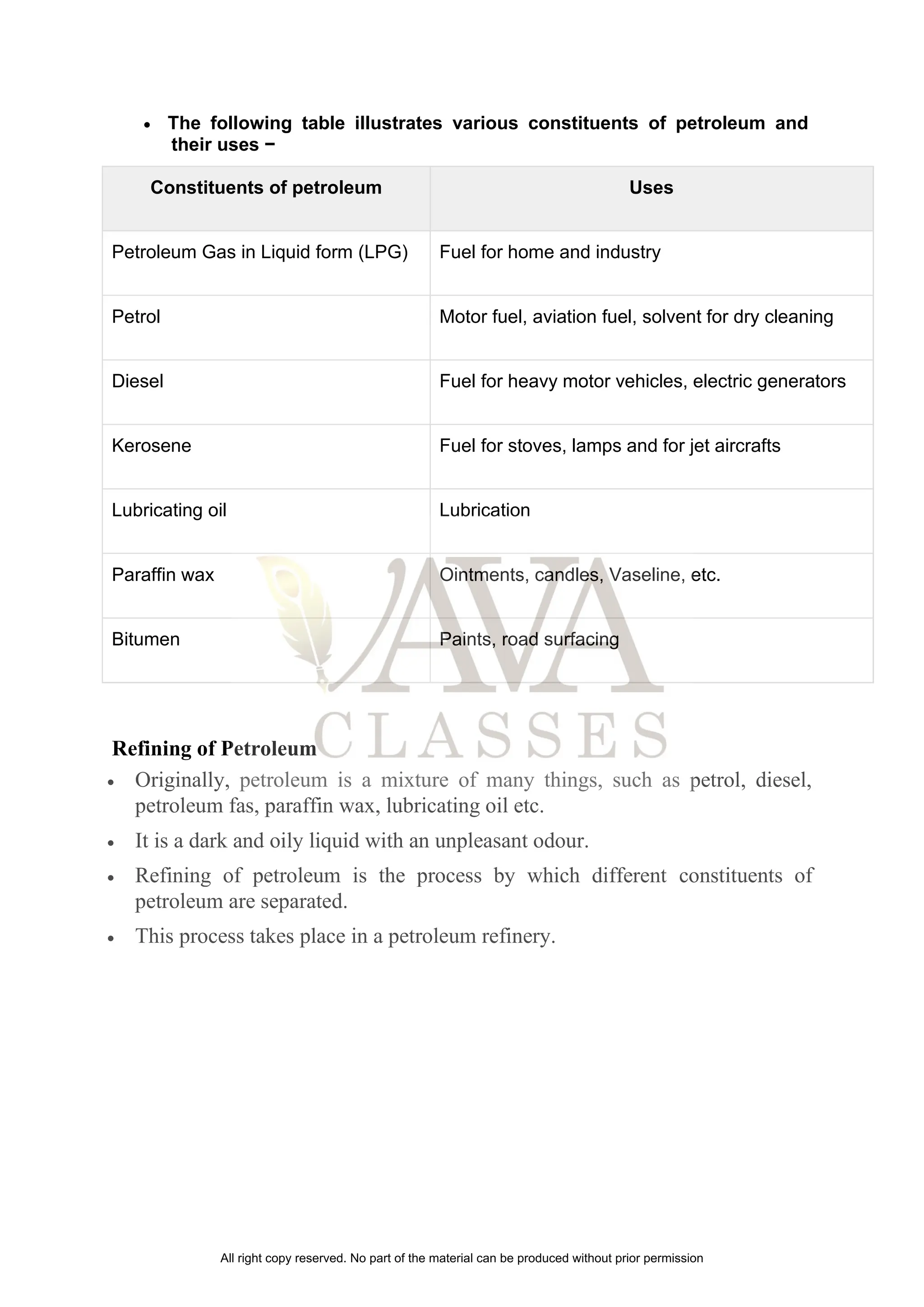
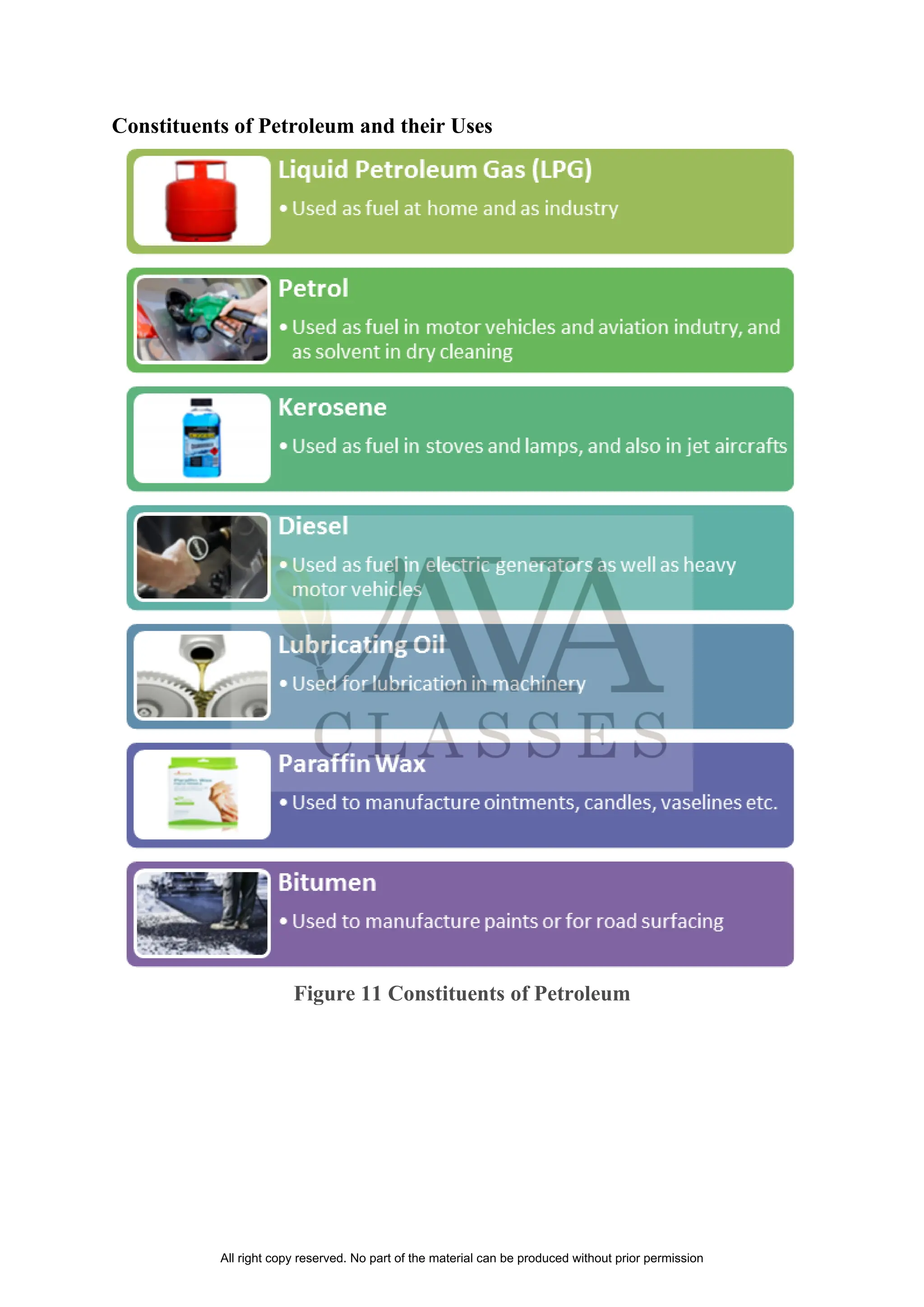
• The following table illustrates various constituents of petroleum and
their uses −
Constituents of petroleum Uses
Petroleum Gas in Liquid form (LPG) Fuel for home and industry
Petrol Motor fuel, aviation fuel, solvent for dry cleaning
Diesel Fuel for heavy motor vehicles, electric generators
Kerosene Fuel for stoves, lamps and for jet aircrafts
Lubricating oil Lubrication
Paraffin wax Ointments, candles, Vaseline, etc.
Bitumen Paints, road surfacing
Refining of Petroleum
• Originally, petroleum is a mixture of many things, such as petrol, diesel,
petroleum fas, paraffin wax, lubricating oil etc.
• It is a dark and oily liquid with an unpleasant odour.
• Refining of petroleum is the process by which different constituents of
petroleum are separated.
• This process takes place in a petroleum refinery.
All right copy reserved. No part of the material can be produced without prior permission
Constituents of Petroleum and their Uses
Figure 11 Constituents of Petroleum
All right copy reserved. No part of the material can be produced without prior permission
Why Petroleum is called ‘black gold?
Petroleum is called 'black god' because it yields several substances that are
commercially successful. The useful substances obtained from petroleum and
natural gas are called 'petrochemicals'.
Petrochemicals are used in manufacturing:
• Synthetic fibres (such as Polyester, Nylon, Acrylic etc.),
• Detergents,
• Polythene, and
• Man-made plastics.
Natural gas also yields Hydrogen gas which is used in the production of
fertilisers (such as urea).
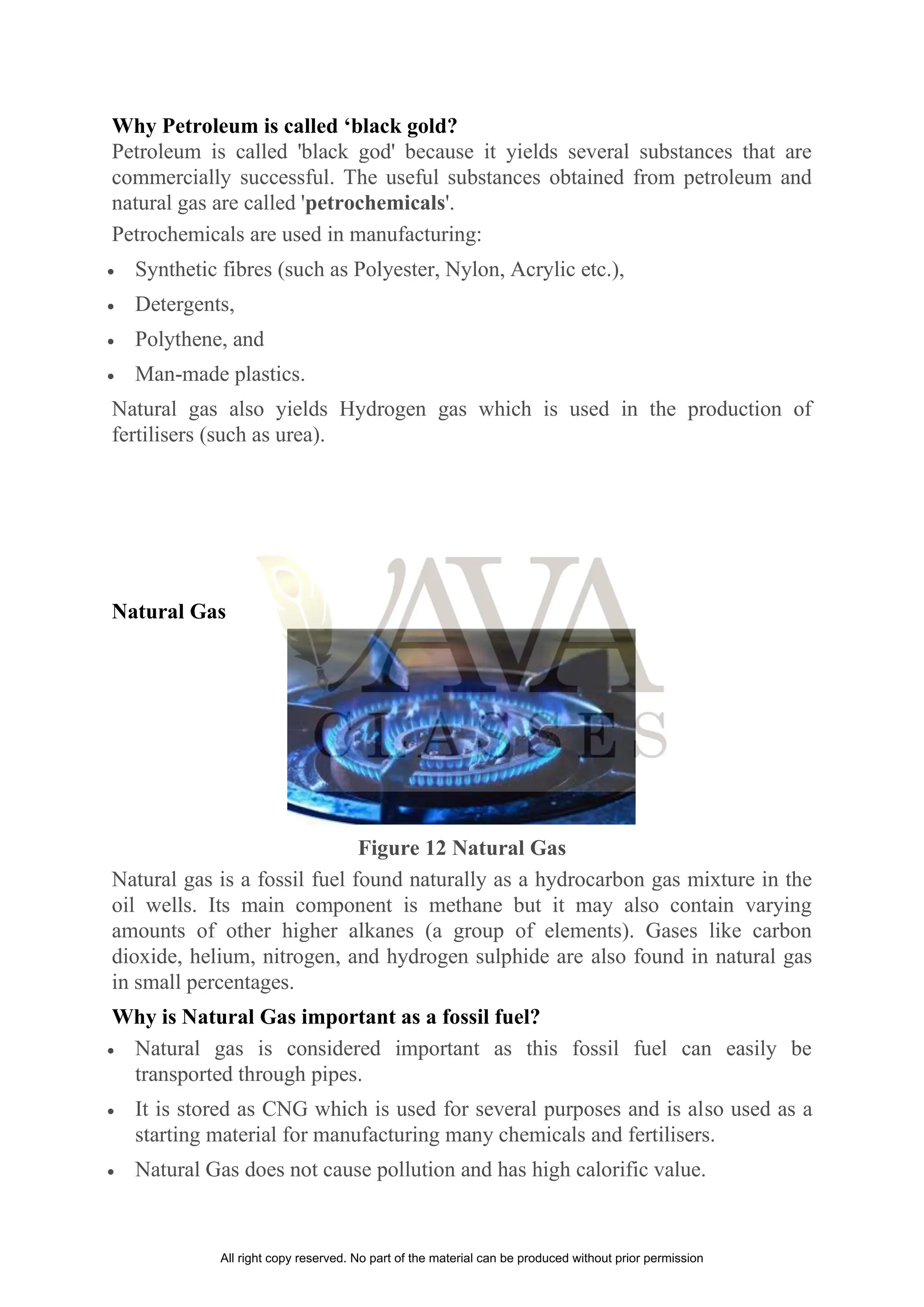
Natural Gas
Figure 12 Natural Gas
Natural gas is a fossil fuel found naturally as a hydrocarbon gas mixture in the
oil wells. Its main component is methane but it may also contain varying
amounts of other higher alkanes (a group of elements). Gases like carbon
dioxide, helium, nitrogen, and hydrogen sulphide are also found in natural gas
in small percentages.
Why is Natural Gas important as a fossil fuel?
• Natural gas is considered important as this fossil fuel can easily be
transported through pipes.
• It is stored as CNG which is used for several purposes and is also used as a
starting material for manufacturing many chemicals and fertilisers.
• Natural Gas does not cause pollution and has high calorific value.
All right copy reserved. No part of the material can be produced without prior permission
Compressed Natural Gas (CNG) is the natural gas stored under high pressure.
Why is CNG useful?
CNG is used as:
• Fuel to generate power
• Cleaner fuel for transport vehicles (less polluting than petrol and diesel)
• Fuel in homes and industries which can be supplied through pipes.
• CNG pipeline network already exists in Vadodara in Gujarat, some parts of
Delhi and some other places.
Why is CNG considered as a cleaner fuel?
• Natural gas is considered a better fuel than coal and petroleum because it is
cleaner.
• This means that it results in less amount of pollution that the other fossil
fuels.
• Natural gas emits 50% less carbon dioxide, sulphur and nitrogen oxides in
the air.
• However, it is not the best solution as there are better sources of energy
present nowadays like solar energy.
All right copy reserved. No part of the material can be produced without prior permission
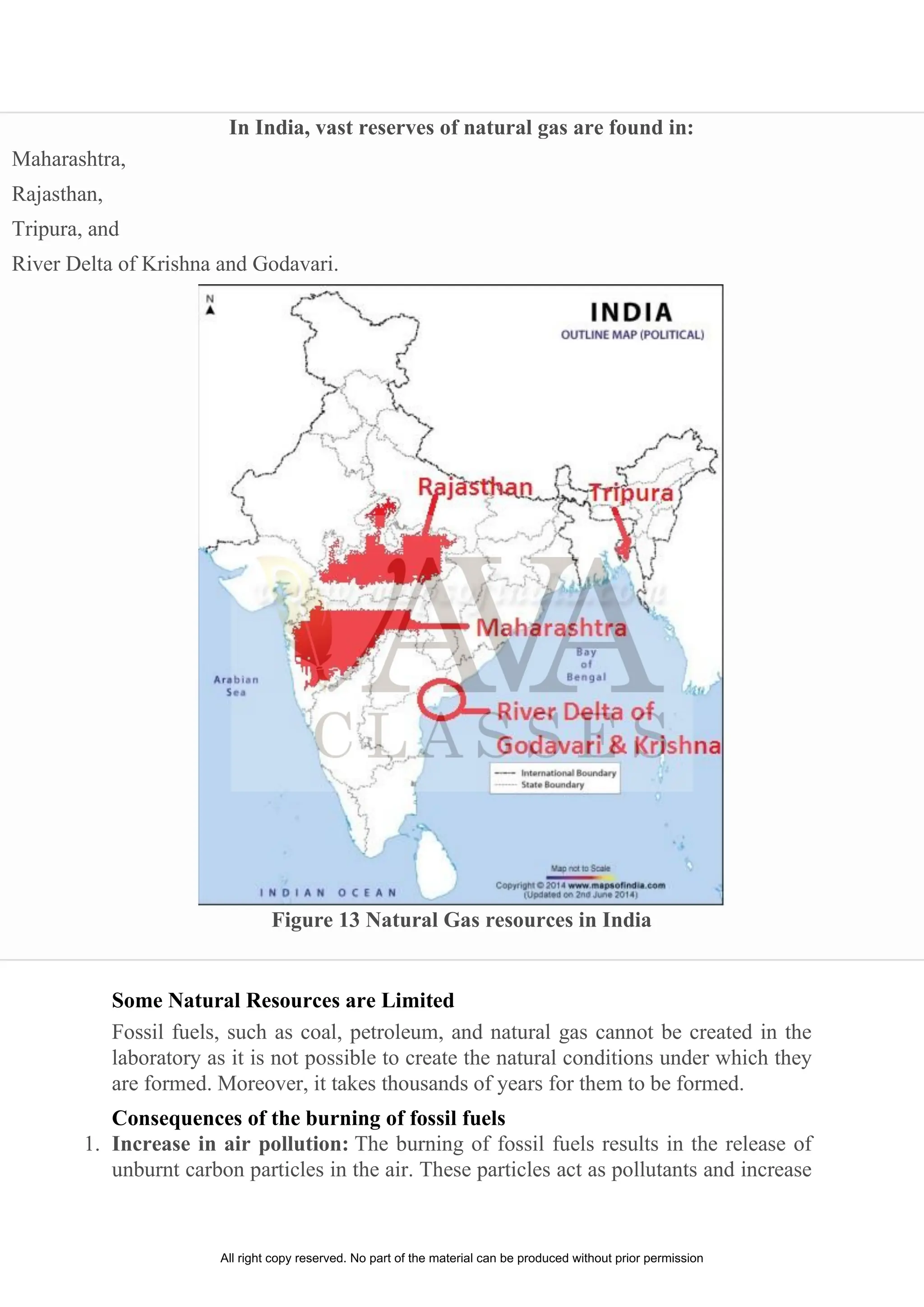
In India, vast reserves of natural gas are found in:
Maharashtra,
Rajasthan,
Tripura, and
River Delta of Krishna and Godavari.
Figure 13 Natural Gas resources in India
Some Natural Resources are Limited
Fossil fuels, such as coal, petroleum, and natural gas cannot be created in the
laboratory as it is not possible to create the natural conditions under which they
are formed. Moreover, it takes thousands of years for them to be formed.
Consequences of the burning of fossil fuels
1. Increase in air pollution: The burning of fossil fuels results in the release of
unburnt carbon particles in the air. These particles act as pollutants and increase
All right copy reserved. No part of the material can be produced without prior permission
air pollution. Fossil fuels release poisonous gases such as carbon monoxide and
sulphur dioxide in the atmosphere.
2. Global Warming: Fossil fuels when burnt release large amounts of carbon
dioxide in the air. As the amount of carbon dioxide increases it results in an
increase in the global temperature of the earth and leads to global warming.
Why should we use fossil fuels economically?
1. They are available in limited quantities.
2. Burning these fuels also cause air pollution as well as global warming.
Hence, we should use these fuels economically to make sure that we can use
them for a longer time, the risk of global warming gets reduced, and we can live
in a cleaner environment.
How can we save petrol or diesel while driving?
According to the Petroleum Conservation Research Association (PCRA) in
India, we can save petrol or diesel while driving by:
1. Drive at a constant and moderate speed.
2. Maintain tyre pressure at correct levels.
3. Switch off the engine when you are waiting( such as traffic light).
4. Do regular maintenance of your vehicle.
Why fossil fuels can last for 100 years only?
• Fossil fuels are exhaustible resources which mean that they are not present in
abundant quantities on the earth.
• They take hundreds and thousands of years to replenish.
• The rate at which they are being consumed today is increasing at a rapid
pace.
• It means that more amounts of fossil fuels are being used than it is being
replenished.
• Hence, scientists claim that they can replenish completely in 100 years.
All right copy reserved. No part of the material can be produced without prior permission

class 8 science chapter 5 Coal and Petroleum pdf

  • 1.
    Reading material onCoal and Petroleum Introduction We use various materials for our basic needs. Some of them are found in nature and some have been made by human efforts. Natural resources Definition The sources which are obtained from nature are called natural resources. Types of natural resources 1. Inexhaustible natural resources These sources are present in unlimited quantity in nature and are not likely to be exhausted by human activities. Examples: Sunlight, air, etc. 2. Exhaustible natural resources The amount of these resources in nature is limited, they can be exhausted by human activities. Examples: Forests, coal, petroleum. minerals, wild life, natural gas, etc. Figure 1 Classification of Resources All right copy reserved. No part of the material can be produced without prior permission
  • 2.
    Coal, Petroleum andNatural Gas are exhaustible natural resources. They are fossil fuels. Fossil fuels are fuels that are formed by fossils (or dead remains) of living organisms. What are fuels? Fuels A fuel is a substance, which bums In air to produce energy without releasing harmful gases in large quantities. Fuels can be classified as natural (primary) fuels and derived (secondary) fuels. If a fuel Is present in its natural state, it is called natural fuel. If a fuel is processed to improve its quality, it Is called derived fuel. Memory map Calorific value of a fuel Calorific value of a fuel is the amount of heat liberated by complete burning of a unit mass or volume of a fuel. For liquid or gaseous fuels, volume of fuel is considered while for solid fuels mass of fuel is considered to find out the calorific value. Why do we need fossil fuels? Fuels are required for different purposes such as: 1. Transportation: fuels are used to run different vehicles such as cars, trucks, motorcycles, trains, airplanes etc. 2. Cooking: fuels are needed for cooking. For instance, LPG is used in urban areas while firewood, coal and cattle dung is used in rural areas. 3. Heating: fuel is also used to generate heat 4. Electricity production: different fuels such as coal, petrol, natural gas and diesel are used to generate electricity in power plants All right copy reserved. No part of the material can be produced without prior permission
  • 3.
    5. Industrial usage:many industries use fuels for different purposes such as producing electricity, running their machinery and heating 6. Rockets and other space vehicles: fuels called propellants are used in rockets that help in launching the space vehicles What are the characteristics of a good fuel? The characteristics of good fuel are: 1. It should be economical. 2. It should be available easily 3. It should not emit poisonous gases on burning 4. It should produce large amounts of heat with respect to its mass (it should have a high calorific value) 5. It should be easy to transport and handle 6. It should not produce a bad odour 7. It should be clean and should not produce many ashes 8. It should not ignite easily at room temperature Coal Figure 2 Coal Coal is a fossil fuel formed from dead plant matter over millions of years due to heat and pressure. Coal Coal is a complex mixture of carbon, hydrogen and oxygen compounds. me nitrogen, sulphur and phosphorus compounds are also present in it. It is found in coal mines deep under the surface of earth. Story of formation : It is believed that millions of years ago, the ground below the forests was split open by natural forces such as earthquakes and volcanoes. The forests got buried under the surface of earth. Thus, the plants had no contact with oxygen. Successive layers of sediments sealed the buried plants. Over millions of year, these deposits were subjected to tremendous pressure and heat finally transformed them into coal. All right copy reserved. No part of the material can be produced without prior permission
  • 4.
    How is Coalformed? Figure 3 Formation of Coal • Over millions of years, coal is formed through different biological and geological processes on dead and decaying plant matter. • Coal mainly contains carbon. The process of conversion of dead vegetation into coal is called carbonisation. • Coal comes from a coal mine. • What is the composition of coal? o Coal consists of hydrogen, carbon and oxygen and sulphur (small amount). • What is coal mining? o Coal is extracted from the ground with a process called mining. Coal Mining can be of two types: 1. Opencast Mining: Mining in which coal is extracted from near the earth’s surface 2. Underground Mining: Mining in which coal is extracted from deep inside the earth’s crust All right copy reserved. No part of the material can be produced without prior permission
  • 5.
    Carbonisation: The chemicalprocess involved in the transformation of punt matter into coal is called the carbonisation of plant matter. The carbon content of coal depends upon the variety of the coal. The higher the temperature and pressure of the Earth and the longer the coal has been hurried under the Earth, the more is the carbon content in it. So, the different varieties of coal are as follows (1) Peat (2) Lignite (3) Bituminous coal (4) Anthracite coal Peat: It is the youngest variety of coal which is light brown in colour. It contains minimum carbon content and produces less heat and more smoke on burning. Its calorific value is 10 to 15 kJ/g. Lignite: It is known as soft coal. It is also brown in colour and contains more carbon than peat. Its calorific value is 15 to 20 kJ/g. Bituminous coal: It is the common household coal. It is the most abundant f and Is compact, black, contains more carbon and produces more heat than peat and lignite. Its calorific value is 30 to 35 kJ/g. Anthracite coal: It is the hardest coal containing maximum carbon. T+ burns with difficulty due to presence of very low volatile matter. Therefore it is not used for household purposes, it is mainly used for industrial purposes. Its calorific value is 28 to 30 kJ/g. All right copy reserved. No part of the material can be produced without prior permission
  • 6.
    Different Types Coal Ascoal gets older, the carbon content in it is higher. When coal is burnt, it mainly produces carbon dioxide gas. Figure 4 Types of Coal Uses of Coal • Used as fuel to cook food. • Used in thermal power plants to produce electricity. • Used as fuel in various industries. • Once used as fuel to run steam-powered railway engines. When processed, coal yields coke, coal tar and coal gas which in turn is used by many industries. What is destructive distillation? Figure 5 Destructive Distillation All right copy reserved. No part of the material can be produced without prior permission
  • 7.
    It is aprocess in which coal is heated at very high temperature in the absence of air to obtain various useful products from it. Consider the diagram below to understand the process of destructive distillation. Different products obtained through this process are coal gas, coal tar, coke and liquor ammonia. Figure 6 Destructive Distillation Process Flow Chart Major Coal Products All right copy reserved. No part of the material can be produced without prior permission
  • 8.
    Figure 7. Coalproducts What are hydrocarbons? Hydrocarbons are the substances that consist of only carbon and hydrogen. Compounds like methane, butane, and hexane are hydrocarbons that are produced on burning of the fossil fuels. What will happen if the coal reserves get depleted? • Coal is being used as a major source of energy in industries as well as rural areas. • Not only this, it serves various other purposes like the synthesis of synthetic oil, natural gas, coke, coal tar and coal gas. • If the amount of coal gets depleted it would become much difficult for us to produce energy for various purposes. Hence, we must use coal in an efficient way. What substances are released on the burning of coal? 1. Carbon dioxide 2. Carbon monoxide 3. Sulphur Dioxide 4. Nitrogen 5. Lead 6. Arsenic 7. Mercury Petroleum Figure 8 Petroleum The term 'Petroleum' is derived from two words - 'Petra' which means 'rock' and 'oleum' which means 'oil'. It is mined from the rocks under the Earth. Petroleum (also known as crude oil) is a fossil fuel formed from the remains of ancient marine organisms. • Petrol and diesel are obtained from a natural resource known as petroleum. All right copy reserved. No part of the material can be produced without prior permission
  • 9.
    • Petroleum wasformed from the organisms living in the sea. • Over millions of years (the dead organisms buried inside the earth), in the presence high temperature, high pressure, and in the absence of air, the dead organisms transformed into petroleum and natural gas. • In 1859, the world’s first oil well was drilled in Pennsylvania, USA. • In 1867, oil was stuck at Makum in Assam, India. • In India, petroleum is largely found in Assam, Gujarat, Mumbai High, Maharashtra, and in the river basins of Godavari and Krishna. How is Petroleum and Natural Gas formed? Figure 9 Formation of petrol and natural gas • When the sea organisms die, their bodies sink to the bottom of the sea. With time, they get covered by the layers of sand and clay. • Over millions of years, these remains get transformed in petroleum and natural gas due to high temperature, high pressure, and absence of air. • When we dig oil wells, natural gas is above crude oil which in turn is above water. This happens because gas and oil are lighter than water and do not mix with it. All right copy reserved. No part of the material can be produced without prior permission
  • 10.
    First Oil Wellin the World was drilled in Pennsylvania, USA in 1859. Second Oil Well in the World was drilled in Makum, Assam, India in 1867 (after eight years). In India, the oil is found in: • Assam, • Gujarat, • Mumbai High, and • River basins of Godavari and Krishna. Figure 10 Oil Resources in India All right copy reserved. No part of the material can be produced without prior permission
  • 11.
    Petroleum • The followingimage illustrates the layer of gas and oil − • Petroleum is a mixture of various constituents such as petrol, petroleum gas, diesel, lubricating oil, paraffin wax, etc. • The process of separating the various constituents of petroleum is known as refining. • The different useful substances, which are obtained from the petroleum and natural gas, are known as ‘Petrochemicals.’ • Petrochemicals are used in the manufacturing of detergents, fibers (polyester, nylon, acrylic etc.), polythene and other man-made plastics. • Hydrogen gas, which is obtained from natural gas, is used in the production of fertilizers (urea). • Because of having the great commercial importance, petroleum is also known as ‘black gold.’ • Natural gas is normally stored under high pressure and hence known as Compressed Natural Gas (CNG). • CNG is used for power generation and fuel for vehicles. All right copy reserved. No part of the material can be produced without prior permission
  • 12.
    • The followingtable illustrates various constituents of petroleum and their uses − Constituents of petroleum Uses Petroleum Gas in Liquid form (LPG) Fuel for home and industry Petrol Motor fuel, aviation fuel, solvent for dry cleaning Diesel Fuel for heavy motor vehicles, electric generators Kerosene Fuel for stoves, lamps and for jet aircrafts Lubricating oil Lubrication Paraffin wax Ointments, candles, Vaseline, etc. Bitumen Paints, road surfacing Refining of Petroleum • Originally, petroleum is a mixture of many things, such as petrol, diesel, petroleum fas, paraffin wax, lubricating oil etc. • It is a dark and oily liquid with an unpleasant odour. • Refining of petroleum is the process by which different constituents of petroleum are separated. • This process takes place in a petroleum refinery. All right copy reserved. No part of the material can be produced without prior permission
  • 13.
    Constituents of Petroleumand their Uses Figure 11 Constituents of Petroleum All right copy reserved. No part of the material can be produced without prior permission
  • 14.
    Why Petroleum iscalled ‘black gold? Petroleum is called 'black god' because it yields several substances that are commercially successful. The useful substances obtained from petroleum and natural gas are called 'petrochemicals'. Petrochemicals are used in manufacturing: • Synthetic fibres (such as Polyester, Nylon, Acrylic etc.), • Detergents, • Polythene, and • Man-made plastics. Natural gas also yields Hydrogen gas which is used in the production of fertilisers (such as urea). Natural Gas Figure 12 Natural Gas Natural gas is a fossil fuel found naturally as a hydrocarbon gas mixture in the oil wells. Its main component is methane but it may also contain varying amounts of other higher alkanes (a group of elements). Gases like carbon dioxide, helium, nitrogen, and hydrogen sulphide are also found in natural gas in small percentages. Why is Natural Gas important as a fossil fuel? • Natural gas is considered important as this fossil fuel can easily be transported through pipes. • It is stored as CNG which is used for several purposes and is also used as a starting material for manufacturing many chemicals and fertilisers. • Natural Gas does not cause pollution and has high calorific value. All right copy reserved. No part of the material can be produced without prior permission
  • 15.
    Compressed Natural Gas(CNG) is the natural gas stored under high pressure. Why is CNG useful? CNG is used as: • Fuel to generate power • Cleaner fuel for transport vehicles (less polluting than petrol and diesel) • Fuel in homes and industries which can be supplied through pipes. • CNG pipeline network already exists in Vadodara in Gujarat, some parts of Delhi and some other places. Why is CNG considered as a cleaner fuel? • Natural gas is considered a better fuel than coal and petroleum because it is cleaner. • This means that it results in less amount of pollution that the other fossil fuels. • Natural gas emits 50% less carbon dioxide, sulphur and nitrogen oxides in the air. • However, it is not the best solution as there are better sources of energy present nowadays like solar energy. All right copy reserved. No part of the material can be produced without prior permission
  • 16.
    In India, vastreserves of natural gas are found in: Maharashtra, Rajasthan, Tripura, and River Delta of Krishna and Godavari. Figure 13 Natural Gas resources in India Some Natural Resources are Limited Fossil fuels, such as coal, petroleum, and natural gas cannot be created in the laboratory as it is not possible to create the natural conditions under which they are formed. Moreover, it takes thousands of years for them to be formed. Consequences of the burning of fossil fuels 1. Increase in air pollution: The burning of fossil fuels results in the release of unburnt carbon particles in the air. These particles act as pollutants and increase All right copy reserved. No part of the material can be produced without prior permission
  • 17.
    air pollution. Fossilfuels release poisonous gases such as carbon monoxide and sulphur dioxide in the atmosphere. 2. Global Warming: Fossil fuels when burnt release large amounts of carbon dioxide in the air. As the amount of carbon dioxide increases it results in an increase in the global temperature of the earth and leads to global warming. Why should we use fossil fuels economically? 1. They are available in limited quantities. 2. Burning these fuels also cause air pollution as well as global warming. Hence, we should use these fuels economically to make sure that we can use them for a longer time, the risk of global warming gets reduced, and we can live in a cleaner environment. How can we save petrol or diesel while driving? According to the Petroleum Conservation Research Association (PCRA) in India, we can save petrol or diesel while driving by: 1. Drive at a constant and moderate speed. 2. Maintain tyre pressure at correct levels. 3. Switch off the engine when you are waiting( such as traffic light). 4. Do regular maintenance of your vehicle. Why fossil fuels can last for 100 years only? • Fossil fuels are exhaustible resources which mean that they are not present in abundant quantities on the earth. • They take hundreds and thousands of years to replenish. • The rate at which they are being consumed today is increasing at a rapid pace. • It means that more amounts of fossil fuels are being used than it is being replenished. • Hence, scientists claim that they can replenish completely in 100 years. All right copy reserved. No part of the material can be produced without prior permission