SCI WINDOWS
COAL AND PETROLEM
RANVEER PAWAR
INTRODUCTION
• We use various materials for our basic needs. Some of them are found in nature and some have
been made by human efforts.
NATURAL RESORCE
• Definition
• The sources which are obtained from nature are called natural
resources.
TYPE FO NATURAL RESOURCE
• 1. Inexhaustible natural resources
• These sources are present in unlimited quantity in nature and are not likely to be
exhausted by human activities.
• Examples: Sunlight, air, etc.
• 2. Exhaustible natural resources
• The amount of these resources in nature is limited, they can be exhausted by human
activities.
• Examples: Forests, coal, petroleum. minerals, wild life, natural gas, etc.
EXPLANATION
• Sunlight is an ultimate source of energy available free of cost. It
cannot be exhausted by human activities as it is produced by a
natural process of fusion inside the sun. Due to this nuclear fusion
extremely large amount of energy is produced which comes in the
form of sunlight.
TYPE FO NATURAL RESOURCES
FULES
• A fuel is a substance, which bums In air to produce energy without
releasing harmful gases in large quantities.
• Fuels can be classified as natural (primary) fuels and derived
(secondary) fuels. If a fuel Is present in its natural state, it is called
natural fuel. If a fuel is processed to improve its quality, it Is called
derived fuel.
TYPE OF FULE
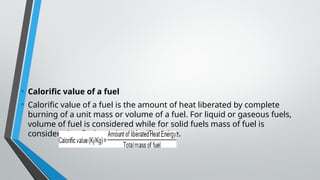
• Calorific value of a fuel
• Calorific value of a fuel is the amount of heat liberated by complete
burning of a unit mass or volume of a fuel. For liquid or gaseous fuels,
volume of fuel is considered while for solid fuels mass of fuel is
considered to find out the calorific value.
CAREACTERISTICS OF AN IDEAL FUEL
• (1) It should have a high calorific value.
• (2) It should not cause any pollution or should not produce harmful gases on
combustion.
• (3) It should be of low cost and easily available.
• (4) It should be easy to handle, store and transport.
• (5) It should have moderate ignition temperature.
• (6) It should have moderate rate of combustion.
FOSSIL FULE
• Exhaustible natural resources like coal, petroleum and natural gas
were formed from the dead remains of living organism (fossils).
So, these are called fossil fuels. Coal and petroleum are very
important natural resources and play a vital role in modem
society. They are found in the earth's crust.
COAL
• Coal
• Coal is a complex mixture of carbon, hydrogen and oxygen compounds. me nitrogen, sulphur
and phosphorus compounds are also present in it. It is found in coal mines deep under the
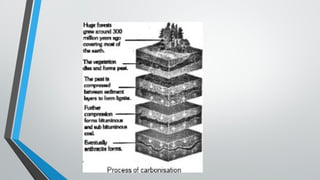
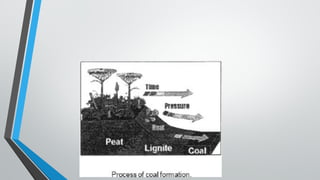
surface of earth. Story of formation : It is believed that millions of years ago, the ground below
the forests was split open by natural forces such as earthquakes and volcanoes. The forests
got buried under the surface of earth. Thus, the plants had no contact with oxygen. Successive
layers of sediments sealed the buried plants. Over millions of year, these deposits were
subjected to tremendous pressure and heat finally transformed them into coal.
• Carbonisation: The chemical process involved in the transformation of punt matter into coal
is called the carbonisation of plant matter.
• The carbon content of coal depends upon the variety of the coal.
The higher the temperature and pressure of the Earth and the
longer the coal has been hurried under the Earth, the more is the
carbon content in it. So, the different varieties of coal are as
follows (1) Peat (2) Lignite (3) Bituminous coal (4) Anthracite coal
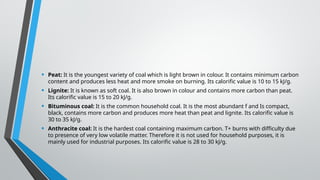
• Peat: It is the youngest variety of coal which is light brown in colour. It contains minimum carbon
content and produces less heat and more smoke on burning. Its calorific value is 10 to 15 kJ/g.
• Lignite: It is known as soft coal. It is also brown in colour and contains more carbon than peat.
Its calorific value is 15 to 20 kJ/g.
• Bituminous coal: It is the common household coal. It is the most abundant f and Is compact,
black, contains more carbon and produces more heat than peat and lignite. Its calorific value is
30 to 35 kJ/g.
• Anthracite coal: It is the hardest coal containing maximum carbon. T+ burns with difficulty due
to presence of very low volatile matter. Therefore it is not used for household purposes, it is
mainly used for industrial purposes. Its calorific value is 28 to 30 kJ/g.
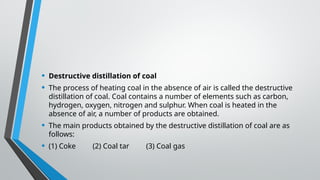
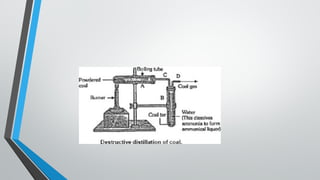
• Destructive distillation of coal
• The process of heating coal in the absence of air is called the destructive
distillation of coal. Coal contains a number of elements such as carbon,
hydrogen, oxygen, nitrogen and sulphur. When coal is heated in the
absence of air, a number of products are obtained.
• The main products obtained by the destructive distillation of coal are as
follows:
• (1) Coke (2) Coal tar (3) Coal gas
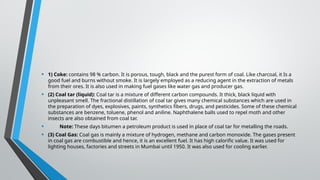
• 1) Coke: contains 98 % carbon. It is porous, tough, black and the purest form of coal. Like charcoal, it Is a
good fuel and burns without smoke. It is largely employed as a reducing agent in the extraction of metals
from their ores. It is also used in making fuel gases like water gas and producer gas.
• (2) Coal tar (liquid): Coal tar is a mixture of different carbon compounds. It thick, black liquid with
unpleasant smell. The fractional distillation of coal tar gives many chemical substances which are used in
the preparation of dyes, explosives, paints, synthetics fibers, drugs, and pesticides. Some of these chemical
substances are benzene, toluene, phenol and aniline. Naphthalene balls used to repel moth and other
insects are also obtained from coal tar.
• Note: These days bitumen a petroleum product is used in place of coal tar for metalling the roads.
• (3) Coal Gas: Coal gas is mainly a mixture of hydrogen, methane and carbon monoxide. The gases present
in coal gas are combustible and hence, it is an excellent fuel. It has high calorific value. It was used for
lighting houses, factories and streets in Mumbai until 1950. It was also used for cooling earlier.
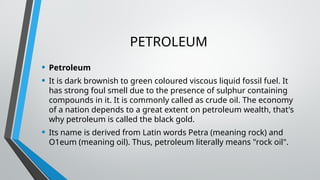
PETROLEUM
• Petroleum
• It is dark brownish to green coloured viscous liquid fossil fuel. It
has strong foul smell due to the presence of sulphur containing
compounds in it. It is commonly called as crude oil. The economy
of a nation depends to a great extent on petroleum wealth, that's
why petroleum is called the black gold.
• Its name is derived from Latin words Petra (meaning rock) and
O1eum (meaning oil). Thus, petroleum literally means "rock oil".
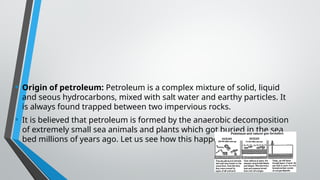
• Origin of petroleum: Petroleum is a complex mixture of solid, liquid
and seous hydrocarbons, mixed with salt water and earthy particles. It
is always found trapped between two impervious rocks.
• It is believed that petroleum is formed by the anaerobic decomposition
of extremely small sea animals and plants which got buried in the sea
bed millions of years ago. Let us see how this happened.
• Occurrence of petroleum: Petroleum occurs at a moderate depth (500 m to 200 m) between the 2 layers of impervious rocks. The petroleum is
lighter than It water & hence, floats over it. Natural gas is found above petroleum, trapped between the rock cap & petroleum layer.
• Drilling of oil wells: The hole is drilled in the Earth's crust & when it reached the rock cap, the natural gas comes out first with a great pressure.
When the pressure of gas subsides, petroleum starts flowing out due to the pressure of natural gas.
• Refining of petroleum: Petroleum is a mixture of several hydrocarbons. It also contains water, salt and rocky materials. It cannot be used in this
made form either as a fuel or a basic material to produce other useful components. Before being put to use, it has to be purified or refined. The
process of separating the various components of petroleum from one another is known as the refining of petroleum. This is done by a process
called fractional distillation which is based on the fact that the different components of petroleum have distinctly different boiling points.
• In fractional distillation, crude petroleum is heated to a temperature of ,4U0°C or slightly above in a furnace.
• Uses of petroleum
• (1) Petroleum products are used as fuels.
• (2) Lubricating oils, and vaseline are used as lubricants.
• (3) Paraffin wax, products of petroleum, is used for manufacturing candles, polishes, waxed paper, water proofing, etc.
• (4) Some of the by-products of petroleum after purification are used in the preparation of medicines, ointments, face creams and cosmetics.
• Natural gas
• Natural gas was formed millions of years ago along with petroleum when microscopic sea plants &
animals died & got buried under the sand & mud. These plants & animals under anaerobic conditions
changed to gas.
• Composition
• It consist mainly of methane (about 85%), ethane (about 10%) propane (about 3%) and butane when
natural gas is compressed at high pressure then it is called CNG (compressed natural gas). CNG is used
for power generation.
• It is now being used as a fuel for transport vehicles because it is less polluting. The great advantage of
CNG is that it can be used directly for burning in homes and factories where it can be supplied through
pipes. Such network of pjpeline exists in Vadodara (Gujarat) and some parts of Delhi.
• Occurrence
• It is generally found trapped between impervious rocks, sometimes
along with petroleum & sometimes without petroleum.
• In our country, natural gas has been found in Tripura, Rajasthan,
Maharashtra and in the Krishna Godavari Delta.
• Uses of natural gas
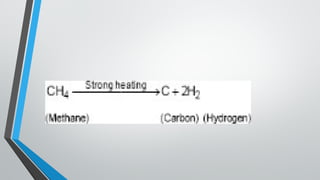
• (1) As a fuel - It has a very high calorific value of 55 ktJ/g
• Explanation
• Many useful substances are obtained from petroleum which can be used for the manufacture of detergents, fibers (polyester, nylon, acrylic etc.) polye thene and
many other plastics.
• Due to its great commercial importance, petroleum is also called Black Gold.
• Conservation of fossil fuels
• It is believed that it took millions of years for the dead organisms to change into coal, petroleum or natural gas. Furthermore, their known reserves are limited.
• Another problem with fossil fuels is that they are steadily increasing air . pollution, their use is linked to global warming. So, it is important that we use fuels only
when it is absolutely necessary. tri this way, we can save these fuels for the Manufacture of many substances which are dependent on petrochemicals.
• For energy purpose, we must look for alternative sources, such as solar energy, tidal energy, wind energy, etc. Furthermore, fossil fuels will be available to future
generations for more useful products.
• In India, the Petroleum Conservation Research Association (PCRA) offers the following tips to conserve petrol & diesel while driving.
• (1) Drive at a constant & moderate speed as far as possible. Driving at a high speed or slow speed wastes a lot of fuel.
• (2) Switch off engine if you have to wait at traffic lights or for any other reason.
• (3) Check the tyPe pressure regularly, low pressure or too high pressure waste fuel.
• (4) Make sure that you send your vehicle to garage for regular maintenance.

SCI WINDOWS Ranveer Pawer class 9 netizens

  • 1.
    SCI WINDOWS COAL ANDPETROLEM RANVEER PAWAR
  • 2.
    INTRODUCTION • We usevarious materials for our basic needs. Some of them are found in nature and some have been made by human efforts.
  • 3.
    NATURAL RESORCE • Definition •The sources which are obtained from nature are called natural resources.
  • 4.
    TYPE FO NATURALRESOURCE • 1. Inexhaustible natural resources • These sources are present in unlimited quantity in nature and are not likely to be exhausted by human activities. • Examples: Sunlight, air, etc. • 2. Exhaustible natural resources • The amount of these resources in nature is limited, they can be exhausted by human activities. • Examples: Forests, coal, petroleum. minerals, wild life, natural gas, etc.
  • 5.
    EXPLANATION • Sunlight isan ultimate source of energy available free of cost. It cannot be exhausted by human activities as it is produced by a natural process of fusion inside the sun. Due to this nuclear fusion extremely large amount of energy is produced which comes in the form of sunlight.
  • 6.
    TYPE FO NATURALRESOURCES
  • 7.
    FULES • A fuelis a substance, which bums In air to produce energy without releasing harmful gases in large quantities. • Fuels can be classified as natural (primary) fuels and derived (secondary) fuels. If a fuel Is present in its natural state, it is called natural fuel. If a fuel is processed to improve its quality, it Is called derived fuel.
  • 8.
  • 9.
    • Calorific valueof a fuel • Calorific value of a fuel is the amount of heat liberated by complete burning of a unit mass or volume of a fuel. For liquid or gaseous fuels, volume of fuel is considered while for solid fuels mass of fuel is considered to find out the calorific value.
  • 10.
    CAREACTERISTICS OF ANIDEAL FUEL • (1) It should have a high calorific value. • (2) It should not cause any pollution or should not produce harmful gases on combustion. • (3) It should be of low cost and easily available. • (4) It should be easy to handle, store and transport. • (5) It should have moderate ignition temperature. • (6) It should have moderate rate of combustion.
  • 11.
    FOSSIL FULE • Exhaustiblenatural resources like coal, petroleum and natural gas were formed from the dead remains of living organism (fossils). So, these are called fossil fuels. Coal and petroleum are very important natural resources and play a vital role in modem society. They are found in the earth's crust.
  • 12.
    COAL • Coal • Coalis a complex mixture of carbon, hydrogen and oxygen compounds. me nitrogen, sulphur and phosphorus compounds are also present in it. It is found in coal mines deep under the surface of earth. Story of formation : It is believed that millions of years ago, the ground below the forests was split open by natural forces such as earthquakes and volcanoes. The forests got buried under the surface of earth. Thus, the plants had no contact with oxygen. Successive layers of sediments sealed the buried plants. Over millions of year, these deposits were subjected to tremendous pressure and heat finally transformed them into coal. • Carbonisation: The chemical process involved in the transformation of punt matter into coal is called the carbonisation of plant matter.
  • 14.
    • The carboncontent of coal depends upon the variety of the coal. The higher the temperature and pressure of the Earth and the longer the coal has been hurried under the Earth, the more is the carbon content in it. So, the different varieties of coal are as follows (1) Peat (2) Lignite (3) Bituminous coal (4) Anthracite coal
  • 15.
    • Peat: Itis the youngest variety of coal which is light brown in colour. It contains minimum carbon content and produces less heat and more smoke on burning. Its calorific value is 10 to 15 kJ/g. • Lignite: It is known as soft coal. It is also brown in colour and contains more carbon than peat. Its calorific value is 15 to 20 kJ/g. • Bituminous coal: It is the common household coal. It is the most abundant f and Is compact, black, contains more carbon and produces more heat than peat and lignite. Its calorific value is 30 to 35 kJ/g. • Anthracite coal: It is the hardest coal containing maximum carbon. T+ burns with difficulty due to presence of very low volatile matter. Therefore it is not used for household purposes, it is mainly used for industrial purposes. Its calorific value is 28 to 30 kJ/g.
  • 17.
    • Destructive distillationof coal • The process of heating coal in the absence of air is called the destructive distillation of coal. Coal contains a number of elements such as carbon, hydrogen, oxygen, nitrogen and sulphur. When coal is heated in the absence of air, a number of products are obtained. • The main products obtained by the destructive distillation of coal are as follows: • (1) Coke (2) Coal tar (3) Coal gas
  • 19.
    • 1) Coke:contains 98 % carbon. It is porous, tough, black and the purest form of coal. Like charcoal, it Is a good fuel and burns without smoke. It is largely employed as a reducing agent in the extraction of metals from their ores. It is also used in making fuel gases like water gas and producer gas. • (2) Coal tar (liquid): Coal tar is a mixture of different carbon compounds. It thick, black liquid with unpleasant smell. The fractional distillation of coal tar gives many chemical substances which are used in the preparation of dyes, explosives, paints, synthetics fibers, drugs, and pesticides. Some of these chemical substances are benzene, toluene, phenol and aniline. Naphthalene balls used to repel moth and other insects are also obtained from coal tar. • Note: These days bitumen a petroleum product is used in place of coal tar for metalling the roads. • (3) Coal Gas: Coal gas is mainly a mixture of hydrogen, methane and carbon monoxide. The gases present in coal gas are combustible and hence, it is an excellent fuel. It has high calorific value. It was used for lighting houses, factories and streets in Mumbai until 1950. It was also used for cooling earlier.
  • 20.
    PETROLEUM • Petroleum • Itis dark brownish to green coloured viscous liquid fossil fuel. It has strong foul smell due to the presence of sulphur containing compounds in it. It is commonly called as crude oil. The economy of a nation depends to a great extent on petroleum wealth, that's why petroleum is called the black gold. • Its name is derived from Latin words Petra (meaning rock) and O1eum (meaning oil). Thus, petroleum literally means "rock oil".
  • 21.
    • Origin ofpetroleum: Petroleum is a complex mixture of solid, liquid and seous hydrocarbons, mixed with salt water and earthy particles. It is always found trapped between two impervious rocks. • It is believed that petroleum is formed by the anaerobic decomposition of extremely small sea animals and plants which got buried in the sea bed millions of years ago. Let us see how this happened.
  • 22.
    • Occurrence ofpetroleum: Petroleum occurs at a moderate depth (500 m to 200 m) between the 2 layers of impervious rocks. The petroleum is lighter than It water & hence, floats over it. Natural gas is found above petroleum, trapped between the rock cap & petroleum layer. • Drilling of oil wells: The hole is drilled in the Earth's crust & when it reached the rock cap, the natural gas comes out first with a great pressure. When the pressure of gas subsides, petroleum starts flowing out due to the pressure of natural gas. • Refining of petroleum: Petroleum is a mixture of several hydrocarbons. It also contains water, salt and rocky materials. It cannot be used in this made form either as a fuel or a basic material to produce other useful components. Before being put to use, it has to be purified or refined. The process of separating the various components of petroleum from one another is known as the refining of petroleum. This is done by a process called fractional distillation which is based on the fact that the different components of petroleum have distinctly different boiling points. • In fractional distillation, crude petroleum is heated to a temperature of ,4U0°C or slightly above in a furnace. • Uses of petroleum • (1) Petroleum products are used as fuels. • (2) Lubricating oils, and vaseline are used as lubricants. • (3) Paraffin wax, products of petroleum, is used for manufacturing candles, polishes, waxed paper, water proofing, etc. • (4) Some of the by-products of petroleum after purification are used in the preparation of medicines, ointments, face creams and cosmetics.
  • 24.
    • Natural gas •Natural gas was formed millions of years ago along with petroleum when microscopic sea plants & animals died & got buried under the sand & mud. These plants & animals under anaerobic conditions changed to gas. • Composition • It consist mainly of methane (about 85%), ethane (about 10%) propane (about 3%) and butane when natural gas is compressed at high pressure then it is called CNG (compressed natural gas). CNG is used for power generation. • It is now being used as a fuel for transport vehicles because it is less polluting. The great advantage of CNG is that it can be used directly for burning in homes and factories where it can be supplied through pipes. Such network of pjpeline exists in Vadodara (Gujarat) and some parts of Delhi.
  • 25.
    • Occurrence • Itis generally found trapped between impervious rocks, sometimes along with petroleum & sometimes without petroleum. • In our country, natural gas has been found in Tripura, Rajasthan, Maharashtra and in the Krishna Godavari Delta. • Uses of natural gas • (1) As a fuel - It has a very high calorific value of 55 ktJ/g
  • 27.
    • Explanation • Manyuseful substances are obtained from petroleum which can be used for the manufacture of detergents, fibers (polyester, nylon, acrylic etc.) polye thene and many other plastics. • Due to its great commercial importance, petroleum is also called Black Gold. • Conservation of fossil fuels • It is believed that it took millions of years for the dead organisms to change into coal, petroleum or natural gas. Furthermore, their known reserves are limited. • Another problem with fossil fuels is that they are steadily increasing air . pollution, their use is linked to global warming. So, it is important that we use fuels only when it is absolutely necessary. tri this way, we can save these fuels for the Manufacture of many substances which are dependent on petrochemicals. • For energy purpose, we must look for alternative sources, such as solar energy, tidal energy, wind energy, etc. Furthermore, fossil fuels will be available to future generations for more useful products. • In India, the Petroleum Conservation Research Association (PCRA) offers the following tips to conserve petrol & diesel while driving. • (1) Drive at a constant & moderate speed as far as possible. Driving at a high speed or slow speed wastes a lot of fuel. • (2) Switch off engine if you have to wait at traffic lights or for any other reason. • (3) Check the tyPe pressure regularly, low pressure or too high pressure waste fuel. • (4) Make sure that you send your vehicle to garage for regular maintenance.