25.5 Hydrocarbons from Earth
Natural Gas Fossil fuels provide much of the world’s energy Natural gas and petroleum contain mostly the aliphatic (or straight-chain) hydrocarbons – formed from marine life buried in sediment of the oceans Natural gas is an important source of alkanes of low molecular mass
Natural Gas Natural gas is typically: 80% methane, 10% ethane, 4% propane, and 2% butane with the remainder being nitrogen and higher molar mass hydrocarbons also contains a small amount of He, and is one of it’s major sources
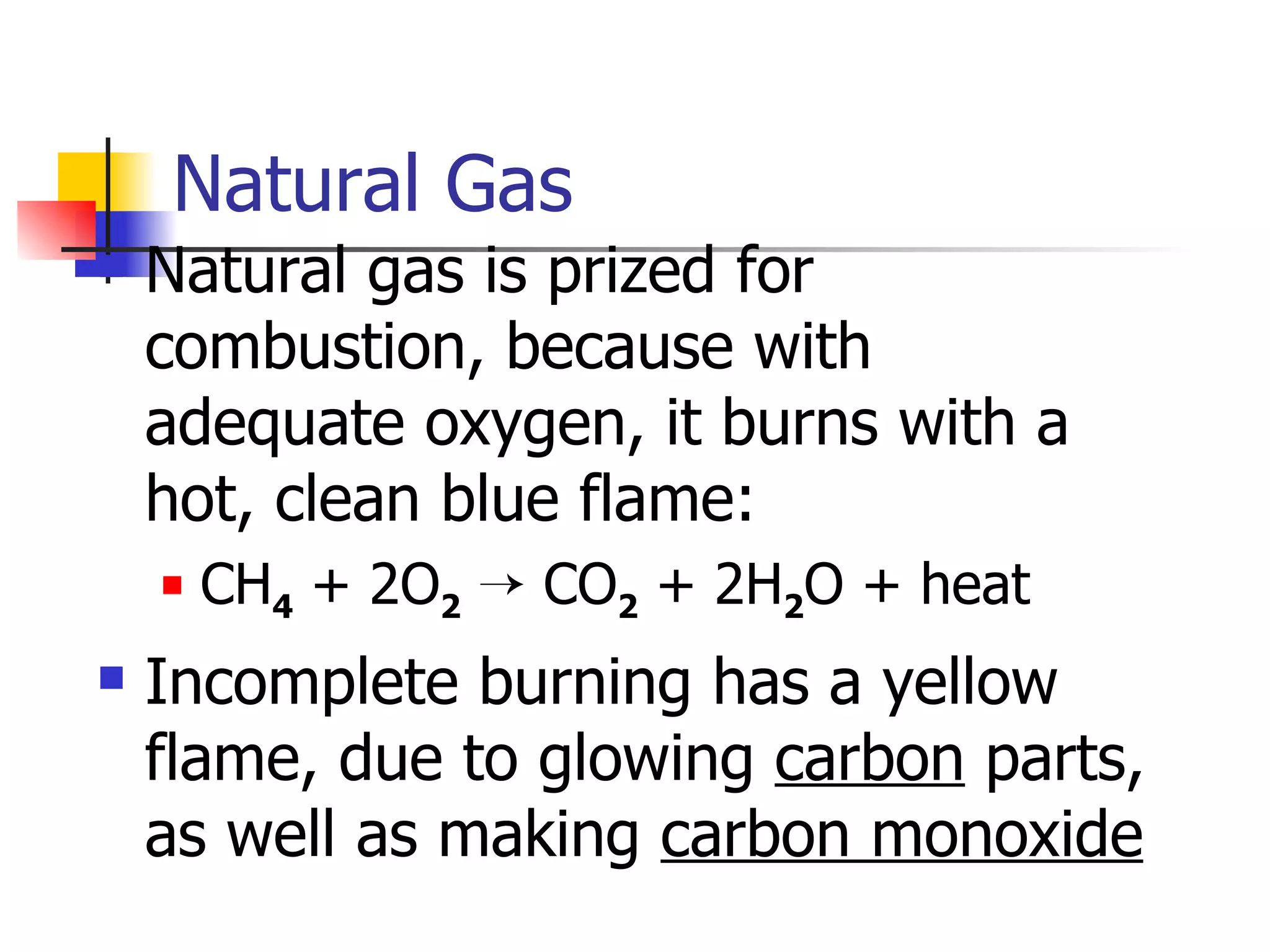
Natural Gas Natural gas is prized for combustion, because with adequate oxygen, it burns with a hot, clean blue flame: CH 4  + 2O 2     CO 2  + 2H 2 O + heat Incomplete burning has a yellow flame, due to glowing  carbon  parts, as well as making  carbon monoxide
Petroleum The compounds found in petroleum (or crude oil) are more complex than those in natural gas Usually straight-chain and branched-chain alkanes, with some aromatic compounds also Crude oil must be refined (separated) before being used
Petroleum It is separated by distillation into fractions, according to boiling pt. Fractions containing higher molar mass can be “ cracked ” into more useful shorter chain components, such as gasoline and kerosene involves catalyst and heat starts materials for plastics and paints
Coal From huge fern trees and mosses decaying millions of years ago under great pressure of rocks / soil. Stages in coal formation: 1.  Peat - soft, fibrous material much like decayed garden refuse; high water content.  After drying will make a low-cost, smoky fuel
Coal 2.  Lignite - peat left in the ground longer, loses it’s fibrous texture, and is also called brown coal harder than peat; higher C content (50%); still has high water content 3.  Bituminous , or soft coal- formed after more time; lower water content, higher C content (70-80%)
Coal 4.  Anthracite , or hard coal carbon content exceeding 80%, making it an excellent fuel source Coal may be found close to the surface (strip-mined), or deep within the earth Pollutants from coal are common; soot and sulfur problems
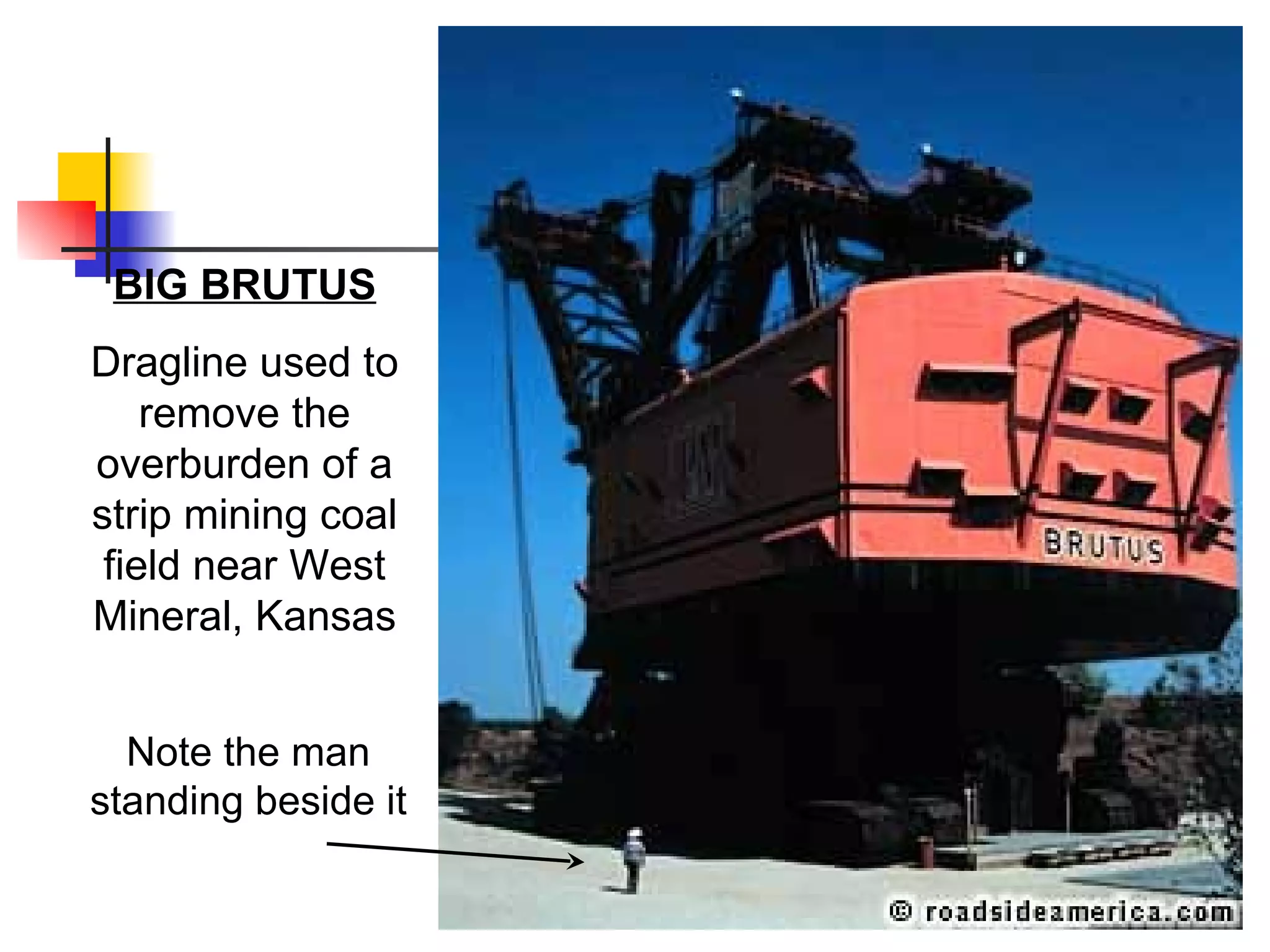
BIG BRUTUS Dragline used to remove the overburden of a strip mining coal field near West Mineral, Kansas Note the man standing beside it
Coal Coal may be distilled for many products coal gas, coal tar, coke, and ammonia further distilled into benzene, toluene, naphthalene, phenol- the aromatics Coke is almost pure carbon; produces intense heat and little or no smoke, thus used in industrial processes

25sec5

  • 1.
  • 2.
    Natural Gas Fossilfuels provide much of the world’s energy Natural gas and petroleum contain mostly the aliphatic (or straight-chain) hydrocarbons – formed from marine life buried in sediment of the oceans Natural gas is an important source of alkanes of low molecular mass
  • 3.
    Natural Gas Naturalgas is typically: 80% methane, 10% ethane, 4% propane, and 2% butane with the remainder being nitrogen and higher molar mass hydrocarbons also contains a small amount of He, and is one of it’s major sources
  • 4.
    Natural Gas Naturalgas is prized for combustion, because with adequate oxygen, it burns with a hot, clean blue flame: CH 4 + 2O 2  CO 2 + 2H 2 O + heat Incomplete burning has a yellow flame, due to glowing carbon parts, as well as making carbon monoxide
  • 5.
    Petroleum The compoundsfound in petroleum (or crude oil) are more complex than those in natural gas Usually straight-chain and branched-chain alkanes, with some aromatic compounds also Crude oil must be refined (separated) before being used
  • 6.
    Petroleum It isseparated by distillation into fractions, according to boiling pt. Fractions containing higher molar mass can be “ cracked ” into more useful shorter chain components, such as gasoline and kerosene involves catalyst and heat starts materials for plastics and paints
  • 7.
    Coal From hugefern trees and mosses decaying millions of years ago under great pressure of rocks / soil. Stages in coal formation: 1. Peat - soft, fibrous material much like decayed garden refuse; high water content. After drying will make a low-cost, smoky fuel
  • 8.
    Coal 2. Lignite - peat left in the ground longer, loses it’s fibrous texture, and is also called brown coal harder than peat; higher C content (50%); still has high water content 3. Bituminous , or soft coal- formed after more time; lower water content, higher C content (70-80%)
  • 9.
    Coal 4. Anthracite , or hard coal carbon content exceeding 80%, making it an excellent fuel source Coal may be found close to the surface (strip-mined), or deep within the earth Pollutants from coal are common; soot and sulfur problems
  • 10.
    BIG BRUTUS Draglineused to remove the overburden of a strip mining coal field near West Mineral, Kansas Note the man standing beside it
  • 11.
    Coal Coal maybe distilled for many products coal gas, coal tar, coke, and ammonia further distilled into benzene, toluene, naphthalene, phenol- the aromatics Coke is almost pure carbon; produces intense heat and little or no smoke, thus used in industrial processes