CKD-Mineral Bone Disease


              Sandeep G Huilgol
CKD-MBD

• Mineral Metabolism

• Mineral Bone Disease

• Treatment – KDIGO and KDOQI guidelines
Chronic kidney disease (CKD)–mineral and bone
  disorder (CKD-MBD) is a term that encompasses a
  constellation of abnormalities seen in progressive
  kidney disease that include
• Altered levels of calcium,
• Phosphorus
• Parathyroid hormone (PTH), and
• Vitamin D;
• Disturbances in bone modeling and remodeling
• Extraskeletal calcification in soft tissues and
  arteries
Definition of CKD-MBD
 A systemic disorder of mineral and bone
  metabolism due to CKD manifested by either one
  or a combination of the following:
• Abnormalities of calcium, phosphorus, PTH, or
  vitamin D metabolism
• Abnormalities in bone turnover, mineralization,
  volume, linear growth, or strength
• Vascular or other soft-tissue calcification
 Reference: KDIGO Clinical Practice Guideline for the Diagnosis, Evaluation,
  Prevention, and Treatment of CKD-MBD(Kidney Int. 2009; 76[suppl 113])
Phosphurus
Physiology:

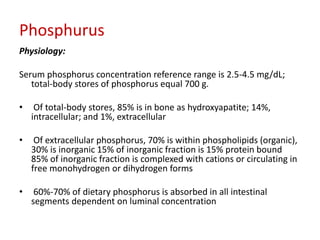
Serum phosphorus concentration reference range is 2.5-4.5 mg/dL;
   total-body stores of phosphorus equal 700 g.

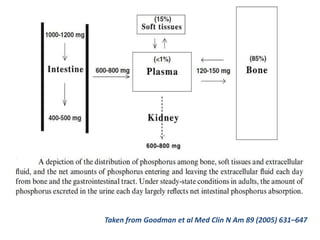
•    Of total-body stores, 85% is in bone as hydroxyapatite; 14%,
    intracellular; and 1%, extracellular

•    Of extracellular phosphorus, 70% is within phospholipids (organic),
    30% is inorganic 15% of inorganic fraction is 15% protein bound
    85% of inorganic fraction is complexed with cations or circulating in
    free monohydrogen or dihydrogen forms

•    60%-70% of dietary phosphorus is absorbed in all intestinal
    segments dependent on luminal concentration
• Absorbed through sodium/phosphate cotransporter 2b (Npt2b)

•   Stimulated by calcitriol

ROLE OF KIDNEYS
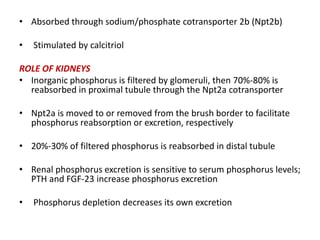
• Inorganic phosphorus is filtered by glomeruli, then 70%-80% is
  reabsorbed in proximal tubule through the Npt2a cotransporter

• Npt2a is moved to or removed from the brush border to facilitate
  phosphorus reabsorption or excretion, respectively

• 20%-30% of filtered phosphorus is reabsorbed in distal tubule

• Renal phosphorus excretion is sensitive to serum phosphorus levels;
  PTH and FGF-23 increase phosphorus excretion

•   Phosphorus depletion decreases its own excretion
Taken from Goodman et al Med Clin N Am 89 (2005) 631–647
FGF-23
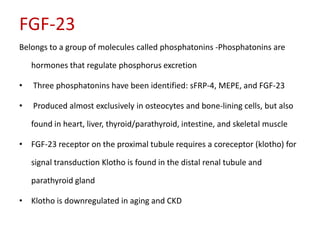
Belongs to a group of molecules called phosphatonins -Phosphatonins are

    hormones that regulate phosphorus excretion

•   Three phosphatonins have been identified: sFRP-4, MEPE, and FGF-23

•   Produced almost exclusively in osteocytes and bone-lining cells, but also

    found in heart, liver, thyroid/parathyroid, intestine, and skeletal muscle

• FGF-23 receptor on the proximal tubule requires a coreceptor (klotho) for

    signal transduction Klotho is found in the distal renal tubule and

    parathyroid gland

• Klotho is downregulated in aging and CKD
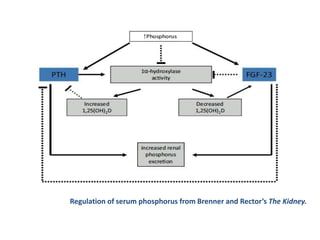
FGF-23 has the following actions

•   Downregulates luminal sodium/phosphate cotransporters in the
    proximal tubule, decreasing phosphorus reabsorption and therefore
    increasing its excretion

•   Inhibits 1-hydroxylase, decreasing the conversion of 25-
    hydroxyvitamin D (25[OH]D) to 1,25-dihydoxyvitamin D
    (1,25[OH]2D3; calcitriol

•   Stimulates 24-hydroxylase (CYP24), leading to vitamin D
    degradation

•   Inhibits PTH secretion
Regulation of serum phosphorus from Brenner and Rector’s The Kidney.
CKD and Phosphorus
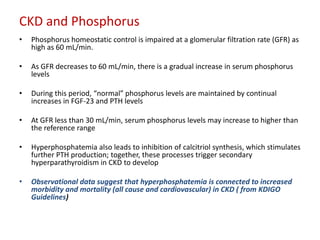
•   Phosphorus homeostatic control is impaired at a glomerular filtration rate (GFR) as
    high as 60 mL/min.

•   As GFR decreases to 60 mL/min, there is a gradual increase in serum phosphorus
    levels

•   During this period, “normal” phosphorus levels are maintained by continual
    increases in FGF-23 and PTH levels

•   At GFR less than 30 mL/min, serum phosphorus levels may increase to higher than
    the reference range

•   Hyperphosphatemia also leads to inhibition of calcitriol synthesis, which stimulates
    further PTH production; together, these processes trigger secondary
    hyperparathyroidism in CKD to develop

•   Observational data suggest that hyperphosphatemia is connected to increased
    morbidity and mortality (all cause and cardiovascular) in CKD ( from KDIGO
    Guidelines)
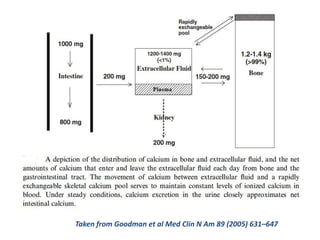
Calcium
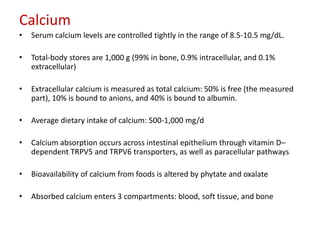
•   Serum calcium levels are controlled tightly in the range of 8.5-10.5 mg/dL.

•   Total-body stores are 1,000 g (99% in bone, 0.9% intracellular, and 0.1%
    extracellular)

•   Extracellular calcium is measured as total calcium: 50% is free (the measured
    part), 10% is bound to anions, and 40% is bound to albumin.

•   Average dietary intake of calcium: 500-1,000 mg/d

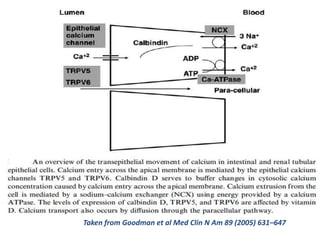
•   Calcium absorption occurs across intestinal epithelium through vitamin D–
    dependent TRPV5 and TRPV6 transporters, as well as paracellular pathways

•   Bioavailability of calcium from foods is altered by phytate and oxalate

•   Absorbed calcium enters 3 compartments: blood, soft tissue, and bone
Taken from Goodman et al Med Clin N Am 89 (2005) 631–647
Renal Handling
• 60%-70% is reabsorbed passively in proximal tubules with sodium and
   water reabsorption
• 10% is reabsorbed in the thick ascending limb by the paracellular route
• The rest is reabsorbed through transcellular pathways in the distal
   convoluted tubule, and cortical collecting duct through TRPV5 and TRPV6
   calcium channels
• TRPV6 predominates in the intestine, whereas TRPV5 predominates in the
   kidney

Calcium-sensing receptor (CaSR)
• G-protein–coupled protein that binds calcium to sense small changes in
   ionized calcium levels; decreased ionized calcium stimulates PTH secretion
• CaSR is expressed in parathyroid cells, thyroid C cells, intestine, kidney,
   and likely bone
• In the kidney, CaSR is in mesangial cells and throughout tubules, activation
   of CaSR on the thick ascending limb decreases paracellular calcium
   reabsorption.
• Upregulation of CaSR in hypercalcemia inhibits antidiuretic hormone
   (ADH)-induced free water reabsorption, leading to urinary dilution
Taken from Goodman et al Med Clin N Am 89 (2005) 631–647
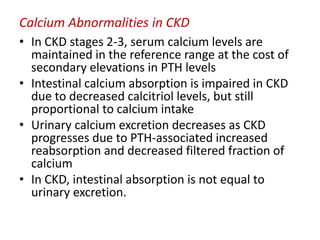
Calcium Abnormalities in CKD
• In CKD stages 2-3, serum calcium levels are
  maintained in the reference range at the cost of
  secondary elevations in PTH levels
• Intestinal calcium absorption is impaired in CKD
  due to decreased calcitriol levels, but still
  proportional to calcium intake
• Urinary calcium excretion decreases as CKD
  progresses due to PTH-associated increased
  reabsorption and decreased filtered fraction of
  calcium
• In CKD, intestinal absorption is not equal to
  urinary excretion.
Vitamin D
• Increase TRPV5 and TRPV6, the calcium
  adenosine triphosphatase and sodium/calcium
  transporters in the intestine and kidney

• This increases oral calcium absorption and
  calcium reabsorption in renal tubules

• Decreases PTH synthesis by binding to the
  vitamin D receptor in the parathyroid gland,
  inhibiting PTH gene expression, and decreasing
  PTH cell proliferation
25(OH)D is thought to have a multitude of
  effects on the immune system, muscle activity,
  and endothelial function
Vitamin D in CKD
• Patients with CKD have decreased 1,25(OH)2D levels

• Reduced phosphorus excretion leads to an increase in
  serum phosphorus and FGF-23 levels, which suppress
  1-hydroxylase activity and thereby decrease
  1,25(OH)2D levels

• Lower 1,25(OH)2D levels decrease intestinal calcium
  absorption, and the lower serum calcium level
  stimulates PTH release and increases phosphorus
  excretion

• As CKD progresses, these compensatory mechanisms
  fail.
Parathyroid Harmone
Physiologic Role
• PTH is secreted by the parathyroid glands in response to
  hypocalcemia, hyperphosphatemia, and/or calcitriol
  deficiency
• This 84–amino acid protein is cleaved from pre-pro PTH
  in the parathyroid gland
• Intact PTH (iPTH) has a short half-life (2-4 minutes)
• Cleaved into amino-terminal, carboxy-terminal, and
  midlength fragments, which are metabolized in the liver
  and kidney
• Amino-terminal fragments remain active; carboxy-
  terminal fragments accumulate in CKD
References
• Moorthi R N and Moe S N. CKD–Mineral and Bone
  Disorder. Am J Kidney Dis. 2011;58(6):1022-1036

• Goodman et al. Calcium and Phosphorus Metabolism
  in Patients Who Have Chronic Kidney Disease. Med
  Clin N Am 89 (2005) 631–647.

• Sharon M. Moe and Stuart M. Sprague. Chronic
  Kidney Disease- Mineral Bone Disorder. In: Brenner
  and Rector’s , The Kidney 9e. ISBN: 978-1-4160-
  6193-9.
Thank you

Chronic Kidney Disease MBD Part 1

  • 1.
    CKD-Mineral Bone Disease Sandeep G Huilgol
  • 2.
    CKD-MBD • Mineral Metabolism •Mineral Bone Disease • Treatment – KDIGO and KDOQI guidelines
  • 3.
    Chronic kidney disease(CKD)–mineral and bone disorder (CKD-MBD) is a term that encompasses a constellation of abnormalities seen in progressive kidney disease that include • Altered levels of calcium, • Phosphorus • Parathyroid hormone (PTH), and • Vitamin D; • Disturbances in bone modeling and remodeling • Extraskeletal calcification in soft tissues and arteries
  • 4.
    Definition of CKD-MBD A systemic disorder of mineral and bone metabolism due to CKD manifested by either one or a combination of the following: • Abnormalities of calcium, phosphorus, PTH, or vitamin D metabolism • Abnormalities in bone turnover, mineralization, volume, linear growth, or strength • Vascular or other soft-tissue calcification Reference: KDIGO Clinical Practice Guideline for the Diagnosis, Evaluation, Prevention, and Treatment of CKD-MBD(Kidney Int. 2009; 76[suppl 113])
  • 5.
    Phosphurus Physiology: Serum phosphorus concentrationreference range is 2.5-4.5 mg/dL; total-body stores of phosphorus equal 700 g. • Of total-body stores, 85% is in bone as hydroxyapatite; 14%, intracellular; and 1%, extracellular • Of extracellular phosphorus, 70% is within phospholipids (organic), 30% is inorganic 15% of inorganic fraction is 15% protein bound 85% of inorganic fraction is complexed with cations or circulating in free monohydrogen or dihydrogen forms • 60%-70% of dietary phosphorus is absorbed in all intestinal segments dependent on luminal concentration
  • 6.
    • Absorbed throughsodium/phosphate cotransporter 2b (Npt2b) • Stimulated by calcitriol ROLE OF KIDNEYS • Inorganic phosphorus is filtered by glomeruli, then 70%-80% is reabsorbed in proximal tubule through the Npt2a cotransporter • Npt2a is moved to or removed from the brush border to facilitate phosphorus reabsorption or excretion, respectively • 20%-30% of filtered phosphorus is reabsorbed in distal tubule • Renal phosphorus excretion is sensitive to serum phosphorus levels; PTH and FGF-23 increase phosphorus excretion • Phosphorus depletion decreases its own excretion
  • 7.
    Taken from Goodmanet al Med Clin N Am 89 (2005) 631–647
  • 8.
    FGF-23 Belongs to agroup of molecules called phosphatonins -Phosphatonins are hormones that regulate phosphorus excretion • Three phosphatonins have been identified: sFRP-4, MEPE, and FGF-23 • Produced almost exclusively in osteocytes and bone-lining cells, but also found in heart, liver, thyroid/parathyroid, intestine, and skeletal muscle • FGF-23 receptor on the proximal tubule requires a coreceptor (klotho) for signal transduction Klotho is found in the distal renal tubule and parathyroid gland • Klotho is downregulated in aging and CKD
  • 9.
    FGF-23 has thefollowing actions • Downregulates luminal sodium/phosphate cotransporters in the proximal tubule, decreasing phosphorus reabsorption and therefore increasing its excretion • Inhibits 1-hydroxylase, decreasing the conversion of 25- hydroxyvitamin D (25[OH]D) to 1,25-dihydoxyvitamin D (1,25[OH]2D3; calcitriol • Stimulates 24-hydroxylase (CYP24), leading to vitamin D degradation • Inhibits PTH secretion
  • 10.
    Regulation of serumphosphorus from Brenner and Rector’s The Kidney.
  • 11.
    CKD and Phosphorus • Phosphorus homeostatic control is impaired at a glomerular filtration rate (GFR) as high as 60 mL/min. • As GFR decreases to 60 mL/min, there is a gradual increase in serum phosphorus levels • During this period, “normal” phosphorus levels are maintained by continual increases in FGF-23 and PTH levels • At GFR less than 30 mL/min, serum phosphorus levels may increase to higher than the reference range • Hyperphosphatemia also leads to inhibition of calcitriol synthesis, which stimulates further PTH production; together, these processes trigger secondary hyperparathyroidism in CKD to develop • Observational data suggest that hyperphosphatemia is connected to increased morbidity and mortality (all cause and cardiovascular) in CKD ( from KDIGO Guidelines)
  • 12.
    Calcium • Serum calcium levels are controlled tightly in the range of 8.5-10.5 mg/dL. • Total-body stores are 1,000 g (99% in bone, 0.9% intracellular, and 0.1% extracellular) • Extracellular calcium is measured as total calcium: 50% is free (the measured part), 10% is bound to anions, and 40% is bound to albumin. • Average dietary intake of calcium: 500-1,000 mg/d • Calcium absorption occurs across intestinal epithelium through vitamin D– dependent TRPV5 and TRPV6 transporters, as well as paracellular pathways • Bioavailability of calcium from foods is altered by phytate and oxalate • Absorbed calcium enters 3 compartments: blood, soft tissue, and bone
  • 13.
    Taken from Goodmanet al Med Clin N Am 89 (2005) 631–647
  • 14.
    Renal Handling • 60%-70%is reabsorbed passively in proximal tubules with sodium and water reabsorption • 10% is reabsorbed in the thick ascending limb by the paracellular route • The rest is reabsorbed through transcellular pathways in the distal convoluted tubule, and cortical collecting duct through TRPV5 and TRPV6 calcium channels • TRPV6 predominates in the intestine, whereas TRPV5 predominates in the kidney Calcium-sensing receptor (CaSR) • G-protein–coupled protein that binds calcium to sense small changes in ionized calcium levels; decreased ionized calcium stimulates PTH secretion • CaSR is expressed in parathyroid cells, thyroid C cells, intestine, kidney, and likely bone • In the kidney, CaSR is in mesangial cells and throughout tubules, activation of CaSR on the thick ascending limb decreases paracellular calcium reabsorption. • Upregulation of CaSR in hypercalcemia inhibits antidiuretic hormone (ADH)-induced free water reabsorption, leading to urinary dilution
  • 15.
    Taken from Goodmanet al Med Clin N Am 89 (2005) 631–647
  • 16.
    Calcium Abnormalities inCKD • In CKD stages 2-3, serum calcium levels are maintained in the reference range at the cost of secondary elevations in PTH levels • Intestinal calcium absorption is impaired in CKD due to decreased calcitriol levels, but still proportional to calcium intake • Urinary calcium excretion decreases as CKD progresses due to PTH-associated increased reabsorption and decreased filtered fraction of calcium • In CKD, intestinal absorption is not equal to urinary excretion.
  • 17.
    Vitamin D • IncreaseTRPV5 and TRPV6, the calcium adenosine triphosphatase and sodium/calcium transporters in the intestine and kidney • This increases oral calcium absorption and calcium reabsorption in renal tubules • Decreases PTH synthesis by binding to the vitamin D receptor in the parathyroid gland, inhibiting PTH gene expression, and decreasing PTH cell proliferation
  • 18.
    25(OH)D is thoughtto have a multitude of effects on the immune system, muscle activity, and endothelial function
  • 19.
    Vitamin D inCKD • Patients with CKD have decreased 1,25(OH)2D levels • Reduced phosphorus excretion leads to an increase in serum phosphorus and FGF-23 levels, which suppress 1-hydroxylase activity and thereby decrease 1,25(OH)2D levels • Lower 1,25(OH)2D levels decrease intestinal calcium absorption, and the lower serum calcium level stimulates PTH release and increases phosphorus excretion • As CKD progresses, these compensatory mechanisms fail.
  • 20.
    Parathyroid Harmone Physiologic Role •PTH is secreted by the parathyroid glands in response to hypocalcemia, hyperphosphatemia, and/or calcitriol deficiency • This 84–amino acid protein is cleaved from pre-pro PTH in the parathyroid gland • Intact PTH (iPTH) has a short half-life (2-4 minutes) • Cleaved into amino-terminal, carboxy-terminal, and midlength fragments, which are metabolized in the liver and kidney • Amino-terminal fragments remain active; carboxy- terminal fragments accumulate in CKD
  • 21.
    References • Moorthi RN and Moe S N. CKD–Mineral and Bone Disorder. Am J Kidney Dis. 2011;58(6):1022-1036 • Goodman et al. Calcium and Phosphorus Metabolism in Patients Who Have Chronic Kidney Disease. Med Clin N Am 89 (2005) 631–647. • Sharon M. Moe and Stuart M. Sprague. Chronic Kidney Disease- Mineral Bone Disorder. In: Brenner and Rector’s , The Kidney 9e. ISBN: 978-1-4160- 6193-9.
  • 22.