Heidi Schaeffer
Knowledge Management and Learning
AOHC
Canadian Index of Wellbeing
Applications for Community Health
Anna Piszczkiewicz
Knowledge Transfer and Communications
AOHC
Gary Machan
Canadian Research Advisory Group
Canadian Index of Wellbeing
communityhealthandwellbeing.org#ACAC2015
Objectives
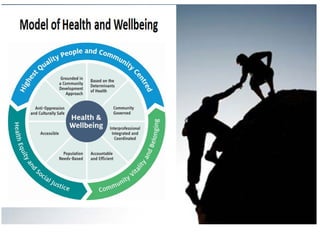
1 The journey we are on - the Model of Health and Wellbeing
and the best possible health and wellbeing for everyone.
2Understand the Canadian Index of Wellbeing framework in
measuring what matters to Canadians.
3 Get Inspired by how community-governed primary health
centres are adapting and adopting the CIW for evidence,
engagement, partnership, advocacy and policy change.
To achieve the best possible health and wellbeing for everyone
things need to shift:
• From a fragmented non-system focused on sickness to an
integrating health and wellbeing system
• From downstream focus to upstream focus on a complete sense
of health and wellbeing
• From health disparities to health equity
6
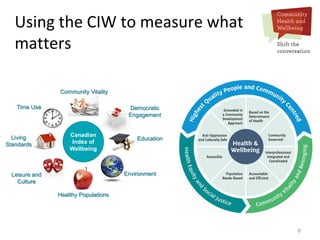
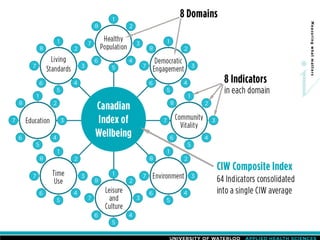
Using the CIW to measure what
matters
Living
Standards
Canadian
Index of
Wellbeing
Time Use
Community Vitality
Democratic
Engagement
Education
Leisure and
Culture
Environment
Healthy Populations
Gary Machan
Canadian Research Advisory Group
Canadian Index ofWellbeing
and
Bryan Smale, Ph.D.
Director, Canadian Index of Wellbeing
University of Waterloo
The Canadian Index of Wellbeing:
Applications for Community Health
Canadian Association of Community Health Centres, 2015 National Conference
“Community Health Centres:Agents of Care,Agents of Change”
Ottawa, Ontario – September 16-18, 2015
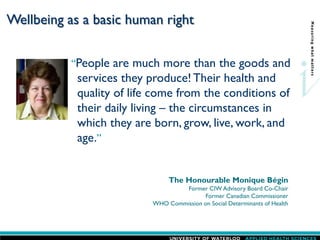
Wellbeing as a basic human right
“People are much more than the goods and
services they produce! Their health and
quality of life come from the conditions of
their daily living – the circumstances in
which they are born, grow, live, work, and
age.”
The Honourable Monique Bégin
Former CIW Advisory Board Co-Chair
Former Canadian Commissioner
WHO Commission on Social Determinants of Health
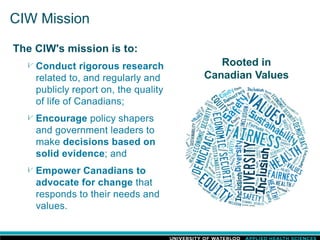
CIW Mission
The CIW's mission is to:
Conduct rigorous research
related to, and regularly and
publicly report on, the quality
of life of Canadians;
Encourage policy shapers
and government leaders to
make decisions based on
solid evidence; and
Empower Canadians to
advocate for change that
responds to their needs and
values.
Rooted in
Canadian Values
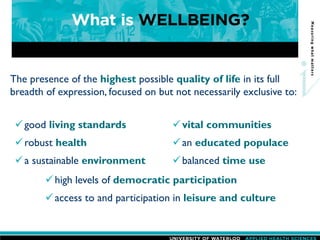
The presence of the highest possible quality of life in its full
breadth of expression, focused on but not necessarily exclusive to:
high levels of democratic participation
access to and participation in leisure and culture
good living standards
robust health
a sustainable environment
vital communities
an educated populace
balanced time use
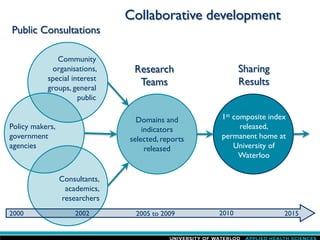
Collaborative development
Public Consultations
Research
Teams
Sharing
Results
Domains and
indicators
selected, reports
released
1st composite index
released,
permanent home at
University of
Waterloo
Community
organisations,
special interest
groups, general
public
Policy makers,
government
agencies
Consultants,
academics,
researchers
2002 2010 20152000 2005 to 2009
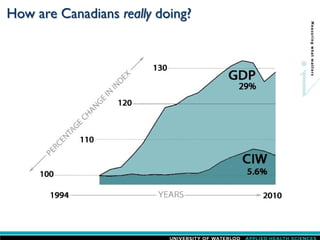
How are Canadians really doing?
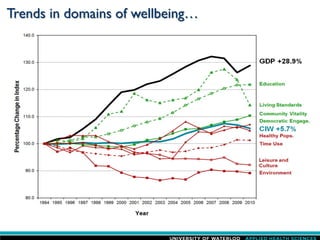
Trends in domains of wellbeing…
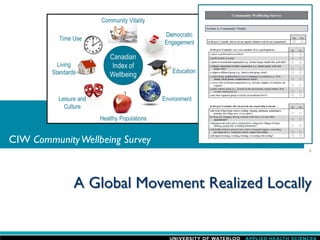
A Global Movement Realized Locally
CIW CommunityWellbeing Survey
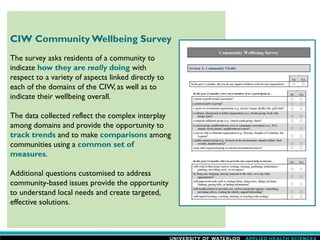
CIW Community Wellbeing Survey
The survey asks residents of a community to
indicate how they are really doing with
respect to a variety of aspects linked directly to
each of the domains of the CIW, as well as to
indicate their wellbeing overall.
The data collected reflect the complex interplay
among domains and provide the opportunity to
track trends and to make comparisons among
communities using a common set of
measures.
Additional questions customised to address
community-based issues provide the opportunity
to understand local needs and create targeted,
effective solutions.
Leading to Action and Impact
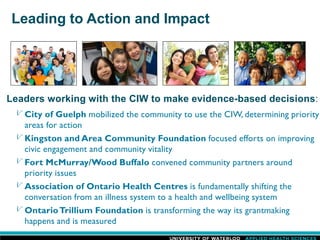
Leaders working with the CIW to make evidence-based decisions:
City of Guelph mobilized the community to use the CIW, determining priority
areas for action
Kingston and Area Community Foundation focused efforts on improving
civic engagement and community vitality
Fort McMurray/Wood Buffalo convened community partners around
priority issues
Association of Ontario Health Centres is fundamentally shifting the
conversation from an illness system to a health and wellbeing system
OntarioTrillium Foundation is transforming the way its grantmaking
happens and is measured
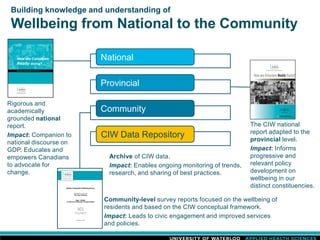
Community-level survey reports focused on the wellbeing of
residents and based on the CIW conceptual framework.
Impact: Leads to civic engagement and improved services
and policies.
The CIW national
report adapted to the
provincial level.
Impact: Informs
progressive and
relevant policy
development on
wellbeing in our
distinct constituencies.
National
Community
Provincial
CIW Data Repository
Archive of CIW data.
Impact: Enables ongoing monitoring of trends,
research, and sharing of best practices.
Rigorous and
academically
grounded national
report.
Impact: Companion to
national discourse on
GDP. Educates and
empowers Canadians
to advocate for
change.
Building knowledge and understanding of
Wellbeing from National to the Community
@ciwnetwork #wellbeing
www.ciw.ca
21
Ontario Trillium Foundation
has funded AOHC to explore:
Using the CIW as a vehicle
• to guide development, delivery and improvement of health
promotion and community development initiatives,
• for public communications and local partnership
development;
• and to promote province-wide dialogue about how the CIW
can kick start a shift to upstream interventions in communities
22
In order to evaluate the
impact of our investments,
OTF will use the CIW as both
a measurement framework
and a baseline.
—Andrea Cohen Barrack
CEO, Ontario Trillium Foundation
Ontario Trillium Foundation
redesigns investment strategy
23
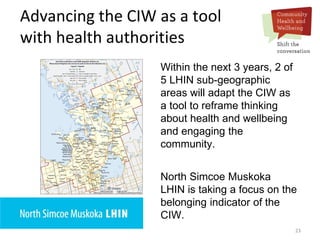
Advancing the CIW as a tool
with health authorities
Within the next 3 years, 2 of
5 LHIN sub-geographic
areas will adapt the CIW as
a tool to reframe thinking
about health and wellbeing
and engaging the
community.
North Simcoe Muskoka
LHIN is taking a focus on the
belonging indicator of the
CIW.
24
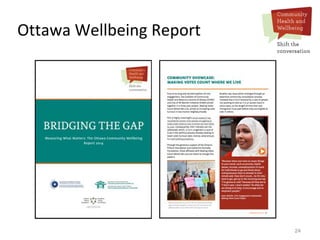
Ottawa Wellbeing Report
25
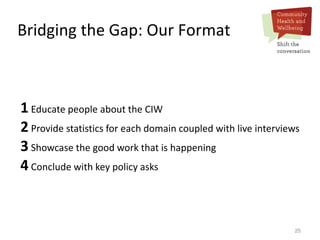
Bridging the Gap: Our Format
1Educate people about the CIW
2Provide statistics for each domain coupled with live interviews
3Showcase the good work that is happening
4Conclude with key policy asks
26
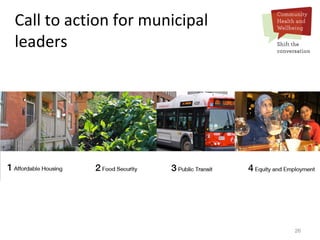
Call to action for municipal
leaders
27
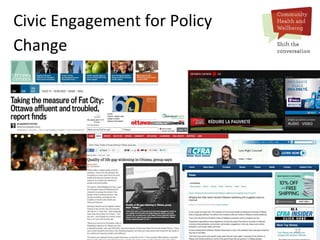
Civic Engagement for Policy
Change
27
28
We will fail or flourish according to the extent to which
we hold true to our commitment to civic engagement.
- Jack McCarthy, Executive Director, Somerset West CHC
29
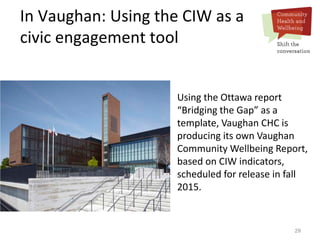
In Vaughan: Using the CIW as a
civic engagement tool
Using the Ottawa report
“Bridging the Gap” as a
template, Vaughan CHC is
producing its own Vaughan
Community Wellbeing Report,
based on CIW indicators,
scheduled for release in fall
2015.
30
Building effective community
collaboratives
The Woodstock CHC has applied
the CIW to initiate a multi-
partner community wide process
that is addressing how to
improve community vitality and
people’s “sense of belonging”
Public Health is a key partner
31
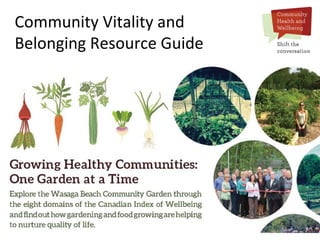
Community Vitality and
Belonging Resource Guide
32
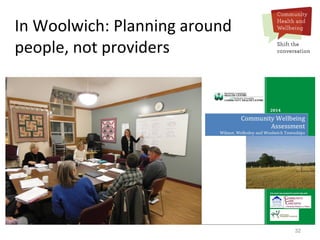
In Woolwich: Planning around
people, not providers
33
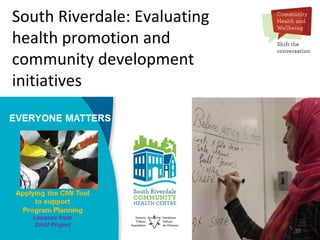
South Riverdale: Evaluating
health promotion and
community development
initiatives
34
We had this window of opportunity to do more intake, take more
clients into the centre. And I think [the Be Well survey] offers a good
way to see the needs of our residents from a community perspective
and not just from a physical perspective.”
- Yves Barbeau, Executive Director of Kapuskasing CHC
35
“Be Well” Survey Purposes
1. Understand and start to collect data on the wellbeing needs of our clients
and communities
2 Develop standardized core questions for wellbeing data comparability over
time across member centres & where possible with CIW’s provincial data
sources.
3 Maintain comparability, validity, and reliability of the core and extended
wellbeing questions.
4 Inform decisions around local, regional and provincial healthy public policy
and advocacy work.
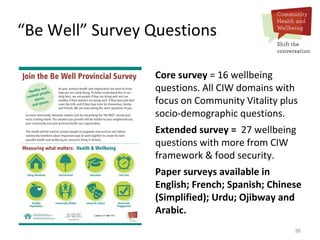
“Be Well” Survey Questions
Core survey = 16 wellbeing
questions. All CIW domains with
focus on Community Vitality plus
socio-demographic questions.
Extended survey = 27 wellbeing
questions with more from CIW
framework & food security.
Paper surveys available in
English; French; Spanish; Chinese
(Simplified); Urdu; Ojibway and
Arabic.
36
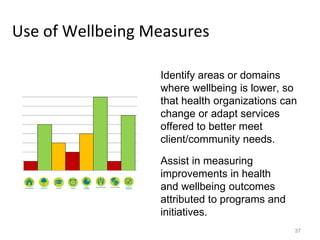
Use of Wellbeing Measures
Identify areas or domains
where wellbeing is lower, so
that health organizations can
change or adapt services
offered to better meet
client/community needs.
37
Assist in measuring
improvements in health
and wellbeing outcomes
attributed to programs and
initiatives.
Use of Wellbeing Measures
38
Enhance the ability of health organizations to engage clients in
a discussion about their personal health and wellbeing needs.
Provide input into strategic planning and inform the
development of collective impact initiatives and partnerships
which aim to address gaps and the broader health and
wellbeing goals of the community.
39
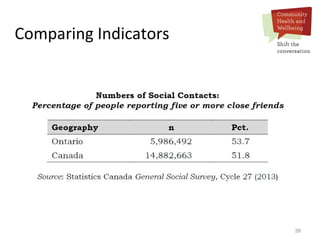
Comparing Indicators
40
According to the Public Health Agency of Canada (2015) in
“What makes Canadians healthy or unhealthy?”, the people
with adequate social relationships are at a 50% lower risk of
death than those with poor or insufficient relationships.
41
“Be Well” Survey:
Provincial Report
• A provincial baseline report will be produced by this November
with surveys collected April-July, 2015.
• A second report will be produced in March 2017 with surveys
collected September – December 2016.
• Centre support available with planning for use, sampling design,
interpretation and decision support.
• Centre support available to address gaps in results and support
with planning and evaluation.
42
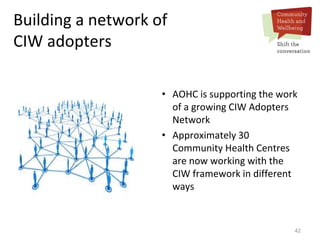
Building a network of
CIW adopters
• AOHC is supporting the work
of a growing CIW Adopters
Network
• Approximately 30
Community Health Centres
are now working with the
CIW framework in different
ways
43
THE CONVERSATION CONTINUES AT
www.communityhealthandwellbeing.org

CIW AOHC - 2015 CACHC Conference Presentation

  • 1.
    Heidi Schaeffer Knowledge Managementand Learning AOHC Canadian Index of Wellbeing Applications for Community Health Anna Piszczkiewicz Knowledge Transfer and Communications AOHC Gary Machan Canadian Research Advisory Group Canadian Index of Wellbeing communityhealthandwellbeing.org#ACAC2015
  • 2.
    Objectives 1 The journeywe are on - the Model of Health and Wellbeing and the best possible health and wellbeing for everyone. 2Understand the Canadian Index of Wellbeing framework in measuring what matters to Canadians. 3 Get Inspired by how community-governed primary health centres are adapting and adopting the CIW for evidence, engagement, partnership, advocacy and policy change.
  • 3.
    To achieve thebest possible health and wellbeing for everyone things need to shift: • From a fragmented non-system focused on sickness to an integrating health and wellbeing system • From downstream focus to upstream focus on a complete sense of health and wellbeing • From health disparities to health equity
  • 6.
    6 Using the CIWto measure what matters Living Standards Canadian Index of Wellbeing Time Use Community Vitality Democratic Engagement Education Leisure and Culture Environment Healthy Populations
  • 7.
    Gary Machan Canadian ResearchAdvisory Group Canadian Index ofWellbeing and Bryan Smale, Ph.D. Director, Canadian Index of Wellbeing University of Waterloo The Canadian Index of Wellbeing: Applications for Community Health Canadian Association of Community Health Centres, 2015 National Conference “Community Health Centres:Agents of Care,Agents of Change” Ottawa, Ontario – September 16-18, 2015
  • 8.
    Wellbeing as abasic human right “People are much more than the goods and services they produce! Their health and quality of life come from the conditions of their daily living – the circumstances in which they are born, grow, live, work, and age.” The Honourable Monique Bégin Former CIW Advisory Board Co-Chair Former Canadian Commissioner WHO Commission on Social Determinants of Health
  • 9.
    CIW Mission The CIW'smission is to: Conduct rigorous research related to, and regularly and publicly report on, the quality of life of Canadians; Encourage policy shapers and government leaders to make decisions based on solid evidence; and Empower Canadians to advocate for change that responds to their needs and values. Rooted in Canadian Values
  • 10.
    The presence ofthe highest possible quality of life in its full breadth of expression, focused on but not necessarily exclusive to: high levels of democratic participation access to and participation in leisure and culture good living standards robust health a sustainable environment vital communities an educated populace balanced time use
  • 11.
    Collaborative development Public Consultations Research Teams Sharing Results Domainsand indicators selected, reports released 1st composite index released, permanent home at University of Waterloo Community organisations, special interest groups, general public Policy makers, government agencies Consultants, academics, researchers 2002 2010 20152000 2005 to 2009
  • 13.
    How are Canadiansreally doing?
  • 14.
    Trends in domainsof wellbeing…
  • 16.
    A Global MovementRealized Locally CIW CommunityWellbeing Survey
  • 17.
    CIW Community WellbeingSurvey The survey asks residents of a community to indicate how they are really doing with respect to a variety of aspects linked directly to each of the domains of the CIW, as well as to indicate their wellbeing overall. The data collected reflect the complex interplay among domains and provide the opportunity to track trends and to make comparisons among communities using a common set of measures. Additional questions customised to address community-based issues provide the opportunity to understand local needs and create targeted, effective solutions.
  • 18.
    Leading to Actionand Impact Leaders working with the CIW to make evidence-based decisions: City of Guelph mobilized the community to use the CIW, determining priority areas for action Kingston and Area Community Foundation focused efforts on improving civic engagement and community vitality Fort McMurray/Wood Buffalo convened community partners around priority issues Association of Ontario Health Centres is fundamentally shifting the conversation from an illness system to a health and wellbeing system OntarioTrillium Foundation is transforming the way its grantmaking happens and is measured
  • 19.
    Community-level survey reportsfocused on the wellbeing of residents and based on the CIW conceptual framework. Impact: Leads to civic engagement and improved services and policies. The CIW national report adapted to the provincial level. Impact: Informs progressive and relevant policy development on wellbeing in our distinct constituencies. National Community Provincial CIW Data Repository Archive of CIW data. Impact: Enables ongoing monitoring of trends, research, and sharing of best practices. Rigorous and academically grounded national report. Impact: Companion to national discourse on GDP. Educates and empowers Canadians to advocate for change. Building knowledge and understanding of Wellbeing from National to the Community
  • 20.
  • 21.
    21 Ontario Trillium Foundation hasfunded AOHC to explore: Using the CIW as a vehicle • to guide development, delivery and improvement of health promotion and community development initiatives, • for public communications and local partnership development; • and to promote province-wide dialogue about how the CIW can kick start a shift to upstream interventions in communities
  • 22.
    22 In order toevaluate the impact of our investments, OTF will use the CIW as both a measurement framework and a baseline. —Andrea Cohen Barrack CEO, Ontario Trillium Foundation Ontario Trillium Foundation redesigns investment strategy
  • 23.
    23 Advancing the CIWas a tool with health authorities Within the next 3 years, 2 of 5 LHIN sub-geographic areas will adapt the CIW as a tool to reframe thinking about health and wellbeing and engaging the community. North Simcoe Muskoka LHIN is taking a focus on the belonging indicator of the CIW.
  • 24.
  • 25.
    25 Bridging the Gap:Our Format 1Educate people about the CIW 2Provide statistics for each domain coupled with live interviews 3Showcase the good work that is happening 4Conclude with key policy asks
  • 26.
    26 Call to actionfor municipal leaders
  • 27.
    27 Civic Engagement forPolicy Change 27
  • 28.
    28 We will failor flourish according to the extent to which we hold true to our commitment to civic engagement. - Jack McCarthy, Executive Director, Somerset West CHC
  • 29.
    29 In Vaughan: Usingthe CIW as a civic engagement tool Using the Ottawa report “Bridging the Gap” as a template, Vaughan CHC is producing its own Vaughan Community Wellbeing Report, based on CIW indicators, scheduled for release in fall 2015.
  • 30.
    30 Building effective community collaboratives TheWoodstock CHC has applied the CIW to initiate a multi- partner community wide process that is addressing how to improve community vitality and people’s “sense of belonging” Public Health is a key partner
  • 31.
  • 32.
    32 In Woolwich: Planningaround people, not providers
  • 33.
    33 South Riverdale: Evaluating healthpromotion and community development initiatives
  • 34.
    34 We had thiswindow of opportunity to do more intake, take more clients into the centre. And I think [the Be Well survey] offers a good way to see the needs of our residents from a community perspective and not just from a physical perspective.” - Yves Barbeau, Executive Director of Kapuskasing CHC
  • 35.
    35 “Be Well” SurveyPurposes 1. Understand and start to collect data on the wellbeing needs of our clients and communities 2 Develop standardized core questions for wellbeing data comparability over time across member centres & where possible with CIW’s provincial data sources. 3 Maintain comparability, validity, and reliability of the core and extended wellbeing questions. 4 Inform decisions around local, regional and provincial healthy public policy and advocacy work.
  • 36.
    “Be Well” SurveyQuestions Core survey = 16 wellbeing questions. All CIW domains with focus on Community Vitality plus socio-demographic questions. Extended survey = 27 wellbeing questions with more from CIW framework & food security. Paper surveys available in English; French; Spanish; Chinese (Simplified); Urdu; Ojibway and Arabic. 36
  • 37.
    Use of WellbeingMeasures Identify areas or domains where wellbeing is lower, so that health organizations can change or adapt services offered to better meet client/community needs. 37 Assist in measuring improvements in health and wellbeing outcomes attributed to programs and initiatives.
  • 38.
    Use of WellbeingMeasures 38 Enhance the ability of health organizations to engage clients in a discussion about their personal health and wellbeing needs. Provide input into strategic planning and inform the development of collective impact initiatives and partnerships which aim to address gaps and the broader health and wellbeing goals of the community.
  • 39.
  • 40.
    40 According to thePublic Health Agency of Canada (2015) in “What makes Canadians healthy or unhealthy?”, the people with adequate social relationships are at a 50% lower risk of death than those with poor or insufficient relationships.
  • 41.
    41 “Be Well” Survey: ProvincialReport • A provincial baseline report will be produced by this November with surveys collected April-July, 2015. • A second report will be produced in March 2017 with surveys collected September – December 2016. • Centre support available with planning for use, sampling design, interpretation and decision support. • Centre support available to address gaps in results and support with planning and evaluation.
  • 42.
    42 Building a networkof CIW adopters • AOHC is supporting the work of a growing CIW Adopters Network • Approximately 30 Community Health Centres are now working with the CIW framework in different ways
  • 43.
    43 THE CONVERSATION CONTINUESAT www.communityhealthandwellbeing.org