Sharing your passion for health equity:
Building our collective understanding
April 9, 2013
Charlottetown, PEI
The 10 Promising Practices for Advancing
Health Equity
Hannah Moffatt
Knowledge Translation Specialist
Public health roles for health equity
1. Assess & report on: a) the existence & impact of
health inequities, & b) effective strategies to reduce these
inequities.
2. Modify & orient interventions & services to help
reduce inequities, with an understanding of the unique
needs of populations that experience marginalization.
3. Partner with other government & community
organizations to identify ways to improve health
outcomes for populations that experience
marginalization.
4. Lead, support & participate with other organizations in
policy analysis & development, & in advocacy for
improvements in the determinants of health.
Forthcoming, NCCDH 2013
10 Promising Practices to Reduce Social
Inequities in Health
• Intersectoral action
• Targeting with
universalism
• Purposeful reporting
• Social marketing
• Health equity target
setting
• Equity-focused health
impact assessment
• Competencies/organizatio
nal standards
• Contribution to evidence
base
• Early childhood
development
• Community engagement
http://nccdh.ca/resources/entry/10-promising-practices-guide
Sudbury & District Health Unit 2009
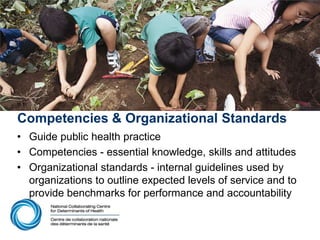
Competencies & Organizational Standards
• Guide public health practice
• Competencies - essential knowledge, skills and attitudes
• Organizational standards - internal guidelines used by
organizations to outline expected levels of service and to
provide benchmarks for performance and accountability
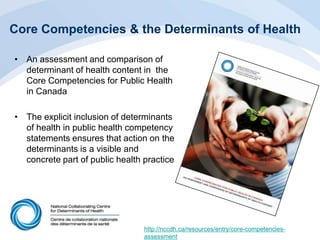
Core Competencies & the Determinants of Health
• An assessment and comparison of
determinant of health content in the
Core Competencies for Public Health
in Canada
• The explicit inclusion of determinants
of health in public health competency
statements ensures that action on the
determinants is a visible and
concrete part of public health practice
http://nccdh.ca/resources/entry/core-competencies-
assessment
An Assessment and Comparison of
Determinants of Health Content
• The determinants of health are throughout PHAC’s
Release 1.0
• The references are often general, implicit and
contained in sections other than the Core
Competency Statements (e.g., values; examples)
• International sets of competencies were sometimes
more explicit in their inclusion of health equity work
Organizational Standards as a Promising
Practice for Health Equity: Conversations
with Public Health Experts
• Four public health experts interviewed about their
experiences and reflections on the
conceptualization, development, and implementation
of organizational standards
We have also been able to use the Standards as a bit of a
rallying cry to encourage other partners to work with us. We‟ve
been able to leverage the requirements and the societal goals
as a conversation starter to say, „we need to work together on
this‟ – Dr. Rosana Pellizzari
Forthcoming, NCCDH 2013
Nova Scotia Public Health Standards
• The work of public health is
grounded in:
– health equity and social
justice
– the principles of the
Ottawa Charter for
Health Promotion
• Requirements for Health
Equity and Social Justice
We interviewed the usual and
unusual suspects and it just
became clearer and clearer to us
across the health system that there
was no one area that really took
health equity on. And it became
clearer and clearer through our
process that this could be a very
strong role for public health. We
couldn‟t walk away from that role.
– Janet Braunstein Moody
http://www.gov.ns.ca/hpp/yourmove/Pu
blic_Health_Standards_EN.pdf
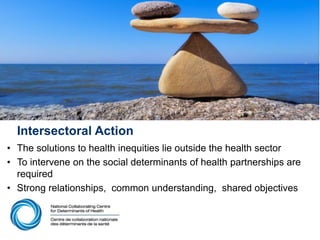
Intersectoral Action
• The solutions to health inequities lie outside the health sector
• To intervene on the social determinants of health partnerships are
required
• Strong relationships, common understanding, shared objectives
What’s the evidence? Intersectoral Action
• What is the impact/effectiveness of
intersectoral action as a public health
practice for health equity?
• Rapid systematic literature review
– Total of17 articles included:
1 systematic review, 14 quantitative
studies & 2 qualitative studies
– Difficult to determine how observed
outcomes relate to intersectoral
action
http://nccdh.ca/resources/entry/assessing-
the-impact-and-effectiveness-of-
intersectoral-action-on-the-SDOH
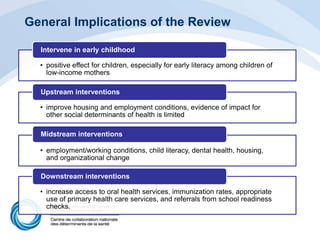
General Implications of the Review
• positive effect for children, especially for early literacy among children of
low-income mothers
Intervene in early childhood
• improve housing and employment conditions, evidence of impact for
other social determinants of health is limited
Upstream interventions
• employment/working conditions, child literacy, dental health, housing,
and organizational change
Midstream interventions
• increase access to oral health services, immunization rates, appropriate
use of primary health care services, and referrals from school readiness
checks.
Downstream interventions
Intersectoral Action:
Sudbury & District Health’s Experience
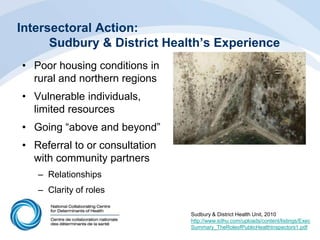
• Poor housing conditions in
rural and northern regions
• Vulnerable individuals,
limited resources
• Going “above and beyond”
• Referral to or consultation
with community partners
– Relationships
– Clarity of roles
Sudbury & District Health Unit, 2010
http://www.sdhu.com/uploads/content/listings/Exec
Summary_TheRoleofPublicHealthInspectors1.pdf
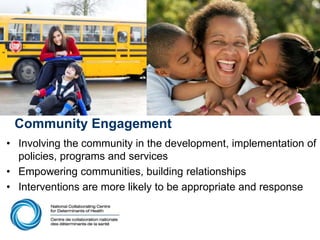
Community Engagement
• Involving the community in the development, implementation of
policies, programs and services
• Empowering communities, building relationships
• Interventions are more likely to be appropriate and response
What’s the evidence? Community engagement
• Review of reviews on community engagement, the social
determinants of health and health equity
Questions:
• What is the impact (direct and indirect) of community engagement
on the community and community members who are involved?
• What is the experience of community engagement for the
communities and/or community members involved?
– How are power and control in interventions addressed?
– What role do communities play?
– What is the quality of the engagement?
Coming soon from NCCDH
• What level of engagement occurs? Are different
levels of engagement associated with different
outcomes?
• What are the processes and approaches for
community engagement? How can public health
implement an inclusive practice at all levels of the
planning cycle? What is the optimal intensity of
community engagement?
(Expanded and adapted from Kelly et al, 2007:63-64 and
Popay et al. 2007)
What’s the evidence? Community engagement
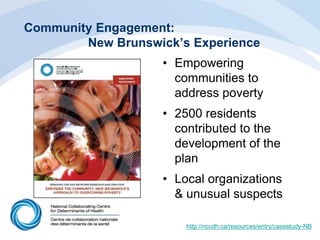
Community Engagement:
New Brunswick’s Experience
• Empowering
communities to
address poverty
• 2500 residents
contributed to the
development of the
plan
• Local organizations
& unusual suspects
http://nccdh.ca/resources/entry/casestudy-NB
Purposeful Reporting
•Intentionally reporting the relationship between health and social
determinants of health
•Measuring the breadth and depth of health differences –
stratifying by socioeconomic status, using indicators
•Guide future interventions, assess the impacts of interventions
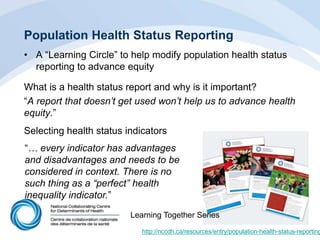
Population Health Status Reporting
• A “Learning Circle” to help modify population health status
reporting to advance equity
What is a health status report and why is it important?
“A report that doesn‟t get used won‟t help us to advance health
equity.”
Selecting health status indicators
http://nccdh.ca/resources/entry/population-health-status-reporting
“… every indicator has advantages
and disadvantages and needs to be
considered in context. There is no
such thing as a “perfect” health
inequality indicator.”
Learning Together Series
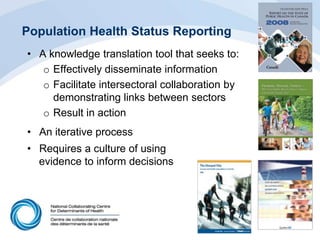
Population Health Status Reporting
• A knowledge translation tool that seeks to:
o Effectively disseminate information
o Facilitate intersectoral collaboration by
demonstrating links between sectors
o Result in action
• An iterative process
• Requires a culture of using
evidence to inform decisions
Purposefully Reporting:
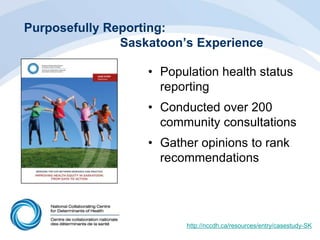
Saskatoon’s Experience
• Population health status
reporting
• Conducted over 200
community consultations
• Gather opinions to rank
recommendations
http://nccdh.ca/resources/entry/casestudy-SK
Contact Us
National Collaborating Centre for Determinants of Health
St. Francis Xavier University
PO Box 5000 , Antigonish, NS B2G 2W5
Email: NCCDH@stfx.ca
Phone: (902) 867-5406 Fax: (902) 867-6130
www.nccdh.ca and www.ccnds.ca
@NCCDH_CCNDS

Health Equity Workshop - Promising Practices

  • 1.
    Sharing your passionfor health equity: Building our collective understanding April 9, 2013 Charlottetown, PEI
  • 2.
    The 10 PromisingPractices for Advancing Health Equity Hannah Moffatt Knowledge Translation Specialist
  • 3.
    Public health rolesfor health equity 1. Assess & report on: a) the existence & impact of health inequities, & b) effective strategies to reduce these inequities. 2. Modify & orient interventions & services to help reduce inequities, with an understanding of the unique needs of populations that experience marginalization. 3. Partner with other government & community organizations to identify ways to improve health outcomes for populations that experience marginalization. 4. Lead, support & participate with other organizations in policy analysis & development, & in advocacy for improvements in the determinants of health. Forthcoming, NCCDH 2013
  • 4.
    10 Promising Practicesto Reduce Social Inequities in Health • Intersectoral action • Targeting with universalism • Purposeful reporting • Social marketing • Health equity target setting • Equity-focused health impact assessment • Competencies/organizatio nal standards • Contribution to evidence base • Early childhood development • Community engagement http://nccdh.ca/resources/entry/10-promising-practices-guide Sudbury & District Health Unit 2009
  • 5.
    Competencies & OrganizationalStandards • Guide public health practice • Competencies - essential knowledge, skills and attitudes • Organizational standards - internal guidelines used by organizations to outline expected levels of service and to provide benchmarks for performance and accountability
  • 6.
    Core Competencies &the Determinants of Health • An assessment and comparison of determinant of health content in the Core Competencies for Public Health in Canada • The explicit inclusion of determinants of health in public health competency statements ensures that action on the determinants is a visible and concrete part of public health practice http://nccdh.ca/resources/entry/core-competencies- assessment
  • 7.
    An Assessment andComparison of Determinants of Health Content • The determinants of health are throughout PHAC’s Release 1.0 • The references are often general, implicit and contained in sections other than the Core Competency Statements (e.g., values; examples) • International sets of competencies were sometimes more explicit in their inclusion of health equity work
  • 8.
    Organizational Standards asa Promising Practice for Health Equity: Conversations with Public Health Experts • Four public health experts interviewed about their experiences and reflections on the conceptualization, development, and implementation of organizational standards We have also been able to use the Standards as a bit of a rallying cry to encourage other partners to work with us. We‟ve been able to leverage the requirements and the societal goals as a conversation starter to say, „we need to work together on this‟ – Dr. Rosana Pellizzari Forthcoming, NCCDH 2013
  • 9.
    Nova Scotia PublicHealth Standards • The work of public health is grounded in: – health equity and social justice – the principles of the Ottawa Charter for Health Promotion • Requirements for Health Equity and Social Justice We interviewed the usual and unusual suspects and it just became clearer and clearer to us across the health system that there was no one area that really took health equity on. And it became clearer and clearer through our process that this could be a very strong role for public health. We couldn‟t walk away from that role. – Janet Braunstein Moody http://www.gov.ns.ca/hpp/yourmove/Pu blic_Health_Standards_EN.pdf
  • 10.
    Intersectoral Action • Thesolutions to health inequities lie outside the health sector • To intervene on the social determinants of health partnerships are required • Strong relationships, common understanding, shared objectives
  • 11.
    What’s the evidence?Intersectoral Action • What is the impact/effectiveness of intersectoral action as a public health practice for health equity? • Rapid systematic literature review – Total of17 articles included: 1 systematic review, 14 quantitative studies & 2 qualitative studies – Difficult to determine how observed outcomes relate to intersectoral action http://nccdh.ca/resources/entry/assessing- the-impact-and-effectiveness-of- intersectoral-action-on-the-SDOH
  • 12.
    General Implications ofthe Review • positive effect for children, especially for early literacy among children of low-income mothers Intervene in early childhood • improve housing and employment conditions, evidence of impact for other social determinants of health is limited Upstream interventions • employment/working conditions, child literacy, dental health, housing, and organizational change Midstream interventions • increase access to oral health services, immunization rates, appropriate use of primary health care services, and referrals from school readiness checks. Downstream interventions
  • 13.
    Intersectoral Action: Sudbury &District Health’s Experience • Poor housing conditions in rural and northern regions • Vulnerable individuals, limited resources • Going “above and beyond” • Referral to or consultation with community partners – Relationships – Clarity of roles Sudbury & District Health Unit, 2010 http://www.sdhu.com/uploads/content/listings/Exec Summary_TheRoleofPublicHealthInspectors1.pdf
  • 14.
    Community Engagement • Involvingthe community in the development, implementation of policies, programs and services • Empowering communities, building relationships • Interventions are more likely to be appropriate and response
  • 15.
    What’s the evidence?Community engagement • Review of reviews on community engagement, the social determinants of health and health equity Questions: • What is the impact (direct and indirect) of community engagement on the community and community members who are involved? • What is the experience of community engagement for the communities and/or community members involved? – How are power and control in interventions addressed? – What role do communities play? – What is the quality of the engagement? Coming soon from NCCDH
  • 16.
    • What levelof engagement occurs? Are different levels of engagement associated with different outcomes? • What are the processes and approaches for community engagement? How can public health implement an inclusive practice at all levels of the planning cycle? What is the optimal intensity of community engagement? (Expanded and adapted from Kelly et al, 2007:63-64 and Popay et al. 2007) What’s the evidence? Community engagement
  • 17.
    Community Engagement: New Brunswick’sExperience • Empowering communities to address poverty • 2500 residents contributed to the development of the plan • Local organizations & unusual suspects http://nccdh.ca/resources/entry/casestudy-NB
  • 18.
    Purposeful Reporting •Intentionally reportingthe relationship between health and social determinants of health •Measuring the breadth and depth of health differences – stratifying by socioeconomic status, using indicators •Guide future interventions, assess the impacts of interventions
  • 19.
    Population Health StatusReporting • A “Learning Circle” to help modify population health status reporting to advance equity What is a health status report and why is it important? “A report that doesn‟t get used won‟t help us to advance health equity.” Selecting health status indicators http://nccdh.ca/resources/entry/population-health-status-reporting “… every indicator has advantages and disadvantages and needs to be considered in context. There is no such thing as a “perfect” health inequality indicator.” Learning Together Series
  • 20.
    Population Health StatusReporting • A knowledge translation tool that seeks to: o Effectively disseminate information o Facilitate intersectoral collaboration by demonstrating links between sectors o Result in action • An iterative process • Requires a culture of using evidence to inform decisions
  • 21.
    Purposefully Reporting: Saskatoon’s Experience •Population health status reporting • Conducted over 200 community consultations • Gather opinions to rank recommendations http://nccdh.ca/resources/entry/casestudy-SK
  • 22.
    Contact Us National CollaboratingCentre for Determinants of Health St. Francis Xavier University PO Box 5000 , Antigonish, NS B2G 2W5 Email: NCCDH@stfx.ca Phone: (902) 867-5406 Fax: (902) 867-6130 www.nccdh.ca and www.ccnds.ca @NCCDH_CCNDS

Editor's Notes

  • #4 An action model
  • #7 With that in mind, we did this assessment of the 2001, release 1.0 of the Core Competencies for Public Health in Canada We reviewed competencies from other countries and found that there where sometimes more explicit.
  • #9 The conversations featured in this resource were adapted from one-to-one interviews with four leaders in public health practice and research. These experts were selected from across Canada to share their experiences and reflections on the conceptualization, development, and implementation of organizational standards in varied contexts. The purpose of the resource: Share knowledge about organizational standards as a promising practice for health equity Build capacity among public health leaders, practitioners, and researchers for the development and implementation of organizational standards.Inform change at all levels of the public health system to support organizational standards as an opportunity to advance health equity.
  • #14 A research project conducted by Sudbury & District Health Unit - interviewed 34 PHIs across northeastern OntarioThe bad news: PHIs frequently encounter poor housing conditions in their day-to-day work—conditions that most of us cannot even imagine. 
The good news: PHIs are deeply committed to their work. Many reported going “above and beyond” to resolve issues, improve housing conditions, and protect the health of the residents.Partnership was the necessary intervention - The outcomes largelydetermined by the working relationships between the partners & the clarity of respective rolesThe comments from the PHIs helped the research team and advisory committee develop nine recommendations… The recommendations range from specific public health unit practice to broader research and policy advocacy initiatives.
  • #15 Health equity is ultimately about fairness and justice. Often the communities most affected by inequities are those with access to the least power. Meaningful engagement of communities in decisions and actions which affect their lives ensures that their voices are centred in the conversation on improving health equity. Oftentimes this means letting ourselves experience a modicum of professional discomfort as we step aside from what we think we know best or in the words of … getting comfortable with being uncomfortableA range of frameworks and strategies are being employed across the country which provide excellent models of practice.
  • #18 From New Brunswick's Community Inclusion Networks tasked with implementing the poverty reduction strategy in that province to involving community in health assessments. In this process we must ensure that we are not only talking to the usual suspects.
  • #21 So I went back to our earlier work – about the purpose and benefit of population health status reporting. Thought it would serve as a useful reminder for us. Which methods and tools that are also effective for capturing knowledge and feedback in inform the process and future recommendations?
  • #22 Really also a story of community engagement