Abt Associates Inc.
In collaboration with:
Avenir Health | Broad Branch Associates | Development Alternatives Inc. (DAI) | Johns Hopkins Bloomberg School of Public Health (JHSPH) |
Results for Development Institute (R4D) | RTI International | Training Resources Group, Inc. (TRG)
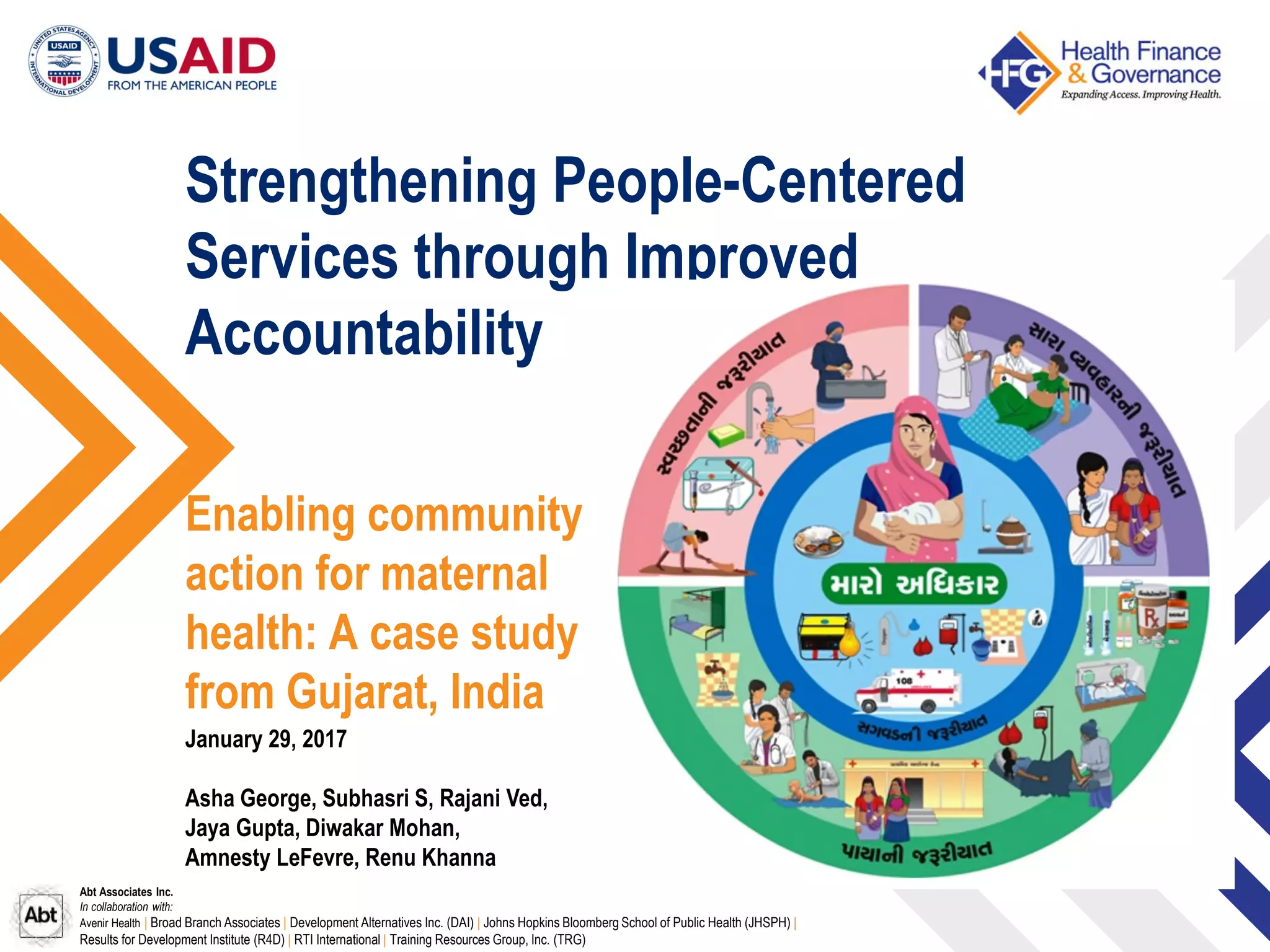
Enabling community
action for maternal
health: A case study
from Gujarat, India
Strengthening People-Centered
Services through Improved
Accountability
January 29, 2017
Asha George, Subhasri S, Rajani Ved,
Jaya Gupta, Diwakar Mohan,
Amnesty LeFevre, Renu Khanna
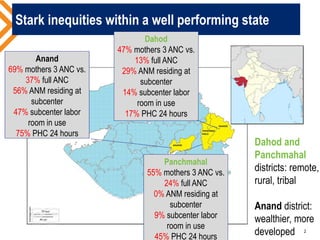
Stark inequities within a well performing state
Dahod
47% mothers 3 ANC vs.
13% full ANC
29% ANM residing at
subcenter
14% subcenter labor
room in use
17% PHC 24 hours
Anand
69% mothers 3 ANC vs.
37% full ANC
56% ANM residing at
subcenter
47% subcenter labor
room in use
75% PHC 24 hours
Panchmahal
55% mothers 3 ANC vs.
24% full ANC
0% ANM residing at
subcenter
9% subcenter labor
room in use
45% PHC 24 hours
Dahod and
Panchmahal
districts: remote,
rural, tribal
Anand district:
wealthier, more
developed 2
Community Action for Maternal Health
NGOs working at community level through women’s
groups, health committees and self help groups
Covering 45 villages in two different regions of Gujarat
 Approximately 108,000 people
 6 primary health centers (PHC) and 25 sub-centers
Key strategies
 Framing and awareness of entitlements by pregnant women,
community and providers
 Community monitoring of receipt and delivery of services
 Dialogue with providers and administrators about gaps identified
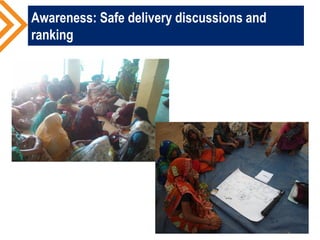
Awareness: Safe delivery discussions and
ranking
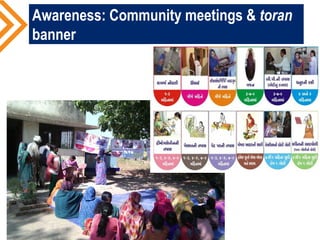
Awareness: Community meetings & toran
banner
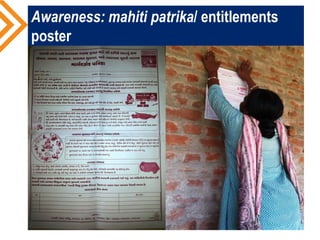
Awareness: mahiti patrika/ entitlements
poster
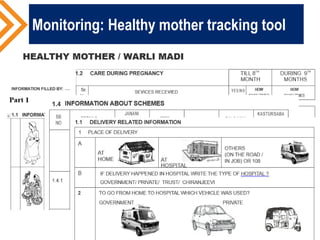
Monitoring: Healthy mother tracking tool
Monitoring: VHND monitoring tool
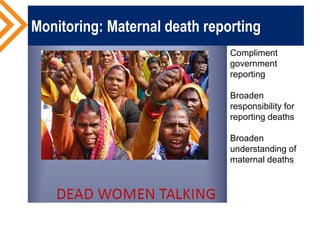
Monitoring: Maternal death reporting
Compliment
government
reporting
Broaden
responsibility for
reporting deaths
Broaden
understanding of
maternal deaths
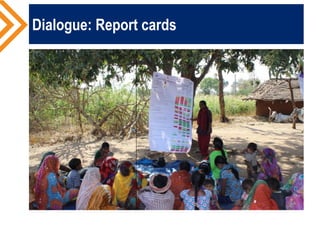
Dialogue: Report cards
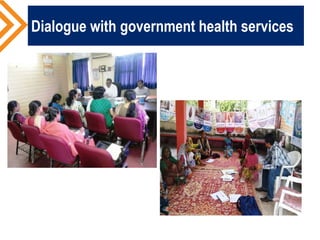
Dialogue with government health services
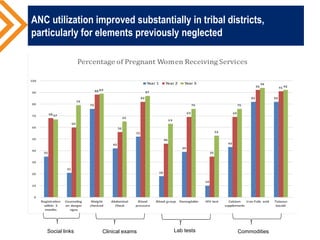
ANC utilization improved substantially in tribal districts,
particularly for elements previously neglected
Social links Clinical exams Lab tests Commodities
Underlying SERVICE DELIVERY processes that explain the
outcomes, based on project reporting of dialogues
Restarting of services, previously only on paper
 Increase in number of VHNDs in hard to reach areas
 Deliveries being conducted at once defunct PHC
Repairs that improved quality of service environment
 Leakages fixed at one PHC
 Toilets provided for women in a sub centre
Underlying GOVERNANCE processes that explain the outcomes,
based on project reporting of dialogues
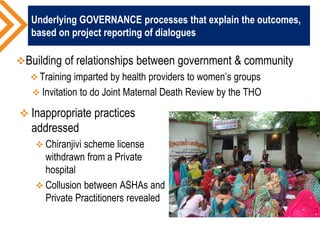
Building of relationships between government & community
 Training imparted by health providers to women’s groups
 Invitation to do Joint Maternal Death Review by the THO
 Inappropriate practices
addressed
 Chiranjivi scheme license
withdrawn from a Private
hospital
 Collusion between ASHAs and
Private Practitioners revealed
Lessons for scale up: Community level
Participatory process of developing consensus around
problem, framing entitlements, developing tools
 Iterative process that allows for local adaptations
 Takes time but deep dividends for ownership
Process intensive intervention
 Intensity of monitoring tools vs. community capacity
 Should poor women be volunteering to monitor service delivery?
Who is the community: Fulcrum for the project?
 Whole community
 Community platform: women’s groups, health committees, self help groups
 NGO and community volunteers
Lessons for scale up: Role of NGOs
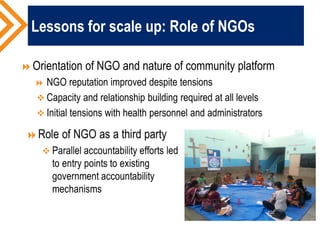
Orientation of NGO and nature of community platform
 NGO reputation improved despite tensions
 Capacity and relationship building required at all levels
 Initial tensions with health personnel and administrators
So what?
HEALTH EFFECTS
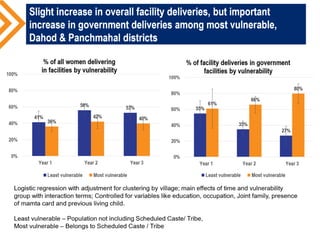
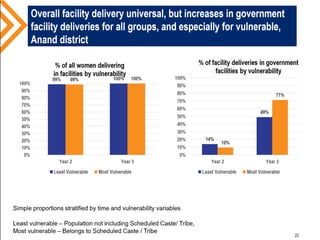
Community accountability initiatives can directly improve
health care utilization, with important equity effects
 Requires time, resources, flexibility
GOVERNANCE EFFECTS
Even in a ‘well performing’ state, NGOs play a critical role
in addressing both demand and supply side barriers that
can inhibit the functionality of governments in providing
quality services
 Requires facilitation, trust building at multiple levels
Abt Associates Inc.
In collaboration with:
Avenir Health | Broad Branch Associates | Development Alternatives Inc. (DAI) | Johns Hopkins Bloomberg School of Public Health (JHSPH) |
Results for Development Institute (R4D) | RTI International | Training Resources Group, Inc. (TRG)
Thank you
All the respondents, including women and volunteers at community level, NGO
volunteers and staff, government health officials and health care providers in the
districts and at the state level
Dr.Dholakia, Ministry of Health and Family Welfare, Government of Gujarat
Sunanda Ganju, Mahima Taparia, Pallavi Saha, Calvin Parmar, Sandhya (SAHAJ)
Neeta Hardikar, Pradeepa Dube, Sheela Khant, Rita Parmar, Urmila Baria, Mena Rathva,
Veena Baria, Devgadh Mahila Sangathan members and other field volunteers (ANANDI)
Father Joseph Appavoo, Meena, Sunita Macwan, Bhanu, Usha, Hetal, Geeta and local
volunteers (Kaira Social Service Society)
Dr. Pankaj Shah, Dr. Leela Visaria, Dr. Sridhar Srikantiah, Dr. Sundari Ravindran
CommonHealth: Coalition for Maternal-Neonatal and Safe Abortion
MacArthur Foundation for their partnership and financial support
Marianne El-Khoury, Rachel Stepka, Carlos Avila, Nicole Barcikowski, Catherine Connor
(Abt Associates)
Jeremy Kanthor (DAI)
Robert Franks, James Willett, Elliot Rosen (JHSPH Administrative Staff)
IIHMR, Abt Associates and JHSPH IRB committees and support staff
Jodi Charles, Scott Stewart (USAID)
www.hfgproject.org

Strengthening people-centered services through improved accountability

  • 1.
    Abt Associates Inc. Incollaboration with: Avenir Health | Broad Branch Associates | Development Alternatives Inc. (DAI) | Johns Hopkins Bloomberg School of Public Health (JHSPH) | Results for Development Institute (R4D) | RTI International | Training Resources Group, Inc. (TRG) Enabling community action for maternal health: A case study from Gujarat, India Strengthening People-Centered Services through Improved Accountability January 29, 2017 Asha George, Subhasri S, Rajani Ved, Jaya Gupta, Diwakar Mohan, Amnesty LeFevre, Renu Khanna
  • 2.
    Stark inequities withina well performing state Dahod 47% mothers 3 ANC vs. 13% full ANC 29% ANM residing at subcenter 14% subcenter labor room in use 17% PHC 24 hours Anand 69% mothers 3 ANC vs. 37% full ANC 56% ANM residing at subcenter 47% subcenter labor room in use 75% PHC 24 hours Panchmahal 55% mothers 3 ANC vs. 24% full ANC 0% ANM residing at subcenter 9% subcenter labor room in use 45% PHC 24 hours Dahod and Panchmahal districts: remote, rural, tribal Anand district: wealthier, more developed 2
  • 3.
    Community Action forMaternal Health NGOs working at community level through women’s groups, health committees and self help groups Covering 45 villages in two different regions of Gujarat  Approximately 108,000 people  6 primary health centers (PHC) and 25 sub-centers Key strategies  Framing and awareness of entitlements by pregnant women, community and providers  Community monitoring of receipt and delivery of services  Dialogue with providers and administrators about gaps identified
  • 4.
    Awareness: Safe deliverydiscussions and ranking
  • 5.
  • 6.
    Awareness: mahiti patrika/entitlements poster
  • 7.
  • 8.
  • 9.
    Monitoring: Maternal deathreporting Compliment government reporting Broaden responsibility for reporting deaths Broaden understanding of maternal deaths
  • 10.
  • 11.
    Dialogue with governmenthealth services
  • 12.
    ANC utilization improvedsubstantially in tribal districts, particularly for elements previously neglected Social links Clinical exams Lab tests Commodities
  • 15.
    Underlying SERVICE DELIVERYprocesses that explain the outcomes, based on project reporting of dialogues Restarting of services, previously only on paper  Increase in number of VHNDs in hard to reach areas  Deliveries being conducted at once defunct PHC Repairs that improved quality of service environment  Leakages fixed at one PHC  Toilets provided for women in a sub centre
  • 16.
    Underlying GOVERNANCE processesthat explain the outcomes, based on project reporting of dialogues Building of relationships between government & community  Training imparted by health providers to women’s groups  Invitation to do Joint Maternal Death Review by the THO  Inappropriate practices addressed  Chiranjivi scheme license withdrawn from a Private hospital  Collusion between ASHAs and Private Practitioners revealed
  • 17.
    Lessons for scaleup: Community level Participatory process of developing consensus around problem, framing entitlements, developing tools  Iterative process that allows for local adaptations  Takes time but deep dividends for ownership Process intensive intervention  Intensity of monitoring tools vs. community capacity  Should poor women be volunteering to monitor service delivery? Who is the community: Fulcrum for the project?  Whole community  Community platform: women’s groups, health committees, self help groups  NGO and community volunteers
  • 18.
    Lessons for scaleup: Role of NGOs Orientation of NGO and nature of community platform  NGO reputation improved despite tensions  Capacity and relationship building required at all levels  Initial tensions with health personnel and administrators
  • 19.
    So what? HEALTH EFFECTS Communityaccountability initiatives can directly improve health care utilization, with important equity effects  Requires time, resources, flexibility GOVERNANCE EFFECTS Even in a ‘well performing’ state, NGOs play a critical role in addressing both demand and supply side barriers that can inhibit the functionality of governments in providing quality services  Requires facilitation, trust building at multiple levels
  • 20.
    Abt Associates Inc. Incollaboration with: Avenir Health | Broad Branch Associates | Development Alternatives Inc. (DAI) | Johns Hopkins Bloomberg School of Public Health (JHSPH) | Results for Development Institute (R4D) | RTI International | Training Resources Group, Inc. (TRG) Thank you All the respondents, including women and volunteers at community level, NGO volunteers and staff, government health officials and health care providers in the districts and at the state level Dr.Dholakia, Ministry of Health and Family Welfare, Government of Gujarat Sunanda Ganju, Mahima Taparia, Pallavi Saha, Calvin Parmar, Sandhya (SAHAJ) Neeta Hardikar, Pradeepa Dube, Sheela Khant, Rita Parmar, Urmila Baria, Mena Rathva, Veena Baria, Devgadh Mahila Sangathan members and other field volunteers (ANANDI) Father Joseph Appavoo, Meena, Sunita Macwan, Bhanu, Usha, Hetal, Geeta and local volunteers (Kaira Social Service Society) Dr. Pankaj Shah, Dr. Leela Visaria, Dr. Sridhar Srikantiah, Dr. Sundari Ravindran CommonHealth: Coalition for Maternal-Neonatal and Safe Abortion MacArthur Foundation for their partnership and financial support Marianne El-Khoury, Rachel Stepka, Carlos Avila, Nicole Barcikowski, Catherine Connor (Abt Associates) Jeremy Kanthor (DAI) Robert Franks, James Willett, Elliot Rosen (JHSPH Administrative Staff) IIHMR, Abt Associates and JHSPH IRB committees and support staff Jodi Charles, Scott Stewart (USAID) www.hfgproject.org