CUPSCalgary.com
CUPS Coordinated Care Team
Transitional Support for Vulnerable Calgarians
Darryn Werth & Elaine Wilson

Calgary Urban Project Society
CUPSCalgary.com
Calgary Urban Project Society
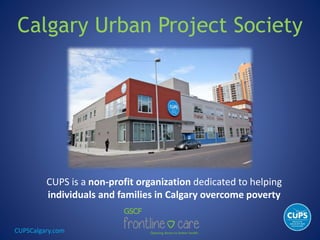
CUPS is a non-profit organization dedicated to helping
individuals and families in Calgary overcome poverty
CUPSCalgary.com
A Broader Community Issue:
Poverty in Calgary
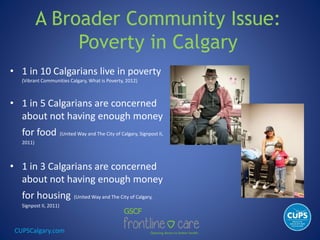
• 1 in 10 Calgarians live in poverty
(Vibrant Communities Calgary, What is Poverty, 2012)
• 1 in 5 Calgarians are concerned
about not having enough money
for food (United Way and The City of Calgary, Signpost II,
2011)
• 1 in 3 Calgarians are concerned
about not having enough money
for housing (United Way and The City of Calgary,
Signpost II, 2011)
CUPSCalgary.com
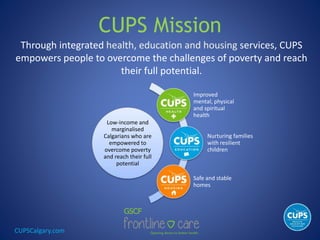
CUPS Mission
Through integrated health, education and housing services, CUPS
empowers people to overcome the challenges of poverty and reach
their full potential.
Low-income and
marginalised
Calgarians who are
empowered to
overcome poverty
and reach their full
potential
Improved
mental, physical
and spiritual
health
Nurturing families
with resilient
children
Safe and stable
homes
CUPSCalgary.com
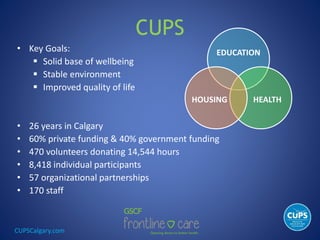
CUPS
• Key Goals:
 Solid base of wellbeing
 Stable environment
 Improved quality of life
• 26 years in Calgary
• 60% private funding & 40% government funding
• 470 volunteers donating 14,544 hours
• 8,418 individual participants
• 57 organizational partnerships
• 170 staff
EDUCATION
HEALTHHOUSING
CUPSCalgary.com
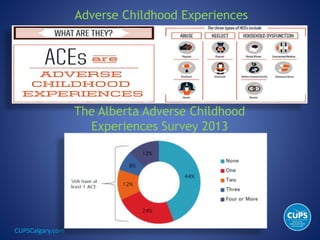
The Alberta Adverse Childhood
Experiences Survey 2013
Adverse Childhood Experiences
CUPSCalgary.com
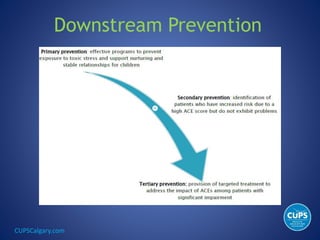
Downstream Prevention
CUPSCalgary.com
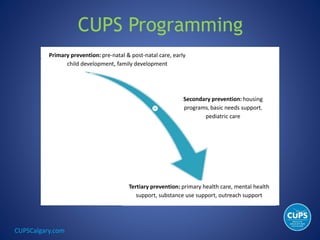
CUPS Programming
Tertiary prevention: primary health care, mental health
support, substance use support, outreach support
Primary prevention: pre-natal & post-natal care, early
child development, family development
Secondary prevention: housing
programs, basic needs support,
pediatric care
CUPSCalgary.com
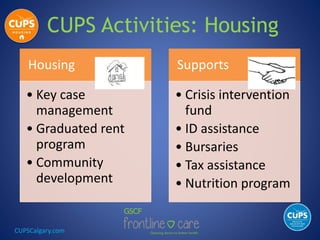
CUPS Activities: Housing
Housing
• Key case
management
• Graduated rent
program
• Community
development
Supports
• Crisis intervention
fund
• ID assistance
• Bursaries
• Tax assistance
• Nutrition program
CUPSCalgary.com
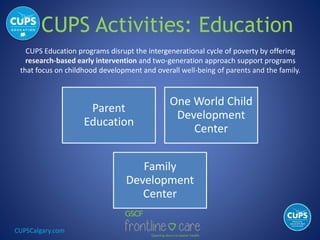
CUPS Activities: Education
Parent
Education
One World Child
Development
Center
Family
Development
Center
CUPS Education programs disrupt the intergenerational cycle of poverty by offering
research-based early intervention and two-generation approach support programs
that focus on childhood development and overall well-being of parents and the family.
CUPSCalgary.com
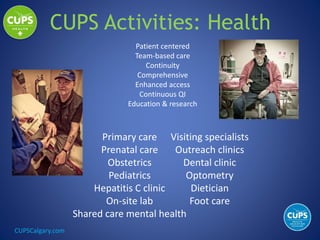
Primary care
Prenatal care
Obstetrics
Pediatrics
Hepatitis C clinic
On-site lab
Shared care mental health
Visiting specialists
Outreach clinics
Dental clinic
Optometry
Dietician
Foot care
CUPS Activities: Health
Patient centered
Team-based care
Continuity
Comprehensive
Enhanced access
Continuous QI
Education & research
CUPSCalgary.com
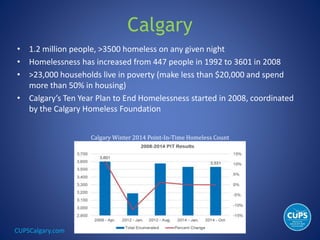
Calgary
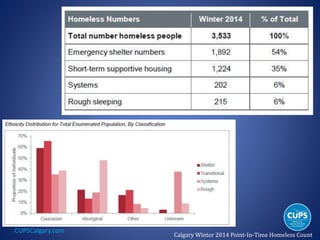
• 1.2 million people, >3500 homeless on any given night
• Homelessness has increased from 447 people in 1992 to 3601 in 2008
• >23,000 households live in poverty (make less than $20,000 and spend
more than 50% in housing)
• Calgary’s Ten Year Plan to End Homelessness started in 2008, coordinated
by the Calgary Homeless Foundation
Calgary Winter 2014 Point-In-Time Homeless Count
CUPSCalgary.com
Calgary Winter 2014 Point-In-Time Homeless Count
CUPSCalgary.com
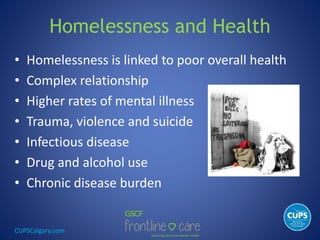
Homelessness and Health
• Homelessness is linked to poor overall health
• Complex relationship
• Higher rates of mental illness
• Trauma, violence and suicide
• Infectious disease
• Drug and alcohol use
• Chronic disease burden
CUPSCalgary.com
Hospitalization and Homelessness
• Challenges of acute care use and homeless population are
not new
• Homeless individuals have been shown to be 2-4 times
more likely to have a repeat emergency department (ED)
visit within 7 days
• Frequent ED users are often homeless and from low socio-
economic levels
• Individuals may be accessing ED for non-medical reasons
• Limited ability in ED to meet complex needs of individuals
• 25-28% of acute care high users in Canada are from low-
income neighbourhoods
CUPSCalgary.com
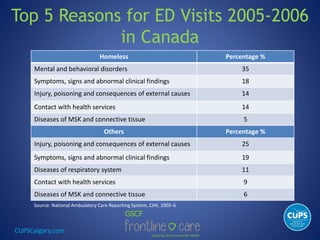
Top 5 Reasons for ED Visits 2005-2006
in Canada
Homeless Percentage %
Mental and behavioral disorders 35
Symptoms, signs and abnormal clinical findings 18
Injury, poisoning and consequences of external causes 14
Contact with health services 14
Diseases of MSK and connective tissue 5
Others Percentage %
Injury, poisoning and consequences of external causes 25
Symptoms, signs and abnormal clinical findings 19
Diseases of respiratory system 11
Contact with health services 9
Diseases of MSK and connective tissue 6
Source: National Ambulatory Care Reporting System, CIHI, 2005-6
CUPSCalgary.com
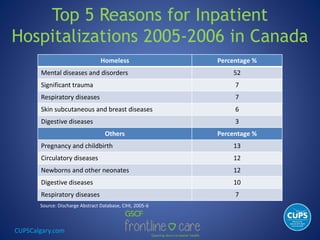
Top 5 Reasons for Inpatient
Hospitalizations 2005-2006 in Canada
Homeless Percentage %
Mental diseases and disorders 52
Significant trauma 7
Respiratory diseases 7
Skin subcutaneous and breast diseases 6
Digestive diseases 3
Others Percentage %
Pregnancy and childbirth 13
Circulatory diseases 12
Newborns and other neonates 12
Digestive diseases 10
Respiratory diseases 7
Source: Discharge Abstract Database, CIHI, 2005-6
CUPSCalgary.com
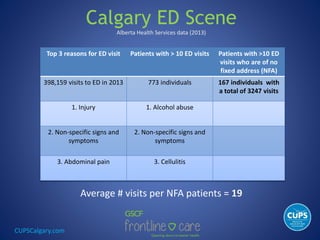
Calgary ED Scene
Alberta Health Services data (2013)
Top 3 reasons for ED visit Patients with > 10 ED visits Patients with >10 ED
visits who are of no
fixed address (NFA)
398,159 visits to ED in 2013 773 individuals 167 individuals with
a total of 3247 visits
1. Injury 1. Alcohol abuse
2. Non-specific signs and
symptoms
2. Non-specific signs and
symptoms
3. Abdominal pain 3. Cellulitis
Average # visits per NFA patients = 19
CUPSCalgary.com
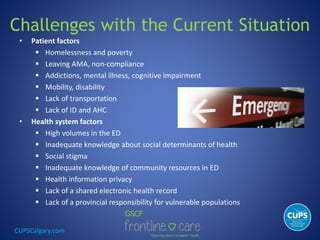
Challenges with the Current Situation
• Patient factors
 Homelessness and poverty
 Leaving AMA, non-compliance
 Addictions, mental illness, cognitive impairment
 Mobility, disability
 Lack of transportation
 Lack of ID and AHC
• Health system factors
 High volumes in the ED
 Inadequate knowledge about social determinants of health
 Social stigma
 Inadequate knowledge of community resources in ED
 Health information privacy
 Lack of a shared electronic health record
 Lack of a provincial responsibility for vulnerable populations
CUPSCalgary.com
CUPSCalgary.com
A Potential Solution….
CUPS Coordinated Care Team
A community based team that will provide intensive case management
and transition care to vulnerable, low-income patients presenting to the
Emergency Departments
• Funded by Green Shield Canada Foundation – 2 year pilot project at
the Foothills Medical Centre
• Innovative strategy aligns Alberta Health Services, CUPS and
community stakeholder priorities
• Case management focus
• Community based
• Stakeholder engagement
• Partnerships
• Green Shield Canada Foundation
• Innoweave
• University of Calgary
CUPSCalgary.com
Case Management
• Case management provides more continuous care that helps
guide client through the process
• Assessment, planning, facilitation and advocacy
• Intervention that extends into the community, providing
upstream care
• Flexible and dynamic
• Various models and definitions of case management
• Coordinate housing, financial supports, addictions treatment
and mental health resources, thus improving care and
avoiding unnecessary presentations to acute care facilities
CUPSCalgary.com
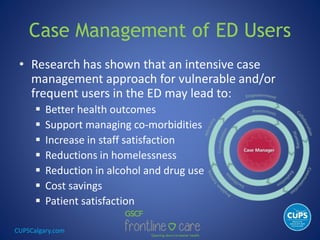
Case Management of ED Users
• Research has shown that an intensive case
management approach for vulnerable and/or
frequent users in the ED may lead to:
 Better health outcomes
 Support managing co-morbidities
 Increase in staff satisfaction
 Reductions in homelessness
 Reduction in alcohol and drug use
 Cost savings
 Patient satisfaction
CUPSCalgary.com
Community Based
• Individuals presenting to ED may have other
needs that are not addressed by treating
medical issue alone
• Benefit from more appropriate and consistent
medical and social services
• Frequency and availability for follow-up in the
community has been shown to improve
outcomes
• Improved communication
CUPSCalgary.com
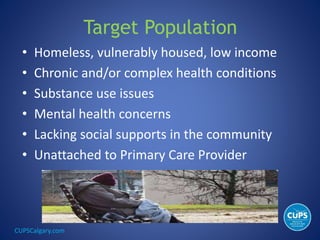
Target Population
• Homeless, vulnerably housed, low income
• Chronic and/or complex health conditions
• Substance use issues
• Mental health concerns
• Lacking social supports in the community
• Unattached to Primary Care Provider
CUPSCalgary.com
Stakeholder Engagement and
Collaboration
• Met with numerous community partners and
departments/working groups within Alberta Health
Services
• Engaged with University regarding research support
• Support from Green Shield Canada Foundation
CUPSCalgary.com
CUPS Coordinated Care Team
• 1.0 FTE RN, 1.0 FTE Psychiatric RN
• AHS acute care site privileges and EMR access
• Access to other databases as needed –
including the Calgary Homeless Foundation
HMIS
• Referrals from ED staff, inpatient units as well
as community partners
CUPSCalgary.com
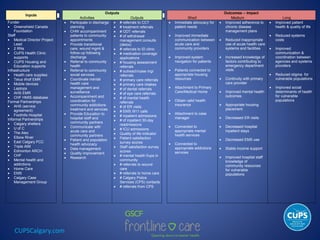
Inputs
Outputs Outcomes -- Impact
Activities Outputs Short Medium Long
Funder
 Greenshield Canada
Foundation
Staff
 Medical Director Project
Lead
 2 RNs
 CUPS Health Clinic
supports
 CUPS Housing and
Education supports
Infrastructure
 Health care supplies
 Telus Wolf EMR
 Mobile devices
 Laptops
 AHS EMR
 CHF HMIS database
Formal Partnerships
 AHS (service
agreement)
 Foothills Hospital
Informal Partnerships
 Calgary shelters
 U of C
 The Alex
 Elbow River
 East Calgary FCC
 Triple AIM
 Edmonton ARCH
 CHF
 Mental health and
addictions
 Home Care
 EMS
 Calgary Case
Management Group
 Participate in discharge
planning
 CHW accompaniment
patients to community
appointments
 Provide transitional
care, wound mgmt &
follow-up following
discharge
 Referral to community
health
 Referral to community
social services
 Coordinate mental
health care
management and
surveillance
 Accompaniment and
coordination for
community addictions
treatment and services
 Provide Education to
hospital staff and
community partners
 Communicate with
acute care and
community partners
 Patient and population
health advocacy
 Data management
 Quality improvement
 Research
 # referrals to CCT
 # treatment referrals
 # ODT referrals
 # of withdrawal
management consults
(detox)
 # referrals to ID clinic
 # medication coverage
applications
 # housing assessment
referrals
 # outreach/case mgr
referrals
 # primary care referrals
 # primary care intakes
 # of dental referrals
 # of eye care referrals
 # of mental health
referrals
 # of ER visits
 # EMS /911 calls
 # inpatient admissions
 # of inpatient 30-day
readmissions
 # ICU admissions
 Quality of life indicator
 Patient satisfaction
survey scores
 Staff satisfaction survey
scores
 # mental health f/ups in
community
 # referrals to wound
care
 # referrals to home care
 # Calgary Police
Services (CPS) contacts
 # referrals from CPS
 Immediate advocacy for
patient needs
 Improved immediate
communication between
acute care and
community providers
 Improved system
navigation for patients
 Patients connected to
appropriate housing
resources
 Attachment to Primary
Care/Medical Home
 Obtain valid health
insurance
 Attachment to case
manager
 Connected to
appropriate mental
health services
 Connected to
appropriate addictions
services
 Improved adherence to
chronic disease
management plans
 Reduced inappropriate
use of acute health care
systems and facilities
 Increased knowledge of
factors contributing to
emergency department
visits
 Continuity with primary
care provider
 Improved mental health
outcomes
 Appropriate housing
placement
 Decreased ER visits
 Decreased hospital
inpatient stays
 Decreased EMS use
 Stable income support
 Improved hospital staff
knowledge of
community resources
for vulnerable
populations
 Improved patient
health & quality of life
 Reduced systems
costs
 Improved
communication &
coordination between
agencies and systems
providers
 Reduced stigma for
vulnerable populations
 Improved social
determinants of health
for vulnerable
populations
CUPSCalgary.com
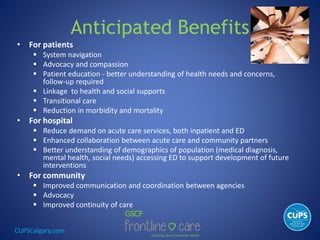
Anticipated Benefits
• For patients
 System navigation
 Advocacy and compassion
 Patient education - better understanding of health needs and concerns,
follow-up required
 Linkage to health and social supports
 Transitional care
 Reduction in morbidity and mortality
• For hospital
 Reduce demand on acute care services, both inpatient and ED
 Enhanced collaboration between acute care and community partners
 Better understanding of demographics of population (medical diagnosis,
mental health, social needs) accessing ED to support development of future
interventions
• For community
 Improved communication and coordination between agencies
 Advocacy
 Improved continuity of care
CUPSCalgary.com
Data Collection
• Looking to show effectiveness and success
 How are these best defined?
 In this context?
• Some of the data we are collecting:
 Demographics: AHC status, housing stability,
 Hospital visit: admitting diagnosis, interventions
received, discharge plan
 Health needs: PCP, problem list, # of medications,
quality of life
 Addictions and mental health: accessing care,
diagnosis
CUPSCalgary.com
Evaluation
• Plan to assess the structure, process, and outcomes of
the intervention to determine whether it is effective
and what the key success factors are
 U of C
 Green Shield Canada Foundation
 Innoweave
• Not a RCT - pre/post intervention data
• Hopeful that this partnership between CUPS, AHS, and
community agencies will help to improve community-
based care for these vulnerable patients and will
ultimately lead to improved economic, social and
health outcomes for this population
CUPSCalgary.com
The Early Days…
• Patient demographics
 ~70% male
 Majority are homeless
 Needs include PCP attachment, discharge planning,
addictions support & mental health support
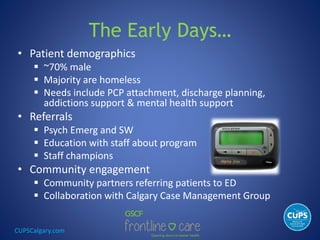
• Referrals
 Psych Emerg and SW
 Education with staff about program
 Staff champions
• Community engagement
 Community partners referring patients to ED
 Collaboration with Calgary Case Management Group
CUPSCalgary.com
Potential Challenges
• Data collection!
• Limited resources
• Case loads
• Triage process
CUPSCalgary.com
Sustainability
• Alignment with Alberta Health and provincial goals of
improving transition care for vulnerable populations
• Alignment with the provincial primary care strategy
and enhancement of the medical/health home for
patients
• Ongoing quality improvement efforts and initiatives
• Research partnerships
 University of Calgary
 Canadian Association of Community Health Centers
 Southern Alberta Primary Care Research Network
 Canadian Primary Care Sentinel Surveillance Network
CUPSCalgary.com
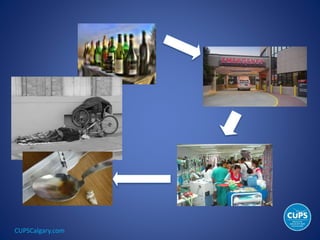
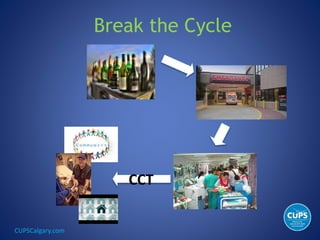
Break the Cycle
CCT
CUPSCalgary.com
Questions?
Thank you!
Darryn Werth
darrynw@cupscalgary.com
Elaine Wilson
elainew@cupscalgary.com
CUPSCalgary.com
References
Bodenmann, P. et al. 2014. Case management for frequent users of the emergency department: study protocol of a randomised
controlled trial. BMC Health Services Research 14: 264.
Chambers, C. et al. 2013. High utilizers of emergency health services in a population-based cohort of homeless adults. Am J Public Health.
103(S 2): S302-S310.
Calgary Homeless Foundation. 2014. Point-In-Time Homeless Count: Winter 2014. [http://calgaryhomeless.com/wp-
content/uploads/2014/06/Winter-2014-PIT-Count-Report.pdf].
Canadian Institute for Health Information. 2006. National Ambulatory Care Reporting System. Ottawa: ON. CIHI.
Canadian Institute for Health Information. 2015. Defining High Users in Acute Care: An Examination of Different Approaches. Ottawa:
ON. CIHI.
Canadian Medical Association. 2013. Health care in Canada: What makes us sick? Canadian Medical Association Town Hall Report.
Fine, A. et al. 2013. Attitudes towards homeless people among emergency department teachers and learners: a cross-sectional study of
medical students and emergency physicians. BMC Medical Education. 13 (112):
Frankish, C. J. et al. 2005. Homelessness and Health in Canada: Research Lessons and Priorities. Canadian Journal of Public Health. 96
(S2): S23-S29.
Forchuk et al. 2008. Developing and testing an intervention to prevent homelessness among individuals discharged from psychiatric
wards to shelters and No Fixed Address. Journal of Psychiatric and Mental Health Nursing. 15: 569-575.
CUPSCalgary.com
Forchuk et al. 2015. Homelessness and housing crises among individuals accessing services within a Canadian emergency department.
Journal of Psychiatric and Mental Health Nursing. 22: 354-359.
Gaetz, S. et al. 2013. The State of Homelessness in Canada, 2013. Toronto. Canadian Homelessness Research Network Press.
[http://www.homelesshub.ca/ResourceFiles/SOHC2103.pdf].
Guriguis-Younger, M. et al. 2014. Homelessness and Health in Canada. University of Ottawa Press.
[http://www.press.uottawa.ca/homelessness-health-in-canada].
Hwang, S. et al. 2009. Hospital Costs and Length of Stay Among Homeless Patients Admitted to Medical, Surgical and Psychiatric Services.
Medical Care. 49 (4): 350-354.
Kumar, G. & Klein, R. 2013. Effectiveness of case management strategies in reducing emergency department visits in frequent user patient
populations: a systematic review. Journal of Emergency Medicine. 44 (3): 717-729.
Pillow, M. et al. 2013. An emergency department-initiated, web-based, multidisciplinary approach to decreasing emergency department
visits by the top frequent visitors using patient care plans. Journal of Emergency Medicine. 44 (4): 853-860.
Pines, J. et al. 2011. Frequent Users of Emergency Department Services: Gaps in Knowledge and a Proposed Research Agenda. Academic
Emergency Medicine. 18 (6): e64-e69.
Sadowski, L. et al. 2009. Effect of a Housing and Case Management Program on Emergency Department Visits and Hospitalizations Among
Chronically Ill Homeless Adults: A Randomized Trial. JAMA 301 (17): 1771-1778.
Tricco, A. et al. 2014. Effectiveness of quality improvement strategies for coordination of care to reduce use of health care services: a
systematic review and meta-analysis. CMAJ. 186 (15): E568-E578.
CUPSCalgary.com

CUPS Calgary - 2015 CACHC Conference Presentation

  • 1.
    CUPSCalgary.com CUPS Coordinated CareTeam Transitional Support for Vulnerable Calgarians Darryn Werth & Elaine Wilson Calgary Urban Project Society
  • 2.
    CUPSCalgary.com Calgary Urban ProjectSociety CUPS is a non-profit organization dedicated to helping individuals and families in Calgary overcome poverty
  • 3.
    CUPSCalgary.com A Broader CommunityIssue: Poverty in Calgary • 1 in 10 Calgarians live in poverty (Vibrant Communities Calgary, What is Poverty, 2012) • 1 in 5 Calgarians are concerned about not having enough money for food (United Way and The City of Calgary, Signpost II, 2011) • 1 in 3 Calgarians are concerned about not having enough money for housing (United Way and The City of Calgary, Signpost II, 2011)
  • 4.
    CUPSCalgary.com CUPS Mission Through integratedhealth, education and housing services, CUPS empowers people to overcome the challenges of poverty and reach their full potential. Low-income and marginalised Calgarians who are empowered to overcome poverty and reach their full potential Improved mental, physical and spiritual health Nurturing families with resilient children Safe and stable homes
  • 5.
    CUPSCalgary.com CUPS • Key Goals: Solid base of wellbeing  Stable environment  Improved quality of life • 26 years in Calgary • 60% private funding & 40% government funding • 470 volunteers donating 14,544 hours • 8,418 individual participants • 57 organizational partnerships • 170 staff EDUCATION HEALTHHOUSING
  • 6.
    CUPSCalgary.com The Alberta AdverseChildhood Experiences Survey 2013 Adverse Childhood Experiences
  • 7.
  • 8.
    CUPSCalgary.com CUPS Programming Tertiary prevention:primary health care, mental health support, substance use support, outreach support Primary prevention: pre-natal & post-natal care, early child development, family development Secondary prevention: housing programs, basic needs support, pediatric care
  • 9.
    CUPSCalgary.com CUPS Activities: Housing Housing •Key case management • Graduated rent program • Community development Supports • Crisis intervention fund • ID assistance • Bursaries • Tax assistance • Nutrition program
  • 10.
    CUPSCalgary.com CUPS Activities: Education Parent Education OneWorld Child Development Center Family Development Center CUPS Education programs disrupt the intergenerational cycle of poverty by offering research-based early intervention and two-generation approach support programs that focus on childhood development and overall well-being of parents and the family.
  • 11.
    CUPSCalgary.com Primary care Prenatal care Obstetrics Pediatrics HepatitisC clinic On-site lab Shared care mental health Visiting specialists Outreach clinics Dental clinic Optometry Dietician Foot care CUPS Activities: Health Patient centered Team-based care Continuity Comprehensive Enhanced access Continuous QI Education & research
  • 12.
    CUPSCalgary.com Calgary • 1.2 millionpeople, >3500 homeless on any given night • Homelessness has increased from 447 people in 1992 to 3601 in 2008 • >23,000 households live in poverty (make less than $20,000 and spend more than 50% in housing) • Calgary’s Ten Year Plan to End Homelessness started in 2008, coordinated by the Calgary Homeless Foundation Calgary Winter 2014 Point-In-Time Homeless Count
  • 13.
    CUPSCalgary.com Calgary Winter 2014Point-In-Time Homeless Count
  • 14.
    CUPSCalgary.com Homelessness and Health •Homelessness is linked to poor overall health • Complex relationship • Higher rates of mental illness • Trauma, violence and suicide • Infectious disease • Drug and alcohol use • Chronic disease burden
  • 15.
    CUPSCalgary.com Hospitalization and Homelessness •Challenges of acute care use and homeless population are not new • Homeless individuals have been shown to be 2-4 times more likely to have a repeat emergency department (ED) visit within 7 days • Frequent ED users are often homeless and from low socio- economic levels • Individuals may be accessing ED for non-medical reasons • Limited ability in ED to meet complex needs of individuals • 25-28% of acute care high users in Canada are from low- income neighbourhoods
  • 16.
    CUPSCalgary.com Top 5 Reasonsfor ED Visits 2005-2006 in Canada Homeless Percentage % Mental and behavioral disorders 35 Symptoms, signs and abnormal clinical findings 18 Injury, poisoning and consequences of external causes 14 Contact with health services 14 Diseases of MSK and connective tissue 5 Others Percentage % Injury, poisoning and consequences of external causes 25 Symptoms, signs and abnormal clinical findings 19 Diseases of respiratory system 11 Contact with health services 9 Diseases of MSK and connective tissue 6 Source: National Ambulatory Care Reporting System, CIHI, 2005-6
  • 17.
    CUPSCalgary.com Top 5 Reasonsfor Inpatient Hospitalizations 2005-2006 in Canada Homeless Percentage % Mental diseases and disorders 52 Significant trauma 7 Respiratory diseases 7 Skin subcutaneous and breast diseases 6 Digestive diseases 3 Others Percentage % Pregnancy and childbirth 13 Circulatory diseases 12 Newborns and other neonates 12 Digestive diseases 10 Respiratory diseases 7 Source: Discharge Abstract Database, CIHI, 2005-6
  • 18.
    CUPSCalgary.com Calgary ED Scene AlbertaHealth Services data (2013) Top 3 reasons for ED visit Patients with > 10 ED visits Patients with >10 ED visits who are of no fixed address (NFA) 398,159 visits to ED in 2013 773 individuals 167 individuals with a total of 3247 visits 1. Injury 1. Alcohol abuse 2. Non-specific signs and symptoms 2. Non-specific signs and symptoms 3. Abdominal pain 3. Cellulitis Average # visits per NFA patients = 19
  • 19.
    CUPSCalgary.com Challenges with theCurrent Situation • Patient factors  Homelessness and poverty  Leaving AMA, non-compliance  Addictions, mental illness, cognitive impairment  Mobility, disability  Lack of transportation  Lack of ID and AHC • Health system factors  High volumes in the ED  Inadequate knowledge about social determinants of health  Social stigma  Inadequate knowledge of community resources in ED  Health information privacy  Lack of a shared electronic health record  Lack of a provincial responsibility for vulnerable populations
  • 20.
  • 21.
    CUPSCalgary.com A Potential Solution…. CUPSCoordinated Care Team A community based team that will provide intensive case management and transition care to vulnerable, low-income patients presenting to the Emergency Departments • Funded by Green Shield Canada Foundation – 2 year pilot project at the Foothills Medical Centre • Innovative strategy aligns Alberta Health Services, CUPS and community stakeholder priorities • Case management focus • Community based • Stakeholder engagement • Partnerships • Green Shield Canada Foundation • Innoweave • University of Calgary
  • 22.
    CUPSCalgary.com Case Management • Casemanagement provides more continuous care that helps guide client through the process • Assessment, planning, facilitation and advocacy • Intervention that extends into the community, providing upstream care • Flexible and dynamic • Various models and definitions of case management • Coordinate housing, financial supports, addictions treatment and mental health resources, thus improving care and avoiding unnecessary presentations to acute care facilities
  • 23.
    CUPSCalgary.com Case Management ofED Users • Research has shown that an intensive case management approach for vulnerable and/or frequent users in the ED may lead to:  Better health outcomes  Support managing co-morbidities  Increase in staff satisfaction  Reductions in homelessness  Reduction in alcohol and drug use  Cost savings  Patient satisfaction
  • 24.
    CUPSCalgary.com Community Based • Individualspresenting to ED may have other needs that are not addressed by treating medical issue alone • Benefit from more appropriate and consistent medical and social services • Frequency and availability for follow-up in the community has been shown to improve outcomes • Improved communication
  • 25.
    CUPSCalgary.com Target Population • Homeless,vulnerably housed, low income • Chronic and/or complex health conditions • Substance use issues • Mental health concerns • Lacking social supports in the community • Unattached to Primary Care Provider
  • 26.
    CUPSCalgary.com Stakeholder Engagement and Collaboration •Met with numerous community partners and departments/working groups within Alberta Health Services • Engaged with University regarding research support • Support from Green Shield Canada Foundation
  • 27.
    CUPSCalgary.com CUPS Coordinated CareTeam • 1.0 FTE RN, 1.0 FTE Psychiatric RN • AHS acute care site privileges and EMR access • Access to other databases as needed – including the Calgary Homeless Foundation HMIS • Referrals from ED staff, inpatient units as well as community partners
  • 28.
    CUPSCalgary.com Inputs Outputs Outcomes --Impact Activities Outputs Short Medium Long Funder  Greenshield Canada Foundation Staff  Medical Director Project Lead  2 RNs  CUPS Health Clinic supports  CUPS Housing and Education supports Infrastructure  Health care supplies  Telus Wolf EMR  Mobile devices  Laptops  AHS EMR  CHF HMIS database Formal Partnerships  AHS (service agreement)  Foothills Hospital Informal Partnerships  Calgary shelters  U of C  The Alex  Elbow River  East Calgary FCC  Triple AIM  Edmonton ARCH  CHF  Mental health and addictions  Home Care  EMS  Calgary Case Management Group  Participate in discharge planning  CHW accompaniment patients to community appointments  Provide transitional care, wound mgmt & follow-up following discharge  Referral to community health  Referral to community social services  Coordinate mental health care management and surveillance  Accompaniment and coordination for community addictions treatment and services  Provide Education to hospital staff and community partners  Communicate with acute care and community partners  Patient and population health advocacy  Data management  Quality improvement  Research  # referrals to CCT  # treatment referrals  # ODT referrals  # of withdrawal management consults (detox)  # referrals to ID clinic  # medication coverage applications  # housing assessment referrals  # outreach/case mgr referrals  # primary care referrals  # primary care intakes  # of dental referrals  # of eye care referrals  # of mental health referrals  # of ER visits  # EMS /911 calls  # inpatient admissions  # of inpatient 30-day readmissions  # ICU admissions  Quality of life indicator  Patient satisfaction survey scores  Staff satisfaction survey scores  # mental health f/ups in community  # referrals to wound care  # referrals to home care  # Calgary Police Services (CPS) contacts  # referrals from CPS  Immediate advocacy for patient needs  Improved immediate communication between acute care and community providers  Improved system navigation for patients  Patients connected to appropriate housing resources  Attachment to Primary Care/Medical Home  Obtain valid health insurance  Attachment to case manager  Connected to appropriate mental health services  Connected to appropriate addictions services  Improved adherence to chronic disease management plans  Reduced inappropriate use of acute health care systems and facilities  Increased knowledge of factors contributing to emergency department visits  Continuity with primary care provider  Improved mental health outcomes  Appropriate housing placement  Decreased ER visits  Decreased hospital inpatient stays  Decreased EMS use  Stable income support  Improved hospital staff knowledge of community resources for vulnerable populations  Improved patient health & quality of life  Reduced systems costs  Improved communication & coordination between agencies and systems providers  Reduced stigma for vulnerable populations  Improved social determinants of health for vulnerable populations
  • 29.
    CUPSCalgary.com Anticipated Benefits • Forpatients  System navigation  Advocacy and compassion  Patient education - better understanding of health needs and concerns, follow-up required  Linkage to health and social supports  Transitional care  Reduction in morbidity and mortality • For hospital  Reduce demand on acute care services, both inpatient and ED  Enhanced collaboration between acute care and community partners  Better understanding of demographics of population (medical diagnosis, mental health, social needs) accessing ED to support development of future interventions • For community  Improved communication and coordination between agencies  Advocacy  Improved continuity of care
  • 30.
    CUPSCalgary.com Data Collection • Lookingto show effectiveness and success  How are these best defined?  In this context? • Some of the data we are collecting:  Demographics: AHC status, housing stability,  Hospital visit: admitting diagnosis, interventions received, discharge plan  Health needs: PCP, problem list, # of medications, quality of life  Addictions and mental health: accessing care, diagnosis
  • 31.
    CUPSCalgary.com Evaluation • Plan toassess the structure, process, and outcomes of the intervention to determine whether it is effective and what the key success factors are  U of C  Green Shield Canada Foundation  Innoweave • Not a RCT - pre/post intervention data • Hopeful that this partnership between CUPS, AHS, and community agencies will help to improve community- based care for these vulnerable patients and will ultimately lead to improved economic, social and health outcomes for this population
  • 32.
    CUPSCalgary.com The Early Days… •Patient demographics  ~70% male  Majority are homeless  Needs include PCP attachment, discharge planning, addictions support & mental health support • Referrals  Psych Emerg and SW  Education with staff about program  Staff champions • Community engagement  Community partners referring patients to ED  Collaboration with Calgary Case Management Group
  • 33.
    CUPSCalgary.com Potential Challenges • Datacollection! • Limited resources • Case loads • Triage process
  • 34.
    CUPSCalgary.com Sustainability • Alignment withAlberta Health and provincial goals of improving transition care for vulnerable populations • Alignment with the provincial primary care strategy and enhancement of the medical/health home for patients • Ongoing quality improvement efforts and initiatives • Research partnerships  University of Calgary  Canadian Association of Community Health Centers  Southern Alberta Primary Care Research Network  Canadian Primary Care Sentinel Surveillance Network
  • 35.
  • 36.
  • 37.
    CUPSCalgary.com References Bodenmann, P. etal. 2014. Case management for frequent users of the emergency department: study protocol of a randomised controlled trial. BMC Health Services Research 14: 264. Chambers, C. et al. 2013. High utilizers of emergency health services in a population-based cohort of homeless adults. Am J Public Health. 103(S 2): S302-S310. Calgary Homeless Foundation. 2014. Point-In-Time Homeless Count: Winter 2014. [http://calgaryhomeless.com/wp- content/uploads/2014/06/Winter-2014-PIT-Count-Report.pdf]. Canadian Institute for Health Information. 2006. National Ambulatory Care Reporting System. Ottawa: ON. CIHI. Canadian Institute for Health Information. 2015. Defining High Users in Acute Care: An Examination of Different Approaches. Ottawa: ON. CIHI. Canadian Medical Association. 2013. Health care in Canada: What makes us sick? Canadian Medical Association Town Hall Report. Fine, A. et al. 2013. Attitudes towards homeless people among emergency department teachers and learners: a cross-sectional study of medical students and emergency physicians. BMC Medical Education. 13 (112): Frankish, C. J. et al. 2005. Homelessness and Health in Canada: Research Lessons and Priorities. Canadian Journal of Public Health. 96 (S2): S23-S29. Forchuk et al. 2008. Developing and testing an intervention to prevent homelessness among individuals discharged from psychiatric wards to shelters and No Fixed Address. Journal of Psychiatric and Mental Health Nursing. 15: 569-575.
  • 38.
    CUPSCalgary.com Forchuk et al.2015. Homelessness and housing crises among individuals accessing services within a Canadian emergency department. Journal of Psychiatric and Mental Health Nursing. 22: 354-359. Gaetz, S. et al. 2013. The State of Homelessness in Canada, 2013. Toronto. Canadian Homelessness Research Network Press. [http://www.homelesshub.ca/ResourceFiles/SOHC2103.pdf]. Guriguis-Younger, M. et al. 2014. Homelessness and Health in Canada. University of Ottawa Press. [http://www.press.uottawa.ca/homelessness-health-in-canada]. Hwang, S. et al. 2009. Hospital Costs and Length of Stay Among Homeless Patients Admitted to Medical, Surgical and Psychiatric Services. Medical Care. 49 (4): 350-354. Kumar, G. & Klein, R. 2013. Effectiveness of case management strategies in reducing emergency department visits in frequent user patient populations: a systematic review. Journal of Emergency Medicine. 44 (3): 717-729. Pillow, M. et al. 2013. An emergency department-initiated, web-based, multidisciplinary approach to decreasing emergency department visits by the top frequent visitors using patient care plans. Journal of Emergency Medicine. 44 (4): 853-860. Pines, J. et al. 2011. Frequent Users of Emergency Department Services: Gaps in Knowledge and a Proposed Research Agenda. Academic Emergency Medicine. 18 (6): e64-e69. Sadowski, L. et al. 2009. Effect of a Housing and Case Management Program on Emergency Department Visits and Hospitalizations Among Chronically Ill Homeless Adults: A Randomized Trial. JAMA 301 (17): 1771-1778. Tricco, A. et al. 2014. Effectiveness of quality improvement strategies for coordination of care to reduce use of health care services: a systematic review and meta-analysis. CMAJ. 186 (15): E568-E578.
  • 39.

Editor's Notes

  • #4 Poverty is linked causally to an increased likelihood of chronic health concerns and of educational and skill-based deficits. Growing up in poverty increases the likelihood of living in poverty as an adult and experiencing those health and educational deficits.” (Calgary Poverty Reduction Initiative, Recent Trends, 2012)
  • #6 Solid Base of Wellbeing Physical, mental emotional and spiritual health Readiness for productive activity Stable Environment Housing that provides a stable base from which to survive and thrive Adequate necessities in the home to provide nurturing and safe environment Engaged, supportive community Improved Quality of Life Drug and alcohol independency Stress reduction Education Higher income
  • #7 This graphic is from the Robert Wood Johnson Foundation who has done research on ACEs RWJF is a partner in a research project that CUPS has recently become engaged with In addition to these, ACEs have been identified as the root of other social issues such as: Poverty Isolation Conflict with the law Parenting difficulties The original ACEs study was done between 1994-1998 in the U.S., surveying 17,000 individuals In 2013, a telephone survey of 1,200 Albertans was completed Key findings were: Before the age of 18, 27.2% experienced abuse & 49.1% experienced family dysfunction ACEs usually occur in clusters; having one ACE increases the probability of experiencing another by 84%
  • #8 Dr. Suzanne Tough, who was the principal investigator with the Alberta Adverse Childhood Experiences Survey, and a good friend of CUPS, has identified three mechanisms to preventing the effects of ACEs: Firstly by preventing the exposure of children to ACEs Secondly by identifying those at risk for ACEs & providing interventions Finally by providing targeted treatments for those suffering from ACEs This is the plan to stop the spread of the ACEs disease!!
  • #9 CUPS’ programming addresses all three mechanisms!
  • #10 Housing services help vulnerable adults and children secure housing, as well as build the skills and community connections needed to maintain it CUPS offer housing assistance through Key Case Management, a Graduated Rent Program, and Community Development, all which aim to provide housing stability Support programs provide crisis management, referrals, assistance in obtaining ID, educational bursaries, nutritional education, and help with filing taxes
  • #11 Parent-focused programs: Nurturing Parenting and Supporting Father Involvement Child-focused programs: Pre-natal to Three and One World Child Development Centre The Family Development Centre provides support for the family unit as a whole.
  • #15 - Higher levels of morbidity and mortality, higher incidences of alcohol and drug use, higher rates of mental illness, infectious disease
  • #17 Data from the Canadian Institute for Health Information This study tracked ED use mostly in Ontario Proportion of the homeless who received ER services in the past year: 32 – 40% 9,10 ER visits by the homeless: mental health and behavioral disorders were the most common reasons. Hospitalizations by the homeless: mental health and behavioral disorders were the most common reasons. Mental health reasons not even in the top 5 reasons for ER visits/hospitalizations in the rest of the population.
  • #18 Study excluded Quebec
  • #19 3247 total # of visits by homeless patients divided by 5 ER/UC sites = 650 visits per site Divided by 365 days/year = 1.8 patients per day per site Excluding weekends, 260 working days in a year = 468 patients/site/year so this team of 2 case managers will be able to help 4 patients per day per hospital (2 hospitals). Aim to help 700-900 patients per year between 2 hospitals and 2 case managers. Total # visits by NFA patients Avg Visit per NFA patient 3247 (0.8%) 19.44
  • #20 In Alberta, 5% of patients utilize ~70% of all acute care spending Mental illness, addictions, poverty, housing instability and food insecurity – additionally medical complexity, all lead to high burdens of illness
  • #25 Social: HOUSING FIRST Multiple examples of ED case management programs across Canada – Vancouver (Friendly Faces), Edmonton (ARCH), Winnipeg, Toronto (CATCH-ED)
  • #31 We will use a mixed methods approach to evaluate the intervention, encompassing both quantitative and qualitative assessments using: granular clinical and administrative data, primary survey data, and interview and focus group data from both providers, patients and community partners. Our comprehensive evaluation will ensure that, in addition to considering final outcomes, we gain a complete understanding of how the intervention’s structure and processes, in relation its context in which it is deployed, influence its success.
  • #34 Some discussion here – any solutions? Things that have worked for other agencies Other barriers?