Modified Civil Engineering Standard Method of Measurement Page 1 of 46
CLASS A: GENERAL ITEMS
Includes: General obligations site services & facilities, Temporary Works, testing of materials
& work, Provisional Sums & Prime Cost Items, and Items to cover elements of the cost of the
work which are not to be considered as proportional to the quantities of the Permanent Works
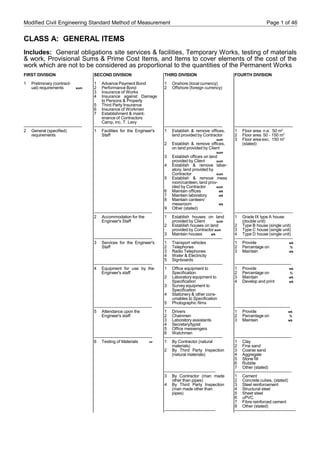
FIRST DIVISION
1 Preliminary (contract-
ual) requirements sum
-----------------------------------------
2 General (specified)
requirements
SECOND DIVISION
1 Advance Payment Bond
2 Performance Bond
3 Insurance of Works
4 Insurance against Damage
to Persons & Property
5 Third Party Insurance
6 Insurance of Workmen
7 Establishment & maint-
enance of Contractors
Camp, inc. T. Levy
-----------------------------------------
1 Facilities for the Engineer's
Staff
-----------------------------------------
2 Accommodation for the
Engineer's Staff
-----------------------------------------
3 Services for the Engineer's
Staff
-----------------------------------------
4 Equipment for use by the
Engineer's staff
-----------------------------------------
5 Attendance upon the
Engineer's staff
-----------------------------------------
6 Testing of Materials nr
THIRD DIVISION
1 Onshore (local currency)
2 Offshore (foreign currency)
-----------------------------------------
1 Establish & remove offices,
land provided by Contractor
sum
2 Establish & remove offices,
on land provided by Client
sum
3 Establish offices on land
provided by Client sum
4 Establish & remove labar-
atory, land provided by
Contractor sum
5 Establish & remove mess
room/canteen, land prov-
ided by Contractor sum
6 Maintain offices wk
7 Maintain laboratory wk
8 Maintain canteen/
messroom wk
9 Other (stated)
-----------------------------------------
1 Establish houses on land
provided by Client sum
2 Establish houses on land
provided by Contractor sum
3 Maintain houses wk
-----------------------------------------
1 Transport vehicles
2 Telephones
3 Radio Telephones
4 Water & Electricity
5 Signboards
-----------------------------------------
1 Office equipment to
Specification
2 Laboratory equipment to
Specification
3 Survey equipment to
Specification
4 Stationery & other cons-
umables to Specification
5 Photographic films
----------------------------------------
1 Drivers
2 Chainmen
3 Laboratory assistants
4 Secretary/typist
5 Office messengers
6 Watchmen
-----------------------------------------
1 By Contractor (natural
materials)
2 By Third Party Inspection
(natural materials)
------------------------------------
3 By Contractor (man made
other than pipes)
4 By Third Party Inspection
(man made other than
pipes)
------------------------------------
FOURTH DIVISION
-----------------------------------------
1 Floor area n.e. 50 m2
2 Floor area 50 - 150 m2
3 Floor area exc. 150 m2
(stated)
-----------------------------------------
1 Grade IX type A house
(double unit)
2 Type B house (single unit)
3 Type C house (single unit)
4 Type D house (single unit)
-----------------------------------------
1 Provide wk
2 Percentage on %
3 Maintain wk
----------------------------------------
1 Provide wk
2 Percentage on %
3 Maintain wk
4 Develop and print wk
---------------------------------------
1 Provide wk
2 Percentage on %
3 Maintain wk
----------------------------------------
1 Clay
2 Fine sand
3 Coarse sand
4 Aggregate
5 Stone fill
6 Rubble
7 Other (stated)
----------------------------------------
1 Cement
2 Concrete cubes, (stated)
3 Steel reinforcement
4 Structural steel
5 Sheet steel
6 uPVC
7 Fibre reinforced cement
8 Other (stated)
-------------------------------------------
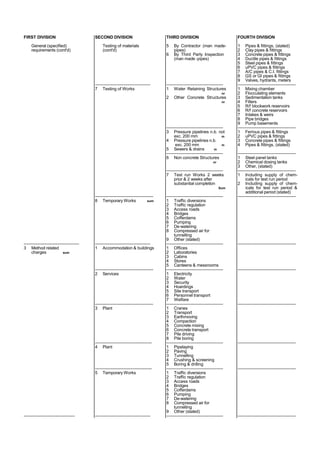
FIRST DIVISION
General (specified)
requirements (cont'd)
---------------------------------------
3 Method related
charges sum
------------------------------------
SECOND DIVISION
Testing of materials
(cont'd)
---------------------------------------
7 Testing of Works
-----------------------------------------
8 Temporary Works sum
---------------------------------------
1 Accommodation & buildings
-----------------------------------------
2 Services
-----------------------------------------
3 Plant
----------------------------------------
4 Plant
----------------------------------------
5 Temporary Works
---------------------------------------
THIRD DIVISION
5 By Contractor (man made-
pipes)
6 By Third Party Inspection
(man made -pipes)
----------------------------------------
1 Water Retaining Structures
nr
2 Other Concrete Structures
nr
----------------------------------------
3 Pressure pipelines n.b. not
exc. 200 mm m
4 Pressure pipelines n.b.
exc. 200 mm m
5 Sewers & drains m
----------------------------------------
6 Non concrete Structures
nr
----------------------------------------
7 Test run Works 2 weeks
prior & 2 weeks after
substantial completion
Sum
----------------------------------------
1 Traffic diversions
2 Traffic regulation
3 Access roads
4 Bridges
5 Cofferdams
6 Pumping
7 De-watering
8 Compressed air for
tunnelling
9 Other (stated)
----------------------------------------
1 Offices
2 Laboratories
3 Cabins
4 Stores
5 Canteens & messrooms
----------------------------------------
1 Electricity
2 Water
3 Security
4 Hoardings
5 Site transport
6 Personnel transport
7 Welfare
----------------------------------------
1 Cranes
2 Transport
3 Earthmoving
4 Compaction
5 Concrete mixing
6 Concrete transport
7 Pile driving
8 Pile boring
----------------------------------------
1 Pipelaying
2 Paving
3 Tunnelling
4 Crushing & screening
5 Boring & drilling
----------------------------------------
1 Traffic diversions
2 Traffic regulation
3 Access roads
4 Bridges
5 Cofferdams
6 Pumping
7 De-watering
8 Compressed air for
tunnelling
9 Other (stated)
----------------------------------------
FOURTH DIVISION
1 Pipes & fittings, (stated)
2 Clay pipes & fittings
3 Concrete pipes & fittings
4 Ductile pipes & fittings
5 Steel pipes & fittings
6 uPVC pipes & fittings
7 A/C pipes & C.I. fittings
8 GS or GI pipes & fittings
9 Valves, hydrants, meters
-----------------------------------------
1 Mixing chamber
2 Flocculating elements
3 Sedimentation tanks
4 Filters
5 R/f blockwork reservoirs
6 R/f concrete reservoirs
7 Intakes & weirs
8 Pipe bridges
9 Pump basements
-----------------------------------------
1 Ferrous pipes & fittings
2 uPVC pipes & fittings
3 Concrete pipes & fittings
4 Pipes & fittings, (stated)
-----------------------------------------
1 Steel panel tanks
2 Chemical dosing tanks
3 Other, (stated)
-----------------------------------------
1 Including supply of chem-
icals for test run period
2 Including supply of chem-
icals for test run period &
additional period (stated)
-----------------------------------------
-----------------------------------------
-----------------------------------------
-----------------------------------------
-----------------------------------------
-----------------------------------------
-----------------------------------------
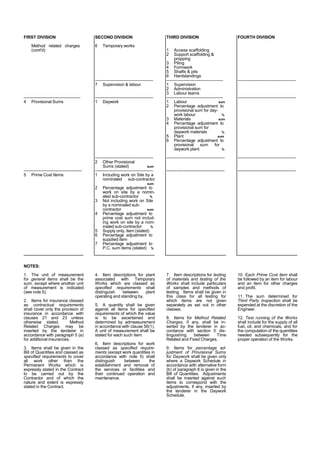
FIRST DIVISION
Method related charges
(cont'd)
----------------------------------------
4 Provisional Sums
-----------------------------------------
5 Prime Cost Items
NOTES:
1. The unit of measurement
for general items shall be the
sum, except where another unit
of measurement is indicated
(see note 5).
2. Items for insurance classed
as contractual requirements
shall cover only the provision of
insurance in accordance with
clauses 21 and 23 unless
otherwise stated. Method
Related Charges may be
inserted by the tenderer in
accordance with paragraph 5 (a)
for additional insurances.
3. Items shall be given in the
Bill of Quantities and classed as
specified requirements to cover
all work other than the
Permanent Works which is
expressly stated in the Contract
to be carried out by the
Contractor and of which the
nature and extent is expressly
stated in the Contract.
SECOND DIVISION
6 Temporary works
-----------------------------------------
7 Supervision & labour
-----------------------------------------
1 Daywork
-----------------------------------------
2 Other Provisional
Sums (stated) sum
-----------------------------------------
1 Including work on Site by a
nominated sub-contractor
sum
2 Percentage adjustment to
work on site by a nomin-
ated sub-contractor %
3 Not including work on Site
by a nominated sub-
contractor sum
4 Percentage adjustment to
prime cost sum not includ-
ing work on site by a nom-
inated sub-contractor %
5 Supply only, item (stated)
6 Percentage adjustment to
supplied item
7 Percentage adjustment to
P.C. sum items (stated) %
4. Item descriptions for plant
associated with Temporary
Works which are classed as
specified requirements shall
distinguish between plant
operating and standing by.
5. A quantity shall be given
against all items for specified
requirements of which the value
is to be ascertained and
determined by admeasurement
in accordance with clause 56(1).
A unit of measurement shall be
stated for each such item.
6. Item descriptions for work
classed as specified require-
ments (except work quantities in
accordance with note 5) shall
distinguish between the
establishment and removal of
the services or facilities and
their continued operation and
maintenance.
THIRD DIVISION
1 Access scaffolding
2 Support scaffolding &
propping
3 Piling
4 Formwork
5 Shafts & pits
6 Hardstandings
----------------------------------------
1 Supervision
2 Administration
3 Labour teams
----------------------------------------
1 Labour sum
2 Percentage adjustment to
provisional sum for day-
work labour %
3 Materials sum
4 Percentage adjustment to
provisional sum for
daywork materials %
5 Plant sum
6 Percentage adjustment to
provisional sum for
daywork plant %
-----------------------------------------
-----------------------------------------
7. Item descriptions for testing
of materials and testing of the
Works shall include particulars
of samples and methods of
testing. Items shall be given in
this class for all testing for
which items are not given
separately as set out in other
classes.
8. Items for Method Related
Charges, if any, shall be in-
serted by the tenderer in ac-
cordance with section 5 dis-
tinguishing between Time
Related and Fixed Charges.
9. Items for percentage ad-
justment of Provisional Sums
for Daywork shall be given only
where a Daywork Schedule in
accordance with alternative form
(b) of paragraph 8 is given in the
Bill of Quantities. Adjustments
shall be inserted against such
items to correspond with the
adjustments, if any, inserted by
the tenderer in the Daywork
Schedule.
FOURTH DIVISION
-----------------------------------------
-----------------------------------------
-----------------------------------------
-----------------------------------------
10. Each Prime Cost item shall
be followed by an item for labour
and an item for other charges
and profit.
11. The sum determined for
Third Party Inspection shall be
expended at the discretion of the
Engineer.
12. Test running of the Works
shall include for the supply of all
fuel, oil, and chemicals, and for
the computation of the quantities
needed subsequently for the
proper operation of the Works.
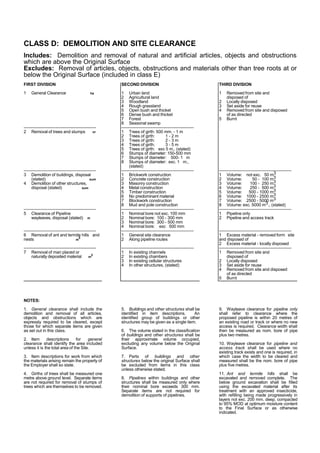
CLASS D: DEMOLITION AND SITE CLEARANCE
Includes: Demolition and removal of natural and artificial articles, objects and obstructions
which are above the Original Surface
Excludes: Removal of articles, objects, obstructions and materials other than tree roots at or
below the Original Surface (included in class E)
FIRST DIVISION
1 General Clearance ha
---------------------------------------------------
2 Removal of trees and stumps nr
---------------------------------------------------
3 Demolition of buildings, disposal
(stated) sum
4 Demolition of other structures,
disposal (stated) sum
---------------------------------------------------
5 Clearance of Pipeline
wayleaves, disposal (stated) m
---------------------------------------------------
6 Removal of ant and termite hills and
nests m
3
---------------------------------------------------
7 Removal of man placed or
naturally deposited material m
3
NOTES:
1. General clearance shall include the
demolition and removal of all articles,
objects and obstructions which are
expressly required to be cleared, except
those for which separate items are given
as set out in this class.
2. Item descriptions for general
clearance shall identify the area included
unless it is the total area of the Site.
3. Item descriptions for work from which
the materials arising remain the property of
the Employer shall so state.
4. Girths of trees shall be measured one
metre above ground level. Separate items
are not required for removal of stumps of
trees which are themselves to be removed.
SECOND DIVISION
1 Urban land
2 Agricultural land
3 Woodland
4 Rough grassland
5 Open bush and thicket
6 Dense bush and thicket
7 Forest
8 Seasonal swamp
---------------------------------------------------
1 Trees of girth: 500 mm. - 1 m
2 Trees of girth: 1 - 2 m
3 Trees of girth: 2 - 3 m
4 Trees of girth: 3 - 5 m
5 Trees of girth: exc 5 m., (stated)
6 Stumps of diameter: 150-500 mm
7 Stumps of diameter: 500- 1 m
8 Stumps of diameter: exc. 1 m.,
(stated)
---------------------------------------------------
1 Brickwork construction
2 Concrete construction
3 Masonry construction
4 Metal construction
5 Timber construction
6 No predominant material
7 Blockwork construction
8 Mud and pole construction
---------------------------------------------------
1 Nominal bore not exc. 100 mm
2 Nominal bore: 100 - 300 mm
3 Nominal bore: 300 - 500 mm
4 Nominal bore: exc 500 mm
---------------------------------------------------
1 General site clearance
2 Along pipeline routes
---------------------------------------------------
1 In existing channels
2 In existing chambers
3 In existing cellular structures
4 In other structures, (stated)
5. Buildings and other structures shall be
identified in item descriptions. An
identified group of buildings or other
structures may be given as a single item.
6. The volume stated in the classification
of buildings and other structures shall be
their approximate volume occupied,
excluding any volume below the Original
Surface.
7. Parts of buildings and other
structures below the original Surface shall
be excluded from items in this class
unless otherwise stated.
8. Pipelines within buildings and other
structures shall be measured only where
their nominal bore exceeds 300 mm.
Separate items are not required for
demolition of supports of pipelines.
THIRD DIVISION
1 Removed from site and
disposed of
2 Locally disposed
3 Set aside for reuse
4 Removed from site and disposed
of as directed
5 Burnt
---------------------------------------------------
1 Volume: not exc. 50 m3
2 Volume: 50 - 100 m3
3 Volume: 100 - 250 m3
4 Volume: 250 - 500 m3
5 Volume: 500 - 1000 m3
6 Volume: 1000 - 2500 m3
7 Volume: 2500 - 5000 m3
8 Volume: exc. 5000 m3., (stated)
---------------------------------------------------
1 Pipeline only
2 Pipeline and access track
---------------------------------------------------
1 Excess material - removed form site
and disposed of
2 Excess material - locally disposed
---------------------------------------------------
1 Removed from site and
disposed of
2 Locally disposed
3 Set aside for reuse
4 Removed from site and disposed
of as directed
5 Burnt
9. Wayleave clearance for pipeline only
shall refer to clearance where the
proposed pipeline is within 20 metres of
an existing road or track or where no new
access is required. Clearance width shall
then be measured as nom. bore of pipe
plus two metres.
10. Wayleave clearance for pipeline and
access track shall be used where no
existing track exists and one is required, in
which case the width to be cleared and
measured shall be the nom. bore of pipe
plus five metres.
11. Ant and termite hills shall be
excavated and removed complete. The
below ground excavation shall be filled
using the excavated material after its
treatment with an approved insecticide,
with refilling being made progressively in
layers not exc. 200 mm. deep, compacted
to 95% MOD at optimum moisture content
to the Final Surface or as otherwise
indicated.
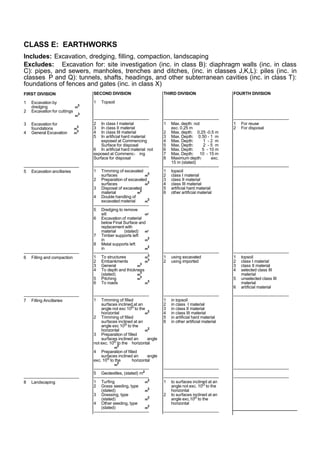
CLASS E: EARTHWORKS
Includes: Excavation, dredging, filling, compaction, landscaping
Excludes: Excavation for: site investigation (inc. in class B): diaphragm walls (inc. in class
C): pipes, and sewers, manholes, trenches and ditches, (inc. in classes J,K,L): piles (inc. in
classes P and Q): tunnels, shafts, headings, and other subterranean cavities (inc. in class T):
foundations of fences and gates (inc. in class X)
FIRST DIVISION
1 Excavation by
dredging m
3
2 Excavation for cuttings
m
3
3 Excavation for
foundations m
3
4 General Excavation m
3
---------------------------------------
5 Excavation ancillaries
---------------------------------------
6 Filling and compaction
---------------------------------------
7 Filling Ancillaries
---------------------------------------
8 Landscaping
SECOND DIVISION
1 Topsoil
---------------------------------------
2 In class I material
3 In class II material
4 In class III material
5 In artificial hard material
exposed at Commencing
Surface for disposal
6 In artificial hard material not
exposed at Commenc- ing
Surface for disposal
---------------------------------------
1 Trimming of excavated
surfaces m
2
2 Preparation of excavated
surfaces m
2
3 Disposal of excavated
material m
2
4 Double handling of
excavated material m
2
---------------------------------------
5 Dredging to remove
silt m3
6 Excavation of material
below Final Surface and
replacement with
material (stated) m3
7 Timber supports left
in m
2
8 Metal supports left
in m
2
---------------------------------------
1 To structures m
3
2 Embankments m
3
3 General m
3
4 To depth and thickness
(stated) m
3
5 Pitching m
3
6 To roads m
3
---------------------------------------
1 Trimming of filled
surfaces inclined at an
angle not exc 10o to the
horizontal m
2
2 Trimming of filled
surfaces inclined at an
angle exc 10o to the
horizontal m
2
3 Preparation of filled
surfaces inclined an angle
not exc. 10o to the horizontal
m
2
4 Preparation of filled
surfaces inclined an angle
exc. 10o to the horizontal
m
2
---------------------------------------
5 Geotextiles, (stated) m2
---------------------------------------
1 Turfing m
2
2 Grass seeding, type
(stated) m
2
3 Grassing, type
(stated) m
2
4 Other seeding, type
(stated) m
2
---------------------------------------
THIRD DIVISION
---------------------------------------
1 Max. depth: not
exc. 0.25 m
2 Max. depth: 0.25 -0.5 m
3 Max. Depth: 0.50 - 1 m
4 Max. Depth: 1 - 2 m
5 Max. Depth: 2 - 5 m
6 Max. Depth: 5 - 10 m
7 Max. Depth: 10 - 15 m
8 Maximum depth: exc.
15 m (stated)
---------------------------------------
1 topsoil
2 class I material
3 class II material
4 class III material
5 artificial hard material
6 other artificial material
---------------------------------------
1 using excavated
2 using imported
---------------------------------------
1 in topsoil
2 in class I material
3 in class II material
4 in class III material
5 in artificial hard material
6 in other artificial material
---------------------------------------
---------------------------------------
1 to surfaces inclined at an
angle not exc. 10o to the
horizontal
2 to surfaces inclined at an
angle exc.10o to the
horizontal
---------------------------------------
FOURTH DIVISION
---------------------------------------
1 For reuse
2 For disposal
---------------------------------------
---------------------------------------
1 topsoil
2 class I material
3 class II material
4 selected class III
material
5 unselected class III
material
6 artificial material
---------------------------------------
---------------------------------------
---------------------------------------
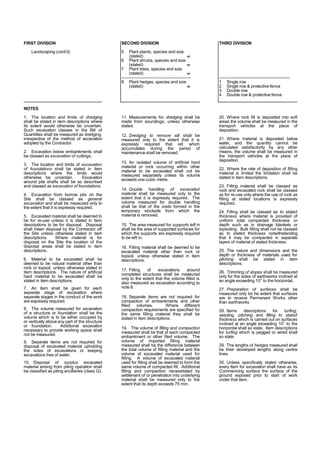
FIRST DIVISION
Landscaping (cont'd)
NOTES
1. The location and limits of dredging
shall be stated in item descriptions where
its extent would otherwise be uncertain.
Such excavation classes in the Bill of
Quantities shall be measured as dredging,
irrespective of the method of excavation
adopted by the Contractor.
2. Excavation below embankments shall
be classed as excavation of cuttings.
3. The location and limits of excavation
of foundations shall be stated in item
descriptions where the limits would
otherwise be uncertain. Excavation
around pile shafts shall be so described
and classed as excavation of foundations.
4. Excavation from borrow pits on the
Site shall be classed as general
excavation and shall be measured only to
the extent that it is expressly required.
5. Excavated material shall be deemed to
be for re-use unless it is stated in item
descriptions to be for disposal. Disposal
shall mean disposal by the Contractor off
the Site unless otherwise stated in item
descriptions. Where material is for
disposal on the Site the location of the
disposal areas shall be stated in item
descriptions.
6. Material to be excavated shall be
deemed to be natural material other than
rock or topsoil, unless otherwise stated in
item descriptions. The nature of artificial
hard material to be excavated shall be
stated in item descriptions.
7. An item shall be given for each
separate stage of excavation where
separate stages in the conduct of the work
are expressly required.
8. The volume measured for excavation
of a structure or foundation shall be the
volume which is to be either occupied by
or vertically above any part of the structure
or foundation. Additional excavation
necessary to provide working space shall
not be measured.
9. Separate items are not required for
disposal of excavated material upholding
the sides of excavations or keeping
excavations free of water.
10. Disposal of surplus excavated
material arising from piling operation shall
be classified as piling ancillaries (class Q).
SECOND DIVISION
5 Plant plants, species and size
(stated) nr
6 Plant shrubs, species and size
(stated) nr
7 Plant trees, species and size
(stated) nr
-------------------------------------------------
8 Plant hedges, species and size
(stated) nr
11. Measurements for dredging shall be
made from soundings, unless otherwise
stated.
12. Dredging to remove silt shall be
measured only to the extent that it is
expressly required that silt which
accumulates during the period of
maintenance shall be removed.
13. An isolated volume of artificial hard
material or rock occurring within other
material to be excavated shall not be
measured separately unless its volume
exceeds one cubic metre.
14. Double handling of excavated
material shall be measured only to the
extent that it is expressly required. The
volume measured for double handling
shall be that of the voids formed in the
temporary stockpile from which the
material is removed.
15. The area measured for supports left in
shall be the area of supported surfaces for
which the supports are expressly required
to be left in.
16. Filling material shall be deemed to be
excavated material other than rock or
topsoil, unless otherwise stated in item
descriptions.
17. Filling of excavations around
completed structures shall be measured
only to the extent that the volume filled is
also measured as excavation according to
note 8.
18. Separate items are not required for
compaction of embankments and other
filled volumes. Where different
compaction requirements are specified for
the same filling material they shall be
stated in item descriptions.
19. The volume of filling and compaction
measured shall be that of each compacted
embankment or other filed volume. The
volume of imported filling material
measured shall be the difference between
the total volume of filling material and the
volume of excavated material used for
filling. A volume of excavated material
used for filling shall be deemed to form the
same volume of compacted fill. Additional
filling and compaction necessitated by
settlement of or penetration into underlying
material shall be measured only to the
extent that its depth exceeds 75 mm.
THIRD DIVISION
--------------------------------------------------
1 Single row
2 Single row & protective fence
3 Double row
4 Double row & protective fence
20. Where rock fill is deposited into soft
areas the volume shall be measured in the
transport vehicles at the place of
deposition.
21. Where material is deposited below
water, and the quantity cannot be
calculated satisfactorily by any other
means, the volume shall be measured in
the transport vehicles at the place of
deposition.
22. Where the rate of deposition of filling
material is limited the limitation shall be
stated in item descriptions.
23. Filling material shall be classed as
rock and excavated rock shall be classed
as for re-use only where the use of rock as
filling at stated locations is expressly
required.
24. Filling shall be classed as to stated
thickness where material is provided of
uniform total compacted thickness or
depth such as in drainage blankets or
topsoiling. Bulk filling shall not be classed
as to stated thickness notwithstanding
that it may be compacted in separate
layers of material of stated thickness.
25. The nature and dimensions and the
depth or thickness of materials used for
pitching shall be stated in item
descriptions.
26. Trimming of slopes shall be measured
only for the sides of earthworks inclined at
an angle exceeding 10° to the horizontal.
27. Preparation of surfaces shall be
measured only tot he extent that surfaces
are to receive Permanent Works other
than earthworks.
28. Items descriptions for turfing,
seeding, pitching and filling to stated
thickness which is carried out on surfaces
inclined at an angle exceeding 10° to the
horizontal shall so state. Item descriptions
for turfing which is pegged or wired shall
so state.
29. The lengths of hedges measured shall
be their developed lengths along centre
lines.
30. Unless specifically stated otherwise,
every item for excavation shall have as its
Commencing surface the surface of the
ground exposed prior to start of work
under that item.
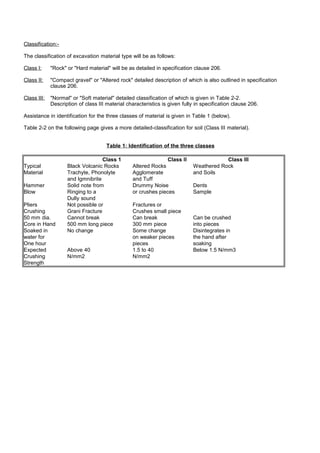
Classification:-
The classification of excavation material type will be as follows:
Class I: "Rock" or "Hard material" will be as detailed in specification clause 206.
Class II: "Compact gravel" or "Altered rock" detailed description of which is also outlined in specification
clause 206.
Class III: "Normal" or "Soft material" detailed classification of which is given in Table 2-2.
Description of class III material characteristics is given fully in specification clause 206.
Assistance in identification for the three classes of material is given in Table 1 (below).
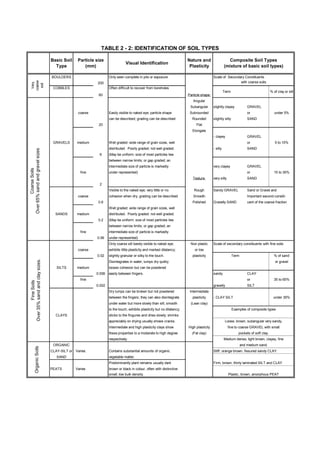
Table 2-2 on the following page gives a more detailed-classification for soil (Class III material).
Table 1: Identification of the three classes
Class 1 Class II Class III
Typical Black Volcanic Rocks Altered Rocks Weathered Rock
Material Trachyte, Phonolyte Agglomerate and Soils
and Igmnibrite and Tuff
Hammer Solid note from Drummy Noise Dents
Blow Ringing to a or crushes pieces Sample
Dully sound
Pliers Not possible or Fractures or
Crushing Grani Fracture Crushes small piece
50 mm dia. Cannot break Can break Can be crushed
Core in Hand 500 mm long piece 300 mm piece into pieces
Soaked in No change Some change Disintegrates in
water for on weaker pieces the hand after
One hour pieces soaking
Expected Above 40 1.5 to 40 Below 1.5 N/mm3
Crushing N/mm2 N/mm2
Strength
TABLE 2 - 2: IDENTIFICATION OF SOIL TYPES
Basic Soil
Type
Particle size
(mm)
Visual Identification
Nature and
Plasticity
Composite Soil Types
(mixture of basic soil types)
BOULDERS Only seen complete in pits or exposure Scale of Secondary Constituents
200 with coarse soils
COBBLES
60
Often difficult to recover from boreholes
Particle shape:
Term % of clay or silt
Angular
Subangular slightly clayey GRAVEL
coarse Easily visible to naked eye; particle shape Subrounded or under 5%
can be described; grading can be described Rounded slightly silty SAND
20 Flat
Elongate
- clayey GRAVEL
GRAVELS medium Well graded: wide range of grain sizes, well or 5 to 15%
distributed. Poorly graded: not well graded. - silty SAND
6 (May be uniform: size of most particles lies
between narrow limits; or gap graded; an
intermediate size of particle is markedly very clayey GRAVEL
fine under represented) or 15 to 35%
Texture: very silty SAND
2
Visible to the naked eye; very little or no Rough Sandy GRAVEL Sand or Gravel and
coarse cohesion when dry; grading can be described Smooth Important second constit-
0.6 Polished Gravelly SAND uent of the coarse fraction
Well graded: wide range of grain sizes, well
SANDS medium distributed. Poorly graded: not well graded.
0.2 (May be uniform: size of most particles lies
between narrow limits; or gap graded; an
fine intermediate size of particle is markedly
0.06 under represented)
Only coarse silt barely visible to naked eye; Non plastic Scale of secondary constituents with fine soils
coarse exhibits little plasticity and marked dilatancy; or low
0.02 slightly granular or silky to the touch. plasticity Term % of sand
Disintegrates in water; lumps dry quikly; or gravel
SILTS medium looses cohesion but can be powdered
0.006 easily between fingers. sandy CLAY
fine or 35 to 65%
0.002 gravelly SILT
Dry lumps can be broken but not powdered Intermediate
between the fingers; they can also disintegrate plasticity - CLAY SILT under 35%
under water but more slowly than silt; smooth (Lean clay)
to the touch; exhibits plasticity but no dilatancy; Examples of composite types
CLAYS sticks to the fingures and dries slowly; shrinks
appreciably on drying usually shows cracks. Loose, brown, subangular very sandy,
Intermediate and high plasticity clays show High plasticity fine to coarse GRAVEL with small
these properties to a moderate to high degree (Fat clay) pockets of soft clay.
respectively. Medium dense, light brown, clayey, fine
ORGANIC and medium sand.
CLAY-SILT or Varies Contains substantial amounts of organic Stiff, orange brown, fissured sandy CLAY.
SAND vegetable matter.
Predominantly plant remains usually dark Firm, brown, thinly laminated SILT and CLAY
PEATS Varies brown or black in colour, often with distinctive
smell; low bulk density. Plastic, brown, amorphous PEAT
Very
coarse
soil
CoarseSoils
Over65%sandandgravelsizes
FineSoils
Over35%sandandclaysizes.OrganicSoils
CLASS F: IN-SITU CONCRETE
Excludes: In situ concrete for:
Capping of boreholes (inc. in class B): diaphragm walls (inc. in class C): drainage and
pipework (inc. in classes K and L): piles (inc. in classes P and Q): roads (inc. in class R): rail
track foundations (inc. in class S): tunnels and shaft linings (inc. in class T): foundations of
fences and gates (inc. in class X)
FIRST DIVISION
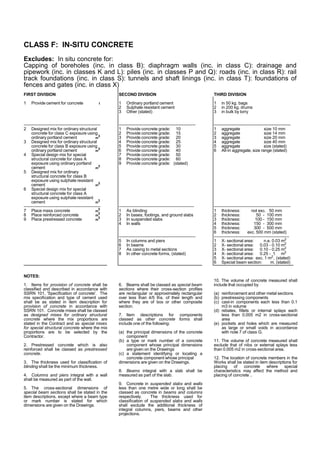
1 Provide cement for concrete t
------------------------------------------------------
2 Designed mix for ordinary structural
concrete for class C exposure using
ordinary portland cement m
3
3 Designed mix for ordinary structural
concrete for class B exposure using
ordinary portland cement m
3
4 Special design mix for special
structural concrete for class A
exposure using ordinary portland
cement m
3
5 Designed mix for ordinary
structural concrete for class B
exposure using sulphate resistant
cement m
3
6 Special design mix for special
structural concrete for class A
exposure using sulphate resistant
cement m
3
------------------------------------------------------
7 Place mass concrete m
3
8 Place reinforced concrete m
3
9 Place prestressed concrete m
3
NOTES:
1. Items for provision of concrete shall be
classified and described in accordance with
SSRN 101, 'Specification of concrete'. The
mix specification and type of cement used
shall be as stated in item description for
provision of concrete in accordance with
SSRN 101. Concrete mixes shall be classed
as designed mixes for ordinary structural
concrete where the mix proportions are
stated in the Contract and as special mixes
for special structural concrete where the mix
proportions are to be selected by the
Contractor.
2. Prestressed concrete which is also
reinforced shall be classed as prestressed
concrete.
3. The thickness used for classification of
blinding shall be the minimum thickness.
4. Columns and piers integral with a wall
shall be measured as part of the wall.
5. The cross-sectional dimensions of
special beam sections shall be stated in the
item descriptions, except where a beam type
or mark number is stated for which
dimensions are given on the Drawings.
SECOND DIVISION
1 Ordinary portland cement
2 Sulphate resistant cement
3 Other (stated)
------------------------------------------------------
1 Provide concrete grade: 10
2 Provide concrete grade: 15
3 Provide concrete grade: 20
4 Provide concrete grade: 25
5 Provide concrete grade: 30
6 Provide concrete grade: 40
7 Provide concrete grade: 50
8 Provide concrete grade: 60
9 Provide concrete grade: (stated)
-----------------------------------------------------
1 As blinding
2 In bases, footings, and ground slabs
3 In suspended slabs
4 In walls
------------------------------------------------------
5 In columns and piers
6 In beams
7 As casing to metal sections
8 In other concrete forms, (stated)
6. Beams shall be classed as special beam
sections where their cross-section profiles
are rectangular or approximately rectangular
over less than 4/5 ths. of their length and
where they are of box or other composite
section.
7. Item descriptions for components
classed as other concrete forms shall
include one of the following:
(a) the principal dimensions of the concrete
component
(b) a type or mark number of a concrete
component whose principal dimensions
are given on the Drawings
(c) a statement identifying or locating a
concrete component whose principal
dimensions are given on the Drawings.
8. Beams integral with a slab shall be
measured as part of the slab.
9. Concrete in suspended slabs and walls
less than one metre wide or long shall be
classed as concrete in beams and columns
respectively. The thickness used for
classification of suspended slabs and walls
shall exclude the additional thickness of
integral columns, piers, beams and other
projections.
THIRD DIVISION
1 in 50 kg. bags
2 in 200 kg. drums
3 in bulk by lorry
------------------------------------------------------
1 aggregate size 10 mm
2 aggregate size 14 mm
3 aggregate size 20 mm
4 aggregate size 40 mm
5 aggregate size (stated)
6 All-in aggregate, size range (stated)
------------------------------------------------------
1 thickness: not exc. 50 mm
2 thickness: 50 - 100 mm
3 thickness: 100 - 150 mm
4 thickness: 150 - 300 mm
5 thickness: 300 - 500 mm
6 thickness: exc. 500 mm (stated)
-----------------------------------------------------
1 X- sectional area: n.e. 0.03 m2
2 X- sectional area: 0.03 - 0.10 m2
3 X- sectional area: 0.10 - 0.25 m2
4 X- sectional area: 0.25 - 1 m2
5 X- sectional area: exc. 1 m2
, (stated)
6 Special beam section: m. (stated)
10. The volume of concrete measured shall
include that occupied by
(a) reinforcement and other metal sections
(b) prestressing components
(c) cast-in components each less than 0.1
m3 in volume
(d) rebates, fillets or internal splays each
less than 0.005 m2 in cross-sectional
area
(e) pockets and holes which are measured
as large or small voids in accordance
with note 7 of class G.
11. The volume of concrete measured shall
exclude that of nibs or external splays less
than 0.005 m2 in cross-sectional area.
12. The location of concrete members in the
Works shall be stated in item descriptions for
placing of concrete where special
characteristics may affect the method and
placing of concrete ..
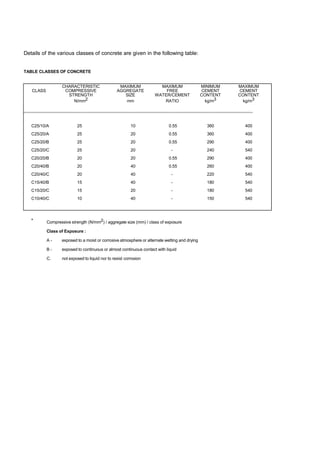
Details of the various classes of concrete are given in the following table:
TABLE CLASSES OF CONCRETE
CHARACTERISTIC MAXIMUM MAXIMUM MINIMUM MAXIMUM
CLASS COMPRESSIVE AGGREGATE FREE CEMENT CEMENT
STRENGTH SIZE WATER/CEMENT CONTENT CONTENT
N/mm2 mm RATIO kg/m3 kg/m3
C25/10/A 25 10 0.55 360 400
C25/20/A 25 20 0.55 360 400
C25/20/B 25 20 0.55 290 400
C25/20/C 25 20 - 240 540
C20/20/B 20 20 0.55 290 400
C20/40/B 20 40 0.55 260 400
C20/40/C 20 40 - 220 540
C15/40/B 15 40 - 180 540
C15/20/C 15 20 - 180 540
C10/40/C 10 40 - 150 540
* Compressive strength (N/mm2) / aggregate size (mm) / class of exposure
Class of Exposure :
A - exposed to a moist or corrosive atmosphere or alternate wetting and drying
B - exposed to continuous or almost continuous contact with liquid
C. not exposed to liquid nor to resist corrosion
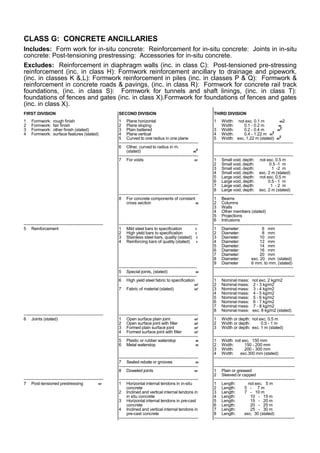
CLASS G: CONCRETE ANCILLARIES
Includes: Form work for in-situ concrete: Reinforcement for in-situ concrete: Joints in in-situ
concrete: Post-tensioning prestressing: Accessories for in-situ concrete.
Excludes: Reinforcement in diaphragm walls (inc. in class C): Post-tensioned pre-stressing
reinforcement (inc. in class H): Formwork reinforcement ancillary to drainage and pipework,
(inc. in classes K &,L): Formwork reinforcement in piles (inc. in classes P & Q): Formwork &
reinforcement in concrete roads & pavings, (inc. in class R): Formwork for concrete rail track
foundations, (inc. in class S): Formwork for tunnels and shaft linings, (inc. in class T):
foundations of fences and gates (inc. in class X).Formwork for foundations of fences and gates
(inc. in class X).
FIRST DIVISION
1 Formwork: rough finish
2 Formwork: fair finish
3 Formwork: other finish (stated)
4 Formwork: surface features (stated)
--------------------------------------------------------
5 Reinforcement
--------------------------------------------------------
6 Joints (stated)
--------------------------------------------------------
7 Post-tensioned prestressing nr
SECOND DIVISION
1 Plane horizontal
2 Plane sloping
3 Plain battered
4 Plane vertical
5 Curved to one radius in one plane
--------------------------------------------------------
6 Other, curved to radius in m.
(stated) m
2
--------------------------------------------------------
7 For voids nr
--------------------------------------------------------
8 For concrete components of constant
cross section m
--------------------------------------------------------
1 Mild steel bars to specification t
2 High yield bars to specification t
3 Stainless steel bars, quality (stated) t
4 Reinforcing bars of quality (stated) t
-------------------------------------------------------
5 Special joints, (stated) nr
-------------------------------------------------------
6 High yield steel fabric to specification
m2
7 Fabric of material (stated) m2
--------------------------------------------------------
1 Open surface plain joint m2
2 Open surface joint with filler m2
3 Formed plain surface joint m2
4 Formed surface joint with filler m2
--------------------------------------------------------
5 Plastic or rubber waterstop m
6 Metal waterstop m
--------------------------------------------------------
7 Sealed rebate or grooves m
--------------------------------------------------------
8 Doweled joints nr
--------------------------------------------------------
1 Horizontal internal tendons in in-situ
concrete
2 Inclined and vertical internal tendons in
in situ concrete
3 Horizontal internal tendons in pre-cast
concrete
4 Inclined and vertical internal tendons in
pre-cast concrete
--------------------------------------------------------
THIRD DIVISION
1 Width: not exc. 0.1 m m2
Width: 0.1 - 0.2 m m
3 Width: 0.2 - 0.4 m m
2
4 Width: 0.4 - 1.22 m m
2
5 Width: exc. 1.22 m (stated) m
2
--------------------------------------------------------
--------------------------------------------------------
1 Small void, depth: not exc. 0.5 m
2 Small void, depth: 0.5 -1 m
3 Small void, depth: 1 -2 m
4 Small void, depth: exc. 2 m (stated)
5 Large void, depth: not exc. 0.5 m
6 Large void, depth: 0.5 - 1 m
7 Large void, depth: 1 - 2 m
8 Large void, depth: exc. 2 m (stated)
--------------------------------------------------------
1 Beams
2 Columns
3 Walls
4 Other members (stated)
5 Projections
6 Intrusions
-------------------------------------------------------
1 Diameter: 6 mm
2 Diameter: 8 mm
3 Diameter: 10 mm
4 Diameter: 12 mm
5 Diameter: 14 mm
6 Diameter: 16 mm
7 Diameter: 20 mm
8 Diameter: exc. 20 mm (stated)
9 Diameter 6 mm. to mm. (stated)
--------------------------------------------------------
---------------------------------------------------------
1 Nominal mass: not exc. 2 kg/m2
2 Nominal mass: 2 - 3 kg/m2
3 Nominal mass: 3 - 4 kg/m2
4 Nominal mass: 4 - 5 kg/m2
5 Nominal mass: 5 - 6 kg/m2
6 Nominal mass: 6 - 7 kg/m2
7 Nominal mass: 7 - 8 kg/m2
8 Nominal mass: exc. 8 kg/m2 (stated)
---------------------------------------------------------
1 Width or depth: not exc. 0.5 m
2 Width or depth: 0.5 - 1 m
3 Width or depth: exc. 1 m (stated)
---------------------------------------------------------
1 Width: not exc. 150 mm
2 Width: 150 - 200 mm
3 Width: 200 - 300 mm
4 Width: exc.300 mm (stated)
---------------------------------------------------------
---------------------------------------------------------
1 Plain or greased
2 Sleeved or capped
---------------------------------------------------------
1 Length: not exc. 5 m
2 Length: 5 - 7 m
3 Length: 7 - 10 m
4 Length: 10 - 15 m
5 Length: 15 - 20 m
6 Length: 20 - 25 m
7 Length: 25 - 30 m
8 Length: exc. 30 (stated)
---------------------------------------------------------
FIRST DIVISION
(Post tensioned pre.stressing (cont’d)
---------------------------------------------------------
8 Concrete accessories
NOTES
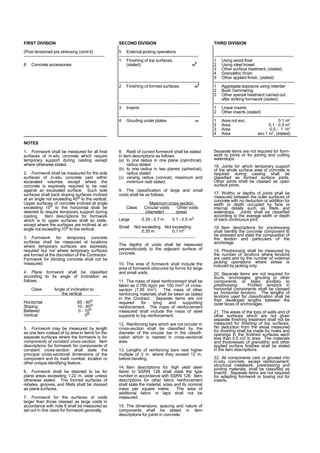
1. Formwork shall be measured for all final
surfaces of in-situ concrete which require
temporary support during casting except
where otherwise stated.
2. Formwork shall be measured for the side
surfaces of in-situ concrete cast within
excavated volumes except where the
concrete is expressly required to be cast
against an excavated surface. Such side
surfaces shall back sloping surfaces inclined
at an angle not exceeding 45o to the vertical.
Upper surfaces of concrete inclined at angle
exceeding 15o to the horizontal shall be
deemed to require temporary support during
casting. Item descriptions for formwork
which is to upper surfaces shall so state,
except where the surfaces are inclined at an
angle not exceeding 10o to the vertical.
3. Formwork for temporary concrete
surfaces shall be measured at locations
where temporary surfaces are expressly
required but not where temporary surfaces
are formed at the discretion of the Contractor.
Formwork for blinding concrete shall not be
measured.
4. Plane formwork shall be classified
according to its angle of inclination as
follows.
Class Angle of inclination to
the vertical
Horizontal 85 - 90o
Sloping 10 - 85o
Battered 0 - 10o
Vertical 0o
5. Formwork may be measured by length
as one item instead of by area in items for the
separate surfaces where the formwork is for
components of constant cross-section. Item
descriptions for formwork for components of
constant cross-section shall state the
principal cross-sectional dimensions of the
component and its mark number, location or
other unique identifying feature.
6. Formwork shall be deemed to be for
plane areas exceeding 1.22 m. wide unless
otherwise stated. The formed surfaces of
rebates, grooves, and fillets shall be classed
as plane surfaces.
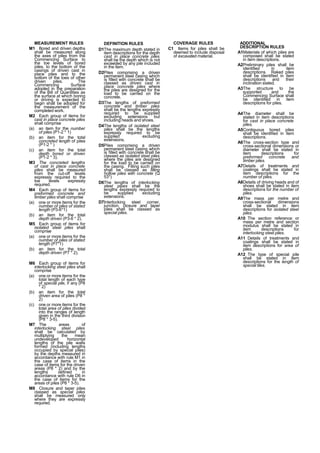
7. Formwork for the surfaces of voids
larger than those classed as large voids in
accordance with note 8 shall be measured as
set out in this class for formwork generally.
SECOND DIVISION
5 External jacking operations
--------------------------------------------------------
1 Finishing of top surfaces,
(stated) m
2
---------------------------------------------------------
2 Finishing of formed surfaces m
2
---------------------------------------------------------
3 Inserts
---------------------------------------------------------
4 Grouting under plates nr
8. Radii of curved formwork shall be stated
in item descriptions as follows.
(a) to one radius in one plane (cylindrical),
radius stated
(b) to one radius in two planes (spherical),
radius stated
(c) varying radius (conical), maximum and
minimum radii stated.
9. The classification of large and small
voids shall be as follows.
Maximum cross-section
Class Circular voids Other voids
(diameter) (area)
Large 0.35 - 0.7 m 0.1 - 0.5 m2
Small Not exceeding Not exceeding
0.35 m 0.1 m2
The depths of voids shall be measured
perpendicularly to the adjacent surface of
concrete.
10. The area of formwork shall include the
area of formwork obscured by forms for large
and small voids.
11. The mass of steel reinforcement shall be
taken as 0.785 kg/m per 100 mm2
of cross-
section (7.85 t/m2
). The mass of other
reinforcing materials shall be taken as stated
in the Contract. Separate items are not
required for tying and supporting
reinforcement. The mass of reinforcement
measured shall include the mass of steel
supports to top reinforcement.
12. Reinforcing bars which are not circular in
cross-section shall be classified by the
diameter of the circular bar in the classifi-
cation which is nearest in cross-sectional
area.
13. Lengths of reinforcing bars next higher
multiple of 3 m. where they exceed 12 m.
before bending.
14. Item descriptions for high yield steel
fabric to SSRN 128 shall state the type
number in accordance with SSRN 128. Item
descriptions for other fabric reinforcement
shall state the material, sizes and its nominal
mass per square metre. The area of
additional fabric in laps shall not be
measured.
15. The dimensions, spacing and nature of
components shall be stated in item
descriptions for joints in concrete.
THIRD DIVISION
--------------------------------------------------------
1 Using wood float
2 Using steel trowel
3 Other surface treatment, (stated).
4 Granolithic finish
5 Other applied finish, (stated)
---------------------------------------------------------
1 Aggregate exposure using retarder
2 Bush hammering
3 Other special treatment carried out
after striking formwork (stated)
---------------------------------------------------------
1 Linear inserts
2 Other inserts (stated)
---------------------------------------------------------
1 Area not exc. 0.1 m2
2 Area 0.1 - 0.5 m2
3 Area 0.5 - 1 m2
4 Area exc 1 m2
, (stated)
Separate items are not required for form-
work to joints or for joining and cutting
waterstops.
16. Joints for which temporary support
of the whole surface area of concrete is
required during casting shall be
classified as formed surface joints.
Other joints shall be classed as open
surface joints.
17. Widths or depths of joints shall be
measured between the outer surfaces of
concrete with no deduction or addition for
width or depth occupied by face or
internal details such as fillets and
waterstops. Joints shall be classified
according to the average width or depth
of each continuous joint.
18. Item descriptions for prestressing
shall identify the concrete component to
be stressed and state the composition of
the tendon and particulars of the
anchorage.
19. Prestressing shall be measured by
the number of tendons where tendons
are used and by the number of external
jacking operations where stress is
induced by jacking only.
20. Separate items are not required for
ducts, anchorages, grouting or other
components or tasks ancillary to
prestressing. Profiled tendons in
horizontal components shall be classed
as horizontal tendons. The lengths of
tendons used for classification shall be
their developed lengths between the
outer faces of anchorages.
21. The areas of the tops of walls and of
other surfaces which are not given
separate finishing treatment shall not be
measured for finishing of top surfaces.
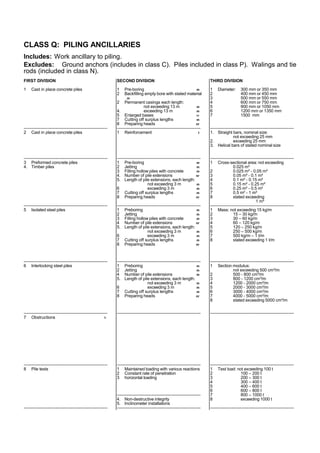
No deduction from the areas measured
for finishing shall be made for holes and
openings in the finished surfaces each
less than 0.5 m2 in area. The materials
and thicknesses of granolithic and other
applied surface finishes shall be stated
in the item descriptions.
22. All components cast or grouted into
in-situ concrete, except reinforcement,
structural metalwork, prestressing and
jointing materials, shall be classified as
inserts. Separate items are not required
for adapting formwork or boxing out for
inserts.
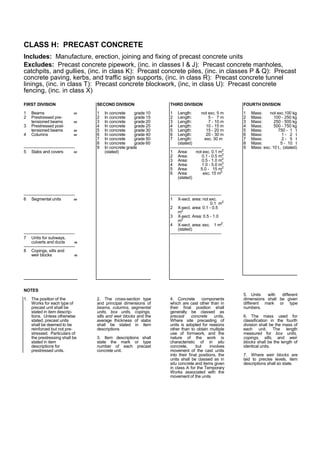
CLASS H: PRECAST CONCRETE
Includes: Manufacture, erection, joining and fixing of precast concrete units
Excludes: Precast concrete pipework, (inc. in classes I & J): Precast concrete manholes,
catchpits, and gullies, (inc. in class K): Precast concrete piles, (inc. in classes P & Q): Precast
concrete paving, kerbs, and traffic sign supports, (inc. in class R): Precast concrete tunnel
linings, (inc. in class T): Precast concrete blockwork, (inc, in class U): Precast concrete
fencing, (inc. in class X)
FIRST DIVISION
1 Beams nr
2 Prestressed pre-
tensioned beams nr
3 Prestressed post-
tensioned beams nr
4 Columns nr
------------------------------------
5 Slabs and covers nr
------------------------------------
6 Segmental units nr
------------------------------------
7 Units for subways,
culverts and ducts m
------------------------------------
8 Copings, sills and
weir blocks m
NOTES
1. The position of the
Works for each type of
precast unit shall be
stated in item descrip-
tions. Unless otherwise
stated, precast units
shall be deemed to be
reinforced but not pre-
stressed. Particulars of
the prestressing shall be
stated in item
descriptions for
prestressed units.
SECOND DIVISION
1 In concrete grade 10
2 In concrete grade 15
3 In concrete grade 20
4 In concrete grade 25
5 In concrete grade 30
6 In concrete grade 40
7 In concrete grade 50
8 In concrete grade 60
9 In concrete grade
(stated)
2. The cross-section type
and principal dimensions of
beams, columns, segmental
units, box units, copings,
sills and weir blocks and the
average thickness of slabs
shall be stated in item
descriptions
3. Item descriptions shall
state the mark or type
number of each precast
concrete unit.
THIRD DIVISION
1 Length: not exc. 5 m
2 Length: 5 - 7 m
3 Length: 7 - 10 m
4 Length: 10 - 15 m
5 Length: 15 - 20 m
6 Length: 20 - 30 m
7 Length: exc. 30 m
(stated)
------------------------------------
1 Area: not exc. 0.1 m2
2 Area: 0.1 - 0.5 m2
3 Area: 0.5 - 1.0 m2
4 Area: 1.0 - 5.0 m2
5 Area: 5.0 - 15 m2
6 Area: exc. 15 m2
(stated)
------------------------------------
1 X-sect. area: not exc.
0.1 m2
2 X-sect. area: 0.1 - 0.5
m2
3 X-sect. Area: 0.5 - 1.0
m2
4 X-sect. area: exc. 1 m2
,
(stated)
------------------------------------
4. Concrete components
which are cast other than in
their final position shall
generally be classed as
precast concrete units.
Where site precasting of
units is adopted for reasons
other than to obtain multiple
use of formwork, and the
nature of the work is
characteristic of in situ
concrete, but involves
movement of the cast units
into their final positions, the
units shall be classed as in
situ concrete and items given
in class A for the Temporary
Works associated with the
movement of the units
FOURTH DIVISION
1 Mass: not exc.100 kg
2 Mass: 100 - 250 kg
3 Mass: 250 - 500 kg
4 Mass: 500 - 750 kg
5 Mass: 750 - 1 t
6 Mass: 1 - 2 t
7 Mass: 2 - 5 t
8 Mass: 5 - 10 t
9 Mass: exc. 10 t., (stated)
5. Units with different
dimensions shall be given
different mark or type
numbers.
6. The mass used for
classification in the fourth
division shall be the mass of
each unit. The length
measured for box units,
copings, sills, and weir
blocks shall be the length of
identical units.
7. Where weir blocks are
laid to precise levels, item
descriptions shall so state.
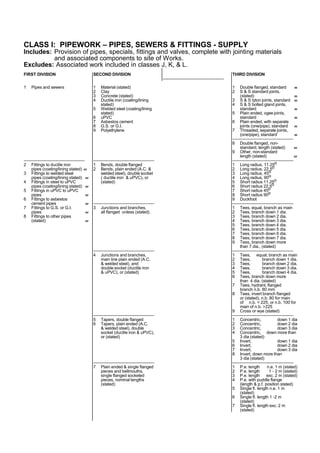
CLASS I: PIPEWORK – PIPES, SEWERS & FITTINGS - SUPPLY
Includes: Provision of pipes, specials, fittings and valves, complete with jointing materials
and associated components to site of Works.
Excludes: Associated work included in classes J, K, & L.
FIRST DIVISION
1 Pipes and sewers
-------------------------------------------
2 Fittings to ductile iron
pipes (coating/lining stated) nr
3 Fittings to welded steel
pipes (coating/lining stated) nr
4 Fittings in steel to uPVC
pipes (coating/lining stated) nr
5 Fittings in uPVC to uPVC
pipes nr
6 Fittings to asbestos
cement pipes nr
7 Fittings to G.S. or G.I.
pipes nr
8 Fittings to other pipes
(stated) nr
SECOND DIVISION
1 Material (stated)
2 Clay
3 Concrete (stated)
4 Ductile iron (coating/lining
stated)
5 Welded steel (coating/lining
stated)
6 uPVC
7 Asbestos cement
8 G.S. or G.I.
9 Polyethylene
-------------------------------------------
1 Bends, double flanged
2 Bends, plain ended (A.C. &
welded steel), double socket
( ductile iron & uPVC), or
(stated)
-------------------------------------------
3 Junctions and branches,
all flanged unless (stated)
-------------------------------------------
4 Junctions and branches,
main line plain ended (A.C.
& welded steel), and
double socket (ductile iron
& uPVC), or (stated)
-------------------------------------------
5 Tapers, double flanged
6 Tapers, plain ended (A.C.
& welded steel), double
socket (ductile iron & uPVC),
or (stated)
-------------------------------------------
7 Plain ended & single flanged
pieces and bellmouths,
single flanged socketed
pieces, nominal lengths
(stated)
-------------------------------------------
THIRD DIVISION
1 Double flanged, standard m
2 S & S standard joints,
(stated) m
3 S & S tyton joints, standard m
4 S & S bolted gland joints,
standard m
5 Plain ended, ogee joints,
standard m
6 Plain ended, with separate
joints (one/pipe), standard m
7 Threaded, separate joints,
(one/pipe), standard m
-------------------------------------------
8 Double flanged, non-
standard, length (stated) nr
9 Other, non-standard
length (stated) nr
-------------------------------------------
1 Long radius, 11.25o
2 Long radius, 22.5o
3 Long radius, 45o
4 Long radius, 90o
5 Short radius 11.25o
6 Short radius 22.5o
7 Short radius 45o
8 Short radius 90o
9 Duckfoot
-------------------------------------------
1 Tees, equal, branch as main
2 Tees, branch down 1 dia.
3 Tees, branch down 2 dia.
4 Tees, branch down 3 dia.
5 Tees, branch down 4 dia.
6 Tees, branch down 5 dia.
7 Tees, branch down 6 dia.
8 Tees, branch down 7 dia.
9 Tess, branch down more
than 7 dia., (stated)
-------------------------------------------
1 Tees, equal, branch as main
2 Tees, branch down 1 dia.
3 Tees, branch down 2 dia.
4 Tees, branch down 3 dia.
5 Tees, branch down 4 dia.
6 Tees, branch down more
than 4 dia. (stated)
7 Tees, hydrant, flanged
branch n.b. 80 mm
8 Tees, invert branch flanged
or (stated), n.b. 80 for main
of n.b. < 225, or n.b. 100 for
main of n.b. >225
9 Cross or wye (stated)
-------------------------------------------
1 Concentric, down 1 dia
2 Concentric, down 2 dia
3 Concentric, down 3 dia
4 Concentric, down more than
3 dia (stated)
5 Invert, down 1 dia
6 Invert, down 2 dia
7 Invert, down 3 dia
8 Invert, down more than
3 dia (stated)
-------------------------------------------
1 P.e. length n.e. 1 m (stated)
2 P.e. length 1 - 2 m (stated)
3 P.e. length exc. 2 m (stated)
4 P.e. with puddle flange
(length & p.f. position stated)
5 Single fl. length n.e. 1 m
(stated)
6 Single fl. length 1 -2 m
(stated)
7 Single fl. length exc. 2 m
(stated)
8 Single fl. with puddle
flange (length & p.f. position)
(stated)
9 Bellmouth
-------------------------------------------
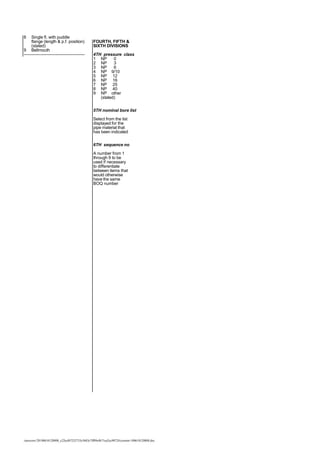
FOURTH, FIFTH &
SIXTH DIVISIONS
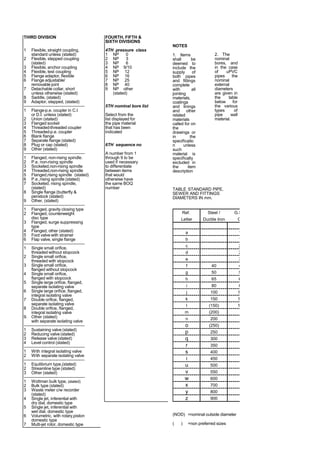
4TH pressure class
1 NP 0
2 NP 3
3 NP 6
4 NP 9/10
5 NP 12
6 NP 16
7 NP 25
8 NP 40
9 NP other
(stated)
5TH nominal bore list
Select from the list
displayed for the
pipe material that
has been indicated
6TH sequence no
A number from 1
through 9 to be
used if necessary
to differentiate
between items that
would otherwise
have the same
BOQ number
/unoconv/20180610120808_c22eef67252733c5683c7ff09e4b71ea2ec90724/cesmm-180610120808.doc
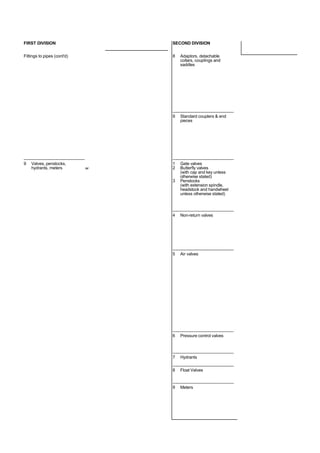
FIRST DIVISION
Fittings to pipes (cont'd)
-------------------------------------------
9 Valves, penstocks,
hydrants, meters nr
SECOND DIVISION
8 Adaptors, detachable
collars, couplings and
saddles
-------------------------------------------
9 Standard couplers & end
pieces
-------------------------------------------
1 Gate valves
2 Butterfly valves
(with cap and key unless
otherwise stated)
3 Penstocks
(with extension spindle,
headstock and handwheel
unless otherwise stated)
-------------------------------------------
4 Non-return valves
-------------------------------------------
5 Air valves
-------------------------------------------
6 Pressure control valves
-------------------------------------------
7 Hydrants
-------------------------------------------
8 Float Valves
-------------------------------------------
9 Meters
THIRD DIVISION
1 Flexible, straight coupling,
standard unless (stated)
2 Flexible, stepped coupling
(stated)
3 Flexible, anchor coupling
4 Flexible, test coupling
5 Flange adaptor, flexible
6 Flange adjustable/
removable joint
7 Detachable collar, short
unless otherwise (stated)
8 Saddle, (stated)
9 Adaptor, stepped, (stated)
-------------------------------------------
1 Flange-p.e. coupler in C.I
or D.I. unless (stated)
2 Union (stated)
3 Flanged socket
4 Threaded-threaded coupler
5 Threaded-p.e. coupler
6 Blank flange
7 Separate flange (stated)
8 Plug or cap (stated)
9 Other (stated)
-------------------------------------------
1 Flanged, non-rising spindle.
2 P.e. non-rising spindle
3 Socketed,non-rising spindle
4 Threaded,non-rising spindle
5 Flanged,rising spindle (stated)
6 P.e.,rising spindle (stated)
7 Socketed, rising spindle,
(stated)
8 Single flange (butterfly &
penstock (stated)
9 Other, (stated)
-------------------------------------------
1 Flanged, gravity closing type
2 Flanged, counterweight
disc type
3 Flanged, surge suppressing
type
4 Flanged, other (stated)
5 Foot valve with strainer
6 Flap valve, single flange
-------------------------------------------
1 Single small orifice,
threaded without stopcock
2 Single small orifice,
threaded with stopcock
3 Single small orifice,
flanged without stopcock
4 Single small orifice,
flanged with stopcock
5 Single large orifice, flanged,
separate isolating valve
6 Single large orifice, flanged,
integral isolating valve
7 Double orifice, flanged,
separate isolating valve
8 Double orifice, flanged,
integral isolating valve
9. Other (stated)
with separate isolating valve
-------------------------------------------
1 Sustaining valve (stated)
2 Reducing valve (stated)
3 Release valve (stated)
4 Level control (stated)
-------------------------------------------
1 With integral isolating valve
2 With separate isolating valve
-------------------------------------------
1 Equilibrium type,(stated)
2 Streamline type (stated)
3 Other (stated)
-------------------------------------------
1 Woltman bulk type, (stated)
2 Bulk type (stated)
3 Waste meter c/w recorder
(stated)
4 Single jet, inferential with
dry dial, domestic type
5 Single jet, inferential with
wet dial, domestic type
6 Volumetric, with rotary,piston
domestic type
7 Multi-jet rotor, domestic type
FOURTH, FIFTH &
SIXTH DIVISIONS
4TH pressure class
1 NP 0
2 NP 3
3 NP 6
4 NP 9/10
5 NP 12
6 NP 16
7 NP 25
8 NP 40
9 NP other
(stated)
5TH nominal bore list
Select from the
list displayed for
the pipe material
that has been
indicated
6TH sequence no
A number from 1
through 9 to be
used if necessary
to differentiate
between items
that would
otherwise have
the same BOQ
number
NOTES
1. Items
shall be
deemed to
include the
supply of
both pipes
and fittings
complete
with all
jointing
materials,
coatings
and linings
and other
related
materials
called for on
the
drawings or
in the
specificatio
n unless
such
material is
specifically
excluded in
the item
description
2. The
nominal
bores, and
in the case
of uPVC
pipes the
nominal
external
diameters
are given in
the table
below for
the various
types of
pipe wall
material.
TABLE STANDARD PIPE,
SEWER AND FITTINGS
DIAMETERS IN mm.
Ref. Steel / G.S. or PVC HDPE Asb
Letter Ductile Iron G.I. Ce
a 10
b 15 15
c 20 20
d 25 32
e 32 40
f 40 40 50 50
g 50 50 63 63
h 65 65 75 75
i 80 80 90 90
j 100 100 110 110 1
k 150 125 160 160 1
l (150) 150 180 180 1
m (200) 200 200 (2
n 200 225 225 2
o (250) 250 250 (2
p 250 280 2
q 300 315 315 3
r 350 350 3
s 400 400 4
t 450 4
u 500 5
v 550
w 600 6
x 700 7
y 800 8
z 900
(NOD) =nominal outside diameter
( ) =non preferred sizes
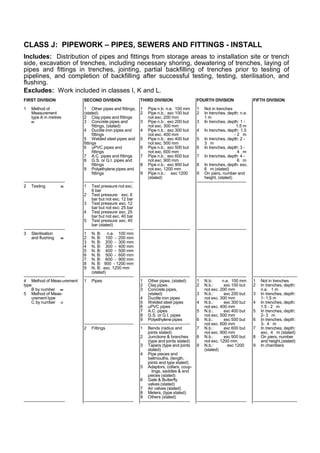
CLASS J: PIPEWORK – PIPES, SEWERS AND FITTINGS - INSTALL
Includes: Distribution of pipes and fittings from storage areas to installation site or trench
side, excavation of trenches, including necessary shoring, dewatering of trenches, laying of
pipes and fittings in trenches, jointing, partial backfilling of trenches prior to testing of
pipelines, and completion of backfilling after successful testing, testing, sterilisation, and
flushing.
Excludes: Work included in classes I, K and L.
FIRST DIVISION
1 Method of
Measurement
type A in metres
m
-----------------------------
2 Testing m
-----------------------------
3 Sterilisation
and flushing m
-----------------------------
4 Method of Meas-urement
type
B by number nr
5 Method of Meas-
urement type
C by number nr
-----------------------------
SECOND DIVISION
1 Other pipes and fittings,
(stated)
2 Clay pipes and fittings
3 Concrete pipes and
fittings, (stated)
4 Ductile iron pipes and
fittings
5 Welded steel pipes and
fittings
6 uPVC pipes and
fittings
7 A.C. pipes and fittings
8 G.S. or G.I. pipes and
fittings
9 Polyethylene pipes and
fittings
-----------------------------------
1 Test pressure not exc.
6 bar
2 Test pressure exc. 6
bar but not exc. 12 bar
3 Test pressure exc. 12
bar but not exc: 25 bar
4 Test pressure exc. 25
bar but not exc. 40 bar
5 Test pressure exc. 40
bar (stated)
-----------------------------------
1 N. B: n.e. 100 mm
2 N. B: 100 - 200 mm
3 N. B: 200 - 300 mm
4 N. B: 300 - 400 mm
5 N. B: 400 - 500 mm
6 N. B: 500 - 600 mm
7 N. B: 600 - 900 mm
8 N. B: 900 - 1200 mm
9 N. B: exc. 1200 mm
(stated)
-----------------------------------
1 Pipes
-----------------------------------
2 Fittings
-----------------------------------
THIRD DIVISION
1 Pipe n.b: n.e. 100 mm
2 Pipe n.b.: exc 100 but
not exc. 200 mm
3 Pipe n.b.: exc 200 but
not exc. 300 mm
4 Pipe n.b.: exc 300 but
not exc. 400 mm
5 Pipe n.b.: exc 400 but
not exc. 500 mm
6 Pipe n.b.: exc 500 but
not exc. 600 mm
7 Pipe n.b.: exc 600 but
not exc. 900 mm
8 Pipe n.b.: exc 900 but
not exc. 1200 mm
9 Pipe n.b.: exc 1200
(stated)
-----------------------------------
-----------------------------------
1 Other pipes, (stated)
2 Clay pipes
3 Concrete pipes,
(stated)
4 Ductile iron pipes
5 Welded steel pipes
6 uPVC pipes
7 A.C. pipes
8 G.S. or G.I. pipes
9 Polyethylene pipes
-----------------------------------
1 Bends (radius and
joints stated)
2 Junctions & branches
(type and joints stated)
3 Tapers (type and joints
stated)
4 Pipe pieces and
bellmouths, (length,
joints and type stated)
5 Adaptors, collars, coup-
lings, saddles & end
pieces (stated)
6 Gate & Butterfly
valves (stated)
7 Air valves (stated)
8 Meters, (type stated)
9 Others (stated)
-----------------------------------
FOURTH DIVISION
1 Not in trenches
2 In trenches, depth: n.e.
1 m
3 In trenches, depth: 1 -
1.5 m
4 In trenches, depth: 1.5
- 2 m
5 In trenches, depth: 2 -
3 m
6 In trenches, depth: 3 -
4 m
7 In trenches, depth: 4 -
6 m
8 In trenches, depth: exc.
6 m (stated)
9 On piers, number and
height, (stated)
-----------------------------------
-----------------------------------
-----------------------------------
1 N.b: n.e. 100 mm
2 N.b.: exc 100 but
not exc. 200 mm
3 N.b.: exc 200 but
not exc. 300 mm
4 N.b.: exc 300 but
not exc. 400 mm
5 N.b.: exc 400 but
not exc. 500 mm
6 N.b.: exc 500 but
not exc. 600 mm
7 N.b.: exc 600 but
not exc. 900 mm
8 N.b.: exc 900 but
not exc. 1200 mm
9 N.b.: exc 1200
(stated)
-----------------------------------
FIFTH DIVISION
-------------------------------
1 Not in trenches
2 In trenches, depth:
n.e. 1 m
3 In trenches, depth:
1- 1.5 m
4 In trenches, depth:
1.5 - 2 m
5 In trenches, depth:
2- 3 m
6 In trenches, depth:
3- 4 m
7 In trenches, depth:
exc. 4 m (stated)
8 On piers, number
and height,(stated)
9 In chambers
-------------------------------
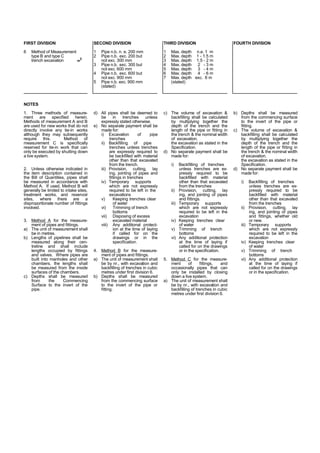
FIRST DIVISION
6 Method of Measurement
type B and type C
trench excavation m
3
NOTES
1. Three methods of measure-
ment are specified herein.
Methods of measurement A and B
are used for new works that do not
directly involve any tie-in works
although they may subsequently
require this. Method of
measurement C is specifically
reserved for tie-in work that can
only be executed by shutting down
a live system.
2. Unless otherwise indicated in
the item description contained in
the Bill of Quantities, pipes shall
be measured in accordance with
Method A. If used, Method B will
generally be limited to intake sites,
treatment works, and reservoir
sites, where there are a
disproportionate number of fittings
involved.
3. Method A for the measure-
ment of pipes and fittings.
a) The unit of measurement shall
be in metres.
b) Lengths of pipelines shall be
measured along their cen-
treline and shall include
lengths occupied by fittings
and valves. Where pipes are
built into manholes and other
chambers, the lengths shall
be measured from the inside
surfaces of the chambers.
c) Depths shall be measured
from the Commencing
Surface to the invert of the
pipe.
SECOND DIVISION
1 Pipe n.b. n. e. 200 mm
2 Pipe n.b. exc. 200 but
not exc. 300 mm
3 Pipe n.b. exc. 300 but
not exc. 600 mm
4 Pipe n.b. exc. 600 but
not exc. 900 mm
5 Pipe n.b. exc. 900 mm
(stated)
d) All pipes shall be deemed to
be in trenches unless
expressly stated otherwise.
e) No separate payment shall be
made for:
i) Excavation of pipe
trenches
ii) Backfilling of pipe
trenches unless trenches
are expressly required to
be backfilled with material
other than that excavated
from the trench.
iii) Provision, cutting, lay
ing, jointing of pipes and
fittings in trenches
iv) Temporary supports
which are not expressly
required to be left in the
excavations
v) Keeping trenches clear
of water
vi) Trimming of trench
bottoms
vii) Disposing of excess
excavated material
viii) Any additional protect-
ion at the time of laying
if called for on the
drawings or in the
specification.
4. Method B for the measure-
ment of pipes and fittings.
a) The unit of measurement shall
be by nr., with excavation and
backfilling of trenches in cubic
metres under first division 6.
b) Depths shall be measured
from the commencing surface
to the invert of the pipe or
fitting.
THIRD DIVISION
1 Max. depth n.e. 1 m
2 Max. depth 1 - 1.5 m
3 Max. depth 1.5 - 2 m
4 Max. depth 2 - 3 m
5 Max. depth 3 - 4 m
6 Max. depth 4 - 6 m
7 Max. depth exc. 6 m
(stated)
c) The volume of excavation &
backfilling shall be calculated
by multiplying together the
depth of the trench and the
length of the pipe or fitting in
the trench & the nominal width
of excavation,
the excavation as stated in the
Specification.
d) No separate payment shall be
made for:
i) Backfilling of trenches
unless trenches are ex-
pressly required to be
backfilled with material
other than that excavated
from the trenches
ii) Provision, cutting, lay
ing, and jointing of pipes
and fittings.
iii) Temporary supports
which are not expressly
required to be left in the
excavation
iv) Keeping trenches clear
of water
v) Trimming of trench
bottoms
vi) Any additional protection
at the time of laying if
called for on the drawings
or in the specification.
5. Method C for the measure-
ment of fittings, and
occasionally pipes that can
only be installed by closing
down a live system.
a) The unit of measurement shall
be by nr., with excavation and
backfilling of trenches in cubic
metres under first division 6.
FOURTH DIVISION
b) Depths shall be measured
from the commencing surface
to the invert of the pipe or
fitting.
c) The volume of excavation &
backfilling shall be calculated
by multiplying together the
depth of the trench and the
length of the pipe or fitting in
the trench & the nominal width
of excavation,
the excavation as stated in the
Specification.
d) No separate payment shall be
made for:
i) Backfilling of trenches
unless trenches are ex-
pressly required to be
backfilled with material
other than that excavated
from the trenches
ii) Provision, cutting, lay
ing, and jointing of pipes
and fittings, whether old
or new.
iii) Temporary supports
which are not expressly
required to be left in the
excavation
iv) Keeping trenches clear
of water
v) Trimming of trench
bottoms
vi) Any additional protection
at the time of laying if
called for on the drawings
or in the specification.
CLASS K: PIPEWORK - MANHOLE & PIPE & SEWER WORK ANCILLARIES
Includes: Manholes and other chambers, ducts, metal culverts, crossings and
reinstate-ment, other ancillaries as listed
Excludes: Work included in classes I, J, L and Y.
FIRST DIVISION
1 Manholes & other
chambers, in accord-
ance with standard
drawings, (stated) nr
----------------------------------
2 Concrete manhole
covers or surr-
ounds (stated) nr
----------------------------------
3 Gullies nr
----------------------------------
4 French drains,
rubble drains and
ditches
----------------------------------
5 Ducts and metal
culverts m
---------------------------------- SECOND DIVISION
1 Brick
2 Brick with backdrop
3 In-situ concrete
4 In-situ concrete
with backdrop
5 Precast concrete
6 Precast concrete
with backdrop
7 Masonry or
blockwork
8 Masonry or block-
work with backdrop
9 Other (stated)
----------------------------------
1 Paving, (stated)
3 In-situ concrete
5 Precast concrete
7 Masonry or block-work
----------------------------------
1 Clay
2 Clay trapped
3 In-situ concrete
4 In-situ concrete
trapped
5 Precast concrete
6 Precast concrete
trapped
7 Plastics
8 Plastics trapped
----------------------------------
1 Filling of french &
rubble drains with
graded material m
3
2 Filling of french &
rubble drains with
rubble m
3
----------------------------------
3 Trenches for unpiped
rubble drains m
4 Unlined rectangular
section ditches m
5 Lined rectangular
section ditches m
6 Unlined vee section
ditches m
7 Lined vee section
ditches m
8 Trenches for pipes or
cables to be laid by
others m
----------------------------------
1 Cable ducts: 1 way
2 Cable ducts: 2 way
3 Cable ducts: 3 way
4 Cable ducts: exc. 3
way (stated)
5 Sectional corrugated
metal culverts n.i.d.
n.e. 0.5 m
6 Sectional corrugated
metal culverts n.i.d.
0.5 - 1 m
7 Sectional corrugated
metal culverts n.i.d.
1 - 1.5 m
8 Sectional corrugated
metal culverts n.i.d.
exc. 1.5 m (stated)
---------------------------------- THIRD DIVISION
1 Sluice (gate) valve box
2 Single air valve,(small
orifice) chamber
3 Single air valve, (large
orifice), or double air
valve chamber
4 Meter chamber
5 Hydrant chamber
6 Washout valve
chamber (single or
double stated)
7 Sewer manhole
8 Drainage manhole
9 Outfall, (stated)
----------------------------------
1 Area: n. e. 0.5 m2
2 Area: 0.5 - 1 m2
3 Area: 1 - 2 m2
4 Area: 2 - 3 m2
5 Area: 3 - 4 m2
6 Area: 4 - 5 m2
7 Area: exc. 5 m2
(stated)
----------------------------------
----------------------------------
----------------------------------
1 X-sect. area:
n.e. 0.25 m2
2 X-sect. area:0.25 -
0.5 m2
3 X-sect. area:0.5 -
0.75 m2
4 X-sect. area:0.75 -
1 m2
5 X-sect.area:1-1.5 m2
6 X-sect.area:1.5-2 m2
7 X-sect area: 2 -3 m2
8 X-sect. Area: exc.
3 m2
(stated)
----------------------------------
1 Not in trenches
2 In trenches, depth:
n. e. 1m
3 In trenches, depth:
1 - 1.5 m
4 In trenches, depth:
1.5 - 2 m
5 In trenches, depth:
2 - 3 m
6 In trenches, depth:
3 - 4 m
7 In trenches, depth:
4 - 6 m
8 In trenches, depth:
exc. 6 m (stated)
9 Elevated on piers, no.
& height (stated)
VOLUME II
Modified Civil Engineering Standard Method of Measurement Page 18 of 35
---------------------------------- FOURTH DIVISION
1 Nom. bore n.e. 100
mm
2 Nom. bore exc 100
but n.e. 200 mm
3 Nom. bore exc. 200
but n.e. 300 mm
4 Nom. bore exc.300
but n.e. 400 mm
5 Nom. bore exc.400
but n.e. 500 mm
6 Nom. bore exc. 500
but n.e. 600 mm
7 Nom. bore exc.600
but n.e. 900 mm
8 Nom. bore exc 900
but n.e. 1200 mm
9 Nom. bore exc.
1200 mm (stated)
--------------------------------
----------------------------------
----------------------------------
----------------------------------
----------------------------------
----------------------------------
FIFTH DIVISION
1 Depth: n.e. 1.5 m
2 Depth: 1.5 - 2 m
3 Depth: 2 - 3 m
4 Depth: 3 - 4 m
5 Depth: 4 - 5 m
6 Depth: 5 - 6 m
7 Depth: exc. 6m
(stated)
----------------------------------
----------------------------------
FIRST DIVISION
6 Crossings nr
------------------------------------------
7 Reinstatement m
------------------------------------------
8 Other pipework ancillaries
------------------------------------------
9 Metal covers and surface
boxes nr
SECOND DIVISION
1 River, stream or canal, width 1 -
3 m
2 River, stream or canal, width 3 -
10 m
3 River, stream or canal, width
exc. 10 m (stated)
4 Hedge crossing
5 Wall crossing
6 Fence crossing
7 Sewer, ditch or drain crossing
8 Other underground
service, (stated)
9 Railway crossing, (stated)
-----------------------------------------------
1 Breaking up and temporary
reinstatement - surfaced roads
2 Breaking up and temporary re-
instatement of dirt roads (where
specified by Engineer)
3 Breaking up, temporary
and permanent reinstatement
of surfaced roads
4 Breaking up, temporary and
permanent re-instatement of dirt
roads (where specified)
5 Reinstatement of grassland
6 Reinstatement of cultivated
lands incl. gardens
7 Reinstatement of sports fields
-----------------------------------------------
1 Reinstatement of field
drains m
-----------------------------------------------
2 Marker posts for (stated) nr
----------------------------------------------
3 Timber supports left in
excavations m
2
4 Metal supports left in
excavations m
2
--------------------------------------------
5 Connection of pipes to
existing manholes, and
other chambers
nr
-------------------------------------
----------
1 Other, (stated)
2 Cast iron
3 Rust resistant steel
4 Mild steel, plain
5 Galvanised steel
/unoconv/20180610120808_c22eef67252733c5683c7ff09e4b71ea2ec90724/cesmm-180610120808.doc
20
VOLUME II
Modified Civil Engineering Standard Method of Measurement Page 18 of 35
THIRD DIVISION
1 Pipe nom.bore n.e. 250 mm
2 Pipe nom.bore 250- 500 mm
3 Pipe nom.bore 500-1000 mm
4 Pipe nom.bore 1000-1500 mm
5 Pipe nom.bore 1500-2000 mm
6 Pipe nom.bore exc. 2000 mm
(stated)
-----------------------------------------------
1 Pipe nom.bore n.e. 250 mm
2 Pipe nom.bore 250- 500 mm
3 Pipe nom.bore 500-1000 mm
4 Pipe nom.bore 1000-1500 mm
5 Pipe nom.bore 1500-2000 mm
6 Pipe nom.bore exc. 2000 mm
(stated)
-----------------------------------------------
-----------------------------------------------
1 Sluice valves
2 Air valves
3 Fire hydrants
4 Washouts
5 Pipelines
6 Other (stated)
-----------------------------------------------
-------------------------------------------
1 Existing materials (stated)
2 Existing materials (clay)
3 Existing materials (concrete)
4 Existing materials (ductile
iron)
5 Existing materials (welded
steel)
6 Existing materials (uPVC)
7 Existing materials (A/C)
8 Existing materials (G.S. or
G.I.)
----------------------------------------------
1 With grade A cover & frame
2 With grade B cover & frame
3 With heavyduty cover &
frame
4 With medium duty cover &
frame
5 With light duty cover & frame
6 With cover & frame, (stated)
7 With lockable cover and
frame as per standard
drawing
FOURTH DIVISION
1 Overcrossing - type I
2 Over crossing - type II
3 Undercrossing - type III
-------------------------------------
-------------------------------------
-------------------------------------
1 In class 30 precast
concrete
2 In accordance with standard
drawings
-------------------------------------
-------------------------------------
1 Pipe n.b. n.e. 100 mm
2 Pipe n.b. 100 - 200 mm
3 Pipe n.b. 200 - 300 mm
4 Pipe n.b. 300 - 400 mm
5 Pipe n.b. 400 - 500 mm
6 Pipe n.b. 600 - 900 mm
7 Pipe n.b. 900 -1200 mm
8 Pipe n.b. exc. 1200 mm
(stated)
-------------------------------------
1 Area: not exc. 0.1 m2
2 Area: 0.1 - 0.5 m2
3 Area: 0.5 - 1 m2
4 Area: 1 - 5 m2
5 Area: 5 - 15 m2
6 Area: exc. 15 m2
(stated)
NOTES
1. Type or mark numbers shall be stated in item descriptions for manholes and other chambers of which details are given elsewhere in the
Contract. Item descriptions shall identify different configurations of manholes and other chambers. Separate items are not required for different
arrangements of inlets and outlets or for access shafts of different heights.
2. Types and loading duties of manhole gully and catchpit covers shall be stated in item description.
3. Depths of manholes and catchpits shall be measured from the tops of covers to the tops of base slabs.
4. Separate items are not required for excavation for work in this class except as set out in class L (see notes 1-5 of class L).
5. Excavation and pipe laying for piped French and rubble drains shall be included in Class J. The nature of the filling material shall be stated in
item descriptions for filling of French and rubble drains in this class.
/unoconv/20180610120808_c22eef67252733c5683c7ff09e4b71ea2ec90724/cesmm-180610120808.doc
21
VOLUME II
Modified Civil Engineering Standard Method of Measurement Page 18 of 35
6. Notes in classes I, K and L which refer to pipe and pipework shall also apply to ducts and metal culverts in this class. Crossings, reinstatement
and other pipework ancillaries for ducts and metal culverts shall be itemized, described and measured as set out in this class, except that the
dimension used for classification in the third division shall be the maximum nominal distance between the inside faces of the outer walls of the duct or
culvert. Non-circular metal culverts shall be classified by their maximum nominal internal cross-sectional dimension. Separate items are not required
for bends in cable ducts.
7. Materials and dimensions of linings to ditches shall be stated in item descriptions. The cross-sectional areas of rubble drains and ditches shall
be measured to the Excavated Surfaces.
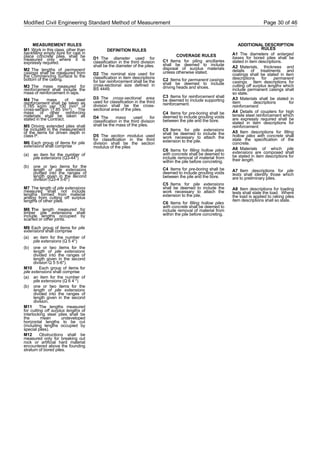
8. Types of surfaces shall be stated in item descriptions for breaking up and reinstatement of roads. Separate items are not required for removal
and reinstatement of kerbs. Surfaced roads denote tarmac, concrete, paving bricks or similar surfaces. Dirt roads denote only official designated
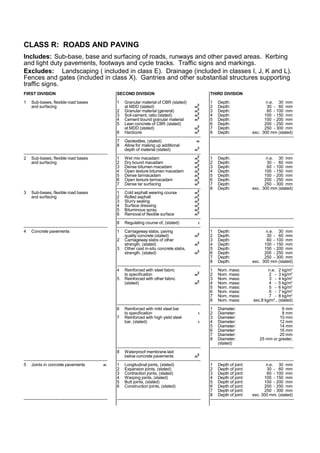
murram roads of at least 6 m width and where specified by the Engineer or his Representative.
9. River, stream and canal crossings shall be classified by their widths between banks measured along pipe centre lines. Crossings of streams
shall be measured only where their width exceeds one metre. Items for crossings shall include reinstatement unless otherwise stated. Where linings
to rivers, streams or canals are to be broken through and reinstated the type of lining shall be stated in item descriptions for crossings. Crossings of
roads and paths shall be classed as breaking up and reinstatement of roads and paths. Lengths for breaking up and reinstatement of roads and
footpaths shall be measured along pipe centre lines and shall include lengths occupied by manholes and other chambers.
10. Sizes and types of marker posts shall be given in item descriptions or given on drawings.
11. The area measured for supports left in excavations shall be the area of supported surfaces for which the supports are expressly required to be
left in.
/unoconv/20180610120808_c22eef67252733c5683c7ff09e4b71ea2ec90724/cesmm-180610120808.doc
22
CLASS L: PIPEWORK - SUPPORTS AND PROTECTION, ANCILLARIES TO
LAYING AND EXCAVATION
Includes: Extras to excavation and backfilling of trenches for pipework, ducts and metal
culverts, manholes and other chambers. Pipelaying in headings and thrust borings.
Excavation for and provision of supports and protection to pipework, ducts and metal culverts
Excludes: Work included in classes I,J, and K.
FIRST DIVISION
1 Extras to excavation and
backfilling m
3
-----------------------------------------
2 Special laying methods m
-----------------------------------------
3 Beds m
4 Haunches m
5 Surrounds m
-----------------------------------------
6 Wrapping & lagging of m
-----------------------------------------
7 Concrete stools and thrust
blocks, concrete class
(stated) nr
-----------------------------------------
8 Other isolated pipe
supports nr
SECOND DIVISION
1 In pipe trenches
2 In manholes and chambers
3 In headings
4 In thrust borings
5 In pipe jackings
6 In foundations
7 Other (stated)
-----------------------------------------
1 Pipe laying in headings
2 Pipe laying in thrust
borings
3 Pipe jacking
-----------------------------------------
1 Sand
2 Selected granular material
3 Imported granular material
4 Mass concrete
5 Reinforced concrete
-----------------------------------------
1 Polythene sheeting,
grade (stated)
2 Material, (stated)
-----------------------------------------
1 To horizontal bends
2 To vertical bends at crest
3 To vertical bends at trough
4 To steep slopes
5 To junctions
6 To tapers
7 To other (stated)
-----------------------------------------
1 Height: n.e. 1 m.
2 Height: 1 - 1.5 m.
3 Height: 1.5 - 2 m.
4 Height: 2 - 3 m.
5 Height: 3 - 4 m.
6 Height: 4 - 5 m.
7 Height: 5 - 6 m.
8 Height: exc. 6 m.(stated)
THIRD DIVISION
1 Excavation of rock class I
material
2 Excavation of rock class II
material
3 Excavation of mass concrete
4 Excavation of reinforced
concrete
5 Excavation of other artificial
hard material
6 Backfilling above Final
Surface with concrete
7 Backfilling above Final
Surface with material other
than concrete (stated)
8 Excavation of natural
material below the Final
Surface and backfilling with
concrete
9 Excavation of natural material
below the Final Surface and
backfilling below the Final
Surface with material other
than concrete (stated)
-----------------------------------------
1 Pipe n.b. n.e. 100 mm
2 Pipe n.b. 100 - 200 mm
3 Pipe n.b. 200 - 300 mm
4 Pipe n.b. 300 - 400 mm
5 Pipe n.b. 400 - 500 mm
6 Pipe n.b. 500 - 600 mm
7 Pipe n.b. 600 - 900 mm
8 Pipe n.b. 900 -1200 mm
9 Pipe n.b. exc. 1200 mm
(stated)
-----------------------------------------
1 Volume: n.e. 0.1 m3
2 Volume: 0.1 - 0.2 m3
3 Volume: 0.2 - 0.5 m3
4 Volume: 0.5 - 1 m3
5 Volume: 1 - 2 m3
6 Volume: 2 - 4 m3
7 Volume: 4 - 8 m3
8 Volume: exc. 8 m3
(stated)
-----------------------------------------
1 Pipe n.b. n.e. 100 mm
2 Pipe n.b. 100 - 200 mm
3 Pipe n.b. 200 - 300 mm
4 Pipe n.b. 300 - 400 mm
5 Pipe n.b. 400 - 500 mm
6 Pipe n.b. 600 - 900 mm
7 Pipe n.b. 900 -1200 mm
8 Pipe n.b. exc. 1200 mm
(stated)
FOURTH DIVISION
-----------------------------------------
1 Pipe n.b. n.e. 100 mm
2 Pipe n.b. 100 - 200 mm
3 Pipe n.b. 200 - 300 mm
4 Pipe n.b. 300 - 400 mm
5 Pipe n.b. 400 - 500 mm
6 Pipe n.b. 500 - 600 mm
7 Pipe n.b. 600 - 900 mm
8 Pipe n.b. 900 -1200 mm
9 Pipe n.b. exc. 1200 mm
(stated)
-----------------------------------------
NOTES
1. Items shall be given in this class in addition to the items for the provision and jointing of pipes, ducts and culverts and for the excavation, laying
and backfilling of pipes, ducts and culverts laid in trenches in classes I and K. Items shall be given in this class in addition to the items for manholes
and other chambers in class K.
2. The volume of extras to excavation and backfilling for pipes shall be calculated by multiplying together the average depth and length of the
material removed or backfilled and the nominal width is stated it shall be taken as 500 mm greater than the maximum nominal distance between the
inside faces of the outer pipe walls where this distance does not exceed one metre, and as 750 mm greater than this distance where it needs one
metre.
VOLUME II
Modified Civil Engineering Standard Method of Measurement Page 22 of 35
3. The volume of extras to excavation and backfilling for manholes and other chambers shall be calculated by multiplying the average depth of the
material removed or backfilled by the maximum horizontal external cross-sectional area of the manhole or chamber.
4. Breaking up of roads and pavings shall be included in class K.
5. Backfilling above the Final Surface (L1 - 5-6*) shall be measured only if it is expressly required that the material excavated shall not be used for
backfilling. Excavation below the Final Surface and backfilling (L1 - 7-8*) shall be measured only where it is expressly required.
6. Pipe laying in headings and by thrust boring shall be measured only where they are expressly required. Item descriptions for pipe laying in
headings and by thrust borings shall identify the run of pipe or pipes laid. The type of packing shall be stated in item descriptions for pipe laying in
headings. Thrust blocks constructed for the purposes of thrust boring only shall be classed as Temporary Works in class A.
7. Lengths of supports and protection to pipelines shall be measured along pipe centre lines including lengths occupied by fittings and valves but
not including lengths occupied by manholes and chambers through which the support or protection is not continued.
8. Materials used for beds, haunches and surrounds to pipes and the depths of beds shall be stated in item descriptions. Separate items shall not
be given for beds to haunched or surrounded pipes where the same material is used for beds and haunches or beds and surrounds respectively.
9. Materials used for wrapping and lagging of pipes shall be stated in item descriptions. Separate items are not required for wrapping and lagging of
fittings and valves.
10. Principal dimensions and materials shall be stated in item descriptions for pipe supports. Heights of pipe supports shall be measured from the
ground or other supporting surface to the invert of the highest pipe where pipes are supported from below and of the lowest pipe where pipes are
supported from above. Where two or more pipes are carried by a support, the item for the support shall be classified in the third division by the
aggregate bore of the pipes supported.
11. The specification of concrete shall be stated in item description for concrete stools and thrust blocks.
12. Work in this class associated with ducts and metal culverts shall be itemized, described and measured as set out for work associated with pipes,
except that the dimension used for classification in the third division shall be the maximum nominal distance between the inside faces of the outer
walls of the duct or culvert.
/unoconv/20180610120808_c22eef67252733c5683c7ff09e4b71ea2ec90724/cesmm-180610120808.doc
23
CLASS N: MISCELLANEOUS METALWORK
Excludes: Metal reinforcement for concrete (included in classes C, G, H and R). Metal
concrete inserts (included in classes G and H). Pipework (included in classes I, J, K, and L).
Structural metalwork (included in class M). Fittings and fastenings to timber (included in O).
Piles (included in classes P and Q). Traffic signs (included in class R). Rail track and
accessories (included in class S). Surface treatment of metalwork on site (included in class
V). Fences (included in class X).
FIRST DIVISION
1 Mild steel, plain
2 Galvanized steel
3 Aluminium
4 Stainless steel
5 Other (stated)
-----------------------------------------------------------
6 Cast Iron
7 Rust resistant steel
8 Mild steel, plain
9 Other (stated)
SECOND DIVISION
1 Stairways and landing t
2 Walkways and platforms t
-----------------------------------------------------------
3 Ladders and step irons m
-----------------------------------------------------------
4 Handrails m
5 Bridge parapets m
-----------------------------------------------------------
6 Miscellaneous frames,
dimensions, (stated) m
-----------------------------------------------------------
7 Flooring, dimensions, (stated) m
2
-----------------------------------------------------------
8 Screens, dimensions, (stated) m
2
-----------------------------------------------------------
9 Plate, dimensions, (stated) m
2
-----------------------------------------------------------
1 Cladding m
2
2 Welded mesh panelling m
2
3 Duct covers m
2
4 Tie rods nr
5 Walings nr
-----------------------------------------------------------
6 Bridge bearings nr
-----------------------------------------------------------
7 Tanks, nominal size, (stated) nr
-----------------------------------------------------------
8 Tank ancillaries nr
-----------------------------------------------------------
9 Hand stops (stated) m
2
THIRD DIVISION
-----------------------------------------------------------
1 Ladders, dimensions (stated)
2 Step irons, dimensions (stated)
-----------------------------------------------------------
-----------------------------------------------------------
1 From angle section, painted
2 From angle section, hot dip
galvanized
3 From channel section, painted
4 From channel section, hot dip
galvanized
5 From I section, painted
6 From I section, hot dip galvanized
7 From tubular section, round, painted
8 From tubular section, round, hot dip
galvanized
9 From tubular section, rectangular,
(stated)
-----------------------------------------------------------
1 From plain plate
2 From open grid
3 From chequer plate
4 From chequer plate, lockable
-----------------------------------------------------------
1 Fine, dia 5 to 10 mm., (stated)
2 Coarse, dia. 30 to 50 mm, (stated)
-----------------------------------------------------------
1 With notch 53 degrees, fixed
2 With notch 53 degrees, removable
3 With notch, 90 degrees, fixed
4 With notch, 90 degrees, removable
5 Fixed, detail (stated)
6 Removable, detail (stated)
-----------------------------------------------------------
-----------------------------------------------------------
1 Roller
2 Slide
3 Rocker
4 Cylindrical
5 Spherical
6 Plain rubber
7 Laminated rubber
8 Rubber pot
-----------------------------------------------------------
1 Volume: n.e. 1 m3
2 Volume: 1 - 3 m3
3 Volume: 3 - 10 m3
4 Volume: 10 - 30 m3
5 Volume: 30 - 100 m3
6 Volume: 100 - 300 m3
7 Volume: 300 - 1000 m3
8 Volume: exc. 1000 m3
-----------------------------------------------------------
1 Cover description (stated)
-----------------------------------------------------------
1 Roof vent assembly, diam.: 50 mm
2 Roof vent assembly, diam.: 80 mm
3 Roof vent assembly, diam.: 100 mm
4 Roof vent assembly, diam.: 150 mm
-----------------------------------------------------------
VOLUME II
Modified Civil Engineering Standard Method of Measurement Page 24 of 35
NOTES
1. Item descriptions shall state the specification and thicknesses of metal used off-site surface treatments and principal dimensions of
miscellaneous metalwork assemblies. Alternatively, item descriptions may identify assemblies by mark numbers related to detail shown on the
Drawings or given in the Specification.
2. Masses calculated for measurement of miscellaneous metalwork assemblies shall include the mass of all metal components and attached
pieces. Separate items are not required for the components of miscellaneous metalwork assemblies.
3. Item codes N3-38** shall be used for miscellaneous metalwork not listed in the classification. Generally the measurement unit for such work
shall be the tonne.
4. Separate items are not required for erection and fixing of miscellaneous metalwork or for provision of fixings to miscellaneous metalwork.
5. The lengths of handrails and bridge parapets shall be measured along their top members. The lengths of rectangular frames shall be measured
along their external perimeters.
6. No deductions from the masses or areas measured for miscellaneous metalwork shall be made for openings and holes each less than 0.5 m¨ in
area.
25
CLASS O: TIMBER
Includes: Timber components and fittings Timber decking
Excludes: Formwork to concrete (included in class G). Timber piles (included in class
P). Timber sleepers (included in class S). Timber fencing (included in class X). Building
carpentry and joinery.
FIRST DIVISION
1 Hardwood components for
general use m
2 Hardwood components for
marine use m
3 Softwood components m
-----------------------------------------------------------
4 Hardwood decking for
general use m
2
5 Hardwood decking for
marine use m
2
6 Softwood decking m
2
-----------------------------------------------------------
7 Fittings and fastenings nr
-----------------------------------------------------------
8 Roofing nr
NOTES
1. Timber components in buildings which
may be included in civil engineering contracts
need not be measured according to the
procedure set down in this class
2. The nominal gross cross-sectional
dimensions or thicknesses, species and any
impregnation requirements or special surface
finishes shall be stated in item descriptions for
timber components and decking.
SECOND DIVISION
1 X-sect. area: n.e. 0.01 m2
2 X-sect. area: 0.01 - 0.02 m2
3 X-sect. area: 0.02 - 0.04 m2
4 X-sect. area: 0.04 - 0.10 m2
5 X-sect. area: 0.10 - 0.20 m2
6 X-sect. area: 0.20 - 0.40 m2
7 X-sect. area: exc. 0.4 m2
(stated)
-----------------------------------------------------------
1 Thickness: 25 mm
2 Thickness: 50 mm
3 Thickness: 75 mm
4 Thickness: 100 mm
5 Thickness: 125 mm
6 Thickness: 150 mm
7 Thickness: 200 mm
8 Thickness: 225 mm
9 Thickness exc. 225 mm, (stated)
-----------------------------------------------------------
1 Straps of dimensions, (stated)
2 Spikes of length, diameter, (stated)
3 Coach screws of length, diameter,
(stated)
4 Bolts of diameter, length, (stated)
5 Plates of dimensions, (stated)
-----------------------------------------------------------
1 Truss assemblies, (stated)
2 Rafters, (stated)
3. The structural use and location of timber
components shall be stated in item
descriptions for components longer than 3
metres.
4. The length of each timber component
measured shall be its overall length with no
deduction for scarfed or other joints.
5. The cross-sectional areas used for
classification of timber components shall be
their nominal gross cross-sectional areas.
THIRD DIVISION
1 Length: n.e. 1.5 m
2 Length: 1.5 - 3 m
3 Length: 3 - 5 m
4 Length: 5 - 8 m
5 Length: 8 - 12 m
6 Length: 12 - 20 m
7 Length: exc. 20 m (stated)
-----------------------------------------------------------
1 Width 75 mm.
2 Width 100 mm.
3 Width 125 mm.
4 Width 150 mm.
5 Width 225 mm.
6 Width 250 mm.
7 Width 300 mm.
8 Width 450 mm.
9 Width, exc. 450 mm., (stated)
-----------------------------------------------------------
-----------------------------------------------------------
6. The thickness used for classification of
and stated in item descriptions for timber
decking shall be its nominal gross thickness.
7. Separate items are not required for fixing
timber components and decking or fittings and
fastenings or for boring and cutting.
8. No deduction from the areas measured for
timber decking shall be made for openings and
holes each less than 0.5 m2 in area.
CLASS P: PILES
Excludes: Boring for site investigation (included in class B). Ground anchors (included
in class C). Walings and tie rods (included in class N). Piling ancillaries (included in class
Q).
FIRST DIVISION
1 Bored cast in place concrete piles
2 Driven cast in place concrete piles
-----------------------------------------------------------
3 Preformed concrete piles
4 Preformed prestressed concrete tiles
5 Preformed concrete sheet piles
6 Timber piles
-----------------------------------------------------------
7 Isolated steel pipes
-----------------------------------------------------------
8 Interlinked steel pipe piles
-----------------------------------------------------------
9 Interlocking steel piles
SECOND DIVISION
1 Diameter: 300 mm or 350 mm
2. 400 mm or 450 mm
3 500 mm or 550 mm
4 600 mm or 750 mm
5 900 mm or 1050 mm
6 1200 mm or 1350 mm
7 1500
-----------------------------------------------------------
1 Cross-sectional area: not exceeding
0.025 m²
2 0.025-0.05 m²
3 0.05 – 0.1 m²
4 0.1 – 0.15 m²
5 0.15 – 0.25 m²
6 0.25 – 0.5 m ²
7 0.5 – 1 m²
8 exceeding 1 m²
-----------------------------------------------------------
1 Mass: not exceeding 15 kg/m
2 15 – 30 kg/m
3 30 – 60 kg/m
4 60 – 120 kg/m
5 120 – 250 kg/m
6 250 – 500 kg/m
7 500 kg/m – 1 t/m
8 exceeding 1 t/m
-----------------------------------------------------------
1 Section modulus: not exceeding
500 cm³/m
2 500-800 cm³/m
3 800-1200 cm³/m
4 1200-2000 cm³/m
5 2000-3000 cm³/m
6 3000-4000 cm³/m
7 4000-5000 cm³/m
8 exceeding
5000 cm³/m
THIRD DIVISION
1 Number of piles nr
2 Concreted length m
3 Depth bored or driven to stated maximum
depth m
-----------------------------------------------------------
1 Number of piles of stated length nr
2 Depth driven m
-----------------------------------------------------------
1 Number of piles of stated length nr
2 Depth driven m
-----------------------------------------------------------
1 Length of special piles m
2 Driven area m²
3 Area of piles of length:
not exceeding 14 m m²
4 14-24 m m²
5 exceeding 24 m m²
MEASUREMENT RULES
M1 Bored and driven depths
shall be measured along
the axes of piles from the
Commencing Surface to
the toe levels of bored
piles, to the bottom of the
casings of driven cast in
place piles and to the
bottom of the toes of other
driven piles. The
Commencing Surface
adopted in the preparation
of the Bill of Quantities as
the surface at which boring
or driving is expected to
begin shall be adopted for
the measurement of the
completed work.
M2 Each group of items for
cast in place concrete piles
shall comprise
(a) an item for the number
of piles (P1-2 * 1)
(b) an item for the total
concreted length of piles
(P1-2 * )
(c) an item for the total
depth bored or driven
(P1-2 * 3).
M3 The concreted lengths
of cast in place concrete
piles shall be measured
from the cut-off levels
expressly required to the
toe levels expressly
required.
M4 Each group of items for
preformed concrete and
timber piles shall comprise
(a) one or more items for the
number of piles of stated
length (P3-6*1)
(b) an item for the total
depth driven (P3-6 * 2).
M5 Each group of items for
isolated steel piles shall
comprise
(a) one or more items for the
number of piles of stated
length (P7*1)
(b) an item for the total
depth driven (P7 * 2).
M6 Each group of items for
interlocking steel piles shall
comprise
(a) one or more items for the
total length of each type
of special pile, if any (P8
* 2)
(b) an item for the total
driven area of piles (P8 *
2)
(c) one or more items for the
total area of piles divided
into the ranges of length
given in the third division
(P8 * 3-5).
M7 The areas of
interlocking steel piles
shall be calculated by
multiplying the mean
undeveloped horizontal
lengths of the pile walls
formed (including lengths
occupied by special piles)
by the depths measured in
accordance with rule M1 in
the case of items in the
case of items for the driven
areas (P8 * 2) and by the
lengths defined in
accordance with rule D6 in
the case of items for the
areas of piles (P8 * 3-5).
M8 Closure and taper piles
classed as special piles
shall be measured only
where they are expressly
required.
DEFINITION RULES
D1The maximum depth stated in
item descriptions for the depth
cast in place concrete piles
shall be the depth which is not
exceeded by any pile included
in the item.
D2Piles comprising a driven
permanent steel casing which
is filled with concrete shall be
classed as driven cast in
place concrete piles where
the piles are designed for the
load to be carried on the
concrete.
D3The lengths of preformed
concrete and timber piles
shall be the lengths expressly
required to be supplied
excluding extensions but
including heads and shoes.
D4The lengths of isolated steel
piles shall be the lengths
expressly required to be
supplied excluding
extensions.
D5Piles comprising a driven
permanent steel casing which
is filled with concrete shall be
classed as isolated steel piles
where the piles are designed
for the load to be carried on
the casing. Filling such piles
shall be classed as filling
hollow piles with concrete (Q
53*)
D6The lengths of interlocking
steel pipes shall be the
lengths expressly required to
be supplied excluding
extensions.
D7Interlocking steel corner,
junction, closure and taper
piles shall be classed as
special piles.
COVERAGE RULES
C1 Items for piles shall be
deemed to include disposal
of excavated material.
ADDITIONAL
DESCRIPTION RULES
A1Materials of which piles are
composed shall be stated
in item descriptions.
A2Preliminary piles shall be
identified in item
descriptions. Raked piles
shall be identified in item
descriptions and their
inclination stated.
A3The structure to be
supported and the
Commencing Surface shall
be identified in item
descriptions for piles.
A4The diameter shall be
stated in item descriptions
for cast in place concrete
piles.
A5Contiguous bored piles
shall be identified in item
descriptions.
A6The cross-section type and
cross-sectional dimensions or
diameter shall be stated in
item descriptions for
preformed concrete and
timber piles.
A7Details of treatments and
coatings shall be stated in
item descriptions for the
number of piles.
A8Details of driving heads and of
shoes shall be stated in item
descriptions for the number of
piles.
A9The mass per metre and
cross-sectional dimensions
shall be stated in item
descriptions for isolated steel
piles.
A10 The section reference or
mass per metre and section
modulus shall be stated in
item descriptions for
interlocking steel piles.
A11 Details of treatments and
coatings shall be stated in
item descriptions for area of
piles.
A12 The type of special pile
shall be stated in item
descriptions for the length of
special tiles.
CLASS Q: PILING ANCILLARIES
Includes: Work ancillary to piling.
Excludes: Ground anchors (includes in class C). Piles included in class P). Walings and tie
rods (included in class N).
FIRST DIVISION
1 Cast in place concrete piles
-----------------------------------------------------------
2 Cast in place concrete piles
-----------------------------------------------------------
3 Preformed concrete piles
4. Timber piles
-----------------------------------------------------------
5 Isolated steel piles
-----------------------------------------------------------
6 Interlocking steel piles
-----------------------------------------------------------
7 Obstructions h
-----------------------------------------------------------
8 Pile tests
-----------------------------------------------------------
SECOND DIVISION
1 Pre-boring m
2 Backfilling empty bore with stated material
m
2 Permanent casings each length:
not exceeding 13 m m
4. exceeding 13 m m
5 Enlarged bases nr
7 Cutting off surplus lengths m
8 Preparing heads nr
-----------------------------------------------------------
1 Reinforcement t
-----------------------------------------------------------
1 Pre-boring m
2 Jetting m
3 Filling hollow piles with concrete m
4. Number of pile extensions nr
5. Length of pile extensions, each length:
not exceeding 3 m m
6 exceeding 3 m m
7 Cutting off surplus lengths m
8 Preparing heads nr
-----------------------------------------------------------
1 Preboring m
2 Jetting m
3 Filling hollow piles with concrete m
4 Number of pile extensions nr
5. Length of pile extensions, each length:
not exceeding 3 m m
6 exceeding 3 m m
7 Cutting off surplus lengths m
8 Preparing heads nr
-----------------------------------------------------------
1 Preboring m
2 Jetting m
4 Number of pile extensions m
5. Length of pile extensions, each length:
not exceeding 3 m m
6 exceeding 3 m m
7 Cutting off surplus lengths m
8 Preparing heads nr
-----------------------------------------------------------
-----------------------------------------------------------
1 Maintained loading with various reactions
2 Constant rate of penetration
3 horizontal loading
-----------------------------------------------------------
4. Non-destructive integrity
5. Inclinometer installations
-----------------------------------------------------------
THIRD DIVISION
1 Diameter: 300 mm or 350 mm
2 400 mm or 450 mm
3 500 mm or 550 mm
4 600 mm or 750 mm
5 900 mm or 1050 mm
6 1200 mm or 1350 mm
7 1500 mm
-----------------------------------------------------------
1. Straight bars, nominal size:
not exceeding 25 mm
2. exceeding 25 mm
3. Helical bars of stated nominal size
-----------------------------------------------------------
1 Cross-sectional area: not exceeding
0.025 m²
2 0.025 m² - 0.05 m²
3 0.05 m² - 0.1 m²
4 0.1 m² - 0.15 m²
5 0.15 m² - 0.25 m²
6 0.25 m² - 0.5 m²
7 0.5 m² - 1 m²
8 stated exceeding
1 m²
-----------------------------------------------------------
1 Mass: not exceeding 15 kg/m
2 15 – 30 kg/m
3 30 – 60 kg/m
4 60 – 120 kg/m
5 120 – 250 kg/m
6 250 – 500 kg/m
7 500 kg/m – 1 t/m
8 stated exceeding 1 t/m
-----------------------------------------------------------
1 Section modulus:
not exceeding 500 cm³/m
2 500 - 800 cm³/m
3 800 - 1200 cm³/m
4 1200 - 2000 cm³/m
5 2000 - 3000 cm³/m
6 3000 - 4000 cm³/m
7 4000 - 5000 cm³/m
8 stated exceeding 5000 cm³/m
-----------------------------------------------------------
-----------------------------------------------------------
1 Test load: not exceeding 100 t
2 100 – 200 t
3 200 – 300 t
4 300 – 400 t
5 400 – 600 t
6 600 – 800 t
7 800 – 1000 t
8 exceeding 1000 t
-----------------------------------------------------------
Modified Civil Engineering Standard Method of Measurement Page 30 of 46
MEASUREMENT RULES
M1 Work in this class, other than
backfilling empty bore for cast in
place concrete piles, shall be
measured only where it is
expressly required.
M2 The lengths of permanent
casings shall be measured from
the Commencing Surface to the
bottom of the casing.
M3 The mass measured for
reinforcement shall include the
mass of reinforcement in laps.
M4 The mass of steel
reinforcement shall be taken as
0.785 kg/m per 100 mm² of
cross-section (7.85 t/m³). The
mass of other reinforcing
materials shall be taken as
stated in the Contract.
M5 Driving extended piles shall
be included in the measurement
of the items for driven depth in
class P.
M6 Each group of items for pile
extensions shall comprise
(a) an item for the number of
pile extensions (Q3-44*)
(b) one or two items for the
length of pile extensions
divided into the ranges of
length given in the second
division (Q3-4 5-6*)
M7 The length of pile extensions
measured shall not include
lengths formed from material
arising from cutting off surplus
lengths of other piles.
M8 The length measured for
timber pile extensions shall
include lengths occupied by
scarfed or other joints.
M9 Each group of items for pile
extensions shall comprise
(a) an item for the number of
pile extensions (Q 5 4*)
(b) one or two items for the
length of pile extensions
divided into the ranges of
length given in the second
division Q 5 5-6*).
M10 Each group of items for
pile extensions shall comprise
(a) an item for the number of
pile extensions (Q 6 4 *)
(b) one or two items for the
length of pile extensions
divided into the ranges of
length given in the second
division.
M11 The lengths measured
for cutting off surplus lengths of
interlocking steel piles shall be
the mean undeveloped
horizontal lengths to be cut
(including lengths occupied by
special piles).
M12 Obstructions shall be
measured only for breaking out
rock or artificial hard material
encountered above the founding
stratum of bored piles.
DEFINITION RULES
D1 The diameter used for
classification in the third division
shall be the diameter of the piles.
D2 The nominal size used for
classification in item descriptions
for bar reinforcement shall be the
cross-sectional size defined in
BS 4449.
D3 The cross-sectional area
used for classification in the third
division shall be the cross-
sectional area of the piles.
D4 The mass used for
classification in the third division
shall be the mass of the piles.
D5 The section modulus used
for classification in the third
division shall be the section
modulus of the piles
COVERAGE RULES
C1 Items for piling ancillaries
shall be deemed to include
disposal of surplus materials
unless otherwise stated.
C2 Items for permanent casings
shall be deemed to include
driving heads and shoes.
C3 Items for reinforcement shall
be deemed to include supporting
reinforcement.
C4 Items for pre-boring shall be
deemed to include grouting voids
between the pile and the bore.
C5 Items for pile extensions
shall be deemed to include the
work necessary to attach the
extension to the pile.
C6 Items for filling hollow piles
with concrete shall be deemed to
include removal of material from
within the pile before concreting.
C4 Items for pre-boring shall be
deemed to include grouting voids
between the pile and the bore.
C5 Items for pile extensions
shall be deemed to include the
work necessary to attach the
extension to the pile.
C6 Items for filling hollow piles
with concrete shall be deemed to
include removal of material from
within the pile before concreting.
ADDITIONAL DESCRIPTION
RULES
A1 The diameters of enlarged
bases for bored piles shall be
stated in item descriptions.
A2 Materials, thickness and
details of treatments and
coatings shall be stated in item
descriptions for permanent
casings. Item descriptions for
cutting off surplus lengths which
include permanent casings shall
so state.
A3 Materials shall be stated in
item descriptions for
reinforcement.
A4 Details of couplers for high
tensile steel reinforcement which
are expressly required shall be
stated in item descriptions for
reinforcement.
A5 Item descriptions for filling
hollow piles with concrete shall
state the specification of the
concrete.
A6 Materials of which pile
extensions are composed shall
be stated in item descriptions for
their length.
A7 Item descriptions for pile
tests shall identify those which
are to preliminary piles.
A8 Item descriptions for loading
tests shall state the load. Where
the load is applied to raking piles
item descriptions shall so state.
CLASS R: ROADS AND PAVING
Includes: Sub-base, base and surfacing of roads, runways and other paved areas. Kerbing
and light duty pavements, footways and cycle tracks. Traffic signs and markings.
Excludes: Landscaping ( included in class E). Drainage (included in classes I, J, K and L).
Fences and gates (included in class X). Gantries and other substantial structures supporting
traffic signs.
FIRST DIVISION
1 Sub-bases, flexible road bases
and surfacing
-----------------------------------------------------------
2 Sub-bases, flexible road bases
and surfacing
3 Sub-bases, flexible road bases
and surfacing
-----------------------------------------------------------
4 Concrete pavements
-----------------------------------------------------------
5 Joints in concrete pavements m
-----------------------------------------------------------
SECOND DIVISION
1 Granular material of CBR (stated)
at MDD (stated) m
2
2 Granular material (general) m
2
3 Soil-cement, ratio (stated) m
2
4 Cement bound granular material m
2
5 Lean concrete of CBR (stated)
at MDD (stated) m
2
6 Hardcore m
2
-----------------------------------------------------------
7 Geotextiles, (stated) m
8 Allow for making up additional
depth of material (stated) m
3
-----------------------------------------------------------
1 Wet mix macadam m
2
2 Dry bound macadam m
2
3 Dense bitumen macadam m
2
4 Open texture bitumen macadam m
2
5 Dense tarmacadam m
2
6 Open texture tarmacadam m
2
7 Dense tar surfacing m
2
-----------------------------------------------------------
1 Cold asphalt wearing course m
2
2 Rolled asphalt m
2
3 Slurry sealing m
2
4 Surface dressing m
2
5 Bituminous spray m
2
6 Removal of flexible surface m
2
-----------------------------------------------------------
8 Regulating course of, (stated) t
-----------------------------------------------------------
1 Carriageway slabs, paving
quality concrete (stated) m
2
2 Carriageway slabs of other
strength, (stated) m
2
3 Other cast in-situ concrete slabs,
strength, (stated) m
2
-----------------------------------------------------------
4 Reinforced with steel fabric
to specification m
2
5 Reinforced with other fabric
(stated) m
2
-----------------------------------------------------------
6 Reinforced with mild steel bar
to specification t
7 Reinforced with high yield steel
bar, (stated) t
-----------------------------------------------------------
8 Waterproof membrane laid
below concrete pavements m
2
-----------------------------------------------------------
1 Longitudinal joints, (stated)
2 Expansion joints, (stated)
3 Contraction joints, (stated)
4 Warping joints, (stated)
5 Butt joints, (stated)
6 Construction joints, (stated)
-----------------------------------------------------------
THIRD DIVISION
1 Depth: n.e. 30 mm
2 Depth: 30 - 60 mm
3 Depth: 60 - 100 mm
4 Depth: 100 - 150 mm
5 Depth: 150 - 200 mm
6 Depth: 200 - 250 mm
7 Depth: 250 - 300 mm
8 Depth: exc. 300 mm (stated)
-----------------------------------------------------------
-----------------------------------------------------------
1 Depth: n.e. 30 mm
2 Depth: 30 - 60 mm
3 Depth: 60 - 100 mm
4 Depth: 100 - 150 mm
5 Depth: 150 - 200 mm
6 Depth: 200 - 250 mm
7 Depth: 250 - 300 mm
8 Depth: exc. 300 mm (stated)
-----------------------------------------------------------
-----------------------------------------------------------
1 Depth: n.e. 30 mm
2 Depth: 30 - 60 mm
3 Depth: 60 - 100 mm
4 Depth: 100 - 150 mm
5 Depth: 150 - 200 mm
6 Depth: 200 - 250 mm
7 Depth: 250 - 300 mm
8 Depth: exc. 300 mm (stated)
-----------------------------------------------------------
1 Nom. mass: n.e. 2 kg/m2
2 Nom. mass: 2 - 3 kg/m2
3 Nom. mass: 3 - 4 kg/m2
4 Nom. mass: 4 - 5 kg/m2
5 Nom. mass: 5 - 6 kg/m2
6 Nom. mass: 6 - 7 kg/m2
7 Nom. mass: 7 - 8 kg/m2
8 Nom. mass: exc.8 kg/m2
., (stated)
-----------------------------------------------------------
1 Diameter: 6 mm
2 Diameter: 8 mm
3 Diameter: 10 mm
4 Diameter: 12 mm
5 Diameter: 14 mm
6 Diameter: 16 mm
7 Diameter: 20 mm
8 Diameter: 25 mm or greater,
(stated)
-----------------------------------------------------------
-----------------------------------------------------------
1 Depth of joint: n.e. 30 mm
2 Depth of joint: 30 - 60 mm
3 Depth of joint: 60 - 100 mm
4 Depth of joint: 100 - 150 mm
5 Depth of joint: 150 - 200 mm
6 Depth of joint: 200 - 250 mm
7 Depth of joint: 250 - 300 mm
8 Depth of joint: exc. 300 mm, (stated)
-----------------------------------------------------------
Modified Civil Engineering Standard Method of Measurement Page 32 of 46
FIRST DIVISION
6 Kerbs, channels and edgings
-----------------------------------------------------------
7 Light duty pavements m
2
-----------------------------------------------------------
8 Ancillaries
NOTES
1. Item description for all courses of paving
and road making materials and pavement slabs
shall identify the materials and state the depth
of each course or slab.
2. Item descriptions for work in this class
which is applied to surface inclined at an angle
exceeding 10° to the horizontal shall so state.
3. The width of each course of material shall
be measured at the top surface of the course.
The area of a manhole cover or other intrusion
into a surface shall not be deducted where the
are of the intrusion is less than one square
metre.
4. Item descriptions for steel fabric
reinforcements to SSRN 128 shall include the
type number or letter in accordance with SSRN
128. Item descriptions for other fabric
reinforcement shall state the material sizes and
its nominal mass per square metre. The area
of additional fabric in laps shall not be
measured.
SECOND DIVISION
1 Precast concrete kerbs to
specification, bullnosed type
2 Precast concrete kerbs to
specification, full batter type
3 Precast concrete kerbs to
specification, half batter type
4 In-situ kerbs and edgings
5 Precast concrete channels
6 Precast concrete edgings
7 Asphalt kerbs, (stated)
8 Asphalt channels, (stated)
-----------------------------------------------------------
1 Granular base
2 Hardcore base
3 Tarmacadam
4 Rolled asphalt
5 Bitumen macadam
6 Dense tar
7 In-situ concrete, strength (stated)
8 Precast concrete flags, specification
(stated)
-----------------------------------------------------------
1 Traffic signs
-----------------------------------------------------------
2 Surface markings
5. Reinforcing bars which are not circular in
cross-section shall be classified by the
diameter of the circular bar given in the
classification nearest in cross-sectional area to
the bars measured.
6. Separate items are not required for
formwork to concrete pavement or formwork to
joints in concrete pavements.
7. The dimensions, spacing and nature of
components shall be stated in item descriptions
for joints in concrete pavements. Construction
joints shall be measured only where they are
expressly required.
8. Materials, cross-sectional dimensions and
details of backings and beds shall be stated in
item descriptions for kerbs, channels and
edgings.
9. The shape and colour of aspects shall be
stated in item descriptions for reflecting road
studs.
THIRD DIVISION
1 Laid straight or curved to
radius exc. 12 m m
2 Laid curved to radius n.e. 12 m m
3 Quadrants nr
4 Drops nr
5 Transitions nr
-----------------------------------------------------------
1 Depth: n.e. 30 mm
2 Depth: 30 - 60 mm
3 Depth: 60 - 100 mm
4 Depth: 100 - 150 mm
5 Depth: 150 - 200 mm
6 Depth: 200 - 250 mm
7 Depth: 250 - 300 mm
8 Depth: exc. 300 mm (stated)
-----------------------------------------------------------
1 Non-illuminated nr
2 Illuminated nr
-----------------------------------------------------------
1 Using non-reflecting road studs,
(stated) nr
2 Using reflecting road studs,
(stated) nr
3 Using letters and shapes,
(stated) nr
4 Using continuous lines, (stated) m
5 Using intermittent lines, (stated) m
10. The material, size and diagram number
taken from Traffic signs, regulations and
general directions, issued by the Ministry
responsible for roads, shall be stated in item
descriptions for traffic sings and surface
markings.
11. Separate items are not required for
supporting posts and foundations for traffic
signs. Items for supporting gantries and other
substantial structures associated with traffic
signs which are constructed in concrete,
structural metalwork or other materials shall be
given in the appropriate classes.
12. Lengths measured for linear surface
markings shall exclude gaps in intermittent
markings.
13. The expression - 'Specified' shall mean as
specified in the Specification for road and
bridge works issued by the Ministry
responsible for roads.
Modified Civil Engineering Standard Method of Measurement Page 33 of 46
CLASS U: BRICKWORK, BLOCKWORK AND MASONRY
Excludes: Brickwork, blockwork and masonry in manholes and other brickwork, blockwork or
masonry incidental to, pipework (included in class K).
FIRST DIVISION
1 Common brickwork
2 Facing brickwork
3 Engineering brickwork
4 Lightweight blockwork
5 Dense concrete blockwork
6 Artificial stone blockwork
7 Ashlar masonry
8 Rubble masonry
NOTES
1. Item descriptions for brickwork and
blockwork shall either state the materials,
nominal dimensions and types of brick or block
or give equivalent references to applicable
Standard specifications. The thickness of
mass brickwork and blockwork shall be stated
in item descriptions where it does not excess
one metre.
2. The materials and nominal thicknesses
shall be stated in item descriptions for
masonry.
3. Separate items are not required for joints,
pointing, fixings or ties to brickwork, blockwork
or masonry.
4. Item descriptions for brickwork, blockwork
and masonry which is in cavity or composite
construction shall so state. Where different
bonding patterns are specified for the same
material, the bonding pattern shall be stated in
the item descriptions.
SECOND DIVISION
1 Composite construction, thick-
ness not exc. 150 mm. m
2
2 Cavity construction, thickness
150 - 250 mm. m
2
3 Composite construction, thick-
ness 150 - 250 mm. m
2
4 Cavity construction, thickness
250 - 500 mm m
2
5 Composite construction, thick-
ness 250 - 500 mm m
2
6 Composite construction, thick-
ness 500 - 1000 mm. m
2
7 Composite construction, thick-
ness exc. 1000 mm., (stated) m
3
----------------------------------------------------------
8 Surface and other features
----------------------------------------------------------
9 Ancillaries
5. Volumes and areas measured for
brickwork, blockwork and masonry shall
include the volumes and areas of joints. No
deduction or addition to the volumes and areas
measured shall be made for rebates, projecting
courses or other surface features each less
than 0.05 m2 in cross-sectional area. No
deduction from areas and volumes measured
shall be made for holes and openings in walls
or surfaces each less than 0.25 m2 in cross-
sectional area. Areas shall be measured at the
centre lines of brickwork, blockwork and
masonry
6. Walls battered on one side shall be
classed as battered walls.
7. Item descriptions for surface features shall
include sufficient detail to identify special or cut
bricks or blocks. The spacings of intermittent
surface features shall be stated in the item
descriptions. Reveals shall not be classed as
surface features.
THIRD DIVISION
1 In vertical straight walls
2 In vertical curved walls
3 In battered straight walls
4 In battered curved walls
5 As vertical facing to concrete
6 As battered facing to concrete
7 As casing to metal section
8 As other, (stated)
----------------------------------------------------------
1 Copings and cills m
2 Rebates and chases m
3 Cornices m
4 Band courses m
5 Corbels m
6 Pilasters m
7 Plinths m
8 Fair facing m
2
9 Columns and piers, cross-sect.
dimensions (stated) m
----------------------------------------------------------
1 Joint reinforcement using (stated)
m
2 Damp proof courses m
3 Movement joint filled with,
material, width, (stated) m
4 Bond to existing work by,
(stated) m2
5 Concrete infill, material, thickness
(stated) m2
6 Fixing and ties, material, means,
centres, (stated) m2
7 Built in pipes and ducts, X-sect.
area n.e. 0.025 m2 nr
8 Built in pipes and ducts, X-sect.
area 0.025 - 0.25 m2 nr
9 Built in pipes and ducts, X-sect.
area exc. 0.25 m2 (stated) nr
8. The materials and dimensions of joint
reinforcement and damp proof courses and the
mix specification of concrete infills shall be
stated in item descriptions.
9. The area measured for centering to arches
shall be the temporarily supported area of the
intrados.
Modified Civil Engineering Standard Method of Measurement Page 34 of 46
CLASS V: PAINTING
Includes: In-situ painting, and in-situ surface preparation
Excludes: Painting and other surface treatment carried out prior to delivery of components to
Site and maintenance of such surfaces until completion (measured only for metalwork in
classes M & N)
FIRST DIVISION
1 Lead, iron or zinc based primer paint
2 Etch primer paint
3 Oil paint
4 Alkyd gloss paint
5 Emulsion paint
6 Cement paint
7 Epoxy or polyurethane paint
8 Bituminous or coal tar paint
NOTES
1. Item descriptions for work in this class
shall state the materials used and either the
number of coats or the film thickness.
2. Surfaces of width not exceeding one metre
shall not be distinguished by inclination.
3. No deduction from areas measured for
painting shall be made for holes and openings
in the painted surfaces each less than 0.5 m2
in area.
SECOND DIVISION
1 On metal other than metal sections
and metal pipework
2 On timber
3 On smooth concrete
4 On rough concrete
5 On masonry
6 On brickwork and blockwork
-----------------------------------------------------------
7 On metal sections m
2
8 On pipework m
2
4. Isolated groups of surfaces may be
classed as such only where the total surface
area of each group does not exceed 6 m2.
Item descriptions for isolated groups of
surfaces shall identify the work to be painted
and state its location. Groups of surfaces of
the same shape and dimensions may be
included in one item.
5. In calculating the painted area of metal
sections, the presence of connecting plates,
brackets, rivets, bolts, nuts and similar
projections shall be ignored.
THIRD DIVISION
1 With upper surface inclined at
an angle not exc. 30o to the
horizontal m
2
2 With upper surface inclined at
30o - 60o to the horizontal m
2
3 With surface inclined at an angle
exc. 60o to the horizontal m
2
4 With soffit surfaces and lower
surfaces inclined at an angle
not exc. 60o to the horizontal m
2
5 With surfaces of width
not exc. 300 mm m
6 With surfaces of width
300 mm - 1 m m
7 To isolated groups of surfaces nr
-----------------------------------------------------------
6. The area measured for painting pipework
shall be the length multiplied by the barrel girth
of each length of pipework. Lengths occupied
by valves and other projecting fittings shall not
be deducted. Surfaces of flanges, valves and
other projecting fittings shall not be measured.
7. Separate items are not required for
preparation of surfaces before painting.
Modified Civil Engineering Standard Method of Measurement Page 35 of 46
CLASS W: WATERPROOFING
Includes: Damp proofing, tanking and roofing
Excludes: Waterproofed joints (included in classes C, G, H, I, J, K, R, T, and X). Damp proof
courses in brickwork, blockwork and masonry (included in class U).
FIRST DIVISION
1 Damp proofing
2 Tanking
3 Roofing
-----------------------------------------------------------
4 Protective layers of
-----------------------------------------------------------
5 Sprayed or brushed waterproofing
using (stated) m
2
NOTES
1. Item descriptions for work in this class
shall state the materials used and the number
and thickness of coatings or layers.
2. Separate items are not required for
preparing surfaces or for joints, overlaps,
mitres, angles, fillets, and built-up edges or for
laying to falls and cambers.
3. Surfaces of width not exceeding one metre
shall not be distinguished by inclination or
curvature.
SECOND DIVISION
1 Using asphalt
2 Using sheet metal, material (stated)
3 Using waterproof sheeting
4 Using waterproof coating of (stated)
5 Using rendering in ordinary cement
mortar
6 Using rendering in waterproof cement
mortar
7 Using rendering with proprietary mix
mortar (stated)
-----------------------------------------------------------
1 Sand asphalt
2 Flexible sheeting
3 Sand
4 Sand and cement screed
5 Tiles
-----------------------------------------------------------
4. The areas measured for waterproofing
shall be those of the surfaces covered. No
deduction from the areas measured for
waterproofing shall be made for holes and
openings in the waterproofed surfaces each
less than 0.5 m2 in area.
5. Waterproofing shall be classed as to
curved or domed surfaces only where the
radius of curvature of the surface is less than
10 m. Waterproofing so classed shall not be
distinguished by inclination.
THIRD DIVISION
1 On upper surface inclined at an angle
not exc. 30o to the horizontal m
2
2 On upper surface inclined at
30o - 60o to the horizontal m
2
3 On surface inclined at an angle
exc. 60o to the horizontal m
2
4 On curved surfaces of less than
10 m. radius m
2
5 On domed surfaces of less than
10 m. radius m
2
6 On surfaces of width not exc.
300 mm m
7 On surfaces of width
300 mm. - 1 m. m
8 To isolated groups of surfaces nr
-----------------------------------------------------------
6. Isolated groups of surfaces may be
classed as such only where the total surface
area of each group does not exceed 6 m2.
Item descriptions for isolated groups of
surfaces shall identify the work to be
waterproofed and state its location. Groups of
surfaces of the same shape and dimensions
may be included in one item.
CLASS X: MISCELLANEOUS WORK
Includes: Fences, gates and their foundations. Rock filled gabions. Windows and doors.
Drainage to structures above ground. Underdrainage to structures. Filter media. Other items
not allowed for elsewhere and as stated.
FIRST DIVISION
1 Fences m
-----------------------------------------------------------
2 Gates and stiles nr
-----------------------------------------------------------
3 Drainage to structures above ground
-----------------------------------------------------------
4 Rock filled gabions
-----------------------------------------------------------
5 Underdrainage to structures m
-----------------------------------------------------------
6 Windows nr
-----------------------------------------------------------
7 Doors nr
-----------------------------------------------------------
8 Filter media m
3
-----------------------------------------------------------
9 Other (stated)
SECOND DIVISION
1 Timber post and rail
2 Timber post and wire
3 Concrete post and wire
4 Metal post and wire
5 Coated metal post and wire
6 Timber close boarded
-----------------------------------------------------------
1 Timber field gates
2 Timber wicket gates
3 Metal field gates
4 Metal wicket gates
5 Stiles
-----------------------------------------------------------
1 Mild steel
2 Cast iron
3 Plastics
4 Asbestos cement
-----------------------------------------------------------
1 Boxes , size, mesh and fill material
(stated) nr
2 Mattress of thickness, mesh and fill
material (stated) m
2
-----------------------------------------------------------
1 Perforated clay
2 Clay layed with gaps
3 Perforated uPVC
4 No fines concrete
5 Concrete laid with gaps
6 Perforated asbestos cement
-----------------------------------------------------------
1 Wooden frame, openable
2 Wooden frame, deadlight
3 Mild steel frame, openable
4 Mild steel frame, deadlight
5 Aluminium frame, openable
6 Aluminium frame, deadlight
7 Louvre, wooden frame, lockable
8 Louvre, aluminium frame, lockable
9 Other (stated)
-----------------------------------------------------------
1 Wood, flush, internal
2 Wood, flush, external
3 Wood, panel, internal
4 Wood, panel, external
5 Wood, matchboard, internal
6 Wood, matchboard, external
7 Metal, flush
-----------------------------------------------------------
1 Graded sand
2 Graded gravel
-----------------------------------------------------------
THIRD DIVISION
1 Height: n.e. 1 m.
2 Height: 1 - 1.25 m.
3 Height: 1.25 - 1.50 m.
4 Height: 1.50 - 2 m.
5 Height: 2 - 2.50 m.
6 Height: 2.50 - 3 m.
7 Height: exc. 3 m. (stated)
-----------------------------------------------------------
1 Width: n.e. 1.5 m.
2 Width: 1.5 - 2 m.
3 Width: 2 - 2.5 m.
4 Width: 2.5 - 3 m.
5 Width: 3 - 4 m.
6 Width: 4 - 5 m.
7 Width: exc. 5 m. (stated)
-----------------------------------------------------------
1 Gutters m
2 Fittings to gutters nr
3 Downpipes m
4 Fittings to downpipes nr
-----------------------------------------------------------
-----------------------------------------------------------
1 Diameter: 100 mm.
2 Diameter: 150 mm.
3 Diameter: 200 mm.
4 Diameter: 250 mm.
5 Diameter: exc. 250 mm. (stated)
-----------------------------------------------------------
1 Area: n.e. 1 m2
.
2 Area: 1 - 2 m2
.
3 Area: 2 - 3 m2
.
4 Area: 3 - 4 m2
.
5 Area: 4 - 5 m2
.
6 Area: exc. 5 m2
. (stated)
-----------------------------------------------------------
1 Single leaf, standard
2 Single leaf, stable type
3 Double leaf, standard
4 Double leaf, non standard (stated)
-----------------------------------------------------------
1 Effective size 0.25 -0.35 mm.,
uniformity coeff. 2.0 - 3.0 for slow
sand filters.
2 Effective size 0.55 mm., uniformity
coeff. not exc. 1.5 for rapid gravity
filters.
3 Other, (stated).
-----------------------------------------------------------
4 Particle size 2 - 5 mm., layer
thickness 50 -80 mm., ave. 65mm.
5 Particle size 5 - 12 mm., layer
thickness 50 -80 mm., ave. 65mm
6 Particle size 12 - 20 mm.,layer thick-
ness 80 - 130 mm., ave. 100 mm.
7 Particle size 20 - 38 mm., layer thick-
ness 80 - 130 mm., ave. 100 mm.
8 Particle size 38 - 65 mm., layer thick-
ness 80 - 130 mm., ave. 100 mm.
9 Other, (stated)
-----------------------------------------------------------
NOTES
VOLUME II
Modified Civil Engineering Standard Method of Measurement Page 32 of 35
1. The types and principal dimensions of fences, gates and stiles and of their foundations shall be stated in item descriptions.
2. Item descriptions for fences which are erected on a curve of radius not exceeding 100 m or on a surface inclined at an angle exceeding 10° shall
so state.
3. Heights of fences shall be measured from the Commencing Surface. Widths of gates and stiles shall be measured between the inside faces of
posts.
4. Item descriptions for drainage to structures above ground shall state the type, principal dimensions and materials of the components.
5. Fittings to gutters shall include bands, angles, stop ends and outlets. Fittings to downpipes shall include bends, swan necks, shoes and roof
outlets fixed directly to downpipes.
37
CLASS Y: SEWER RENOVATION AND ANCILLARY WORKS
Includes: Preparation and renovation of existing sewers and manholes and new manholes
within the length of existing sewers.
Excludes: Grouting carried out from the outside of the sewer (included in class C). Supply
and installation of new sewers and, new manhole and pipework ancillaries and supports and
protection ancillaries to laying and excavation included in classes I, J, and K.
FIRST DIVISION
1 Preparation of
existing sewers
-----------------------------
2 Stabilisation of
existing sewers
-----------------------------
3 Renovation of
existing sewers
-----------------------------
3 Laterals to reno-
vated sewers
-----------------------------
SECOND DIVISION
1 Other sewer wall
material (stated)
2 Clay sewers
3 RC concrete
sewers
4 Cast iron sewers
5 Steel sewers
6 uPVC sewers
7 A.C. sewers
8 Unreinforced
concrete sewers
------------------------------
1 Other sewer wall
material (stated)
2 Clay sewers
3 RC concrete
sewers
4 Cast iron sewers
5 Steel sewers
6 uPVC sewers
7 A.C. sewers
8 Unreinforced
concrete sewers
------------------------------
1 Other sewer wall
material (stated)
2 Clay sewers
3 RC concrete
sewers
4 Cast iron sewers
5 Steel sewers
6 uPVC sewers
7 A.C. sewers
8 Unreinforced
concrete sewers
------------------------------
1 Other sewer wall
material (stated)
2 Clay sewers
3 RC concrete
sewers
4 Cast iron sewers
5 Steel sewers
6 uPVC sewers
7 A.C. sewers
8 Unreinforced
concrete sewers
------------------------------
9 Flapvalves
------------------------------
THIRD DIVISION
1 N. b. n.e. 100
mm
2 N. b. exc. 100 - 200
mm
3 N. b. exc. 200 - 300
mm
4 N. b. exc. 300 - 400
mm
5 N. b. exc. 400 - 500
mm
6 N. b. exc. 500 - 600
mm
7 N. b. exc. 600 - 900
mm
8 N. b. exc. 900 - 1200
mm
9 N. b. exc. 1200 mm
(stated)
---------------------------------
------------
1 N. b. n.e. 100
mm
2 N. b. exc. 100 - 200
mm
3 N. b. exc. 200 - 300
mm
4 N. b. exc. 300 - 400
mm
5 N. b. exc. 400 - 500
mm
6 N. b. exc. 500 - 600
mm
7 N. b. exc. 600 - 900
mm
8 N. b. exc. 900 - 1200
mm
9 N. b. exc. 1200 mm
(stated)
---------------------------------
------------
1 N. b. n.e. 100
mm
2 N. b. exc. 100 - 200
mm
3 N. b. exc. 200 - 300
mm
4 N. b. exc. 300 - 400
mm
5 N. b. exc. 400 - 500
mm
6 N. b. exc. 500 - 600
mm
7 N. b. exc. 600 - 900
mm
8 N. b. exc. 900 - 1200
mm
9 N. b. exc. 1200 mm
(stated)
Modified Civil Engineering Standard Method of Measurement Page 41 of 46
---------------------------------------
------
1 N. b. n.e. 100 mm
2 N. b. exc. 100 - 200 mm
3 N. b. exc. 200 - 300 mm
4 N. b. exc. 300 - 400 mm
5 N. b. exc. 400 - 500 mm
6 N. b. exc. 500 - 600 mm
7 N. b. exc. 600 - 900 mm
8 N. b. exc. 900 - 1200 mm
9 N. b. exc. 1200 mm
(stated)
---------------------------------------
------
1 N.b. n.e. 100 mm
2 N.b. exc. 100 - 200 mm
3 N.b. exc. 200 - 300 mm
4 N.b. exc. 300 - 400 mm
5 N.b. exc. 400 - 500 mm
6 N.b. exc. 500 – 600 mm
7 N.b. exc. 600 mm
(stated)
---------------------------------------
----
FOURTH DIVISION
1 Cleaning m
------------------------------
2 Removing
intrusions nr
------------------------------
3 Plugging laterals nr
4 Filling laterals &
other sewers, mat-
erials stated m3
----------------------------------------
5 Local internal
repairs nr
------------------------------
1 Pointing, materials
stated m2
2 Joint sealing, mat-
erial stated nr
------------------------------
3 External grouting
------------------------------
1 Sliplining
------------------------------
2 In-situ jointed
sewer lining
------------------------------
3 Segmental lining
------------------------------
4 Proprietary lining
(stated)
------------------------------
5 Gunite coating,
thickness stated
------------------------------
6 Annulus grouting
materials stated
------------------------------
1 Jointing
------------------------------
2 Flapvalves
------------------------------
FIFTH DIVISION
-------------------------------
1 Laterals, bore n.e.
150 mm
2 Laterals, profile & size exc.
150 mm
in one or more dim-ensions,
(stated)
3 Other artificial
intrusions (stated)
-------------------------------
1 Bore n.e. 300 mm
2 Profile & size exc.
300 mm in one or
more dimensions
(stated)
-------------------------------
1 Area: n.e. 0.1 m2
2 Area: 0.1 – 0.25 m2
3 Area exc. 0.25 m2
(stated)
---------------------------------
---------------------------------
1 Number of holes nr
2 Injection of grout,
material stated m3
---------------------------------
1 Polyethylene
2 Polypropylene
---------------------------------
1 Polyethylene
2 Polypropylene
3 Glass reinforced
plastic
---------------------------------
1 Glass reinforced
plastic
2 Glass reinforced
concrete
3 Cast gunite
4 Resin concrete
---------------------------------
---------------------------------
1 Bore n.e. 150 mm
2 Bore 150 to 300 mm
3 Profile & size exc.
300 mm in one or
more dimensions
(stated)
---------------------------------
1 Remove existing
2 Replace existing
3 New flap valve,
type stated
---------------------------------
FIRST DIVISION
5 New manholes in
new locations nr
6 New manholes
replacing existing
manholes nr
-----------------------------
7 Existing man-
holes nr
-----------------------------
8 Interruptions
SECOND DIVISION
1 Brick
2 Brick with back-
drop
3 In-situ concrete
4 In-situ concrete
with backdrop
5 Precast concrete
6 Precast concrete
with backdrop
7 Masonry or
blockwork
8 Masonry or block
work with back-
drop
9 Other (stated)
-----------------------------
1 N. b. n.e. 100 mm
2 N. b. exc. 100 -
200 mm
3 N. b. exc. 200 -
300 mm
4 N. b. exc. 300 -
400 mm
5 N. b. exc. 400 -
500 mm
6 N. b. exc. 500 -
600 mm
7 N. b. exc. 600 -
900 mm
8 N. b. exc. 900 -
1200 mm
9 N. b. exc. 1200
mm (stated)
THIRD DIVISION
1 N. b. n.e. 100 mm
2 N. b. exc. 100 - 200 mm
3 N. b. exc. 200 - 300 mm
4 N. b. exc. 300 - 400 mm
5 N. b. exc. 400 - 500 mm
6 N. b. exc. 500 - 600 mm
7 N. b. exc. 600 - 900 mm
8 N. b. exc. 900 - 1200 mm
9 N. b. exc. 1200 mm (stated)
--------------------------------------------
1 Depth: n.e. 1.5 m
2 Depth: 1.5 - 2 m
3 Depth: 2 - 3 m
4 Depth: 3 - 4 m
5 Depth: 4 - 5 m
6 Depth: 5 - 6 m
7 Depth: exc. 6m
(stated)
FOURTH DIVISION
1 Depth: n.e. 1.5 m
2 Depth: 1.5 - 2 m
3 Depth: 2 - 3 m
4 Depth: 3 - 4 m
5 Depth: 4 - 5 m
6 Depth: 5 - 6 m
7 Depth: exc. 6m
(stated)
------------------------------
1 Preparation of
existing sewers
2 Stabilisation of
existing sewers
------------------------------
3 Renovation of
existing sewers
------------------------------
4 Work on laterals to
renovated sewers
5 Work on manholes
FIFTH DIVISION
---------------------------------
1 Abandonment
2 Alteration
---------------------------------
---------------------------------
1 Sliplining
2 In-situ jointed pipe
lining
3 Segmental lining
4 Proprietary lining,
(stated)
5 Gunite coating
6 Annulus grouting
---------------------------------
Modified Civil Engineering Standard Method of Measurement Page 40 of 46
MEASUREMENT RULES
M1 Lengths of sewers shall be
measured along their centre lines be-
tween the inside surfaces of manholes
but shall exclude lengths occupied by
pipes and fittings comprising
backdrops to manholes.
M2 Where work is expressly required to
be carried out by excavation,
crossings, reinstatement and other
sewer-work ancillaries shall be
measured in class K and extras to ex-
cavation and backfilling shall be
measured in class L.
M3 No deduction shall be made from
the areas of sewer surfaces measured
for pointing for openings or voids each
not exceeding 0.5 m2
in area.
M4 External grouting shall be measured
only where grouting is expressly re-
quired to be carried out as a separate
operation from annulus grouting
M5 The volume measured for annulus
grouting shall not include the volume
measured for external grouting
( Y 2 [1-8] [1-9] .3 2).
M6 Interruptions shall be measured only
where a minimum pumping capacity is
expressly required and for periods of
time during normal working hours
wherein the flow in the sewer exceeds
the installed pumping capacity and
work is interrupted.
DEFINITION RULES
D1Items shall be classed as removing
intrusions where artificial intrusions
into the bores of existing sewers are to
be removed prior to renovation.
D2The areas stated in item descriptions
for local internal repairs shall be the
finished surface areas.
D3External grouting shall be grouting of
voids outside the existing sewer from
within the existing sewer other than
voids grouted in the course of annulus
grouting.
D4Annulus grouting shall be grouting of
the annular voids between new linings
and existing sewers and of other voids
grouted in the course of grouting
annular voids.
D5The depth of manholes shall be
measured from the tops of covers to
channel inverts or to tops of base
slabs, whichever is the lower.
COVERAGE RULES
C1 Items for work which is expressly
required to be carried out by excavation
shall be deemed to include preparation
of surfaces, disposal of excavated
material, disposal of excavation,
backfilling and removal of existing
services.
C2 Items for cleaning shall be deemed
to include making good resultant
damage.
C3 Items for removing intrusions shall
be deemed to include making good.
C4 Annulus grouting shall be grouting
of the annular voids between new
linings and existing sewers and of
other voids grouted in the course
of grouting annular voids.
C5 Items for pointing and sewer joint
sealing shall be deemed to include
preparation of joints.
C6 Items for laterals shall be deemed to
include the work involved in connecting
to the lining within 1 m from the inside
face of the lined sewer.
C7 Items for new manholes shall be
deemed to include excavation,
preparation of surfaces, disposal of ex-
cavated material, upholding sides of
excavation, backfilling, concrete, re-
inforcement, form-work, joints, finishes
and reinstatement.
C8 Items for manholes shall be deemed
to include metalwork, different ar-
rangements of inlets and outlets, and
access shafts of different heights and
connection of sewers to manholes.
Items for manholes with backdrops
shall be deemed to include the sewers
and fittings comprising the backdrop.
C9 Items for new manholes replacing
existing manholes shall be deemed to
include breaking out and disposal of
existing manholes.
ADDITIONAL DESCRIPTION RULES
A1The location of the work in each item or
group of items shall be stated so that
the work can be identified by reference
to the Drawings.
A2Principal dimensions, other than
diameter and depth of sewers and pro-
files of sewers shall be identified by
reference to the Drawings.
A3Work expressly required to be carried
out manually or by remotely controlled
methods shall each be so stated in
item descriptions.
A4Item descriptions for work which is
expressly required to be carried out by
excavation shall so state and (except
for manholes) shall state the maximum
depth of excavation in stages of 1 m
measured to the invert of the sewer.
A5Item descriptions for preparation,
stabilisation, renovation and laterals
shall state the material forming of the
existing sewer.
A6Item descriptions for removing
intrusions shall state the materials
forming the intrusions.
A7Where external grouting is carried out
through sewer joints, descriptions of
items for the number of holes shall so
state.
A8Item descriptions for slip-lining, in situ
jointed pipe lining, segmental lining
and stated proprietary lining shall state
the type lining, its minimum finished
internal size and its thickness or grade.
A9Item descriptions for in situ jointed
sewer lining and segmental lining shall
state the offset where the lining is
curved to an offset which exceeds 35
mm per metre.
A10 Item descriptions for jointing laterals
shall state the type of lining to which
the laterals are to be connected and
identify those laterals which are to be
regraded.
A11 Type or mark numbers shall be
stated in item descriptions for man-
holes of which details are given
elsewhere in the Contract. Item
descriptions shall identify different
configurations of manholes.
A12 Types and loading duties of covers
shall be stated in item descriptions for
new manholes.
A13 Item descriptions for existing
manholes shall state details of the work
required.

Cesmm

  • 1.
    Modified Civil EngineeringStandard Method of Measurement Page 1 of 46 CLASS A: GENERAL ITEMS Includes: General obligations site services & facilities, Temporary Works, testing of materials & work, Provisional Sums & Prime Cost Items, and Items to cover elements of the cost of the work which are not to be considered as proportional to the quantities of the Permanent Works FIRST DIVISION 1 Preliminary (contract- ual) requirements sum ----------------------------------------- 2 General (specified) requirements SECOND DIVISION 1 Advance Payment Bond 2 Performance Bond 3 Insurance of Works 4 Insurance against Damage to Persons & Property 5 Third Party Insurance 6 Insurance of Workmen 7 Establishment & maint- enance of Contractors Camp, inc. T. Levy ----------------------------------------- 1 Facilities for the Engineer's Staff ----------------------------------------- 2 Accommodation for the Engineer's Staff ----------------------------------------- 3 Services for the Engineer's Staff ----------------------------------------- 4 Equipment for use by the Engineer's staff ----------------------------------------- 5 Attendance upon the Engineer's staff ----------------------------------------- 6 Testing of Materials nr THIRD DIVISION 1 Onshore (local currency) 2 Offshore (foreign currency) ----------------------------------------- 1 Establish & remove offices, land provided by Contractor sum 2 Establish & remove offices, on land provided by Client sum 3 Establish offices on land provided by Client sum 4 Establish & remove labar- atory, land provided by Contractor sum 5 Establish & remove mess room/canteen, land prov- ided by Contractor sum 6 Maintain offices wk 7 Maintain laboratory wk 8 Maintain canteen/ messroom wk 9 Other (stated) ----------------------------------------- 1 Establish houses on land provided by Client sum 2 Establish houses on land provided by Contractor sum 3 Maintain houses wk ----------------------------------------- 1 Transport vehicles 2 Telephones 3 Radio Telephones 4 Water & Electricity 5 Signboards ----------------------------------------- 1 Office equipment to Specification 2 Laboratory equipment to Specification 3 Survey equipment to Specification 4 Stationery & other cons- umables to Specification 5 Photographic films ---------------------------------------- 1 Drivers 2 Chainmen 3 Laboratory assistants 4 Secretary/typist 5 Office messengers 6 Watchmen ----------------------------------------- 1 By Contractor (natural materials) 2 By Third Party Inspection (natural materials) ------------------------------------ 3 By Contractor (man made other than pipes) 4 By Third Party Inspection (man made other than pipes) ------------------------------------ FOURTH DIVISION ----------------------------------------- 1 Floor area n.e. 50 m2 2 Floor area 50 - 150 m2 3 Floor area exc. 150 m2 (stated) ----------------------------------------- 1 Grade IX type A house (double unit) 2 Type B house (single unit) 3 Type C house (single unit) 4 Type D house (single unit) ----------------------------------------- 1 Provide wk 2 Percentage on % 3 Maintain wk ---------------------------------------- 1 Provide wk 2 Percentage on % 3 Maintain wk 4 Develop and print wk --------------------------------------- 1 Provide wk 2 Percentage on % 3 Maintain wk ---------------------------------------- 1 Clay 2 Fine sand 3 Coarse sand 4 Aggregate 5 Stone fill 6 Rubble 7 Other (stated) ---------------------------------------- 1 Cement 2 Concrete cubes, (stated) 3 Steel reinforcement 4 Structural steel 5 Sheet steel 6 uPVC 7 Fibre reinforced cement 8 Other (stated) -------------------------------------------
  • 2.
    FIRST DIVISION General (specified) requirements(cont'd) --------------------------------------- 3 Method related charges sum ------------------------------------ SECOND DIVISION Testing of materials (cont'd) --------------------------------------- 7 Testing of Works ----------------------------------------- 8 Temporary Works sum --------------------------------------- 1 Accommodation & buildings ----------------------------------------- 2 Services ----------------------------------------- 3 Plant ---------------------------------------- 4 Plant ---------------------------------------- 5 Temporary Works --------------------------------------- THIRD DIVISION 5 By Contractor (man made- pipes) 6 By Third Party Inspection (man made -pipes) ---------------------------------------- 1 Water Retaining Structures nr 2 Other Concrete Structures nr ---------------------------------------- 3 Pressure pipelines n.b. not exc. 200 mm m 4 Pressure pipelines n.b. exc. 200 mm m 5 Sewers & drains m ---------------------------------------- 6 Non concrete Structures nr ---------------------------------------- 7 Test run Works 2 weeks prior & 2 weeks after substantial completion Sum ---------------------------------------- 1 Traffic diversions 2 Traffic regulation 3 Access roads 4 Bridges 5 Cofferdams 6 Pumping 7 De-watering 8 Compressed air for tunnelling 9 Other (stated) ---------------------------------------- 1 Offices 2 Laboratories 3 Cabins 4 Stores 5 Canteens & messrooms ---------------------------------------- 1 Electricity 2 Water 3 Security 4 Hoardings 5 Site transport 6 Personnel transport 7 Welfare ---------------------------------------- 1 Cranes 2 Transport 3 Earthmoving 4 Compaction 5 Concrete mixing 6 Concrete transport 7 Pile driving 8 Pile boring ---------------------------------------- 1 Pipelaying 2 Paving 3 Tunnelling 4 Crushing & screening 5 Boring & drilling ---------------------------------------- 1 Traffic diversions 2 Traffic regulation 3 Access roads 4 Bridges 5 Cofferdams 6 Pumping 7 De-watering 8 Compressed air for tunnelling 9 Other (stated) ---------------------------------------- FOURTH DIVISION 1 Pipes & fittings, (stated) 2 Clay pipes & fittings 3 Concrete pipes & fittings 4 Ductile pipes & fittings 5 Steel pipes & fittings 6 uPVC pipes & fittings 7 A/C pipes & C.I. fittings 8 GS or GI pipes & fittings 9 Valves, hydrants, meters ----------------------------------------- 1 Mixing chamber 2 Flocculating elements 3 Sedimentation tanks 4 Filters 5 R/f blockwork reservoirs 6 R/f concrete reservoirs 7 Intakes & weirs 8 Pipe bridges 9 Pump basements ----------------------------------------- 1 Ferrous pipes & fittings 2 uPVC pipes & fittings 3 Concrete pipes & fittings 4 Pipes & fittings, (stated) ----------------------------------------- 1 Steel panel tanks 2 Chemical dosing tanks 3 Other, (stated) ----------------------------------------- 1 Including supply of chem- icals for test run period 2 Including supply of chem- icals for test run period & additional period (stated) ----------------------------------------- ----------------------------------------- ----------------------------------------- ----------------------------------------- ----------------------------------------- ----------------------------------------- -----------------------------------------
  • 3.
    FIRST DIVISION Method relatedcharges (cont'd) ---------------------------------------- 4 Provisional Sums ----------------------------------------- 5 Prime Cost Items NOTES: 1. The unit of measurement for general items shall be the sum, except where another unit of measurement is indicated (see note 5). 2. Items for insurance classed as contractual requirements shall cover only the provision of insurance in accordance with clauses 21 and 23 unless otherwise stated. Method Related Charges may be inserted by the tenderer in accordance with paragraph 5 (a) for additional insurances. 3. Items shall be given in the Bill of Quantities and classed as specified requirements to cover all work other than the Permanent Works which is expressly stated in the Contract to be carried out by the Contractor and of which the nature and extent is expressly stated in the Contract. SECOND DIVISION 6 Temporary works ----------------------------------------- 7 Supervision & labour ----------------------------------------- 1 Daywork ----------------------------------------- 2 Other Provisional Sums (stated) sum ----------------------------------------- 1 Including work on Site by a nominated sub-contractor sum 2 Percentage adjustment to work on site by a nomin- ated sub-contractor % 3 Not including work on Site by a nominated sub- contractor sum 4 Percentage adjustment to prime cost sum not includ- ing work on site by a nom- inated sub-contractor % 5 Supply only, item (stated) 6 Percentage adjustment to supplied item 7 Percentage adjustment to P.C. sum items (stated) % 4. Item descriptions for plant associated with Temporary Works which are classed as specified requirements shall distinguish between plant operating and standing by. 5. A quantity shall be given against all items for specified requirements of which the value is to be ascertained and determined by admeasurement in accordance with clause 56(1). A unit of measurement shall be stated for each such item. 6. Item descriptions for work classed as specified require- ments (except work quantities in accordance with note 5) shall distinguish between the establishment and removal of the services or facilities and their continued operation and maintenance. THIRD DIVISION 1 Access scaffolding 2 Support scaffolding & propping 3 Piling 4 Formwork 5 Shafts & pits 6 Hardstandings ---------------------------------------- 1 Supervision 2 Administration 3 Labour teams ---------------------------------------- 1 Labour sum 2 Percentage adjustment to provisional sum for day- work labour % 3 Materials sum 4 Percentage adjustment to provisional sum for daywork materials % 5 Plant sum 6 Percentage adjustment to provisional sum for daywork plant % ----------------------------------------- ----------------------------------------- 7. Item descriptions for testing of materials and testing of the Works shall include particulars of samples and methods of testing. Items shall be given in this class for all testing for which items are not given separately as set out in other classes. 8. Items for Method Related Charges, if any, shall be in- serted by the tenderer in ac- cordance with section 5 dis- tinguishing between Time Related and Fixed Charges. 9. Items for percentage ad- justment of Provisional Sums for Daywork shall be given only where a Daywork Schedule in accordance with alternative form (b) of paragraph 8 is given in the Bill of Quantities. Adjustments shall be inserted against such items to correspond with the adjustments, if any, inserted by the tenderer in the Daywork Schedule. FOURTH DIVISION ----------------------------------------- ----------------------------------------- ----------------------------------------- ----------------------------------------- 10. Each Prime Cost item shall be followed by an item for labour and an item for other charges and profit. 11. The sum determined for Third Party Inspection shall be expended at the discretion of the Engineer. 12. Test running of the Works shall include for the supply of all fuel, oil, and chemicals, and for the computation of the quantities needed subsequently for the proper operation of the Works.
  • 4.
    CLASS D: DEMOLITIONAND SITE CLEARANCE Includes: Demolition and removal of natural and artificial articles, objects and obstructions which are above the Original Surface Excludes: Removal of articles, objects, obstructions and materials other than tree roots at or below the Original Surface (included in class E) FIRST DIVISION 1 General Clearance ha --------------------------------------------------- 2 Removal of trees and stumps nr --------------------------------------------------- 3 Demolition of buildings, disposal (stated) sum 4 Demolition of other structures, disposal (stated) sum --------------------------------------------------- 5 Clearance of Pipeline wayleaves, disposal (stated) m --------------------------------------------------- 6 Removal of ant and termite hills and nests m 3 --------------------------------------------------- 7 Removal of man placed or naturally deposited material m 3 NOTES: 1. General clearance shall include the demolition and removal of all articles, objects and obstructions which are expressly required to be cleared, except those for which separate items are given as set out in this class. 2. Item descriptions for general clearance shall identify the area included unless it is the total area of the Site. 3. Item descriptions for work from which the materials arising remain the property of the Employer shall so state. 4. Girths of trees shall be measured one metre above ground level. Separate items are not required for removal of stumps of trees which are themselves to be removed. SECOND DIVISION 1 Urban land 2 Agricultural land 3 Woodland 4 Rough grassland 5 Open bush and thicket 6 Dense bush and thicket 7 Forest 8 Seasonal swamp --------------------------------------------------- 1 Trees of girth: 500 mm. - 1 m 2 Trees of girth: 1 - 2 m 3 Trees of girth: 2 - 3 m 4 Trees of girth: 3 - 5 m 5 Trees of girth: exc 5 m., (stated) 6 Stumps of diameter: 150-500 mm 7 Stumps of diameter: 500- 1 m 8 Stumps of diameter: exc. 1 m., (stated) --------------------------------------------------- 1 Brickwork construction 2 Concrete construction 3 Masonry construction 4 Metal construction 5 Timber construction 6 No predominant material 7 Blockwork construction 8 Mud and pole construction --------------------------------------------------- 1 Nominal bore not exc. 100 mm 2 Nominal bore: 100 - 300 mm 3 Nominal bore: 300 - 500 mm 4 Nominal bore: exc 500 mm --------------------------------------------------- 1 General site clearance 2 Along pipeline routes --------------------------------------------------- 1 In existing channels 2 In existing chambers 3 In existing cellular structures 4 In other structures, (stated) 5. Buildings and other structures shall be identified in item descriptions. An identified group of buildings or other structures may be given as a single item. 6. The volume stated in the classification of buildings and other structures shall be their approximate volume occupied, excluding any volume below the Original Surface. 7. Parts of buildings and other structures below the original Surface shall be excluded from items in this class unless otherwise stated. 8. Pipelines within buildings and other structures shall be measured only where their nominal bore exceeds 300 mm. Separate items are not required for demolition of supports of pipelines. THIRD DIVISION 1 Removed from site and disposed of 2 Locally disposed 3 Set aside for reuse 4 Removed from site and disposed of as directed 5 Burnt --------------------------------------------------- 1 Volume: not exc. 50 m3 2 Volume: 50 - 100 m3 3 Volume: 100 - 250 m3 4 Volume: 250 - 500 m3 5 Volume: 500 - 1000 m3 6 Volume: 1000 - 2500 m3 7 Volume: 2500 - 5000 m3 8 Volume: exc. 5000 m3., (stated) --------------------------------------------------- 1 Pipeline only 2 Pipeline and access track --------------------------------------------------- 1 Excess material - removed form site and disposed of 2 Excess material - locally disposed --------------------------------------------------- 1 Removed from site and disposed of 2 Locally disposed 3 Set aside for reuse 4 Removed from site and disposed of as directed 5 Burnt 9. Wayleave clearance for pipeline only shall refer to clearance where the proposed pipeline is within 20 metres of an existing road or track or where no new access is required. Clearance width shall then be measured as nom. bore of pipe plus two metres. 10. Wayleave clearance for pipeline and access track shall be used where no existing track exists and one is required, in which case the width to be cleared and measured shall be the nom. bore of pipe plus five metres. 11. Ant and termite hills shall be excavated and removed complete. The below ground excavation shall be filled using the excavated material after its treatment with an approved insecticide, with refilling being made progressively in layers not exc. 200 mm. deep, compacted to 95% MOD at optimum moisture content to the Final Surface or as otherwise indicated.
  • 5.
    CLASS E: EARTHWORKS Includes:Excavation, dredging, filling, compaction, landscaping Excludes: Excavation for: site investigation (inc. in class B): diaphragm walls (inc. in class C): pipes, and sewers, manholes, trenches and ditches, (inc. in classes J,K,L): piles (inc. in classes P and Q): tunnels, shafts, headings, and other subterranean cavities (inc. in class T): foundations of fences and gates (inc. in class X) FIRST DIVISION 1 Excavation by dredging m 3 2 Excavation for cuttings m 3 3 Excavation for foundations m 3 4 General Excavation m 3 --------------------------------------- 5 Excavation ancillaries --------------------------------------- 6 Filling and compaction --------------------------------------- 7 Filling Ancillaries --------------------------------------- 8 Landscaping SECOND DIVISION 1 Topsoil --------------------------------------- 2 In class I material 3 In class II material 4 In class III material 5 In artificial hard material exposed at Commencing Surface for disposal 6 In artificial hard material not exposed at Commenc- ing Surface for disposal --------------------------------------- 1 Trimming of excavated surfaces m 2 2 Preparation of excavated surfaces m 2 3 Disposal of excavated material m 2 4 Double handling of excavated material m 2 --------------------------------------- 5 Dredging to remove silt m3 6 Excavation of material below Final Surface and replacement with material (stated) m3 7 Timber supports left in m 2 8 Metal supports left in m 2 --------------------------------------- 1 To structures m 3 2 Embankments m 3 3 General m 3 4 To depth and thickness (stated) m 3 5 Pitching m 3 6 To roads m 3 --------------------------------------- 1 Trimming of filled surfaces inclined at an angle not exc 10o to the horizontal m 2 2 Trimming of filled surfaces inclined at an angle exc 10o to the horizontal m 2 3 Preparation of filled surfaces inclined an angle not exc. 10o to the horizontal m 2 4 Preparation of filled surfaces inclined an angle exc. 10o to the horizontal m 2 --------------------------------------- 5 Geotextiles, (stated) m2 --------------------------------------- 1 Turfing m 2 2 Grass seeding, type (stated) m 2 3 Grassing, type (stated) m 2 4 Other seeding, type (stated) m 2 --------------------------------------- THIRD DIVISION --------------------------------------- 1 Max. depth: not exc. 0.25 m 2 Max. depth: 0.25 -0.5 m 3 Max. Depth: 0.50 - 1 m 4 Max. Depth: 1 - 2 m 5 Max. Depth: 2 - 5 m 6 Max. Depth: 5 - 10 m 7 Max. Depth: 10 - 15 m 8 Maximum depth: exc. 15 m (stated) --------------------------------------- 1 topsoil 2 class I material 3 class II material 4 class III material 5 artificial hard material 6 other artificial material --------------------------------------- 1 using excavated 2 using imported --------------------------------------- 1 in topsoil 2 in class I material 3 in class II material 4 in class III material 5 in artificial hard material 6 in other artificial material --------------------------------------- --------------------------------------- 1 to surfaces inclined at an angle not exc. 10o to the horizontal 2 to surfaces inclined at an angle exc.10o to the horizontal --------------------------------------- FOURTH DIVISION --------------------------------------- 1 For reuse 2 For disposal --------------------------------------- --------------------------------------- 1 topsoil 2 class I material 3 class II material 4 selected class III material 5 unselected class III material 6 artificial material --------------------------------------- --------------------------------------- ---------------------------------------
  • 6.
    FIRST DIVISION Landscaping (cont'd) NOTES 1.The location and limits of dredging shall be stated in item descriptions where its extent would otherwise be uncertain. Such excavation classes in the Bill of Quantities shall be measured as dredging, irrespective of the method of excavation adopted by the Contractor. 2. Excavation below embankments shall be classed as excavation of cuttings. 3. The location and limits of excavation of foundations shall be stated in item descriptions where the limits would otherwise be uncertain. Excavation around pile shafts shall be so described and classed as excavation of foundations. 4. Excavation from borrow pits on the Site shall be classed as general excavation and shall be measured only to the extent that it is expressly required. 5. Excavated material shall be deemed to be for re-use unless it is stated in item descriptions to be for disposal. Disposal shall mean disposal by the Contractor off the Site unless otherwise stated in item descriptions. Where material is for disposal on the Site the location of the disposal areas shall be stated in item descriptions. 6. Material to be excavated shall be deemed to be natural material other than rock or topsoil, unless otherwise stated in item descriptions. The nature of artificial hard material to be excavated shall be stated in item descriptions. 7. An item shall be given for each separate stage of excavation where separate stages in the conduct of the work are expressly required. 8. The volume measured for excavation of a structure or foundation shall be the volume which is to be either occupied by or vertically above any part of the structure or foundation. Additional excavation necessary to provide working space shall not be measured. 9. Separate items are not required for disposal of excavated material upholding the sides of excavations or keeping excavations free of water. 10. Disposal of surplus excavated material arising from piling operation shall be classified as piling ancillaries (class Q). SECOND DIVISION 5 Plant plants, species and size (stated) nr 6 Plant shrubs, species and size (stated) nr 7 Plant trees, species and size (stated) nr ------------------------------------------------- 8 Plant hedges, species and size (stated) nr 11. Measurements for dredging shall be made from soundings, unless otherwise stated. 12. Dredging to remove silt shall be measured only to the extent that it is expressly required that silt which accumulates during the period of maintenance shall be removed. 13. An isolated volume of artificial hard material or rock occurring within other material to be excavated shall not be measured separately unless its volume exceeds one cubic metre. 14. Double handling of excavated material shall be measured only to the extent that it is expressly required. The volume measured for double handling shall be that of the voids formed in the temporary stockpile from which the material is removed. 15. The area measured for supports left in shall be the area of supported surfaces for which the supports are expressly required to be left in. 16. Filling material shall be deemed to be excavated material other than rock or topsoil, unless otherwise stated in item descriptions. 17. Filling of excavations around completed structures shall be measured only to the extent that the volume filled is also measured as excavation according to note 8. 18. Separate items are not required for compaction of embankments and other filled volumes. Where different compaction requirements are specified for the same filling material they shall be stated in item descriptions. 19. The volume of filling and compaction measured shall be that of each compacted embankment or other filed volume. The volume of imported filling material measured shall be the difference between the total volume of filling material and the volume of excavated material used for filling. A volume of excavated material used for filling shall be deemed to form the same volume of compacted fill. Additional filling and compaction necessitated by settlement of or penetration into underlying material shall be measured only to the extent that its depth exceeds 75 mm. THIRD DIVISION -------------------------------------------------- 1 Single row 2 Single row & protective fence 3 Double row 4 Double row & protective fence 20. Where rock fill is deposited into soft areas the volume shall be measured in the transport vehicles at the place of deposition. 21. Where material is deposited below water, and the quantity cannot be calculated satisfactorily by any other means, the volume shall be measured in the transport vehicles at the place of deposition. 22. Where the rate of deposition of filling material is limited the limitation shall be stated in item descriptions. 23. Filling material shall be classed as rock and excavated rock shall be classed as for re-use only where the use of rock as filling at stated locations is expressly required. 24. Filling shall be classed as to stated thickness where material is provided of uniform total compacted thickness or depth such as in drainage blankets or topsoiling. Bulk filling shall not be classed as to stated thickness notwithstanding that it may be compacted in separate layers of material of stated thickness. 25. The nature and dimensions and the depth or thickness of materials used for pitching shall be stated in item descriptions. 26. Trimming of slopes shall be measured only for the sides of earthworks inclined at an angle exceeding 10° to the horizontal. 27. Preparation of surfaces shall be measured only tot he extent that surfaces are to receive Permanent Works other than earthworks. 28. Items descriptions for turfing, seeding, pitching and filling to stated thickness which is carried out on surfaces inclined at an angle exceeding 10° to the horizontal shall so state. Item descriptions for turfing which is pegged or wired shall so state. 29. The lengths of hedges measured shall be their developed lengths along centre lines. 30. Unless specifically stated otherwise, every item for excavation shall have as its Commencing surface the surface of the ground exposed prior to start of work under that item.
  • 7.
    Classification:- The classification ofexcavation material type will be as follows: Class I: "Rock" or "Hard material" will be as detailed in specification clause 206. Class II: "Compact gravel" or "Altered rock" detailed description of which is also outlined in specification clause 206. Class III: "Normal" or "Soft material" detailed classification of which is given in Table 2-2. Description of class III material characteristics is given fully in specification clause 206. Assistance in identification for the three classes of material is given in Table 1 (below). Table 2-2 on the following page gives a more detailed-classification for soil (Class III material). Table 1: Identification of the three classes Class 1 Class II Class III Typical Black Volcanic Rocks Altered Rocks Weathered Rock Material Trachyte, Phonolyte Agglomerate and Soils and Igmnibrite and Tuff Hammer Solid note from Drummy Noise Dents Blow Ringing to a or crushes pieces Sample Dully sound Pliers Not possible or Fractures or Crushing Grani Fracture Crushes small piece 50 mm dia. Cannot break Can break Can be crushed Core in Hand 500 mm long piece 300 mm piece into pieces Soaked in No change Some change Disintegrates in water for on weaker pieces the hand after One hour pieces soaking Expected Above 40 1.5 to 40 Below 1.5 N/mm3 Crushing N/mm2 N/mm2 Strength
  • 8.
    TABLE 2 -2: IDENTIFICATION OF SOIL TYPES Basic Soil Type Particle size (mm) Visual Identification Nature and Plasticity Composite Soil Types (mixture of basic soil types) BOULDERS Only seen complete in pits or exposure Scale of Secondary Constituents 200 with coarse soils COBBLES 60 Often difficult to recover from boreholes Particle shape: Term % of clay or silt Angular Subangular slightly clayey GRAVEL coarse Easily visible to naked eye; particle shape Subrounded or under 5% can be described; grading can be described Rounded slightly silty SAND 20 Flat Elongate - clayey GRAVEL GRAVELS medium Well graded: wide range of grain sizes, well or 5 to 15% distributed. Poorly graded: not well graded. - silty SAND 6 (May be uniform: size of most particles lies between narrow limits; or gap graded; an intermediate size of particle is markedly very clayey GRAVEL fine under represented) or 15 to 35% Texture: very silty SAND 2 Visible to the naked eye; very little or no Rough Sandy GRAVEL Sand or Gravel and coarse cohesion when dry; grading can be described Smooth Important second constit- 0.6 Polished Gravelly SAND uent of the coarse fraction Well graded: wide range of grain sizes, well SANDS medium distributed. Poorly graded: not well graded. 0.2 (May be uniform: size of most particles lies between narrow limits; or gap graded; an fine intermediate size of particle is markedly 0.06 under represented) Only coarse silt barely visible to naked eye; Non plastic Scale of secondary constituents with fine soils coarse exhibits little plasticity and marked dilatancy; or low 0.02 slightly granular or silky to the touch. plasticity Term % of sand Disintegrates in water; lumps dry quikly; or gravel SILTS medium looses cohesion but can be powdered 0.006 easily between fingers. sandy CLAY fine or 35 to 65% 0.002 gravelly SILT Dry lumps can be broken but not powdered Intermediate between the fingers; they can also disintegrate plasticity - CLAY SILT under 35% under water but more slowly than silt; smooth (Lean clay) to the touch; exhibits plasticity but no dilatancy; Examples of composite types CLAYS sticks to the fingures and dries slowly; shrinks appreciably on drying usually shows cracks. Loose, brown, subangular very sandy, Intermediate and high plasticity clays show High plasticity fine to coarse GRAVEL with small these properties to a moderate to high degree (Fat clay) pockets of soft clay. respectively. Medium dense, light brown, clayey, fine ORGANIC and medium sand. CLAY-SILT or Varies Contains substantial amounts of organic Stiff, orange brown, fissured sandy CLAY. SAND vegetable matter. Predominantly plant remains usually dark Firm, brown, thinly laminated SILT and CLAY PEATS Varies brown or black in colour, often with distinctive smell; low bulk density. Plastic, brown, amorphous PEAT Very coarse soil CoarseSoils Over65%sandandgravelsizes FineSoils Over35%sandandclaysizes.OrganicSoils
  • 9.
    CLASS F: IN-SITUCONCRETE Excludes: In situ concrete for: Capping of boreholes (inc. in class B): diaphragm walls (inc. in class C): drainage and pipework (inc. in classes K and L): piles (inc. in classes P and Q): roads (inc. in class R): rail track foundations (inc. in class S): tunnels and shaft linings (inc. in class T): foundations of fences and gates (inc. in class X) FIRST DIVISION 1 Provide cement for concrete t ------------------------------------------------------ 2 Designed mix for ordinary structural concrete for class C exposure using ordinary portland cement m 3 3 Designed mix for ordinary structural concrete for class B exposure using ordinary portland cement m 3 4 Special design mix for special structural concrete for class A exposure using ordinary portland cement m 3 5 Designed mix for ordinary structural concrete for class B exposure using sulphate resistant cement m 3 6 Special design mix for special structural concrete for class A exposure using sulphate resistant cement m 3 ------------------------------------------------------ 7 Place mass concrete m 3 8 Place reinforced concrete m 3 9 Place prestressed concrete m 3 NOTES: 1. Items for provision of concrete shall be classified and described in accordance with SSRN 101, 'Specification of concrete'. The mix specification and type of cement used shall be as stated in item description for provision of concrete in accordance with SSRN 101. Concrete mixes shall be classed as designed mixes for ordinary structural concrete where the mix proportions are stated in the Contract and as special mixes for special structural concrete where the mix proportions are to be selected by the Contractor. 2. Prestressed concrete which is also reinforced shall be classed as prestressed concrete. 3. The thickness used for classification of blinding shall be the minimum thickness. 4. Columns and piers integral with a wall shall be measured as part of the wall. 5. The cross-sectional dimensions of special beam sections shall be stated in the item descriptions, except where a beam type or mark number is stated for which dimensions are given on the Drawings. SECOND DIVISION 1 Ordinary portland cement 2 Sulphate resistant cement 3 Other (stated) ------------------------------------------------------ 1 Provide concrete grade: 10 2 Provide concrete grade: 15 3 Provide concrete grade: 20 4 Provide concrete grade: 25 5 Provide concrete grade: 30 6 Provide concrete grade: 40 7 Provide concrete grade: 50 8 Provide concrete grade: 60 9 Provide concrete grade: (stated) ----------------------------------------------------- 1 As blinding 2 In bases, footings, and ground slabs 3 In suspended slabs 4 In walls ------------------------------------------------------ 5 In columns and piers 6 In beams 7 As casing to metal sections 8 In other concrete forms, (stated) 6. Beams shall be classed as special beam sections where their cross-section profiles are rectangular or approximately rectangular over less than 4/5 ths. of their length and where they are of box or other composite section. 7. Item descriptions for components classed as other concrete forms shall include one of the following: (a) the principal dimensions of the concrete component (b) a type or mark number of a concrete component whose principal dimensions are given on the Drawings (c) a statement identifying or locating a concrete component whose principal dimensions are given on the Drawings. 8. Beams integral with a slab shall be measured as part of the slab. 9. Concrete in suspended slabs and walls less than one metre wide or long shall be classed as concrete in beams and columns respectively. The thickness used for classification of suspended slabs and walls shall exclude the additional thickness of integral columns, piers, beams and other projections. THIRD DIVISION 1 in 50 kg. bags 2 in 200 kg. drums 3 in bulk by lorry ------------------------------------------------------ 1 aggregate size 10 mm 2 aggregate size 14 mm 3 aggregate size 20 mm 4 aggregate size 40 mm 5 aggregate size (stated) 6 All-in aggregate, size range (stated) ------------------------------------------------------ 1 thickness: not exc. 50 mm 2 thickness: 50 - 100 mm 3 thickness: 100 - 150 mm 4 thickness: 150 - 300 mm 5 thickness: 300 - 500 mm 6 thickness: exc. 500 mm (stated) ----------------------------------------------------- 1 X- sectional area: n.e. 0.03 m2 2 X- sectional area: 0.03 - 0.10 m2 3 X- sectional area: 0.10 - 0.25 m2 4 X- sectional area: 0.25 - 1 m2 5 X- sectional area: exc. 1 m2 , (stated) 6 Special beam section: m. (stated) 10. The volume of concrete measured shall include that occupied by (a) reinforcement and other metal sections (b) prestressing components (c) cast-in components each less than 0.1 m3 in volume (d) rebates, fillets or internal splays each less than 0.005 m2 in cross-sectional area (e) pockets and holes which are measured as large or small voids in accordance with note 7 of class G. 11. The volume of concrete measured shall exclude that of nibs or external splays less than 0.005 m2 in cross-sectional area. 12. The location of concrete members in the Works shall be stated in item descriptions for placing of concrete where special characteristics may affect the method and placing of concrete ..
  • 10.
    Details of thevarious classes of concrete are given in the following table: TABLE CLASSES OF CONCRETE CHARACTERISTIC MAXIMUM MAXIMUM MINIMUM MAXIMUM CLASS COMPRESSIVE AGGREGATE FREE CEMENT CEMENT STRENGTH SIZE WATER/CEMENT CONTENT CONTENT N/mm2 mm RATIO kg/m3 kg/m3 C25/10/A 25 10 0.55 360 400 C25/20/A 25 20 0.55 360 400 C25/20/B 25 20 0.55 290 400 C25/20/C 25 20 - 240 540 C20/20/B 20 20 0.55 290 400 C20/40/B 20 40 0.55 260 400 C20/40/C 20 40 - 220 540 C15/40/B 15 40 - 180 540 C15/20/C 15 20 - 180 540 C10/40/C 10 40 - 150 540 * Compressive strength (N/mm2) / aggregate size (mm) / class of exposure Class of Exposure : A - exposed to a moist or corrosive atmosphere or alternate wetting and drying B - exposed to continuous or almost continuous contact with liquid C. not exposed to liquid nor to resist corrosion
  • 11.
    CLASS G: CONCRETEANCILLARIES Includes: Form work for in-situ concrete: Reinforcement for in-situ concrete: Joints in in-situ concrete: Post-tensioning prestressing: Accessories for in-situ concrete. Excludes: Reinforcement in diaphragm walls (inc. in class C): Post-tensioned pre-stressing reinforcement (inc. in class H): Formwork reinforcement ancillary to drainage and pipework, (inc. in classes K &,L): Formwork reinforcement in piles (inc. in classes P & Q): Formwork & reinforcement in concrete roads & pavings, (inc. in class R): Formwork for concrete rail track foundations, (inc. in class S): Formwork for tunnels and shaft linings, (inc. in class T): foundations of fences and gates (inc. in class X).Formwork for foundations of fences and gates (inc. in class X). FIRST DIVISION 1 Formwork: rough finish 2 Formwork: fair finish 3 Formwork: other finish (stated) 4 Formwork: surface features (stated) -------------------------------------------------------- 5 Reinforcement -------------------------------------------------------- 6 Joints (stated) -------------------------------------------------------- 7 Post-tensioned prestressing nr SECOND DIVISION 1 Plane horizontal 2 Plane sloping 3 Plain battered 4 Plane vertical 5 Curved to one radius in one plane -------------------------------------------------------- 6 Other, curved to radius in m. (stated) m 2 -------------------------------------------------------- 7 For voids nr -------------------------------------------------------- 8 For concrete components of constant cross section m -------------------------------------------------------- 1 Mild steel bars to specification t 2 High yield bars to specification t 3 Stainless steel bars, quality (stated) t 4 Reinforcing bars of quality (stated) t ------------------------------------------------------- 5 Special joints, (stated) nr ------------------------------------------------------- 6 High yield steel fabric to specification m2 7 Fabric of material (stated) m2 -------------------------------------------------------- 1 Open surface plain joint m2 2 Open surface joint with filler m2 3 Formed plain surface joint m2 4 Formed surface joint with filler m2 -------------------------------------------------------- 5 Plastic or rubber waterstop m 6 Metal waterstop m -------------------------------------------------------- 7 Sealed rebate or grooves m -------------------------------------------------------- 8 Doweled joints nr -------------------------------------------------------- 1 Horizontal internal tendons in in-situ concrete 2 Inclined and vertical internal tendons in in situ concrete 3 Horizontal internal tendons in pre-cast concrete 4 Inclined and vertical internal tendons in pre-cast concrete -------------------------------------------------------- THIRD DIVISION 1 Width: not exc. 0.1 m m2 Width: 0.1 - 0.2 m m 3 Width: 0.2 - 0.4 m m 2 4 Width: 0.4 - 1.22 m m 2 5 Width: exc. 1.22 m (stated) m 2 -------------------------------------------------------- -------------------------------------------------------- 1 Small void, depth: not exc. 0.5 m 2 Small void, depth: 0.5 -1 m 3 Small void, depth: 1 -2 m 4 Small void, depth: exc. 2 m (stated) 5 Large void, depth: not exc. 0.5 m 6 Large void, depth: 0.5 - 1 m 7 Large void, depth: 1 - 2 m 8 Large void, depth: exc. 2 m (stated) -------------------------------------------------------- 1 Beams 2 Columns 3 Walls 4 Other members (stated) 5 Projections 6 Intrusions ------------------------------------------------------- 1 Diameter: 6 mm 2 Diameter: 8 mm 3 Diameter: 10 mm 4 Diameter: 12 mm 5 Diameter: 14 mm 6 Diameter: 16 mm 7 Diameter: 20 mm 8 Diameter: exc. 20 mm (stated) 9 Diameter 6 mm. to mm. (stated) -------------------------------------------------------- --------------------------------------------------------- 1 Nominal mass: not exc. 2 kg/m2 2 Nominal mass: 2 - 3 kg/m2 3 Nominal mass: 3 - 4 kg/m2 4 Nominal mass: 4 - 5 kg/m2 5 Nominal mass: 5 - 6 kg/m2 6 Nominal mass: 6 - 7 kg/m2 7 Nominal mass: 7 - 8 kg/m2 8 Nominal mass: exc. 8 kg/m2 (stated) --------------------------------------------------------- 1 Width or depth: not exc. 0.5 m 2 Width or depth: 0.5 - 1 m 3 Width or depth: exc. 1 m (stated) --------------------------------------------------------- 1 Width: not exc. 150 mm 2 Width: 150 - 200 mm 3 Width: 200 - 300 mm 4 Width: exc.300 mm (stated) --------------------------------------------------------- --------------------------------------------------------- 1 Plain or greased 2 Sleeved or capped --------------------------------------------------------- 1 Length: not exc. 5 m 2 Length: 5 - 7 m 3 Length: 7 - 10 m 4 Length: 10 - 15 m 5 Length: 15 - 20 m 6 Length: 20 - 25 m 7 Length: 25 - 30 m 8 Length: exc. 30 (stated) ---------------------------------------------------------
  • 12.
    FIRST DIVISION (Post tensionedpre.stressing (cont’d) --------------------------------------------------------- 8 Concrete accessories NOTES 1. Formwork shall be measured for all final surfaces of in-situ concrete which require temporary support during casting except where otherwise stated. 2. Formwork shall be measured for the side surfaces of in-situ concrete cast within excavated volumes except where the concrete is expressly required to be cast against an excavated surface. Such side surfaces shall back sloping surfaces inclined at an angle not exceeding 45o to the vertical. Upper surfaces of concrete inclined at angle exceeding 15o to the horizontal shall be deemed to require temporary support during casting. Item descriptions for formwork which is to upper surfaces shall so state, except where the surfaces are inclined at an angle not exceeding 10o to the vertical. 3. Formwork for temporary concrete surfaces shall be measured at locations where temporary surfaces are expressly required but not where temporary surfaces are formed at the discretion of the Contractor. Formwork for blinding concrete shall not be measured. 4. Plane formwork shall be classified according to its angle of inclination as follows. Class Angle of inclination to the vertical Horizontal 85 - 90o Sloping 10 - 85o Battered 0 - 10o Vertical 0o 5. Formwork may be measured by length as one item instead of by area in items for the separate surfaces where the formwork is for components of constant cross-section. Item descriptions for formwork for components of constant cross-section shall state the principal cross-sectional dimensions of the component and its mark number, location or other unique identifying feature. 6. Formwork shall be deemed to be for plane areas exceeding 1.22 m. wide unless otherwise stated. The formed surfaces of rebates, grooves, and fillets shall be classed as plane surfaces. 7. Formwork for the surfaces of voids larger than those classed as large voids in accordance with note 8 shall be measured as set out in this class for formwork generally. SECOND DIVISION 5 External jacking operations -------------------------------------------------------- 1 Finishing of top surfaces, (stated) m 2 --------------------------------------------------------- 2 Finishing of formed surfaces m 2 --------------------------------------------------------- 3 Inserts --------------------------------------------------------- 4 Grouting under plates nr 8. Radii of curved formwork shall be stated in item descriptions as follows. (a) to one radius in one plane (cylindrical), radius stated (b) to one radius in two planes (spherical), radius stated (c) varying radius (conical), maximum and minimum radii stated. 9. The classification of large and small voids shall be as follows. Maximum cross-section Class Circular voids Other voids (diameter) (area) Large 0.35 - 0.7 m 0.1 - 0.5 m2 Small Not exceeding Not exceeding 0.35 m 0.1 m2 The depths of voids shall be measured perpendicularly to the adjacent surface of concrete. 10. The area of formwork shall include the area of formwork obscured by forms for large and small voids. 11. The mass of steel reinforcement shall be taken as 0.785 kg/m per 100 mm2 of cross- section (7.85 t/m2 ). The mass of other reinforcing materials shall be taken as stated in the Contract. Separate items are not required for tying and supporting reinforcement. The mass of reinforcement measured shall include the mass of steel supports to top reinforcement. 12. Reinforcing bars which are not circular in cross-section shall be classified by the diameter of the circular bar in the classifi- cation which is nearest in cross-sectional area. 13. Lengths of reinforcing bars next higher multiple of 3 m. where they exceed 12 m. before bending. 14. Item descriptions for high yield steel fabric to SSRN 128 shall state the type number in accordance with SSRN 128. Item descriptions for other fabric reinforcement shall state the material, sizes and its nominal mass per square metre. The area of additional fabric in laps shall not be measured. 15. The dimensions, spacing and nature of components shall be stated in item descriptions for joints in concrete. THIRD DIVISION -------------------------------------------------------- 1 Using wood float 2 Using steel trowel 3 Other surface treatment, (stated). 4 Granolithic finish 5 Other applied finish, (stated) --------------------------------------------------------- 1 Aggregate exposure using retarder 2 Bush hammering 3 Other special treatment carried out after striking formwork (stated) --------------------------------------------------------- 1 Linear inserts 2 Other inserts (stated) --------------------------------------------------------- 1 Area not exc. 0.1 m2 2 Area 0.1 - 0.5 m2 3 Area 0.5 - 1 m2 4 Area exc 1 m2 , (stated) Separate items are not required for form- work to joints or for joining and cutting waterstops. 16. Joints for which temporary support of the whole surface area of concrete is required during casting shall be classified as formed surface joints. Other joints shall be classed as open surface joints. 17. Widths or depths of joints shall be measured between the outer surfaces of concrete with no deduction or addition for width or depth occupied by face or internal details such as fillets and waterstops. Joints shall be classified according to the average width or depth of each continuous joint. 18. Item descriptions for prestressing shall identify the concrete component to be stressed and state the composition of the tendon and particulars of the anchorage. 19. Prestressing shall be measured by the number of tendons where tendons are used and by the number of external jacking operations where stress is induced by jacking only. 20. Separate items are not required for ducts, anchorages, grouting or other components or tasks ancillary to prestressing. Profiled tendons in horizontal components shall be classed as horizontal tendons. The lengths of tendons used for classification shall be their developed lengths between the outer faces of anchorages. 21. The areas of the tops of walls and of other surfaces which are not given separate finishing treatment shall not be measured for finishing of top surfaces. No deduction from the areas measured for finishing shall be made for holes and openings in the finished surfaces each less than 0.5 m2 in area. The materials and thicknesses of granolithic and other applied surface finishes shall be stated in the item descriptions. 22. All components cast or grouted into in-situ concrete, except reinforcement, structural metalwork, prestressing and jointing materials, shall be classified as inserts. Separate items are not required for adapting formwork or boxing out for inserts.
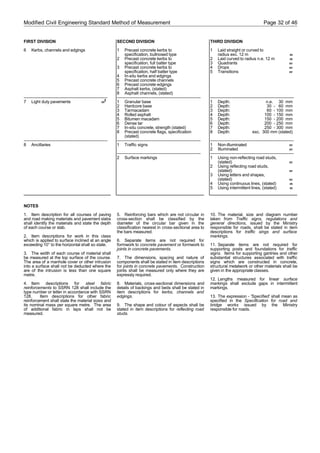
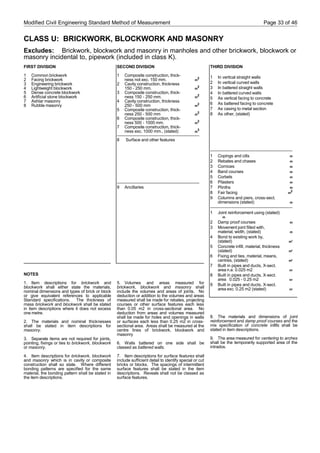
  • 13.
    CLASS H: PRECASTCONCRETE Includes: Manufacture, erection, joining and fixing of precast concrete units Excludes: Precast concrete pipework, (inc. in classes I & J): Precast concrete manholes, catchpits, and gullies, (inc. in class K): Precast concrete piles, (inc. in classes P & Q): Precast concrete paving, kerbs, and traffic sign supports, (inc. in class R): Precast concrete tunnel linings, (inc. in class T): Precast concrete blockwork, (inc, in class U): Precast concrete fencing, (inc. in class X) FIRST DIVISION 1 Beams nr 2 Prestressed pre- tensioned beams nr 3 Prestressed post- tensioned beams nr 4 Columns nr ------------------------------------ 5 Slabs and covers nr ------------------------------------ 6 Segmental units nr ------------------------------------ 7 Units for subways, culverts and ducts m ------------------------------------ 8 Copings, sills and weir blocks m NOTES 1. The position of the Works for each type of precast unit shall be stated in item descrip- tions. Unless otherwise stated, precast units shall be deemed to be reinforced but not pre- stressed. Particulars of the prestressing shall be stated in item descriptions for prestressed units. SECOND DIVISION 1 In concrete grade 10 2 In concrete grade 15 3 In concrete grade 20 4 In concrete grade 25 5 In concrete grade 30 6 In concrete grade 40 7 In concrete grade 50 8 In concrete grade 60 9 In concrete grade (stated) 2. The cross-section type and principal dimensions of beams, columns, segmental units, box units, copings, sills and weir blocks and the average thickness of slabs shall be stated in item descriptions 3. Item descriptions shall state the mark or type number of each precast concrete unit. THIRD DIVISION 1 Length: not exc. 5 m 2 Length: 5 - 7 m 3 Length: 7 - 10 m 4 Length: 10 - 15 m 5 Length: 15 - 20 m 6 Length: 20 - 30 m 7 Length: exc. 30 m (stated) ------------------------------------ 1 Area: not exc. 0.1 m2 2 Area: 0.1 - 0.5 m2 3 Area: 0.5 - 1.0 m2 4 Area: 1.0 - 5.0 m2 5 Area: 5.0 - 15 m2 6 Area: exc. 15 m2 (stated) ------------------------------------ 1 X-sect. area: not exc. 0.1 m2 2 X-sect. area: 0.1 - 0.5 m2 3 X-sect. Area: 0.5 - 1.0 m2 4 X-sect. area: exc. 1 m2 , (stated) ------------------------------------ 4. Concrete components which are cast other than in their final position shall generally be classed as precast concrete units. Where site precasting of units is adopted for reasons other than to obtain multiple use of formwork, and the nature of the work is characteristic of in situ concrete, but involves movement of the cast units into their final positions, the units shall be classed as in situ concrete and items given in class A for the Temporary Works associated with the movement of the units FOURTH DIVISION 1 Mass: not exc.100 kg 2 Mass: 100 - 250 kg 3 Mass: 250 - 500 kg 4 Mass: 500 - 750 kg 5 Mass: 750 - 1 t 6 Mass: 1 - 2 t 7 Mass: 2 - 5 t 8 Mass: 5 - 10 t 9 Mass: exc. 10 t., (stated) 5. Units with different dimensions shall be given different mark or type numbers. 6. The mass used for classification in the fourth division shall be the mass of each unit. The length measured for box units, copings, sills, and weir blocks shall be the length of identical units. 7. Where weir blocks are laid to precise levels, item descriptions shall so state.
  • 14.
    CLASS I: PIPEWORK– PIPES, SEWERS & FITTINGS - SUPPLY Includes: Provision of pipes, specials, fittings and valves, complete with jointing materials and associated components to site of Works. Excludes: Associated work included in classes J, K, & L. FIRST DIVISION 1 Pipes and sewers ------------------------------------------- 2 Fittings to ductile iron pipes (coating/lining stated) nr 3 Fittings to welded steel pipes (coating/lining stated) nr 4 Fittings in steel to uPVC pipes (coating/lining stated) nr 5 Fittings in uPVC to uPVC pipes nr 6 Fittings to asbestos cement pipes nr 7 Fittings to G.S. or G.I. pipes nr 8 Fittings to other pipes (stated) nr SECOND DIVISION 1 Material (stated) 2 Clay 3 Concrete (stated) 4 Ductile iron (coating/lining stated) 5 Welded steel (coating/lining stated) 6 uPVC 7 Asbestos cement 8 G.S. or G.I. 9 Polyethylene ------------------------------------------- 1 Bends, double flanged 2 Bends, plain ended (A.C. & welded steel), double socket ( ductile iron & uPVC), or (stated) ------------------------------------------- 3 Junctions and branches, all flanged unless (stated) ------------------------------------------- 4 Junctions and branches, main line plain ended (A.C. & welded steel), and double socket (ductile iron & uPVC), or (stated) ------------------------------------------- 5 Tapers, double flanged 6 Tapers, plain ended (A.C. & welded steel), double socket (ductile iron & uPVC), or (stated) ------------------------------------------- 7 Plain ended & single flanged pieces and bellmouths, single flanged socketed pieces, nominal lengths (stated) ------------------------------------------- THIRD DIVISION 1 Double flanged, standard m 2 S & S standard joints, (stated) m 3 S & S tyton joints, standard m 4 S & S bolted gland joints, standard m 5 Plain ended, ogee joints, standard m 6 Plain ended, with separate joints (one/pipe), standard m 7 Threaded, separate joints, (one/pipe), standard m ------------------------------------------- 8 Double flanged, non- standard, length (stated) nr 9 Other, non-standard length (stated) nr ------------------------------------------- 1 Long radius, 11.25o 2 Long radius, 22.5o 3 Long radius, 45o 4 Long radius, 90o 5 Short radius 11.25o 6 Short radius 22.5o 7 Short radius 45o 8 Short radius 90o 9 Duckfoot ------------------------------------------- 1 Tees, equal, branch as main 2 Tees, branch down 1 dia. 3 Tees, branch down 2 dia. 4 Tees, branch down 3 dia. 5 Tees, branch down 4 dia. 6 Tees, branch down 5 dia. 7 Tees, branch down 6 dia. 8 Tees, branch down 7 dia. 9 Tess, branch down more than 7 dia., (stated) ------------------------------------------- 1 Tees, equal, branch as main 2 Tees, branch down 1 dia. 3 Tees, branch down 2 dia. 4 Tees, branch down 3 dia. 5 Tees, branch down 4 dia. 6 Tees, branch down more than 4 dia. (stated) 7 Tees, hydrant, flanged branch n.b. 80 mm 8 Tees, invert branch flanged or (stated), n.b. 80 for main of n.b. < 225, or n.b. 100 for main of n.b. >225 9 Cross or wye (stated) ------------------------------------------- 1 Concentric, down 1 dia 2 Concentric, down 2 dia 3 Concentric, down 3 dia 4 Concentric, down more than 3 dia (stated) 5 Invert, down 1 dia 6 Invert, down 2 dia 7 Invert, down 3 dia 8 Invert, down more than 3 dia (stated) ------------------------------------------- 1 P.e. length n.e. 1 m (stated) 2 P.e. length 1 - 2 m (stated) 3 P.e. length exc. 2 m (stated) 4 P.e. with puddle flange (length & p.f. position stated) 5 Single fl. length n.e. 1 m (stated) 6 Single fl. length 1 -2 m (stated) 7 Single fl. length exc. 2 m (stated)
  • 15.
    8 Single fl.with puddle flange (length & p.f. position) (stated) 9 Bellmouth ------------------------------------------- FOURTH, FIFTH & SIXTH DIVISIONS 4TH pressure class 1 NP 0 2 NP 3 3 NP 6 4 NP 9/10 5 NP 12 6 NP 16 7 NP 25 8 NP 40 9 NP other (stated) 5TH nominal bore list Select from the list displayed for the pipe material that has been indicated 6TH sequence no A number from 1 through 9 to be used if necessary to differentiate between items that would otherwise have the same BOQ number /unoconv/20180610120808_c22eef67252733c5683c7ff09e4b71ea2ec90724/cesmm-180610120808.doc
  • 16.
    FIRST DIVISION Fittings topipes (cont'd) ------------------------------------------- 9 Valves, penstocks, hydrants, meters nr SECOND DIVISION 8 Adaptors, detachable collars, couplings and saddles ------------------------------------------- 9 Standard couplers & end pieces ------------------------------------------- 1 Gate valves 2 Butterfly valves (with cap and key unless otherwise stated) 3 Penstocks (with extension spindle, headstock and handwheel unless otherwise stated) ------------------------------------------- 4 Non-return valves ------------------------------------------- 5 Air valves ------------------------------------------- 6 Pressure control valves ------------------------------------------- 7 Hydrants ------------------------------------------- 8 Float Valves ------------------------------------------- 9 Meters
  • 17.
    THIRD DIVISION 1 Flexible,straight coupling, standard unless (stated) 2 Flexible, stepped coupling (stated) 3 Flexible, anchor coupling 4 Flexible, test coupling 5 Flange adaptor, flexible 6 Flange adjustable/ removable joint 7 Detachable collar, short unless otherwise (stated) 8 Saddle, (stated) 9 Adaptor, stepped, (stated) ------------------------------------------- 1 Flange-p.e. coupler in C.I or D.I. unless (stated) 2 Union (stated) 3 Flanged socket 4 Threaded-threaded coupler 5 Threaded-p.e. coupler 6 Blank flange 7 Separate flange (stated) 8 Plug or cap (stated) 9 Other (stated) ------------------------------------------- 1 Flanged, non-rising spindle. 2 P.e. non-rising spindle 3 Socketed,non-rising spindle 4 Threaded,non-rising spindle 5 Flanged,rising spindle (stated) 6 P.e.,rising spindle (stated) 7 Socketed, rising spindle, (stated) 8 Single flange (butterfly & penstock (stated) 9 Other, (stated) ------------------------------------------- 1 Flanged, gravity closing type 2 Flanged, counterweight disc type 3 Flanged, surge suppressing type 4 Flanged, other (stated) 5 Foot valve with strainer 6 Flap valve, single flange ------------------------------------------- 1 Single small orifice, threaded without stopcock 2 Single small orifice, threaded with stopcock 3 Single small orifice, flanged without stopcock 4 Single small orifice, flanged with stopcock 5 Single large orifice, flanged, separate isolating valve 6 Single large orifice, flanged, integral isolating valve 7 Double orifice, flanged, separate isolating valve 8 Double orifice, flanged, integral isolating valve 9. Other (stated) with separate isolating valve ------------------------------------------- 1 Sustaining valve (stated) 2 Reducing valve (stated) 3 Release valve (stated) 4 Level control (stated) ------------------------------------------- 1 With integral isolating valve 2 With separate isolating valve ------------------------------------------- 1 Equilibrium type,(stated) 2 Streamline type (stated) 3 Other (stated) ------------------------------------------- 1 Woltman bulk type, (stated) 2 Bulk type (stated) 3 Waste meter c/w recorder (stated) 4 Single jet, inferential with dry dial, domestic type 5 Single jet, inferential with wet dial, domestic type 6 Volumetric, with rotary,piston domestic type 7 Multi-jet rotor, domestic type FOURTH, FIFTH & SIXTH DIVISIONS 4TH pressure class 1 NP 0 2 NP 3 3 NP 6 4 NP 9/10 5 NP 12 6 NP 16 7 NP 25 8 NP 40 9 NP other (stated) 5TH nominal bore list Select from the list displayed for the pipe material that has been indicated 6TH sequence no A number from 1 through 9 to be used if necessary to differentiate between items that would otherwise have the same BOQ number NOTES 1. Items shall be deemed to include the supply of both pipes and fittings complete with all jointing materials, coatings and linings and other related materials called for on the drawings or in the specificatio n unless such material is specifically excluded in the item description 2. The nominal bores, and in the case of uPVC pipes the nominal external diameters are given in the table below for the various types of pipe wall material. TABLE STANDARD PIPE, SEWER AND FITTINGS DIAMETERS IN mm. Ref. Steel / G.S. or PVC HDPE Asb Letter Ductile Iron G.I. Ce a 10 b 15 15 c 20 20 d 25 32 e 32 40 f 40 40 50 50 g 50 50 63 63 h 65 65 75 75 i 80 80 90 90 j 100 100 110 110 1 k 150 125 160 160 1 l (150) 150 180 180 1 m (200) 200 200 (2 n 200 225 225 2 o (250) 250 250 (2 p 250 280 2 q 300 315 315 3 r 350 350 3 s 400 400 4 t 450 4 u 500 5 v 550 w 600 6 x 700 7 y 800 8 z 900 (NOD) =nominal outside diameter ( ) =non preferred sizes
  • 18.
    CLASS J: PIPEWORK– PIPES, SEWERS AND FITTINGS - INSTALL Includes: Distribution of pipes and fittings from storage areas to installation site or trench side, excavation of trenches, including necessary shoring, dewatering of trenches, laying of pipes and fittings in trenches, jointing, partial backfilling of trenches prior to testing of pipelines, and completion of backfilling after successful testing, testing, sterilisation, and flushing. Excludes: Work included in classes I, K and L. FIRST DIVISION 1 Method of Measurement type A in metres m ----------------------------- 2 Testing m ----------------------------- 3 Sterilisation and flushing m ----------------------------- 4 Method of Meas-urement type B by number nr 5 Method of Meas- urement type C by number nr ----------------------------- SECOND DIVISION 1 Other pipes and fittings, (stated) 2 Clay pipes and fittings 3 Concrete pipes and fittings, (stated) 4 Ductile iron pipes and fittings 5 Welded steel pipes and fittings 6 uPVC pipes and fittings 7 A.C. pipes and fittings 8 G.S. or G.I. pipes and fittings 9 Polyethylene pipes and fittings ----------------------------------- 1 Test pressure not exc. 6 bar 2 Test pressure exc. 6 bar but not exc. 12 bar 3 Test pressure exc. 12 bar but not exc: 25 bar 4 Test pressure exc. 25 bar but not exc. 40 bar 5 Test pressure exc. 40 bar (stated) ----------------------------------- 1 N. B: n.e. 100 mm 2 N. B: 100 - 200 mm 3 N. B: 200 - 300 mm 4 N. B: 300 - 400 mm 5 N. B: 400 - 500 mm 6 N. B: 500 - 600 mm 7 N. B: 600 - 900 mm 8 N. B: 900 - 1200 mm 9 N. B: exc. 1200 mm (stated) ----------------------------------- 1 Pipes ----------------------------------- 2 Fittings ----------------------------------- THIRD DIVISION 1 Pipe n.b: n.e. 100 mm 2 Pipe n.b.: exc 100 but not exc. 200 mm 3 Pipe n.b.: exc 200 but not exc. 300 mm 4 Pipe n.b.: exc 300 but not exc. 400 mm 5 Pipe n.b.: exc 400 but not exc. 500 mm 6 Pipe n.b.: exc 500 but not exc. 600 mm 7 Pipe n.b.: exc 600 but not exc. 900 mm 8 Pipe n.b.: exc 900 but not exc. 1200 mm 9 Pipe n.b.: exc 1200 (stated) ----------------------------------- ----------------------------------- 1 Other pipes, (stated) 2 Clay pipes 3 Concrete pipes, (stated) 4 Ductile iron pipes 5 Welded steel pipes 6 uPVC pipes 7 A.C. pipes 8 G.S. or G.I. pipes 9 Polyethylene pipes ----------------------------------- 1 Bends (radius and joints stated) 2 Junctions & branches (type and joints stated) 3 Tapers (type and joints stated) 4 Pipe pieces and bellmouths, (length, joints and type stated) 5 Adaptors, collars, coup- lings, saddles & end pieces (stated) 6 Gate & Butterfly valves (stated) 7 Air valves (stated) 8 Meters, (type stated) 9 Others (stated) ----------------------------------- FOURTH DIVISION 1 Not in trenches 2 In trenches, depth: n.e. 1 m 3 In trenches, depth: 1 - 1.5 m 4 In trenches, depth: 1.5 - 2 m 5 In trenches, depth: 2 - 3 m 6 In trenches, depth: 3 - 4 m 7 In trenches, depth: 4 - 6 m 8 In trenches, depth: exc. 6 m (stated) 9 On piers, number and height, (stated) ----------------------------------- ----------------------------------- ----------------------------------- 1 N.b: n.e. 100 mm 2 N.b.: exc 100 but not exc. 200 mm 3 N.b.: exc 200 but not exc. 300 mm 4 N.b.: exc 300 but not exc. 400 mm 5 N.b.: exc 400 but not exc. 500 mm 6 N.b.: exc 500 but not exc. 600 mm 7 N.b.: exc 600 but not exc. 900 mm 8 N.b.: exc 900 but not exc. 1200 mm 9 N.b.: exc 1200 (stated) ----------------------------------- FIFTH DIVISION ------------------------------- 1 Not in trenches 2 In trenches, depth: n.e. 1 m 3 In trenches, depth: 1- 1.5 m 4 In trenches, depth: 1.5 - 2 m 5 In trenches, depth: 2- 3 m 6 In trenches, depth: 3- 4 m 7 In trenches, depth: exc. 4 m (stated) 8 On piers, number and height,(stated) 9 In chambers -------------------------------
  • 19.
    FIRST DIVISION 6 Methodof Measurement type B and type C trench excavation m 3 NOTES 1. Three methods of measure- ment are specified herein. Methods of measurement A and B are used for new works that do not directly involve any tie-in works although they may subsequently require this. Method of measurement C is specifically reserved for tie-in work that can only be executed by shutting down a live system. 2. Unless otherwise indicated in the item description contained in the Bill of Quantities, pipes shall be measured in accordance with Method A. If used, Method B will generally be limited to intake sites, treatment works, and reservoir sites, where there are a disproportionate number of fittings involved. 3. Method A for the measure- ment of pipes and fittings. a) The unit of measurement shall be in metres. b) Lengths of pipelines shall be measured along their cen- treline and shall include lengths occupied by fittings and valves. Where pipes are built into manholes and other chambers, the lengths shall be measured from the inside surfaces of the chambers. c) Depths shall be measured from the Commencing Surface to the invert of the pipe. SECOND DIVISION 1 Pipe n.b. n. e. 200 mm 2 Pipe n.b. exc. 200 but not exc. 300 mm 3 Pipe n.b. exc. 300 but not exc. 600 mm 4 Pipe n.b. exc. 600 but not exc. 900 mm 5 Pipe n.b. exc. 900 mm (stated) d) All pipes shall be deemed to be in trenches unless expressly stated otherwise. e) No separate payment shall be made for: i) Excavation of pipe trenches ii) Backfilling of pipe trenches unless trenches are expressly required to be backfilled with material other than that excavated from the trench. iii) Provision, cutting, lay ing, jointing of pipes and fittings in trenches iv) Temporary supports which are not expressly required to be left in the excavations v) Keeping trenches clear of water vi) Trimming of trench bottoms vii) Disposing of excess excavated material viii) Any additional protect- ion at the time of laying if called for on the drawings or in the specification. 4. Method B for the measure- ment of pipes and fittings. a) The unit of measurement shall be by nr., with excavation and backfilling of trenches in cubic metres under first division 6. b) Depths shall be measured from the commencing surface to the invert of the pipe or fitting. THIRD DIVISION 1 Max. depth n.e. 1 m 2 Max. depth 1 - 1.5 m 3 Max. depth 1.5 - 2 m 4 Max. depth 2 - 3 m 5 Max. depth 3 - 4 m 6 Max. depth 4 - 6 m 7 Max. depth exc. 6 m (stated) c) The volume of excavation & backfilling shall be calculated by multiplying together the depth of the trench and the length of the pipe or fitting in the trench & the nominal width of excavation, the excavation as stated in the Specification. d) No separate payment shall be made for: i) Backfilling of trenches unless trenches are ex- pressly required to be backfilled with material other than that excavated from the trenches ii) Provision, cutting, lay ing, and jointing of pipes and fittings. iii) Temporary supports which are not expressly required to be left in the excavation iv) Keeping trenches clear of water v) Trimming of trench bottoms vi) Any additional protection at the time of laying if called for on the drawings or in the specification. 5. Method C for the measure- ment of fittings, and occasionally pipes that can only be installed by closing down a live system. a) The unit of measurement shall be by nr., with excavation and backfilling of trenches in cubic metres under first division 6. FOURTH DIVISION b) Depths shall be measured from the commencing surface to the invert of the pipe or fitting. c) The volume of excavation & backfilling shall be calculated by multiplying together the depth of the trench and the length of the pipe or fitting in the trench & the nominal width of excavation, the excavation as stated in the Specification. d) No separate payment shall be made for: i) Backfilling of trenches unless trenches are ex- pressly required to be backfilled with material other than that excavated from the trenches ii) Provision, cutting, lay ing, and jointing of pipes and fittings, whether old or new. iii) Temporary supports which are not expressly required to be left in the excavation iv) Keeping trenches clear of water v) Trimming of trench bottoms vi) Any additional protection at the time of laying if called for on the drawings or in the specification.
  • 20.
    CLASS K: PIPEWORK- MANHOLE & PIPE & SEWER WORK ANCILLARIES Includes: Manholes and other chambers, ducts, metal culverts, crossings and reinstate-ment, other ancillaries as listed Excludes: Work included in classes I, J, L and Y. FIRST DIVISION 1 Manholes & other chambers, in accord- ance with standard drawings, (stated) nr ---------------------------------- 2 Concrete manhole covers or surr- ounds (stated) nr ---------------------------------- 3 Gullies nr ---------------------------------- 4 French drains, rubble drains and ditches ---------------------------------- 5 Ducts and metal culverts m ---------------------------------- SECOND DIVISION 1 Brick 2 Brick with backdrop 3 In-situ concrete 4 In-situ concrete with backdrop 5 Precast concrete 6 Precast concrete with backdrop 7 Masonry or blockwork 8 Masonry or block- work with backdrop 9 Other (stated) ---------------------------------- 1 Paving, (stated) 3 In-situ concrete 5 Precast concrete 7 Masonry or block-work ---------------------------------- 1 Clay 2 Clay trapped 3 In-situ concrete 4 In-situ concrete trapped 5 Precast concrete 6 Precast concrete trapped 7 Plastics 8 Plastics trapped ---------------------------------- 1 Filling of french & rubble drains with graded material m 3 2 Filling of french & rubble drains with rubble m 3 ---------------------------------- 3 Trenches for unpiped rubble drains m 4 Unlined rectangular section ditches m 5 Lined rectangular section ditches m 6 Unlined vee section ditches m 7 Lined vee section ditches m 8 Trenches for pipes or cables to be laid by others m ---------------------------------- 1 Cable ducts: 1 way 2 Cable ducts: 2 way 3 Cable ducts: 3 way 4 Cable ducts: exc. 3 way (stated) 5 Sectional corrugated metal culverts n.i.d. n.e. 0.5 m 6 Sectional corrugated metal culverts n.i.d. 0.5 - 1 m 7 Sectional corrugated metal culverts n.i.d. 1 - 1.5 m 8 Sectional corrugated metal culverts n.i.d. exc. 1.5 m (stated) ---------------------------------- THIRD DIVISION 1 Sluice (gate) valve box 2 Single air valve,(small orifice) chamber 3 Single air valve, (large orifice), or double air valve chamber 4 Meter chamber 5 Hydrant chamber 6 Washout valve chamber (single or double stated) 7 Sewer manhole 8 Drainage manhole 9 Outfall, (stated) ---------------------------------- 1 Area: n. e. 0.5 m2 2 Area: 0.5 - 1 m2 3 Area: 1 - 2 m2 4 Area: 2 - 3 m2 5 Area: 3 - 4 m2 6 Area: 4 - 5 m2 7 Area: exc. 5 m2 (stated) ---------------------------------- ---------------------------------- ---------------------------------- 1 X-sect. area: n.e. 0.25 m2 2 X-sect. area:0.25 - 0.5 m2 3 X-sect. area:0.5 - 0.75 m2 4 X-sect. area:0.75 - 1 m2 5 X-sect.area:1-1.5 m2 6 X-sect.area:1.5-2 m2 7 X-sect area: 2 -3 m2 8 X-sect. Area: exc. 3 m2 (stated) ---------------------------------- 1 Not in trenches 2 In trenches, depth: n. e. 1m 3 In trenches, depth: 1 - 1.5 m 4 In trenches, depth: 1.5 - 2 m 5 In trenches, depth: 2 - 3 m 6 In trenches, depth: 3 - 4 m 7 In trenches, depth: 4 - 6 m 8 In trenches, depth: exc. 6 m (stated) 9 Elevated on piers, no. & height (stated)
  • 21.
    VOLUME II Modified CivilEngineering Standard Method of Measurement Page 18 of 35 ---------------------------------- FOURTH DIVISION 1 Nom. bore n.e. 100 mm 2 Nom. bore exc 100 but n.e. 200 mm 3 Nom. bore exc. 200 but n.e. 300 mm 4 Nom. bore exc.300 but n.e. 400 mm 5 Nom. bore exc.400 but n.e. 500 mm 6 Nom. bore exc. 500 but n.e. 600 mm 7 Nom. bore exc.600 but n.e. 900 mm 8 Nom. bore exc 900 but n.e. 1200 mm 9 Nom. bore exc. 1200 mm (stated) -------------------------------- ---------------------------------- ---------------------------------- ---------------------------------- ---------------------------------- ---------------------------------- FIFTH DIVISION 1 Depth: n.e. 1.5 m 2 Depth: 1.5 - 2 m 3 Depth: 2 - 3 m 4 Depth: 3 - 4 m 5 Depth: 4 - 5 m 6 Depth: 5 - 6 m 7 Depth: exc. 6m (stated) ---------------------------------- ---------------------------------- FIRST DIVISION 6 Crossings nr ------------------------------------------ 7 Reinstatement m ------------------------------------------ 8 Other pipework ancillaries ------------------------------------------ 9 Metal covers and surface boxes nr SECOND DIVISION 1 River, stream or canal, width 1 - 3 m 2 River, stream or canal, width 3 - 10 m 3 River, stream or canal, width exc. 10 m (stated) 4 Hedge crossing 5 Wall crossing 6 Fence crossing 7 Sewer, ditch or drain crossing 8 Other underground service, (stated) 9 Railway crossing, (stated) ----------------------------------------------- 1 Breaking up and temporary reinstatement - surfaced roads 2 Breaking up and temporary re- instatement of dirt roads (where specified by Engineer) 3 Breaking up, temporary and permanent reinstatement of surfaced roads 4 Breaking up, temporary and permanent re-instatement of dirt roads (where specified) 5 Reinstatement of grassland 6 Reinstatement of cultivated lands incl. gardens 7 Reinstatement of sports fields ----------------------------------------------- 1 Reinstatement of field drains m ----------------------------------------------- 2 Marker posts for (stated) nr ---------------------------------------------- 3 Timber supports left in excavations m 2 4 Metal supports left in excavations m 2 -------------------------------------------- 5 Connection of pipes to existing manholes, and other chambers nr ------------------------------------- ---------- 1 Other, (stated) 2 Cast iron 3 Rust resistant steel 4 Mild steel, plain 5 Galvanised steel /unoconv/20180610120808_c22eef67252733c5683c7ff09e4b71ea2ec90724/cesmm-180610120808.doc 20
  • 22.
    VOLUME II Modified CivilEngineering Standard Method of Measurement Page 18 of 35 THIRD DIVISION 1 Pipe nom.bore n.e. 250 mm 2 Pipe nom.bore 250- 500 mm 3 Pipe nom.bore 500-1000 mm 4 Pipe nom.bore 1000-1500 mm 5 Pipe nom.bore 1500-2000 mm 6 Pipe nom.bore exc. 2000 mm (stated) ----------------------------------------------- 1 Pipe nom.bore n.e. 250 mm 2 Pipe nom.bore 250- 500 mm 3 Pipe nom.bore 500-1000 mm 4 Pipe nom.bore 1000-1500 mm 5 Pipe nom.bore 1500-2000 mm 6 Pipe nom.bore exc. 2000 mm (stated) ----------------------------------------------- ----------------------------------------------- 1 Sluice valves 2 Air valves 3 Fire hydrants 4 Washouts 5 Pipelines 6 Other (stated) ----------------------------------------------- ------------------------------------------- 1 Existing materials (stated) 2 Existing materials (clay) 3 Existing materials (concrete) 4 Existing materials (ductile iron) 5 Existing materials (welded steel) 6 Existing materials (uPVC) 7 Existing materials (A/C) 8 Existing materials (G.S. or G.I.) ---------------------------------------------- 1 With grade A cover & frame 2 With grade B cover & frame 3 With heavyduty cover & frame 4 With medium duty cover & frame 5 With light duty cover & frame 6 With cover & frame, (stated) 7 With lockable cover and frame as per standard drawing FOURTH DIVISION 1 Overcrossing - type I 2 Over crossing - type II 3 Undercrossing - type III ------------------------------------- ------------------------------------- ------------------------------------- 1 In class 30 precast concrete 2 In accordance with standard drawings ------------------------------------- ------------------------------------- 1 Pipe n.b. n.e. 100 mm 2 Pipe n.b. 100 - 200 mm 3 Pipe n.b. 200 - 300 mm 4 Pipe n.b. 300 - 400 mm 5 Pipe n.b. 400 - 500 mm 6 Pipe n.b. 600 - 900 mm 7 Pipe n.b. 900 -1200 mm 8 Pipe n.b. exc. 1200 mm (stated) ------------------------------------- 1 Area: not exc. 0.1 m2 2 Area: 0.1 - 0.5 m2 3 Area: 0.5 - 1 m2 4 Area: 1 - 5 m2 5 Area: 5 - 15 m2 6 Area: exc. 15 m2 (stated) NOTES 1. Type or mark numbers shall be stated in item descriptions for manholes and other chambers of which details are given elsewhere in the Contract. Item descriptions shall identify different configurations of manholes and other chambers. Separate items are not required for different arrangements of inlets and outlets or for access shafts of different heights. 2. Types and loading duties of manhole gully and catchpit covers shall be stated in item description. 3. Depths of manholes and catchpits shall be measured from the tops of covers to the tops of base slabs. 4. Separate items are not required for excavation for work in this class except as set out in class L (see notes 1-5 of class L). 5. Excavation and pipe laying for piped French and rubble drains shall be included in Class J. The nature of the filling material shall be stated in item descriptions for filling of French and rubble drains in this class. /unoconv/20180610120808_c22eef67252733c5683c7ff09e4b71ea2ec90724/cesmm-180610120808.doc 21
  • 23.
    VOLUME II Modified CivilEngineering Standard Method of Measurement Page 18 of 35 6. Notes in classes I, K and L which refer to pipe and pipework shall also apply to ducts and metal culverts in this class. Crossings, reinstatement and other pipework ancillaries for ducts and metal culverts shall be itemized, described and measured as set out in this class, except that the dimension used for classification in the third division shall be the maximum nominal distance between the inside faces of the outer walls of the duct or culvert. Non-circular metal culverts shall be classified by their maximum nominal internal cross-sectional dimension. Separate items are not required for bends in cable ducts. 7. Materials and dimensions of linings to ditches shall be stated in item descriptions. The cross-sectional areas of rubble drains and ditches shall be measured to the Excavated Surfaces. 8. Types of surfaces shall be stated in item descriptions for breaking up and reinstatement of roads. Separate items are not required for removal and reinstatement of kerbs. Surfaced roads denote tarmac, concrete, paving bricks or similar surfaces. Dirt roads denote only official designated murram roads of at least 6 m width and where specified by the Engineer or his Representative. 9. River, stream and canal crossings shall be classified by their widths between banks measured along pipe centre lines. Crossings of streams shall be measured only where their width exceeds one metre. Items for crossings shall include reinstatement unless otherwise stated. Where linings to rivers, streams or canals are to be broken through and reinstated the type of lining shall be stated in item descriptions for crossings. Crossings of roads and paths shall be classed as breaking up and reinstatement of roads and paths. Lengths for breaking up and reinstatement of roads and footpaths shall be measured along pipe centre lines and shall include lengths occupied by manholes and other chambers. 10. Sizes and types of marker posts shall be given in item descriptions or given on drawings. 11. The area measured for supports left in excavations shall be the area of supported surfaces for which the supports are expressly required to be left in. /unoconv/20180610120808_c22eef67252733c5683c7ff09e4b71ea2ec90724/cesmm-180610120808.doc 22
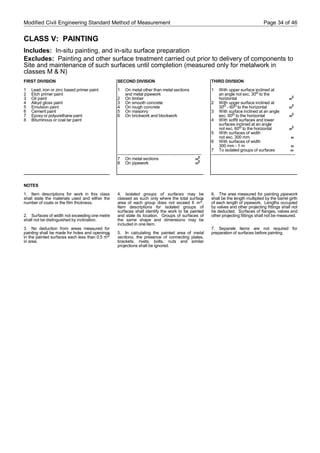
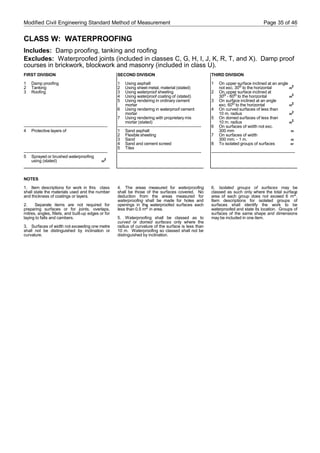
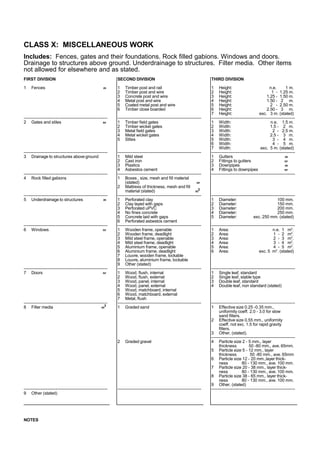
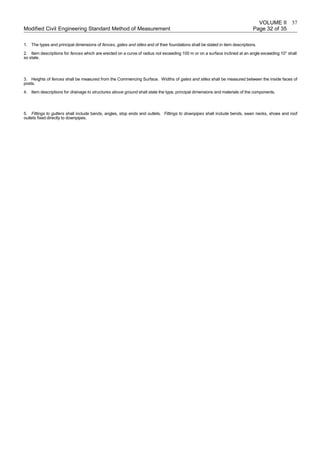
  • 24.
    CLASS L: PIPEWORK- SUPPORTS AND PROTECTION, ANCILLARIES TO LAYING AND EXCAVATION Includes: Extras to excavation and backfilling of trenches for pipework, ducts and metal culverts, manholes and other chambers. Pipelaying in headings and thrust borings. Excavation for and provision of supports and protection to pipework, ducts and metal culverts Excludes: Work included in classes I,J, and K. FIRST DIVISION 1 Extras to excavation and backfilling m 3 ----------------------------------------- 2 Special laying methods m ----------------------------------------- 3 Beds m 4 Haunches m 5 Surrounds m ----------------------------------------- 6 Wrapping & lagging of m ----------------------------------------- 7 Concrete stools and thrust blocks, concrete class (stated) nr ----------------------------------------- 8 Other isolated pipe supports nr SECOND DIVISION 1 In pipe trenches 2 In manholes and chambers 3 In headings 4 In thrust borings 5 In pipe jackings 6 In foundations 7 Other (stated) ----------------------------------------- 1 Pipe laying in headings 2 Pipe laying in thrust borings 3 Pipe jacking ----------------------------------------- 1 Sand 2 Selected granular material 3 Imported granular material 4 Mass concrete 5 Reinforced concrete ----------------------------------------- 1 Polythene sheeting, grade (stated) 2 Material, (stated) ----------------------------------------- 1 To horizontal bends 2 To vertical bends at crest 3 To vertical bends at trough 4 To steep slopes 5 To junctions 6 To tapers 7 To other (stated) ----------------------------------------- 1 Height: n.e. 1 m. 2 Height: 1 - 1.5 m. 3 Height: 1.5 - 2 m. 4 Height: 2 - 3 m. 5 Height: 3 - 4 m. 6 Height: 4 - 5 m. 7 Height: 5 - 6 m. 8 Height: exc. 6 m.(stated) THIRD DIVISION 1 Excavation of rock class I material 2 Excavation of rock class II material 3 Excavation of mass concrete 4 Excavation of reinforced concrete 5 Excavation of other artificial hard material 6 Backfilling above Final Surface with concrete 7 Backfilling above Final Surface with material other than concrete (stated) 8 Excavation of natural material below the Final Surface and backfilling with concrete 9 Excavation of natural material below the Final Surface and backfilling below the Final Surface with material other than concrete (stated) ----------------------------------------- 1 Pipe n.b. n.e. 100 mm 2 Pipe n.b. 100 - 200 mm 3 Pipe n.b. 200 - 300 mm 4 Pipe n.b. 300 - 400 mm 5 Pipe n.b. 400 - 500 mm 6 Pipe n.b. 500 - 600 mm 7 Pipe n.b. 600 - 900 mm 8 Pipe n.b. 900 -1200 mm 9 Pipe n.b. exc. 1200 mm (stated) ----------------------------------------- 1 Volume: n.e. 0.1 m3 2 Volume: 0.1 - 0.2 m3 3 Volume: 0.2 - 0.5 m3 4 Volume: 0.5 - 1 m3 5 Volume: 1 - 2 m3 6 Volume: 2 - 4 m3 7 Volume: 4 - 8 m3 8 Volume: exc. 8 m3 (stated) ----------------------------------------- 1 Pipe n.b. n.e. 100 mm 2 Pipe n.b. 100 - 200 mm 3 Pipe n.b. 200 - 300 mm 4 Pipe n.b. 300 - 400 mm 5 Pipe n.b. 400 - 500 mm 6 Pipe n.b. 600 - 900 mm 7 Pipe n.b. 900 -1200 mm 8 Pipe n.b. exc. 1200 mm (stated) FOURTH DIVISION ----------------------------------------- 1 Pipe n.b. n.e. 100 mm 2 Pipe n.b. 100 - 200 mm 3 Pipe n.b. 200 - 300 mm 4 Pipe n.b. 300 - 400 mm 5 Pipe n.b. 400 - 500 mm 6 Pipe n.b. 500 - 600 mm 7 Pipe n.b. 600 - 900 mm 8 Pipe n.b. 900 -1200 mm 9 Pipe n.b. exc. 1200 mm (stated) ----------------------------------------- NOTES 1. Items shall be given in this class in addition to the items for the provision and jointing of pipes, ducts and culverts and for the excavation, laying and backfilling of pipes, ducts and culverts laid in trenches in classes I and K. Items shall be given in this class in addition to the items for manholes and other chambers in class K. 2. The volume of extras to excavation and backfilling for pipes shall be calculated by multiplying together the average depth and length of the material removed or backfilled and the nominal width is stated it shall be taken as 500 mm greater than the maximum nominal distance between the inside faces of the outer pipe walls where this distance does not exceed one metre, and as 750 mm greater than this distance where it needs one metre.
  • 25.
    VOLUME II Modified CivilEngineering Standard Method of Measurement Page 22 of 35 3. The volume of extras to excavation and backfilling for manholes and other chambers shall be calculated by multiplying the average depth of the material removed or backfilled by the maximum horizontal external cross-sectional area of the manhole or chamber. 4. Breaking up of roads and pavings shall be included in class K. 5. Backfilling above the Final Surface (L1 - 5-6*) shall be measured only if it is expressly required that the material excavated shall not be used for backfilling. Excavation below the Final Surface and backfilling (L1 - 7-8*) shall be measured only where it is expressly required. 6. Pipe laying in headings and by thrust boring shall be measured only where they are expressly required. Item descriptions for pipe laying in headings and by thrust borings shall identify the run of pipe or pipes laid. The type of packing shall be stated in item descriptions for pipe laying in headings. Thrust blocks constructed for the purposes of thrust boring only shall be classed as Temporary Works in class A. 7. Lengths of supports and protection to pipelines shall be measured along pipe centre lines including lengths occupied by fittings and valves but not including lengths occupied by manholes and chambers through which the support or protection is not continued. 8. Materials used for beds, haunches and surrounds to pipes and the depths of beds shall be stated in item descriptions. Separate items shall not be given for beds to haunched or surrounded pipes where the same material is used for beds and haunches or beds and surrounds respectively. 9. Materials used for wrapping and lagging of pipes shall be stated in item descriptions. Separate items are not required for wrapping and lagging of fittings and valves. 10. Principal dimensions and materials shall be stated in item descriptions for pipe supports. Heights of pipe supports shall be measured from the ground or other supporting surface to the invert of the highest pipe where pipes are supported from below and of the lowest pipe where pipes are supported from above. Where two or more pipes are carried by a support, the item for the support shall be classified in the third division by the aggregate bore of the pipes supported. 11. The specification of concrete shall be stated in item description for concrete stools and thrust blocks. 12. Work in this class associated with ducts and metal culverts shall be itemized, described and measured as set out for work associated with pipes, except that the dimension used for classification in the third division shall be the maximum nominal distance between the inside faces of the outer walls of the duct or culvert. /unoconv/20180610120808_c22eef67252733c5683c7ff09e4b71ea2ec90724/cesmm-180610120808.doc 23
  • 26.
    CLASS N: MISCELLANEOUSMETALWORK Excludes: Metal reinforcement for concrete (included in classes C, G, H and R). Metal concrete inserts (included in classes G and H). Pipework (included in classes I, J, K, and L). Structural metalwork (included in class M). Fittings and fastenings to timber (included in O). Piles (included in classes P and Q). Traffic signs (included in class R). Rail track and accessories (included in class S). Surface treatment of metalwork on site (included in class V). Fences (included in class X). FIRST DIVISION 1 Mild steel, plain 2 Galvanized steel 3 Aluminium 4 Stainless steel 5 Other (stated) ----------------------------------------------------------- 6 Cast Iron 7 Rust resistant steel 8 Mild steel, plain 9 Other (stated) SECOND DIVISION 1 Stairways and landing t 2 Walkways and platforms t ----------------------------------------------------------- 3 Ladders and step irons m ----------------------------------------------------------- 4 Handrails m 5 Bridge parapets m ----------------------------------------------------------- 6 Miscellaneous frames, dimensions, (stated) m ----------------------------------------------------------- 7 Flooring, dimensions, (stated) m 2 ----------------------------------------------------------- 8 Screens, dimensions, (stated) m 2 ----------------------------------------------------------- 9 Plate, dimensions, (stated) m 2 ----------------------------------------------------------- 1 Cladding m 2 2 Welded mesh panelling m 2 3 Duct covers m 2 4 Tie rods nr 5 Walings nr ----------------------------------------------------------- 6 Bridge bearings nr ----------------------------------------------------------- 7 Tanks, nominal size, (stated) nr ----------------------------------------------------------- 8 Tank ancillaries nr ----------------------------------------------------------- 9 Hand stops (stated) m 2 THIRD DIVISION ----------------------------------------------------------- 1 Ladders, dimensions (stated) 2 Step irons, dimensions (stated) ----------------------------------------------------------- ----------------------------------------------------------- 1 From angle section, painted 2 From angle section, hot dip galvanized 3 From channel section, painted 4 From channel section, hot dip galvanized 5 From I section, painted 6 From I section, hot dip galvanized 7 From tubular section, round, painted 8 From tubular section, round, hot dip galvanized 9 From tubular section, rectangular, (stated) ----------------------------------------------------------- 1 From plain plate 2 From open grid 3 From chequer plate 4 From chequer plate, lockable ----------------------------------------------------------- 1 Fine, dia 5 to 10 mm., (stated) 2 Coarse, dia. 30 to 50 mm, (stated) ----------------------------------------------------------- 1 With notch 53 degrees, fixed 2 With notch 53 degrees, removable 3 With notch, 90 degrees, fixed 4 With notch, 90 degrees, removable 5 Fixed, detail (stated) 6 Removable, detail (stated) ----------------------------------------------------------- ----------------------------------------------------------- 1 Roller 2 Slide 3 Rocker 4 Cylindrical 5 Spherical 6 Plain rubber 7 Laminated rubber 8 Rubber pot ----------------------------------------------------------- 1 Volume: n.e. 1 m3 2 Volume: 1 - 3 m3 3 Volume: 3 - 10 m3 4 Volume: 10 - 30 m3 5 Volume: 30 - 100 m3 6 Volume: 100 - 300 m3 7 Volume: 300 - 1000 m3 8 Volume: exc. 1000 m3 ----------------------------------------------------------- 1 Cover description (stated) ----------------------------------------------------------- 1 Roof vent assembly, diam.: 50 mm 2 Roof vent assembly, diam.: 80 mm 3 Roof vent assembly, diam.: 100 mm 4 Roof vent assembly, diam.: 150 mm -----------------------------------------------------------
  • 27.
    VOLUME II Modified CivilEngineering Standard Method of Measurement Page 24 of 35 NOTES 1. Item descriptions shall state the specification and thicknesses of metal used off-site surface treatments and principal dimensions of miscellaneous metalwork assemblies. Alternatively, item descriptions may identify assemblies by mark numbers related to detail shown on the Drawings or given in the Specification. 2. Masses calculated for measurement of miscellaneous metalwork assemblies shall include the mass of all metal components and attached pieces. Separate items are not required for the components of miscellaneous metalwork assemblies. 3. Item codes N3-38** shall be used for miscellaneous metalwork not listed in the classification. Generally the measurement unit for such work shall be the tonne. 4. Separate items are not required for erection and fixing of miscellaneous metalwork or for provision of fixings to miscellaneous metalwork. 5. The lengths of handrails and bridge parapets shall be measured along their top members. The lengths of rectangular frames shall be measured along their external perimeters. 6. No deductions from the masses or areas measured for miscellaneous metalwork shall be made for openings and holes each less than 0.5 m¨ in area. 25
  • 28.
    CLASS O: TIMBER Includes:Timber components and fittings Timber decking Excludes: Formwork to concrete (included in class G). Timber piles (included in class P). Timber sleepers (included in class S). Timber fencing (included in class X). Building carpentry and joinery. FIRST DIVISION 1 Hardwood components for general use m 2 Hardwood components for marine use m 3 Softwood components m ----------------------------------------------------------- 4 Hardwood decking for general use m 2 5 Hardwood decking for marine use m 2 6 Softwood decking m 2 ----------------------------------------------------------- 7 Fittings and fastenings nr ----------------------------------------------------------- 8 Roofing nr NOTES 1. Timber components in buildings which may be included in civil engineering contracts need not be measured according to the procedure set down in this class 2. The nominal gross cross-sectional dimensions or thicknesses, species and any impregnation requirements or special surface finishes shall be stated in item descriptions for timber components and decking. SECOND DIVISION 1 X-sect. area: n.e. 0.01 m2 2 X-sect. area: 0.01 - 0.02 m2 3 X-sect. area: 0.02 - 0.04 m2 4 X-sect. area: 0.04 - 0.10 m2 5 X-sect. area: 0.10 - 0.20 m2 6 X-sect. area: 0.20 - 0.40 m2 7 X-sect. area: exc. 0.4 m2 (stated) ----------------------------------------------------------- 1 Thickness: 25 mm 2 Thickness: 50 mm 3 Thickness: 75 mm 4 Thickness: 100 mm 5 Thickness: 125 mm 6 Thickness: 150 mm 7 Thickness: 200 mm 8 Thickness: 225 mm 9 Thickness exc. 225 mm, (stated) ----------------------------------------------------------- 1 Straps of dimensions, (stated) 2 Spikes of length, diameter, (stated) 3 Coach screws of length, diameter, (stated) 4 Bolts of diameter, length, (stated) 5 Plates of dimensions, (stated) ----------------------------------------------------------- 1 Truss assemblies, (stated) 2 Rafters, (stated) 3. The structural use and location of timber components shall be stated in item descriptions for components longer than 3 metres. 4. The length of each timber component measured shall be its overall length with no deduction for scarfed or other joints. 5. The cross-sectional areas used for classification of timber components shall be their nominal gross cross-sectional areas. THIRD DIVISION 1 Length: n.e. 1.5 m 2 Length: 1.5 - 3 m 3 Length: 3 - 5 m 4 Length: 5 - 8 m 5 Length: 8 - 12 m 6 Length: 12 - 20 m 7 Length: exc. 20 m (stated) ----------------------------------------------------------- 1 Width 75 mm. 2 Width 100 mm. 3 Width 125 mm. 4 Width 150 mm. 5 Width 225 mm. 6 Width 250 mm. 7 Width 300 mm. 8 Width 450 mm. 9 Width, exc. 450 mm., (stated) ----------------------------------------------------------- ----------------------------------------------------------- 6. The thickness used for classification of and stated in item descriptions for timber decking shall be its nominal gross thickness. 7. Separate items are not required for fixing timber components and decking or fittings and fastenings or for boring and cutting. 8. No deduction from the areas measured for timber decking shall be made for openings and holes each less than 0.5 m2 in area.
  • 29.
    CLASS P: PILES Excludes:Boring for site investigation (included in class B). Ground anchors (included in class C). Walings and tie rods (included in class N). Piling ancillaries (included in class Q). FIRST DIVISION 1 Bored cast in place concrete piles 2 Driven cast in place concrete piles ----------------------------------------------------------- 3 Preformed concrete piles 4 Preformed prestressed concrete tiles 5 Preformed concrete sheet piles 6 Timber piles ----------------------------------------------------------- 7 Isolated steel pipes ----------------------------------------------------------- 8 Interlinked steel pipe piles ----------------------------------------------------------- 9 Interlocking steel piles SECOND DIVISION 1 Diameter: 300 mm or 350 mm 2. 400 mm or 450 mm 3 500 mm or 550 mm 4 600 mm or 750 mm 5 900 mm or 1050 mm 6 1200 mm or 1350 mm 7 1500 ----------------------------------------------------------- 1 Cross-sectional area: not exceeding 0.025 m² 2 0.025-0.05 m² 3 0.05 – 0.1 m² 4 0.1 – 0.15 m² 5 0.15 – 0.25 m² 6 0.25 – 0.5 m ² 7 0.5 – 1 m² 8 exceeding 1 m² ----------------------------------------------------------- 1 Mass: not exceeding 15 kg/m 2 15 – 30 kg/m 3 30 – 60 kg/m 4 60 – 120 kg/m 5 120 – 250 kg/m 6 250 – 500 kg/m 7 500 kg/m – 1 t/m 8 exceeding 1 t/m ----------------------------------------------------------- 1 Section modulus: not exceeding 500 cm³/m 2 500-800 cm³/m 3 800-1200 cm³/m 4 1200-2000 cm³/m 5 2000-3000 cm³/m 6 3000-4000 cm³/m 7 4000-5000 cm³/m 8 exceeding 5000 cm³/m THIRD DIVISION 1 Number of piles nr 2 Concreted length m 3 Depth bored or driven to stated maximum depth m ----------------------------------------------------------- 1 Number of piles of stated length nr 2 Depth driven m ----------------------------------------------------------- 1 Number of piles of stated length nr 2 Depth driven m ----------------------------------------------------------- 1 Length of special piles m 2 Driven area m² 3 Area of piles of length: not exceeding 14 m m² 4 14-24 m m² 5 exceeding 24 m m²
  • 30.
    MEASUREMENT RULES M1 Boredand driven depths shall be measured along the axes of piles from the Commencing Surface to the toe levels of bored piles, to the bottom of the casings of driven cast in place piles and to the bottom of the toes of other driven piles. The Commencing Surface adopted in the preparation of the Bill of Quantities as the surface at which boring or driving is expected to begin shall be adopted for the measurement of the completed work. M2 Each group of items for cast in place concrete piles shall comprise (a) an item for the number of piles (P1-2 * 1) (b) an item for the total concreted length of piles (P1-2 * ) (c) an item for the total depth bored or driven (P1-2 * 3). M3 The concreted lengths of cast in place concrete piles shall be measured from the cut-off levels expressly required to the toe levels expressly required. M4 Each group of items for preformed concrete and timber piles shall comprise (a) one or more items for the number of piles of stated length (P3-6*1) (b) an item for the total depth driven (P3-6 * 2). M5 Each group of items for isolated steel piles shall comprise (a) one or more items for the number of piles of stated length (P7*1) (b) an item for the total depth driven (P7 * 2). M6 Each group of items for interlocking steel piles shall comprise (a) one or more items for the total length of each type of special pile, if any (P8 * 2) (b) an item for the total driven area of piles (P8 * 2) (c) one or more items for the total area of piles divided into the ranges of length given in the third division (P8 * 3-5). M7 The areas of interlocking steel piles shall be calculated by multiplying the mean undeveloped horizontal lengths of the pile walls formed (including lengths occupied by special piles) by the depths measured in accordance with rule M1 in the case of items in the case of items for the driven areas (P8 * 2) and by the lengths defined in accordance with rule D6 in the case of items for the areas of piles (P8 * 3-5). M8 Closure and taper piles classed as special piles shall be measured only where they are expressly required. DEFINITION RULES D1The maximum depth stated in item descriptions for the depth cast in place concrete piles shall be the depth which is not exceeded by any pile included in the item. D2Piles comprising a driven permanent steel casing which is filled with concrete shall be classed as driven cast in place concrete piles where the piles are designed for the load to be carried on the concrete. D3The lengths of preformed concrete and timber piles shall be the lengths expressly required to be supplied excluding extensions but including heads and shoes. D4The lengths of isolated steel piles shall be the lengths expressly required to be supplied excluding extensions. D5Piles comprising a driven permanent steel casing which is filled with concrete shall be classed as isolated steel piles where the piles are designed for the load to be carried on the casing. Filling such piles shall be classed as filling hollow piles with concrete (Q 53*) D6The lengths of interlocking steel pipes shall be the lengths expressly required to be supplied excluding extensions. D7Interlocking steel corner, junction, closure and taper piles shall be classed as special piles. COVERAGE RULES C1 Items for piles shall be deemed to include disposal of excavated material. ADDITIONAL DESCRIPTION RULES A1Materials of which piles are composed shall be stated in item descriptions. A2Preliminary piles shall be identified in item descriptions. Raked piles shall be identified in item descriptions and their inclination stated. A3The structure to be supported and the Commencing Surface shall be identified in item descriptions for piles. A4The diameter shall be stated in item descriptions for cast in place concrete piles. A5Contiguous bored piles shall be identified in item descriptions. A6The cross-section type and cross-sectional dimensions or diameter shall be stated in item descriptions for preformed concrete and timber piles. A7Details of treatments and coatings shall be stated in item descriptions for the number of piles. A8Details of driving heads and of shoes shall be stated in item descriptions for the number of piles. A9The mass per metre and cross-sectional dimensions shall be stated in item descriptions for isolated steel piles. A10 The section reference or mass per metre and section modulus shall be stated in item descriptions for interlocking steel piles. A11 Details of treatments and coatings shall be stated in item descriptions for area of piles. A12 The type of special pile shall be stated in item descriptions for the length of special tiles.
  • 31.
    CLASS Q: PILINGANCILLARIES Includes: Work ancillary to piling. Excludes: Ground anchors (includes in class C). Piles included in class P). Walings and tie rods (included in class N). FIRST DIVISION 1 Cast in place concrete piles ----------------------------------------------------------- 2 Cast in place concrete piles ----------------------------------------------------------- 3 Preformed concrete piles 4. Timber piles ----------------------------------------------------------- 5 Isolated steel piles ----------------------------------------------------------- 6 Interlocking steel piles ----------------------------------------------------------- 7 Obstructions h ----------------------------------------------------------- 8 Pile tests ----------------------------------------------------------- SECOND DIVISION 1 Pre-boring m 2 Backfilling empty bore with stated material m 2 Permanent casings each length: not exceeding 13 m m 4. exceeding 13 m m 5 Enlarged bases nr 7 Cutting off surplus lengths m 8 Preparing heads nr ----------------------------------------------------------- 1 Reinforcement t ----------------------------------------------------------- 1 Pre-boring m 2 Jetting m 3 Filling hollow piles with concrete m 4. Number of pile extensions nr 5. Length of pile extensions, each length: not exceeding 3 m m 6 exceeding 3 m m 7 Cutting off surplus lengths m 8 Preparing heads nr ----------------------------------------------------------- 1 Preboring m 2 Jetting m 3 Filling hollow piles with concrete m 4 Number of pile extensions nr 5. Length of pile extensions, each length: not exceeding 3 m m 6 exceeding 3 m m 7 Cutting off surplus lengths m 8 Preparing heads nr ----------------------------------------------------------- 1 Preboring m 2 Jetting m 4 Number of pile extensions m 5. Length of pile extensions, each length: not exceeding 3 m m 6 exceeding 3 m m 7 Cutting off surplus lengths m 8 Preparing heads nr ----------------------------------------------------------- ----------------------------------------------------------- 1 Maintained loading with various reactions 2 Constant rate of penetration 3 horizontal loading ----------------------------------------------------------- 4. Non-destructive integrity 5. Inclinometer installations ----------------------------------------------------------- THIRD DIVISION 1 Diameter: 300 mm or 350 mm 2 400 mm or 450 mm 3 500 mm or 550 mm 4 600 mm or 750 mm 5 900 mm or 1050 mm 6 1200 mm or 1350 mm 7 1500 mm ----------------------------------------------------------- 1. Straight bars, nominal size: not exceeding 25 mm 2. exceeding 25 mm 3. Helical bars of stated nominal size ----------------------------------------------------------- 1 Cross-sectional area: not exceeding 0.025 m² 2 0.025 m² - 0.05 m² 3 0.05 m² - 0.1 m² 4 0.1 m² - 0.15 m² 5 0.15 m² - 0.25 m² 6 0.25 m² - 0.5 m² 7 0.5 m² - 1 m² 8 stated exceeding 1 m² ----------------------------------------------------------- 1 Mass: not exceeding 15 kg/m 2 15 – 30 kg/m 3 30 – 60 kg/m 4 60 – 120 kg/m 5 120 – 250 kg/m 6 250 – 500 kg/m 7 500 kg/m – 1 t/m 8 stated exceeding 1 t/m ----------------------------------------------------------- 1 Section modulus: not exceeding 500 cm³/m 2 500 - 800 cm³/m 3 800 - 1200 cm³/m 4 1200 - 2000 cm³/m 5 2000 - 3000 cm³/m 6 3000 - 4000 cm³/m 7 4000 - 5000 cm³/m 8 stated exceeding 5000 cm³/m ----------------------------------------------------------- ----------------------------------------------------------- 1 Test load: not exceeding 100 t 2 100 – 200 t 3 200 – 300 t 4 300 – 400 t 5 400 – 600 t 6 600 – 800 t 7 800 – 1000 t 8 exceeding 1000 t -----------------------------------------------------------
  • 32.
    Modified Civil EngineeringStandard Method of Measurement Page 30 of 46 MEASUREMENT RULES M1 Work in this class, other than backfilling empty bore for cast in place concrete piles, shall be measured only where it is expressly required. M2 The lengths of permanent casings shall be measured from the Commencing Surface to the bottom of the casing. M3 The mass measured for reinforcement shall include the mass of reinforcement in laps. M4 The mass of steel reinforcement shall be taken as 0.785 kg/m per 100 mm² of cross-section (7.85 t/m³). The mass of other reinforcing materials shall be taken as stated in the Contract. M5 Driving extended piles shall be included in the measurement of the items for driven depth in class P. M6 Each group of items for pile extensions shall comprise (a) an item for the number of pile extensions (Q3-44*) (b) one or two items for the length of pile extensions divided into the ranges of length given in the second division (Q3-4 5-6*) M7 The length of pile extensions measured shall not include lengths formed from material arising from cutting off surplus lengths of other piles. M8 The length measured for timber pile extensions shall include lengths occupied by scarfed or other joints. M9 Each group of items for pile extensions shall comprise (a) an item for the number of pile extensions (Q 5 4*) (b) one or two items for the length of pile extensions divided into the ranges of length given in the second division Q 5 5-6*). M10 Each group of items for pile extensions shall comprise (a) an item for the number of pile extensions (Q 6 4 *) (b) one or two items for the length of pile extensions divided into the ranges of length given in the second division. M11 The lengths measured for cutting off surplus lengths of interlocking steel piles shall be the mean undeveloped horizontal lengths to be cut (including lengths occupied by special piles). M12 Obstructions shall be measured only for breaking out rock or artificial hard material encountered above the founding stratum of bored piles. DEFINITION RULES D1 The diameter used for classification in the third division shall be the diameter of the piles. D2 The nominal size used for classification in item descriptions for bar reinforcement shall be the cross-sectional size defined in BS 4449. D3 The cross-sectional area used for classification in the third division shall be the cross- sectional area of the piles. D4 The mass used for classification in the third division shall be the mass of the piles. D5 The section modulus used for classification in the third division shall be the section modulus of the piles COVERAGE RULES C1 Items for piling ancillaries shall be deemed to include disposal of surplus materials unless otherwise stated. C2 Items for permanent casings shall be deemed to include driving heads and shoes. C3 Items for reinforcement shall be deemed to include supporting reinforcement. C4 Items for pre-boring shall be deemed to include grouting voids between the pile and the bore. C5 Items for pile extensions shall be deemed to include the work necessary to attach the extension to the pile. C6 Items for filling hollow piles with concrete shall be deemed to include removal of material from within the pile before concreting. C4 Items for pre-boring shall be deemed to include grouting voids between the pile and the bore. C5 Items for pile extensions shall be deemed to include the work necessary to attach the extension to the pile. C6 Items for filling hollow piles with concrete shall be deemed to include removal of material from within the pile before concreting. ADDITIONAL DESCRIPTION RULES A1 The diameters of enlarged bases for bored piles shall be stated in item descriptions. A2 Materials, thickness and details of treatments and coatings shall be stated in item descriptions for permanent casings. Item descriptions for cutting off surplus lengths which include permanent casings shall so state. A3 Materials shall be stated in item descriptions for reinforcement. A4 Details of couplers for high tensile steel reinforcement which are expressly required shall be stated in item descriptions for reinforcement. A5 Item descriptions for filling hollow piles with concrete shall state the specification of the concrete. A6 Materials of which pile extensions are composed shall be stated in item descriptions for their length. A7 Item descriptions for pile tests shall identify those which are to preliminary piles. A8 Item descriptions for loading tests shall state the load. Where the load is applied to raking piles item descriptions shall so state.
  • 33.
    CLASS R: ROADSAND PAVING Includes: Sub-base, base and surfacing of roads, runways and other paved areas. Kerbing and light duty pavements, footways and cycle tracks. Traffic signs and markings. Excludes: Landscaping ( included in class E). Drainage (included in classes I, J, K and L). Fences and gates (included in class X). Gantries and other substantial structures supporting traffic signs. FIRST DIVISION 1 Sub-bases, flexible road bases and surfacing ----------------------------------------------------------- 2 Sub-bases, flexible road bases and surfacing 3 Sub-bases, flexible road bases and surfacing ----------------------------------------------------------- 4 Concrete pavements ----------------------------------------------------------- 5 Joints in concrete pavements m ----------------------------------------------------------- SECOND DIVISION 1 Granular material of CBR (stated) at MDD (stated) m 2 2 Granular material (general) m 2 3 Soil-cement, ratio (stated) m 2 4 Cement bound granular material m 2 5 Lean concrete of CBR (stated) at MDD (stated) m 2 6 Hardcore m 2 ----------------------------------------------------------- 7 Geotextiles, (stated) m 8 Allow for making up additional depth of material (stated) m 3 ----------------------------------------------------------- 1 Wet mix macadam m 2 2 Dry bound macadam m 2 3 Dense bitumen macadam m 2 4 Open texture bitumen macadam m 2 5 Dense tarmacadam m 2 6 Open texture tarmacadam m 2 7 Dense tar surfacing m 2 ----------------------------------------------------------- 1 Cold asphalt wearing course m 2 2 Rolled asphalt m 2 3 Slurry sealing m 2 4 Surface dressing m 2 5 Bituminous spray m 2 6 Removal of flexible surface m 2 ----------------------------------------------------------- 8 Regulating course of, (stated) t ----------------------------------------------------------- 1 Carriageway slabs, paving quality concrete (stated) m 2 2 Carriageway slabs of other strength, (stated) m 2 3 Other cast in-situ concrete slabs, strength, (stated) m 2 ----------------------------------------------------------- 4 Reinforced with steel fabric to specification m 2 5 Reinforced with other fabric (stated) m 2 ----------------------------------------------------------- 6 Reinforced with mild steel bar to specification t 7 Reinforced with high yield steel bar, (stated) t ----------------------------------------------------------- 8 Waterproof membrane laid below concrete pavements m 2 ----------------------------------------------------------- 1 Longitudinal joints, (stated) 2 Expansion joints, (stated) 3 Contraction joints, (stated) 4 Warping joints, (stated) 5 Butt joints, (stated) 6 Construction joints, (stated) ----------------------------------------------------------- THIRD DIVISION 1 Depth: n.e. 30 mm 2 Depth: 30 - 60 mm 3 Depth: 60 - 100 mm 4 Depth: 100 - 150 mm 5 Depth: 150 - 200 mm 6 Depth: 200 - 250 mm 7 Depth: 250 - 300 mm 8 Depth: exc. 300 mm (stated) ----------------------------------------------------------- ----------------------------------------------------------- 1 Depth: n.e. 30 mm 2 Depth: 30 - 60 mm 3 Depth: 60 - 100 mm 4 Depth: 100 - 150 mm 5 Depth: 150 - 200 mm 6 Depth: 200 - 250 mm 7 Depth: 250 - 300 mm 8 Depth: exc. 300 mm (stated) ----------------------------------------------------------- ----------------------------------------------------------- 1 Depth: n.e. 30 mm 2 Depth: 30 - 60 mm 3 Depth: 60 - 100 mm 4 Depth: 100 - 150 mm 5 Depth: 150 - 200 mm 6 Depth: 200 - 250 mm 7 Depth: 250 - 300 mm 8 Depth: exc. 300 mm (stated) ----------------------------------------------------------- 1 Nom. mass: n.e. 2 kg/m2 2 Nom. mass: 2 - 3 kg/m2 3 Nom. mass: 3 - 4 kg/m2 4 Nom. mass: 4 - 5 kg/m2 5 Nom. mass: 5 - 6 kg/m2 6 Nom. mass: 6 - 7 kg/m2 7 Nom. mass: 7 - 8 kg/m2 8 Nom. mass: exc.8 kg/m2 ., (stated) ----------------------------------------------------------- 1 Diameter: 6 mm 2 Diameter: 8 mm 3 Diameter: 10 mm 4 Diameter: 12 mm 5 Diameter: 14 mm 6 Diameter: 16 mm 7 Diameter: 20 mm 8 Diameter: 25 mm or greater, (stated) ----------------------------------------------------------- ----------------------------------------------------------- 1 Depth of joint: n.e. 30 mm 2 Depth of joint: 30 - 60 mm 3 Depth of joint: 60 - 100 mm 4 Depth of joint: 100 - 150 mm 5 Depth of joint: 150 - 200 mm 6 Depth of joint: 200 - 250 mm 7 Depth of joint: 250 - 300 mm 8 Depth of joint: exc. 300 mm, (stated) -----------------------------------------------------------
  • 34.
    Modified Civil EngineeringStandard Method of Measurement Page 32 of 46 FIRST DIVISION 6 Kerbs, channels and edgings ----------------------------------------------------------- 7 Light duty pavements m 2 ----------------------------------------------------------- 8 Ancillaries NOTES 1. Item description for all courses of paving and road making materials and pavement slabs shall identify the materials and state the depth of each course or slab. 2. Item descriptions for work in this class which is applied to surface inclined at an angle exceeding 10° to the horizontal shall so state. 3. The width of each course of material shall be measured at the top surface of the course. The area of a manhole cover or other intrusion into a surface shall not be deducted where the are of the intrusion is less than one square metre. 4. Item descriptions for steel fabric reinforcements to SSRN 128 shall include the type number or letter in accordance with SSRN 128. Item descriptions for other fabric reinforcement shall state the material sizes and its nominal mass per square metre. The area of additional fabric in laps shall not be measured. SECOND DIVISION 1 Precast concrete kerbs to specification, bullnosed type 2 Precast concrete kerbs to specification, full batter type 3 Precast concrete kerbs to specification, half batter type 4 In-situ kerbs and edgings 5 Precast concrete channels 6 Precast concrete edgings 7 Asphalt kerbs, (stated) 8 Asphalt channels, (stated) ----------------------------------------------------------- 1 Granular base 2 Hardcore base 3 Tarmacadam 4 Rolled asphalt 5 Bitumen macadam 6 Dense tar 7 In-situ concrete, strength (stated) 8 Precast concrete flags, specification (stated) ----------------------------------------------------------- 1 Traffic signs ----------------------------------------------------------- 2 Surface markings 5. Reinforcing bars which are not circular in cross-section shall be classified by the diameter of the circular bar given in the classification nearest in cross-sectional area to the bars measured. 6. Separate items are not required for formwork to concrete pavement or formwork to joints in concrete pavements. 7. The dimensions, spacing and nature of components shall be stated in item descriptions for joints in concrete pavements. Construction joints shall be measured only where they are expressly required. 8. Materials, cross-sectional dimensions and details of backings and beds shall be stated in item descriptions for kerbs, channels and edgings. 9. The shape and colour of aspects shall be stated in item descriptions for reflecting road studs. THIRD DIVISION 1 Laid straight or curved to radius exc. 12 m m 2 Laid curved to radius n.e. 12 m m 3 Quadrants nr 4 Drops nr 5 Transitions nr ----------------------------------------------------------- 1 Depth: n.e. 30 mm 2 Depth: 30 - 60 mm 3 Depth: 60 - 100 mm 4 Depth: 100 - 150 mm 5 Depth: 150 - 200 mm 6 Depth: 200 - 250 mm 7 Depth: 250 - 300 mm 8 Depth: exc. 300 mm (stated) ----------------------------------------------------------- 1 Non-illuminated nr 2 Illuminated nr ----------------------------------------------------------- 1 Using non-reflecting road studs, (stated) nr 2 Using reflecting road studs, (stated) nr 3 Using letters and shapes, (stated) nr 4 Using continuous lines, (stated) m 5 Using intermittent lines, (stated) m 10. The material, size and diagram number taken from Traffic signs, regulations and general directions, issued by the Ministry responsible for roads, shall be stated in item descriptions for traffic sings and surface markings. 11. Separate items are not required for supporting posts and foundations for traffic signs. Items for supporting gantries and other substantial structures associated with traffic signs which are constructed in concrete, structural metalwork or other materials shall be given in the appropriate classes. 12. Lengths measured for linear surface markings shall exclude gaps in intermittent markings. 13. The expression - 'Specified' shall mean as specified in the Specification for road and bridge works issued by the Ministry responsible for roads.
  • 35.
    Modified Civil EngineeringStandard Method of Measurement Page 33 of 46 CLASS U: BRICKWORK, BLOCKWORK AND MASONRY Excludes: Brickwork, blockwork and masonry in manholes and other brickwork, blockwork or masonry incidental to, pipework (included in class K). FIRST DIVISION 1 Common brickwork 2 Facing brickwork 3 Engineering brickwork 4 Lightweight blockwork 5 Dense concrete blockwork 6 Artificial stone blockwork 7 Ashlar masonry 8 Rubble masonry NOTES 1. Item descriptions for brickwork and blockwork shall either state the materials, nominal dimensions and types of brick or block or give equivalent references to applicable Standard specifications. The thickness of mass brickwork and blockwork shall be stated in item descriptions where it does not excess one metre. 2. The materials and nominal thicknesses shall be stated in item descriptions for masonry. 3. Separate items are not required for joints, pointing, fixings or ties to brickwork, blockwork or masonry. 4. Item descriptions for brickwork, blockwork and masonry which is in cavity or composite construction shall so state. Where different bonding patterns are specified for the same material, the bonding pattern shall be stated in the item descriptions. SECOND DIVISION 1 Composite construction, thick- ness not exc. 150 mm. m 2 2 Cavity construction, thickness 150 - 250 mm. m 2 3 Composite construction, thick- ness 150 - 250 mm. m 2 4 Cavity construction, thickness 250 - 500 mm m 2 5 Composite construction, thick- ness 250 - 500 mm m 2 6 Composite construction, thick- ness 500 - 1000 mm. m 2 7 Composite construction, thick- ness exc. 1000 mm., (stated) m 3 ---------------------------------------------------------- 8 Surface and other features ---------------------------------------------------------- 9 Ancillaries 5. Volumes and areas measured for brickwork, blockwork and masonry shall include the volumes and areas of joints. No deduction or addition to the volumes and areas measured shall be made for rebates, projecting courses or other surface features each less than 0.05 m2 in cross-sectional area. No deduction from areas and volumes measured shall be made for holes and openings in walls or surfaces each less than 0.25 m2 in cross- sectional area. Areas shall be measured at the centre lines of brickwork, blockwork and masonry 6. Walls battered on one side shall be classed as battered walls. 7. Item descriptions for surface features shall include sufficient detail to identify special or cut bricks or blocks. The spacings of intermittent surface features shall be stated in the item descriptions. Reveals shall not be classed as surface features. THIRD DIVISION 1 In vertical straight walls 2 In vertical curved walls 3 In battered straight walls 4 In battered curved walls 5 As vertical facing to concrete 6 As battered facing to concrete 7 As casing to metal section 8 As other, (stated) ---------------------------------------------------------- 1 Copings and cills m 2 Rebates and chases m 3 Cornices m 4 Band courses m 5 Corbels m 6 Pilasters m 7 Plinths m 8 Fair facing m 2 9 Columns and piers, cross-sect. dimensions (stated) m ---------------------------------------------------------- 1 Joint reinforcement using (stated) m 2 Damp proof courses m 3 Movement joint filled with, material, width, (stated) m 4 Bond to existing work by, (stated) m2 5 Concrete infill, material, thickness (stated) m2 6 Fixing and ties, material, means, centres, (stated) m2 7 Built in pipes and ducts, X-sect. area n.e. 0.025 m2 nr 8 Built in pipes and ducts, X-sect. area 0.025 - 0.25 m2 nr 9 Built in pipes and ducts, X-sect. area exc. 0.25 m2 (stated) nr 8. The materials and dimensions of joint reinforcement and damp proof courses and the mix specification of concrete infills shall be stated in item descriptions. 9. The area measured for centering to arches shall be the temporarily supported area of the intrados.
  • 36.
    Modified Civil EngineeringStandard Method of Measurement Page 34 of 46 CLASS V: PAINTING Includes: In-situ painting, and in-situ surface preparation Excludes: Painting and other surface treatment carried out prior to delivery of components to Site and maintenance of such surfaces until completion (measured only for metalwork in classes M & N) FIRST DIVISION 1 Lead, iron or zinc based primer paint 2 Etch primer paint 3 Oil paint 4 Alkyd gloss paint 5 Emulsion paint 6 Cement paint 7 Epoxy or polyurethane paint 8 Bituminous or coal tar paint NOTES 1. Item descriptions for work in this class shall state the materials used and either the number of coats or the film thickness. 2. Surfaces of width not exceeding one metre shall not be distinguished by inclination. 3. No deduction from areas measured for painting shall be made for holes and openings in the painted surfaces each less than 0.5 m2 in area. SECOND DIVISION 1 On metal other than metal sections and metal pipework 2 On timber 3 On smooth concrete 4 On rough concrete 5 On masonry 6 On brickwork and blockwork ----------------------------------------------------------- 7 On metal sections m 2 8 On pipework m 2 4. Isolated groups of surfaces may be classed as such only where the total surface area of each group does not exceed 6 m2. Item descriptions for isolated groups of surfaces shall identify the work to be painted and state its location. Groups of surfaces of the same shape and dimensions may be included in one item. 5. In calculating the painted area of metal sections, the presence of connecting plates, brackets, rivets, bolts, nuts and similar projections shall be ignored. THIRD DIVISION 1 With upper surface inclined at an angle not exc. 30o to the horizontal m 2 2 With upper surface inclined at 30o - 60o to the horizontal m 2 3 With surface inclined at an angle exc. 60o to the horizontal m 2 4 With soffit surfaces and lower surfaces inclined at an angle not exc. 60o to the horizontal m 2 5 With surfaces of width not exc. 300 mm m 6 With surfaces of width 300 mm - 1 m m 7 To isolated groups of surfaces nr ----------------------------------------------------------- 6. The area measured for painting pipework shall be the length multiplied by the barrel girth of each length of pipework. Lengths occupied by valves and other projecting fittings shall not be deducted. Surfaces of flanges, valves and other projecting fittings shall not be measured. 7. Separate items are not required for preparation of surfaces before painting.
  • 37.
    Modified Civil EngineeringStandard Method of Measurement Page 35 of 46 CLASS W: WATERPROOFING Includes: Damp proofing, tanking and roofing Excludes: Waterproofed joints (included in classes C, G, H, I, J, K, R, T, and X). Damp proof courses in brickwork, blockwork and masonry (included in class U). FIRST DIVISION 1 Damp proofing 2 Tanking 3 Roofing ----------------------------------------------------------- 4 Protective layers of ----------------------------------------------------------- 5 Sprayed or brushed waterproofing using (stated) m 2 NOTES 1. Item descriptions for work in this class shall state the materials used and the number and thickness of coatings or layers. 2. Separate items are not required for preparing surfaces or for joints, overlaps, mitres, angles, fillets, and built-up edges or for laying to falls and cambers. 3. Surfaces of width not exceeding one metre shall not be distinguished by inclination or curvature. SECOND DIVISION 1 Using asphalt 2 Using sheet metal, material (stated) 3 Using waterproof sheeting 4 Using waterproof coating of (stated) 5 Using rendering in ordinary cement mortar 6 Using rendering in waterproof cement mortar 7 Using rendering with proprietary mix mortar (stated) ----------------------------------------------------------- 1 Sand asphalt 2 Flexible sheeting 3 Sand 4 Sand and cement screed 5 Tiles ----------------------------------------------------------- 4. The areas measured for waterproofing shall be those of the surfaces covered. No deduction from the areas measured for waterproofing shall be made for holes and openings in the waterproofed surfaces each less than 0.5 m2 in area. 5. Waterproofing shall be classed as to curved or domed surfaces only where the radius of curvature of the surface is less than 10 m. Waterproofing so classed shall not be distinguished by inclination. THIRD DIVISION 1 On upper surface inclined at an angle not exc. 30o to the horizontal m 2 2 On upper surface inclined at 30o - 60o to the horizontal m 2 3 On surface inclined at an angle exc. 60o to the horizontal m 2 4 On curved surfaces of less than 10 m. radius m 2 5 On domed surfaces of less than 10 m. radius m 2 6 On surfaces of width not exc. 300 mm m 7 On surfaces of width 300 mm. - 1 m. m 8 To isolated groups of surfaces nr ----------------------------------------------------------- 6. Isolated groups of surfaces may be classed as such only where the total surface area of each group does not exceed 6 m2. Item descriptions for isolated groups of surfaces shall identify the work to be waterproofed and state its location. Groups of surfaces of the same shape and dimensions may be included in one item.
  • 38.
    CLASS X: MISCELLANEOUSWORK Includes: Fences, gates and their foundations. Rock filled gabions. Windows and doors. Drainage to structures above ground. Underdrainage to structures. Filter media. Other items not allowed for elsewhere and as stated. FIRST DIVISION 1 Fences m ----------------------------------------------------------- 2 Gates and stiles nr ----------------------------------------------------------- 3 Drainage to structures above ground ----------------------------------------------------------- 4 Rock filled gabions ----------------------------------------------------------- 5 Underdrainage to structures m ----------------------------------------------------------- 6 Windows nr ----------------------------------------------------------- 7 Doors nr ----------------------------------------------------------- 8 Filter media m 3 ----------------------------------------------------------- 9 Other (stated) SECOND DIVISION 1 Timber post and rail 2 Timber post and wire 3 Concrete post and wire 4 Metal post and wire 5 Coated metal post and wire 6 Timber close boarded ----------------------------------------------------------- 1 Timber field gates 2 Timber wicket gates 3 Metal field gates 4 Metal wicket gates 5 Stiles ----------------------------------------------------------- 1 Mild steel 2 Cast iron 3 Plastics 4 Asbestos cement ----------------------------------------------------------- 1 Boxes , size, mesh and fill material (stated) nr 2 Mattress of thickness, mesh and fill material (stated) m 2 ----------------------------------------------------------- 1 Perforated clay 2 Clay layed with gaps 3 Perforated uPVC 4 No fines concrete 5 Concrete laid with gaps 6 Perforated asbestos cement ----------------------------------------------------------- 1 Wooden frame, openable 2 Wooden frame, deadlight 3 Mild steel frame, openable 4 Mild steel frame, deadlight 5 Aluminium frame, openable 6 Aluminium frame, deadlight 7 Louvre, wooden frame, lockable 8 Louvre, aluminium frame, lockable 9 Other (stated) ----------------------------------------------------------- 1 Wood, flush, internal 2 Wood, flush, external 3 Wood, panel, internal 4 Wood, panel, external 5 Wood, matchboard, internal 6 Wood, matchboard, external 7 Metal, flush ----------------------------------------------------------- 1 Graded sand 2 Graded gravel ----------------------------------------------------------- THIRD DIVISION 1 Height: n.e. 1 m. 2 Height: 1 - 1.25 m. 3 Height: 1.25 - 1.50 m. 4 Height: 1.50 - 2 m. 5 Height: 2 - 2.50 m. 6 Height: 2.50 - 3 m. 7 Height: exc. 3 m. (stated) ----------------------------------------------------------- 1 Width: n.e. 1.5 m. 2 Width: 1.5 - 2 m. 3 Width: 2 - 2.5 m. 4 Width: 2.5 - 3 m. 5 Width: 3 - 4 m. 6 Width: 4 - 5 m. 7 Width: exc. 5 m. (stated) ----------------------------------------------------------- 1 Gutters m 2 Fittings to gutters nr 3 Downpipes m 4 Fittings to downpipes nr ----------------------------------------------------------- ----------------------------------------------------------- 1 Diameter: 100 mm. 2 Diameter: 150 mm. 3 Diameter: 200 mm. 4 Diameter: 250 mm. 5 Diameter: exc. 250 mm. (stated) ----------------------------------------------------------- 1 Area: n.e. 1 m2 . 2 Area: 1 - 2 m2 . 3 Area: 2 - 3 m2 . 4 Area: 3 - 4 m2 . 5 Area: 4 - 5 m2 . 6 Area: exc. 5 m2 . (stated) ----------------------------------------------------------- 1 Single leaf, standard 2 Single leaf, stable type 3 Double leaf, standard 4 Double leaf, non standard (stated) ----------------------------------------------------------- 1 Effective size 0.25 -0.35 mm., uniformity coeff. 2.0 - 3.0 for slow sand filters. 2 Effective size 0.55 mm., uniformity coeff. not exc. 1.5 for rapid gravity filters. 3 Other, (stated). ----------------------------------------------------------- 4 Particle size 2 - 5 mm., layer thickness 50 -80 mm., ave. 65mm. 5 Particle size 5 - 12 mm., layer thickness 50 -80 mm., ave. 65mm 6 Particle size 12 - 20 mm.,layer thick- ness 80 - 130 mm., ave. 100 mm. 7 Particle size 20 - 38 mm., layer thick- ness 80 - 130 mm., ave. 100 mm. 8 Particle size 38 - 65 mm., layer thick- ness 80 - 130 mm., ave. 100 mm. 9 Other, (stated) ----------------------------------------------------------- NOTES
  • 39.
    VOLUME II Modified CivilEngineering Standard Method of Measurement Page 32 of 35 1. The types and principal dimensions of fences, gates and stiles and of their foundations shall be stated in item descriptions. 2. Item descriptions for fences which are erected on a curve of radius not exceeding 100 m or on a surface inclined at an angle exceeding 10° shall so state. 3. Heights of fences shall be measured from the Commencing Surface. Widths of gates and stiles shall be measured between the inside faces of posts. 4. Item descriptions for drainage to structures above ground shall state the type, principal dimensions and materials of the components. 5. Fittings to gutters shall include bands, angles, stop ends and outlets. Fittings to downpipes shall include bends, swan necks, shoes and roof outlets fixed directly to downpipes. 37
  • 40.
    CLASS Y: SEWERRENOVATION AND ANCILLARY WORKS Includes: Preparation and renovation of existing sewers and manholes and new manholes within the length of existing sewers. Excludes: Grouting carried out from the outside of the sewer (included in class C). Supply and installation of new sewers and, new manhole and pipework ancillaries and supports and protection ancillaries to laying and excavation included in classes I, J, and K. FIRST DIVISION 1 Preparation of existing sewers ----------------------------- 2 Stabilisation of existing sewers ----------------------------- 3 Renovation of existing sewers ----------------------------- 3 Laterals to reno- vated sewers ----------------------------- SECOND DIVISION 1 Other sewer wall material (stated) 2 Clay sewers 3 RC concrete sewers 4 Cast iron sewers 5 Steel sewers 6 uPVC sewers 7 A.C. sewers 8 Unreinforced concrete sewers ------------------------------ 1 Other sewer wall material (stated) 2 Clay sewers 3 RC concrete sewers 4 Cast iron sewers 5 Steel sewers 6 uPVC sewers 7 A.C. sewers 8 Unreinforced concrete sewers ------------------------------ 1 Other sewer wall material (stated) 2 Clay sewers 3 RC concrete sewers 4 Cast iron sewers 5 Steel sewers 6 uPVC sewers 7 A.C. sewers 8 Unreinforced concrete sewers ------------------------------ 1 Other sewer wall material (stated) 2 Clay sewers 3 RC concrete sewers 4 Cast iron sewers 5 Steel sewers 6 uPVC sewers 7 A.C. sewers 8 Unreinforced concrete sewers ------------------------------ 9 Flapvalves ------------------------------ THIRD DIVISION 1 N. b. n.e. 100 mm 2 N. b. exc. 100 - 200 mm 3 N. b. exc. 200 - 300 mm 4 N. b. exc. 300 - 400 mm 5 N. b. exc. 400 - 500 mm 6 N. b. exc. 500 - 600 mm 7 N. b. exc. 600 - 900 mm 8 N. b. exc. 900 - 1200 mm 9 N. b. exc. 1200 mm (stated) --------------------------------- ------------ 1 N. b. n.e. 100 mm 2 N. b. exc. 100 - 200 mm 3 N. b. exc. 200 - 300 mm 4 N. b. exc. 300 - 400 mm 5 N. b. exc. 400 - 500 mm 6 N. b. exc. 500 - 600 mm 7 N. b. exc. 600 - 900 mm 8 N. b. exc. 900 - 1200 mm 9 N. b. exc. 1200 mm (stated) --------------------------------- ------------ 1 N. b. n.e. 100 mm 2 N. b. exc. 100 - 200 mm 3 N. b. exc. 200 - 300 mm 4 N. b. exc. 300 - 400 mm 5 N. b. exc. 400 - 500 mm 6 N. b. exc. 500 - 600 mm 7 N. b. exc. 600 - 900 mm 8 N. b. exc. 900 - 1200 mm 9 N. b. exc. 1200 mm (stated)
  • 41.
    Modified Civil EngineeringStandard Method of Measurement Page 41 of 46 --------------------------------------- ------ 1 N. b. n.e. 100 mm 2 N. b. exc. 100 - 200 mm 3 N. b. exc. 200 - 300 mm 4 N. b. exc. 300 - 400 mm 5 N. b. exc. 400 - 500 mm 6 N. b. exc. 500 - 600 mm 7 N. b. exc. 600 - 900 mm 8 N. b. exc. 900 - 1200 mm 9 N. b. exc. 1200 mm (stated) --------------------------------------- ------ 1 N.b. n.e. 100 mm 2 N.b. exc. 100 - 200 mm 3 N.b. exc. 200 - 300 mm 4 N.b. exc. 300 - 400 mm 5 N.b. exc. 400 - 500 mm 6 N.b. exc. 500 – 600 mm 7 N.b. exc. 600 mm (stated) --------------------------------------- ---- FOURTH DIVISION 1 Cleaning m ------------------------------ 2 Removing intrusions nr ------------------------------ 3 Plugging laterals nr 4 Filling laterals & other sewers, mat- erials stated m3 ---------------------------------------- 5 Local internal repairs nr ------------------------------ 1 Pointing, materials stated m2 2 Joint sealing, mat- erial stated nr ------------------------------ 3 External grouting ------------------------------ 1 Sliplining ------------------------------ 2 In-situ jointed sewer lining ------------------------------ 3 Segmental lining ------------------------------ 4 Proprietary lining (stated) ------------------------------ 5 Gunite coating, thickness stated ------------------------------ 6 Annulus grouting materials stated ------------------------------ 1 Jointing ------------------------------ 2 Flapvalves ------------------------------ FIFTH DIVISION ------------------------------- 1 Laterals, bore n.e. 150 mm 2 Laterals, profile & size exc. 150 mm in one or more dim-ensions, (stated) 3 Other artificial intrusions (stated) ------------------------------- 1 Bore n.e. 300 mm 2 Profile & size exc. 300 mm in one or more dimensions (stated) ------------------------------- 1 Area: n.e. 0.1 m2 2 Area: 0.1 – 0.25 m2 3 Area exc. 0.25 m2 (stated) --------------------------------- --------------------------------- 1 Number of holes nr 2 Injection of grout, material stated m3 --------------------------------- 1 Polyethylene 2 Polypropylene --------------------------------- 1 Polyethylene 2 Polypropylene 3 Glass reinforced plastic --------------------------------- 1 Glass reinforced plastic 2 Glass reinforced concrete 3 Cast gunite 4 Resin concrete --------------------------------- --------------------------------- 1 Bore n.e. 150 mm 2 Bore 150 to 300 mm 3 Profile & size exc. 300 mm in one or more dimensions (stated) --------------------------------- 1 Remove existing 2 Replace existing 3 New flap valve, type stated ---------------------------------
  • 42.
    FIRST DIVISION 5 Newmanholes in new locations nr 6 New manholes replacing existing manholes nr ----------------------------- 7 Existing man- holes nr ----------------------------- 8 Interruptions SECOND DIVISION 1 Brick 2 Brick with back- drop 3 In-situ concrete 4 In-situ concrete with backdrop 5 Precast concrete 6 Precast concrete with backdrop 7 Masonry or blockwork 8 Masonry or block work with back- drop 9 Other (stated) ----------------------------- 1 N. b. n.e. 100 mm 2 N. b. exc. 100 - 200 mm 3 N. b. exc. 200 - 300 mm 4 N. b. exc. 300 - 400 mm 5 N. b. exc. 400 - 500 mm 6 N. b. exc. 500 - 600 mm 7 N. b. exc. 600 - 900 mm 8 N. b. exc. 900 - 1200 mm 9 N. b. exc. 1200 mm (stated) THIRD DIVISION 1 N. b. n.e. 100 mm 2 N. b. exc. 100 - 200 mm 3 N. b. exc. 200 - 300 mm 4 N. b. exc. 300 - 400 mm 5 N. b. exc. 400 - 500 mm 6 N. b. exc. 500 - 600 mm 7 N. b. exc. 600 - 900 mm 8 N. b. exc. 900 - 1200 mm 9 N. b. exc. 1200 mm (stated) -------------------------------------------- 1 Depth: n.e. 1.5 m 2 Depth: 1.5 - 2 m 3 Depth: 2 - 3 m 4 Depth: 3 - 4 m 5 Depth: 4 - 5 m 6 Depth: 5 - 6 m 7 Depth: exc. 6m (stated) FOURTH DIVISION 1 Depth: n.e. 1.5 m 2 Depth: 1.5 - 2 m 3 Depth: 2 - 3 m 4 Depth: 3 - 4 m 5 Depth: 4 - 5 m 6 Depth: 5 - 6 m 7 Depth: exc. 6m (stated) ------------------------------ 1 Preparation of existing sewers 2 Stabilisation of existing sewers ------------------------------ 3 Renovation of existing sewers ------------------------------ 4 Work on laterals to renovated sewers 5 Work on manholes FIFTH DIVISION --------------------------------- 1 Abandonment 2 Alteration --------------------------------- --------------------------------- 1 Sliplining 2 In-situ jointed pipe lining 3 Segmental lining 4 Proprietary lining, (stated) 5 Gunite coating 6 Annulus grouting ---------------------------------
  • 43.
    Modified Civil EngineeringStandard Method of Measurement Page 40 of 46 MEASUREMENT RULES M1 Lengths of sewers shall be measured along their centre lines be- tween the inside surfaces of manholes but shall exclude lengths occupied by pipes and fittings comprising backdrops to manholes. M2 Where work is expressly required to be carried out by excavation, crossings, reinstatement and other sewer-work ancillaries shall be measured in class K and extras to ex- cavation and backfilling shall be measured in class L. M3 No deduction shall be made from the areas of sewer surfaces measured for pointing for openings or voids each not exceeding 0.5 m2 in area. M4 External grouting shall be measured only where grouting is expressly re- quired to be carried out as a separate operation from annulus grouting M5 The volume measured for annulus grouting shall not include the volume measured for external grouting ( Y 2 [1-8] [1-9] .3 2). M6 Interruptions shall be measured only where a minimum pumping capacity is expressly required and for periods of time during normal working hours wherein the flow in the sewer exceeds the installed pumping capacity and work is interrupted. DEFINITION RULES D1Items shall be classed as removing intrusions where artificial intrusions into the bores of existing sewers are to be removed prior to renovation. D2The areas stated in item descriptions for local internal repairs shall be the finished surface areas. D3External grouting shall be grouting of voids outside the existing sewer from within the existing sewer other than voids grouted in the course of annulus grouting. D4Annulus grouting shall be grouting of the annular voids between new linings and existing sewers and of other voids grouted in the course of grouting annular voids. D5The depth of manholes shall be measured from the tops of covers to channel inverts or to tops of base slabs, whichever is the lower. COVERAGE RULES C1 Items for work which is expressly required to be carried out by excavation shall be deemed to include preparation of surfaces, disposal of excavated material, disposal of excavation, backfilling and removal of existing services. C2 Items for cleaning shall be deemed to include making good resultant damage. C3 Items for removing intrusions shall be deemed to include making good. C4 Annulus grouting shall be grouting of the annular voids between new linings and existing sewers and of other voids grouted in the course of grouting annular voids. C5 Items for pointing and sewer joint sealing shall be deemed to include preparation of joints. C6 Items for laterals shall be deemed to include the work involved in connecting to the lining within 1 m from the inside face of the lined sewer. C7 Items for new manholes shall be deemed to include excavation, preparation of surfaces, disposal of ex- cavated material, upholding sides of excavation, backfilling, concrete, re- inforcement, form-work, joints, finishes and reinstatement. C8 Items for manholes shall be deemed to include metalwork, different ar- rangements of inlets and outlets, and access shafts of different heights and connection of sewers to manholes. Items for manholes with backdrops shall be deemed to include the sewers and fittings comprising the backdrop. C9 Items for new manholes replacing existing manholes shall be deemed to include breaking out and disposal of existing manholes. ADDITIONAL DESCRIPTION RULES A1The location of the work in each item or group of items shall be stated so that the work can be identified by reference to the Drawings. A2Principal dimensions, other than diameter and depth of sewers and pro- files of sewers shall be identified by reference to the Drawings. A3Work expressly required to be carried out manually or by remotely controlled methods shall each be so stated in item descriptions. A4Item descriptions for work which is expressly required to be carried out by excavation shall so state and (except for manholes) shall state the maximum depth of excavation in stages of 1 m measured to the invert of the sewer. A5Item descriptions for preparation, stabilisation, renovation and laterals shall state the material forming of the existing sewer. A6Item descriptions for removing intrusions shall state the materials forming the intrusions. A7Where external grouting is carried out through sewer joints, descriptions of items for the number of holes shall so state. A8Item descriptions for slip-lining, in situ jointed pipe lining, segmental lining and stated proprietary lining shall state the type lining, its minimum finished internal size and its thickness or grade. A9Item descriptions for in situ jointed sewer lining and segmental lining shall state the offset where the lining is curved to an offset which exceeds 35 mm per metre. A10 Item descriptions for jointing laterals shall state the type of lining to which the laterals are to be connected and identify those laterals which are to be regraded. A11 Type or mark numbers shall be stated in item descriptions for man- holes of which details are given elsewhere in the Contract. Item descriptions shall identify different configurations of manholes. A12 Types and loading duties of covers shall be stated in item descriptions for new manholes. A13 Item descriptions for existing manholes shall state details of the work required.