Real Estate Development
Group:
D. Rajesh 11011BA015
Ravi Varma 11011BA019
M. Samyuktha 11011BA022
B. Sarath Reddy 11011BA024
Seshagiri rao 11011BA026
Sravani 11011BA031
School of Planning & Architecture
Submitted to:
Mrs. Shivangi
Planning legislation
Department of Urban & Regional planning
Topic:
Real estate development
especially in Industrial sector
Need for study
• Understanding the subject of real estate provides key insight into demand characteristics of land for
different land use & its impact on economy. Livability & attractiveness of an urban area is often
closely interlinked with “real estate industry” & land prices.
Aim
• The aim of the presentation is to understand the real estate development in public & private sectors
(especially industrial sector)
Objective
• To understand real estate as a facilitator of development;
• Factors driving real estate sector;
• Real estate as a tool for controlling land values;
• Transaction & renting of real estate;
Scope
• The scope of the presentation will be limited to the published data available from different websites
on real estate & the study will be carried out based on the secondary data obtained with a limited
primary survey.
Introduction
Basic Definitions
Real estate
• It is a ‘Property’, which refers to anything that can be owned or possessed. It can be a ‘tangible
asset’ (physical things such as land, buildings etc.) or ‘intangible asset’ (nonphysical such as contractual rights, financial claims etc.)
• In other words…. Real estate can be defined as the land & its permanent improvements.
• Improvements on the land include any fixed structures such as buildings & they are often referred to as
infrastructure facilities development.
Land
• Property or real estate, not including buildings or equipment, that does not occur naturally.
Depending on the title, land ownership may also give the holder the rights to all natural resources on
the land.
Real estate – An industry in transition
• The Indian real estate industry, valued at about
US$ 12 billion, ranks second in the world, after the
United States, in terms of contributing to Gross
Domestic Product (GDP) and generating
employment.
• Presently, real estate accounts for about five per
cent of India’s GDP; in the next five years its share
is expected to rise to six per cent. It is also the
second largest employer in India after agriculture.
Real estate contributes 5% to India’s GDP
Ref: http://www.headhonchos.com/blog/survey-and-
reports/real-estate-an-industry-in-transition.html
Dated: December 23, 2011
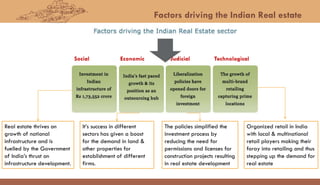
Factors driving the Indian Real estate
Real estate thrives on
growth of national
infrastructure and is
fuelled by the Government
of India’s thrust on
infrastructure development.
It’s success in different
sectors has given a boost
for the demand in land &
other properties for
establishment of different
firms.
The policies simplified the
investment process by
reducing the need for
permissions and licenses for
construction projects resulting
in real estate development
Organized retail in India
with local & multinational
retail players making their
foray into retailing and thus
stepping up the demand for
real estate
Social Economic Judicial Technological
Infrastructure
• Infrastructure plays a prominent role in the real estate sector in determining the land & property
values.
• Infrastructure & real estate industry are interdependent.
Location
• The location of the property also determines its value.
Site aspects
Legal judiciaries
Government regulations
Issues on the land/ property etc…
Real estate scenario…..
It as a tool for determining the property & land prices
Impact of Real estate bill on property markets
• The real estate bill has perhaps been the most debated topics of the year. The bill encompasses the
interests of a large section of the populace.
Points in the bill:
• No more delays in delivery of projects: The buyers can sit happily on their investments as the current bill seeks to
totally eliminate the delays that one encounters after paying up for the property.
• Definitions are to be made clear: The definitions of the actual carpet area, super built-up area, built-up area and
some such terms must be clearly mentioned by the builders before the project is started.
• Projects need to be cleared by appropriate authorities before going to floors: The necessary clearances need to
be obtained before any project is started.
Land bill on real estate
• The much debated Land Acquisition, Rehabilitation and Resettlement Bill, 2012 (LARR Bill) was cleared by the lower
house of parliament in the first half of the Budget session.
• This crucial Bill that seeks to replace the antediluvian Land Acquisition Act, 1894 with a fresh legislation wherein the
component of compensation for resettlement and rehabilitation of the project affected families is added.
• The Bill covers land acquisition including for infrastructure and industrial developments bringing in government,
quasi- government and other.
INDUSTRIAL REAL ESTATE
Patancheru, Isnapur, Pashamylaram
Industrial Real estate
• According to economic science, ‘land’ is termed as one among the factors of production & it is an
important component for any industrial setup.
• Increase in population, demand of different products for their survival induced high growth rate in
services as well as manufacturing sector has resulted in high demand industrial Real Estate.
Real estate development
Residential
80%
Commercial
10%
Industrial
5%
Offices & others
5%
Markets for Real estate development
Source: Real estate sector overview by
M. Chandra Sekhar Reddy, Executive Assistant, CREDAI AP
Dated: 8/7/2013
Introduction to site area
History
• The history of an industrial estate is closely linked with the current environmental condition of the
land and the health of its affected community. And this is no different for the industrial estates in
Medak district of Andhra Pradesh.
• It was after the formation of the Andhra Pradesh Industrial Infrastructure Corporation (APIIC) in
1973 that Patancheru grew into a mega industrial estate.
• In 2010 there were 326 industries in Patancheru, 51 industries have also come up outside the APIIC
designated area. In a 2 decade period (1975-1995) APIIC created 6 industrial estates in
‘backward regions’ around a thirty-mile radius of Hyderabad.
• The largest was the 440-hectare estate in Patancheru. Some of the states biggest bulk drug and
pharmaceutical industries are located in these industrial estates.
Source: Andhra Pradesh Water Mission. Position papers and District
reports (Draft). Mission Support Unit; Water Conservation Mission.
Government of Andhra Pradesh.
Dated: Report of the year 2010
Nearest Town: Patancheru
Distance: 10.8 Km
Stakeholders
• We have mainly studied about two different industries located in that area.
1st Degree stakeholders
Residents of Isnapur village
2nd Degree stakeholders
1. GENSYNTH FINE CHEMICALS PVT. LTD
plot no: 220 & 239, IDA, Phase II
Pashamylaram – 502307
Size: 2 Acres Established in: 2005 Price/ sft during land acquisition – 300/- Present- 2000/-
1. Q
2. MARKSMAN TEXTILE EMBROIDERY PVT. LTD
plot no: 1/B, IDA textile park
Pashamylaram – 502319
Size: 1 Acre Established in: April 2009 Price/ sft during land acquisition – 59.68/- Present- 229.56/-
3rd Degree stakeholders
1. Suresh Reddy
Patancheru zonal manager, APIIC Pvt. Ltd
Patancheru Municipality, Medak District
Base map
1
2
Factors driving for demand
• Industrial park, Textile park & APIIC mega infrastructure park Phase I & II.
• Work force availability
• Location of various engineering, chemical, textile, Pharmaceutical industries already occupied
induced further growth of new dependent industries.
• Availability of all infrastructure needed for setting up & running industries
• Better accessibility (40 feet wide approach road to industrial estate from NH9)
• Infrastructure facilities provided through APIIC
• Price/ sq Yard in Patancheru – 5,004/-
• Price/ sq Yard in Cherlapally – 10,000/-
Project profile
• Location
• Availability of raw materials
• Infrastructure
• Land
• Feasibility study
• Nature of the product & its application
• Market potential
• Installed capacity
• Technology/ manufacturing process
• Plant & Machinery
• Cost of the project & means of finance
• Annual operating expenses
Development
process
Land allotment
The APIIC (Andhra Pradesh Industrial Infrastructure Corporation) allots plots & sheds in Industrial
Development Area’s established in different regions of the state on application process to different
firms which are authentic & eligible for the allotment of plots. The firms which have to be set up in
Industrial Development Area has to submit the application included with the following details…
• Location where the land has to be allotted
• Personal details
• Project details
• Financing & Investment details
• Proposed employment
• Machinery equipped
• Land requirements
• Infrastructural details etc.
Feasibility study
• As the name implies, a feasibility study is
an analysis of the viability of an idea.
• The feasibility study focuses on helping
answer the essential question of “should we
proceed with the proposed project idea?”
All activities of the study are directed
toward helping answer this question.
• It includes
 Evaluating alternatives
 Pre – feasibility study
 Market assessment
 Results & conclusions
Description of Project (Identification of business
scenarios, its alternatives & relationship with surroundings)
Market feasibility (Industry competitiveness, Market
potentials, market outlets, sales projections)
Technical feasibility (facility needs, suitable production
technology, suitability of land, location & raw materials)
Financial/ economic feasibility (estimation of capital
requirements, budget expected costs & returns)
Issues in development (may be technical, infrastructural,
or an issues related to the site)
Plans, proposals, layouts, site plans & their
approvals
Results & conclusions
Feasibility study outline
Cost benefit analysis
When making a decision, especially for the development of
the industry, it is imperative to understand the costs and
benefits of the project, to know the viability & feasibility of
the project.
The main purpose of the CBA is to assess the case for
intervention and guide that intervention. We have to know
that CBA is importantly distinct from financial analysis.
Financial analysis is a business tool that focuses on financial
outlays and receipts associated with an investment. CBA is
concerned with social costs and social benefits; these can
often differ widely from simple financial outlays and receipts.
“By conducting Cost Benefit Analysis the entrepreneur
determine whether or not to proceed with the project
according to the current plan”
Cost Benefit Model
Cost of
Equipment
Cost of Labor
Interventions
Enhancement in
productivity
Displacement of
workers:
Remaining costs
Productivity
Losses
Medical care
for workers
Replacement
Lost work
time
Disability
Losses due to
No Market
Avoided
Economic
Costs
Net – Cost of
Interventions
An Overview of Cost Benefit Model of an industry
A
D
C
B
A+B+C+D
Costs Amount (PV)
Surveying & planning 5,65,000
Project Execution
Administration 8,70,000
Legal services 5,50,000
Acquisation expences 17,25,000
Site clearance 2,15,000
Disposal, Lease & Retention costs 1,30,000
Project inspection 86,000
Construction & Machinary 1,00,00,000
Site improvements 25,45,000
Miscelenious 4,75,000
Total costs 1,71,61,000
Benefits Amount
Increase in Project area land value 10,45,000
Increase in Neighborhood property Values 15,10,000
Value of public improvements 26,60,000
Reductions in service costs
Security11,90,000
Fire protection26,61,000
Miscelinious 15,85,000
Total Benefits 1,06,51,000
Some Benefits are not quantitative but Qualitative
Cost’s & Benefit’s of land for an industry
Ref: Cost Benefit analysis report of Marksman textile industry.
Benefit – Cost ratio
• The first step will be to review the projected operational and maintenance costs for the life of the system.
• The second step will be to examine the projected benefits for the life of the system.
• The costs and benefits will then be compared to determine if the tangible benefits justify the costs for
operation and maintenance of the system.
Description/ FY 2009 2010 2011 2012 2013 2014 2015 Total
Annual costs 3100000 3245000 3480000 3675000 3775550 3900000 4125000 25300550
Annual Benefits 3285000 3375000 3690000 3815200 3982000 4057500 4370000 26574700
Discount Factor 0.9825 0.9483 0.9154 0.8836 0.8529 0.8232 0.7946
Discounted Costs (DC) 3045750 3077234 3185592 3247230 3220167 3210480 3277725 22264177
Discounted Benefits (DB) 3227513 3200513 3377826 3371111 3396248 3340134 3472402 23385746
Discounted Net (DB - DC) 181762.5 123279 192234 123880.7 176081.2 129654 194677 1121568
Benefit/ Cost Ratio 1.059677 1.040062 1.060345 1.03815 1.054681 1.040385 1.059394
Average B/C ratio 1.050385
Discount rate/ factor: This is effectively a desired return, or the return that an investor would expect to receive on some other typical proposal of equal risk. This
means converting future costs and benefits into present value. This is also known as the social discount rate, or the rate at which society makes tradeoffs over time.
As the Benefit/ Cost ratio (1.050385) is >= 1, the project is feasible. Hence, the entrepreneur can continue with current action plan
Ref: Cost Benefit analysis report of Marksman textile industry.
Approvals & clearance required
• An entrepreneur has to obtain various approvals/ clearances in order to set up an industry in
Andhra Pradesh. Such approvals/ clearance are mentioned below for the knowledge of investor:
Approvals/Clearances Required Department /Authority responsible for Approvals/ Clearances
Incorporation of Company Registrar of Companies
Registration/Industrial license/ Industrial Entrepreneur
Memorandum (IEM)
District Industries Centers for SSI / Secretariat for Industrial
Assistance (government of India) for large and medium industries
Allotment of land APIIC
Permission for land use
(in case industry is located outside an industrial area)
APIIC
Department of Town and Country
Planning
Local authority /District Collector
NOC and consent under Water and Air Pollution Control
Acts
Andhra Pradesh State Pollution Control Board
Forest & Environment Clearance Ministry of Forest & Environment, Government of India
Approval of construction activity and building plan Developmental Authority
Permanent Account Number (PAN) Income Tax commissioner
ISI Certificate Regional Office of the Bureau of Indian Standards (BIS)
Real estate portfolio wheel
• Lease• Rent
• Sell• Buy
Industry Land
ShedsWarehouse
Ownership
Own
In general…. Price/ sft in Patancheru – 556/- (at present)
Rented warehouses & sheds
Per sft- 40/- to 60/-
Lease
• Long term lease – 15 years – 15%
10 years – 10% to 15%
• Short term lease - 05 years – per month – 5% to 7%
Ref: IDA decadal report
By Patancheru zonal manager, APIIC Pvt.Ltd, Patancheru zone
Dated: 2011 report
Issues & Opportunities
Issues
• There has been no proper waste disposal facilities built in these areas, combined with this is the fact
that industries have been wantonly disposing off their waste in nearby land or into water bodies.
• The combined industrial estates in Bollaram and Patancheru generate a cumulative 8 X 10⁶ 1/day of
effluents which are directly discharged into surrounding land, irrigation fields and surface water
bodies.
• The Nakkavagu stream that flows through the industrial estate in Patancheru bears the brunt of
waste disposal of over 100 industries.
• Effect of pollutants on the agricultural lands and water bodies extends 0.25 to 0.5 km to either side
of the Nakkavagu river over a length of 25 km.
Opportunities
• APIIC Mega Infrastructure Park is currently in progress. Phase 1 & 2 are already occupied.
• Textile park, 2008, 11.02 crores expenditure industrial park Pashamylaram Patancheru is located in
Patancheru sub-locality, Hyderabad locality, Medak District, Andhra Pradesh State of India Country.
• March 29: Mr. N. Kiran Kumar Reddy laid the foundation stone for Friendly Industrial Park for ladies
in Nandigama Village of Patancheru. The area allotted for this park in 100 acres.
• He assured that Rs. 200 crore would be spent for this park.
Government orders
• GO.Rt.663.2005
Setting up of Integrated Textile Parks in Andhra Pradesh - Preparation of Project feasibility reports
by Infrastructure Leasing and Financial Services Ltd., (IL&FS) - Creation of separate revolving fund -
Orders - Issued. ...
• GO.Ms.336.2002
The Andhra Pradesh Industrial Single Window Clearance Rules, 2002 – Providing for speedy
processing of applications for issue of various clearances required for setting up of industries...
• GO 178
• Industries & Commerce Department – Incentives for setting up of New Industries in Andhra Pradesh-
Industrial Investment Promotion Policy for 2005-2010- Orders- Issued. (100% reimbursement of Stamp duty
and transfer duty paid by the industry on purchase of land meant for industrial use, 100% reimbursement of Stamp duty for
Lease of Land/Shed/Buildings, 100% reimbursement of Stamp duty and Transfer duty paid by the industry on financial
deeds and mortgages etc.)
Real estate transaction
• Land can only be transferred from one individual to another in the legally prescribed manner.
Historically speaking, a written deed is the instrument used to convey ownership of real property.
• A verbal grant was sufficient to complete the transaction, provided that it was accompanied by a
transfer of possession.
“Deed A written instrument, which has been signed and delivered, by which one individual, the grantor, conveys title to
real property to another individual, the grantee; a conveyance of land, tenements, or hereditaments, from one
individual to another.”
• Sale deed: sale deed is a deed which recites a consideration and shows all of the interest of the grantor in the
property to the grantee. It is a deed that does not carry any warranties against liens; hence, it implies that the
grantor is allowed to convey a title.
• Rental deed: A rental agreement includes any written or oral agreement that provides for the use of tangible
property and is treated as a lease for federal income tax purposes."
• Lease deed: A leasehold deed of trust is a long-term lease that is acquired by a leaseholder. It combines
leasehold, which is a rental contractual agreement for an extended period of time and a deed of trust, which is
a deed that pledges one's property as collateral when applying for a loan.
Deed drafting
• Title
• Date of execution
• Place of execution
• Description of parties
• Recitals - Contain the Background / factual details of the transaction between parties
• Testatum Witnessing Clause – After Recitals & Before the Terms & Covenants
• Terms & conditions
• Attestation Signature
• Annexure’ & schedules used to describe the property
• Endorsements means “write on back” Used only on Negotiable Instruments Eg. Bills of Exchange, Cheques, etc.
Conclusion
• This study has found the sensitivity of various parameters of real estate development, its impact on
industrial markets & location of industries, type and ownership preferences of the industries demand
in Patancheru area since they act as growth poles.
• Some of the groups of the real estate market are very sensitive to geographical parameters
whereas others are more responsive to economic and social parameters.
• Changing the geographic, social and economic parameter values through various policies, actions
and strategies can alter the attractive potential of these zones.
• These findings can have immense bearing on policy and regulatory frameworks for future industrial
development anticipated in the Master Plan of the city& economical development of the country
since real estate is a global scenario.

Real estate development

  • 1.
    Real Estate Development Group: D.Rajesh 11011BA015 Ravi Varma 11011BA019 M. Samyuktha 11011BA022 B. Sarath Reddy 11011BA024 Seshagiri rao 11011BA026 Sravani 11011BA031 School of Planning & Architecture Submitted to: Mrs. Shivangi Planning legislation Department of Urban & Regional planning Topic: Real estate development especially in Industrial sector
  • 2.
    Need for study •Understanding the subject of real estate provides key insight into demand characteristics of land for different land use & its impact on economy. Livability & attractiveness of an urban area is often closely interlinked with “real estate industry” & land prices. Aim • The aim of the presentation is to understand the real estate development in public & private sectors (especially industrial sector) Objective • To understand real estate as a facilitator of development; • Factors driving real estate sector; • Real estate as a tool for controlling land values; • Transaction & renting of real estate; Scope • The scope of the presentation will be limited to the published data available from different websites on real estate & the study will be carried out based on the secondary data obtained with a limited primary survey.
  • 3.
    Introduction Basic Definitions Real estate •It is a ‘Property’, which refers to anything that can be owned or possessed. It can be a ‘tangible asset’ (physical things such as land, buildings etc.) or ‘intangible asset’ (nonphysical such as contractual rights, financial claims etc.) • In other words…. Real estate can be defined as the land & its permanent improvements. • Improvements on the land include any fixed structures such as buildings & they are often referred to as infrastructure facilities development. Land • Property or real estate, not including buildings or equipment, that does not occur naturally. Depending on the title, land ownership may also give the holder the rights to all natural resources on the land.
  • 4.
    Real estate –An industry in transition • The Indian real estate industry, valued at about US$ 12 billion, ranks second in the world, after the United States, in terms of contributing to Gross Domestic Product (GDP) and generating employment. • Presently, real estate accounts for about five per cent of India’s GDP; in the next five years its share is expected to rise to six per cent. It is also the second largest employer in India after agriculture. Real estate contributes 5% to India’s GDP Ref: http://www.headhonchos.com/blog/survey-and- reports/real-estate-an-industry-in-transition.html Dated: December 23, 2011
  • 5.
    Factors driving theIndian Real estate Real estate thrives on growth of national infrastructure and is fuelled by the Government of India’s thrust on infrastructure development. It’s success in different sectors has given a boost for the demand in land & other properties for establishment of different firms. The policies simplified the investment process by reducing the need for permissions and licenses for construction projects resulting in real estate development Organized retail in India with local & multinational retail players making their foray into retailing and thus stepping up the demand for real estate Social Economic Judicial Technological
  • 6.
    Infrastructure • Infrastructure playsa prominent role in the real estate sector in determining the land & property values. • Infrastructure & real estate industry are interdependent. Location • The location of the property also determines its value. Site aspects Legal judiciaries Government regulations Issues on the land/ property etc… Real estate scenario….. It as a tool for determining the property & land prices Impact of Real estate bill on property markets • The real estate bill has perhaps been the most debated topics of the year. The bill encompasses the interests of a large section of the populace. Points in the bill: • No more delays in delivery of projects: The buyers can sit happily on their investments as the current bill seeks to totally eliminate the delays that one encounters after paying up for the property. • Definitions are to be made clear: The definitions of the actual carpet area, super built-up area, built-up area and some such terms must be clearly mentioned by the builders before the project is started. • Projects need to be cleared by appropriate authorities before going to floors: The necessary clearances need to be obtained before any project is started. Land bill on real estate • The much debated Land Acquisition, Rehabilitation and Resettlement Bill, 2012 (LARR Bill) was cleared by the lower house of parliament in the first half of the Budget session. • This crucial Bill that seeks to replace the antediluvian Land Acquisition Act, 1894 with a fresh legislation wherein the component of compensation for resettlement and rehabilitation of the project affected families is added. • The Bill covers land acquisition including for infrastructure and industrial developments bringing in government, quasi- government and other.
  • 7.
  • 8.
    Industrial Real estate •According to economic science, ‘land’ is termed as one among the factors of production & it is an important component for any industrial setup. • Increase in population, demand of different products for their survival induced high growth rate in services as well as manufacturing sector has resulted in high demand industrial Real Estate. Real estate development Residential 80% Commercial 10% Industrial 5% Offices & others 5% Markets for Real estate development Source: Real estate sector overview by M. Chandra Sekhar Reddy, Executive Assistant, CREDAI AP Dated: 8/7/2013
  • 9.
    Introduction to sitearea History • The history of an industrial estate is closely linked with the current environmental condition of the land and the health of its affected community. And this is no different for the industrial estates in Medak district of Andhra Pradesh. • It was after the formation of the Andhra Pradesh Industrial Infrastructure Corporation (APIIC) in 1973 that Patancheru grew into a mega industrial estate. • In 2010 there were 326 industries in Patancheru, 51 industries have also come up outside the APIIC designated area. In a 2 decade period (1975-1995) APIIC created 6 industrial estates in ‘backward regions’ around a thirty-mile radius of Hyderabad. • The largest was the 440-hectare estate in Patancheru. Some of the states biggest bulk drug and pharmaceutical industries are located in these industrial estates. Source: Andhra Pradesh Water Mission. Position papers and District reports (Draft). Mission Support Unit; Water Conservation Mission. Government of Andhra Pradesh. Dated: Report of the year 2010
  • 10.
  • 11.
    Stakeholders • We havemainly studied about two different industries located in that area. 1st Degree stakeholders Residents of Isnapur village 2nd Degree stakeholders 1. GENSYNTH FINE CHEMICALS PVT. LTD plot no: 220 & 239, IDA, Phase II Pashamylaram – 502307 Size: 2 Acres Established in: 2005 Price/ sft during land acquisition – 300/- Present- 2000/- 1. Q 2. MARKSMAN TEXTILE EMBROIDERY PVT. LTD plot no: 1/B, IDA textile park Pashamylaram – 502319 Size: 1 Acre Established in: April 2009 Price/ sft during land acquisition – 59.68/- Present- 229.56/- 3rd Degree stakeholders 1. Suresh Reddy Patancheru zonal manager, APIIC Pvt. Ltd Patancheru Municipality, Medak District
  • 12.
  • 13.
    Factors driving fordemand • Industrial park, Textile park & APIIC mega infrastructure park Phase I & II. • Work force availability • Location of various engineering, chemical, textile, Pharmaceutical industries already occupied induced further growth of new dependent industries. • Availability of all infrastructure needed for setting up & running industries • Better accessibility (40 feet wide approach road to industrial estate from NH9) • Infrastructure facilities provided through APIIC • Price/ sq Yard in Patancheru – 5,004/- • Price/ sq Yard in Cherlapally – 10,000/-
  • 14.
    Project profile • Location •Availability of raw materials • Infrastructure • Land • Feasibility study • Nature of the product & its application • Market potential • Installed capacity • Technology/ manufacturing process • Plant & Machinery • Cost of the project & means of finance • Annual operating expenses Development process
  • 15.
    Land allotment The APIIC(Andhra Pradesh Industrial Infrastructure Corporation) allots plots & sheds in Industrial Development Area’s established in different regions of the state on application process to different firms which are authentic & eligible for the allotment of plots. The firms which have to be set up in Industrial Development Area has to submit the application included with the following details… • Location where the land has to be allotted • Personal details • Project details • Financing & Investment details • Proposed employment • Machinery equipped • Land requirements • Infrastructural details etc.
  • 16.
    Feasibility study • Asthe name implies, a feasibility study is an analysis of the viability of an idea. • The feasibility study focuses on helping answer the essential question of “should we proceed with the proposed project idea?” All activities of the study are directed toward helping answer this question. • It includes  Evaluating alternatives  Pre – feasibility study  Market assessment  Results & conclusions Description of Project (Identification of business scenarios, its alternatives & relationship with surroundings) Market feasibility (Industry competitiveness, Market potentials, market outlets, sales projections) Technical feasibility (facility needs, suitable production technology, suitability of land, location & raw materials) Financial/ economic feasibility (estimation of capital requirements, budget expected costs & returns) Issues in development (may be technical, infrastructural, or an issues related to the site) Plans, proposals, layouts, site plans & their approvals Results & conclusions Feasibility study outline
  • 17.
    Cost benefit analysis Whenmaking a decision, especially for the development of the industry, it is imperative to understand the costs and benefits of the project, to know the viability & feasibility of the project. The main purpose of the CBA is to assess the case for intervention and guide that intervention. We have to know that CBA is importantly distinct from financial analysis. Financial analysis is a business tool that focuses on financial outlays and receipts associated with an investment. CBA is concerned with social costs and social benefits; these can often differ widely from simple financial outlays and receipts. “By conducting Cost Benefit Analysis the entrepreneur determine whether or not to proceed with the project according to the current plan”
  • 18.
    Cost Benefit Model Costof Equipment Cost of Labor Interventions Enhancement in productivity Displacement of workers: Remaining costs Productivity Losses Medical care for workers Replacement Lost work time Disability Losses due to No Market Avoided Economic Costs Net – Cost of Interventions An Overview of Cost Benefit Model of an industry A D C B A+B+C+D Costs Amount (PV) Surveying & planning 5,65,000 Project Execution Administration 8,70,000 Legal services 5,50,000 Acquisation expences 17,25,000 Site clearance 2,15,000 Disposal, Lease & Retention costs 1,30,000 Project inspection 86,000 Construction & Machinary 1,00,00,000 Site improvements 25,45,000 Miscelenious 4,75,000 Total costs 1,71,61,000 Benefits Amount Increase in Project area land value 10,45,000 Increase in Neighborhood property Values 15,10,000 Value of public improvements 26,60,000 Reductions in service costs Security11,90,000 Fire protection26,61,000 Miscelinious 15,85,000 Total Benefits 1,06,51,000 Some Benefits are not quantitative but Qualitative Cost’s & Benefit’s of land for an industry Ref: Cost Benefit analysis report of Marksman textile industry.
  • 19.
    Benefit – Costratio • The first step will be to review the projected operational and maintenance costs for the life of the system. • The second step will be to examine the projected benefits for the life of the system. • The costs and benefits will then be compared to determine if the tangible benefits justify the costs for operation and maintenance of the system. Description/ FY 2009 2010 2011 2012 2013 2014 2015 Total Annual costs 3100000 3245000 3480000 3675000 3775550 3900000 4125000 25300550 Annual Benefits 3285000 3375000 3690000 3815200 3982000 4057500 4370000 26574700 Discount Factor 0.9825 0.9483 0.9154 0.8836 0.8529 0.8232 0.7946 Discounted Costs (DC) 3045750 3077234 3185592 3247230 3220167 3210480 3277725 22264177 Discounted Benefits (DB) 3227513 3200513 3377826 3371111 3396248 3340134 3472402 23385746 Discounted Net (DB - DC) 181762.5 123279 192234 123880.7 176081.2 129654 194677 1121568 Benefit/ Cost Ratio 1.059677 1.040062 1.060345 1.03815 1.054681 1.040385 1.059394 Average B/C ratio 1.050385 Discount rate/ factor: This is effectively a desired return, or the return that an investor would expect to receive on some other typical proposal of equal risk. This means converting future costs and benefits into present value. This is also known as the social discount rate, or the rate at which society makes tradeoffs over time. As the Benefit/ Cost ratio (1.050385) is >= 1, the project is feasible. Hence, the entrepreneur can continue with current action plan Ref: Cost Benefit analysis report of Marksman textile industry.
  • 20.
    Approvals & clearancerequired • An entrepreneur has to obtain various approvals/ clearances in order to set up an industry in Andhra Pradesh. Such approvals/ clearance are mentioned below for the knowledge of investor: Approvals/Clearances Required Department /Authority responsible for Approvals/ Clearances Incorporation of Company Registrar of Companies Registration/Industrial license/ Industrial Entrepreneur Memorandum (IEM) District Industries Centers for SSI / Secretariat for Industrial Assistance (government of India) for large and medium industries Allotment of land APIIC Permission for land use (in case industry is located outside an industrial area) APIIC Department of Town and Country Planning Local authority /District Collector NOC and consent under Water and Air Pollution Control Acts Andhra Pradesh State Pollution Control Board Forest & Environment Clearance Ministry of Forest & Environment, Government of India Approval of construction activity and building plan Developmental Authority Permanent Account Number (PAN) Income Tax commissioner ISI Certificate Regional Office of the Bureau of Indian Standards (BIS)
  • 21.
    Real estate portfoliowheel • Lease• Rent • Sell• Buy Industry Land ShedsWarehouse
  • 22.
    Ownership Own In general…. Price/sft in Patancheru – 556/- (at present) Rented warehouses & sheds Per sft- 40/- to 60/- Lease • Long term lease – 15 years – 15% 10 years – 10% to 15% • Short term lease - 05 years – per month – 5% to 7% Ref: IDA decadal report By Patancheru zonal manager, APIIC Pvt.Ltd, Patancheru zone Dated: 2011 report
  • 23.
    Issues & Opportunities Issues •There has been no proper waste disposal facilities built in these areas, combined with this is the fact that industries have been wantonly disposing off their waste in nearby land or into water bodies. • The combined industrial estates in Bollaram and Patancheru generate a cumulative 8 X 10⁶ 1/day of effluents which are directly discharged into surrounding land, irrigation fields and surface water bodies. • The Nakkavagu stream that flows through the industrial estate in Patancheru bears the brunt of waste disposal of over 100 industries. • Effect of pollutants on the agricultural lands and water bodies extends 0.25 to 0.5 km to either side of the Nakkavagu river over a length of 25 km. Opportunities • APIIC Mega Infrastructure Park is currently in progress. Phase 1 & 2 are already occupied. • Textile park, 2008, 11.02 crores expenditure industrial park Pashamylaram Patancheru is located in Patancheru sub-locality, Hyderabad locality, Medak District, Andhra Pradesh State of India Country. • March 29: Mr. N. Kiran Kumar Reddy laid the foundation stone for Friendly Industrial Park for ladies in Nandigama Village of Patancheru. The area allotted for this park in 100 acres. • He assured that Rs. 200 crore would be spent for this park.
  • 24.
    Government orders • GO.Rt.663.2005 Settingup of Integrated Textile Parks in Andhra Pradesh - Preparation of Project feasibility reports by Infrastructure Leasing and Financial Services Ltd., (IL&FS) - Creation of separate revolving fund - Orders - Issued. ... • GO.Ms.336.2002 The Andhra Pradesh Industrial Single Window Clearance Rules, 2002 – Providing for speedy processing of applications for issue of various clearances required for setting up of industries... • GO 178 • Industries & Commerce Department – Incentives for setting up of New Industries in Andhra Pradesh- Industrial Investment Promotion Policy for 2005-2010- Orders- Issued. (100% reimbursement of Stamp duty and transfer duty paid by the industry on purchase of land meant for industrial use, 100% reimbursement of Stamp duty for Lease of Land/Shed/Buildings, 100% reimbursement of Stamp duty and Transfer duty paid by the industry on financial deeds and mortgages etc.)
  • 25.
    Real estate transaction •Land can only be transferred from one individual to another in the legally prescribed manner. Historically speaking, a written deed is the instrument used to convey ownership of real property. • A verbal grant was sufficient to complete the transaction, provided that it was accompanied by a transfer of possession. “Deed A written instrument, which has been signed and delivered, by which one individual, the grantor, conveys title to real property to another individual, the grantee; a conveyance of land, tenements, or hereditaments, from one individual to another.” • Sale deed: sale deed is a deed which recites a consideration and shows all of the interest of the grantor in the property to the grantee. It is a deed that does not carry any warranties against liens; hence, it implies that the grantor is allowed to convey a title. • Rental deed: A rental agreement includes any written or oral agreement that provides for the use of tangible property and is treated as a lease for federal income tax purposes." • Lease deed: A leasehold deed of trust is a long-term lease that is acquired by a leaseholder. It combines leasehold, which is a rental contractual agreement for an extended period of time and a deed of trust, which is a deed that pledges one's property as collateral when applying for a loan.
  • 26.
    Deed drafting • Title •Date of execution • Place of execution • Description of parties • Recitals - Contain the Background / factual details of the transaction between parties • Testatum Witnessing Clause – After Recitals & Before the Terms & Covenants • Terms & conditions • Attestation Signature • Annexure’ & schedules used to describe the property • Endorsements means “write on back” Used only on Negotiable Instruments Eg. Bills of Exchange, Cheques, etc.
  • 27.
    Conclusion • This studyhas found the sensitivity of various parameters of real estate development, its impact on industrial markets & location of industries, type and ownership preferences of the industries demand in Patancheru area since they act as growth poles. • Some of the groups of the real estate market are very sensitive to geographical parameters whereas others are more responsive to economic and social parameters. • Changing the geographic, social and economic parameter values through various policies, actions and strategies can alter the attractive potential of these zones. • These findings can have immense bearing on policy and regulatory frameworks for future industrial development anticipated in the Master Plan of the city& economical development of the country since real estate is a global scenario.