Presented To,
Monirul Islam
Assistant Professor
Dept. of Pharmacy, PUST.
Presented By,
Mehedi Shah
Student id: 161328
Session: 2015-16
Dept. of Pharmacy,PUST.
Topic: Microbial Counts in Antacid & Water.
Sub Topic: Viable Bacterial Count and its Techniques.
Viable Bacteria Count: Determines the number of living bacteria only. A
viable cell is defined as a cell which is able to divide and form a colony.
Common methods:
1.Pour Plate Method.
2.Spread plate Method.
3.Membrane Technique.
Principle
Viable Bacterial Count is one of the most common methods, for the
enumeration of bacteria. Serial dilutions of bacteria are plated onto an
agar plate either by spread plate method or pour plate method. The plates
are incubated so that colonies are formed. Multiplication of a bacterium
on solid media results in the formation of a macroscopic colony visible to
the naked eye. The total number of colonies is counted and this number
multiplied by the dilution factor to find out the concentration of cells in
the original sample. Counting plates should have 30-300 colonies at least.
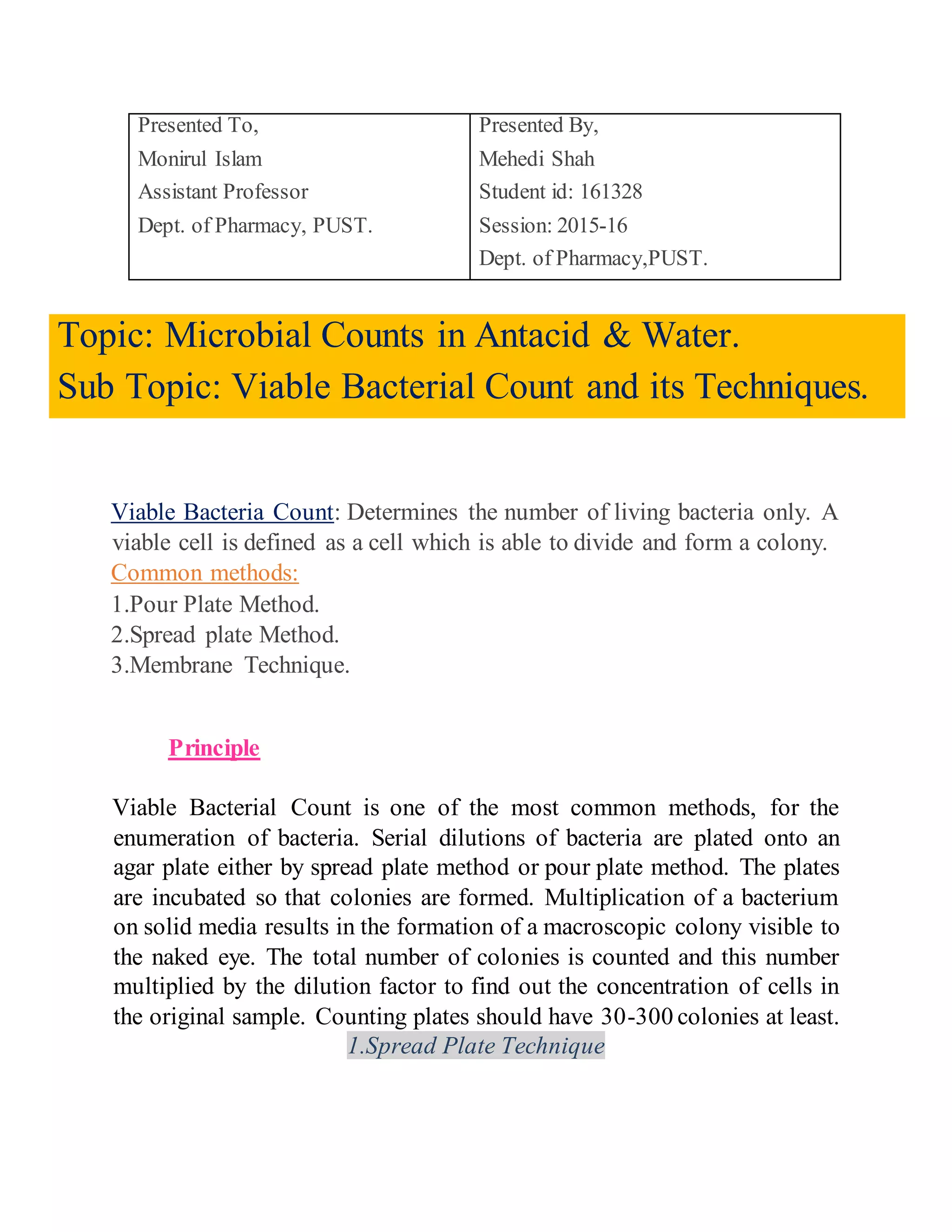
1.Spread Plate Technique
 Make a dilution series (a series of sequential dilution) from a
sample.
 Pipette out 0.1 ml onto the center of the surface of an agar plate.
 Dip the L-shaped glass spreader into alcohol.
 Spread the sample evenly over the surface of agar using the sterile
glass spreader, carefully rotating the Petri dish underneath at the
same time.
 Incubate the plates at 37°C until bacterial colonies grow.
 Calculate the CFU value of the sample. Once you count the
colonies, multiply by the appropriate dilution factor to determine
the number of CFU/ml in the original sample. Only plates with 30-
300 colonies are statistical.
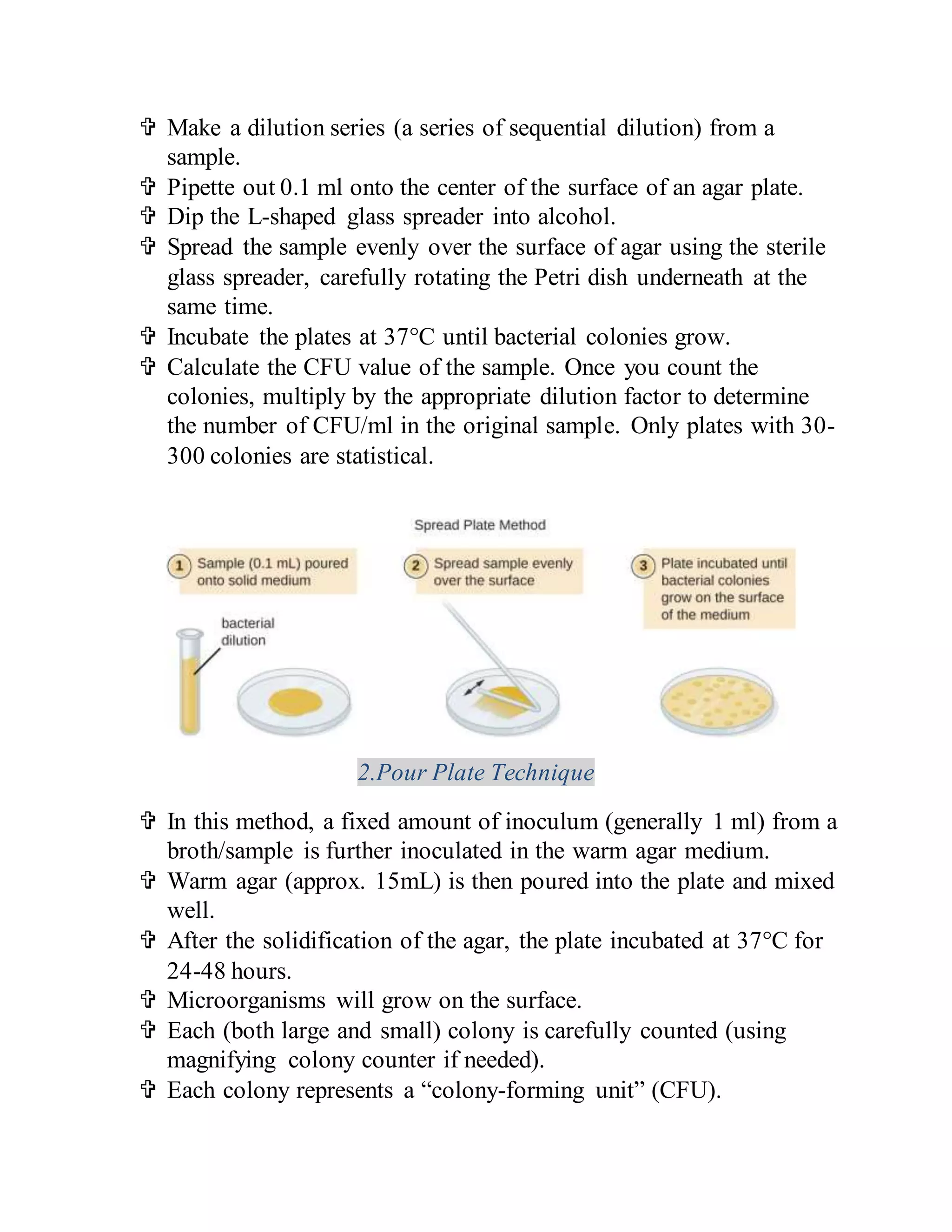
2.Pour Plate Technique
 In this method, a fixed amount of inoculum (generally 1 ml) from a
broth/sample is further inoculated in the warm agar medium.
 Warm agar (approx. 15mL) is then poured into the plate and mixed
well.
 After the solidification of the agar, the plate incubated at 37°C for
24-48 hours.
 Microorganisms will grow on the surface.
 Each (both large and small) colony is carefully counted (using
magnifying colony counter if needed).
 Each colony represents a “colony-forming unit” (CFU).
 The number of microorganisms present in the particular test
sample is determined using the formula:
CFU/mL= CFU x dilution factor /volume
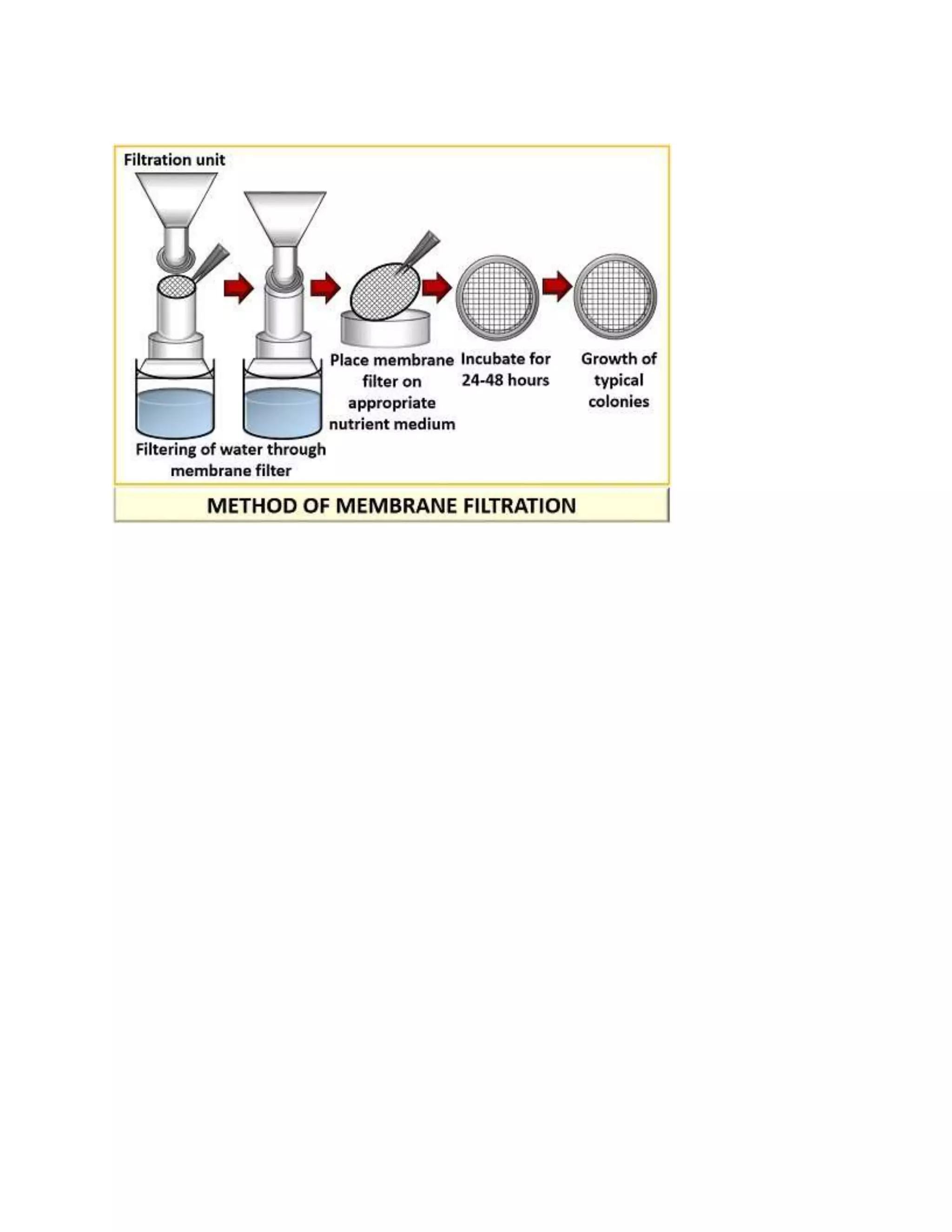
3.Membrane filter technique
 Bacteria from aquatic samples are trapped on membranes.
 Membrane filter placed on appropriate nutrient medium.
 Incubate for 24-48 hours so that colonies grow on
membrane.
 Colony count determines the number of bacteria in the
sample.
Viable bacterial count and its techniques.

Viable bacterial count and its techniques.

  • 1.
    Presented To, Monirul Islam AssistantProfessor Dept. of Pharmacy, PUST. Presented By, Mehedi Shah Student id: 161328 Session: 2015-16 Dept. of Pharmacy,PUST. Topic: Microbial Counts in Antacid & Water. Sub Topic: Viable Bacterial Count and its Techniques. Viable Bacteria Count: Determines the number of living bacteria only. A viable cell is defined as a cell which is able to divide and form a colony. Common methods: 1.Pour Plate Method. 2.Spread plate Method. 3.Membrane Technique. Principle Viable Bacterial Count is one of the most common methods, for the enumeration of bacteria. Serial dilutions of bacteria are plated onto an agar plate either by spread plate method or pour plate method. The plates are incubated so that colonies are formed. Multiplication of a bacterium on solid media results in the formation of a macroscopic colony visible to the naked eye. The total number of colonies is counted and this number multiplied by the dilution factor to find out the concentration of cells in the original sample. Counting plates should have 30-300 colonies at least. 1.Spread Plate Technique
  • 2.
     Make adilution series (a series of sequential dilution) from a sample.  Pipette out 0.1 ml onto the center of the surface of an agar plate.  Dip the L-shaped glass spreader into alcohol.  Spread the sample evenly over the surface of agar using the sterile glass spreader, carefully rotating the Petri dish underneath at the same time.  Incubate the plates at 37°C until bacterial colonies grow.  Calculate the CFU value of the sample. Once you count the colonies, multiply by the appropriate dilution factor to determine the number of CFU/ml in the original sample. Only plates with 30- 300 colonies are statistical. 2.Pour Plate Technique  In this method, a fixed amount of inoculum (generally 1 ml) from a broth/sample is further inoculated in the warm agar medium.  Warm agar (approx. 15mL) is then poured into the plate and mixed well.  After the solidification of the agar, the plate incubated at 37°C for 24-48 hours.  Microorganisms will grow on the surface.  Each (both large and small) colony is carefully counted (using magnifying colony counter if needed).  Each colony represents a “colony-forming unit” (CFU).
  • 3.
     The numberof microorganisms present in the particular test sample is determined using the formula: CFU/mL= CFU x dilution factor /volume 3.Membrane filter technique  Bacteria from aquatic samples are trapped on membranes.  Membrane filter placed on appropriate nutrient medium.  Incubate for 24-48 hours so that colonies grow on membrane.  Colony count determines the number of bacteria in the sample.