Exercise 15:
Carbohydrate Catabolism (part2)
Fermentation
Fermentation tubes
• To detect acid and gas production
• Contain:
- peptone – source of nitrogen
- an acid/base indicator (phenol red),
o It is red in neutral condition,
o Will turn yellow in acidic condition
- inverted tube to trap gas (durham tube), -
- 0.5-1.0 % carbohydrate.
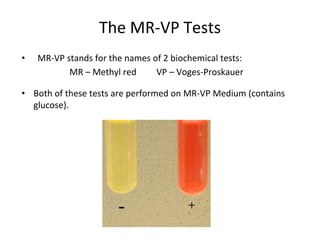
The MR-VP Tests
• MR-VP stands for the names of 2 biochemical tests:
MR – Methyl red VP – Voges-Proskauer
• Both of these tests are performed on MR-VP Medium (contains
glucose).
The Methyl Red Test
• This test determines if a bacterium is capable of mixed acid fermentation.
• Mixed acid fermentation results when glucose is fermented to produce acids, which
lowers the pH of the media.
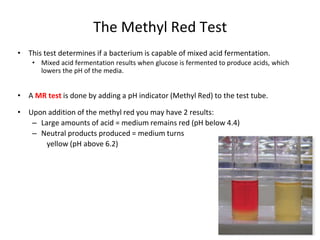
• A MR test is done by adding a pH indicator (Methyl Red) to the test tube.
• Upon addition of the methyl red you may have 2 results:
– Large amounts of acid = medium remains red (pH below 4.4)
– Neutral products produced = medium turns
yellow (pH above 6.2)
The Voges-Proskauer Test
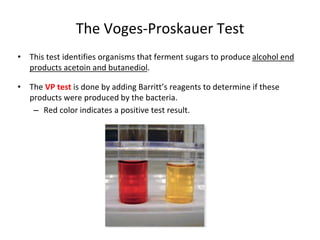
• This test identifies organisms that ferment sugars to produce alcohol end
products acetoin and butanediol.
• The VP test is done by adding Barritt’s reagents to determine if these
products were produced by the bacteria.
– Red color indicates a positive test result.
Methyl Red + Vogeus-Proskaeur +
Alcohol
The Citrate Test
• Citrate can be utilized by some bacteria as a source of energy but ONLY if
they can transport it into their cell.
• Nitrogen (from a source such as ammonium - NH4
+) is also a requirement
for growing bacteria.
• Citrate agar contains citrate (carbon source), ammonium phosphate
(nitrogen source), and bromthymol blue (pH indicator).
• Utilization of citrate and nitrogen release alkaline by-products which
raise the pH and result in a color change of the media from green to blue.
The Citrate Test
Materials
( per group of 2 -3 students)
• Glucose Fermentation tube ( 1 )
• Lactose Fermentation tube ( 1 )
• Sucrose Fermentation tube ( 1 )
• MRVP tubes (4)
• Simmons citrate agar slants (2)
Bacterial cultures (as assigned)
• Fermentation tubes:
– Group 1,5,9 Escherichia coli
– Group 2,6,10 Enterobacter aerogenes
– Group 3,7,11 Alcaligenes faecalis
– Group 4,8,12 Proteus vulgaris
• MRVP tests: (all groups)
– 2 MRVP tubes Escherichia coli
– 2 MRVP tubes Enterobacter aerogenes
• Citrate tests: ( all groups)
– 1 Simmons citrate tubes Escherichia coli
– 1 Simmons citrate tubes Enterobacter aerogenes
observation
• Fermentation Tubes:
– Yellow means positive
– Red means negative
– Bubbles means gas
production
- Record your results on page 105
MR (Methyl Red) test
– To one tube of each MRVP set (one E. coli and
One Enterobacter), add 5 drops of methyl red.
• Record your results on page 106
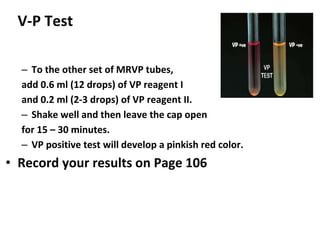
V-P Test
– To the other set of MRVP tubes,
add 0.6 ml (12 drops) of VP reagent I
and 0.2 ml (2-3 drops) of VP reagent II.
– Shake well and then leave the cap open
for 15 – 30 minutes.
– VP positive test will develop a pinkish red color.
• Record your results on Page 106
Citrate test
• Record your results on Page 106.

Bio235_Exe.15 Fermentation_Fall19.pptx

  • 1.
  • 2.
    Fermentation tubes • Todetect acid and gas production • Contain: - peptone – source of nitrogen - an acid/base indicator (phenol red), o It is red in neutral condition, o Will turn yellow in acidic condition - inverted tube to trap gas (durham tube), - - 0.5-1.0 % carbohydrate.
  • 3.
    The MR-VP Tests •MR-VP stands for the names of 2 biochemical tests: MR – Methyl red VP – Voges-Proskauer • Both of these tests are performed on MR-VP Medium (contains glucose).
  • 4.
    The Methyl RedTest • This test determines if a bacterium is capable of mixed acid fermentation. • Mixed acid fermentation results when glucose is fermented to produce acids, which lowers the pH of the media. • A MR test is done by adding a pH indicator (Methyl Red) to the test tube. • Upon addition of the methyl red you may have 2 results: – Large amounts of acid = medium remains red (pH below 4.4) – Neutral products produced = medium turns yellow (pH above 6.2)
  • 5.
    The Voges-Proskauer Test •This test identifies organisms that ferment sugars to produce alcohol end products acetoin and butanediol. • The VP test is done by adding Barritt’s reagents to determine if these products were produced by the bacteria. – Red color indicates a positive test result.
  • 6.
    Methyl Red +Vogeus-Proskaeur + Alcohol
  • 8.
    The Citrate Test •Citrate can be utilized by some bacteria as a source of energy but ONLY if they can transport it into their cell. • Nitrogen (from a source such as ammonium - NH4 +) is also a requirement for growing bacteria. • Citrate agar contains citrate (carbon source), ammonium phosphate (nitrogen source), and bromthymol blue (pH indicator). • Utilization of citrate and nitrogen release alkaline by-products which raise the pH and result in a color change of the media from green to blue.
  • 9.
  • 11.
    Materials ( per groupof 2 -3 students) • Glucose Fermentation tube ( 1 ) • Lactose Fermentation tube ( 1 ) • Sucrose Fermentation tube ( 1 ) • MRVP tubes (4) • Simmons citrate agar slants (2)
  • 12.
    Bacterial cultures (asassigned) • Fermentation tubes: – Group 1,5,9 Escherichia coli – Group 2,6,10 Enterobacter aerogenes – Group 3,7,11 Alcaligenes faecalis – Group 4,8,12 Proteus vulgaris • MRVP tests: (all groups) – 2 MRVP tubes Escherichia coli – 2 MRVP tubes Enterobacter aerogenes • Citrate tests: ( all groups) – 1 Simmons citrate tubes Escherichia coli – 1 Simmons citrate tubes Enterobacter aerogenes
  • 13.
    observation • Fermentation Tubes: –Yellow means positive – Red means negative – Bubbles means gas production - Record your results on page 105
  • 14.
    MR (Methyl Red)test – To one tube of each MRVP set (one E. coli and One Enterobacter), add 5 drops of methyl red. • Record your results on page 106
  • 15.
    V-P Test – Tothe other set of MRVP tubes, add 0.6 ml (12 drops) of VP reagent I and 0.2 ml (2-3 drops) of VP reagent II. – Shake well and then leave the cap open for 15 – 30 minutes. – VP positive test will develop a pinkish red color. • Record your results on Page 106
  • 16.
    Citrate test • Recordyour results on Page 106.