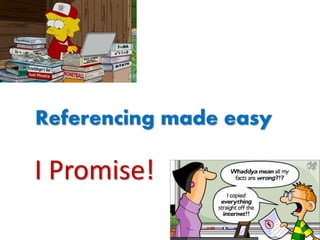
Referencing made easy
I Promise!
Nothing to be Afraid of!
Getting Started
• The following slides
offer a basic why,
when, where and
how guide to
referencing
• Some short quizzes
are also included so
that you can check
your own progress
What we will look at
1. The reasons why we
need to reference when
writing college papers
2. When and where we
reference
3. How we reference using
the APA style
What is referencing?
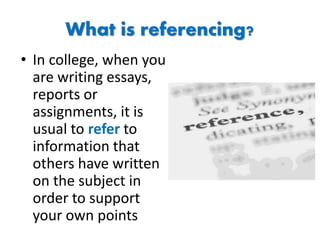
• In college, when you
are writing essays,
reports or
assignments, it is
usual to refer to
information that
others have written
on the subject in
order to support
your own points
Words Explained
“A book or passage referred to”
“The quoting of a book or author in
support of a fact”
(source: www.thefreedictionary.com )
Reference
Citation
Why do I need to reference?
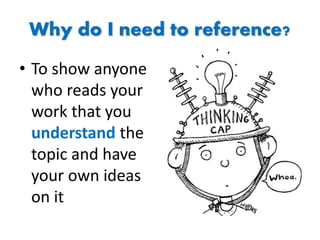
• To show anyone
who reads your
work that you
understand the
topic and have
your own ideas
on it
Why do I need to reference?
• To show that you
have become
knowledgeable
on a subject
through reading
a broad range of
material
Why do I need to reference?
• To allow the
reader of
your work to
find where
you got your
ideas from
Why do I need to reference?
• To provide the reader of your work with the
location and details of the original source of
the information
CHEATING
Why do I need to reference?
Academic Honesty
• It is important that you do not intentionally or
unintentionally pass off someone else's work
as your own
• If your work is being assessed, it is important
that you are not suspected of plagiarism
There are
CONSEQUENCES!
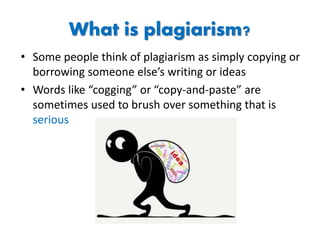
What is plagiarism?
• Some people think of plagiarism as simply copying or
borrowing someone else’s writing or ideas
• Words like “cogging” or “copy-and-paste” are
sometimes used to brush over something that is
serious
When and Where to Reference
When do I need to reference?
• There are two occasions when you need to
reference in your writing
1. Within the text, known as “in-text citation”
2. In detail in a reference list at the end of your
work, also known as a Bibliography
Where do I reference? – in-text citation
• This depends on what
you are doing
• If you are referring to an
idea or theory of another
in your own words,
known as paraphrasing
• You can include reference
at the beginning or the
end of a sentence
Where do I reference? – in-text citation
Example:
• Smith (2003, p.54)
indicates that the best
model for ............
or
• The best approach for
this application is Smith’s
model (Smith, 2003,
p.54)
Try it for Yourself!
• For the following two examples, drag and
drop the correct information from the bottom
of the page to complete the in-text citation as
a reference to a piece from John Doe’s book
from 2007, page 28
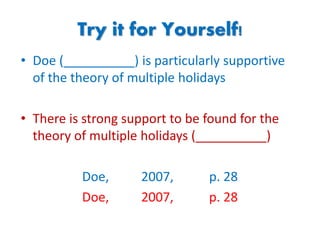
Try it for Yourself!
• Doe (__________) is particularly supportive
of the theory of multiple holidays
• There is strong support to be found for the
theory of multiple holidays (__________)
Doe, 2007, p. 28
Doe, 2007, p. 28
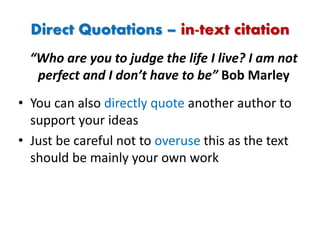
Direct Quotations – in-text citation
• You can also directly quote another author to
support your ideas
• Just be careful not to overuse this as the text
should be mainly your own work
“Who are you to judge the life I live? I am not
perfect and I don’t have to be” Bob Marley
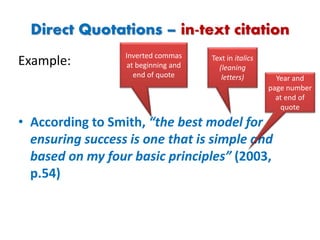
Direct Quotations – in-text citation
Example:
• According to Smith, “the best model for
ensuring success is one that is simple and
based on my four basic principles” (2003,
p.54)
Inverted commas
at beginning and
end of quote
Text in italics
(leaning
letters) Year and
page number
at end of
quote
How to Reference
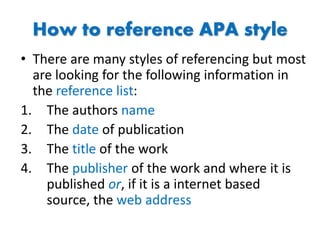
How to reference APA style
• There are many styles of referencing but most
are looking for the following information in
the reference list:
1. The authors name
2. The date of publication
3. The title of the work
4. The publisher of the work and where it is
published or, if it is a internet based
source, the web address
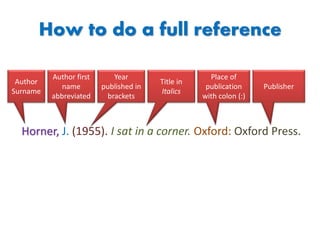
How to do a full reference
Horner, J. (1955). I sat in a corner. Oxford: Oxford Press.
Author
Surname
Author first
name
abbreviated
Year
published in
brackets
Title in
Italics
Place of
publication
with colon (:)
Publisher
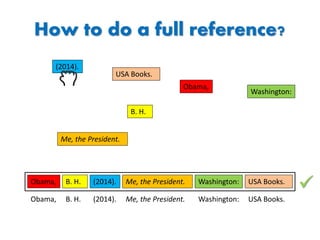
How to do a full reference?
Obama, B. H. (2014). Me, the President. Washington: USA Books.
Obama,
B. H.
(2014).
Me, the President.
Washington:
USA Books.
Obama, B. H. (2014). Me, the President. Washington: USA Books.


Referencing made easy

  • 1.
  • 2.
    Nothing to beAfraid of!
  • 3.
    Getting Started • Thefollowing slides offer a basic why, when, where and how guide to referencing • Some short quizzes are also included so that you can check your own progress
  • 4.
    What we willlook at 1. The reasons why we need to reference when writing college papers 2. When and where we reference 3. How we reference using the APA style
  • 5.
    What is referencing? •In college, when you are writing essays, reports or assignments, it is usual to refer to information that others have written on the subject in order to support your own points
  • 6.
    Words Explained “A bookor passage referred to” “The quoting of a book or author in support of a fact” (source: www.thefreedictionary.com ) Reference Citation
  • 7.
    Why do Ineed to reference?
  • 8.
    Why do Ineed to reference? • To show anyone who reads your work that you understand the topic and have your own ideas on it
  • 9.
    Why do Ineed to reference? • To show that you have become knowledgeable on a subject through reading a broad range of material
  • 10.
    Why do Ineed to reference? • To allow the reader of your work to find where you got your ideas from
  • 11.
    Why do Ineed to reference? • To provide the reader of your work with the location and details of the original source of the information
  • 12.
    CHEATING Why do Ineed to reference?
  • 13.
    Academic Honesty • Itis important that you do not intentionally or unintentionally pass off someone else's work as your own • If your work is being assessed, it is important that you are not suspected of plagiarism There are CONSEQUENCES!
  • 14.
    What is plagiarism? •Some people think of plagiarism as simply copying or borrowing someone else’s writing or ideas • Words like “cogging” or “copy-and-paste” are sometimes used to brush over something that is serious
  • 15.
    When and Whereto Reference
  • 16.
    When do Ineed to reference? • There are two occasions when you need to reference in your writing 1. Within the text, known as “in-text citation” 2. In detail in a reference list at the end of your work, also known as a Bibliography
  • 17.
    Where do Ireference? – in-text citation • This depends on what you are doing • If you are referring to an idea or theory of another in your own words, known as paraphrasing • You can include reference at the beginning or the end of a sentence
  • 18.
    Where do Ireference? – in-text citation Example: • Smith (2003, p.54) indicates that the best model for ............ or • The best approach for this application is Smith’s model (Smith, 2003, p.54)
  • 19.
    Try it forYourself! • For the following two examples, drag and drop the correct information from the bottom of the page to complete the in-text citation as a reference to a piece from John Doe’s book from 2007, page 28
  • 20.
    Try it forYourself! • Doe (__________) is particularly supportive of the theory of multiple holidays • There is strong support to be found for the theory of multiple holidays (__________) Doe, 2007, p. 28 Doe, 2007, p. 28
  • 21.
    Direct Quotations –in-text citation • You can also directly quote another author to support your ideas • Just be careful not to overuse this as the text should be mainly your own work “Who are you to judge the life I live? I am not perfect and I don’t have to be” Bob Marley
  • 22.
    Direct Quotations –in-text citation Example: • According to Smith, “the best model for ensuring success is one that is simple and based on my four basic principles” (2003, p.54) Inverted commas at beginning and end of quote Text in italics (leaning letters) Year and page number at end of quote
  • 23.
  • 24.
    How to referenceAPA style • There are many styles of referencing but most are looking for the following information in the reference list: 1. The authors name 2. The date of publication 3. The title of the work 4. The publisher of the work and where it is published or, if it is a internet based source, the web address
  • 25.
    How to doa full reference Horner, J. (1955). I sat in a corner. Oxford: Oxford Press. Author Surname Author first name abbreviated Year published in brackets Title in Italics Place of publication with colon (:) Publisher
  • 26.
    How to doa full reference? Obama, B. H. (2014). Me, the President. Washington: USA Books. Obama, B. H. (2014). Me, the President. Washington: USA Books. Obama, B. H. (2014). Me, the President. Washington: USA Books. 