The Nottingham Trent University
Nottingham Business School
CIISM (BUSI 42632) Assignment
Critical analysis of Tesla Motors, Inc.
entry to the Japanese market and its
strategic position
Student ID: N0611xxx Nottingham
Word Count: 4,500 January 2015
N0611318 - 2014-2015 2
TABLE OF CONTENTS
Executive Summary ..............................................................................4
INTRDUCTION......................................................................................5
1. Critical Literature Review..................................................................6
2. Tesla Motors, Inc. Company Overview................................................9
2.1 History........................................................................................9
2.2 Corporate Strategy.....................................................................9
2.2.1 2014 Patent Giveaway .........................................................10
2.3 Strategic Marketing Plan ...........................................................11
2.3.1 Market Share......................................................................11
2.4 SWOT Analysis.........................................................................11
2.4.1 Strengths ...........................................................................11
2.4.2 Weaknesses .......................................................................12
2.4.3 Opportunities......................................................................12
2.4.4 Threats ..............................................................................13
3. BEV Environment in Japan ..............................................................13
3.1 Strategic Considerations for Tesla’s Entry to Japanese Markets ......14
3.2 Macroeconomic Environment Analysis .........................................14
3.3 Microeconomic Environment Analysis ..........................................18
3.4 Key Success Factors .................................................................20
4. Critical Evaluation of Tesla’s Entry to the Japanese BEV Market ...........20
CONCLUSION ..................................................................................23
Bibliography.......................................................................................25
List of Acronyms and Abbreviations: .....................................................30
N0611318 - 2014-2015 3
Appendices ........................................................................................31
Appendix 1-A ..................................................................................31
Appendix 1-B ..................................................................................31
Appendix 2-A ..................................................................................32
Appendix 2-B ..................................................................................32
Appendix 2-C ..................................................................................33
Appendix 2-D ..................................................................................35
Appendix 2-E...................................................................................35
Appendix 2-F...................................................................................36
Appendix 3-A ..................................................................................37
Appendix 3-B ..................................................................................37
Appendix 3-B ..................................................................................40
N0611318 - 2014-2015 4
Executive Summary
This critical analysis provides evaluation of Tesla Motors Inc. market
entry to Japan. Several assumptions were made considering different
perspectives of Japanese electric vehicle industry and environment using
acknowledged frameworks such as PESTL analysis. Regarding Tesla, the
report suggests that it has effectively executed a new market entry thanks to
its niche product, strategic alliances and a unique direct-to-customer selling
model. Furthermore, Japanese consumers are considered ideal since they are
technologically savvy, environmentally cautious and the nation has a well-
developed network of charging stations.
The author did not use an existing case study, a new case was built
based on careful observations and study of a given area. This investigation
was addressed from a general perspective based upon extended literature
research. A qualitative, exploratory approach was adopted for the analysis.
Research was conducted via extensive secondary literature collection and data
analysis, as well as in-depth examination of case studies and online sources.
Key conclusions are: (1) Japanese BAV market represents a viable
option for international expansion; (2) Tesla offers an unmatched product in
Japan and is likely to capitalize upon this expansion; (3) the existing
competitors represent a treat should they manage to enforce other than plug-
in technologies, most notably fuel-cells hybrids.
Limitations: Tesla is a relatively newly established company (2003) and not
surprisingly, the amount of academic research dedicated to the company is
limited. The author used a large range of online sources tracing Tesla’s current
development as he believes these sources are most relevant and up to date.
N0611318 - 2014-2015 5
INTRDUCTION
In direct compliance with perceived globalization trends, Tesla Motors,
Inc. (Tesla) seeks to expand their business internationally and increase their
global presence (Tesla, 2013). With its highly unique product, electric vehicle
engineering expertise, and operational structure differentiates, Tesla
managed to find a competitive edge and differentiate itself from world
incumbent automobile manufacturers. In 2014, Tesla performed a strategic
entry to Japan, United Kingdom, China, and Australia (Tesla, 2013).
The author of this report will direct his focus to critically evaluate entry
to the Japanese market (commenced September 2014) considering (but not
limited to) the following: (1) Japan's per-capita penetration of electric vehicles
(EVs) is comparable to the U.S.'s (Wile, 2014); (2) Japanese consumers are
known to be extremely open to new technologies and enormously demanding
in terms of quality (Yu, 2013); (3) rapidly growing power-charging Japanese
infrastructure and a very convenient size of the country (compared to the
United States or Australia) diminishes concerns with electricity shortages
experienced while driving (Takahashi, 2013). Although Tesla employs a global
branding strategy and is supremely technologically developed, it is still
generally perceived as a young company in a somewhat undiscovered industry
niche – electric automobiles (compared to a 100-year-old internal combustion
automobile industry), which represents a challenge.
The core international strategic issues addressed in this report include:
(1) analysis of Tesla’s corporate strategy and major developments within the
electric vehicle industry which shall help enter the Japanese market; (2)
analysis of Japanese market situation based on acknowledged strategic
frameworks – Porter’s Five Forces, PESTLE, SWOT (for Tesla); and (3) Tesla’s
possible future response to capitalize on this specific market opportunity.
N0611318 - 2014-2015 6
1. Critical Literature Review
International expansion of originally domestic companies has become a
very common occurrence in the contemporary business world. The past three
decades represented a fundamental shift from a world where national
economies posed as self-contained bodies separated from one another by a
variety of barriers, tariffs, quotas, cross-trade regulations all of which
hindered internationalization and global business. Hill (2011) argues that we
are currently moving towards a world where barriers to cross-border trade are
declining, distances are diminishing thanks to advanced transportation,
communication and technology, and national economies are in the process of
merging into an interdependent, integrated global economic system.
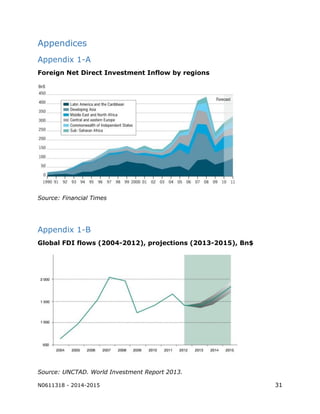
Additionally, further bolstering his statements, global FDIs have been on a
steady rise (see Appendix 1-A, Appendix 1-B) providing direct evidence of
globalization tendencies (with respect to global move of goods, services and
investments.
Schlie and Yip (2000, p. 343) claim that “the effects of globalisation
have fundamentally changed the rules of global competition,” and, that a large
number of international businesses has reacted accordingly by abandoning
multi-domestic (Porter, 1986), multinational (Barlett & Ghoshal, 1989), or
multi-local (Yip, 1992) strategies preferring strategies which tend to be more
globally integrated. Research and empirical evidence suggest that the key for
success in global strategy is to discover a perfect balance between local
adaptation (responsiveness) and global standardization.
In his immensely influential essay, Levitt (1983) proclaims that well-
managed firms evolved from customization towards global products (such as
Tesla’s Model S) which build on solid performance, functionality and low
pricing. He declares that it is only the companies that decide to completely
embrace global approach, will achieve sustainable track of success, as the
N0611318 - 2014-2015 7
world is powerfully driven towards a ‘single converging commonality’ due to
significant technological progress accelerating all areas of international
business. Rugman (2001), on the other hand, positions his views strongly
against universal globalization claiming strong governmental regulation limits
free market forces. He proposes a ‘think local, act regional and forget global’
strategy for international expansion. Thus, the core decision problem when
entering new markets lies between a focus distinctive regional elements
strategies, and entirely global strategies.
Furthermore, according to Koning, Subramanian & Verdin (2004), the
discussion on globalization at the firm level is dominated by two major
frameworks. The first one is an integration-responsiveness framework
proposed by Prahalad and Doz (1987), which gulfs the strategy into two
opposite challenges: scale efficiencies might be achieved from high levels of
integration but at the same time might cause low levels of local
responsiveness or national differentiation. The second framework introduced
by Bartlett and Ghoshal (1989) is predominantly perceived as an extension of
the former with an additional element of learning. Entering a foreign market,
Tesla faces a challenge whether or not customize its product to be fully locally
responsive or fully globally universal (current status quo).
Submerging deeper into the topic of international business strategies,
Wall, Minocha & Rees (2010) offer another division: global strategy,
transnational strategy, international strategy and multi-domestic strategy.
The appropriateness of each individual strategy depends significantly on the
amount of pressures faced by the international business with regards to both
local responsiveness and cost structure.
In terms of a new market entry, complex analysis of the market needs
to be performed prior to the entry. External analysis highlights generic
influential environmental forces the company needs to cope with; a leading
N0611318 - 2014-2015 8
example is the PESTLE analysis – political, economic, social, technological,
legal and ecological factors investigation to reveal number of threats and
opportunities (Wall, et al., 2010), whereas an internal analysis identifies areas
in which the company is doing extraordinarily well – strengths, and those
features which potentially constrain its capacity to evolve profitably –
weaknesses (together forming a SWOT analysis). Once current strengths and
environmental opportunities are matched, strategic prospects arise.
Furthermore, Porter (2008, p. web) argued that the very essence of strategic
planning is managing competition: “The strongest competitive force or forces
determine the profitability of an industry and become the most important to
strategy formulation.” Levitt (1983) notably remarked that accustomed
differences lie both in national and regional preferences; this statement
perfectly justifies a market entry for an American automobile maker with a
very standardized model portfolio to Japan to further extend its distribution
channels, and is well in accordance with Yip’s (1992) proposal of a “total
global” strategy.
A new market entrant bearing unique technologies and products as its
main competitive advantage might exploit imperfect reaction of incumbent
companies already within that market. Hill and Rothaermel (2003) offer an
elaboration on incumbent firms’ responsiveness to technological progress and
innovation. Incumbents tend to decline, while new entrants exploit the new
technology and rise to market dominance. Tesla is a prime example of such
case since they are currently in possession technological competitive
advantage. Researchers attribute this decline to incumbents' failure to
embrace the new technology which sometimes leads to a certain lag between
new-technology embracers and incumbents.
According to Buckley and Casson (1998), it is assumed that the entrant
is able to anticipate the reaction of its rival in the leading-host country, and
incorporate it into its market entry strategy. In addition, they argue that
N0611318 - 2014-2015 9
technological and marketing skills have been identified as the key elements in
a successful foreign market entry.
Sturgeon et al. (2009, p. 22) claim that global automotive industry is
comparable to other industries where “geographic scope of lead firms and
their largest suppliers expanded in a wave of offshore investments, mergers,
acquisitions, and equity-based alliances in the 1990s.” Dominant leading
companies, industry associations and massive-scale employment shape the
overall perception of automotive industry in minds of consumers.
2. Tesla Motors, Inc. Company Overview
(Please, refer to Appendix 2-C)
2.1 History
(Please, refer to Appendix 2-C)
2.2 Corporate Strategy
According to Musk (2006), Tesla’s main objective has been to enter the
electric automotive market with premium, high-end product targeted at
wealthy clients. After Tesla has been able to secure larger customer base,
profitability, and wider acceptance, the company seeks to enter more
competitive markets at lower price points. Tesla strives to achieve this in three
ways:
(1) Direct marketing – cars are marketed and sold directly to consumers via
an international network of company-owned stores and galleries (Tesla,
2013). Tesla avoided the traditional automobile dealership model.
N0611318 - 2014-2015 10
(2) Stimulation of global electric vehicle interest and sales is to be
accomplished by large-scale selling of its patented electric powertrain
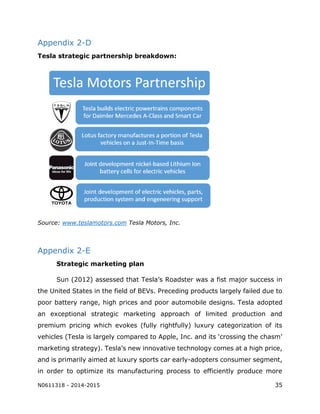
components to other automakers (Mangram, 2012). For Tesla’s partnership
breakdown, see Appendix 2-D.
(3) Establish a catalyst and a positive example of a unique combination of
eco-friendliness, sustainability and a comprehensive sports car experience.
Additionally, Tesla, along with its strategic partner Panasonic, have begun a
construction of a massive lithium-ion battery packs factory suitably called
‘gigafactory’ in Nevada. This project is strategically important since it will lead
to a significant cost reduction of these battery cells. It is estimated that by
2020, the ‘gigafactory’ will produce more lithium ion batteries than all of the
world’s combined output in 2013 (Tesla Motors, 2015).
Tesla’s Model S Sedan mass production initiated in 2012 allowed for
targeting larger customer segment of middle to upper-middle class consumers
since it came at a much more affordable price – around $60,000 (compared
to Tesla Roadster for averagely $109,000) (Seeking Alpha, 2011). Ultimately,
mass-market consumer segment will be targeted in 2015 with Tesla’s new
models available for under $30,000 (Mangram, 2012). See Appendix 2-E for
complete models overview.
2.2.1 2014 Patent Giveaway
In the spirit of open source movement, Tesla released all of its patent
holdings in June 2014. Musk (2014) famously proclaimed that “Tesla will not
initiate patent lawsuits against anyone who, in good faith, wants to use our
technology.” Wall Street reaction was in favour of this decision sending Tesla’s
stock price up 14% to $231/share at the time. This radical move strengthened
Tesla’s position and can be seen as a sophisticated move towards increased
global demand for electric vehicles. Tesla realized that competition lies within
N0611318 - 2014-2015 11
the enormous flood of combustion engine cars, now approaching 100 million
units produced annually.
2.3 Strategic Marketing Plan
(Please, refer to Appendix 2-E)
2.3.1 Market Share
King (2013) concludes that Tesla managed to seize a market share of
8.4 % in the U.S. luxury-car market. Currently, Tesla’s Model S is outselling
models such as the Audi A8 ($72,200), BMW 7 Series ($73,600) and Mercedes
S-Class ($92,350) (Neiger, 2013).
2.4 SWOT Analysis
Following SWOT analysis takes primarily Japanese market expansion
into consideration.
2.4.1 Strengths
 Cutting-edge technologies (vehicle design, powertrain technology,
battery technology) (Tesla Motors, 2015).
 Superior one-of-a-kind range of products especially in terms of
incomparable vehicle performance, vehicle range capabilities and unique
vehicle designs (Mangram, 2012).
 Forward-thinking, innovation-driven corporate leadership.
 Strong brand name recognition, positive reputation among customers
and critical acclaim.
N0611318 - 2014-2015 12
2.4.2 Weaknesses
 Minor scale of operations, currently no economies of scale leading to
higher production cost structure.
 Cash-intensive cost structure, investment-heavy industry (Walsh,
2014).
 Increased demand will lead to plausible component supply and product
output.
 BEV support infrastructure yet to achieve maturity and enlargement.
2.4.3 Opportunities
 Substantial barriers to entry in the BEV industry greatly limit potential
entrants (recently failed: Aptera, Venture Vehicles, TH!NK) (Mangram,
2012).
 Technological advances in Lithium-Ion battery systems extend range
per charge, life cycle and durability (Tesla Motors, 2015).
 Overall oil-peak anxieties and fears along with increasing oil prices.
Japan is completely dependent on oil imports (U.S. Energy Information
Administration, 2014).
 Environmental benefits seen behind Tesla’s eco-friendly approach (CO2
reduction and sustainability which is in positive correlation with
Japanese corporate social responsibility.
 Government subsidies, incentives and regulations in favour of BEV
industry, rebates, tax breaks, low-interest loans, grants, etc. (Japanese
subsidies are described below).
N0611318 - 2014-2015 13
2.4.4 Threats
 Large established Japanese motor companies with economies of scale
capabilities devoting more resources into BEV development inevitably
leading to increased competition.
 Extremely limited sales of foreign cars in Japan (less than 5%), thick
and impenetrable red tape, trade barriers.
 Potential key breakthrough (by competitors) in related alternative
energy technology (e.g. natural gas vehicles, ICE vehicles, plug-in/gas-
powered hybrids, etc.), and Fuel cells technology.
 Falling oil prices incentivising gasoline powered vehicles manufacturing
and sales (Tesla Motors, 2015).
 Limited BEV support infrastructure (charging stations network, etc.)
 Loss of government subsidies.
3. BEV Environment in Japan
For Tesla, there is a massive incentive to enter Japanese BEV market
since it is the second largest after the United States, hence creating a perfect
environment for distribution (Cob, 2014). Japan has continually ranked second
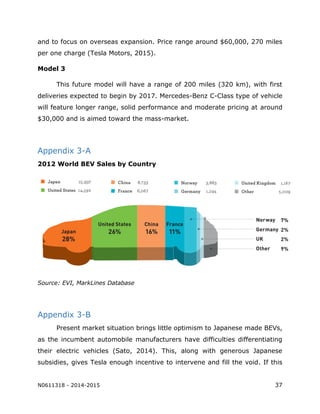
in market share of total BEV sales (Japan led the statistics in 2012, see
Appendix 3-A). Highway-capable BEV sales in 2013 reached 29,716 units
which accounts for 0.55% of total automobile sales in 2013 (International
Energy Agency, Clean Energy Ministerial, and Electric Vehicles Initiative,
2013).
The BEV support network is positively situated based on the following
observations:
(1) At the end of 2012, Japan became the leader with the highest ratio
charging points to the number of BEV vehicles (ratio 0.03).
N0611318 - 2014-2015 14
(2) Currently, there are 1,381 public quick-charge stations which
accounts for the largest number in any country worldwide.
(3) By 2020, Japanese government plans to install 2 million slow
chargers and 5,000 fast chargers (Navigant Consulting, 2013).
(4) Navigant (2013) expects Japan to be the leading market for BEV
sales in 2020, with approximately 900,000 units sold that year.
3.1 Strategic Considerations for Tesla’s Entry to Japanese
Markets
Tesla entered the Japanese market in September 2014 (Tesla Motors,
2015). Japan BEV market setup represents a unique combination of
environmental concerns, government support for electric cars, and a solid
base of wealthy customers who seek luxury brands (Assis, 2014). By the end
of 2015, Tesla’s own network of superchargers (which are capable of charging
50% of the battery in 20 minutes) is projected expand to 20 in the Tokyo
metro area and beyond. According to Musk, this service will forever remain
free for the Model S owners which has been viewed as a major catalyst for
Tesla sales (Mangram, 2012)
Tesla managed to find its way to Japan via strategic alliances with
Toyota (which is now inactive as Toyota embraced fuel-cell technologies) and
Panasonic – both dominant Japanese companies (Mangram, 2012).
3.2 Macroeconomic Environment Analysis
Drawing on Rugman and Collison (2012), PESTL framework is one of the
most general and multidisciplinary frameworks used to assess particular
competitive environments and investment contexts for companies at both
national and regional levels. Due to its significance and comprehensiveness,
N0611318 - 2014-2015 15
the author of this report will use this model to analyse the macro-
environmental factors relevant to Tesla.
Political factor
Although being a constitutional monarchy, Japan’s Emperor Akihito
holds little power compared to the Prime Minister Shinzō Abe (Prime Minister
of Japan and His Cabinet, 1947). Based on the free enterprise capitalism
principles, Japan emerged as the most developed nation in Asia. More
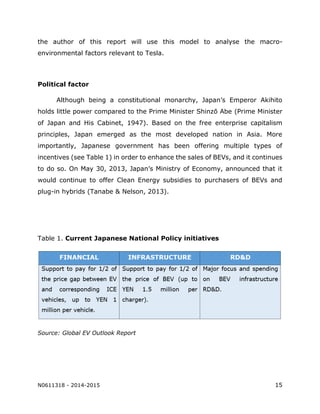
importantly, Japanese government has been offering multiple types of
incentives (see Table 1) in order to enhance the sales of BEVs, and it continues
to do so. On May 30, 2013, Japan’s Ministry of Economy, announced that it
would continue to offer Clean Energy subsidies to purchasers of BEVs and
plug-in hybrids (Tanabe & Nelson, 2013).
Table 1. Current Japanese National Policy initiatives
Source: Global EV Outlook Report
N0611318 - 2014-2015 16
Economic factor
In terms of nominal GDP (total $4.788 trillion (4th)/per capita $37,683
(28th) (International Monetary Fund, 2014)), Japan is the third largest
national economy in the world, after the United States and China, and the
fourth largest national economy in the world in purchasing power parity
(International Monetary Fund, 2014). During 1990s and early 2000s, Japan
experienced a massive slow-down, often referred to as ‘Lost Decade’ largely
due to the consequences of the Japanese asset price bubble and a subsequent
banking crisis.
Japan’s noteworthy PPP implies potentially strong buying power of
consumers, a fact which is crucially relevant to Tesla, since it primarily targets
higher-income clientele. Japan's infrastructure supporting BEVs is well-
developed and road spending is extensive. Contrariwise, prevailing deflation
and diminishing domestic demand pose a threat to Tesla (International
Monetary Fund, 2014). Additionally, the country’s public debt has increased
to 238% of GDP which inevitably leads to decreased ability of Japanese
government to stimulate the economy through increased spending (possibly
negatively affecting BEV infrastructure subsidies).
Social factor
Japan's population of 126 million has experienced a remarkable growth
rate in the last 100 years (now decreasing) as a result of scientific, industrial,
and sociological progress. Japan has the second highest life expectancy with
83.5 years which implies overall health safety and long-term orientation which
can be positively linked to Tesla’s maximum focus on environmental
sustainability and driver’s safety (International Monetary Fund, 2014).
N0611318 - 2014-2015 17
Technological factor
Tesla’s Japanese expansion has a major advantage – Japan is a nation
of ‘technophiles’ (Yu, 2013), and the new Model S is viewed as a technological
marvel (Boyadjis, et al., 2014). Protuberant scientists and technology
researchers direct their attention to Japan, as it is on the pathway to becoming
one of the world’s leaders in industrial technology, infrastructure, and
intelligence transport system (Thornton, 2004). Japanese government heavily
subsidies BEV infrastructure development and the overall setup is principally
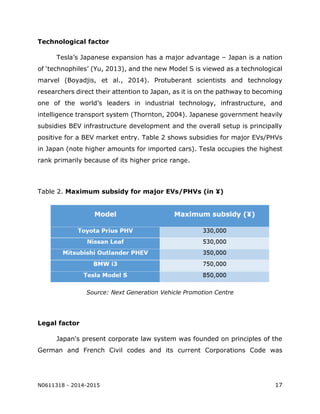
positive for a BEV market entry. Table 2 shows subsidies for major EVs/PHVs
in Japan (note higher amounts for imported cars). Tesla occupies the highest
rank primarily because of its higher price range.
Table 2. Maximum subsidy for major EVs/PHVs (in ¥)
Source: Next Generation Vehicle Promotion Centre
Legal factor
Japan's present corporate law system was founded on principles of the
German and French Civil codes and its current Corporations Code was
N0611318 - 2014-2015 18
implemented in 2006. Tesla operates as Kabushiki kaisha (KK), a type similar
to a business corporation in the United States.
3.3 Microeconomic Environment Analysis
To evaluate Tesla’s microeconomic environment, Porter’s Five
Competitive Forces framework will be used. According to Porter (2008), to
fully define competitive interaction in a given industry, the extended rivalry
which stems from all five forces needs to be analysed.
Threat of new entrants
(HIGH) - Globalization allows businesses to expand internationally which
massively affects the automobile market. Generally, entering the car industry
requires heavy capital investments, however, for already established
producers with enough economic power, barriers to enter such markets are
low, especially when they can largely benefit from governments incentives for
BEVs. Tesla proved in Japan that incumbent manufacturers have been unable
to present a ground-breaking BEV product which would allow them to seize
enough market share to prevent Tesla from entering (Sato, 2014).
Bargaining power of suppliers
(MODERATE to HIGH) - Tesla currently uses components from more
than 200 suppliers worldwide (Tesla, 2013), and is greatly dependent on
them, as any delay in the value-chain causes immediate production disruption,
which would detrimentally affect the company’s image (Harryson & Keller,
2014). Completion of the ‘gigafactory’ in 2018 will help Tesla reduce
N0611318 - 2014-2015 19
dependency on its current battery supplier (Panasonic), and further decrease
costs by 30% (Tesla Motors, 2014).
The Bargaining Power of Buyers
(LOW to MODERATE) - It is important to distinguish between retail
customers and corporate buyers. Drawing on Tesla Annual Report (2013), the
relationship with Daimler and Toyota played a significant role for Tesla,
because Tesla’s profit is largely dependent on supplying these, thus their
power is considerably higher than the retail consumers’ power, who have little
or no negotiating leverage. Oppositely, Tesla sells a very unique product which
has no direct substitutes, is currently in a shortage of supplies, and no sales
are made in bulk so the pricing model remains relatively intact. Moreover,
government subsidy programs and tax credit deductions in Japan stimulate
BEV demand which further diminishes the bargaining power of Buyers.
Threat of Substitute products
(LOW to MODERATE) – Following direct substitutes are available in
Japan – vehicles: hybrid, hydrogen, fuel cells, ICE and BEV, and public
transportation systems (Tesla Motors, 2015). More importantly, the higher the
cost of operating the automobile such as the price of fuels, the more likely will
consumers seek alternative means of transportation. Tesla’s vehicles are
designed to require minimal maintenance, as well as operating costs, and are
targeted at consumers who are very environmentally cautious, hence likely to
seek eco-friendly means of transportation (much like Japanese consumers).
N0611318 - 2014-2015 20
Rivalry among existing competitors
(MODERATE to HIGH) – BEV market in Japan classifies among the
developed ones, however overall rivalry is incomparably smaller to IEC
industry. Major automobile manufacturers based in Japan: Nissan Motor
Company Ltd. of Yokohama, Honda Motor Co. of Tokyo, and the Toyota Motor
Corporation of Toyota City. For a competitor analysis, see Appendix 3-B.
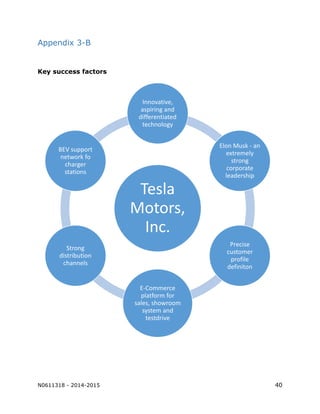
3.4 Key Success Factors
(Please, refer to Appendix 3-C)
4. Critical Evaluation of Tesla’s Entry to the Japanese
BEV Market
With respect to theories of Yip (1992), Levitt (1983), and Bartlett &
Ghoshal (1989), Tesla has decided to penetrate Japanese markets with a
standardized global product which only has minor local customizations
predominantly regarding right-hand steering system (which is also used in the
United Kingdom). The choice of this strategy has yet to prove successful.
Uniqueness and supremacy of Tesla’s products bear a significant competitive
advantage on which Tesla shall commercialize in Japan. Technological
advancement is well in compliance with Japanese perception of importance of
technology. The already well-established BEV infrastructure in Japan and
overall pro-electric mind-set is a favourable factor for Tesla’s expansion
endeavour. By entering the Japanese market, Tesla seized the opportunity to
profit from the first mover advantage, because foreign automakers, especially
the ones from the United States, sell only a small amount of automobiles in
Japan (only 4% non-Japanese cars sold) (Nakagawa, 2014). Foreign
N0611318 - 2014-2015 21
perception of Tesla’s products might be diminished by using Panasonic
batteries. Furthermore, the country’s generous BEV subsidy program,
developed public charging groundwork, and substantial price difference
between gasoline and electricity represent optimal conditions for the PEV
market expansion (Shepard, 2014).
In accordance with Hill and Rothaermel’ thesis (2003), incumbent
automakers in Japan have been unable to saturate the country’s demand for
high-quality luxury BEVs, thus allowing new entrants to capitalize. Strong
brand identity, differentiation heavy government subsidies shall serve as a
catalyst for Tesla to establish a strong initial position in the Japanese markets.
The company employs focus-differentiated strategy, targeting upper-income
level customers of which there is abundance in Japan, especially in Tokyo area
where the sales originate.
Tesla’s strategic partnership with Toyota (invested 50 million in Tesla)
benefited both companies as they exchanged knowhow and created
economies of scale (Seeking Alpha, 2011), and overall selling of components
creates a steady stream of revenue. Tesla's market influence is remarkable,
further bolstered by the decision to share their patents which could be critical
to the company's long-term success (Takahashi, 2013).
Rapid international expansion is well beyond Tesla’s budget, however
the investors see such occurrence as positive driving the stock up (currently
in a slight downtrend), and the company virtually promotes itself which brings
massive savings in marketing (Sparks, 2014). In the author’s opinion,
principal challenges for Tesla Japan are (1) mounting costs – primarily
supercharger network construction and expansion costs (new retail locations);
(2) delivery delays – Tesla is currently unable to satisfy demand for its
product; (3) strong position of existing rivals; and (4) fuel cells – Toyota
introduces the first purpose-built HFC car, the Mirai (Wahlman, 2014), as the
N0611318 - 2014-2015 22
Japanese Prime Minister Shinzo Abe confirmed that government will provide
additional support to the country's fuel-cell vehicle industry (Wile, 2014).
Additionally, the author considers Tesla’s superior product as its major
competitive advantage, especially in terms of their batteries: cells in Model S
have a specific energy of 233 Wh/kg (largely thanks to the NCA chemistry and
high-density electrodes). This results in an approximately 40% greater
efficiency than the current industry standard (155 Wh/kg) (Mangram, 2012).
The analysis suggests, that the following caveats: legal hindrances,
Japan’s powerful car lobby, Japanese sense of patriotic duty and national
pride. Tesla fully realizes the fact that they probably will not be able to sell
huge numbers of cars in protectionist Japan (Schnitt, 2012).
N0611318 - 2014-2015 23
CONCLUSION
Tesla’s entry to the Japanese market has a large potential considering
that the Japanese consumers will keep their demand for BEVs in current or
higher levels. Tesla found a very unique niche market which is poised for a
massive growth in Japan under status quo conditions where luxury vehicles
such as Model S should be Tesla’s main focus to avoid customer segments
occupied by Nissan Leaf and Toyota Prius.
Competitive environment in Japan indicates that major automobile
companies are already in the mass-market BEV plug-in hybrid segments. They
are substantially larger than Tesla and have decisive economies of scale,
marketing and production advantages, therefore Tesla must fully focus on
solidifying its brand recognition in Japan via advertising, and optimizing its
cost structure to extend its experience curve. The author views Japan’s
protectionist national automotive policy as self-constraining its own national
energy sustainability and greenhouse gas reduction goals. Favourably, more
BEVs which have substantial energy efficiency enhancements will reduce
Japan’s oil dependency issues. Tesla makes an impression of not merely an
automaker, but also a technology and design enterprise with a focus on energy
innovation, eco-friendliness and sustainability. Tesla’s competitive advantages
include: superior BEV technology, brand recognition, and exclusive component
product lines.
Major conclusions are: (1) Japanese BAV market represents a viable
option for Tesla’s international expansion predominantly due to the supportive
network of publicly accessible chargers, strong consumer awareness and
relatively high purchasing power parity; (2) Tesla introduced an unmatched
product in Japan and is likely to capitalize upon this expansion with further
employment of focus differentiated strategy, targeting upper-income level
customers; and (3) the existing competitors represent a threat should they
N0611318 - 2014-2015 24
manage to enforce other than plug-in technologies, most notably fuel-cells
hybrids.
Taking into consideration the analysis conducted on Tesla’s entry to the
Japanese market, the author suggests following recommendations: (1)
maintain strong product differentiation strategy for future market expansion
and retain Tesla’s brand name perception as cutting-edge and innovative; (2)
consider increasing advertising budgets as the brand is new to the Japanese
market; (3) extend production capacities to satisfy growing demand; (4)
establish Japanese supercharger network as rapidly as possible; (5) take full
advantage of government subsidies; and (6) eventually extend their product
portfolio to target middle-income consumers.
N0611318 - 2014-2015 25
Bibliography
Assis, C., 2014. Tesla map shows big plans for China, Japan. MarketWatch. [Online]
Available at: http://www.marketwatch.com/story/tesla-map-shows-big-plans-for-china-japan-2014-09-
10?siteid=rss&rss=1
[Accessed 21 December 2014].
Barlett, C. & Ghoshal, S., 1989. Managing Across Borders: The Transnational Solution. London:
Hutchinson Business.
Boyadjis, M., Rassweiler, A. & Brinley, S., 2014. IHS. IHS. [Online]
Available at: https://www.ihs.com/articles/features/tesla-motors.html
[Accessed 12 January 2015].
Buckley, P. J. & Casson, M. C., 1998. Analyzing Foreign Market Entry Strategies: Extending the
Internalization Approach. Journal of International Business Studies, 29(3), pp. 539-562.
Cob, J., 2014. Global Plug-in Car Sales Now Over 600,000. Hybridcars. [Online]
Available at: http://www.hybridcars.com/global-plug-in-car-sales-now-over-600000/
[Accessed 4 January 2015].
DE KONING, A., SUBRAMANIAN, V. & VERDIN, P., 2004. Reach for Regional Strategies for Global
Competitive Advantage. EconPapers.
Fehrenbacher, K., 2009. Tesla Founder Eberhard Files Lawsuit Against Tesla, Elon Musk. Giacom. [Online]
Available at: https://gigaom.com/2009/06/11/tesla-founder-eberhard-files-lawsuit-against-tesla-elon-
musk/
[Accessed 12 January 2015].
Garthwaite, J., 2009. Tesla Motors Claims $1M July Profit (a First!), Thanks to Roadster 2. Giacom.
[Online]
Available at: https://gigaom.com/2009/08/07/tesla-motors-claims-1m-july-profit-a-first-thanks-to-
roadster-2/
[Accessed 23 December 2014].
Harryson, S. & Keller, S., 2014. Tesla Motors Case II: From Technology Start up to Commercialization
Vehicle. CIEL-LAB. [Online]
Available at: http://ciel-lab.dk/wp-content/uploads/2013/04/Case_Tesla-Motors-Part-II.pdf
[Accessed January 4 2015].
Hill, C. W. L., 2011. International Business - Competing in the Global Marketplace. 8th ed. New York:
McGraw-Hill/Irwin.
Hill, C. W. & Rothaermel, F. T., 2003. The Performance of Incumbent Firms in the Face of Radical
Technological Innovation. The Academy of Management Review, April, 28(2), pp. 257-274.
International Energy Agency, Clean Energy Ministerial, and Electric Vehicles Initiative, 2013. Global EV
Outlook 2013 - Understanding the Electric Vehicle Landscape to 2020. [Online]
N0611318 - 2014-2015 26
Available at: http://www.iea.org/publications/globalevoutlook_2013.pdf
[Accessed 5 January 2015].
International Monetary Fund, 2014. Japan. [Online]
Available at:
http://www.imf.org/external/pubs/ft/weo/2014/02/weodata/weorept.aspx?pr.x=75&pr.y=13&sy=2014
&ey=2014&scsm=1&ssd=1&sort=country&ds=.&br=1&c=158&s=NGDPD%2CNGDPDPC%2CPPPGDP%2C
PPPPC&grp=0&a=
[Accessed 9 January 2015].
King, D., 2013. Tesla's 8.4% market share beats Audi A8, BMW 7 Series. Autoblog. [Online]
Available at: http://www.autoblog.com/2013/08/07/teslas-8-4-market-share-beats-audi-a8-bmw-7-
series/
[Accessed 4 January 2015].
LaMonica, M., 2011. Tesla's next act: Cheaper electric cars...and a profit?. [Online]
Available at: http://www.cnet.com/news/teslas-next-act-cheaper-electric-cars-and-a-profit/
[Accessed 3 January 2015].
Levitt, T., 1983. The Globalization of Markets. [Online]
Available at: https://hbr.org/1983/05/the-globalization-of-markets
[Accessed 12 1 2015].
Mangram, M. E., 2012. The globalization of Tesla Motors: a strategic marketing plan analysis. Journal of
Strategic Marketing, 20(4), pp. 289-312.
Musk, E., 2006. The Secret Tesla Motors Master Plan (just between you and me). [Online]
Available at: http://www.teslamotors.com/blog/secret-tesla-motors-master-plan-just-between-you-
and-me
[Accessed 2 January 2015].
Musk, E., 2014. All Our Patent Are Belong To You. [Online]
Available at: http://www.teslamotors.com/blog/all-our-patent-are-belong-you
[Accessed 22 December 2015].
Nakagawa, M., 2014. Tesla Motors began delivering in Japan. [Online]
Available at: http://toyokeizai.net/articles/-/47897
[Accessed 11 January 2015].
NASDAQ, 2015. NASDAQ. [Online]
Available at: http://www.nasdaq.com/symbol/tsla/after-hours
[Accessed 11 January 2015].
Navigant Consulting, 2013. Navigant forecasts hybrids to account for almost 4% of global LDV sales by
2020, plug-ins 3%. [Online]
Available at: http://www.greencarcongress.com/2013/06/navi-ev-20130611.html
[Accessed 30 December 2015].
N0611318 - 2014-2015 27
Neiger, C., 2013. Tesla Nabs 8% of the U.S. Luxury Car Market. [Online] Motley Fool.
Available at: http://www.fool.com/investing/general/2013/08/04/tesla-nabs-8-of-the-us-luxury-car-
market.aspx
[Accessed 23 January 2015].
Nissan Motors, 2013. Nissan LEAF Smashes 50,000 Global Sales Milestone. [Online] Nissan.
Available at: http://nissannews.com/en-US/nissan/usa/releases/nissan-leaf-smashes-50-000-global-
sales-milestone
[Accessed 25 January 2015].
Porter, M., 1986. Competition in Global Industries: A Conceptual Framework.. Boston, MA: Harvard
Business School Press.
Porter, M. A., 2008. The Five Competitive Forces That Shape Strategy. Harvard Business Review.
PRAHALAD, C. K. & DOZ, I. D., 1987. The Multinational Mission: Balancing Local Demands and Global
Vision. New York: Free Press.
Prime Minister of Japan and His Cabinet, 1947. Constitution of Japan. [Online] Japan Kantei.
Available at: http://japan.kantei.go.jp/constitution_and_government_of_japan/constitution_e.html
[Accessed 8 January 2015].
Rugman, A. M., 2001. VIEWPOINT: The Myth of Global Strategy. International Marketing Review, 18(6),
pp. 583 - 588.
Rugman, A. M. & Collison, S., 2012. International Business. 6th ed. Harlow: Pearson Education Limited.
Sanger, D. E., 1995. A DEAL ON AUTO TRADE: THE AGREEMENT; U.S. SETTLES TRADE DISPUTE, AVERTING
BILLIONS IN TARIFFS ON JAPANESE LUXURY AUTOS. [Online] New York Times.
Available at: http://www.nytimes.com/1995/06/29/us/deal-auto-trade-agreement-us-settles-trade-
dispute-averting-billions-tariffs.html
[Accessed 5 January 2015].
Sato, H., 2014. Big Subsidies for Foreign Electric Cars in Japan. [Online] Nikkei Business.
Available at: http://business.nikkeibp.co.jp/article/eng/20140916/271299/
[Accessed 24 January 2015].
Seeking Alpha, 2011. Is Tesla Motors Ready to Accelerate?. [Online] Seeking Alpha.
Available at: http://seekingalpha.com/article/253638-is-tesla-motors-ready-to-accelerate
[Accessed 3 January 2015].
Seeking Alpha, 2011. Is Tesla Motors Ready to Accelerate?. [Online] Seeking Alpha.
Available at: http://seekingalpha.com/article/253638-is-tesla-motors-ready-to-accelerate
[Accessed 9 January 2015].
Shepard, S., 2014. Tesla Breaks into Japan. [Online] Forbes.
Available at: http://www.forbes.com/sites/pikeresearch/2014/09/30/tesla-breaks-into-japan/
[Accessed 7 January 2015].
N0611318 - 2014-2015 28
SCHLIE, E. & YIP, G., 2000. Regional Follows Global: Strategy Mixes in the World Automotive Industry.
European Management Journal, 18(4), p. 343–354.
Schnitt, B., 2012. While Detroit Complains About A Closed Japanese Market, Imports Are Way Up.
[Online] The Truth About Cars.
Available at: http://www.thetruthaboutcars.com/2012/10/while-detroit-complains-about-a-closed-
japanese-market-imports-are-way-up/
[Accessed 12 January 2015].
Sparks, D., 2014. Tesla Motors, Inc. Continues Its Rapid International Expansion. [Online] Motley Fool.
Available at: http://www.fool.com/investing/general/2014/06/12/tesla-motors-inc-continues-its-rapid-
international.aspx
[Accessed 14 January 2015].
Sturgeon, T. J., Memedovic, O., Biesebroeck, J. V. & Gereffi, G., 2009. Globalisation of the automotive
industry: main features and trends. International Journal of Technological Learning, Innovation and
Development, Volume 2.
Sun, L., 2012. Tesla Motors (TSLA) May Overtake Detroit Steel with Silicon Valley Smarts. [Online]
Investor Guide.
Available at: http://www.investorguide.com/article/10521/tesla-motors-tsla-may-overtake-detroit-
steel-with-silicon-valley-smarts/
[Accessed 3 January 2015].
Takahashi, Y., 2013. The Wall Street Journal. [Online]
Available at: http://blogs.wsj.com/japanrealtime/2013/11/20/tesla-sees-opportunity-in-nation-of-
technophiles/
[Accessed 23 December 2015].
Tanabe, M. & Nelson, T. D., 2013. Japan Continues to Offer Electric Vehicle Incentives. [Online]
Available at: http://www.autoindustrylawblog.com/2013/09/12/japan-continues-to-offer-electric-
vehicle-incentives/
[Accessed 9 January 2015].
Tesla Motors, 2014. Gigafactroy. [Online] Tesla Motors.
Available at: http://www.teslamotors.com/blog/gigafactory
[Accessed 6 January 2015].
Tesla Motors, 2015. Tesla Motors. [Online] Tesla Motors.
Available at: http://www.teslamotors.com/about
[Accessed 20 December 2015].
Tesla, 2013. ANNUAL REPORT ON FORM 10-K FOR THE YEAR ENDED DECEMBER 31, 2013. [Online] Tesla
Motors.
Available at: http://ir.teslamotors.com/secfiling.cfm?filingID=1193125-14-69681&
[Accessed 14 January 2015].
Thornton, P., 2004. Markets from Culture: Institutional Logistics and Organizational Decisions in Higher
Education Publishing. Stanford, CA: Stanford University Press.
N0611318 - 2014-2015 29
Toyota Motor Corporation, 2014. Toyota Global. [Online] Tesla Motors.
Available at: http://www.toyota-global.com/company/profile/overview/
[Accessed 25 January 2015].
Toyota Motors Corporation, 2014. Worldwide Sales of Toyota Hybrids Top 6 Million Units. [Online]
Available at:
http://corporatenews.pressroom.toyota.com/releases/worldwide+toyota+hybrid+sales+top+6+million.h
tm?view_id=35924
[Accessed 22 January 2015].
U.S. Energy Information Administration, 2014. Japan. [Online] EIA.
Available at: http://www.eia.gov/countries/cab.cfm?fips=ja
[Accessed 16 January 2015].
Wahlman, A., 2014. Can Toyota's First Hydrogen Car Challenge Tesla?. [Online] Seeking Alpha.
Available at: http://seekingalpha.com/article/2718205-can-toyotas-first-hydrogen-car-challenge-tesla
[Accessed 20 January 2015].
Wall, S., MINOCHA, S. & REES, B., 2010. International Business. 3rd ed. Harlow: Pearson Education
Limited.
Walsh, T., 2014. 3 Challenges Facing Tesla Motors in 2014. [Online] Motley Fool.
Available at: http://www.fool.com/investing/general/2014/01/07/3-challenges-facing-tesla-motors-in-
2014.aspx
[Accessed 6 January 2015].
Wile, R., 2014. It Looks Like Japan May Be Trying To Crush Tesla. [Online] Business Insider.
Available at: http://www.businessinsider.com/japan-is-betting-against-tesla-2014-6?IR=T
[Accessed 20 January 2015].
Yip, G., 1992. Total Global Strategy: Managing for Worldwide Competitive Advantage. nglewood Cliffs,
NJ: Prentice Hall.
Yu, K., 2013. Tokyo Motor Show Briefing [Interview] (November 2013).
N0611318 - 2014-2015 30
List of Acronyms and Abbreviations:
BEV = Battery electric vehicle
EV = Electric vehicle
GDP = Gross domestic product
HFC = Hydrogen fuel cell
ICE = Internal combustion vehicle
IPO = Initial public offering
MRSP = Manufacturer's suggested retail price
NCA = Lithium nickel cobalt aluminium oxide
PHV = Plug-in hybrid vehicle
PPP = Purchasing power parity
RD&D = Research, development and demonstration
N0611318 - 2014-2015 31
Appendices
Appendix 1-A
Foreign Net Direct Investment Inflow by regions
Source: Financial Times
Appendix 1-B
Global FDI flows (2004-2012), projections (2013-2015), Bn$
Source: UNCTAD. World Investment Report 2013.
N0611318 - 2014-2015 32
Appendix 2-A
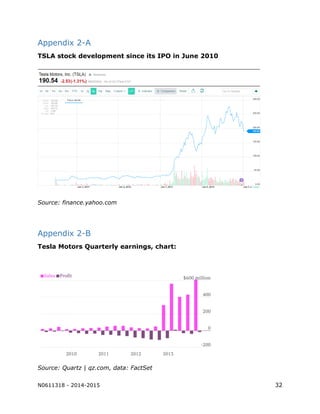
TSLA stock development since its IPO in June 2010
Source: finance.yahoo.com
Appendix 2-B
Tesla Motors Quarterly earnings, chart:
Source: Quartz | qz.com, data: FactSet
N0611318 - 2014-2015 33
Appendix 2-C
Company overview
Tesla Motors, Inc. is a global enterprise, incorporated in the United
States, which designs, manufactures and markets battery electric powered
vehicles (BEVs) and components, especially electric powertrains. (Tesla,
2013). Currently, it is the only automobile producer selling zero-emission
sports cars in serial production. (Mangram, 2012). Tesla Motors, Inc. is a
publicly traded company which is listed on the NASDAQ stock exchange under
the ticker symbol TSLA (NASDAQ, 2015). Since its IPO in 2010 (initial public
offering), TSLA stock has seen a remarkable success, currently up 618% (see
Appendix 2-A). Global sales have been rising steadily (see Appendix 2-B) since
Tesla first turned profitable in July 2009 (Garthwaite, 2009), however,
currently in a loss.
Tesla’s global strategy focused on selling luxury, eco-friendly designs at
premium margins reverberates the business model employed by Apple, Inc. –
a strong Silicon Valley-style tech-entrepreneurship attitude. This unique
approach enabled Tesla to advance faster, work more efficiently, and create
ground-breaking designs around sustainable mobility and automotive
technology (Boyadjis, et al., 2014), and differed it significantly from its
industry peers.
History of Tesla Motors, Inc.
Tesla Motors was incorporated in July 2003 by Martin Eberhard and Marc
Tarpenning, both of whom played active roles in the company's early
development before Elon Musk became involved (Musk joined in 2004 as a
Chairman of Board of Directors) (Fehrenbacher, 2009). Initially, Tesla aimed
to commercialize on electric vehicles, with its primary focus on premium sports
N0611318 - 2014-2015 34
cars directed to higher income early adopter clientele, and then moving as
quickly as possible into more conventional vehicles, such as sedans and
affordable compacts. Tesla’s founders wanted to prove “that electric cars could
be better than gasoline-powered cars. With instant torque, incredible power,
and zero emissions, Tesla’s products would be cars without compromise”
(Tesla Motors, 2015, p. web). From a general perspective, opinions on Tesla’s
future vary greatly among investors. Tesla has reported very limited
profitability since its creation which leads to increased scepticism and
detraction for some investors. Others, who remain bullish, call it the ‘Apple of
automakers’ (Mangram, 2012).
In 2008, Tesla Roadster – their first model, was launched. Boasting
with an unprecedented range of 245 miles (394km) per one charge with
acceleration from 0 to 60 mph in 3.7 seconds this model has seen success in
more than 30 countries (Tesla Motors, 2015). In 2012, Tesla launched Model
S, the world’s first first-class electric sedan. Model S was named Motor Trend’s
2013 Car of the Year and achieved a 5-star safety rating from the U.S. National
Highway Traffic Safety Administration. Presently, Tesla sold more than 50,000
vehicles worldwide – a minuscule amount compared to internal combustion
vehicle unit sales. In 2015, Tesla is preparing to launch Model X, a crossover
vehicle with exhilarating acceleration, falcon wing doors, and room for three
rows of seating, Model X defies categorization (Tesla Motors, 2015).
Picture 1. Tesla Motors, Inc. corporate logo
Source: Tesla Motors
N0611318 - 2014-2015 35
Appendix 2-D
Tesla strategic partnership breakdown:
Source: www.teslamotors.com Tesla Motors, Inc.
Appendix 2-E
Strategic marketing plan
Sun (2012) assessed that Tesla’s Roadster was a fist major success in
the United States in the field of BEVs. Preceding products largely failed due to
poor battery range, high prices and poor automobile designs. Tesla adopted
an exceptional strategic marketing approach of limited production and
premium pricing which evokes (fully rightfully) luxury categorization of its
vehicles (Tesla is largely compared to Apple, Inc. and its ‘crossing the chasm’
marketing strategy). Tesla’s new innovative technology comes at a high price,
and is primarily aimed at luxury sports car early-adopters consumer segment,
in order to optimize its manufacturing process to efficiently produce more
N0611318 - 2014-2015 36
affordable BEVs targeted at mid-class to high-class consumer segment
(Mangram, 2012).
LaMonica (2011) suggests that such approach to strategic marketing is
unique and rare for automakers industry, in which mass production at lower
costs forms the leading business model. Tesla is in a position where it
competes more than a century of technology development and trillions of
dollars invested in internal combustion engine vehicle industry.
Appendix 2-F
Tesla Roadster
The Roadster, luxury all-electric sports car, was Tesla’s first production
automobile the first highway-capable BEV introduced to the U.S. markets.
Additionally, the Roadster had a range of more 200 miles per one lithium-ion
battery charge, the first of its kind (Tesla Motors, 2015).
Model S
The first units of Model S started deliveries in in the U.S. in June 2012,
and in Japan in 2014 (the right-hand-drive model). Reaching up to 300 miles
per charge, it brought a new standard to the BEV industry. Positioned to
compete in the luxury sedan market, Model S was the top selling new car in
Norway in September 2013 and became the first electric car to top the sales
ranking in any country. 2014 models feature semi-autonomous drive and dual
engine customization (Tesla Motors, 2015).
Model X
Model X is full-size crossover utility vehicle (CUV) currently under
development. Production was originally planned to commence by the end of
2013, and later postponed multiple times to satisfy Model S production targets
N0611318 - 2014-2015 37
and to focus on overseas expansion. Price range around $60,000, 270 miles
per one charge (Tesla Motors, 2015).
Model 3
This future model will have a range of 200 miles (320 km), with first
deliveries expected to begin by 2017. Mercedes-Benz C-Class type of vehicle
will feature longer range, solid performance and moderate pricing at around
$30,000 and is aimed toward the mass-market.
Appendix 3-A
2012 World BEV Sales by Country
Source: EVI, MarkLines Database
Appendix 3-B
Present market situation brings little optimism to Japanese made BEVs,
as the incumbent automobile manufacturers have difficulties differentiating
their electric vehicles (Sato, 2014). This, along with generous Japanese
subsidies, gives Tesla enough incentive to intervene and fill the void. If this
N0611318 - 2014-2015 38
trend endures, Japanese BEVs might lose their market share. Mangram notes
that (2012, p. 299) “Tesla will continue to experience direct competition from
other BEV entrants, indirect competition from existing and emerging plug-in
hybrid vehicle manufacturers and competition from BEV ‘substitutes’ including
gasoline hybrid and gasoline powered vehicles.” Below, is a very brief
description of the biggest companies within the Japanese BEV industry. The
author believes, that the major competitor for Tesla is not a single company
but a major break-through in technologies which might out-perform Tesla’s
technology.
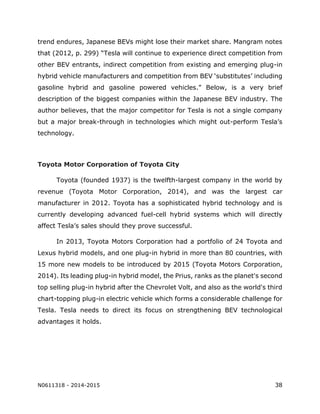
Toyota Motor Corporation of Toyota City
Toyota (founded 1937) is the twelfth-largest company in the world by
revenue (Toyota Motor Corporation, 2014), and was the largest car
manufacturer in 2012. Toyota has a sophisticated hybrid technology and is
currently developing advanced fuel-cell hybrid systems which will directly
affect Tesla’s sales should they prove successful.
In 2013, Toyota Motors Corporation had a portfolio of 24 Toyota and
Lexus hybrid models, and one plug-in hybrid in more than 80 countries, with
15 more new models to be introduced by 2015 (Toyota Motors Corporation,
2014). Its leading plug-in hybrid model, the Prius, ranks as the planet's second
top selling plug-in hybrid after the Chevrolet Volt, and also as the world's third
chart-topping plug-in electric vehicle which forms a considerable challenge for
Tesla. Tesla needs to direct its focus on strengthening BEV technological
advantages it holds.
N0611318 - 2014-2015 39
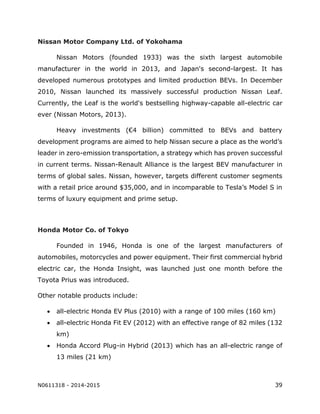
Nissan Motor Company Ltd. of Yokohama
Nissan Motors (founded 1933) was the sixth largest automobile
manufacturer in the world in 2013, and Japan's second-largest. It has
developed numerous prototypes and limited production BEVs. In December
2010, Nissan launched its massively successful production Nissan Leaf.
Currently, the Leaf is the world's bestselling highway-capable all-electric car
ever (Nissan Motors, 2013).
Heavy investments (€4 billion) committed to BEVs and battery
development programs are aimed to help Nissan secure a place as the world’s
leader in zero-emission transportation, a strategy which has proven successful
in current terms. Nissan-Renault Alliance is the largest BEV manufacturer in
terms of global sales. Nissan, however, targets different customer segments
with a retail price around $35,000, and in incomparable to Tesla’s Model S in
terms of luxury equipment and prime setup.
Honda Motor Co. of Tokyo
Founded in 1946, Honda is one of the largest manufacturers of
automobiles, motorcycles and power equipment. Their first commercial hybrid
electric car, the Honda Insight, was launched just one month before the
Toyota Prius was introduced.
Other notable products include:
 all-electric Honda EV Plus (2010) with a range of 100 miles (160 km)
 all-electric Honda Fit EV (2012) with an effective range of 82 miles (132
km)
 Honda Accord Plug-in Hybrid (2013) which has an all-electric range of
13 miles (21 km)
N0611318 - 2014-2015 40
Appendix 3-B
Key success factors
Tesla
Motors,
Inc.
Innovative,
aspiring and
differentiated
technology
Elon Musk - an
extremely
strong
corporate
leadership
Precise
customer
profile
definiton
E-Commerce
platform for
sales, showroom
system and
testdrive
Strong
distribution
channels
BEV support
network fo
charger
stations

CISSM Assignment ENGL

  • 1.
    The Nottingham TrentUniversity Nottingham Business School CIISM (BUSI 42632) Assignment Critical analysis of Tesla Motors, Inc. entry to the Japanese market and its strategic position Student ID: N0611xxx Nottingham Word Count: 4,500 January 2015
  • 2.
    N0611318 - 2014-20152 TABLE OF CONTENTS Executive Summary ..............................................................................4 INTRDUCTION......................................................................................5 1. Critical Literature Review..................................................................6 2. Tesla Motors, Inc. Company Overview................................................9 2.1 History........................................................................................9 2.2 Corporate Strategy.....................................................................9 2.2.1 2014 Patent Giveaway .........................................................10 2.3 Strategic Marketing Plan ...........................................................11 2.3.1 Market Share......................................................................11 2.4 SWOT Analysis.........................................................................11 2.4.1 Strengths ...........................................................................11 2.4.2 Weaknesses .......................................................................12 2.4.3 Opportunities......................................................................12 2.4.4 Threats ..............................................................................13 3. BEV Environment in Japan ..............................................................13 3.1 Strategic Considerations for Tesla’s Entry to Japanese Markets ......14 3.2 Macroeconomic Environment Analysis .........................................14 3.3 Microeconomic Environment Analysis ..........................................18 3.4 Key Success Factors .................................................................20 4. Critical Evaluation of Tesla’s Entry to the Japanese BEV Market ...........20 CONCLUSION ..................................................................................23 Bibliography.......................................................................................25 List of Acronyms and Abbreviations: .....................................................30
  • 3.
    N0611318 - 2014-20153 Appendices ........................................................................................31 Appendix 1-A ..................................................................................31 Appendix 1-B ..................................................................................31 Appendix 2-A ..................................................................................32 Appendix 2-B ..................................................................................32 Appendix 2-C ..................................................................................33 Appendix 2-D ..................................................................................35 Appendix 2-E...................................................................................35 Appendix 2-F...................................................................................36 Appendix 3-A ..................................................................................37 Appendix 3-B ..................................................................................37 Appendix 3-B ..................................................................................40
  • 4.
    N0611318 - 2014-20154 Executive Summary This critical analysis provides evaluation of Tesla Motors Inc. market entry to Japan. Several assumptions were made considering different perspectives of Japanese electric vehicle industry and environment using acknowledged frameworks such as PESTL analysis. Regarding Tesla, the report suggests that it has effectively executed a new market entry thanks to its niche product, strategic alliances and a unique direct-to-customer selling model. Furthermore, Japanese consumers are considered ideal since they are technologically savvy, environmentally cautious and the nation has a well- developed network of charging stations. The author did not use an existing case study, a new case was built based on careful observations and study of a given area. This investigation was addressed from a general perspective based upon extended literature research. A qualitative, exploratory approach was adopted for the analysis. Research was conducted via extensive secondary literature collection and data analysis, as well as in-depth examination of case studies and online sources. Key conclusions are: (1) Japanese BAV market represents a viable option for international expansion; (2) Tesla offers an unmatched product in Japan and is likely to capitalize upon this expansion; (3) the existing competitors represent a treat should they manage to enforce other than plug- in technologies, most notably fuel-cells hybrids. Limitations: Tesla is a relatively newly established company (2003) and not surprisingly, the amount of academic research dedicated to the company is limited. The author used a large range of online sources tracing Tesla’s current development as he believes these sources are most relevant and up to date.
  • 5.
    N0611318 - 2014-20155 INTRDUCTION In direct compliance with perceived globalization trends, Tesla Motors, Inc. (Tesla) seeks to expand their business internationally and increase their global presence (Tesla, 2013). With its highly unique product, electric vehicle engineering expertise, and operational structure differentiates, Tesla managed to find a competitive edge and differentiate itself from world incumbent automobile manufacturers. In 2014, Tesla performed a strategic entry to Japan, United Kingdom, China, and Australia (Tesla, 2013). The author of this report will direct his focus to critically evaluate entry to the Japanese market (commenced September 2014) considering (but not limited to) the following: (1) Japan's per-capita penetration of electric vehicles (EVs) is comparable to the U.S.'s (Wile, 2014); (2) Japanese consumers are known to be extremely open to new technologies and enormously demanding in terms of quality (Yu, 2013); (3) rapidly growing power-charging Japanese infrastructure and a very convenient size of the country (compared to the United States or Australia) diminishes concerns with electricity shortages experienced while driving (Takahashi, 2013). Although Tesla employs a global branding strategy and is supremely technologically developed, it is still generally perceived as a young company in a somewhat undiscovered industry niche – electric automobiles (compared to a 100-year-old internal combustion automobile industry), which represents a challenge. The core international strategic issues addressed in this report include: (1) analysis of Tesla’s corporate strategy and major developments within the electric vehicle industry which shall help enter the Japanese market; (2) analysis of Japanese market situation based on acknowledged strategic frameworks – Porter’s Five Forces, PESTLE, SWOT (for Tesla); and (3) Tesla’s possible future response to capitalize on this specific market opportunity.
  • 6.
    N0611318 - 2014-20156 1. Critical Literature Review International expansion of originally domestic companies has become a very common occurrence in the contemporary business world. The past three decades represented a fundamental shift from a world where national economies posed as self-contained bodies separated from one another by a variety of barriers, tariffs, quotas, cross-trade regulations all of which hindered internationalization and global business. Hill (2011) argues that we are currently moving towards a world where barriers to cross-border trade are declining, distances are diminishing thanks to advanced transportation, communication and technology, and national economies are in the process of merging into an interdependent, integrated global economic system. Additionally, further bolstering his statements, global FDIs have been on a steady rise (see Appendix 1-A, Appendix 1-B) providing direct evidence of globalization tendencies (with respect to global move of goods, services and investments. Schlie and Yip (2000, p. 343) claim that “the effects of globalisation have fundamentally changed the rules of global competition,” and, that a large number of international businesses has reacted accordingly by abandoning multi-domestic (Porter, 1986), multinational (Barlett & Ghoshal, 1989), or multi-local (Yip, 1992) strategies preferring strategies which tend to be more globally integrated. Research and empirical evidence suggest that the key for success in global strategy is to discover a perfect balance between local adaptation (responsiveness) and global standardization. In his immensely influential essay, Levitt (1983) proclaims that well- managed firms evolved from customization towards global products (such as Tesla’s Model S) which build on solid performance, functionality and low pricing. He declares that it is only the companies that decide to completely embrace global approach, will achieve sustainable track of success, as the
  • 7.
    N0611318 - 2014-20157 world is powerfully driven towards a ‘single converging commonality’ due to significant technological progress accelerating all areas of international business. Rugman (2001), on the other hand, positions his views strongly against universal globalization claiming strong governmental regulation limits free market forces. He proposes a ‘think local, act regional and forget global’ strategy for international expansion. Thus, the core decision problem when entering new markets lies between a focus distinctive regional elements strategies, and entirely global strategies. Furthermore, according to Koning, Subramanian & Verdin (2004), the discussion on globalization at the firm level is dominated by two major frameworks. The first one is an integration-responsiveness framework proposed by Prahalad and Doz (1987), which gulfs the strategy into two opposite challenges: scale efficiencies might be achieved from high levels of integration but at the same time might cause low levels of local responsiveness or national differentiation. The second framework introduced by Bartlett and Ghoshal (1989) is predominantly perceived as an extension of the former with an additional element of learning. Entering a foreign market, Tesla faces a challenge whether or not customize its product to be fully locally responsive or fully globally universal (current status quo). Submerging deeper into the topic of international business strategies, Wall, Minocha & Rees (2010) offer another division: global strategy, transnational strategy, international strategy and multi-domestic strategy. The appropriateness of each individual strategy depends significantly on the amount of pressures faced by the international business with regards to both local responsiveness and cost structure. In terms of a new market entry, complex analysis of the market needs to be performed prior to the entry. External analysis highlights generic influential environmental forces the company needs to cope with; a leading
  • 8.
    N0611318 - 2014-20158 example is the PESTLE analysis – political, economic, social, technological, legal and ecological factors investigation to reveal number of threats and opportunities (Wall, et al., 2010), whereas an internal analysis identifies areas in which the company is doing extraordinarily well – strengths, and those features which potentially constrain its capacity to evolve profitably – weaknesses (together forming a SWOT analysis). Once current strengths and environmental opportunities are matched, strategic prospects arise. Furthermore, Porter (2008, p. web) argued that the very essence of strategic planning is managing competition: “The strongest competitive force or forces determine the profitability of an industry and become the most important to strategy formulation.” Levitt (1983) notably remarked that accustomed differences lie both in national and regional preferences; this statement perfectly justifies a market entry for an American automobile maker with a very standardized model portfolio to Japan to further extend its distribution channels, and is well in accordance with Yip’s (1992) proposal of a “total global” strategy. A new market entrant bearing unique technologies and products as its main competitive advantage might exploit imperfect reaction of incumbent companies already within that market. Hill and Rothaermel (2003) offer an elaboration on incumbent firms’ responsiveness to technological progress and innovation. Incumbents tend to decline, while new entrants exploit the new technology and rise to market dominance. Tesla is a prime example of such case since they are currently in possession technological competitive advantage. Researchers attribute this decline to incumbents' failure to embrace the new technology which sometimes leads to a certain lag between new-technology embracers and incumbents. According to Buckley and Casson (1998), it is assumed that the entrant is able to anticipate the reaction of its rival in the leading-host country, and incorporate it into its market entry strategy. In addition, they argue that
  • 9.
    N0611318 - 2014-20159 technological and marketing skills have been identified as the key elements in a successful foreign market entry. Sturgeon et al. (2009, p. 22) claim that global automotive industry is comparable to other industries where “geographic scope of lead firms and their largest suppliers expanded in a wave of offshore investments, mergers, acquisitions, and equity-based alliances in the 1990s.” Dominant leading companies, industry associations and massive-scale employment shape the overall perception of automotive industry in minds of consumers. 2. Tesla Motors, Inc. Company Overview (Please, refer to Appendix 2-C) 2.1 History (Please, refer to Appendix 2-C) 2.2 Corporate Strategy According to Musk (2006), Tesla’s main objective has been to enter the electric automotive market with premium, high-end product targeted at wealthy clients. After Tesla has been able to secure larger customer base, profitability, and wider acceptance, the company seeks to enter more competitive markets at lower price points. Tesla strives to achieve this in three ways: (1) Direct marketing – cars are marketed and sold directly to consumers via an international network of company-owned stores and galleries (Tesla, 2013). Tesla avoided the traditional automobile dealership model.
  • 10.
    N0611318 - 2014-201510 (2) Stimulation of global electric vehicle interest and sales is to be accomplished by large-scale selling of its patented electric powertrain components to other automakers (Mangram, 2012). For Tesla’s partnership breakdown, see Appendix 2-D. (3) Establish a catalyst and a positive example of a unique combination of eco-friendliness, sustainability and a comprehensive sports car experience. Additionally, Tesla, along with its strategic partner Panasonic, have begun a construction of a massive lithium-ion battery packs factory suitably called ‘gigafactory’ in Nevada. This project is strategically important since it will lead to a significant cost reduction of these battery cells. It is estimated that by 2020, the ‘gigafactory’ will produce more lithium ion batteries than all of the world’s combined output in 2013 (Tesla Motors, 2015). Tesla’s Model S Sedan mass production initiated in 2012 allowed for targeting larger customer segment of middle to upper-middle class consumers since it came at a much more affordable price – around $60,000 (compared to Tesla Roadster for averagely $109,000) (Seeking Alpha, 2011). Ultimately, mass-market consumer segment will be targeted in 2015 with Tesla’s new models available for under $30,000 (Mangram, 2012). See Appendix 2-E for complete models overview. 2.2.1 2014 Patent Giveaway In the spirit of open source movement, Tesla released all of its patent holdings in June 2014. Musk (2014) famously proclaimed that “Tesla will not initiate patent lawsuits against anyone who, in good faith, wants to use our technology.” Wall Street reaction was in favour of this decision sending Tesla’s stock price up 14% to $231/share at the time. This radical move strengthened Tesla’s position and can be seen as a sophisticated move towards increased global demand for electric vehicles. Tesla realized that competition lies within
  • 11.
    N0611318 - 2014-201511 the enormous flood of combustion engine cars, now approaching 100 million units produced annually. 2.3 Strategic Marketing Plan (Please, refer to Appendix 2-E) 2.3.1 Market Share King (2013) concludes that Tesla managed to seize a market share of 8.4 % in the U.S. luxury-car market. Currently, Tesla’s Model S is outselling models such as the Audi A8 ($72,200), BMW 7 Series ($73,600) and Mercedes S-Class ($92,350) (Neiger, 2013). 2.4 SWOT Analysis Following SWOT analysis takes primarily Japanese market expansion into consideration. 2.4.1 Strengths  Cutting-edge technologies (vehicle design, powertrain technology, battery technology) (Tesla Motors, 2015).  Superior one-of-a-kind range of products especially in terms of incomparable vehicle performance, vehicle range capabilities and unique vehicle designs (Mangram, 2012).  Forward-thinking, innovation-driven corporate leadership.  Strong brand name recognition, positive reputation among customers and critical acclaim.
  • 12.
    N0611318 - 2014-201512 2.4.2 Weaknesses  Minor scale of operations, currently no economies of scale leading to higher production cost structure.  Cash-intensive cost structure, investment-heavy industry (Walsh, 2014).  Increased demand will lead to plausible component supply and product output.  BEV support infrastructure yet to achieve maturity and enlargement. 2.4.3 Opportunities  Substantial barriers to entry in the BEV industry greatly limit potential entrants (recently failed: Aptera, Venture Vehicles, TH!NK) (Mangram, 2012).  Technological advances in Lithium-Ion battery systems extend range per charge, life cycle and durability (Tesla Motors, 2015).  Overall oil-peak anxieties and fears along with increasing oil prices. Japan is completely dependent on oil imports (U.S. Energy Information Administration, 2014).  Environmental benefits seen behind Tesla’s eco-friendly approach (CO2 reduction and sustainability which is in positive correlation with Japanese corporate social responsibility.  Government subsidies, incentives and regulations in favour of BEV industry, rebates, tax breaks, low-interest loans, grants, etc. (Japanese subsidies are described below).
  • 13.
    N0611318 - 2014-201513 2.4.4 Threats  Large established Japanese motor companies with economies of scale capabilities devoting more resources into BEV development inevitably leading to increased competition.  Extremely limited sales of foreign cars in Japan (less than 5%), thick and impenetrable red tape, trade barriers.  Potential key breakthrough (by competitors) in related alternative energy technology (e.g. natural gas vehicles, ICE vehicles, plug-in/gas- powered hybrids, etc.), and Fuel cells technology.  Falling oil prices incentivising gasoline powered vehicles manufacturing and sales (Tesla Motors, 2015).  Limited BEV support infrastructure (charging stations network, etc.)  Loss of government subsidies. 3. BEV Environment in Japan For Tesla, there is a massive incentive to enter Japanese BEV market since it is the second largest after the United States, hence creating a perfect environment for distribution (Cob, 2014). Japan has continually ranked second in market share of total BEV sales (Japan led the statistics in 2012, see Appendix 3-A). Highway-capable BEV sales in 2013 reached 29,716 units which accounts for 0.55% of total automobile sales in 2013 (International Energy Agency, Clean Energy Ministerial, and Electric Vehicles Initiative, 2013). The BEV support network is positively situated based on the following observations: (1) At the end of 2012, Japan became the leader with the highest ratio charging points to the number of BEV vehicles (ratio 0.03).
  • 14.
    N0611318 - 2014-201514 (2) Currently, there are 1,381 public quick-charge stations which accounts for the largest number in any country worldwide. (3) By 2020, Japanese government plans to install 2 million slow chargers and 5,000 fast chargers (Navigant Consulting, 2013). (4) Navigant (2013) expects Japan to be the leading market for BEV sales in 2020, with approximately 900,000 units sold that year. 3.1 Strategic Considerations for Tesla’s Entry to Japanese Markets Tesla entered the Japanese market in September 2014 (Tesla Motors, 2015). Japan BEV market setup represents a unique combination of environmental concerns, government support for electric cars, and a solid base of wealthy customers who seek luxury brands (Assis, 2014). By the end of 2015, Tesla’s own network of superchargers (which are capable of charging 50% of the battery in 20 minutes) is projected expand to 20 in the Tokyo metro area and beyond. According to Musk, this service will forever remain free for the Model S owners which has been viewed as a major catalyst for Tesla sales (Mangram, 2012) Tesla managed to find its way to Japan via strategic alliances with Toyota (which is now inactive as Toyota embraced fuel-cell technologies) and Panasonic – both dominant Japanese companies (Mangram, 2012). 3.2 Macroeconomic Environment Analysis Drawing on Rugman and Collison (2012), PESTL framework is one of the most general and multidisciplinary frameworks used to assess particular competitive environments and investment contexts for companies at both national and regional levels. Due to its significance and comprehensiveness,
  • 15.
    N0611318 - 2014-201515 the author of this report will use this model to analyse the macro- environmental factors relevant to Tesla. Political factor Although being a constitutional monarchy, Japan’s Emperor Akihito holds little power compared to the Prime Minister Shinzō Abe (Prime Minister of Japan and His Cabinet, 1947). Based on the free enterprise capitalism principles, Japan emerged as the most developed nation in Asia. More importantly, Japanese government has been offering multiple types of incentives (see Table 1) in order to enhance the sales of BEVs, and it continues to do so. On May 30, 2013, Japan’s Ministry of Economy, announced that it would continue to offer Clean Energy subsidies to purchasers of BEVs and plug-in hybrids (Tanabe & Nelson, 2013). Table 1. Current Japanese National Policy initiatives Source: Global EV Outlook Report
  • 16.
    N0611318 - 2014-201516 Economic factor In terms of nominal GDP (total $4.788 trillion (4th)/per capita $37,683 (28th) (International Monetary Fund, 2014)), Japan is the third largest national economy in the world, after the United States and China, and the fourth largest national economy in the world in purchasing power parity (International Monetary Fund, 2014). During 1990s and early 2000s, Japan experienced a massive slow-down, often referred to as ‘Lost Decade’ largely due to the consequences of the Japanese asset price bubble and a subsequent banking crisis. Japan’s noteworthy PPP implies potentially strong buying power of consumers, a fact which is crucially relevant to Tesla, since it primarily targets higher-income clientele. Japan's infrastructure supporting BEVs is well- developed and road spending is extensive. Contrariwise, prevailing deflation and diminishing domestic demand pose a threat to Tesla (International Monetary Fund, 2014). Additionally, the country’s public debt has increased to 238% of GDP which inevitably leads to decreased ability of Japanese government to stimulate the economy through increased spending (possibly negatively affecting BEV infrastructure subsidies). Social factor Japan's population of 126 million has experienced a remarkable growth rate in the last 100 years (now decreasing) as a result of scientific, industrial, and sociological progress. Japan has the second highest life expectancy with 83.5 years which implies overall health safety and long-term orientation which can be positively linked to Tesla’s maximum focus on environmental sustainability and driver’s safety (International Monetary Fund, 2014).
  • 17.
    N0611318 - 2014-201517 Technological factor Tesla’s Japanese expansion has a major advantage – Japan is a nation of ‘technophiles’ (Yu, 2013), and the new Model S is viewed as a technological marvel (Boyadjis, et al., 2014). Protuberant scientists and technology researchers direct their attention to Japan, as it is on the pathway to becoming one of the world’s leaders in industrial technology, infrastructure, and intelligence transport system (Thornton, 2004). Japanese government heavily subsidies BEV infrastructure development and the overall setup is principally positive for a BEV market entry. Table 2 shows subsidies for major EVs/PHVs in Japan (note higher amounts for imported cars). Tesla occupies the highest rank primarily because of its higher price range. Table 2. Maximum subsidy for major EVs/PHVs (in ¥) Source: Next Generation Vehicle Promotion Centre Legal factor Japan's present corporate law system was founded on principles of the German and French Civil codes and its current Corporations Code was
  • 18.
    N0611318 - 2014-201518 implemented in 2006. Tesla operates as Kabushiki kaisha (KK), a type similar to a business corporation in the United States. 3.3 Microeconomic Environment Analysis To evaluate Tesla’s microeconomic environment, Porter’s Five Competitive Forces framework will be used. According to Porter (2008), to fully define competitive interaction in a given industry, the extended rivalry which stems from all five forces needs to be analysed. Threat of new entrants (HIGH) - Globalization allows businesses to expand internationally which massively affects the automobile market. Generally, entering the car industry requires heavy capital investments, however, for already established producers with enough economic power, barriers to enter such markets are low, especially when they can largely benefit from governments incentives for BEVs. Tesla proved in Japan that incumbent manufacturers have been unable to present a ground-breaking BEV product which would allow them to seize enough market share to prevent Tesla from entering (Sato, 2014). Bargaining power of suppliers (MODERATE to HIGH) - Tesla currently uses components from more than 200 suppliers worldwide (Tesla, 2013), and is greatly dependent on them, as any delay in the value-chain causes immediate production disruption, which would detrimentally affect the company’s image (Harryson & Keller, 2014). Completion of the ‘gigafactory’ in 2018 will help Tesla reduce
  • 19.
    N0611318 - 2014-201519 dependency on its current battery supplier (Panasonic), and further decrease costs by 30% (Tesla Motors, 2014). The Bargaining Power of Buyers (LOW to MODERATE) - It is important to distinguish between retail customers and corporate buyers. Drawing on Tesla Annual Report (2013), the relationship with Daimler and Toyota played a significant role for Tesla, because Tesla’s profit is largely dependent on supplying these, thus their power is considerably higher than the retail consumers’ power, who have little or no negotiating leverage. Oppositely, Tesla sells a very unique product which has no direct substitutes, is currently in a shortage of supplies, and no sales are made in bulk so the pricing model remains relatively intact. Moreover, government subsidy programs and tax credit deductions in Japan stimulate BEV demand which further diminishes the bargaining power of Buyers. Threat of Substitute products (LOW to MODERATE) – Following direct substitutes are available in Japan – vehicles: hybrid, hydrogen, fuel cells, ICE and BEV, and public transportation systems (Tesla Motors, 2015). More importantly, the higher the cost of operating the automobile such as the price of fuels, the more likely will consumers seek alternative means of transportation. Tesla’s vehicles are designed to require minimal maintenance, as well as operating costs, and are targeted at consumers who are very environmentally cautious, hence likely to seek eco-friendly means of transportation (much like Japanese consumers).
  • 20.
    N0611318 - 2014-201520 Rivalry among existing competitors (MODERATE to HIGH) – BEV market in Japan classifies among the developed ones, however overall rivalry is incomparably smaller to IEC industry. Major automobile manufacturers based in Japan: Nissan Motor Company Ltd. of Yokohama, Honda Motor Co. of Tokyo, and the Toyota Motor Corporation of Toyota City. For a competitor analysis, see Appendix 3-B. 3.4 Key Success Factors (Please, refer to Appendix 3-C) 4. Critical Evaluation of Tesla’s Entry to the Japanese BEV Market With respect to theories of Yip (1992), Levitt (1983), and Bartlett & Ghoshal (1989), Tesla has decided to penetrate Japanese markets with a standardized global product which only has minor local customizations predominantly regarding right-hand steering system (which is also used in the United Kingdom). The choice of this strategy has yet to prove successful. Uniqueness and supremacy of Tesla’s products bear a significant competitive advantage on which Tesla shall commercialize in Japan. Technological advancement is well in compliance with Japanese perception of importance of technology. The already well-established BEV infrastructure in Japan and overall pro-electric mind-set is a favourable factor for Tesla’s expansion endeavour. By entering the Japanese market, Tesla seized the opportunity to profit from the first mover advantage, because foreign automakers, especially the ones from the United States, sell only a small amount of automobiles in Japan (only 4% non-Japanese cars sold) (Nakagawa, 2014). Foreign
  • 21.
    N0611318 - 2014-201521 perception of Tesla’s products might be diminished by using Panasonic batteries. Furthermore, the country’s generous BEV subsidy program, developed public charging groundwork, and substantial price difference between gasoline and electricity represent optimal conditions for the PEV market expansion (Shepard, 2014). In accordance with Hill and Rothaermel’ thesis (2003), incumbent automakers in Japan have been unable to saturate the country’s demand for high-quality luxury BEVs, thus allowing new entrants to capitalize. Strong brand identity, differentiation heavy government subsidies shall serve as a catalyst for Tesla to establish a strong initial position in the Japanese markets. The company employs focus-differentiated strategy, targeting upper-income level customers of which there is abundance in Japan, especially in Tokyo area where the sales originate. Tesla’s strategic partnership with Toyota (invested 50 million in Tesla) benefited both companies as they exchanged knowhow and created economies of scale (Seeking Alpha, 2011), and overall selling of components creates a steady stream of revenue. Tesla's market influence is remarkable, further bolstered by the decision to share their patents which could be critical to the company's long-term success (Takahashi, 2013). Rapid international expansion is well beyond Tesla’s budget, however the investors see such occurrence as positive driving the stock up (currently in a slight downtrend), and the company virtually promotes itself which brings massive savings in marketing (Sparks, 2014). In the author’s opinion, principal challenges for Tesla Japan are (1) mounting costs – primarily supercharger network construction and expansion costs (new retail locations); (2) delivery delays – Tesla is currently unable to satisfy demand for its product; (3) strong position of existing rivals; and (4) fuel cells – Toyota introduces the first purpose-built HFC car, the Mirai (Wahlman, 2014), as the
  • 22.
    N0611318 - 2014-201522 Japanese Prime Minister Shinzo Abe confirmed that government will provide additional support to the country's fuel-cell vehicle industry (Wile, 2014). Additionally, the author considers Tesla’s superior product as its major competitive advantage, especially in terms of their batteries: cells in Model S have a specific energy of 233 Wh/kg (largely thanks to the NCA chemistry and high-density electrodes). This results in an approximately 40% greater efficiency than the current industry standard (155 Wh/kg) (Mangram, 2012). The analysis suggests, that the following caveats: legal hindrances, Japan’s powerful car lobby, Japanese sense of patriotic duty and national pride. Tesla fully realizes the fact that they probably will not be able to sell huge numbers of cars in protectionist Japan (Schnitt, 2012).
  • 23.
    N0611318 - 2014-201523 CONCLUSION Tesla’s entry to the Japanese market has a large potential considering that the Japanese consumers will keep their demand for BEVs in current or higher levels. Tesla found a very unique niche market which is poised for a massive growth in Japan under status quo conditions where luxury vehicles such as Model S should be Tesla’s main focus to avoid customer segments occupied by Nissan Leaf and Toyota Prius. Competitive environment in Japan indicates that major automobile companies are already in the mass-market BEV plug-in hybrid segments. They are substantially larger than Tesla and have decisive economies of scale, marketing and production advantages, therefore Tesla must fully focus on solidifying its brand recognition in Japan via advertising, and optimizing its cost structure to extend its experience curve. The author views Japan’s protectionist national automotive policy as self-constraining its own national energy sustainability and greenhouse gas reduction goals. Favourably, more BEVs which have substantial energy efficiency enhancements will reduce Japan’s oil dependency issues. Tesla makes an impression of not merely an automaker, but also a technology and design enterprise with a focus on energy innovation, eco-friendliness and sustainability. Tesla’s competitive advantages include: superior BEV technology, brand recognition, and exclusive component product lines. Major conclusions are: (1) Japanese BAV market represents a viable option for Tesla’s international expansion predominantly due to the supportive network of publicly accessible chargers, strong consumer awareness and relatively high purchasing power parity; (2) Tesla introduced an unmatched product in Japan and is likely to capitalize upon this expansion with further employment of focus differentiated strategy, targeting upper-income level customers; and (3) the existing competitors represent a threat should they
  • 24.
    N0611318 - 2014-201524 manage to enforce other than plug-in technologies, most notably fuel-cells hybrids. Taking into consideration the analysis conducted on Tesla’s entry to the Japanese market, the author suggests following recommendations: (1) maintain strong product differentiation strategy for future market expansion and retain Tesla’s brand name perception as cutting-edge and innovative; (2) consider increasing advertising budgets as the brand is new to the Japanese market; (3) extend production capacities to satisfy growing demand; (4) establish Japanese supercharger network as rapidly as possible; (5) take full advantage of government subsidies; and (6) eventually extend their product portfolio to target middle-income consumers.
  • 25.
    N0611318 - 2014-201525 Bibliography Assis, C., 2014. Tesla map shows big plans for China, Japan. MarketWatch. [Online] Available at: http://www.marketwatch.com/story/tesla-map-shows-big-plans-for-china-japan-2014-09- 10?siteid=rss&rss=1 [Accessed 21 December 2014]. Barlett, C. & Ghoshal, S., 1989. Managing Across Borders: The Transnational Solution. London: Hutchinson Business. Boyadjis, M., Rassweiler, A. & Brinley, S., 2014. IHS. IHS. [Online] Available at: https://www.ihs.com/articles/features/tesla-motors.html [Accessed 12 January 2015]. Buckley, P. J. & Casson, M. C., 1998. Analyzing Foreign Market Entry Strategies: Extending the Internalization Approach. Journal of International Business Studies, 29(3), pp. 539-562. Cob, J., 2014. Global Plug-in Car Sales Now Over 600,000. Hybridcars. [Online] Available at: http://www.hybridcars.com/global-plug-in-car-sales-now-over-600000/ [Accessed 4 January 2015]. DE KONING, A., SUBRAMANIAN, V. & VERDIN, P., 2004. Reach for Regional Strategies for Global Competitive Advantage. EconPapers. Fehrenbacher, K., 2009. Tesla Founder Eberhard Files Lawsuit Against Tesla, Elon Musk. Giacom. [Online] Available at: https://gigaom.com/2009/06/11/tesla-founder-eberhard-files-lawsuit-against-tesla-elon- musk/ [Accessed 12 January 2015]. Garthwaite, J., 2009. Tesla Motors Claims $1M July Profit (a First!), Thanks to Roadster 2. Giacom. [Online] Available at: https://gigaom.com/2009/08/07/tesla-motors-claims-1m-july-profit-a-first-thanks-to- roadster-2/ [Accessed 23 December 2014]. Harryson, S. & Keller, S., 2014. Tesla Motors Case II: From Technology Start up to Commercialization Vehicle. CIEL-LAB. [Online] Available at: http://ciel-lab.dk/wp-content/uploads/2013/04/Case_Tesla-Motors-Part-II.pdf [Accessed January 4 2015]. Hill, C. W. L., 2011. International Business - Competing in the Global Marketplace. 8th ed. New York: McGraw-Hill/Irwin. Hill, C. W. & Rothaermel, F. T., 2003. The Performance of Incumbent Firms in the Face of Radical Technological Innovation. The Academy of Management Review, April, 28(2), pp. 257-274. International Energy Agency, Clean Energy Ministerial, and Electric Vehicles Initiative, 2013. Global EV Outlook 2013 - Understanding the Electric Vehicle Landscape to 2020. [Online]
  • 26.
    N0611318 - 2014-201526 Available at: http://www.iea.org/publications/globalevoutlook_2013.pdf [Accessed 5 January 2015]. International Monetary Fund, 2014. Japan. [Online] Available at: http://www.imf.org/external/pubs/ft/weo/2014/02/weodata/weorept.aspx?pr.x=75&pr.y=13&sy=2014 &ey=2014&scsm=1&ssd=1&sort=country&ds=.&br=1&c=158&s=NGDPD%2CNGDPDPC%2CPPPGDP%2C PPPPC&grp=0&a= [Accessed 9 January 2015]. King, D., 2013. Tesla's 8.4% market share beats Audi A8, BMW 7 Series. Autoblog. [Online] Available at: http://www.autoblog.com/2013/08/07/teslas-8-4-market-share-beats-audi-a8-bmw-7- series/ [Accessed 4 January 2015]. LaMonica, M., 2011. Tesla's next act: Cheaper electric cars...and a profit?. [Online] Available at: http://www.cnet.com/news/teslas-next-act-cheaper-electric-cars-and-a-profit/ [Accessed 3 January 2015]. Levitt, T., 1983. The Globalization of Markets. [Online] Available at: https://hbr.org/1983/05/the-globalization-of-markets [Accessed 12 1 2015]. Mangram, M. E., 2012. The globalization of Tesla Motors: a strategic marketing plan analysis. Journal of Strategic Marketing, 20(4), pp. 289-312. Musk, E., 2006. The Secret Tesla Motors Master Plan (just between you and me). [Online] Available at: http://www.teslamotors.com/blog/secret-tesla-motors-master-plan-just-between-you- and-me [Accessed 2 January 2015]. Musk, E., 2014. All Our Patent Are Belong To You. [Online] Available at: http://www.teslamotors.com/blog/all-our-patent-are-belong-you [Accessed 22 December 2015]. Nakagawa, M., 2014. Tesla Motors began delivering in Japan. [Online] Available at: http://toyokeizai.net/articles/-/47897 [Accessed 11 January 2015]. NASDAQ, 2015. NASDAQ. [Online] Available at: http://www.nasdaq.com/symbol/tsla/after-hours [Accessed 11 January 2015]. Navigant Consulting, 2013. Navigant forecasts hybrids to account for almost 4% of global LDV sales by 2020, plug-ins 3%. [Online] Available at: http://www.greencarcongress.com/2013/06/navi-ev-20130611.html [Accessed 30 December 2015].
  • 27.
    N0611318 - 2014-201527 Neiger, C., 2013. Tesla Nabs 8% of the U.S. Luxury Car Market. [Online] Motley Fool. Available at: http://www.fool.com/investing/general/2013/08/04/tesla-nabs-8-of-the-us-luxury-car- market.aspx [Accessed 23 January 2015]. Nissan Motors, 2013. Nissan LEAF Smashes 50,000 Global Sales Milestone. [Online] Nissan. Available at: http://nissannews.com/en-US/nissan/usa/releases/nissan-leaf-smashes-50-000-global- sales-milestone [Accessed 25 January 2015]. Porter, M., 1986. Competition in Global Industries: A Conceptual Framework.. Boston, MA: Harvard Business School Press. Porter, M. A., 2008. The Five Competitive Forces That Shape Strategy. Harvard Business Review. PRAHALAD, C. K. & DOZ, I. D., 1987. The Multinational Mission: Balancing Local Demands and Global Vision. New York: Free Press. Prime Minister of Japan and His Cabinet, 1947. Constitution of Japan. [Online] Japan Kantei. Available at: http://japan.kantei.go.jp/constitution_and_government_of_japan/constitution_e.html [Accessed 8 January 2015]. Rugman, A. M., 2001. VIEWPOINT: The Myth of Global Strategy. International Marketing Review, 18(6), pp. 583 - 588. Rugman, A. M. & Collison, S., 2012. International Business. 6th ed. Harlow: Pearson Education Limited. Sanger, D. E., 1995. A DEAL ON AUTO TRADE: THE AGREEMENT; U.S. SETTLES TRADE DISPUTE, AVERTING BILLIONS IN TARIFFS ON JAPANESE LUXURY AUTOS. [Online] New York Times. Available at: http://www.nytimes.com/1995/06/29/us/deal-auto-trade-agreement-us-settles-trade- dispute-averting-billions-tariffs.html [Accessed 5 January 2015]. Sato, H., 2014. Big Subsidies for Foreign Electric Cars in Japan. [Online] Nikkei Business. Available at: http://business.nikkeibp.co.jp/article/eng/20140916/271299/ [Accessed 24 January 2015]. Seeking Alpha, 2011. Is Tesla Motors Ready to Accelerate?. [Online] Seeking Alpha. Available at: http://seekingalpha.com/article/253638-is-tesla-motors-ready-to-accelerate [Accessed 3 January 2015]. Seeking Alpha, 2011. Is Tesla Motors Ready to Accelerate?. [Online] Seeking Alpha. Available at: http://seekingalpha.com/article/253638-is-tesla-motors-ready-to-accelerate [Accessed 9 January 2015]. Shepard, S., 2014. Tesla Breaks into Japan. [Online] Forbes. Available at: http://www.forbes.com/sites/pikeresearch/2014/09/30/tesla-breaks-into-japan/ [Accessed 7 January 2015].
  • 28.
    N0611318 - 2014-201528 SCHLIE, E. & YIP, G., 2000. Regional Follows Global: Strategy Mixes in the World Automotive Industry. European Management Journal, 18(4), p. 343–354. Schnitt, B., 2012. While Detroit Complains About A Closed Japanese Market, Imports Are Way Up. [Online] The Truth About Cars. Available at: http://www.thetruthaboutcars.com/2012/10/while-detroit-complains-about-a-closed- japanese-market-imports-are-way-up/ [Accessed 12 January 2015]. Sparks, D., 2014. Tesla Motors, Inc. Continues Its Rapid International Expansion. [Online] Motley Fool. Available at: http://www.fool.com/investing/general/2014/06/12/tesla-motors-inc-continues-its-rapid- international.aspx [Accessed 14 January 2015]. Sturgeon, T. J., Memedovic, O., Biesebroeck, J. V. & Gereffi, G., 2009. Globalisation of the automotive industry: main features and trends. International Journal of Technological Learning, Innovation and Development, Volume 2. Sun, L., 2012. Tesla Motors (TSLA) May Overtake Detroit Steel with Silicon Valley Smarts. [Online] Investor Guide. Available at: http://www.investorguide.com/article/10521/tesla-motors-tsla-may-overtake-detroit- steel-with-silicon-valley-smarts/ [Accessed 3 January 2015]. Takahashi, Y., 2013. The Wall Street Journal. [Online] Available at: http://blogs.wsj.com/japanrealtime/2013/11/20/tesla-sees-opportunity-in-nation-of- technophiles/ [Accessed 23 December 2015]. Tanabe, M. & Nelson, T. D., 2013. Japan Continues to Offer Electric Vehicle Incentives. [Online] Available at: http://www.autoindustrylawblog.com/2013/09/12/japan-continues-to-offer-electric- vehicle-incentives/ [Accessed 9 January 2015]. Tesla Motors, 2014. Gigafactroy. [Online] Tesla Motors. Available at: http://www.teslamotors.com/blog/gigafactory [Accessed 6 January 2015]. Tesla Motors, 2015. Tesla Motors. [Online] Tesla Motors. Available at: http://www.teslamotors.com/about [Accessed 20 December 2015]. Tesla, 2013. ANNUAL REPORT ON FORM 10-K FOR THE YEAR ENDED DECEMBER 31, 2013. [Online] Tesla Motors. Available at: http://ir.teslamotors.com/secfiling.cfm?filingID=1193125-14-69681& [Accessed 14 January 2015]. Thornton, P., 2004. Markets from Culture: Institutional Logistics and Organizational Decisions in Higher Education Publishing. Stanford, CA: Stanford University Press.
  • 29.
    N0611318 - 2014-201529 Toyota Motor Corporation, 2014. Toyota Global. [Online] Tesla Motors. Available at: http://www.toyota-global.com/company/profile/overview/ [Accessed 25 January 2015]. Toyota Motors Corporation, 2014. Worldwide Sales of Toyota Hybrids Top 6 Million Units. [Online] Available at: http://corporatenews.pressroom.toyota.com/releases/worldwide+toyota+hybrid+sales+top+6+million.h tm?view_id=35924 [Accessed 22 January 2015]. U.S. Energy Information Administration, 2014. Japan. [Online] EIA. Available at: http://www.eia.gov/countries/cab.cfm?fips=ja [Accessed 16 January 2015]. Wahlman, A., 2014. Can Toyota's First Hydrogen Car Challenge Tesla?. [Online] Seeking Alpha. Available at: http://seekingalpha.com/article/2718205-can-toyotas-first-hydrogen-car-challenge-tesla [Accessed 20 January 2015]. Wall, S., MINOCHA, S. & REES, B., 2010. International Business. 3rd ed. Harlow: Pearson Education Limited. Walsh, T., 2014. 3 Challenges Facing Tesla Motors in 2014. [Online] Motley Fool. Available at: http://www.fool.com/investing/general/2014/01/07/3-challenges-facing-tesla-motors-in- 2014.aspx [Accessed 6 January 2015]. Wile, R., 2014. It Looks Like Japan May Be Trying To Crush Tesla. [Online] Business Insider. Available at: http://www.businessinsider.com/japan-is-betting-against-tesla-2014-6?IR=T [Accessed 20 January 2015]. Yip, G., 1992. Total Global Strategy: Managing for Worldwide Competitive Advantage. nglewood Cliffs, NJ: Prentice Hall. Yu, K., 2013. Tokyo Motor Show Briefing [Interview] (November 2013).
  • 30.
    N0611318 - 2014-201530 List of Acronyms and Abbreviations: BEV = Battery electric vehicle EV = Electric vehicle GDP = Gross domestic product HFC = Hydrogen fuel cell ICE = Internal combustion vehicle IPO = Initial public offering MRSP = Manufacturer's suggested retail price NCA = Lithium nickel cobalt aluminium oxide PHV = Plug-in hybrid vehicle PPP = Purchasing power parity RD&D = Research, development and demonstration
  • 31.
    N0611318 - 2014-201531 Appendices Appendix 1-A Foreign Net Direct Investment Inflow by regions Source: Financial Times Appendix 1-B Global FDI flows (2004-2012), projections (2013-2015), Bn$ Source: UNCTAD. World Investment Report 2013.
  • 32.
    N0611318 - 2014-201532 Appendix 2-A TSLA stock development since its IPO in June 2010 Source: finance.yahoo.com Appendix 2-B Tesla Motors Quarterly earnings, chart: Source: Quartz | qz.com, data: FactSet
  • 33.
    N0611318 - 2014-201533 Appendix 2-C Company overview Tesla Motors, Inc. is a global enterprise, incorporated in the United States, which designs, manufactures and markets battery electric powered vehicles (BEVs) and components, especially electric powertrains. (Tesla, 2013). Currently, it is the only automobile producer selling zero-emission sports cars in serial production. (Mangram, 2012). Tesla Motors, Inc. is a publicly traded company which is listed on the NASDAQ stock exchange under the ticker symbol TSLA (NASDAQ, 2015). Since its IPO in 2010 (initial public offering), TSLA stock has seen a remarkable success, currently up 618% (see Appendix 2-A). Global sales have been rising steadily (see Appendix 2-B) since Tesla first turned profitable in July 2009 (Garthwaite, 2009), however, currently in a loss. Tesla’s global strategy focused on selling luxury, eco-friendly designs at premium margins reverberates the business model employed by Apple, Inc. – a strong Silicon Valley-style tech-entrepreneurship attitude. This unique approach enabled Tesla to advance faster, work more efficiently, and create ground-breaking designs around sustainable mobility and automotive technology (Boyadjis, et al., 2014), and differed it significantly from its industry peers. History of Tesla Motors, Inc. Tesla Motors was incorporated in July 2003 by Martin Eberhard and Marc Tarpenning, both of whom played active roles in the company's early development before Elon Musk became involved (Musk joined in 2004 as a Chairman of Board of Directors) (Fehrenbacher, 2009). Initially, Tesla aimed to commercialize on electric vehicles, with its primary focus on premium sports
  • 34.
    N0611318 - 2014-201534 cars directed to higher income early adopter clientele, and then moving as quickly as possible into more conventional vehicles, such as sedans and affordable compacts. Tesla’s founders wanted to prove “that electric cars could be better than gasoline-powered cars. With instant torque, incredible power, and zero emissions, Tesla’s products would be cars without compromise” (Tesla Motors, 2015, p. web). From a general perspective, opinions on Tesla’s future vary greatly among investors. Tesla has reported very limited profitability since its creation which leads to increased scepticism and detraction for some investors. Others, who remain bullish, call it the ‘Apple of automakers’ (Mangram, 2012). In 2008, Tesla Roadster – their first model, was launched. Boasting with an unprecedented range of 245 miles (394km) per one charge with acceleration from 0 to 60 mph in 3.7 seconds this model has seen success in more than 30 countries (Tesla Motors, 2015). In 2012, Tesla launched Model S, the world’s first first-class electric sedan. Model S was named Motor Trend’s 2013 Car of the Year and achieved a 5-star safety rating from the U.S. National Highway Traffic Safety Administration. Presently, Tesla sold more than 50,000 vehicles worldwide – a minuscule amount compared to internal combustion vehicle unit sales. In 2015, Tesla is preparing to launch Model X, a crossover vehicle with exhilarating acceleration, falcon wing doors, and room for three rows of seating, Model X defies categorization (Tesla Motors, 2015). Picture 1. Tesla Motors, Inc. corporate logo Source: Tesla Motors
  • 35.
    N0611318 - 2014-201535 Appendix 2-D Tesla strategic partnership breakdown: Source: www.teslamotors.com Tesla Motors, Inc. Appendix 2-E Strategic marketing plan Sun (2012) assessed that Tesla’s Roadster was a fist major success in the United States in the field of BEVs. Preceding products largely failed due to poor battery range, high prices and poor automobile designs. Tesla adopted an exceptional strategic marketing approach of limited production and premium pricing which evokes (fully rightfully) luxury categorization of its vehicles (Tesla is largely compared to Apple, Inc. and its ‘crossing the chasm’ marketing strategy). Tesla’s new innovative technology comes at a high price, and is primarily aimed at luxury sports car early-adopters consumer segment, in order to optimize its manufacturing process to efficiently produce more
  • 36.
    N0611318 - 2014-201536 affordable BEVs targeted at mid-class to high-class consumer segment (Mangram, 2012). LaMonica (2011) suggests that such approach to strategic marketing is unique and rare for automakers industry, in which mass production at lower costs forms the leading business model. Tesla is in a position where it competes more than a century of technology development and trillions of dollars invested in internal combustion engine vehicle industry. Appendix 2-F Tesla Roadster The Roadster, luxury all-electric sports car, was Tesla’s first production automobile the first highway-capable BEV introduced to the U.S. markets. Additionally, the Roadster had a range of more 200 miles per one lithium-ion battery charge, the first of its kind (Tesla Motors, 2015). Model S The first units of Model S started deliveries in in the U.S. in June 2012, and in Japan in 2014 (the right-hand-drive model). Reaching up to 300 miles per charge, it brought a new standard to the BEV industry. Positioned to compete in the luxury sedan market, Model S was the top selling new car in Norway in September 2013 and became the first electric car to top the sales ranking in any country. 2014 models feature semi-autonomous drive and dual engine customization (Tesla Motors, 2015). Model X Model X is full-size crossover utility vehicle (CUV) currently under development. Production was originally planned to commence by the end of 2013, and later postponed multiple times to satisfy Model S production targets
  • 37.
    N0611318 - 2014-201537 and to focus on overseas expansion. Price range around $60,000, 270 miles per one charge (Tesla Motors, 2015). Model 3 This future model will have a range of 200 miles (320 km), with first deliveries expected to begin by 2017. Mercedes-Benz C-Class type of vehicle will feature longer range, solid performance and moderate pricing at around $30,000 and is aimed toward the mass-market. Appendix 3-A 2012 World BEV Sales by Country Source: EVI, MarkLines Database Appendix 3-B Present market situation brings little optimism to Japanese made BEVs, as the incumbent automobile manufacturers have difficulties differentiating their electric vehicles (Sato, 2014). This, along with generous Japanese subsidies, gives Tesla enough incentive to intervene and fill the void. If this
  • 38.
    N0611318 - 2014-201538 trend endures, Japanese BEVs might lose their market share. Mangram notes that (2012, p. 299) “Tesla will continue to experience direct competition from other BEV entrants, indirect competition from existing and emerging plug-in hybrid vehicle manufacturers and competition from BEV ‘substitutes’ including gasoline hybrid and gasoline powered vehicles.” Below, is a very brief description of the biggest companies within the Japanese BEV industry. The author believes, that the major competitor for Tesla is not a single company but a major break-through in technologies which might out-perform Tesla’s technology. Toyota Motor Corporation of Toyota City Toyota (founded 1937) is the twelfth-largest company in the world by revenue (Toyota Motor Corporation, 2014), and was the largest car manufacturer in 2012. Toyota has a sophisticated hybrid technology and is currently developing advanced fuel-cell hybrid systems which will directly affect Tesla’s sales should they prove successful. In 2013, Toyota Motors Corporation had a portfolio of 24 Toyota and Lexus hybrid models, and one plug-in hybrid in more than 80 countries, with 15 more new models to be introduced by 2015 (Toyota Motors Corporation, 2014). Its leading plug-in hybrid model, the Prius, ranks as the planet's second top selling plug-in hybrid after the Chevrolet Volt, and also as the world's third chart-topping plug-in electric vehicle which forms a considerable challenge for Tesla. Tesla needs to direct its focus on strengthening BEV technological advantages it holds.
  • 39.
    N0611318 - 2014-201539 Nissan Motor Company Ltd. of Yokohama Nissan Motors (founded 1933) was the sixth largest automobile manufacturer in the world in 2013, and Japan's second-largest. It has developed numerous prototypes and limited production BEVs. In December 2010, Nissan launched its massively successful production Nissan Leaf. Currently, the Leaf is the world's bestselling highway-capable all-electric car ever (Nissan Motors, 2013). Heavy investments (€4 billion) committed to BEVs and battery development programs are aimed to help Nissan secure a place as the world’s leader in zero-emission transportation, a strategy which has proven successful in current terms. Nissan-Renault Alliance is the largest BEV manufacturer in terms of global sales. Nissan, however, targets different customer segments with a retail price around $35,000, and in incomparable to Tesla’s Model S in terms of luxury equipment and prime setup. Honda Motor Co. of Tokyo Founded in 1946, Honda is one of the largest manufacturers of automobiles, motorcycles and power equipment. Their first commercial hybrid electric car, the Honda Insight, was launched just one month before the Toyota Prius was introduced. Other notable products include:  all-electric Honda EV Plus (2010) with a range of 100 miles (160 km)  all-electric Honda Fit EV (2012) with an effective range of 82 miles (132 km)  Honda Accord Plug-in Hybrid (2013) which has an all-electric range of 13 miles (21 km)
  • 40.
    N0611318 - 2014-201540 Appendix 3-B Key success factors Tesla Motors, Inc. Innovative, aspiring and differentiated technology Elon Musk - an extremely strong corporate leadership Precise customer profile definiton E-Commerce platform for sales, showroom system and testdrive Strong distribution channels BEV support network fo charger stations