2015
AshishKumar [G15072]
Gaurav Sahai [G15079]
Jyoti Gupta [G15085]
NitishBhardwaj [G15095]
Pranav Mehrotra[G15099]
XLRI
9/25/2015
Tesla Motors - India Launch
Contents
1. Define the product/competitor................................................................................................4
1.1 Product...........................................................................................................................4
1.2 Competitors....................................................................................................................4
2. Analysis of Category...............................................................................................................5
2.1 Aggregate Market factors.................................................................................................5
2.2 Category Factors..............................................................................................................6
2.3 Environmental Factors.........................................................................................................7
2.3.1 Technological...............................................................................................................7
2.3.2 Political .......................................................................................................................8
2.3.3 Economic.....................................................................................................................8
2.3.4 Social...........................................................................................................................8
2.3.5 Legal ...........................................................................................................................9
3. Company and Competitor Analysis...........................................................................................9
3.1 Product Features Mix.......................................................................................................9
3.2 Objective ......................................................................................................................11
3.3 Strategies......................................................................................................................11
3.4 Marketing Mix Analysis..................................................................................................12
3.5 Value Proposition..........................................................................................................13
4. Customer Analysis.................................................................................................................14
4.1 Survey Questions...........................................................................................................14
4.1 Segmentation:...............................................................................................................14
4.2 Targeting:......................................................................................................................15
4.3 Positioning:...................................................................................................................15
5. Assumptionsin planning process ...........................................................................................15
5.1 Market Potential ...........................................................................................................15
5.2 Forecast Assumptions....................................................................................................15
5.3 Other Assumptions:.......................................................................................................16
6. Objectives............................................................................................................................16
i. Corporate Objectives (If appropriate).................................................................................16
ii. Divisional Objectives (If appropriate)..................................................................................16
iii. Marketing Objectives.........................................................................................................16
1. Volumes & Profits..........................................................................................................16
2. Time Frame...................................................................................................................17
3. Customer Retention.......................................................................................................17
4. Intermediary Retention..................................................................................................17
7. Strategy - Product.................................................................................................................17
i. Customer Targets..............................................................................................................17
ii. Competitor Targets ...........................................................................................................18
iii. Product / Service Features.................................................................................................19
iv. Core Strategy....................................................................................................................20
 Value Proposition..........................................................................................................20
 Product Positioning........................................................................................................21
8. Strategy - Marketing Programmes..........................................................................................22
i. Integrated Marketing Communications Programs ...............................................................22
ii. Pricing Strategy.................................................................................................................23
iii. Channel Strategy...............................................................................................................24
iv. Customer Market Strategy.................................................................................................24
v. Research...........................................................................................................................25
8. Controls................................................................................................................................25
i. Financial markets ..............................................................................................................25
ii. Marketing Metrics.............................................................................................................26
9. Contingency Plans.................................................................................................................27
8. Exhibit 1...............................................................................................................................28
1. Define the product/competitor
1.1 Product
Tesla Motors, Inc. is an American automotive and energy storage company that designs,
manufactures, and sells electric cars, electric vehicle powertrain components, and battery
products. Tesla first gained widespread attention following their production of the Tesla
Roadster, the first fully electric sports car. The company's next two launches were the Model
S, a fully electric luxury sedan, and Model X.
With India's proposed spending of $2-$2.3 billion for the development of electric charging
infrastructure throughout the country over the next five years and Indian government’s plan
to start National Electric Mobility Mission Plan to sell 6-7 million of electric vehicles in the
country by 2020, India is seen as a potential emerging market for electric cars. Hence Tesla
Motors Inc has decided to enter into the Indian Car Market through its model Tesla Model 3.
1.2 Competitors
Since the Electric cars have not gained much acceptance in India so far, so conventionally
only Bangalore based Reva, which is now part of Mahindra and Mahindra should have been
the major competitor of Tesla Motor 3. However, Tesla Motor 3 would have to compete with
not just Reva, but also with the conventional fuel powered cars in India. The strategy of Tesla
is to enter at the high end of the market, where customers are prepared to pay a premium,
and then drive down market as fast as possible to higher unit volume and lower prices with
each successive model. Having said that Tesla Motor, with debut launch in India, is
positioning itself on: 1.Brand 2. Luxury car 3.High-end motoring experience. Therefore major
competitors for Tesla Motor3 would be BMW X1, Mercedes A class and Audi A3.
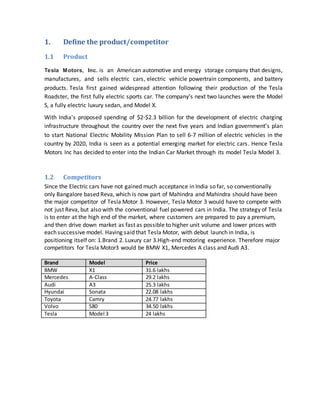
Brand Model Price
BMW X1 31.6 lakhs
Mercedes A-Class 29.2 lakhs
Audi A3 25.3 lakhs
Hyundai Sonata 22.08 lakhs
Toyota Camry 24.77 lakhs
Volvo S80 34.50 lakhs
Tesla Model 3 24 lakhs
2. Analysis of Category
2.1 Aggregate Market factors
1. Market Size: India is yet to take to electric / hybrid cars, probably because they are
considered to be not only expensive to buy, but also to maintain. And when it comes
to alternate fuels, customers have relied more on LPG and CNG instead of electric
energy. However, that hasn't dampened the car manufacturers' hopes in India, as
they have anyway gone ahead and introduced vehicles which are clean and green.
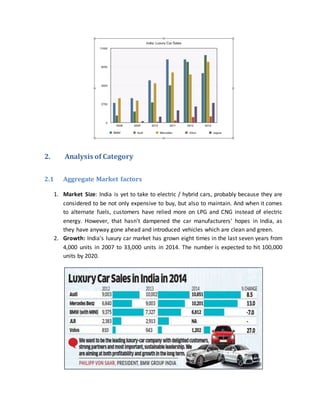
2. Growth: India's luxury car market has grown eight times in the last seven years from
4,000 units in 2007 to 33,000 units in 2014. The number is expected to hit 100,000
units by 2020.
Stage in Product Life Cycle: Tesla Motors, the world's most successful electric car maker,
plans to enter the Indian market with its upcoming sedan that will be priced at less than half
of its existing model. The product is expected to be launched in first quarter 2016.
The product is still in Introduction Phase
3. Profits: Tesla Motors Historical Gross Profit Margin (Quarterly) Data [in US Market].
The company is expected to follow the same profit margin in India.
Data for this date range Profit Margin (in %)
Sept 30, 2014 29.57%
June 30. 2014
27.69%
March 31, 2014 25.00%
Dec 31, 2014
25.45%
The Indian government is planning to start National Electric Mobility Mission Plan,
where it plans to sell 6-7 million of electric vehicles in the country by 2020. It is aimed
at providing incentives to the tune of about Rs 14,000 crore for promotion of cleaner
electric vehicle technologies with the aim of saving 2.2-2.5 million tons of fuel by the
end of this decade. The policy is yet to be approved and implemented. India has one
of the highest import duties in the world - in excess of 100%. This might be a reason
for decline in profit margins.
2.2 Category Factors
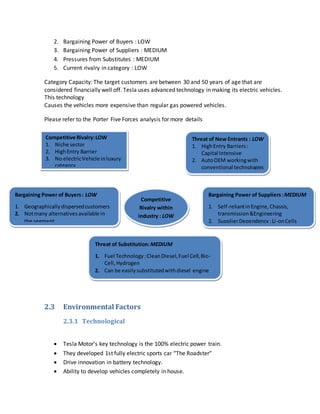
Porter Five Forces analysis for Tesla Motors is as follows:
1. Threat of New Entrants : LOW
2. Bargaining Power of Buyers : LOW
3. Bargaining Power of Suppliers : MEDIUM
4. Pressures from Substitutes : MEDIUM
5. Current rivalry in category : LOW
Category Capacity: The target customers are between 30 and 50 years of age that are
considered financially well off. Tesla uses advanced technology in making its electric vehicles.
This technology
Causes the vehicles more expensive than regular gas powered vehicles.
Please refer to the Porter Five Forces analysis for more details
2.3 Environmental Factors
2.3.1 Technological
 Tesla Motor’s key technology is the 100% electric power train.
 They developed 1st fully electric sports car “The Roadster”
 Drive innovation in battery technology.
 Ability to develop vehicles completely in house.
Competitive Rivalry:LOW
1. Niche sector
2. HighEntry Barrier
3. No electricVehicle inluxury
category
Competitive
Rivalry within
industry : LOW
Threat of New Entrants : LOW
1. HighEntry Barriers:
Capital Intensive
2. AutoOEM workingwith
conventional technologies
Threat of Substitution:MEDIUM
1. Fuel Technology:CleanDiesel,Fuel Cell,Bio-
Cell,Hydrogen
2. Can be easily substitutedwithdiesel engine
Bargaining Power of Suppliers :MEDIUM
1. Self-reliantinEngine,Chassis,
transmission&Engineering
2. SupplierDependency:Li-onCells
Bargaining Power of Buyers: LOW
1. Geographicallydispersedcustomers
2. Notmany alternativesavailable in
the segment
 Lead in development of infrastructure of electric vehicle (EVs) and license it to other
play.
 Strong technological expertise in the area of electric transmissions.
 Also a strong supplier to other manufacturers like Toyota
2.3.2 Political
• Reva, India’s first commercial electric car that has been around for over a decade,
didn’t find many takers, selling fewer than 500 cars a year.
• Indian market presents its own inherent problems for Tesla, including an unreliable
electrical infrastructure, a small fraction of the charging stations, and a population
that by and large can’t even afford the cheapest car.
• To facilitate growth, The Indian government is trying to promote the use of electric
vehicles with its National Electric Mobility Mission Plan 2020, under which it plans to
invest Rs14,000 crore ($2.25 billion) to build the infrastructure required for electric
vehicles.
• A key metric would be how customers adopt to this product initially in India given its
high entry cost between $30,000 to $40,000.
• Large International market potential given its eco-friendly products.
2.3.3 Economic
 Tesla is a high-end luxury car so demand might be somewhat constrained initially and
be similar to other luxury cars.
 Price of the traditional lead-acid batteries in India is around Rs 5,000 per kWh.
Recently launched Tesla “Powerwall”, a lithium-ion energy storage system for the
residential market, according to a rough calculation would work out to Rs 22,000 per
kWh.
2.3.4 Social
 As fuel prices remain high and there is greater concern for the environment, more
energy efficient cars are increasing in demand.
 Increase in environmental consciousness of consumers (green/eco) products.
 Tesla vehicles produce zero emission.
2.3.5 Legal
 India has one of the highest import duty in the world — in excess of 100% — that
goes against Tesla principal of importing car directly from its plants at Freemont in
the US or the assembly unit in Netherlands
 Promotion of new technologies andchangesin energypoliciesbyIndianGovernment.
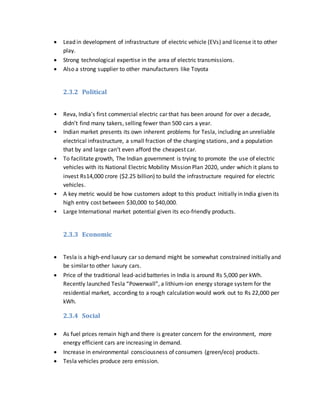
TeslaMotors ProductPortfolio
3. Company and Competitor Analysis
3.1 Product Features Mix
Charging
 Free long distance travel using Tesla’s Supercharger network
 Mobile connector with 110 volt, 240 volt, and J1772 adapters
Interior
 17” capacitive touch screen with digital instrument cluster
 Onboard maps and navigation with free updates for 7 years
 Automatic keyless entry
 Wi-Fi and Internet connectivity
 Mobile app remote control
 Automatic Xenon headlights
The Roadsterwas Tesla’sfirstmodel andwassoldbefore
2012.
Model-Sdeliveriesbeganin2012.
Model-Xdeliveriesare expectedtobeginlaterthisyear.
 Retracting door handles
 One touch power windows
 High definition backup camera
 Rain sensing automatic windshield wipers
 GPS enabled Home link
 Hands free talking with Bluetooth
 Voice activated controls
 AM, FM, and Internet streaming radio
 Available Ultra High Fidelity Sound package with XM radio support
 Electro chromatic mirrors
 Power folding, heated side mirrors with memory
 Two USB ports for media and power
 12 volt power outlet
 Twelve way power adjustable, heated front seats with memory and driver profile
 Available subzero weather package with heated rear seats and wiper blade and
windshield washer fluid defrosters
Safety
 Daytime running lights
 Available Smart Air Suspension for raising and lowering ride height
 Eight airbags for driver and passenger heads, knees, and pelvis plus two side curtain
airbags
 Electronic stability and traction control
 Four wheel antilock disc brakes with electronic parking brake
 Automatic emergency braking
 Blind spot warning
 Lane departure warning
 Parking sensors
 Speed limit display
 Titanium underbody shield and aluminum deflector plates
 Autopilot Convenience Features add
 Traffic-aware cruise control
 Automatic lane centering
 Self-parking
 Automatic high/low beam headlights
 Premium Interior and
Lighting adds
 Fit and finish refinements, including the use of higher quality materials and ambient
lighting
 Power lift gate.
 Fog and cornering lights
 Lighted door handles
 Interior accent lighting
3.2 Objective
Tesla Motors designs and sells high-performance, highly efficient electric all kind of cars —
with no compromises. Tesla Motors cars combine style, acceleration, and handling with
advanced technologies that make them among the quickest and the most energy-efficient
cars on the road.
Tesla mission statement is “Zero Emissions. Zero Compromises”.
Tesla’s mission is to accelerate the world’s transition to sustainable transport.
3.3 Strategies
Corporate Strategies
Growth Strategy: Market Development An effective idea for growth is entering new markets.
If you have access to more customers, you can sell more products and at the same time
concentrating on its primary line of business. You can target new markets by opening
additional retail locations, adding an online presence, selling internationally or reaching new
types of customers. Tesla should keep focusing on its Niche segment as the current status
but expand in different markets such as Europe & Asia in order to increase revenues.
Expansion in new markets avoids the fierce competition in USA. As an example, in 2012, the
Chinese bought over 19 million vehicles, while the U.S. market only bought 14 million. China
is already the world's largest auto market and it's set to grow even bigger in coming years.
Chinese central planners have said that they want to have 5 million electric cars on the road
there by 2020. That's only seven years away. It currently has facilities in the United States
and throughout Europe where parts are being manufactured and assembled. Since they have
limited resources, you must be very selective of the location for its expansion
Advantages Organization becomes pioneer at its specialization Build Brand Name Globally
This not only affects sales through name recognition, but also helps recruit local employees,
sign on new distributors and work with media in each country as part of the overall
marketing efforts. Increase sales and thus revenues.
Product Development: - Tesla could benefit from its strong R&D department and focus on
innovating new cars to target a wider range of customers. If the strategy is properly
implemented, Tesla can gain a reputation as a company that is on the leading edge of EV
industry. This can help capture more market share and create an expectation of exciting
ideas among its customers. In details, Tesla motors should produce different types of electric
cars like 4x4, hutch back or sports cars not only the existing type, as Tesla is currently
suffering from number of units sold and sales so we have to diversify the products just to
increase the sales and brand recognition as it will get to more customers which have
different tastes. So it can be named with different names like model X which will be
introduced in late 2014. Advantages: Creates Value. When a company uses a differentiation
strategy that focuses on the cost value of the product versus other similar products on the
market, it creates a perceived value among consumers and potential customers. Increase
Brand Awareness. Increase number of customers and accordingly Consumer Loyalty. Provide
a competitive advantage especially in the automotive market which dominated by larger
companies. Having multiple product lines may allow a growing business to diversify risk and
capitalize on its established reputation and can attract buyers with different preferences,
increase profitability thanks to market segmentation and, for some businesses, even out
seasonal sales patterns Compete more broadly in your industry. Disadvantages: Different
Competitors will be added to current competition.
3.4 Marketing Mix Analysis
4P’s of Tesla Motor are:
Product: Tesla Motor
 The fully electric car which is expected to be competing with the conventional
fuel powered cars.
 Made of steel
 Unique design and distinctive style
 Range of 200 miles (320 km) on a single electric charge.
 Expected to offer straight line performance of around 0-62mph in 4.1
seconds.
 Added advantage of a cheaper battery thanks to Tesla’s forthcoming
Gigafactory.
 Aimed for providing a full-scale motoring experience
 Environment friendly
 High performance
 Efficient path to a sustainable energy future
Price: TeslaMotor
 US$35,000 starting price(Rs 18 Lakh-25lakh)
 Affordable lower end of the luxury segment
 Three step strategy to start at high price and moving progressively towards
lower cost.
Promotion: TeslaMotor
 Auto-expo and other special events
 Sponsoring high profile events and campaigns
 Innovative programs / campaigns like offering qualifying customers an
opportunity to trade in their current vehicle for new Tesla Motor.
 Discounts on pre-bookings
 Celebrity endorsements
 Integrated marketing campaign with full page newspaper advertisements and
on social media.
 Billboard campaigns
 Google Ad-words
Place: TeslaMotor
 Differentiated selling strategy
 Online/Website booking of a car without having to go to a dealer
 Company owned stores to sell cars
These 4P’s translates into the following key value proposition for customers:
3.5 Value Proposition
 Energy efficient
 High Performance
 Unique style and design
 Un-paralleled motoring experience
 High power
 Sustainable transport
 First of its kind
 Brand value
 Affordable in lower end of luxury segment
 Highly customized purchase of cars as consumer can specify their choices online
 No hidden costs because of direct distribution
 Free long distance travel as free charging available at supercharger station
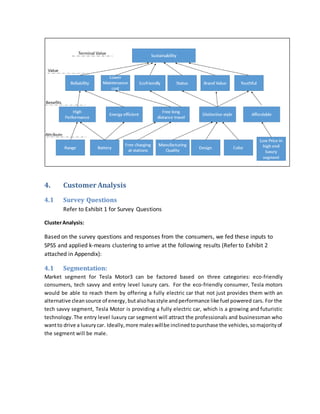
CustomerDecisionMap for TeslaMotor:
4. Customer Analysis
4.1 Survey Questions
Refer to Exhibit 1 for Survey Questions
ClusterAnalysis:
Based on the survey questions and responses from the consumers, we fed these inputs to
SPSS and applied k-means clustering to arrive at the following results (Refer to Exhibit 2
attached in Appendix):
4.1 Segmentation:
Market segment for Tesla Motor3 can be factored based on three categories: eco-friendly
consumers, tech savvy and entry level luxury cars. For the eco-friendly consumer, Tesla motors
would be able to reach them by offering a fully electric car that not just provides them with an
alternative cleansource of energy,butalsohasstyle andperformance like fuel powered cars. For the
tech savvy segment, Tesla Motor is providing a fully electric car, which is a growing and futuristic
technology.The entry level luxury car segment will attract the professionals and businessman who
wantto drive a luxurycar. Ideally,more maleswillbe inclinedtopurchase the vehicles,somajorityof
the segment will be male.
4.2 Targeting:
The target market for Tesla Motor3 will be professionals, mostly males looking for entry
level luxury car. Thus target market will comprise of late 20’s to early 50’s middle, upper or
affluent class working adults. Which constitute around approximately 2% of India’s
population.
4.3 Positioning:
Tesla motor 3 would be positioned as an entry level luxury car that has the added benefit of
being fully electric, while not losing on performance. Since Tesla Motors is known for its high
performance innovative products and great designs, so Tesla motor 3, launched as an entry
level luxury car would be perceived as a brand, that provides the double benefits of luxury
and zero emissions, but does not compromise on its style and performance. By providing
these benefits, it would position itself as a brand that would save consumers more money
than the traditional entry level luxury cars.
5. Assumptions in planning process
5.1 Market Potential
India is considered to as a huge potential market. India has tons of wealthy people willing to
spend top dollar for top end and refined vehicles that are indicative of their status in the
society. The only luxury vehicles you get in India are a bunch of those agricultural Mercedes’,
Audi's and BMW's almost all of which run on those farm grade noisy inefficient Diesel
engines.
If Tesla motors wants to have a global presence, India is one of the right places to start in
Asia. The Indian subcontinent has lots of rich people who love supercars and know their lot
about them. Also with Growth Rate Pegged at 7.5 % for the FY 2015 To 2016 we think it
would not be a bad place to invest in.
5.2 Forecast Assumptions
 Petrol prices will remain to be on higher end.
 Government and people will prefer eco-friendly car.
 There is sufficient electricity produced in India to support charging of cars and
changing points can be easily made.
5.3 Other Assumptions:
 It is assumed that Indians absolutely love the Model S and are more than willing to
buy it rather than a gas guzzler.
 The decrease in the prize of gasoline will not affect the buying choices of people. It is
assumed that people would still prefer an electric car.
 Tesla will get exemption from the Indian government on customs duty because it is
an electric and eco-friendly car.
 Rich people are willing to substitute their gas guzzlers with Tesla’s electric cars.
6. Objectives
i. Corporate Objectives (If appropriate)
 To builda more affordable car suitable tothe needsof Indiancustomer.
 To accelerate the adventof sustainable transportbybringingcompellingmassmarketelectric
cars to Indian marketas soonas possible.
 To expandmarketgeographically.
 Provide zeroemissionelectricpowergenerationoptions.
 To builditsownMobile Service Unit.
 AchievingOperatingEfficiencies,bettercontrol overcosts.
 Bettersafetytrack record.
ii. Divisional Objectives (If appropriate)
 Infrastructure Division :Buildabroad networkof chargingstationsforall electricvehicles
 R&D Division :Sell patentedelectricpowertraincomponentstootherautomakers
iii. Marketing Objectives
1. Volumes&Profits
The IndiangovernmenthasbeenplanningtostartNational ElectricMobilityMissionPlan,
where itplansto sell 6-7millionof electricvehiclesinthe country by 2020. Teslais eyeing
for these volumes. The governmentaims atprovidingincentivestothe tune of aboutRs
14,000 crore for promotionof cleanerelectricvehicle technologieswiththe aimof saving
2.2-2.5 milliontonsof fuel bythe endof this decade.The policyisyettobe approvedand
implemented.
2. TimeFrame
TeslaMotor is planningtolaunchitsentry-levelsedan - Model 3 inIndiainMarch, 2016, and
that itwill costaround $35,000 (Rs.23 lakhs).Itisnot clearfromwhenTeslamotorwill start
itsmarketingcampaigninIndia,butwe are expectingitwillstartinQ4 of financial year2015
-2016.
3. CustomerRetention
As Teslawill be launchedinIndiaforthe firsttime toitbecomesall the more importantfor
themto retainfirstbuyerbecause theywouldinturndowordof mouthmarketingforTesla.
For thisreason we have to do followingthings:
 Personal customerexperience thatwillcreate customerloyalty.
 Trulyengagedworkers – inspiredbywhere the companyisheadedandare
motivatedtoshare that passionwithcustomersbydeliveringgreatcustomerservice
and interaction.
 Appreciate clients/customers.Thankyounotes,thankyougiftsforonboardingnew
clientsand/ordiscountstoyourmostloyal customerscan speakvolumes.
Recognitiononsocial mediaforourmostloyal customerscanbe valuable.
 Welcome andask forconstructive feedback.
 Don’twaitfor negative feedbacktocome.Be proactive
4. IntermediaryRetention
Intermediaryare the mostimportantpartof SupplyChainManagement.We if candevelop
goodintermediariesrelationthenthatwoulddowondersforourbusinesslike itwill reduce
the time for final deliveryof Teslacarsto retail stores.We will use followingstrategiesto
improve intermediaryrelations:
 Offerdiscountstoourintermediaries.
 Pay the feesinadvance.
 Take theiropinioninproductmarketingsothattheyfeel more involved.
 Give thenpaymentshigherthanthe existingcarcompanies.
7. Strategy - Product
i. Customer Targets
The target customers are between30 and 50 years ofage that are considered financiallywell off.
Teslausesadvancedtechnologyinmakingitselectricvehicles. Thistechnologycausesthe vehicles
more expensive thanregulargaspoweredvehicles.Speedanddesignalsoplaysafactorinthe price
because the TeslaRoadsterisconsideredan"exotic"carandthe TeslaModel S isconsideredaluxury
sedan.These types of vehiclesare typicallypurchasedbythose thatcan affordsuchluxuries.
The target groupcomprisesof Innovators and early adoptersof technology.These guysare willingto
take risks, have the highestsocial status, have financial liquidity,are social and have closestcontact
to scientificsourcesand interaction with otherinnovators. Theirrisktolerance allowsthemtoadopt
technologiesthatmayultimatelyfail.Financial resourceshelpabsorbthese failures.The electric
vehicle marketiscurrentlygrowinginthe automotive industry.Manycompaniesare researchinginto
creatinga betterelectricvehicle thatcantravel at a greaterrange and withmore speedandpower.
The risingcost of oil and other non-energies hasincreasedthe searchforalternative waystopowera
vehicle,whichhashelpedgrowthe electricvehicle market.Bringingwindgeneratortechnologyto
the marketwill greatlyenhance the usesforelectricvehiclesbynotusingregularfuelsandasmuch
electricityfrompowerplants.Once onthe market,thistechnologywill continue togrow rapidly.
ii. Competitor Targets
Tesla´scentral competitiveadvantage isthe low costof Tesla’sbatterypack,whichallow tosell the
Model S at a reasonable price butwithanear-normal (upto) 300 mile range,acombinationother
EVs have yetto deliver.TeslaModel s batterypackcosts will be at/below Rs19500/kWh, well below
fromotherOEMs/batterymakers(Rs32500-39000/kWh for2011-2012 timeframe,andRs24375-
32500/kWh mid-decadetarget)
A key source of Tesla’scost advantage isitsabilitytoapplycommoditizedsmall cylindrical lithium
cells(usedinconsumerelectronics) toa car via proprietarythermal/powermanagement.
It alsohas a comprehensive,proprietarytechnologywith40patentsawarded& over200 patent
applicationspending
Targets:
 Teslashouldimprove brandawarenessinIndiabefore enteringthe market.Thiswill
neutralize the pedigreeof the alreadyexistingplayers.
 Tesla’sprice islowerthanthat of its competitorsothis shouldgive themanadvantage.Tesla
shouldlaunchtheircar inthe range of Rs 18-20 lakhsto gaincompetitiveadvantage.
 Technologywise Teslaisequal orbetterthanitscompetitorssotheyshouldmarketthiswhile
creatingbrandawarenessinIndia.
 Teslashouldnotgo on a price war withitscompetitorsinsteaditshouldhighlightits
technologyandEco friendlinesswhile marketingitself.
iii. Product / Service Features
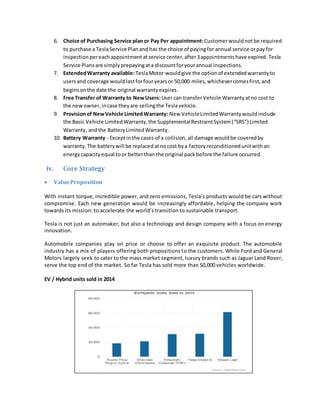
If we drawa mapto studycompetitive advantageforTeslamotorstill now,we findthat TeslaMotors
considersTechnology,ServiceandSupportasits majorpointsof Competitive Advantage.
Product features of TeslaMotor 3 wouldbe:
Please refertoExhibit3for ProductFeatures
Service Strategy:
“The best way to experience service is, of course,notto experienceservice. “
Since Teslaisgoingto launchitself inIndiathroughTeslaModel 3,hence Teslashouldaimon
providingthe bestworldbestserviceandWarrantyprograms.Teslashouldfocusonthe following
strategiesforcapturingthe market:
1. Free ValetService:Customer’s time isvaluable andshouldnotbe spentdrivingtoor waiting
at service centers.Teslais puttinginplace avaletservice,sothatcustomer’s car isseamlessly
pickedupand replacedwithaloaner andthenreturnedas soonas servicingis done.There is
no additional charge forthis.
2. ProvidingPeriodicSoftware Updates: TeslaModel 3 wouldprovide periodicupdatesand
whenan update isreleased,usershouldbe notifiedonthe screenof the car.
3. Facilitate additionof New Features: Throughsoftware updates,itwouldbe possible to
upgrade Model 3 withnewfeaturesasandwhenrequired.
4. Annual Service shouldcoverAnnual Inspection,Replacementparts,SystemMonitoringand
Remote Diagnostics.
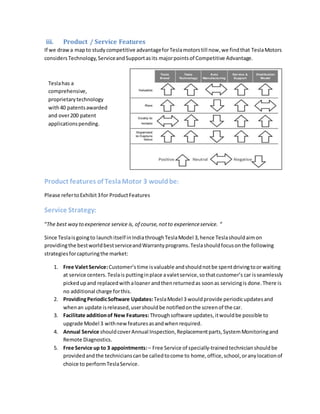
5. Free Service up to 3 appointments:– Free Service of specially-trainedtechnician should be
providedandthe technicianscan be calledtocome to home,office, school,oranylocationof
choice to performTeslaService.
Teslahas a
comprehensive,
proprietarytechnology
with40 patentsawarded
and over200 patent
applicationspending.
6. Choice of Purchasing Service planor Pay Per appointment:Customerwould notbe required
to purchase a TeslaService Planand has the choice of payingfor annual service orpayfor
inspection pereachappointment atservice center,after3appointmentshave expired.Tesla
Service Plansare simplyprepayingata discountforyourannual inspections.
7. ExtendedWarranty available:TeslaMotor wouldgive the optionof extendedwarrantyto
usersand coverage wouldlastforfouryearsor 50,000 miles,whichevercomesfirst,and
beginsonthe date the original warrantyexpires.
8. Free Transfer of Warranty to NewUsers:User can transferVehicle Warrantyatno cost to
the newowner,incase theyare sellingthe Teslavehicle.
9. Provisionof NewVehicle Limited Warranty: New VehicleLimitedWarrantywouldinclude
the Basic Vehicle LimitedWarranty,the SupplementalRestraintSystem(“SRS”) Limited
Warranty, andthe BatteryLimitedWarranty.
10. Battery Warranty - Exceptinthe cases of a collision, all damage wouldbe coveredby
warranty.The batterywill be replacedatnocost bya factoryreconditionedunitwithan
energycapacityequal toor betterthan the original packbefore the failure occurred.
iv. Core Strategy
 ValueProposition
With instant torque, incredible power, and zero emissions, Tesla’s products would be cars without
compromise. Each new generation would be increasingly affordable, helping the company work
towards its mission: to accelerate the world’s transition to sustainable transport.
Tesla is not just an automaker, but also a technology and design company with a focus on energy
innovation.
Automobile companies play on price or choose to offer an exquisite product. The automobile
industry has a mix of players offering both propositions to the customers. While Ford and General
Motors largely seek to cater to the mass market segment, luxury brands such as Jaguar Land Rover,
serve the top end of the market. So far Tesla has sold more than 50,000 vehicles worldwide.
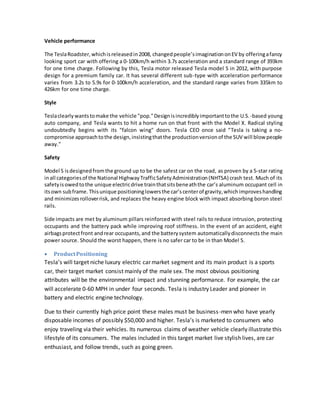
EV / Hybrid units sold in 2014
Vehicle performance
The TeslaRoadster,whichisreleasedin2008, changedpeople’simaginationonEV by offeringafancy
looking sport car with offering a 0-100km/h within 3.7s acceleration and a standard range of 393km
for one time charge. Following by this, Tesla motor released Tesla model S in 2012, with purpose
design for a premium family car. It has several different sub-type with acceleration performance
varies from 3.2s to 5.9s for 0-100km/h acceleration, and the standard range varies from 335km to
426km for one time charge.
Style
Teslaclearlywantstomake the vehicle "pop."Designisincrediblyimportanttothe U.S.-based young
auto company, and Tesla wants to hit a home run on that front with the Model X. Radical styling
undoubtedly begins with its "falcon wing" doors. Tesla CEO once said “Tesla is taking a no-
compromise approachtothe design,insistingthatthe productionversionof the SUV will blow people
away."
Safety
Model S isdesignedfromthe ground up to be the safest car on the road, as proven by a 5-star rating
inall categoriesof the National HighwayTrafficSafetyAdministration(NHTSA) crash test. Much of its
safetyisowedtothe unique electricdrive trainthatsitsbeneaththe car’s aluminum occupant cell in
itsown subframe.Thisunique positioninglowersthe car’scenterof gravity,whichimproveshandling
and minimizesrolloverrisk, and replaces the heavy engine block with impact absorbing boron steel
rails.
Side impacts are met by aluminum pillars reinforced with steel rails to reduce intrusion, protecting
occupants and the battery pack while improving roof stiffness. In the event of an accident, eight
airbagsprotectfront andrear occupants,and the batterysystem automaticallydisconnects the main
power source. Should the worst happen, there is no safer car to be in than Model S.
 ProductPositioning
Tesla’s will target niche luxury electric car market segment and its main product is a sports
car, their target market consist mainly of the male sex. The most obvious positioning
attributes will be the environmental impact and stunning performance. For example, the car
will accelerate 0-60 MPH in under four seconds. Tesla is industry Leader and pioneer in
battery and electric engine technology.
Due to their currently high price point these males must be business-men who have yearly
disposable incomes of possibly $50,000 and higher. Tesla’s is marketed to consumers who
enjoy traveling via their vehicles. Its numerous claims of weather vehicle clearly illustrate this
lifestyle of its consumers. The males included in this target market live stylish lives, are car
enthusiast, and follow trends, such as going green.
8. Strategy - Marketing Programmes
i. Integrated Marketing Communications Programs
We will focus on online sales so site traffic begins to be a major concern. Increasing site
traffic is essential to the overall health of the company. Our communication strategy
concentrates on three main media sources; Google’s Ad Words, major newspapers/
magazines, social media outlets and company sponsored events. These strategies will
increase customer traffic which ultimately will lead to an increase of revenue.
Website and Social Media
The Tesla Motors website will be the main hub of all announcements and advertisements.
We will announce the new car, promote the campaigns, and give complete details through
our website directly. We will also use our Social Media platforms to make announcements
and promote our events taking place. All ads would be on the homepage of each website,
giving it maximum exposure to those who enter the site through other channels.
Google Advertising
To help promote Tesla on the internet, we will use targeted advertising through Google Ad
Words. The targeted advertising would be focused on those who are looking at electric
vehicles or hybrid cars. Google’s Ad Words is a Pay-Per-Click advertising model that allows a
company to advertise online. Tesla will use Google’s specialized program to increase site
traffic. Pay-Per Click is a program that Google offers allowing Tesla to set a predetermined
advertising budget based on the amount of consumers visiting our website. Each click will
lead the potential consumer to www.teslamotors.com. This strategy also has a secondary
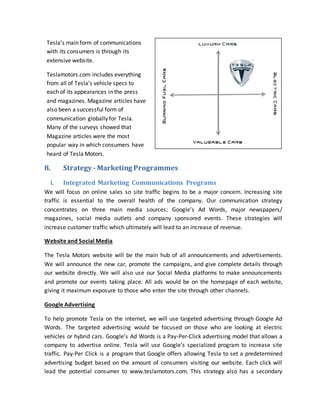
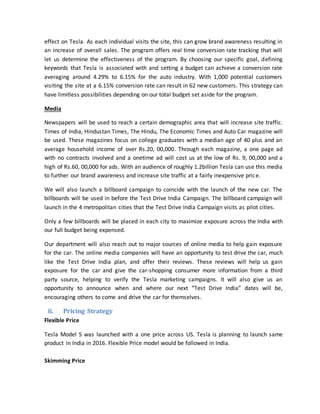
Tesla’s main form of communications
with its consumers is through its
extensive website.
Teslamotors.com includes everything
from all of Tesla’s vehicle specs to
each of its appearances in the press
and magazines. Magazine articles have
also been a successful form of
communication globally for Tesla.
Many of the surveys showed that
Magazine articles were the most
popular way in which consumers have
heard of Tesla Motors.
effect on Tesla. As each individual visits the site, this can grow brand awareness resulting in
an increase of overall sales. The program offers real time conversion rate tracking that will
let us determine the effectiveness of the program. By choosing our specific goal, defining
keywords that Tesla is associated with and setting a budget can achieve a conversion rate
averaging around 4.29% to 6.15% for the auto industry. With 1,000 potential customers
visiting the site at a 6.15% conversion rate can result in 62 new customers. This strategy can
have limitless possibilities depending on our total budget set aside for the program.
Media
Newspapers will be used to reach a certain demographic area that will increase site traffic.
Times of India, Hindustan Times, The Hindu, The Economic Times and Auto Car magazine will
be used. These magazines focus on college graduates with a median age of 40 plus and an
average household income of over Rs.20, 00,000. Through each magazine, a one page ad
with no contracts involved and a onetime ad will cost us at the low of Rs. 9, 00,000 and a
high of Rs.60, 00,000 for ads. With an audience of roughly 1.2billion Tesla can use this media
to further our brand awareness and increase site traffic at a fairly inexpensive price.
We will also launch a billboard campaign to coincide with the launch of the new car. The
billboards will be used in before the Test Drive India Campaign. The billboard campaign will
launch in the 4 metropolitan cities that the Test Drive India Campaign visits as pilot cities.
Only a few billboards will be placed in each city to maximize exposure across the India with
our full budget being expensed.
Our department will also reach out to major sources of online media to help gain exposure
for the car. The online media companies will have an opportunity to test drive the car, much
like the Test Drive India plan, and offer their reviews. These reviews will help us gain
exposure for the car and give the car-shopping consumer more information from a third
party source, helping to verify the Tesla marketing campaigns. It will also give us an
opportunity to announce when and where our next “Test Drive India” dates will be,
encouraging others to come and drive the car for themselves.
ii. Pricing Strategy
Flexible Price
Tesla Model S was launched with a one price across US. Tesla is planning to launch same
product in India in 2016. Flexible Price model would be followed in India.
Skimming Price
Tesla will also follow Price skimming as a pricing strategy in which it will set a relatively high
price for a Model S ‘Performance model’ at first than the base model of Model S, then will
lowers the price over time. The objective of a price skimming strategy is to capture the
consumer surplus. If this is done successfully, then theoretically no customer will pay less for
the product than the maximum they are willing to pay. Tesla Motor will continue to invest in
R&D sector to improve the quality of rechargeable battery technologies and this investment
comes from number of high profile investors and government support. Hence, more
improvement they make in terms of technological innovation and incorporate them in
Electric Vehicle like Model S, it will help to lower introductory base price gradually in
consumer market.
Penetration Price
Penetration pricing is not applicable for Tesla Model S. This pricing model is applicable when
a Company is trying to make profit in the short term, set a low price at the first launch of a
product and continue to increase the price after certain timeline to make more profit. Tesla
Motor’s goal is to get a long term market share and continue to improve quality in EV sector,
especially in battery technology. Hence initial base price of the Model S car will come down
gradually, making the product affordable to consumer space. Penetration pricing strategy
will not be applicable for Model S.
iii. Channel Strategy
A channel strategy is a vendor's plan for moving a product or a service through the chain of
commerce to the end customer. Product manufacturers and service providers face a number
of channel options.
To start with, Tesla will go with the traditional channel strategy - making use of authorized
distributorshiponlyinIndiabecause a multi-channel salesstrategyinAutomotive involves a number
of challenges,bothforthe designof the salesprocessesas well as for customer satisfaction surveys.
“Customer Experience Management” needs some kind of re-design.
iv. Customer Market Strategy
The essential elementsof acustomermanagementstrategyare:
1. Managing Relationships
Tesla reaches out its customer in three different ways (a) online booking - Tesla is pursuing a
differentiatedsellingstrategyforitscars. It lets buyers book a car online, without having to visit any
of the dealers. (b) Company Owned Stores - the brick-and-mortar stores serve as a channel to
promote the electric vehicle concept as well as its own brand. According to Tesla, the “product
specialists” at its stores are not on commission. This means that they differ from the ordinary auto
salesman, whose sole aim is to sell the vehicle. (c) Tesla also offers a test drive to its potential
customers. This also acts as a customer contact point for Tesla.
2. Creating Opportunities
Teslaopensitsshowroomsinshoppingmallsinsteadof opening a big showroom located along main
roads like everyothercardealer,theyare inshoppingmalls –rightalongside brandslike Zara, Macys,
etc.Secondlythe showroomsare onlythe size of a small shop,oftenonlysqueezinginasingle vehicle
intothe space. This radical departure from car marketing norms completely changes the traditional
customer math.
Most cars dealershipswouldbe luckytogeta hundredpotential customersperusingthe cars on their
loteach day.But because of theirlocation,Teslagets tens of thousands of people walking right past
their car, every single day.
v. Research
In Elon Musk’s own words Tesla’s long term plan is “To build a wide range of models, including
affordablypricedfamilycars.Thisisbecause the overarchingpurpose of Tesla istohelp expedite the
move from a mine-and-burn hydrocarbon economy towards a solar electric economy, which is
believed to be the primary, but not exclusive, sustainable solution.”
The strategyof Teslaisto enterat the highend of the market, where customers are prepared to pay
a premium, and then drive down market as fast as possible to higher unit volume and lower prices
witheachsuccessive model. Toachieve thisobjective, all free cash flow should be plowed back into
R&D to drive down the costs and bring new affordable to market as fast as possible. Hence, Tesla’s
Model 3 is priced around 18-24 lakhs which is around 26 lakhs reduction from its previous model –
Model S. So Tesla’sstrategyshouldbe to spend more R&D dollars to drive this goal. Main challenge
for Tesla would be to keep eye popping performance at much lower prices. The rule of thumb is
that it takes anywhere from $1 billion to $3 billion to develop a major new car model. At Tesla's
current R&D burn rate, it should therefore bring out a new car every three to nine years.
8. Controls
i. Financial markets
As suggested,Teslacouldrun“TestDrive Tesla”programsthroughoutthe countryto attract
potential customersbyworkingonthe mental palpabilityof the experience of drivingan
electriccar whichgivesaneye poppingperformanceequivalenttothat of Mercedesor Audi.
Teslacan go for runningthistestdrive programtwice ina yearbefore the launch,at a total
cost of around Rs 2 Croresor 20 million. Duringthe same phase Teslacan start the “Loyalty
programs” too,whose costshouldbe limitedtoaround10% of the salesthatyear.Teslacan
alsoemployaright mix of cars with40KWh batteryandcars with60 KWh batterybyevenly
distributingthe numbersbetweenthe twovariants.
Teslacan late on increase the productionof carsin 40KWh and 60KWh categoryinnexttwo
years,maintainingthe same ratiobetweenthe twovariantsasthisyear.However,with
increase inthe productionof numberof cars, cost of Loyaltyprogramswill alsoincrease next
yearas theyare directlylinkedtothe sales.Basedon the response generatedforthe Tesla
Model 3, it can laterdecide whetherornotto increase the productionof carsor to launcha
newer,affordableversionof the car,ratio betweenthe 40KWhand60KWh batteryvariants
and the budgetto be spentonTest Drive TeslaandLoyaltyPrograms.
ii. Marketing Metrics
Teslamotorswill use the followingmarketingmetrics inIndiatostart with.
Channel-SpecificTraffic.Foundinthe “Acquisition”sectionof Google Analytics, the channel-specific
metricswill segment the trafficbasedontheirpointof origin.Thisisespeciallyuseful forafull-scale
digital marketingcampaignbecause“total visits”can’tgive youanindicationof whichchannelsare
outperformingthe others.The fourmainchannelstokeepaneye onare:
1. “direct,”whichwill tell howmanypeoplevisited the site directly;
2. “referrals,”whichincludeexternal linksfromothersites;
3. “organic,”whichincludesvisitorswhofound "Tesla"afterperformingasearch,and;
4. “social,”whichincludesvisitorswho found"Tesla"throughsocial media.It’sanexcellentway
to gauge the strengths,social mediamarketing,contentmarketing,andtraditional marketing
campaigns.
5. Total Conversions. Total conversionsisone of the mostimportantmetricsformeasuringthe
profitabilityof overallmarketingefforts. Itmeasuresthe numberof customerswhovisitedthe
showroomandthe numberof customerswhoactuallyconvertedintosales.
6. Lead to Close Ratio. Thisis lessa measure of the marketingeffortsandmore ameasure of sales
success,butit’simportantto understandinthe contextof total returnon investment.Withoutan
efficientandsuccessful salesfollow-up,anyleads one getsfrommarketingcouldbe useless.This
metriciseasyto define:simplydivide the total numberof salesbyyourtotal numberof leads,and
one get a ratiothat defines the salessuccessindependentof marketingefforts.If the close rate is
low,anydrop inrevenue oroverspendingcouldmerelybe asymptomof inefficientfinalsales
strategies.
8. CustomerValue. It is goingto be helpful indetermining the overall returnoninvestment.Itcan
alsobe useful insettingannual companygoals.Tofind the average customervalue, we have totake
intoaccount all salesthe average customerwill initiateoverthe course of the customer relationship.
9. Contingency Plans
Teslafacesmanychallengesasa newentrymotorcompanyin a verycompetitive Indianauto
industry.We knowwhatTesladoesbest,"buildsgreatfullyelectriccarwithoutthe sacrifice of
performance orstyle".Teslaisseenbymanyas cool "techy"innovative companybutnoone is
persuadedenoughtocome outand purchase at itsprice tag. Recharge time of car at home and
highwaywouldbe differentiatingfactorforuseroverall experience withanelectricvehicle.
One of topdrawback of Teslaishighinitial costassociatedwithpurchasing.The new model,Gen3,
reducesthe initial costforownershipof an electriccar.
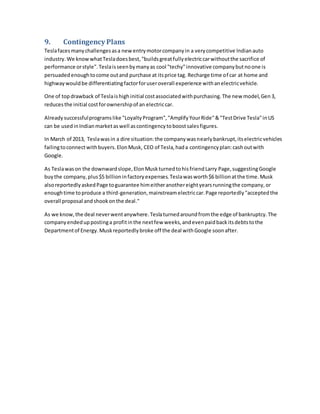
Alreadysuccessfulprogramslike "LoyaltyProgram","AmplifyYourRide"&"TestDrive Tesla"inUS
can be usedinIndianmarketaswell ascontingencytoboostsalesfigures.
In March of 2013, Teslawasin a dire situation:the companywasnearlybankrupt,itselectricvehicles
failingtoconnectwithbuyers.ElonMusk, CEO of Tesla,hada contingencyplan:cashoutwith
Google.
As Teslawason the downwardslope,ElonMuskturnedtohisfriendLarry Page,suggestingGoogle
buythe company,plus$5 billioninfactoryexpenses.Teslawasworth$6 billionatthe time.Musk
alsoreportedlyaskedPage toguarantee himeitheranothereightyearsrunningthe company,or
enoughtime toproduce a third-generation,mainstreamelectriccar.Page reportedly"acceptedthe
overall proposal andshookonthe deal."
As we know,the deal neverwentanywhere.Teslaturnedaroundfromthe edge of bankruptcy.The
companyendeduppostinga profitinthe nextfew weeks,andevenpaidbackitsdebtstothe
Departmentof Energy.Muskreportedlybroke off the deal withGoogle soonafter.
8. Exhibit 1 - Survey Questions
Survey
Questions_Tesla Motors.docx
9. Exhibit 2 - Cluster Analysis
Cluster Analysis
Output_Tesla Motors.doc
10. Exhibit 3 - Product Features
Product
Features_Tesla Motors.docx

Tesla motors version

  • 1.
    2015 AshishKumar [G15072] Gaurav Sahai[G15079] Jyoti Gupta [G15085] NitishBhardwaj [G15095] Pranav Mehrotra[G15099] XLRI 9/25/2015 Tesla Motors - India Launch
  • 2.
    Contents 1. Define theproduct/competitor................................................................................................4 1.1 Product...........................................................................................................................4 1.2 Competitors....................................................................................................................4 2. Analysis of Category...............................................................................................................5 2.1 Aggregate Market factors.................................................................................................5 2.2 Category Factors..............................................................................................................6 2.3 Environmental Factors.........................................................................................................7 2.3.1 Technological...............................................................................................................7 2.3.2 Political .......................................................................................................................8 2.3.3 Economic.....................................................................................................................8 2.3.4 Social...........................................................................................................................8 2.3.5 Legal ...........................................................................................................................9 3. Company and Competitor Analysis...........................................................................................9 3.1 Product Features Mix.......................................................................................................9 3.2 Objective ......................................................................................................................11 3.3 Strategies......................................................................................................................11 3.4 Marketing Mix Analysis..................................................................................................12 3.5 Value Proposition..........................................................................................................13 4. Customer Analysis.................................................................................................................14 4.1 Survey Questions...........................................................................................................14 4.1 Segmentation:...............................................................................................................14 4.2 Targeting:......................................................................................................................15 4.3 Positioning:...................................................................................................................15 5. Assumptionsin planning process ...........................................................................................15 5.1 Market Potential ...........................................................................................................15 5.2 Forecast Assumptions....................................................................................................15 5.3 Other Assumptions:.......................................................................................................16 6. Objectives............................................................................................................................16 i. Corporate Objectives (If appropriate).................................................................................16 ii. Divisional Objectives (If appropriate)..................................................................................16 iii. Marketing Objectives.........................................................................................................16
  • 3.
    1. Volumes &Profits..........................................................................................................16 2. Time Frame...................................................................................................................17 3. Customer Retention.......................................................................................................17 4. Intermediary Retention..................................................................................................17 7. Strategy - Product.................................................................................................................17 i. Customer Targets..............................................................................................................17 ii. Competitor Targets ...........................................................................................................18 iii. Product / Service Features.................................................................................................19 iv. Core Strategy....................................................................................................................20  Value Proposition..........................................................................................................20  Product Positioning........................................................................................................21 8. Strategy - Marketing Programmes..........................................................................................22 i. Integrated Marketing Communications Programs ...............................................................22 ii. Pricing Strategy.................................................................................................................23 iii. Channel Strategy...............................................................................................................24 iv. Customer Market Strategy.................................................................................................24 v. Research...........................................................................................................................25 8. Controls................................................................................................................................25 i. Financial markets ..............................................................................................................25 ii. Marketing Metrics.............................................................................................................26 9. Contingency Plans.................................................................................................................27 8. Exhibit 1...............................................................................................................................28
  • 4.
    1. Define theproduct/competitor 1.1 Product Tesla Motors, Inc. is an American automotive and energy storage company that designs, manufactures, and sells electric cars, electric vehicle powertrain components, and battery products. Tesla first gained widespread attention following their production of the Tesla Roadster, the first fully electric sports car. The company's next two launches were the Model S, a fully electric luxury sedan, and Model X. With India's proposed spending of $2-$2.3 billion for the development of electric charging infrastructure throughout the country over the next five years and Indian government’s plan to start National Electric Mobility Mission Plan to sell 6-7 million of electric vehicles in the country by 2020, India is seen as a potential emerging market for electric cars. Hence Tesla Motors Inc has decided to enter into the Indian Car Market through its model Tesla Model 3. 1.2 Competitors Since the Electric cars have not gained much acceptance in India so far, so conventionally only Bangalore based Reva, which is now part of Mahindra and Mahindra should have been the major competitor of Tesla Motor 3. However, Tesla Motor 3 would have to compete with not just Reva, but also with the conventional fuel powered cars in India. The strategy of Tesla is to enter at the high end of the market, where customers are prepared to pay a premium, and then drive down market as fast as possible to higher unit volume and lower prices with each successive model. Having said that Tesla Motor, with debut launch in India, is positioning itself on: 1.Brand 2. Luxury car 3.High-end motoring experience. Therefore major competitors for Tesla Motor3 would be BMW X1, Mercedes A class and Audi A3. Brand Model Price BMW X1 31.6 lakhs Mercedes A-Class 29.2 lakhs Audi A3 25.3 lakhs Hyundai Sonata 22.08 lakhs Toyota Camry 24.77 lakhs Volvo S80 34.50 lakhs Tesla Model 3 24 lakhs
  • 5.
    2. Analysis ofCategory 2.1 Aggregate Market factors 1. Market Size: India is yet to take to electric / hybrid cars, probably because they are considered to be not only expensive to buy, but also to maintain. And when it comes to alternate fuels, customers have relied more on LPG and CNG instead of electric energy. However, that hasn't dampened the car manufacturers' hopes in India, as they have anyway gone ahead and introduced vehicles which are clean and green. 2. Growth: India's luxury car market has grown eight times in the last seven years from 4,000 units in 2007 to 33,000 units in 2014. The number is expected to hit 100,000 units by 2020.
  • 6.
    Stage in ProductLife Cycle: Tesla Motors, the world's most successful electric car maker, plans to enter the Indian market with its upcoming sedan that will be priced at less than half of its existing model. The product is expected to be launched in first quarter 2016. The product is still in Introduction Phase 3. Profits: Tesla Motors Historical Gross Profit Margin (Quarterly) Data [in US Market]. The company is expected to follow the same profit margin in India. Data for this date range Profit Margin (in %) Sept 30, 2014 29.57% June 30. 2014 27.69% March 31, 2014 25.00% Dec 31, 2014 25.45% The Indian government is planning to start National Electric Mobility Mission Plan, where it plans to sell 6-7 million of electric vehicles in the country by 2020. It is aimed at providing incentives to the tune of about Rs 14,000 crore for promotion of cleaner electric vehicle technologies with the aim of saving 2.2-2.5 million tons of fuel by the end of this decade. The policy is yet to be approved and implemented. India has one of the highest import duties in the world - in excess of 100%. This might be a reason for decline in profit margins. 2.2 Category Factors Porter Five Forces analysis for Tesla Motors is as follows: 1. Threat of New Entrants : LOW
  • 7.
    2. Bargaining Powerof Buyers : LOW 3. Bargaining Power of Suppliers : MEDIUM 4. Pressures from Substitutes : MEDIUM 5. Current rivalry in category : LOW Category Capacity: The target customers are between 30 and 50 years of age that are considered financially well off. Tesla uses advanced technology in making its electric vehicles. This technology Causes the vehicles more expensive than regular gas powered vehicles. Please refer to the Porter Five Forces analysis for more details 2.3 Environmental Factors 2.3.1 Technological  Tesla Motor’s key technology is the 100% electric power train.  They developed 1st fully electric sports car “The Roadster”  Drive innovation in battery technology.  Ability to develop vehicles completely in house. Competitive Rivalry:LOW 1. Niche sector 2. HighEntry Barrier 3. No electricVehicle inluxury category Competitive Rivalry within industry : LOW Threat of New Entrants : LOW 1. HighEntry Barriers: Capital Intensive 2. AutoOEM workingwith conventional technologies Threat of Substitution:MEDIUM 1. Fuel Technology:CleanDiesel,Fuel Cell,Bio- Cell,Hydrogen 2. Can be easily substitutedwithdiesel engine Bargaining Power of Suppliers :MEDIUM 1. Self-reliantinEngine,Chassis, transmission&Engineering 2. SupplierDependency:Li-onCells Bargaining Power of Buyers: LOW 1. Geographicallydispersedcustomers 2. Notmany alternativesavailable in the segment
  • 8.
     Lead indevelopment of infrastructure of electric vehicle (EVs) and license it to other play.  Strong technological expertise in the area of electric transmissions.  Also a strong supplier to other manufacturers like Toyota 2.3.2 Political • Reva, India’s first commercial electric car that has been around for over a decade, didn’t find many takers, selling fewer than 500 cars a year. • Indian market presents its own inherent problems for Tesla, including an unreliable electrical infrastructure, a small fraction of the charging stations, and a population that by and large can’t even afford the cheapest car. • To facilitate growth, The Indian government is trying to promote the use of electric vehicles with its National Electric Mobility Mission Plan 2020, under which it plans to invest Rs14,000 crore ($2.25 billion) to build the infrastructure required for electric vehicles. • A key metric would be how customers adopt to this product initially in India given its high entry cost between $30,000 to $40,000. • Large International market potential given its eco-friendly products. 2.3.3 Economic  Tesla is a high-end luxury car so demand might be somewhat constrained initially and be similar to other luxury cars.  Price of the traditional lead-acid batteries in India is around Rs 5,000 per kWh. Recently launched Tesla “Powerwall”, a lithium-ion energy storage system for the residential market, according to a rough calculation would work out to Rs 22,000 per kWh. 2.3.4 Social  As fuel prices remain high and there is greater concern for the environment, more energy efficient cars are increasing in demand.  Increase in environmental consciousness of consumers (green/eco) products.  Tesla vehicles produce zero emission.
  • 9.
    2.3.5 Legal  Indiahas one of the highest import duty in the world — in excess of 100% — that goes against Tesla principal of importing car directly from its plants at Freemont in the US or the assembly unit in Netherlands  Promotion of new technologies andchangesin energypoliciesbyIndianGovernment. TeslaMotors ProductPortfolio 3. Company and Competitor Analysis 3.1 Product Features Mix Charging  Free long distance travel using Tesla’s Supercharger network  Mobile connector with 110 volt, 240 volt, and J1772 adapters Interior  17” capacitive touch screen with digital instrument cluster  Onboard maps and navigation with free updates for 7 years  Automatic keyless entry  Wi-Fi and Internet connectivity  Mobile app remote control  Automatic Xenon headlights The Roadsterwas Tesla’sfirstmodel andwassoldbefore 2012. Model-Sdeliveriesbeganin2012. Model-Xdeliveriesare expectedtobeginlaterthisyear.
  • 10.
     Retracting doorhandles  One touch power windows  High definition backup camera  Rain sensing automatic windshield wipers  GPS enabled Home link  Hands free talking with Bluetooth  Voice activated controls  AM, FM, and Internet streaming radio  Available Ultra High Fidelity Sound package with XM radio support  Electro chromatic mirrors  Power folding, heated side mirrors with memory  Two USB ports for media and power  12 volt power outlet  Twelve way power adjustable, heated front seats with memory and driver profile  Available subzero weather package with heated rear seats and wiper blade and windshield washer fluid defrosters Safety  Daytime running lights  Available Smart Air Suspension for raising and lowering ride height  Eight airbags for driver and passenger heads, knees, and pelvis plus two side curtain airbags  Electronic stability and traction control  Four wheel antilock disc brakes with electronic parking brake  Automatic emergency braking  Blind spot warning  Lane departure warning  Parking sensors  Speed limit display  Titanium underbody shield and aluminum deflector plates  Autopilot Convenience Features add  Traffic-aware cruise control  Automatic lane centering  Self-parking  Automatic high/low beam headlights  Premium Interior and Lighting adds  Fit and finish refinements, including the use of higher quality materials and ambient lighting
  • 11.
     Power liftgate.  Fog and cornering lights  Lighted door handles  Interior accent lighting 3.2 Objective Tesla Motors designs and sells high-performance, highly efficient electric all kind of cars — with no compromises. Tesla Motors cars combine style, acceleration, and handling with advanced technologies that make them among the quickest and the most energy-efficient cars on the road. Tesla mission statement is “Zero Emissions. Zero Compromises”. Tesla’s mission is to accelerate the world’s transition to sustainable transport. 3.3 Strategies Corporate Strategies Growth Strategy: Market Development An effective idea for growth is entering new markets. If you have access to more customers, you can sell more products and at the same time concentrating on its primary line of business. You can target new markets by opening additional retail locations, adding an online presence, selling internationally or reaching new types of customers. Tesla should keep focusing on its Niche segment as the current status but expand in different markets such as Europe & Asia in order to increase revenues. Expansion in new markets avoids the fierce competition in USA. As an example, in 2012, the Chinese bought over 19 million vehicles, while the U.S. market only bought 14 million. China is already the world's largest auto market and it's set to grow even bigger in coming years. Chinese central planners have said that they want to have 5 million electric cars on the road there by 2020. That's only seven years away. It currently has facilities in the United States and throughout Europe where parts are being manufactured and assembled. Since they have limited resources, you must be very selective of the location for its expansion Advantages Organization becomes pioneer at its specialization Build Brand Name Globally This not only affects sales through name recognition, but also helps recruit local employees, sign on new distributors and work with media in each country as part of the overall marketing efforts. Increase sales and thus revenues. Product Development: - Tesla could benefit from its strong R&D department and focus on innovating new cars to target a wider range of customers. If the strategy is properly implemented, Tesla can gain a reputation as a company that is on the leading edge of EV industry. This can help capture more market share and create an expectation of exciting
  • 12.
    ideas among itscustomers. In details, Tesla motors should produce different types of electric cars like 4x4, hutch back or sports cars not only the existing type, as Tesla is currently suffering from number of units sold and sales so we have to diversify the products just to increase the sales and brand recognition as it will get to more customers which have different tastes. So it can be named with different names like model X which will be introduced in late 2014. Advantages: Creates Value. When a company uses a differentiation strategy that focuses on the cost value of the product versus other similar products on the market, it creates a perceived value among consumers and potential customers. Increase Brand Awareness. Increase number of customers and accordingly Consumer Loyalty. Provide a competitive advantage especially in the automotive market which dominated by larger companies. Having multiple product lines may allow a growing business to diversify risk and capitalize on its established reputation and can attract buyers with different preferences, increase profitability thanks to market segmentation and, for some businesses, even out seasonal sales patterns Compete more broadly in your industry. Disadvantages: Different Competitors will be added to current competition. 3.4 Marketing Mix Analysis 4P’s of Tesla Motor are: Product: Tesla Motor  The fully electric car which is expected to be competing with the conventional fuel powered cars.  Made of steel  Unique design and distinctive style  Range of 200 miles (320 km) on a single electric charge.  Expected to offer straight line performance of around 0-62mph in 4.1 seconds.  Added advantage of a cheaper battery thanks to Tesla’s forthcoming Gigafactory.  Aimed for providing a full-scale motoring experience  Environment friendly  High performance  Efficient path to a sustainable energy future Price: TeslaMotor  US$35,000 starting price(Rs 18 Lakh-25lakh)  Affordable lower end of the luxury segment
  • 13.
     Three stepstrategy to start at high price and moving progressively towards lower cost. Promotion: TeslaMotor  Auto-expo and other special events  Sponsoring high profile events and campaigns  Innovative programs / campaigns like offering qualifying customers an opportunity to trade in their current vehicle for new Tesla Motor.  Discounts on pre-bookings  Celebrity endorsements  Integrated marketing campaign with full page newspaper advertisements and on social media.  Billboard campaigns  Google Ad-words Place: TeslaMotor  Differentiated selling strategy  Online/Website booking of a car without having to go to a dealer  Company owned stores to sell cars These 4P’s translates into the following key value proposition for customers: 3.5 Value Proposition  Energy efficient  High Performance  Unique style and design  Un-paralleled motoring experience  High power  Sustainable transport  First of its kind  Brand value  Affordable in lower end of luxury segment  Highly customized purchase of cars as consumer can specify their choices online  No hidden costs because of direct distribution  Free long distance travel as free charging available at supercharger station CustomerDecisionMap for TeslaMotor:
  • 14.
    4. Customer Analysis 4.1Survey Questions Refer to Exhibit 1 for Survey Questions ClusterAnalysis: Based on the survey questions and responses from the consumers, we fed these inputs to SPSS and applied k-means clustering to arrive at the following results (Refer to Exhibit 2 attached in Appendix): 4.1 Segmentation: Market segment for Tesla Motor3 can be factored based on three categories: eco-friendly consumers, tech savvy and entry level luxury cars. For the eco-friendly consumer, Tesla motors would be able to reach them by offering a fully electric car that not just provides them with an alternative cleansource of energy,butalsohasstyle andperformance like fuel powered cars. For the tech savvy segment, Tesla Motor is providing a fully electric car, which is a growing and futuristic technology.The entry level luxury car segment will attract the professionals and businessman who wantto drive a luxurycar. Ideally,more maleswillbe inclinedtopurchase the vehicles,somajorityof the segment will be male.
  • 15.
    4.2 Targeting: The targetmarket for Tesla Motor3 will be professionals, mostly males looking for entry level luxury car. Thus target market will comprise of late 20’s to early 50’s middle, upper or affluent class working adults. Which constitute around approximately 2% of India’s population. 4.3 Positioning: Tesla motor 3 would be positioned as an entry level luxury car that has the added benefit of being fully electric, while not losing on performance. Since Tesla Motors is known for its high performance innovative products and great designs, so Tesla motor 3, launched as an entry level luxury car would be perceived as a brand, that provides the double benefits of luxury and zero emissions, but does not compromise on its style and performance. By providing these benefits, it would position itself as a brand that would save consumers more money than the traditional entry level luxury cars. 5. Assumptions in planning process 5.1 Market Potential India is considered to as a huge potential market. India has tons of wealthy people willing to spend top dollar for top end and refined vehicles that are indicative of their status in the society. The only luxury vehicles you get in India are a bunch of those agricultural Mercedes’, Audi's and BMW's almost all of which run on those farm grade noisy inefficient Diesel engines. If Tesla motors wants to have a global presence, India is one of the right places to start in Asia. The Indian subcontinent has lots of rich people who love supercars and know their lot about them. Also with Growth Rate Pegged at 7.5 % for the FY 2015 To 2016 we think it would not be a bad place to invest in. 5.2 Forecast Assumptions  Petrol prices will remain to be on higher end.  Government and people will prefer eco-friendly car.  There is sufficient electricity produced in India to support charging of cars and changing points can be easily made.
  • 16.
    5.3 Other Assumptions: It is assumed that Indians absolutely love the Model S and are more than willing to buy it rather than a gas guzzler.  The decrease in the prize of gasoline will not affect the buying choices of people. It is assumed that people would still prefer an electric car.  Tesla will get exemption from the Indian government on customs duty because it is an electric and eco-friendly car.  Rich people are willing to substitute their gas guzzlers with Tesla’s electric cars. 6. Objectives i. Corporate Objectives (If appropriate)  To builda more affordable car suitable tothe needsof Indiancustomer.  To accelerate the adventof sustainable transportbybringingcompellingmassmarketelectric cars to Indian marketas soonas possible.  To expandmarketgeographically.  Provide zeroemissionelectricpowergenerationoptions.  To builditsownMobile Service Unit.  AchievingOperatingEfficiencies,bettercontrol overcosts.  Bettersafetytrack record. ii. Divisional Objectives (If appropriate)  Infrastructure Division :Buildabroad networkof chargingstationsforall electricvehicles  R&D Division :Sell patentedelectricpowertraincomponentstootherautomakers iii. Marketing Objectives 1. Volumes&Profits The IndiangovernmenthasbeenplanningtostartNational ElectricMobilityMissionPlan, where itplansto sell 6-7millionof electricvehiclesinthe country by 2020. Teslais eyeing for these volumes. The governmentaims atprovidingincentivestothe tune of aboutRs 14,000 crore for promotionof cleanerelectricvehicle technologieswiththe aimof saving 2.2-2.5 milliontonsof fuel bythe endof this decade.The policyisyettobe approvedand implemented.
  • 17.
    2. TimeFrame TeslaMotor isplanningtolaunchitsentry-levelsedan - Model 3 inIndiainMarch, 2016, and that itwill costaround $35,000 (Rs.23 lakhs).Itisnot clearfromwhenTeslamotorwill start itsmarketingcampaigninIndia,butwe are expectingitwillstartinQ4 of financial year2015 -2016. 3. CustomerRetention As Teslawill be launchedinIndiaforthe firsttime toitbecomesall the more importantfor themto retainfirstbuyerbecause theywouldinturndowordof mouthmarketingforTesla. For thisreason we have to do followingthings:  Personal customerexperience thatwillcreate customerloyalty.  Trulyengagedworkers – inspiredbywhere the companyisheadedandare motivatedtoshare that passionwithcustomersbydeliveringgreatcustomerservice and interaction.  Appreciate clients/customers.Thankyounotes,thankyougiftsforonboardingnew clientsand/ordiscountstoyourmostloyal customerscan speakvolumes. Recognitiononsocial mediaforourmostloyal customerscanbe valuable.  Welcome andask forconstructive feedback.  Don’twaitfor negative feedbacktocome.Be proactive 4. IntermediaryRetention Intermediaryare the mostimportantpartof SupplyChainManagement.We if candevelop goodintermediariesrelationthenthatwoulddowondersforourbusinesslike itwill reduce the time for final deliveryof Teslacarsto retail stores.We will use followingstrategiesto improve intermediaryrelations:  Offerdiscountstoourintermediaries.  Pay the feesinadvance.  Take theiropinioninproductmarketingsothattheyfeel more involved.  Give thenpaymentshigherthanthe existingcarcompanies. 7. Strategy - Product i. Customer Targets The target customers are between30 and 50 years ofage that are considered financiallywell off. Teslausesadvancedtechnologyinmakingitselectricvehicles. Thistechnologycausesthe vehicles more expensive thanregulargaspoweredvehicles.Speedanddesignalsoplaysafactorinthe price because the TeslaRoadsterisconsideredan"exotic"carandthe TeslaModel S isconsideredaluxury sedan.These types of vehiclesare typicallypurchasedbythose thatcan affordsuchluxuries.
  • 18.
    The target groupcomprisesofInnovators and early adoptersof technology.These guysare willingto take risks, have the highestsocial status, have financial liquidity,are social and have closestcontact to scientificsourcesand interaction with otherinnovators. Theirrisktolerance allowsthemtoadopt technologiesthatmayultimatelyfail.Financial resourceshelpabsorbthese failures.The electric vehicle marketiscurrentlygrowinginthe automotive industry.Manycompaniesare researchinginto creatinga betterelectricvehicle thatcantravel at a greaterrange and withmore speedandpower. The risingcost of oil and other non-energies hasincreasedthe searchforalternative waystopowera vehicle,whichhashelpedgrowthe electricvehicle market.Bringingwindgeneratortechnologyto the marketwill greatlyenhance the usesforelectricvehiclesbynotusingregularfuelsandasmuch electricityfrompowerplants.Once onthe market,thistechnologywill continue togrow rapidly. ii. Competitor Targets Tesla´scentral competitiveadvantage isthe low costof Tesla’sbatterypack,whichallow tosell the Model S at a reasonable price butwithanear-normal (upto) 300 mile range,acombinationother EVs have yetto deliver.TeslaModel s batterypackcosts will be at/below Rs19500/kWh, well below fromotherOEMs/batterymakers(Rs32500-39000/kWh for2011-2012 timeframe,andRs24375- 32500/kWh mid-decadetarget) A key source of Tesla’scost advantage isitsabilitytoapplycommoditizedsmall cylindrical lithium cells(usedinconsumerelectronics) toa car via proprietarythermal/powermanagement. It alsohas a comprehensive,proprietarytechnologywith40patentsawarded& over200 patent applicationspending Targets:  Teslashouldimprove brandawarenessinIndiabefore enteringthe market.Thiswill neutralize the pedigreeof the alreadyexistingplayers.  Tesla’sprice islowerthanthat of its competitorsothis shouldgive themanadvantage.Tesla shouldlaunchtheircar inthe range of Rs 18-20 lakhsto gaincompetitiveadvantage.  Technologywise Teslaisequal orbetterthanitscompetitorssotheyshouldmarketthiswhile creatingbrandawarenessinIndia.  Teslashouldnotgo on a price war withitscompetitorsinsteaditshouldhighlightits technologyandEco friendlinesswhile marketingitself.
  • 19.
    iii. Product /Service Features If we drawa mapto studycompetitive advantageforTeslamotorstill now,we findthat TeslaMotors considersTechnology,ServiceandSupportasits majorpointsof Competitive Advantage. Product features of TeslaMotor 3 wouldbe: Please refertoExhibit3for ProductFeatures Service Strategy: “The best way to experience service is, of course,notto experienceservice. “ Since Teslaisgoingto launchitself inIndiathroughTeslaModel 3,hence Teslashouldaimon providingthe bestworldbestserviceandWarrantyprograms.Teslashouldfocusonthe following strategiesforcapturingthe market: 1. Free ValetService:Customer’s time isvaluable andshouldnotbe spentdrivingtoor waiting at service centers.Teslais puttinginplace avaletservice,sothatcustomer’s car isseamlessly pickedupand replacedwithaloaner andthenreturnedas soonas servicingis done.There is no additional charge forthis. 2. ProvidingPeriodicSoftware Updates: TeslaModel 3 wouldprovide periodicupdatesand whenan update isreleased,usershouldbe notifiedonthe screenof the car. 3. Facilitate additionof New Features: Throughsoftware updates,itwouldbe possible to upgrade Model 3 withnewfeaturesasandwhenrequired. 4. Annual Service shouldcoverAnnual Inspection,Replacementparts,SystemMonitoringand Remote Diagnostics. 5. Free Service up to 3 appointments:– Free Service of specially-trainedtechnician should be providedandthe technicianscan be calledtocome to home,office, school,oranylocationof choice to performTeslaService. Teslahas a comprehensive, proprietarytechnology with40 patentsawarded and over200 patent applicationspending.
  • 20.
    6. Choice ofPurchasing Service planor Pay Per appointment:Customerwould notbe required to purchase a TeslaService Planand has the choice of payingfor annual service orpayfor inspection pereachappointment atservice center,after3appointmentshave expired.Tesla Service Plansare simplyprepayingata discountforyourannual inspections. 7. ExtendedWarranty available:TeslaMotor wouldgive the optionof extendedwarrantyto usersand coverage wouldlastforfouryearsor 50,000 miles,whichevercomesfirst,and beginsonthe date the original warrantyexpires. 8. Free Transfer of Warranty to NewUsers:User can transferVehicle Warrantyatno cost to the newowner,incase theyare sellingthe Teslavehicle. 9. Provisionof NewVehicle Limited Warranty: New VehicleLimitedWarrantywouldinclude the Basic Vehicle LimitedWarranty,the SupplementalRestraintSystem(“SRS”) Limited Warranty, andthe BatteryLimitedWarranty. 10. Battery Warranty - Exceptinthe cases of a collision, all damage wouldbe coveredby warranty.The batterywill be replacedatnocost bya factoryreconditionedunitwithan energycapacityequal toor betterthan the original packbefore the failure occurred. iv. Core Strategy  ValueProposition With instant torque, incredible power, and zero emissions, Tesla’s products would be cars without compromise. Each new generation would be increasingly affordable, helping the company work towards its mission: to accelerate the world’s transition to sustainable transport. Tesla is not just an automaker, but also a technology and design company with a focus on energy innovation. Automobile companies play on price or choose to offer an exquisite product. The automobile industry has a mix of players offering both propositions to the customers. While Ford and General Motors largely seek to cater to the mass market segment, luxury brands such as Jaguar Land Rover, serve the top end of the market. So far Tesla has sold more than 50,000 vehicles worldwide. EV / Hybrid units sold in 2014
  • 21.
    Vehicle performance The TeslaRoadster,whichisreleasedin2008,changedpeople’simaginationonEV by offeringafancy looking sport car with offering a 0-100km/h within 3.7s acceleration and a standard range of 393km for one time charge. Following by this, Tesla motor released Tesla model S in 2012, with purpose design for a premium family car. It has several different sub-type with acceleration performance varies from 3.2s to 5.9s for 0-100km/h acceleration, and the standard range varies from 335km to 426km for one time charge. Style Teslaclearlywantstomake the vehicle "pop."Designisincrediblyimportanttothe U.S.-based young auto company, and Tesla wants to hit a home run on that front with the Model X. Radical styling undoubtedly begins with its "falcon wing" doors. Tesla CEO once said “Tesla is taking a no- compromise approachtothe design,insistingthatthe productionversionof the SUV will blow people away." Safety Model S isdesignedfromthe ground up to be the safest car on the road, as proven by a 5-star rating inall categoriesof the National HighwayTrafficSafetyAdministration(NHTSA) crash test. Much of its safetyisowedtothe unique electricdrive trainthatsitsbeneaththe car’s aluminum occupant cell in itsown subframe.Thisunique positioninglowersthe car’scenterof gravity,whichimproveshandling and minimizesrolloverrisk, and replaces the heavy engine block with impact absorbing boron steel rails. Side impacts are met by aluminum pillars reinforced with steel rails to reduce intrusion, protecting occupants and the battery pack while improving roof stiffness. In the event of an accident, eight airbagsprotectfront andrear occupants,and the batterysystem automaticallydisconnects the main power source. Should the worst happen, there is no safer car to be in than Model S.  ProductPositioning Tesla’s will target niche luxury electric car market segment and its main product is a sports car, their target market consist mainly of the male sex. The most obvious positioning attributes will be the environmental impact and stunning performance. For example, the car will accelerate 0-60 MPH in under four seconds. Tesla is industry Leader and pioneer in battery and electric engine technology. Due to their currently high price point these males must be business-men who have yearly disposable incomes of possibly $50,000 and higher. Tesla’s is marketed to consumers who enjoy traveling via their vehicles. Its numerous claims of weather vehicle clearly illustrate this lifestyle of its consumers. The males included in this target market live stylish lives, are car enthusiast, and follow trends, such as going green.
  • 22.
    8. Strategy -Marketing Programmes i. Integrated Marketing Communications Programs We will focus on online sales so site traffic begins to be a major concern. Increasing site traffic is essential to the overall health of the company. Our communication strategy concentrates on three main media sources; Google’s Ad Words, major newspapers/ magazines, social media outlets and company sponsored events. These strategies will increase customer traffic which ultimately will lead to an increase of revenue. Website and Social Media The Tesla Motors website will be the main hub of all announcements and advertisements. We will announce the new car, promote the campaigns, and give complete details through our website directly. We will also use our Social Media platforms to make announcements and promote our events taking place. All ads would be on the homepage of each website, giving it maximum exposure to those who enter the site through other channels. Google Advertising To help promote Tesla on the internet, we will use targeted advertising through Google Ad Words. The targeted advertising would be focused on those who are looking at electric vehicles or hybrid cars. Google’s Ad Words is a Pay-Per-Click advertising model that allows a company to advertise online. Tesla will use Google’s specialized program to increase site traffic. Pay-Per Click is a program that Google offers allowing Tesla to set a predetermined advertising budget based on the amount of consumers visiting our website. Each click will lead the potential consumer to www.teslamotors.com. This strategy also has a secondary Tesla’s main form of communications with its consumers is through its extensive website. Teslamotors.com includes everything from all of Tesla’s vehicle specs to each of its appearances in the press and magazines. Magazine articles have also been a successful form of communication globally for Tesla. Many of the surveys showed that Magazine articles were the most popular way in which consumers have heard of Tesla Motors.
  • 23.
    effect on Tesla.As each individual visits the site, this can grow brand awareness resulting in an increase of overall sales. The program offers real time conversion rate tracking that will let us determine the effectiveness of the program. By choosing our specific goal, defining keywords that Tesla is associated with and setting a budget can achieve a conversion rate averaging around 4.29% to 6.15% for the auto industry. With 1,000 potential customers visiting the site at a 6.15% conversion rate can result in 62 new customers. This strategy can have limitless possibilities depending on our total budget set aside for the program. Media Newspapers will be used to reach a certain demographic area that will increase site traffic. Times of India, Hindustan Times, The Hindu, The Economic Times and Auto Car magazine will be used. These magazines focus on college graduates with a median age of 40 plus and an average household income of over Rs.20, 00,000. Through each magazine, a one page ad with no contracts involved and a onetime ad will cost us at the low of Rs. 9, 00,000 and a high of Rs.60, 00,000 for ads. With an audience of roughly 1.2billion Tesla can use this media to further our brand awareness and increase site traffic at a fairly inexpensive price. We will also launch a billboard campaign to coincide with the launch of the new car. The billboards will be used in before the Test Drive India Campaign. The billboard campaign will launch in the 4 metropolitan cities that the Test Drive India Campaign visits as pilot cities. Only a few billboards will be placed in each city to maximize exposure across the India with our full budget being expensed. Our department will also reach out to major sources of online media to help gain exposure for the car. The online media companies will have an opportunity to test drive the car, much like the Test Drive India plan, and offer their reviews. These reviews will help us gain exposure for the car and give the car-shopping consumer more information from a third party source, helping to verify the Tesla marketing campaigns. It will also give us an opportunity to announce when and where our next “Test Drive India” dates will be, encouraging others to come and drive the car for themselves. ii. Pricing Strategy Flexible Price Tesla Model S was launched with a one price across US. Tesla is planning to launch same product in India in 2016. Flexible Price model would be followed in India. Skimming Price
  • 24.
    Tesla will alsofollow Price skimming as a pricing strategy in which it will set a relatively high price for a Model S ‘Performance model’ at first than the base model of Model S, then will lowers the price over time. The objective of a price skimming strategy is to capture the consumer surplus. If this is done successfully, then theoretically no customer will pay less for the product than the maximum they are willing to pay. Tesla Motor will continue to invest in R&D sector to improve the quality of rechargeable battery technologies and this investment comes from number of high profile investors and government support. Hence, more improvement they make in terms of technological innovation and incorporate them in Electric Vehicle like Model S, it will help to lower introductory base price gradually in consumer market. Penetration Price Penetration pricing is not applicable for Tesla Model S. This pricing model is applicable when a Company is trying to make profit in the short term, set a low price at the first launch of a product and continue to increase the price after certain timeline to make more profit. Tesla Motor’s goal is to get a long term market share and continue to improve quality in EV sector, especially in battery technology. Hence initial base price of the Model S car will come down gradually, making the product affordable to consumer space. Penetration pricing strategy will not be applicable for Model S. iii. Channel Strategy A channel strategy is a vendor's plan for moving a product or a service through the chain of commerce to the end customer. Product manufacturers and service providers face a number of channel options. To start with, Tesla will go with the traditional channel strategy - making use of authorized distributorshiponlyinIndiabecause a multi-channel salesstrategyinAutomotive involves a number of challenges,bothforthe designof the salesprocessesas well as for customer satisfaction surveys. “Customer Experience Management” needs some kind of re-design. iv. Customer Market Strategy The essential elementsof acustomermanagementstrategyare: 1. Managing Relationships Tesla reaches out its customer in three different ways (a) online booking - Tesla is pursuing a differentiatedsellingstrategyforitscars. It lets buyers book a car online, without having to visit any of the dealers. (b) Company Owned Stores - the brick-and-mortar stores serve as a channel to promote the electric vehicle concept as well as its own brand. According to Tesla, the “product specialists” at its stores are not on commission. This means that they differ from the ordinary auto
  • 25.
    salesman, whose soleaim is to sell the vehicle. (c) Tesla also offers a test drive to its potential customers. This also acts as a customer contact point for Tesla. 2. Creating Opportunities Teslaopensitsshowroomsinshoppingmallsinsteadof opening a big showroom located along main roads like everyothercardealer,theyare inshoppingmalls –rightalongside brandslike Zara, Macys, etc.Secondlythe showroomsare onlythe size of a small shop,oftenonlysqueezinginasingle vehicle intothe space. This radical departure from car marketing norms completely changes the traditional customer math. Most cars dealershipswouldbe luckytogeta hundredpotential customersperusingthe cars on their loteach day.But because of theirlocation,Teslagets tens of thousands of people walking right past their car, every single day. v. Research In Elon Musk’s own words Tesla’s long term plan is “To build a wide range of models, including affordablypricedfamilycars.Thisisbecause the overarchingpurpose of Tesla istohelp expedite the move from a mine-and-burn hydrocarbon economy towards a solar electric economy, which is believed to be the primary, but not exclusive, sustainable solution.” The strategyof Teslaisto enterat the highend of the market, where customers are prepared to pay a premium, and then drive down market as fast as possible to higher unit volume and lower prices witheachsuccessive model. Toachieve thisobjective, all free cash flow should be plowed back into R&D to drive down the costs and bring new affordable to market as fast as possible. Hence, Tesla’s Model 3 is priced around 18-24 lakhs which is around 26 lakhs reduction from its previous model – Model S. So Tesla’sstrategyshouldbe to spend more R&D dollars to drive this goal. Main challenge for Tesla would be to keep eye popping performance at much lower prices. The rule of thumb is that it takes anywhere from $1 billion to $3 billion to develop a major new car model. At Tesla's current R&D burn rate, it should therefore bring out a new car every three to nine years. 8. Controls i. Financial markets As suggested,Teslacouldrun“TestDrive Tesla”programsthroughoutthe countryto attract potential customersbyworkingonthe mental palpabilityof the experience of drivingan electriccar whichgivesaneye poppingperformanceequivalenttothat of Mercedesor Audi. Teslacan go for runningthistestdrive programtwice ina yearbefore the launch,at a total cost of around Rs 2 Croresor 20 million. Duringthe same phase Teslacan start the “Loyalty programs” too,whose costshouldbe limitedtoaround10% of the salesthatyear.Teslacan alsoemployaright mix of cars with40KWh batteryandcars with60 KWh batterybyevenly distributingthe numbersbetweenthe twovariants.
  • 26.
    Teslacan late onincrease the productionof carsin 40KWh and 60KWh categoryinnexttwo years,maintainingthe same ratiobetweenthe twovariantsasthisyear.However,with increase inthe productionof numberof cars, cost of Loyaltyprogramswill alsoincrease next yearas theyare directlylinkedtothe sales.Basedon the response generatedforthe Tesla Model 3, it can laterdecide whetherornotto increase the productionof carsor to launcha newer,affordableversionof the car,ratio betweenthe 40KWhand60KWh batteryvariants and the budgetto be spentonTest Drive TeslaandLoyaltyPrograms. ii. Marketing Metrics Teslamotorswill use the followingmarketingmetrics inIndiatostart with. Channel-SpecificTraffic.Foundinthe “Acquisition”sectionof Google Analytics, the channel-specific metricswill segment the trafficbasedontheirpointof origin.Thisisespeciallyuseful forafull-scale digital marketingcampaignbecause“total visits”can’tgive youanindicationof whichchannelsare outperformingthe others.The fourmainchannelstokeepaneye onare: 1. “direct,”whichwill tell howmanypeoplevisited the site directly; 2. “referrals,”whichincludeexternal linksfromothersites; 3. “organic,”whichincludesvisitorswhofound "Tesla"afterperformingasearch,and; 4. “social,”whichincludesvisitorswho found"Tesla"throughsocial media.It’sanexcellentway to gauge the strengths,social mediamarketing,contentmarketing,andtraditional marketing campaigns. 5. Total Conversions. Total conversionsisone of the mostimportantmetricsformeasuringthe profitabilityof overallmarketingefforts. Itmeasuresthe numberof customerswhovisitedthe showroomandthe numberof customerswhoactuallyconvertedintosales. 6. Lead to Close Ratio. Thisis lessa measure of the marketingeffortsandmore ameasure of sales success,butit’simportantto understandinthe contextof total returnon investment.Withoutan efficientandsuccessful salesfollow-up,anyleads one getsfrommarketingcouldbe useless.This metriciseasyto define:simplydivide the total numberof salesbyyourtotal numberof leads,and one get a ratiothat defines the salessuccessindependentof marketingefforts.If the close rate is low,anydrop inrevenue oroverspendingcouldmerelybe asymptomof inefficientfinalsales strategies. 8. CustomerValue. It is goingto be helpful indetermining the overall returnoninvestment.Itcan alsobe useful insettingannual companygoals.Tofind the average customervalue, we have totake intoaccount all salesthe average customerwill initiateoverthe course of the customer relationship.
  • 27.
    9. Contingency Plans Teslafacesmanychallengesasanewentrymotorcompanyin a verycompetitive Indianauto industry.We knowwhatTesladoesbest,"buildsgreatfullyelectriccarwithoutthe sacrifice of performance orstyle".Teslaisseenbymanyas cool "techy"innovative companybutnoone is persuadedenoughtocome outand purchase at itsprice tag. Recharge time of car at home and highwaywouldbe differentiatingfactorforuseroverall experience withanelectricvehicle. One of topdrawback of Teslaishighinitial costassociatedwithpurchasing.The new model,Gen3, reducesthe initial costforownershipof an electriccar. Alreadysuccessfulprogramslike "LoyaltyProgram","AmplifyYourRide"&"TestDrive Tesla"inUS can be usedinIndianmarketaswell ascontingencytoboostsalesfigures. In March of 2013, Teslawasin a dire situation:the companywasnearlybankrupt,itselectricvehicles failingtoconnectwithbuyers.ElonMusk, CEO of Tesla,hada contingencyplan:cashoutwith Google. As Teslawason the downwardslope,ElonMuskturnedtohisfriendLarry Page,suggestingGoogle buythe company,plus$5 billioninfactoryexpenses.Teslawasworth$6 billionatthe time.Musk alsoreportedlyaskedPage toguarantee himeitheranothereightyearsrunningthe company,or enoughtime toproduce a third-generation,mainstreamelectriccar.Page reportedly"acceptedthe overall proposal andshookonthe deal." As we know,the deal neverwentanywhere.Teslaturnedaroundfromthe edge of bankruptcy.The companyendeduppostinga profitinthe nextfew weeks,andevenpaidbackitsdebtstothe Departmentof Energy.Muskreportedlybroke off the deal withGoogle soonafter.
  • 28.
    8. Exhibit 1- Survey Questions Survey Questions_Tesla Motors.docx 9. Exhibit 2 - Cluster Analysis Cluster Analysis Output_Tesla Motors.doc 10. Exhibit 3 - Product Features Product Features_Tesla Motors.docx