IBUS 705 Global Business Management
Tatiana Kostova
© Darla Moore School of Business
Parellada, Ramsay, Schinle, Schmidt & Shahib 14 October 2018
Group Project – Team 7
Tesla in China
IBUS 705 – Global Business Management
October 04, 2018
Veronica Parellada, Breck Ramsay, Christian Schinle, Marten Schmidt & Mohib Shahid
IBUS 705 Global Business Management
Tatiana Kostova
© Darla Moore School of Business
Parellada, Ramsay, Schinle, Schmidt & Shahib 24 October 2018
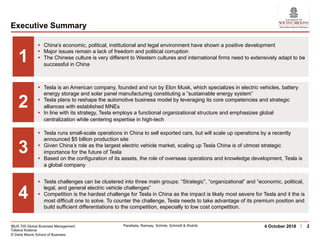
Executive Summary
1
§ China’s economic, political, institutional and legal environment have shown a positive development
§ Major issues remain a lack of freedom and political corruption
§ The Chinese culture is very different to Western cultures and international firms need to extensively adapt to be
successful in China
2
§ Tesla is an American company, founded and run by Elon Musk, which specializes in electric vehicles, battery
energy storage and solar panel manufacturing constituting a ”sustainable energy system”
§ Tesla plans to reshape the automotive business model by leveraging its core competencies and strategic
alliances with established MNEs
§ In line with its strategy, Tesla employs a functional organizational structure and emphasizes global
centralization while centering expertise in high-tech
3
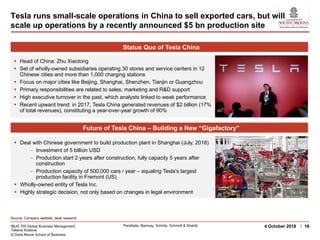
§ Tesla runs small-scale operations in China to sell exported cars, but will scale up operations by a recently
announced $5 billion production site
§ Given China’s role as the largest electric vehicle market, scaling up Tesla China is of utmost strategic
importance for the future of Tesla
§ Based on the configuration of its assets, the role of overseas operations and knowledge development, Tesla is
a global company
4
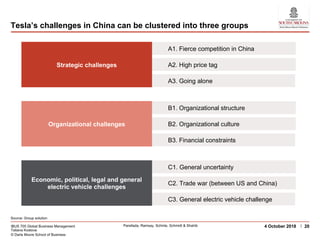
§ Tesla challenges can be clustered into three main groups: “Strategic”, “organizational” and “economic, political,
legal, and general electric vehicle challenges”
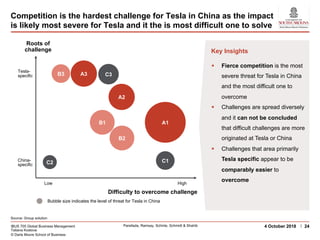
§ Competition is the hardest challenge for Tesla in China as the impact is likely most severe for Tesla and it the is
most difficult one to solve. To counter the challenge, Tesla needs to take advantage of its premium position and
build sufficient differentiations to the competition, especially to low cost competition.
IBUS 705 Global Business Management
Tatiana Kostova
© Darla Moore School of Business
Parellada, Ramsay, Schinle, Schmidt & Shahib 34 October 2018
Agenda
1 Country analysis: China 2 Company overview: Tesla
3 Tesla in China
4 Challenges and solutions for Tesla in China
IBUS 705 Global Business Management
Tatiana Kostova
© Darla Moore School of Business
Parellada, Ramsay, Schinle, Schmidt & Shahib 44 October 2018
Agenda
1 Country analysis: China 2 Company overview: Tesla
3 Tesla in China
4 Challenges and solutions for Tesla in China
IBUS 705 Global Business Management
Tatiana Kostova
© Darla Moore School of Business
Parellada, Ramsay, Schinle, Schmidt & Shahib 54 October 2018
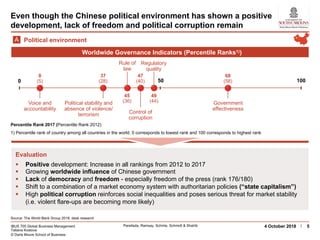
Even though the Chinese political environment has shown a positive
development, lack of freedom and political corruption remain
Source: The World Bank Group 2018, desk research
Worldwide Governance Indicators (Percentile Ranks1))
Evaluation
Political environmentA
0
Political stability and
absence of violence/
terrorism
50 100
Government
effectiveness
Regulatory
quality
Rule of
law
Control of
corruption
Voice and
accountability
8
(5)
37
(28)
45
(36)
49
(44)
47
(40)
68
(58)
Percentile Rank 2017 (Percentile Rank 2012)
1) Percentile rank of country among all countries in the world. 0 corresponds to lowest rank and 100 corresponds to highest rank
§ Positive development: Increase in all rankings from 2012 to 2017
§ Growing worldwide influence of Chinese government
§ Lack of democracy and freedom - especially freedom of the press (rank 176/180)
§ Shift to a combination of a market economy system with authoritarian policies (“state capitalism”)
§ High political corruption reinforces social inequalities and poses serious threat for market stability
(i.e. violent flare-ups are becoming more likely)
IBUS 705 Global Business Management
Tatiana Kostova
© Darla Moore School of Business
Parellada, Ramsay, Schinle, Schmidt & Shahib 64 October 2018
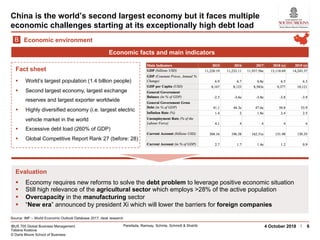
China is the world’s second largest economy but it faces multiple
economic challenges starting at its exceptionally high debt load
Source: IMF – World Economic Outlook Database 2017, desk research
Economic environmentB
Evaluation
Fact sheet
§ Economy requires new reforms to solve the debt problem to leverage positive economic situation
§ Still high relevance of the agricultural sector which employs >28% of the active population
§ Overcapacity in the manufacturing sector
§ “New era” announced by president Xi which will lower the barriers for foreign companies
§ World’s largest population (1.4 billion people)
§ Second largest economy, largest exchange
reserves and largest exporter worldwide
§ Highly diversified economy (i.e. largest electric
vehicle market in the world
§ Excessive debt load (260% of GDP)
§ Global Competitive Report Rank 27 (before: 28)
Economic facts and main indicators
IBUS 705 Global Business Management
Tatiana Kostova
© Darla Moore School of Business
Parellada, Ramsay, Schinle, Schmidt & Shahib 74 October 2018
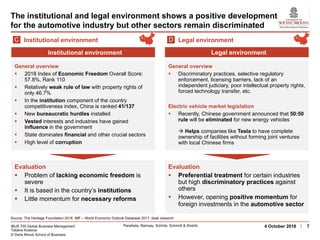
The institutional and legal environment shows a positive development
for the automotive industry but other sectors remain discriminated
Source: The Heritage Foundation 2018, IMF – World Economic Outlook Database 2017, desk research
General overview
§ 2018 Index of Economic Freedom Overall Score:
57.8%, Rank 110
§ Relatively weak rule of law with property rights of
only 46.7%
§ In the institution component of the country
competitiveness index, China is ranked 41/137
§ New bureaucratic hurdles installed
§ Vested interests and industries have gained
influence in the government
§ State dominates financial and other crucial sectors
§ High level of corruption
General overview
§ Discriminatory practices, selective regulatory
enforcement, licensing barriers, lack of an
independent judiciary, poor intellectual property rights,
forced technology transfer, etc.
Electric vehicle market legislation
§ Recently, Chinese government announced that 50:50
rule will be eliminated for new energy vehicles
à Helps companies like Tesla to have complete
ownership of facilities without forming joint ventures
with local Chinese firms
Institutional environment Legal environment
Evaluation
§ Problem of lacking economic freedom is
severe
§ It is based in the country’s institutions
§ Little momentum for necessary reforms
Evaluation
§ Preferential treatment for certain industries
but high discriminatory practices against
others
§ However, opening positive momentum for
foreign investments in the automotive sector
Institutional environmentC Legal environmentD
IBUS 705 Global Business Management
Tatiana Kostova
© Darla Moore School of Business
Parellada, Ramsay, Schinle, Schmidt & Shahib 84 October 2018
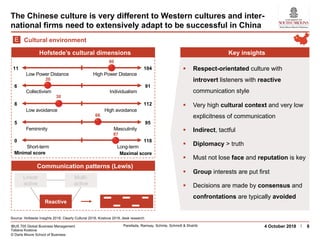
The Chinese culture is very different to Western cultures and inter-
national firms need to extensively adapt to be successful in China
Source: Hofstede Insights 2018, Clearly Cultural 2018, Kostova 2018, desk research
§ Respect-orientated culture with
introvert listeners with reactive
communication style
§ Very high cultural context and very low
explicitness of communication
§ Indirect, tactful
§ Diplomacy > truth
§ Must not lose face and reputation is key
§ Group interests are put first
§ Decisions are made by consensus and
confrontations are typically avoided
Minimal score Maximal score
Cultural environmentE
Hofstede’s cultural dimensions Key insights
Low Power Distance High Power Distance
11 104
80
IndividualismCollectivism
6 91
20
MasculinityFemininity
5 95
66
Long-termShort-term
0 118
87
Low avoidance High avoidance
8 112
30
Communication patterns (Lewis)
Linear
active
Multi-
active
Reactive
IBUS 705 Global Business Management
Tatiana Kostova
© Darla Moore School of Business
Parellada, Ramsay, Schinle, Schmidt & Shahib 94 October 2018
Agenda
1 Country analysis: China 2 Company overview: Tesla
3 Tesla in China
4 Challenges and solutions for Tesla in China
IBUS 705 Global Business Management
Tatiana Kostova
© Darla Moore School of Business
Parellada, Ramsay, Schinle, Schmidt & Shahib 104 October 2018
Tesla is an American company which specializes in electric vehicles,
battery energy storage and solar panel manufacturing
Source: Company website, desk research, NASDAQ
3 4
7
12
-0 -1 -1 -2-5
0
5
10
15
2014 2015 2016 2017
Revenue EBIT
Inter-
national
> Production centralized in US
> Operations in ~ 30 countries
worldwide
Foundation > 2003
Employees > 37,543 (as of December 2017)
HQ > Palo Alto, CA (“Silicon Valley”)
Manage-
ment
> Elon Musk (CEO)
> Jeffrey B. Straubel (CTO)
> Deepak Ahuja (CFO)
Mission > “Accelerate the world’s transition
to sustainable energy
Product
Portfolio
> Energy consumption (cars)
> Energy generation (solar cells)
> Energy storage (batteries)
CAGR Revenue:
38%
Overview Revenue and EBIT development [$ bn]
History
§ 2003: Silicon Valley engineers Martin Eberhard
and Marc Tarpenning found “Tesla Motors”
§ 2004: Elon musk invests in Tesla
§ 2008: Tesla launches the Tesla Roadster
§ 2008: Tesla issues convertible bonds to avoid
bankruptcy
§ 2010: Tesla goes public, raises $226.1 million
(13.3 million shares at $17 per share)
§ 2017: Company renamed into “Tesla Inc.” to
reflect corporate strategy and product portfolio
IBUS 705 Global Business Management
Tatiana Kostova
© Darla Moore School of Business
Parellada, Ramsay, Schinle, Schmidt & Shahib 114 October 2018
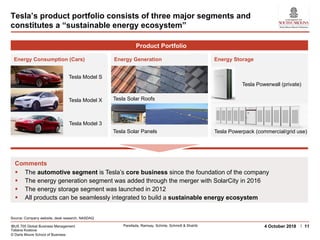
Tesla’s product portfolio consists of three major segments and
constitutes a “sustainable energy ecosystem”
Source: Company website, desk research, NASDAQ
§ The automotive segment is Tesla’s core business since the foundation of the company
§ The energy generation segment was added through the merger with SolarCity in 2016
§ The energy storage segment was launched in 2012
§ All products can be seamlessly integrated to build a sustainable energy ecosystem
Comments
Product Portfolio
Energy Consumption (Cars)
Tesla Model S
Tesla Model X
Tesla Model 3
Energy Generation
Tesla Solar Roofs
Tesla Solar Panels
Energy Storage
Tesla Powerwall (private)
Tesla Powerpack (commercial/grid use)
IBUS 705 Global Business Management
Tatiana Kostova
© Darla Moore School of Business
Parellada, Ramsay, Schinle, Schmidt & Shahib 124 October 2018
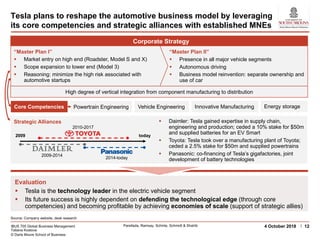
Strategic Alliances § Daimler: Tesla gained expertise in supply chain,
engineering and production; ceded a 10% stake for $50m
and supplied batteries for an EV Smart
§ Toyota: Tesla took over a manufacturing plant of Toyota;
ceded a 2.5% stake for $50m and supplied powertrains
§ Panasonic: co-financing of Tesla’s gigafactories, joint
development of battery technologies
§ Tesla is the technology leader in the electric vehicle segment
§ Its future success is highly dependent on defending the technological edge (through core
competencies) and becoming profitable by achieving economies of scale (support of strategic allies)
Evaluation
Tesla plans to reshape the automotive business model by leveraging
its core competencies and strategic alliances with established MNEs
Corporate Strategy
“Master Plan II”
§ Presence in all major vehicle segments
§ Autonomous driving
§ Business model reinvention: separate ownership and
use of car
“Master Plan I”
§ Market entry on high end (Roadster, Model S and X)
§ Scope expansion to lower end (Model 3)
§ Reasoning: minimize the high risk associated with
automotive startups
High degree of vertical integration from component manufacturing to distribution
Source: Company website, desk research
2009 today
2009-2014
2010-2017
2014-today
Core Competencies Powertrain Engineering Vehicle Engineering Innovative Manufacturing Energy storage
IBUS 705 Global Business Management
Tatiana Kostova
© Darla Moore School of Business
Parellada, Ramsay, Schinle, Schmidt & Shahib 134 October 2018
Functional Organizational Structure
In line with its strategy, Tesla employs a functional organizational
structure and emphasizes global centralization in its operations
§ High degree of centralization: decision-making authority at HQ in US
§ Strategic, administrative and operational control over subsidiaries in ~ 30 countries
§ More autonomy granted to key markets (Norway and China, e.g. sales, marketing)
§ Given Tesla’s current efforts of scaling up its operations to position in the mass market, the
company primarily benefits from its functional structure and centralization
§ Localization and decentralization might become more relevant with increasing complexity of the
company e.g. in terms of product range, number and size of subsidiaries
Evaluation
Engineering &
Production
Software Sales
Human
Resources
Legal & Finance Energy
Organizational Mechanisms – Headquarter-Subsidiary Relations
Musk: “Personal
review of all
expenses above
$1 million.”
Benefits
§ Exploit economies of scale, avoid redundancy
§ Efficient use of concentrated resources
§ Consistent corporation-wide execution of strategy
Drawbacks
§ Silo mentality / resort egoism
§ Lacking accountability of individuals
§ Limited responsiveness to local markets
Tesla places increasing emphasis on geographic areas. For reporting, the markets US, Norway, China and Others
are differentiated. China employs a country manager. A slow shift to a matrix structure at Tesla might be indicated.
Source: Company website, desk research
IBUS 705 Global Business Management
Tatiana Kostova
© Darla Moore School of Business
Parellada, Ramsay, Schinle, Schmidt & Shahib 144 October 2018
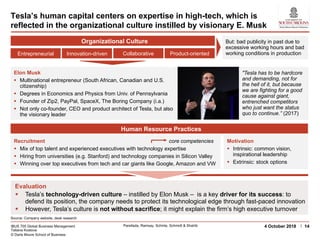
Tesla’s human capital centers on expertise in high-tech, which is
reflected in the organizational culture instilled by visionary E. Musk
Elon Musk
§ Multinational entrepreneur (South African, Canadian and U.S.
citizenship)
§ Degrees in Economics and Physics from Univ. of Pennsylvania
§ Founder of Zip2, PayPal, SpaceX, The Boring Company (i.a.)
§ Not only co-founder, CEO and product architect of Tesla, but also
the visionary leader
Recruitment core competencies
§ Mix of top talent and experienced executives with technology expertise
§ Hiring from universities (e.g. Stanford) and technology companies in Silicon Valley
§ Winning over top executives from tech and car giants like Google, Amazon and VW
But: bad publicity in past due to
excessive working hours and bad
working conditions in production
§ Tesla’s technology-driven culture – instilled by Elon Musk – is a key driver for its success: to
defend its position, the company needs to protect its technological edge through fast-paced innovation
§ However, Tesla’s culture is not without sacrifice; it might explain the firm’s high executive turnover
Evaluation
"Tesla has to be hardcore
and demanding, not for
the hell of it, but because
we are fighting for a good
cause against giant,
entrenched competitors
who just want the status
quo to continue.” (2017)
Entrepreneurial Innovation-driven Collaborative Product-oriented
Motivation
§ Intrinsic: common vision,
inspirational leadership
§ Extrinsic: stock options
Organizational Culture
Human Resource Practices
Source: Company website, desk research
IBUS 705 Global Business Management
Tatiana Kostova
© Darla Moore School of Business
Parellada, Ramsay, Schinle, Schmidt & Shahib 154 October 2018
Agenda
1 Country analysis: China 2 Company overview: Tesla
3 Tesla in China
4 Challenges and solutions for Tesla in China
IBUS 705 Global Business Management
Tatiana Kostova
© Darla Moore School of Business
Parellada, Ramsay, Schinle, Schmidt & Shahib 164 October 2018
Tesla runs small-scale operations in China to sell exported cars, but will
scale up operations by a recently announced $5 bn production site
Source: Company website, desk research
Status Quo of Tesla China
Future of Tesla China – Building a New “Gigafactory”
§ Head of China: Zhu Xiaotong
§ Set of wholly-owned subsidiaries operating 30 stores and service centers in 12
Chinese cities and more than 1,000 charging stations
§ Focus on major cities like Beijing, Shanghai, Shenzhen, Tianjin or Guangzhou
§ Primary responsibilities are related to sales, marketing and R&D support
§ High executive turnover in the past, which analysts linked to weak performance
§ Recent upward trend: in 2017, Tesla China generated revenues of $2 billion (17%
of total revenues), constituting a year-over-year growth of 90%
§ Deal with Chinese government to build production plant in Shanghai (July, 2018)
- Investment of 5 billion USD
- Production start 2 years after construction, fully capacity 5 years after
construction
- Production capacity of 500,000 cars / year – equaling Tesla’s largest
production facility in Fremont (US)
§ Wholly-owned entity of Tesla Inc.
§ Highly strategic decision, not only based on changes in legal environment
IBUS 705 Global Business Management
Tatiana Kostova
© Darla Moore School of Business
Parellada, Ramsay, Schinle, Schmidt & Shahib 174 October 2018
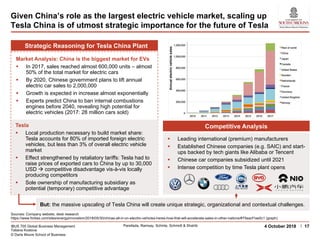
Given China’s role as the largest electric vehicle market, scaling up
Tesla China is of utmost strategic importance for the future of Tesla
Sources: Company website, desk research
https://www.forbes.com/sites/energyinnovation/2018/05/30/chinas-all-in-on-electric-vehicles-heres-how-that-will-accelerate-sales-in-other-nations/#75eacf1ee5c1 (graph)
Market Analysis: China is the biggest market for EVs
§ In 2017, sales reached almost 600,000 units – almost
50% of the total market for electric cars
§ By 2020, Chinese government plans to lift annual
electric car sales to 2,000,000
§ Growth is expected in increase almost exponentially
§ Experts predict China to ban internal combustions
engines before 2040, revealing high potential for
electric vehicles (2017: 28 million cars sold)
Strategic Reasoning for Tesla China Plant
Tesla
§ Local production necessary to build market share:
Tesla accounts for 80% of imported foreign electric
vehicles, but less than 3% of overall electric vehicle
market
§ Effect strengthened by retaliatory tariffs: Tesla had to
raise prices of exported cars to China by up to 30,000
USD à competitive disadvantage vis-à-vis locally
producing competitors
§ Sole ownership of manufacturing subsidiary as
potential (temporary) competitive advantage
Competitive Analysis
§ Leading international (premium) manufacturers
§ Established Chinese companies (e.g. SAIC) and start-
ups backed by tech giants like Alibaba or Tencent
§ Chinese car companies subsidized until 2021
§ Intense competition by time Tesla plant opens
But: the massive upscaling of Tesla China will create unique strategic, organizational and contextual challenges.
IBUS 705 Global Business Management
Tatiana Kostova
© Darla Moore School of Business
Parellada, Ramsay, Schinle, Schmidt & Shahib 184 October 2018
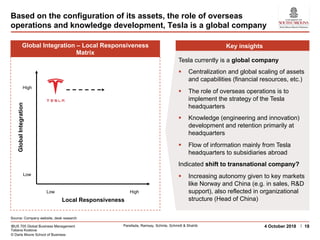
Based on the configuration of its assets, the role of overseas
operations and knowledge development, Tesla is a global company
Source: Company website, desk research
Global Integration – Local Responsiveness
Matrix
Tesla currently is a global company
§ Centralization and global scaling of assets
and capabilities (financial resources, etc.)
§ The role of overseas operations is to
implement the strategy of the Tesla
headquarters
§ Knowledge (engineering and innovation)
development and retention primarily at
headquarters
§ Flow of information mainly from Tesla
headquarters to subsidiaries abroad
Indicated shift to transnational company?
§ Increasing autonomy given to key markets
like Norway and China (e.g. in sales, R&D
support), also reflected in organizational
structure (Head of China)
Key insights
GlobalIntegration
Low High
Low
High
Local Responsiveness
IBUS 705 Global Business Management
Tatiana Kostova
© Darla Moore School of Business
Parellada, Ramsay, Schinle, Schmidt & Shahib 194 October 2018
Agenda
1 Country analysis: China 2 Company overview: Tesla
3 Tesla in China
4 Challenges and solutions for Tesla in China
IBUS 705 Global Business Management
Tatiana Kostova
© Darla Moore School of Business
Parellada, Ramsay, Schinle, Schmidt & Shahib 204 October 2018
Tesla’s challenges in China can be clustered into three groups
Source: Group solution
A1. Fierce competition in China
Strategic challenges A2. High price tag
A3. Going alone
B1. Organizational structure
Organizational challenges B2. Organizational culture
B3. Financial constraints
C1. General uncertainty
Economic, political, legal and general
electric vehicle challenges
C2. Trade war (between US and China)
C3. General electric vehicle challenge
IBUS 705 Global Business Management
Tatiana Kostova
© Darla Moore School of Business
Parellada, Ramsay, Schinle, Schmidt & Shahib 214 October 2018
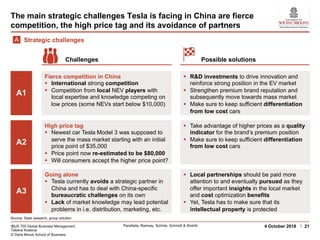
The main strategic challenges Tesla is facing in China are fierce
competition, the high price tag and its avoidance of partners
Source: Desk research, group solution
Challenges Possible solutions
Fierce competition in China
§ International strong competition
§ Competition from local NEV players with
local expertise and knowledge competing on
low prices (some NEVs start below $10,000)
Strategic challengesA
A1
§ R&D investments to drive innovation and
reinforce strong position in the EV market
§ Strengthen premium brand reputation and
subsequently move towards mass market
§ Make sure to keep sufficient differentiation
from low cost cars
High price tag
§ Newest car Tesla Model 3 was supposed to
serve the mass market starting with an initial
price point of $35,000
§ Price point now re-estimated to be $80,000
§ Will consumers accept the higher price point?
A2
§ Take advantage of higher prices as a quality
indicator for the brand’s premium position
§ Make sure to keep sufficient differentiation
from low cost cars
Going alone
§ Tesla currently avoids a strategic partner in
China and has to deal with China-specific
bureaucratic challenges on its own
§ Lack of market knowledge may lead potential
problems in i.e. distribution, marketing, etc.
A3
§ Local partnerships should be paid more
attention to and eventually pursued as they
offer important insights in the local market
and cost optimization benefits
§ Yet, Tesla has to make sure that its
intellectual property is protected
IBUS 705 Global Business Management
Tatiana Kostova
© Darla Moore School of Business
Parellada, Ramsay, Schinle, Schmidt & Shahib 224 October 2018
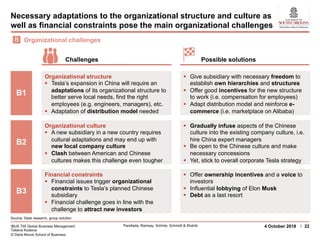
Necessary adaptations to the organizational structure and culture as
well as financial constraints pose the main organizational challenges
Source: Desk research, group solution
Organizational structure
§ Tesla’s expansion in China will require an
adaptations of its organizational structure to
better serve local needs, find the right
employees (e.g. engineers, managers), etc.
§ Adaptation of distribution model needed
Organizational challengesB
B1
§ Give subsidiary with necessary freedom to
establish own hierarchies and structures
§ Offer good incentives for the new structure
to work (i.e. compensation for employees)
§ Adapt distribution model and reinforce e-
commerce (i.e. marketplace on Alibaba)
Organizational culture
§ A new subsidiary in a new country requires
cultural adaptations and may end up with
new local company culture
§ Clash between American and Chinese
cultures makes this challenge even tougher
B2
§ Gradually infuse aspects of the Chinese
culture into the existing company culture, i.e.
hire China expert managers
§ Be open to the Chinese culture and make
necessary concessions
§ Yet, stick to overall corporate Tesla strategy
Financial constraints
§ Financial issues trigger organizational
constraints to Tesla’s planned Chinese
subsidiary
§ Financial challenge goes in line with the
challenge to attract new investors
B3
§ Offer ownership incentives and a voice to
investors
§ Influential lobbying of Elon Musk
§ Debt as a last resort
Challenges Possible solutions
IBUS 705 Global Business Management
Tatiana Kostova
© Darla Moore School of Business
Parellada, Ramsay, Schinle, Schmidt & Shahib 234 October 2018
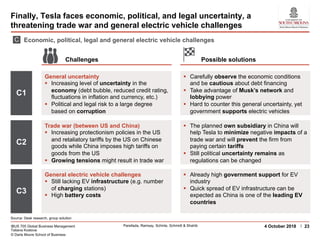
Finally, Tesla faces economic, political, and legal uncertainty, a
threatening trade war and general electric vehicle challenges
Source: Desk research, group solution
General uncertainty
§ Increasing level of uncertainty in the
economy (debt bubble, reduced credit rating,
fluctuations in inflation and currency, etc.)
§ Political and legal risk to a large degree
based on corruption
Economic, political, legal and general electric vehicle challengesC
C1
§ Carefully observe the economic conditions
and be cautious about debt financing
§ Take advantage of Musk’s network and
lobbying power
§ Hard to counter this general uncertainty, yet
government supports electric vehicles
Trade war (between US and China)
§ Increasing protectionism policies in the US
and retaliatory tariffs by the US on Chinese
goods while China imposes high tariffs on
goods from the US
§ Growing tensions might result in trade war
C2
§ The planned own subsidiary in China will
help Tesla to minimize negative impacts of a
trade war and will prevent the firm from
paying certain tariffs
§ Still political uncertainty remains as
regulations can be changed
General electric vehicle challenges
§ Still lacking EV infrastructure (e.g. number
of charging stations)
§ High battery costs
C3
§ Already high government support for EV
industry
§ Quick spread of EV infrastructure can be
expected as China is one of the leading EV
countries
Challenges Possible solutions
IBUS 705 Global Business Management
Tatiana Kostova
© Darla Moore School of Business
Parellada, Ramsay, Schinle, Schmidt & Shahib 244 October 2018
Competition is the hardest challenge for Tesla in China as the impact
is likely most severe for Tesla and it the is most difficult one to solve
Source: Group solution
Key Insights
§ Fierce competition is the most
severe threat for Tesla in China
and the most difficult one to
overcome
§ Challenges are spread diversely
and it can not be concluded
that difficult challenges are more
originated at Tesla or China
§ Challenges that area primarily
Tesla specific appear to be
comparably easier to
overcome
Roots of
challenge
Difficulty to overcome challenge
Bubble size indicates the level of threat for Tesla in China
Low High
China-
specific
Tesla-
specific C3
A1B1
A2
A3
B2
B3
C2 C1
IBUS 705 Global Business Management
Tatiana Kostova
© Darla Moore School of Business
Parellada, Ramsay, Schinle, Schmidt & Shahib 254 October 2018
We are looking forward to your questions and comments J
?

Suggestions Tesla in China

  • 1.
    IBUS 705 GlobalBusiness Management Tatiana Kostova © Darla Moore School of Business Parellada, Ramsay, Schinle, Schmidt & Shahib 14 October 2018 Group Project – Team 7 Tesla in China IBUS 705 – Global Business Management October 04, 2018 Veronica Parellada, Breck Ramsay, Christian Schinle, Marten Schmidt & Mohib Shahid
  • 2.
    IBUS 705 GlobalBusiness Management Tatiana Kostova © Darla Moore School of Business Parellada, Ramsay, Schinle, Schmidt & Shahib 24 October 2018 Executive Summary 1 § China’s economic, political, institutional and legal environment have shown a positive development § Major issues remain a lack of freedom and political corruption § The Chinese culture is very different to Western cultures and international firms need to extensively adapt to be successful in China 2 § Tesla is an American company, founded and run by Elon Musk, which specializes in electric vehicles, battery energy storage and solar panel manufacturing constituting a ”sustainable energy system” § Tesla plans to reshape the automotive business model by leveraging its core competencies and strategic alliances with established MNEs § In line with its strategy, Tesla employs a functional organizational structure and emphasizes global centralization while centering expertise in high-tech 3 § Tesla runs small-scale operations in China to sell exported cars, but will scale up operations by a recently announced $5 billion production site § Given China’s role as the largest electric vehicle market, scaling up Tesla China is of utmost strategic importance for the future of Tesla § Based on the configuration of its assets, the role of overseas operations and knowledge development, Tesla is a global company 4 § Tesla challenges can be clustered into three main groups: “Strategic”, “organizational” and “economic, political, legal, and general electric vehicle challenges” § Competition is the hardest challenge for Tesla in China as the impact is likely most severe for Tesla and it the is most difficult one to solve. To counter the challenge, Tesla needs to take advantage of its premium position and build sufficient differentiations to the competition, especially to low cost competition.
  • 3.
    IBUS 705 GlobalBusiness Management Tatiana Kostova © Darla Moore School of Business Parellada, Ramsay, Schinle, Schmidt & Shahib 34 October 2018 Agenda 1 Country analysis: China 2 Company overview: Tesla 3 Tesla in China 4 Challenges and solutions for Tesla in China
  • 4.
    IBUS 705 GlobalBusiness Management Tatiana Kostova © Darla Moore School of Business Parellada, Ramsay, Schinle, Schmidt & Shahib 44 October 2018 Agenda 1 Country analysis: China 2 Company overview: Tesla 3 Tesla in China 4 Challenges and solutions for Tesla in China
  • 5.
    IBUS 705 GlobalBusiness Management Tatiana Kostova © Darla Moore School of Business Parellada, Ramsay, Schinle, Schmidt & Shahib 54 October 2018 Even though the Chinese political environment has shown a positive development, lack of freedom and political corruption remain Source: The World Bank Group 2018, desk research Worldwide Governance Indicators (Percentile Ranks1)) Evaluation Political environmentA 0 Political stability and absence of violence/ terrorism 50 100 Government effectiveness Regulatory quality Rule of law Control of corruption Voice and accountability 8 (5) 37 (28) 45 (36) 49 (44) 47 (40) 68 (58) Percentile Rank 2017 (Percentile Rank 2012) 1) Percentile rank of country among all countries in the world. 0 corresponds to lowest rank and 100 corresponds to highest rank § Positive development: Increase in all rankings from 2012 to 2017 § Growing worldwide influence of Chinese government § Lack of democracy and freedom - especially freedom of the press (rank 176/180) § Shift to a combination of a market economy system with authoritarian policies (“state capitalism”) § High political corruption reinforces social inequalities and poses serious threat for market stability (i.e. violent flare-ups are becoming more likely)
  • 6.
    IBUS 705 GlobalBusiness Management Tatiana Kostova © Darla Moore School of Business Parellada, Ramsay, Schinle, Schmidt & Shahib 64 October 2018 China is the world’s second largest economy but it faces multiple economic challenges starting at its exceptionally high debt load Source: IMF – World Economic Outlook Database 2017, desk research Economic environmentB Evaluation Fact sheet § Economy requires new reforms to solve the debt problem to leverage positive economic situation § Still high relevance of the agricultural sector which employs >28% of the active population § Overcapacity in the manufacturing sector § “New era” announced by president Xi which will lower the barriers for foreign companies § World’s largest population (1.4 billion people) § Second largest economy, largest exchange reserves and largest exporter worldwide § Highly diversified economy (i.e. largest electric vehicle market in the world § Excessive debt load (260% of GDP) § Global Competitive Report Rank 27 (before: 28) Economic facts and main indicators
  • 7.
    IBUS 705 GlobalBusiness Management Tatiana Kostova © Darla Moore School of Business Parellada, Ramsay, Schinle, Schmidt & Shahib 74 October 2018 The institutional and legal environment shows a positive development for the automotive industry but other sectors remain discriminated Source: The Heritage Foundation 2018, IMF – World Economic Outlook Database 2017, desk research General overview § 2018 Index of Economic Freedom Overall Score: 57.8%, Rank 110 § Relatively weak rule of law with property rights of only 46.7% § In the institution component of the country competitiveness index, China is ranked 41/137 § New bureaucratic hurdles installed § Vested interests and industries have gained influence in the government § State dominates financial and other crucial sectors § High level of corruption General overview § Discriminatory practices, selective regulatory enforcement, licensing barriers, lack of an independent judiciary, poor intellectual property rights, forced technology transfer, etc. Electric vehicle market legislation § Recently, Chinese government announced that 50:50 rule will be eliminated for new energy vehicles à Helps companies like Tesla to have complete ownership of facilities without forming joint ventures with local Chinese firms Institutional environment Legal environment Evaluation § Problem of lacking economic freedom is severe § It is based in the country’s institutions § Little momentum for necessary reforms Evaluation § Preferential treatment for certain industries but high discriminatory practices against others § However, opening positive momentum for foreign investments in the automotive sector Institutional environmentC Legal environmentD
  • 8.
    IBUS 705 GlobalBusiness Management Tatiana Kostova © Darla Moore School of Business Parellada, Ramsay, Schinle, Schmidt & Shahib 84 October 2018 The Chinese culture is very different to Western cultures and inter- national firms need to extensively adapt to be successful in China Source: Hofstede Insights 2018, Clearly Cultural 2018, Kostova 2018, desk research § Respect-orientated culture with introvert listeners with reactive communication style § Very high cultural context and very low explicitness of communication § Indirect, tactful § Diplomacy > truth § Must not lose face and reputation is key § Group interests are put first § Decisions are made by consensus and confrontations are typically avoided Minimal score Maximal score Cultural environmentE Hofstede’s cultural dimensions Key insights Low Power Distance High Power Distance 11 104 80 IndividualismCollectivism 6 91 20 MasculinityFemininity 5 95 66 Long-termShort-term 0 118 87 Low avoidance High avoidance 8 112 30 Communication patterns (Lewis) Linear active Multi- active Reactive
  • 9.
    IBUS 705 GlobalBusiness Management Tatiana Kostova © Darla Moore School of Business Parellada, Ramsay, Schinle, Schmidt & Shahib 94 October 2018 Agenda 1 Country analysis: China 2 Company overview: Tesla 3 Tesla in China 4 Challenges and solutions for Tesla in China
  • 10.
    IBUS 705 GlobalBusiness Management Tatiana Kostova © Darla Moore School of Business Parellada, Ramsay, Schinle, Schmidt & Shahib 104 October 2018 Tesla is an American company which specializes in electric vehicles, battery energy storage and solar panel manufacturing Source: Company website, desk research, NASDAQ 3 4 7 12 -0 -1 -1 -2-5 0 5 10 15 2014 2015 2016 2017 Revenue EBIT Inter- national > Production centralized in US > Operations in ~ 30 countries worldwide Foundation > 2003 Employees > 37,543 (as of December 2017) HQ > Palo Alto, CA (“Silicon Valley”) Manage- ment > Elon Musk (CEO) > Jeffrey B. Straubel (CTO) > Deepak Ahuja (CFO) Mission > “Accelerate the world’s transition to sustainable energy Product Portfolio > Energy consumption (cars) > Energy generation (solar cells) > Energy storage (batteries) CAGR Revenue: 38% Overview Revenue and EBIT development [$ bn] History § 2003: Silicon Valley engineers Martin Eberhard and Marc Tarpenning found “Tesla Motors” § 2004: Elon musk invests in Tesla § 2008: Tesla launches the Tesla Roadster § 2008: Tesla issues convertible bonds to avoid bankruptcy § 2010: Tesla goes public, raises $226.1 million (13.3 million shares at $17 per share) § 2017: Company renamed into “Tesla Inc.” to reflect corporate strategy and product portfolio
  • 11.
    IBUS 705 GlobalBusiness Management Tatiana Kostova © Darla Moore School of Business Parellada, Ramsay, Schinle, Schmidt & Shahib 114 October 2018 Tesla’s product portfolio consists of three major segments and constitutes a “sustainable energy ecosystem” Source: Company website, desk research, NASDAQ § The automotive segment is Tesla’s core business since the foundation of the company § The energy generation segment was added through the merger with SolarCity in 2016 § The energy storage segment was launched in 2012 § All products can be seamlessly integrated to build a sustainable energy ecosystem Comments Product Portfolio Energy Consumption (Cars) Tesla Model S Tesla Model X Tesla Model 3 Energy Generation Tesla Solar Roofs Tesla Solar Panels Energy Storage Tesla Powerwall (private) Tesla Powerpack (commercial/grid use)
  • 12.
    IBUS 705 GlobalBusiness Management Tatiana Kostova © Darla Moore School of Business Parellada, Ramsay, Schinle, Schmidt & Shahib 124 October 2018 Strategic Alliances § Daimler: Tesla gained expertise in supply chain, engineering and production; ceded a 10% stake for $50m and supplied batteries for an EV Smart § Toyota: Tesla took over a manufacturing plant of Toyota; ceded a 2.5% stake for $50m and supplied powertrains § Panasonic: co-financing of Tesla’s gigafactories, joint development of battery technologies § Tesla is the technology leader in the electric vehicle segment § Its future success is highly dependent on defending the technological edge (through core competencies) and becoming profitable by achieving economies of scale (support of strategic allies) Evaluation Tesla plans to reshape the automotive business model by leveraging its core competencies and strategic alliances with established MNEs Corporate Strategy “Master Plan II” § Presence in all major vehicle segments § Autonomous driving § Business model reinvention: separate ownership and use of car “Master Plan I” § Market entry on high end (Roadster, Model S and X) § Scope expansion to lower end (Model 3) § Reasoning: minimize the high risk associated with automotive startups High degree of vertical integration from component manufacturing to distribution Source: Company website, desk research 2009 today 2009-2014 2010-2017 2014-today Core Competencies Powertrain Engineering Vehicle Engineering Innovative Manufacturing Energy storage
  • 13.
    IBUS 705 GlobalBusiness Management Tatiana Kostova © Darla Moore School of Business Parellada, Ramsay, Schinle, Schmidt & Shahib 134 October 2018 Functional Organizational Structure In line with its strategy, Tesla employs a functional organizational structure and emphasizes global centralization in its operations § High degree of centralization: decision-making authority at HQ in US § Strategic, administrative and operational control over subsidiaries in ~ 30 countries § More autonomy granted to key markets (Norway and China, e.g. sales, marketing) § Given Tesla’s current efforts of scaling up its operations to position in the mass market, the company primarily benefits from its functional structure and centralization § Localization and decentralization might become more relevant with increasing complexity of the company e.g. in terms of product range, number and size of subsidiaries Evaluation Engineering & Production Software Sales Human Resources Legal & Finance Energy Organizational Mechanisms – Headquarter-Subsidiary Relations Musk: “Personal review of all expenses above $1 million.” Benefits § Exploit economies of scale, avoid redundancy § Efficient use of concentrated resources § Consistent corporation-wide execution of strategy Drawbacks § Silo mentality / resort egoism § Lacking accountability of individuals § Limited responsiveness to local markets Tesla places increasing emphasis on geographic areas. For reporting, the markets US, Norway, China and Others are differentiated. China employs a country manager. A slow shift to a matrix structure at Tesla might be indicated. Source: Company website, desk research
  • 14.
    IBUS 705 GlobalBusiness Management Tatiana Kostova © Darla Moore School of Business Parellada, Ramsay, Schinle, Schmidt & Shahib 144 October 2018 Tesla’s human capital centers on expertise in high-tech, which is reflected in the organizational culture instilled by visionary E. Musk Elon Musk § Multinational entrepreneur (South African, Canadian and U.S. citizenship) § Degrees in Economics and Physics from Univ. of Pennsylvania § Founder of Zip2, PayPal, SpaceX, The Boring Company (i.a.) § Not only co-founder, CEO and product architect of Tesla, but also the visionary leader Recruitment core competencies § Mix of top talent and experienced executives with technology expertise § Hiring from universities (e.g. Stanford) and technology companies in Silicon Valley § Winning over top executives from tech and car giants like Google, Amazon and VW But: bad publicity in past due to excessive working hours and bad working conditions in production § Tesla’s technology-driven culture – instilled by Elon Musk – is a key driver for its success: to defend its position, the company needs to protect its technological edge through fast-paced innovation § However, Tesla’s culture is not without sacrifice; it might explain the firm’s high executive turnover Evaluation "Tesla has to be hardcore and demanding, not for the hell of it, but because we are fighting for a good cause against giant, entrenched competitors who just want the status quo to continue.” (2017) Entrepreneurial Innovation-driven Collaborative Product-oriented Motivation § Intrinsic: common vision, inspirational leadership § Extrinsic: stock options Organizational Culture Human Resource Practices Source: Company website, desk research
  • 15.
    IBUS 705 GlobalBusiness Management Tatiana Kostova © Darla Moore School of Business Parellada, Ramsay, Schinle, Schmidt & Shahib 154 October 2018 Agenda 1 Country analysis: China 2 Company overview: Tesla 3 Tesla in China 4 Challenges and solutions for Tesla in China
  • 16.
    IBUS 705 GlobalBusiness Management Tatiana Kostova © Darla Moore School of Business Parellada, Ramsay, Schinle, Schmidt & Shahib 164 October 2018 Tesla runs small-scale operations in China to sell exported cars, but will scale up operations by a recently announced $5 bn production site Source: Company website, desk research Status Quo of Tesla China Future of Tesla China – Building a New “Gigafactory” § Head of China: Zhu Xiaotong § Set of wholly-owned subsidiaries operating 30 stores and service centers in 12 Chinese cities and more than 1,000 charging stations § Focus on major cities like Beijing, Shanghai, Shenzhen, Tianjin or Guangzhou § Primary responsibilities are related to sales, marketing and R&D support § High executive turnover in the past, which analysts linked to weak performance § Recent upward trend: in 2017, Tesla China generated revenues of $2 billion (17% of total revenues), constituting a year-over-year growth of 90% § Deal with Chinese government to build production plant in Shanghai (July, 2018) - Investment of 5 billion USD - Production start 2 years after construction, fully capacity 5 years after construction - Production capacity of 500,000 cars / year – equaling Tesla’s largest production facility in Fremont (US) § Wholly-owned entity of Tesla Inc. § Highly strategic decision, not only based on changes in legal environment
  • 17.
    IBUS 705 GlobalBusiness Management Tatiana Kostova © Darla Moore School of Business Parellada, Ramsay, Schinle, Schmidt & Shahib 174 October 2018 Given China’s role as the largest electric vehicle market, scaling up Tesla China is of utmost strategic importance for the future of Tesla Sources: Company website, desk research https://www.forbes.com/sites/energyinnovation/2018/05/30/chinas-all-in-on-electric-vehicles-heres-how-that-will-accelerate-sales-in-other-nations/#75eacf1ee5c1 (graph) Market Analysis: China is the biggest market for EVs § In 2017, sales reached almost 600,000 units – almost 50% of the total market for electric cars § By 2020, Chinese government plans to lift annual electric car sales to 2,000,000 § Growth is expected in increase almost exponentially § Experts predict China to ban internal combustions engines before 2040, revealing high potential for electric vehicles (2017: 28 million cars sold) Strategic Reasoning for Tesla China Plant Tesla § Local production necessary to build market share: Tesla accounts for 80% of imported foreign electric vehicles, but less than 3% of overall electric vehicle market § Effect strengthened by retaliatory tariffs: Tesla had to raise prices of exported cars to China by up to 30,000 USD à competitive disadvantage vis-à-vis locally producing competitors § Sole ownership of manufacturing subsidiary as potential (temporary) competitive advantage Competitive Analysis § Leading international (premium) manufacturers § Established Chinese companies (e.g. SAIC) and start- ups backed by tech giants like Alibaba or Tencent § Chinese car companies subsidized until 2021 § Intense competition by time Tesla plant opens But: the massive upscaling of Tesla China will create unique strategic, organizational and contextual challenges.
  • 18.
    IBUS 705 GlobalBusiness Management Tatiana Kostova © Darla Moore School of Business Parellada, Ramsay, Schinle, Schmidt & Shahib 184 October 2018 Based on the configuration of its assets, the role of overseas operations and knowledge development, Tesla is a global company Source: Company website, desk research Global Integration – Local Responsiveness Matrix Tesla currently is a global company § Centralization and global scaling of assets and capabilities (financial resources, etc.) § The role of overseas operations is to implement the strategy of the Tesla headquarters § Knowledge (engineering and innovation) development and retention primarily at headquarters § Flow of information mainly from Tesla headquarters to subsidiaries abroad Indicated shift to transnational company? § Increasing autonomy given to key markets like Norway and China (e.g. in sales, R&D support), also reflected in organizational structure (Head of China) Key insights GlobalIntegration Low High Low High Local Responsiveness
  • 19.
    IBUS 705 GlobalBusiness Management Tatiana Kostova © Darla Moore School of Business Parellada, Ramsay, Schinle, Schmidt & Shahib 194 October 2018 Agenda 1 Country analysis: China 2 Company overview: Tesla 3 Tesla in China 4 Challenges and solutions for Tesla in China
  • 20.
    IBUS 705 GlobalBusiness Management Tatiana Kostova © Darla Moore School of Business Parellada, Ramsay, Schinle, Schmidt & Shahib 204 October 2018 Tesla’s challenges in China can be clustered into three groups Source: Group solution A1. Fierce competition in China Strategic challenges A2. High price tag A3. Going alone B1. Organizational structure Organizational challenges B2. Organizational culture B3. Financial constraints C1. General uncertainty Economic, political, legal and general electric vehicle challenges C2. Trade war (between US and China) C3. General electric vehicle challenge
  • 21.
    IBUS 705 GlobalBusiness Management Tatiana Kostova © Darla Moore School of Business Parellada, Ramsay, Schinle, Schmidt & Shahib 214 October 2018 The main strategic challenges Tesla is facing in China are fierce competition, the high price tag and its avoidance of partners Source: Desk research, group solution Challenges Possible solutions Fierce competition in China § International strong competition § Competition from local NEV players with local expertise and knowledge competing on low prices (some NEVs start below $10,000) Strategic challengesA A1 § R&D investments to drive innovation and reinforce strong position in the EV market § Strengthen premium brand reputation and subsequently move towards mass market § Make sure to keep sufficient differentiation from low cost cars High price tag § Newest car Tesla Model 3 was supposed to serve the mass market starting with an initial price point of $35,000 § Price point now re-estimated to be $80,000 § Will consumers accept the higher price point? A2 § Take advantage of higher prices as a quality indicator for the brand’s premium position § Make sure to keep sufficient differentiation from low cost cars Going alone § Tesla currently avoids a strategic partner in China and has to deal with China-specific bureaucratic challenges on its own § Lack of market knowledge may lead potential problems in i.e. distribution, marketing, etc. A3 § Local partnerships should be paid more attention to and eventually pursued as they offer important insights in the local market and cost optimization benefits § Yet, Tesla has to make sure that its intellectual property is protected
  • 22.
    IBUS 705 GlobalBusiness Management Tatiana Kostova © Darla Moore School of Business Parellada, Ramsay, Schinle, Schmidt & Shahib 224 October 2018 Necessary adaptations to the organizational structure and culture as well as financial constraints pose the main organizational challenges Source: Desk research, group solution Organizational structure § Tesla’s expansion in China will require an adaptations of its organizational structure to better serve local needs, find the right employees (e.g. engineers, managers), etc. § Adaptation of distribution model needed Organizational challengesB B1 § Give subsidiary with necessary freedom to establish own hierarchies and structures § Offer good incentives for the new structure to work (i.e. compensation for employees) § Adapt distribution model and reinforce e- commerce (i.e. marketplace on Alibaba) Organizational culture § A new subsidiary in a new country requires cultural adaptations and may end up with new local company culture § Clash between American and Chinese cultures makes this challenge even tougher B2 § Gradually infuse aspects of the Chinese culture into the existing company culture, i.e. hire China expert managers § Be open to the Chinese culture and make necessary concessions § Yet, stick to overall corporate Tesla strategy Financial constraints § Financial issues trigger organizational constraints to Tesla’s planned Chinese subsidiary § Financial challenge goes in line with the challenge to attract new investors B3 § Offer ownership incentives and a voice to investors § Influential lobbying of Elon Musk § Debt as a last resort Challenges Possible solutions
  • 23.
    IBUS 705 GlobalBusiness Management Tatiana Kostova © Darla Moore School of Business Parellada, Ramsay, Schinle, Schmidt & Shahib 234 October 2018 Finally, Tesla faces economic, political, and legal uncertainty, a threatening trade war and general electric vehicle challenges Source: Desk research, group solution General uncertainty § Increasing level of uncertainty in the economy (debt bubble, reduced credit rating, fluctuations in inflation and currency, etc.) § Political and legal risk to a large degree based on corruption Economic, political, legal and general electric vehicle challengesC C1 § Carefully observe the economic conditions and be cautious about debt financing § Take advantage of Musk’s network and lobbying power § Hard to counter this general uncertainty, yet government supports electric vehicles Trade war (between US and China) § Increasing protectionism policies in the US and retaliatory tariffs by the US on Chinese goods while China imposes high tariffs on goods from the US § Growing tensions might result in trade war C2 § The planned own subsidiary in China will help Tesla to minimize negative impacts of a trade war and will prevent the firm from paying certain tariffs § Still political uncertainty remains as regulations can be changed General electric vehicle challenges § Still lacking EV infrastructure (e.g. number of charging stations) § High battery costs C3 § Already high government support for EV industry § Quick spread of EV infrastructure can be expected as China is one of the leading EV countries Challenges Possible solutions
  • 24.
    IBUS 705 GlobalBusiness Management Tatiana Kostova © Darla Moore School of Business Parellada, Ramsay, Schinle, Schmidt & Shahib 244 October 2018 Competition is the hardest challenge for Tesla in China as the impact is likely most severe for Tesla and it the is most difficult one to solve Source: Group solution Key Insights § Fierce competition is the most severe threat for Tesla in China and the most difficult one to overcome § Challenges are spread diversely and it can not be concluded that difficult challenges are more originated at Tesla or China § Challenges that area primarily Tesla specific appear to be comparably easier to overcome Roots of challenge Difficulty to overcome challenge Bubble size indicates the level of threat for Tesla in China Low High China- specific Tesla- specific C3 A1B1 A2 A3 B2 B3 C2 C1
  • 25.
    IBUS 705 GlobalBusiness Management Tatiana Kostova © Darla Moore School of Business Parellada, Ramsay, Schinle, Schmidt & Shahib 254 October 2018 We are looking forward to your questions and comments J ?