The Supply Chain
Management
• Industry- Computer Networking
• Headquarter- San Jose, California
• Founded in 1984 by a small group of computer scientists from
Stanford University
• Leaders in the development of Internet Protocol (IP)-based
networking technologies.
• Company's core development area- routing and switching,
home networking, IP telephony, optical networking,
security, storage area networking, and wireless technology.
• Also provides a broad range of service offerings, including
technical support and advanced services.
YEAR EVENT
1995
Cisco introduced applications for selling products and
services in the website.
1996
Cisco introduced “Networked Strategy” to foster its
relationship with the
supplier,customer,manufacturer,distributor etc. It started
product configuration and order placement online.
2000 More than 70% of Cisco orders were online
2001
Market demand decreased due to downturn resulting in
huge loss
Recent
Steps implemented to recover the loss and make the
Cisco supply chain more flexible to market demand
Enable Cisco’s success by delivering
ADAPTABLE, INNOVATIVE, and
SCALABLE SUPPLY CHAIN SERVICES
that OPTIMIZE CUSTOMER
OUTCOMES
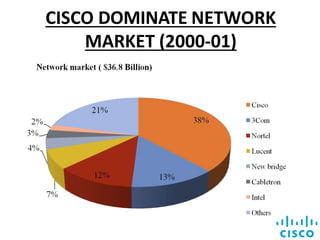
CISCO DOMINATE NETWORK
MARKET (2000-01)
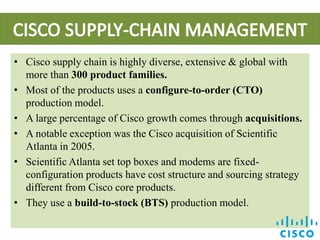
• Cisco supply chain is highly diverse, extensive & global with
more than 300 product families.
• Most of the products uses a configure-to-order (CTO)
production model.
• A large percentage of Cisco growth comes through acquisitions.
• A notable exception was the Cisco acquisition of Scientific
Atlanta in 2005.
• Scientific Atlanta set top boxes and modems are fixed-
configuration products have cost structure and sourcing strategy
different from Cisco core products.
• They use a build-to-stock (BTS) production model.
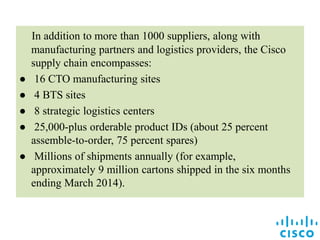
In addition to more than 1000 suppliers, along with
manufacturing partners and logistics providers, the Cisco
supply chain encompasses:
● 16 CTO manufacturing sites
● 4 BTS sites
● 8 strategic logistics centers
● 25,000-plus orderable product IDs (about 25 percent
assemble-to-order, 75 percent spares)
● Millions of shipments annually (for example,
approximately 9 million cartons shipped in the six months
ending March 2014).
In May 2001 Cisco Systems had to write
off $2.2 billion in inventory.
• Cisco relies on contract
manufacturers for final assembly (that
is, tier-1 suppliers).
• Contract manufacturers are supplied
by component producers (that is, tier-2
suppliers)
• who in turn are supplied by
commodity suppliers (that is, tier-3
suppliers).
The Largest Inventory Write-down
• Only tied in the contract
manufacturers.
• Overlapping of the orders
• Artificially inflated demand for the
components.
• Cisco ordered large amounts of the
scare components; demand
increases thus the price increases.
An imbalance between supply and demand caused router
customers to over-order, which created a greater sense of
scarce supply and further over-ordering at higher tiers in
the supply chain.
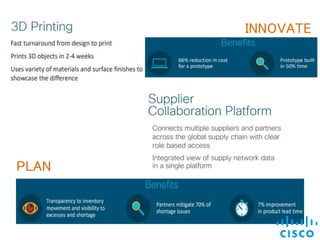
INNOVATE
PLAN
SOURCE
MAKE
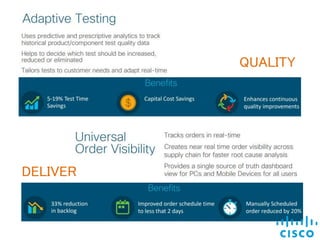
QUALITY
DELIVER
Common software limitations, like “garbage in, garbage out”.
Here: If the demand projections will not improved, Cisco will
still order too much and have inventory they are never able to
market.
Effects on the competition due to more transparency of
information.
Here: Eventual collusive behavior of contract manufacturers
because they know, they can´t fill the whole order alone because
their supplier will only serve the total aggregated demand.
Contract Manufacturers might set higher prices to increase their
profit margin.
Cisco supply chain

Cisco supply chain

  • 1.
  • 2.
    • Industry- ComputerNetworking • Headquarter- San Jose, California • Founded in 1984 by a small group of computer scientists from Stanford University • Leaders in the development of Internet Protocol (IP)-based networking technologies. • Company's core development area- routing and switching, home networking, IP telephony, optical networking, security, storage area networking, and wireless technology. • Also provides a broad range of service offerings, including technical support and advanced services.
  • 3.
    YEAR EVENT 1995 Cisco introducedapplications for selling products and services in the website. 1996 Cisco introduced “Networked Strategy” to foster its relationship with the supplier,customer,manufacturer,distributor etc. It started product configuration and order placement online. 2000 More than 70% of Cisco orders were online 2001 Market demand decreased due to downturn resulting in huge loss Recent Steps implemented to recover the loss and make the Cisco supply chain more flexible to market demand
  • 4.
    Enable Cisco’s successby delivering ADAPTABLE, INNOVATIVE, and SCALABLE SUPPLY CHAIN SERVICES that OPTIMIZE CUSTOMER OUTCOMES
  • 5.
  • 6.
    • Cisco supplychain is highly diverse, extensive & global with more than 300 product families. • Most of the products uses a configure-to-order (CTO) production model. • A large percentage of Cisco growth comes through acquisitions. • A notable exception was the Cisco acquisition of Scientific Atlanta in 2005. • Scientific Atlanta set top boxes and modems are fixed- configuration products have cost structure and sourcing strategy different from Cisco core products. • They use a build-to-stock (BTS) production model.
  • 7.
    In addition tomore than 1000 suppliers, along with manufacturing partners and logistics providers, the Cisco supply chain encompasses: ● 16 CTO manufacturing sites ● 4 BTS sites ● 8 strategic logistics centers ● 25,000-plus orderable product IDs (about 25 percent assemble-to-order, 75 percent spares) ● Millions of shipments annually (for example, approximately 9 million cartons shipped in the six months ending March 2014).
  • 8.
    In May 2001Cisco Systems had to write off $2.2 billion in inventory. • Cisco relies on contract manufacturers for final assembly (that is, tier-1 suppliers). • Contract manufacturers are supplied by component producers (that is, tier-2 suppliers) • who in turn are supplied by commodity suppliers (that is, tier-3 suppliers). The Largest Inventory Write-down
  • 9.
    • Only tiedin the contract manufacturers. • Overlapping of the orders • Artificially inflated demand for the components. • Cisco ordered large amounts of the scare components; demand increases thus the price increases.
  • 10.
    An imbalance betweensupply and demand caused router customers to over-order, which created a greater sense of scarce supply and further over-ordering at higher tiers in the supply chain.
  • 13.
  • 14.
  • 15.
  • 20.
    Common software limitations,like “garbage in, garbage out”. Here: If the demand projections will not improved, Cisco will still order too much and have inventory they are never able to market. Effects on the competition due to more transparency of information. Here: Eventual collusive behavior of contract manufacturers because they know, they can´t fill the whole order alone because their supplier will only serve the total aggregated demand. Contract Manufacturers might set higher prices to increase their profit margin.

Editor's Notes

  • #7 Cisco has a wide range of gear targeted at a spectrum of customers with vastly different expectations and fulfillment requirement. they bring their own supply chain requirements and processes that need to be integrated into Cisco core operations.